


Abstract
In wireless sensor networks, sensor nodes (SNs) powered by small-capacity batteries or supercapacitors are used to monitor an environment. These nodes are typically deployed in areas with harsh environmental conditions, such as volcanic craters and forests. They rapidly deplete their energy by continuously consuming power during data generation, transmission, reception, and idle states. In this study, a Mixed Integer Linear Programming (MILP) model aimed at maximizing the network lifetime of sensor-node-based systems is briefly introduced, and the effects of varying the transmission distances of nodes on routing and network lifetime are discussed. The MILP model is implemented on a 10-node scenario (1 data-generating node, 1 data-collecting node, and 8 transceiver nodes), and its impact on routing and network lifetime is analyzed. For each scenario, 100 simulations were conducted and validated on real hardware.
1. Introduction
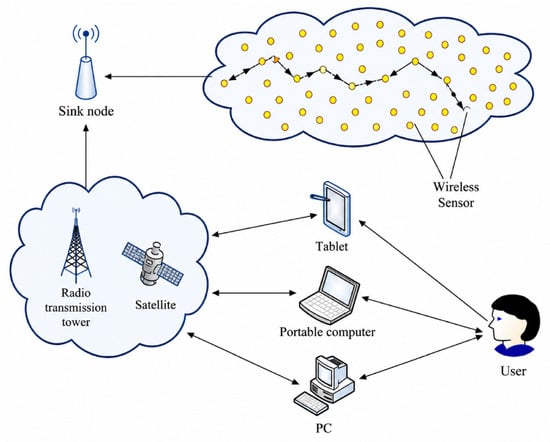
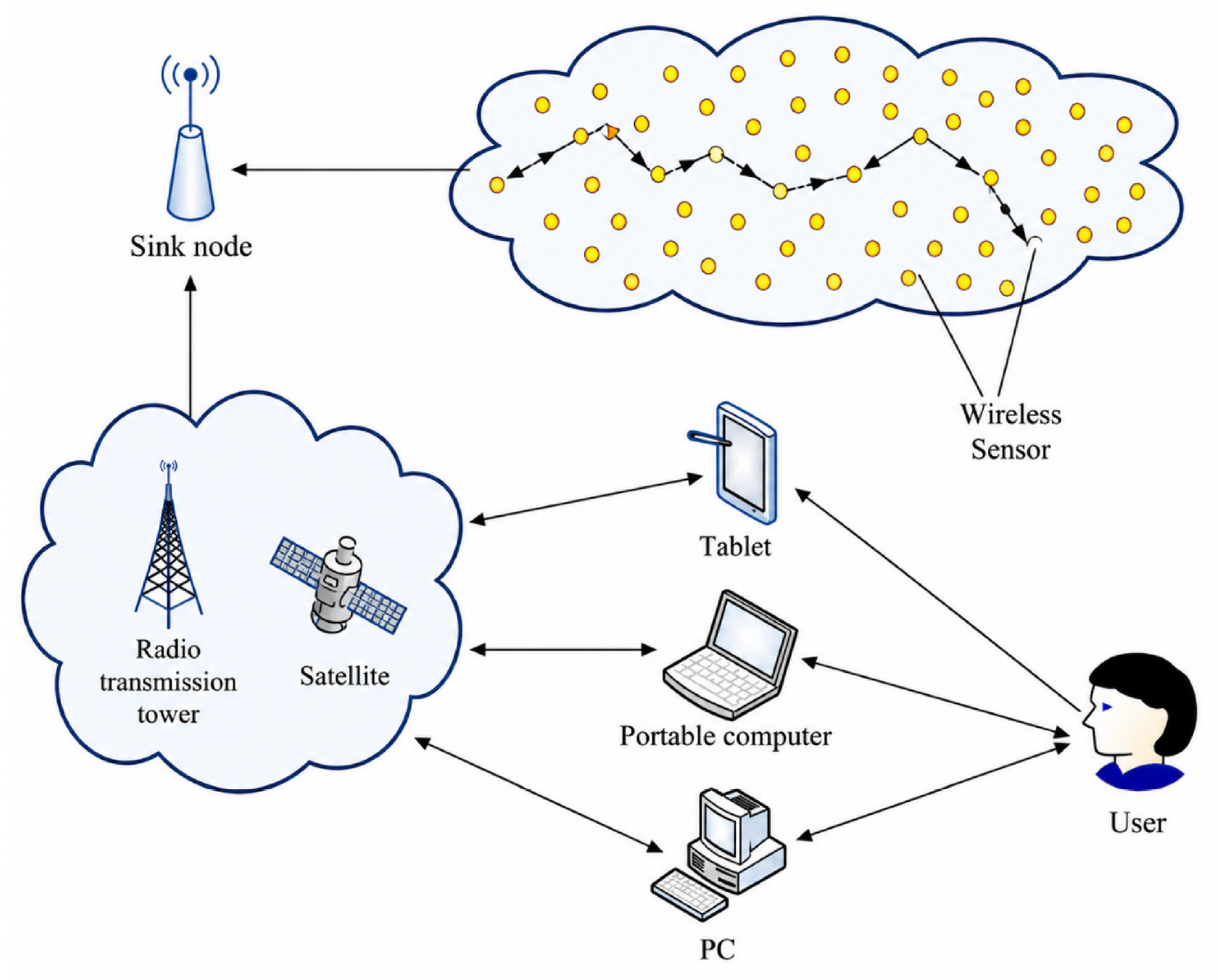
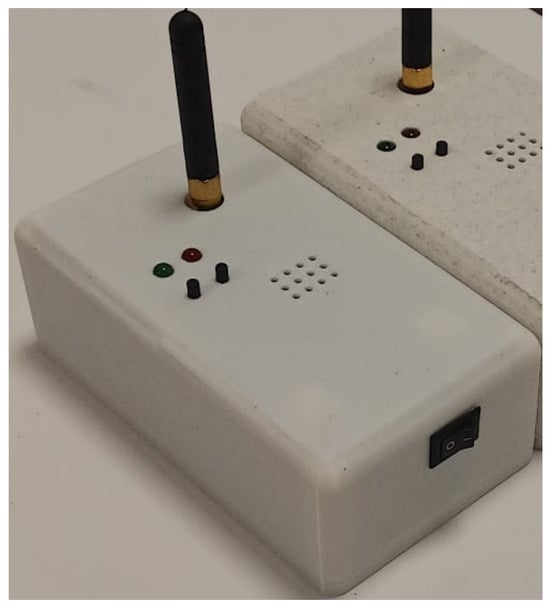
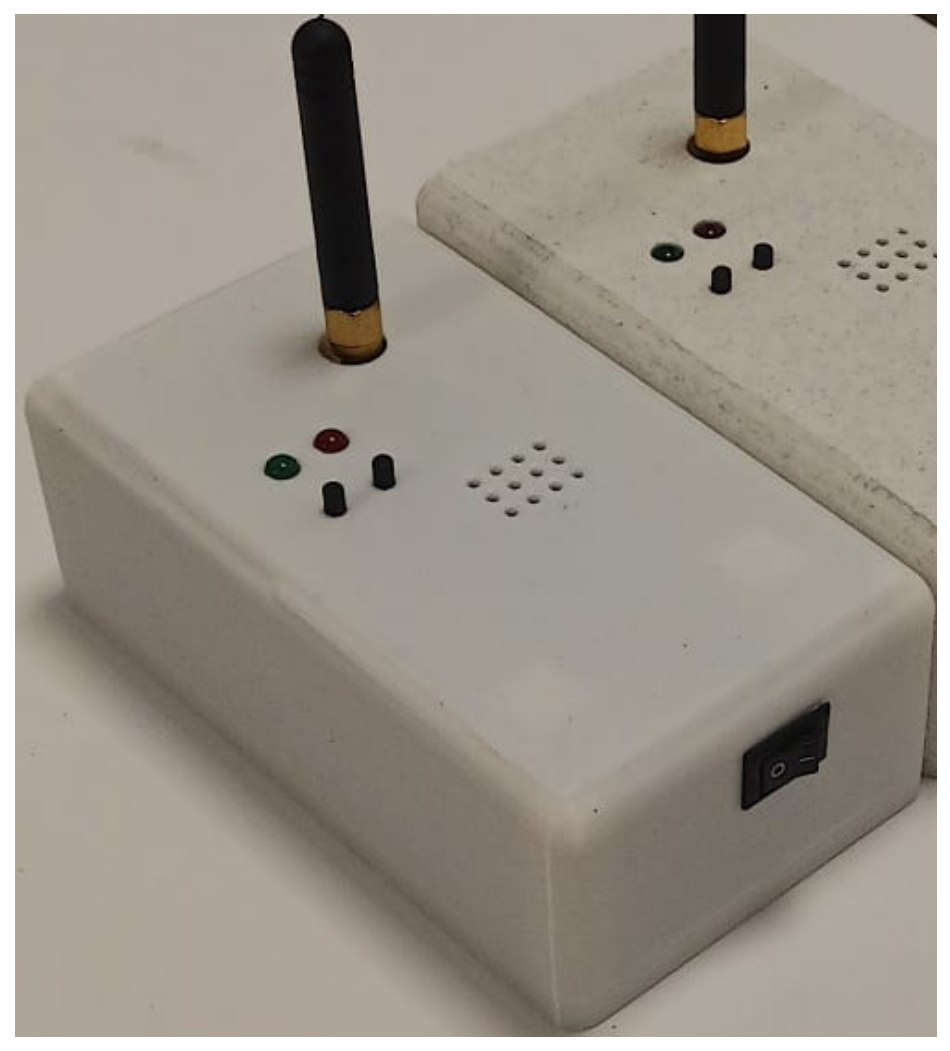
Wireless sensor networks (WSNs) are networks formed by a large number of sensor nodes that collaboratively sense environmental parameters and transmit the collected data to a sink node, which then forwards it to a central station, as illustrated in Figure 1 [1,2]. A sensor node, depicted in Figure 2, consists of a transceiver for communication, a development board for computation and coding, a sensor for detecting environmental parameters, and a battery or supercapacitor to power all these components.
Figure 1.
Wireless sensor network architecture.
Figure 2.
Sensor node.
The communication unit of a sensor node consumes energy during data transmission, reception, and idle listening. When multiple nodes transmit data simultaneously, collisions may occur, preventing messages from reaching their destination; this necessitates retransmissions and results in additional energy loss. Various MAC protocols have been developed to extend network lifetime [3,4,5]. However, although these approaches reduce energy consumption, they cannot completely prevent battery depletion.
As an alternative solution, energy harvesting-based protocols have been proposed, enabling nodes to recharge themselves using sources such as solar, wind, vibration, thermal, and electromagnetic energy [6,7,8]. Nevertheless, since the availability and efficiency of environmental energy sources are limited, the design of efficient routing algorithms becomes critically important. Through routing, data transmission is distributed across different nodes each time, preventing the overuse of specific nodes and ensuring a more balanced energy consumption throughout the network. In this study, the effect of varying sensor transmission distance on routing and network lifetime is investigated and experimentally validated using a mathematical model [9] aimed at maximizing the lifetime of wireless sensor networks.
2. Mathematical Model and Simulation Results
In WSNs, routing and scheduling problems aimed at increasing network lifetime are generally modelled using Integer Programming (IP) or Mixed Integer Linear Programming (MILP) approaches [10,11]. The MILP model aims to maximize the overall network lifetime by taking into account the limited battery capacities and communication ranges of the sensor nodes [9]. The optimization results obtained for a WSN structure with N = 10 nodes, as given in Table 1, were evaluated considering a scheduling horizon of MaxT = 50 periods. Simulations were conducted for five different transmission distance values (ld = 10, 15, 20, 25, 50 m) and a node battery capacity of e0 = 100 units.
Table 1.
Distance matrix (in m).
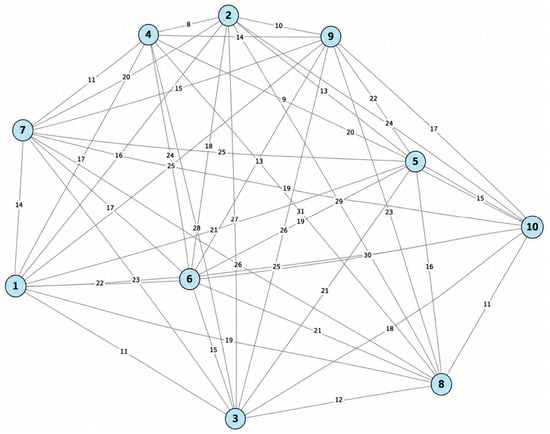
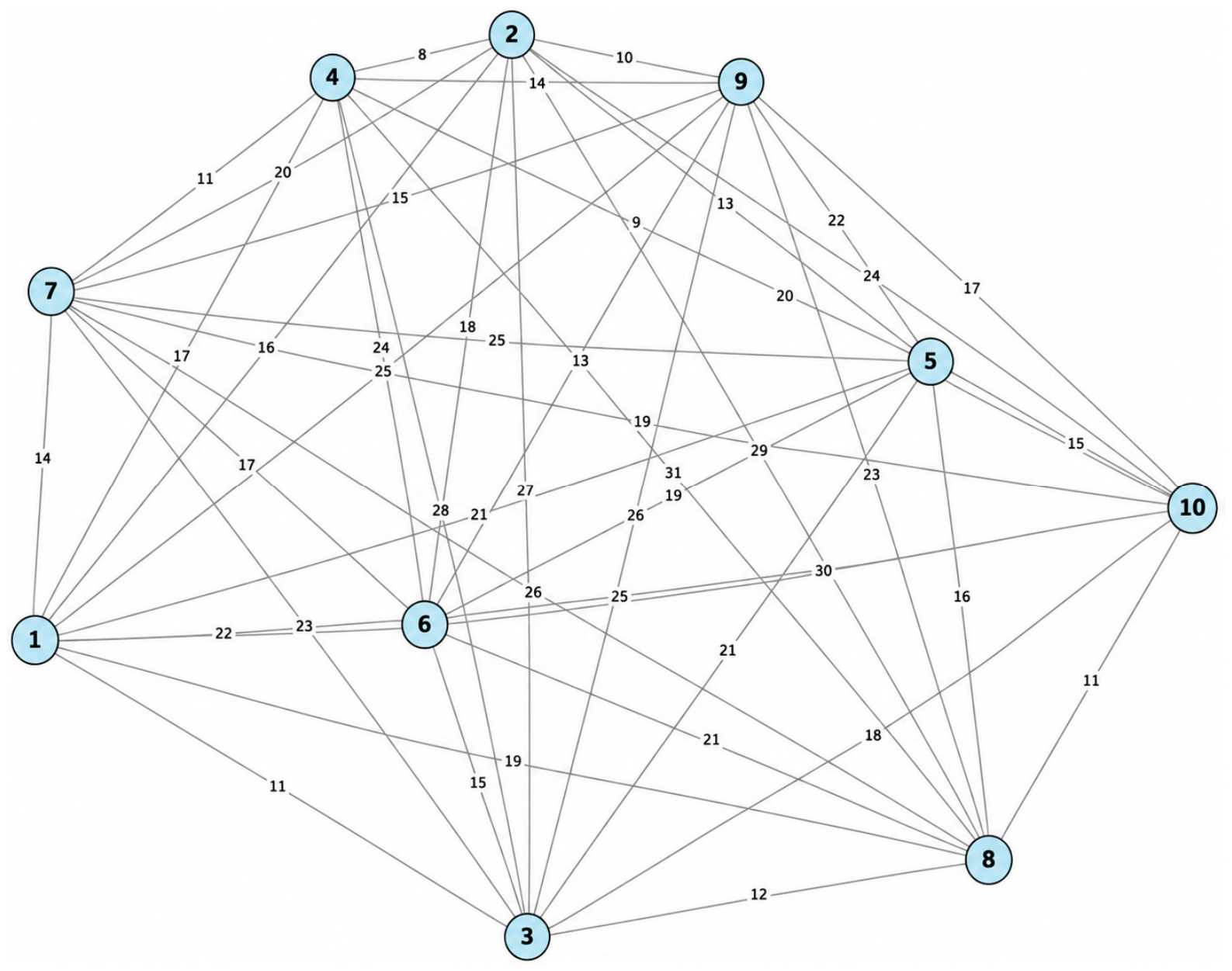
The matrix given in Table 1 represents the distances between each pair of nodes. Node 1 is the data-generating node, while node 10 is the sink node that collects the data in the network. The remaining nodes operate in transceiver mode. The constructed network is illustrated in Figure 3.
Figure 3.
Network image.
The mathematical model was solved using the GUROBI 13.0 optimization solver on a computer with an Intel Core i7 processor and 16 GB of RAM. Five different transmission distances were used for simulation. The maximum network lifetimes obtained by the solver for different transmission distances are presented in Table 2.
Table 2.
Routes for different transmission distances.
As can be seen in Table 2, when the transmission distance is 10 m, there are no routes from the transmitter node, as all other transceiver nodes are at a distance greater than 10 m away from this node. For that reason, no data is transferred from the transmitting node to the sink node, as demonstrated in Table 3. Meanwhile, when the transmission distance is set to 50 m, there is no need for an alternative route due to the transmitter node generating the data and directly sending it to the sink node. As can be seen in Table 3, the energies in the transceiver node diminish with idle listening. Furthermore, with the three other transmission distances, there are alternative routes and the energies of the nodes are consumed in the same way.
Table 3.
Node energy removal for different transmission distances (simulation).
No single node consumes the energy alone, as illustrated in Table 3.
Hardware-based tests were completed for all of the above scenarios, and the available battery charge differences between before and after the experiment are shown in Table 4.
Table 4.
Node energy removal for different transmission distances (hardware).
As can be seen in Table 4, approximately the same voltage difference is obtained after the experiments. The results show that voltage of all transceiver nodes after the experiment was consumed at similar rates. Therefore, network lifetime is maximized.
3. Conclusions
In this study, the effects of transmission distance on routing and network lifetime were discussed. Simulations were performed using the optimization model [9] developed as a solution to the energy constraint problem. The optimal routes determined by the model were implemented on specially developed sensor nodes based on Arduino UNO (Arduino, Ivrea, Italy) and nRF905 (Nordic Semiconductor, Trondheim, Norway), and the system was tested over an uninterrupted communication process of 500 periods. When the transmission distance of the sensor is reduced, no communication occurs, whereas when the transmission distance is significantly increased, the system transitions from a multi-hop topology to a star topology, allowing direct communication with the sink node without using intermediate nodes. Hardware-based tests were also conducted for each transmission distance scenario, and it was observed that the energy levels of the nodes decreased at similar rates.
Author Contributions
Conceptualization, D.B., M.B.T. and H.Y.; methodology, M.B.T. and H.Y.; software, H.Y., S.A., and M.B.T.; validation, S.K., H.Y. and M.B.T.; formal analysis, D.B. and S.A.; investigation, S.A., D.B., and S.K.; resources, M.B.T. and H.Y.; data curation, M.B.T. and H.Y.; writing—original draft preparation, D.B.; writing—review and editing, D.B., M.B.T. and H.Y.; visualization, D.B.; supervision, M.B.T., S.K. and H.Y.; project administration, M.B.T. and H.Y.; funding acquisition, H.Y. and M.B.T. All authors have read and agreed to the published version of the manuscript.
Funding
This research was funded by the Scientific Research Projects Coordination Unit (BAP) of Bursa Technical University, grant number 261N009.
Institutional Review Board Statement
Not applicable.
Informed Consent Statement
Not applicable.
Data Availability Statement
Data is available upon request.
Conflicts of Interest
The authors declare no conflicts of interest.
References
- Akyildiz, I.F.; Su, W.; Sankarasubramaniam, Y.; Cayirci, E. Wireless sensor networks: A survey. Comput. Netw. 2002, 38, 393–422. [Google Scholar] [CrossRef] [Scilit]
- Shaikh, F.K.; Zeadally, S. Energy harvesting in wireless sensor networks: A comprehensive review. Renew. Sustain. Energy Rev. 2016, 55, 1041–1054. [Google Scholar] [CrossRef] [Scilit]
- Polastre, J.; Hill, J.; Culler, D. Versatile low power media access for wireless sensor networks. In Proceedings of the 2nd International Conference on Embedded Networked Sensor Systems, Baltimore, MD, USA, 3–5 November 2004; pp. 94–107. [Google Scholar] [CrossRef] [Scilit]
- Ye, W.; Heidemann, J.; Estrin, D. An energy-efficient MAC protocol for wireless sensor networks. IEEE INFOCOM 2002, 3, 1567–1576. [Google Scholar] [CrossRef] [Scilit]
- Lu, G.; Krishnamachari, B.; Raghavendra, C.S. An adaptive energy-efficient and low-latency MAC for data gathering in wireless sensor networks. In Proceedings of the 18th International Parallel and Distributed Processing Symposium, Santa Fe, NM, USA, 26–30 April 2004. [Google Scholar] [CrossRef] [Scilit]
- Naderi, M.Y.; Nintanavongsa, P.; Chowdhury, K.R. RF-MAC: A medium access control protocol for rechargeable sensornetworks powered by wireless energy harvesting. IEEE Trans. Wirel. Commun. 2014, 13, 3926–3937. [Google Scholar] [CrossRef] [Scilit]
- Kim, T.; Park, J.; Kim, J.; Noh, J.; Cho, S. REACH: An efficient MAC protocol for RF energy harvesting in wireless sensor network. Wirel. Commun. Mob. Comput. 2017, 2017, 6438726. [Google Scholar] [CrossRef] [Scilit]
- Nguyen, K.; Nguyen, V.-H.; Le, D.-D.; Ji, Y.; Duong, D.A.; Yamada, S. ERI-MAC: A receiver-initiated MAC protocol for energy harvesting wireless sensor networks. Int. J. Distrib. Sens. Netw. 2014, 280, 603–610. [Google Scholar] [CrossRef] [Scilit]
- Bayram, B.; Yılmaz, H.; Tabakcıoğlu, M.B. Kablosuz Algılayıcı Ağlarda Ağ Ömrü Optimizasyonu ve Pratik Uygulaması. BSEU J. Sci. 2026, 13, 273–282. [Google Scholar] [CrossRef] [Scilit]
- Keskin, M.E. A column generation heuristic for optimal wireless sensor network design with mobile sinks. Eur. J. Oper. Res. 2017, 260, 291–304. [Google Scholar] [CrossRef] [Scilit]
- Lee, J.H.; Moon, I. Modeling and optimization of energy efficient routing in wireless sensor networks. Appl. Math. Model. 2014, 38, 2280–2289. [Google Scholar] [CrossRef] [Scilit]

Disclaimer/Publisher’s Note: The statements, opinions and data contained in all publications are solely those of the individual author(s) and contributor(s) and not of MDPI and/or the editor(s). MDPI and/or the editor(s) disclaim responsibility for any injury to people or property resulting from any ideas, methods, instructions or products referred to in the content. |
© 2026 by the authors. Licensee MDPI, Basel, Switzerland. This article is an open access article distributed under the terms and conditions of the Creative Commons Attribution (CC BY) license.