


Abstract
Real-time pedestrian analytics systems often combine detection, tracking, and demographic classification. However, generic demographic classifiers may generalize poorly to deployment-specific camera conditions. This paper presents a DeepStream-based pipeline using PeopleNet, object tracking, and independent ResNet18 classifiers for gender and age estimation. A target-domain dataset of 3508 labeled pedestrian crops was used for fine-tuning. The gender model used validation-based threshold calibration, while age optimization included imbalance-aware training and external data balancing. On the target-domain test set, gender macro-F1 improved from 0.7223 to 0.8164 and direct age fine-tuning improved macro-F1 from 0.4410 to 0.5310. The final externally balanced age model achieved 0.5348 macro-F1 on the original target-domain test set and 0.7587 on a separate class-balanced, mixed-source test set. These results show that evaluation source and class distribution materially affect age classification performance.
1. Introduction
Real-time video analytics has become an important component of intelligent monitoring systems, enabling automatic pedestrian detection, tracking, counting, and attribute estimation. In practical deployments, demographic attributes such as age group and gender can be used to summarize pedestrian flow and support aggregate analytics. However, demographic classification in surveillance-like scenarios remains challenging because pedestrian crops are affected by low resolution, motion blur, occlusion, camera viewpoint, illumination changes, and domain shift between training data and deployment scenes.
Modern video analytics frameworks, such as NVIDIA DeepStream, allow multiple inference stages to be integrated into efficient GPU-accelerated pipelines. Nevertheless, the accuracy of the final system depends not only on the detector and tracker, but also on the suitability of the classification models used after detection. A classifier trained on a generic dataset may perform poorly when applied to crops extracted from a particular camera network or deployment environment.
This work addresses this problem by fine-tuning two ResNet18-based demographic classifiers for a DeepStream-based pedestrian analytics pipeline. Instead of treating demographic prediction as a single six-class problem, the proposed system uses two independent classifiers: one for gender with two classes and one for age group with three classes. This design matches the original deployment pipeline and allows each task to be optimized separately.
The main contribution is a deployment-centered adaptation and evaluation methodology that combines target-domain dataset construction, task-specific optimization of independent age and gender classifiers, and event-triggered integration in DeepStream. Predictions are associated with line-crossing events rather than redundant frame-level outputs. The final age model is also evaluated on both the original target-domain distribution and a separate class-balanced, mixed-source distribution to quantify distribution effects.
2. Related Work
Pedestrian analysis in video surveillance commonly involves detection, tracking, and attribute recognition. Deep learning-based detectors have significantly improved the reliability of pedestrian detection in real-world environments, while online tracking methods such as SORT and Deep SORT are commonly used to maintain object identities across frames [1,2]. In industrial deployments, NVIDIA DeepStream provides a GPU-accelerated framework for building multi-stage video analytics pipelines, including detection, tracking, metadata processing, and secondary inference modules [3]. PeopleNet is a pedestrian detection model provided within the NVIDIA ecosystem and is designed to detect people in images and video streams [4].
Pedestrian attribute recognition is closely related to this work because it aims to infer visual attributes from pedestrian crops captured under surveillance-like conditions. Prior studies have explored deep learning architectures for pedestrian analysis, showing that convolutional features can support attribute recognition from full-body or low-resolution pedestrian images [5]. This setting differs from face-centered demographic classification, where higher-resolution facial information is often available.
Recent work has emphasized viewpoint and dataset bias in pedestrian attribute recognition, label-balanced learning, prompt-based adaptation, and cross-domain evaluation [6,7,8,9]. These studies motivate the present focus on target-domain adaptation and separate reporting of target-domain and mixed-source results.
Demographic attribute classification has also been widely studied using convolutional neural networks. Prior work on age and gender classification showed the benefit of CNN-based representations for unconstrained visual conditions [10]. Residual networks introduced by He et al. [11] remain a strong backbone for visual classification tasks because residual connections allow deeper models to be optimized effectively. Datasets such as FairFace [12] have shown the importance of balanced demographic representation when training age and gender classifiers. However, models trained on generic or face-centric datasets may not generalize well to pedestrian crops captured from surveillance cameras, where faces may be small, blurred, or partially occluded.
Class imbalance is another relevant challenge in demographic classification. In real-world pedestrian datasets, some age groups often appear much more frequently than others. If not handled properly, models may achieve acceptable overall accuracy while failing on minority classes [13]. For this reason, metrics such as macro-F1, balanced accuracy, and per-class recall are more informative than accuracy alone when evaluating imbalanced classification problems. Loss reweighting and class-balanced training are common approaches for reducing this bias during optimization [14].
Most prior works focus on offline classification benchmarks, whereas deployed video analytics systems require predictions to be connected to events, such as a pedestrian crossing a virtual line. A remaining gap is the adaptation of demographic classifiers to deployment-specific pedestrian crops and their integration into event-based video analytics workflows. This paper addresses this gap by fine-tuning demographic classifiers inside a DeepStream-based pipeline and evaluating the resulting models on offline test sets derived from the target deployment domain.
3. Materials and Methods
3.1. System Overview
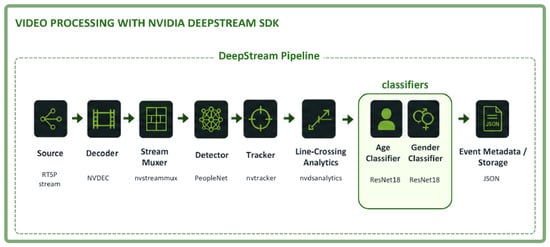
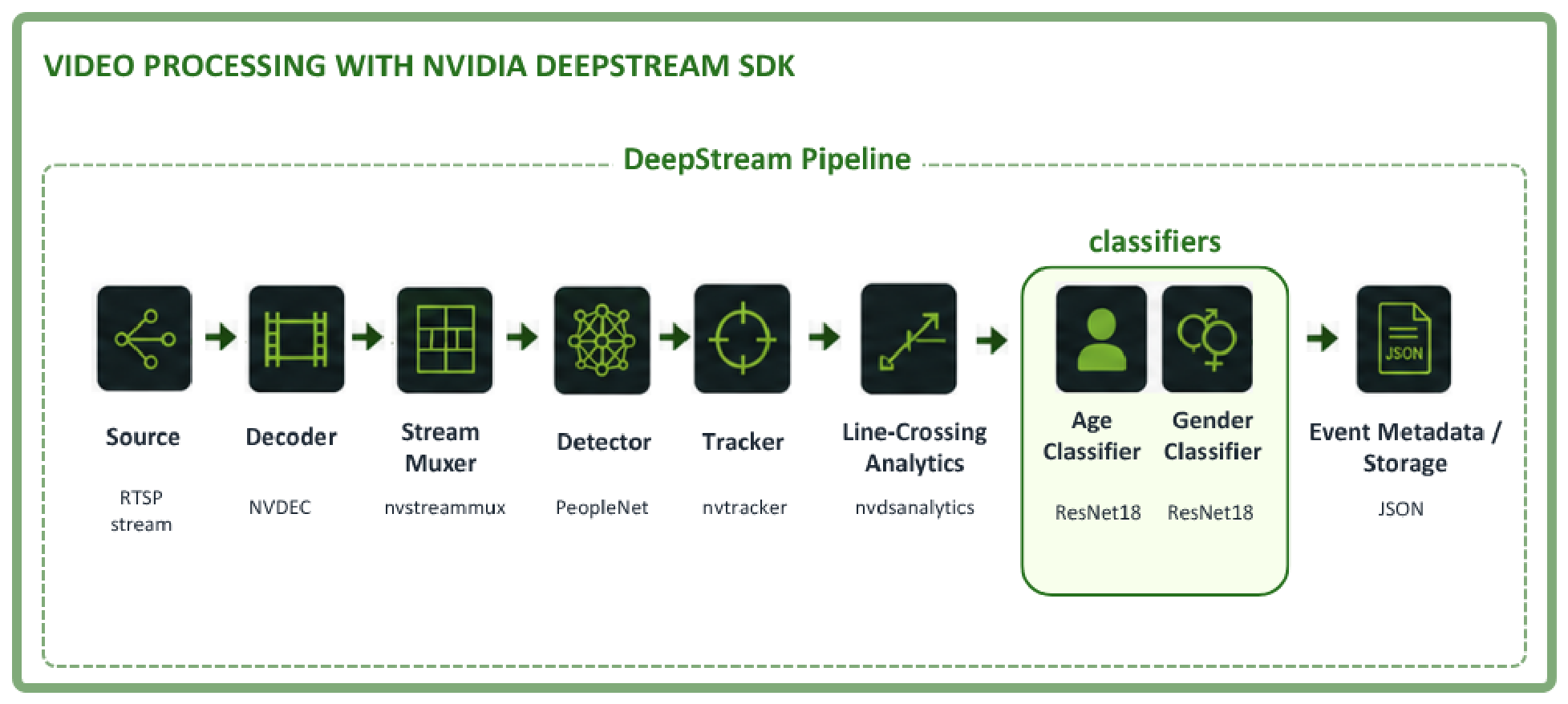
The proposed system is implemented as a DeepStream SDK 5.1-based video analytics pipeline (NVIDIA Corporation, Santa Clara, CA, USA) deployed in a Docker container on Ubuntu 18.04 LTS [3]. The pipeline processes video streams through multiple stages, including pedestrian detection, object tracking, line-crossing event detection, and demographic classification. Pedestrians are detected using the pre-trained PeopleNet model based on a ResNet34 backbone (NVIDIA Corporation, Santa Clara, CA, USA) [4], and the detected objects are tracked across consecutive frames to maintain consistent pedestrian identities.
A virtual counting line is defined in the scene, and a crossing event is triggered when a tracked pedestrian crosses this line. For each tracked pedestrian, secondary classification models estimate demographic attributes, including gender and age group, from the detected crop. The predicted attributes are then associated with the corresponding line-crossing event. Each pedestrian is counted once per crossing event, enabling event-based analytics instead of frame-level counting. Figure 1 summarizes the main processing stages of the deployed DeepStream-based pedestrian analytics pipeline.
Figure 1.
Overview of the deployed DeepStream-based pedestrian analytics pipeline.
3.2. Baseline Models
The baseline demographic classification stage consists of two independent ResNet18-based classifiers used in the pipeline for age and gender estimation. The age classifier predicts three classes, namely 1_18, 19_50, and gt_50, whereas the gender classifier predicts two classes, namely female and male.
These baseline classifiers served as the starting point for transfer learning. They were fine-tuned using pedestrian crops extracted from the target deployment domain to adapt them to the camera viewpoint, image quality, and scene conditions of the deployed system.
3.3. Camera Configuration and Data Acquisition
The data were obtained from four fixed surveillance-camera streams (C1–C4) at one operational site covering indoor pedestrian circulation areas. The cameras provided elevated, oblique views, and the recordings corresponded to late-afternoon sessions at approximately 17:00. Exact locations and access details are withheld for privacy and site security. Table 1 summarizes the protocol, codec, resolution, and nominal frame rate of each camera stream.
Table 1.
Camera-stream configuration. FPS denotes nominal input frame rate.
3.4. Dataset Construction and Annotation
Annotation involved 17 undergraduate Computer Science students, each assigned one 30 min video segment, for approximately 8.5 h of footage. Crops were labeled by perceived gender presentation (female or male) and apparent age group (1_18, 19_50, or gt_50) using visible face, body, clothing, posture, and contextual cues. These labels are visual estimates, not self-identified gender or verified chronological age.
No uncertainty class was used. Each segment had one primary annotator, ambiguous cases were assigned to one predefined class, and inter-annotator agreement was not measured. During consolidation, labels were standardized and repeated variants were grouped by source identifiers, reducing 4812 files to 3508 unique base crops. The absence of independent adjudication and agreement statistics is treated as a limitation.
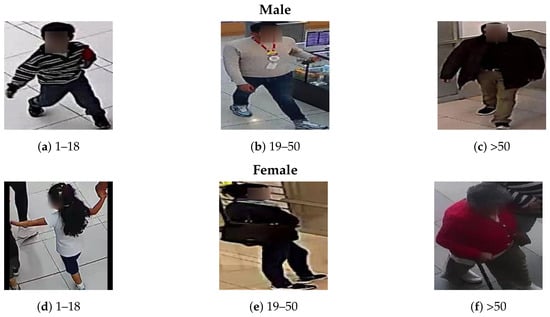
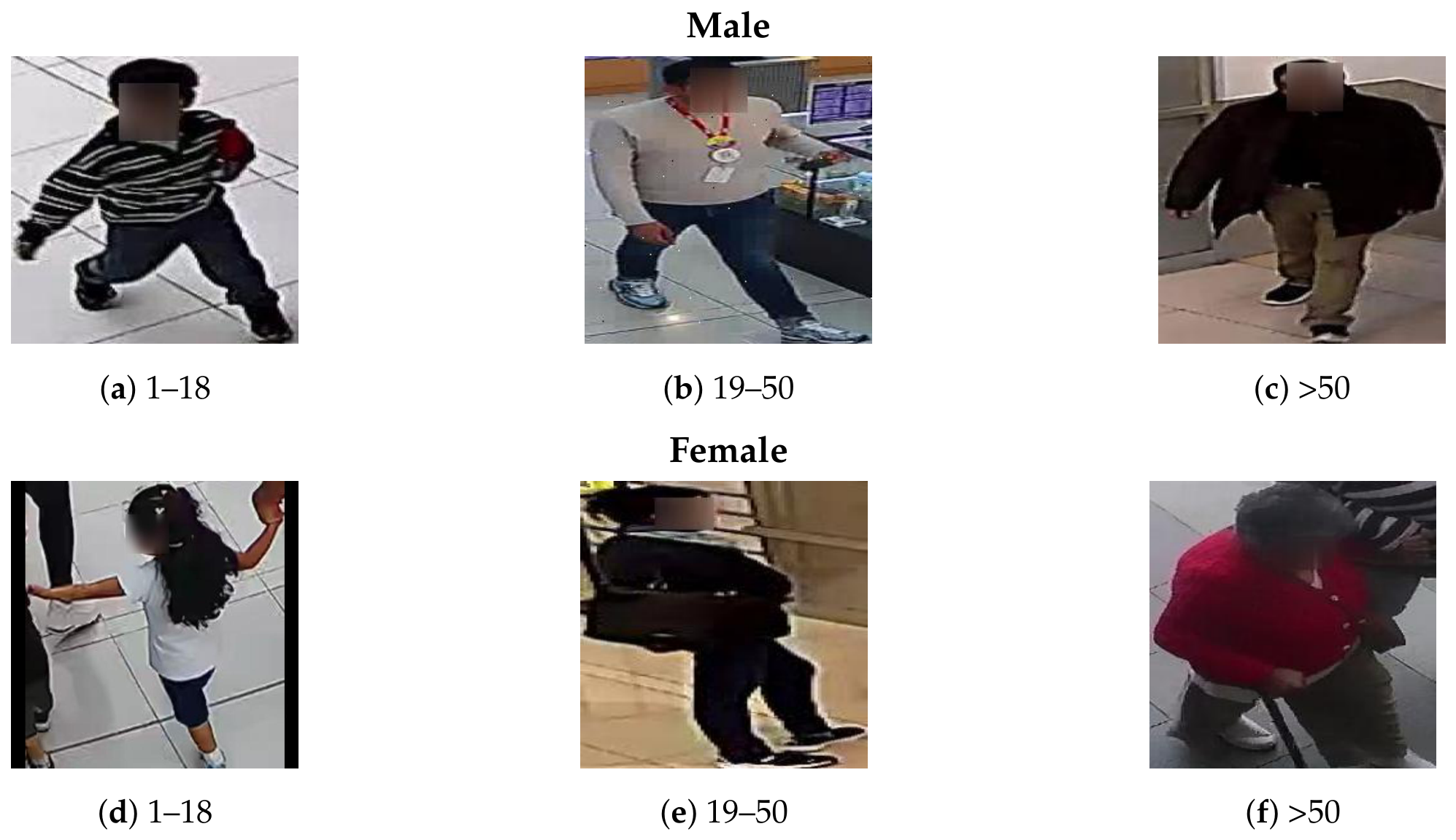
Figure 2 shows representative examples of the six gender–age subgroups used for dataset organization.
Figure 2.
Representative pedestrian crops for each gender and age subgroup. Facial regions were pixelated for publication to reduce identifiability. The original images were used for model development and were not included in the submission package.
The base target-domain dataset contained 3508 labeled pedestrian crops before training-time transformations. Images were organized into six gender–age folders to preserve the joint demographic distribution during dataset organization and stratified splitting. However, these folders do not define a six-class classification problem. Instead, two independent classification tasks were derived from the same dataset: a gender classifier with two classes and an age classifier with three classes.
Table 2 reports the folder-level gender–age distribution used in the experiments.
Table 2.
Folder-level gender–age distribution used for dataset organization and stratified splitting. The six groups were used for stratification and do not define a six-class classification task.
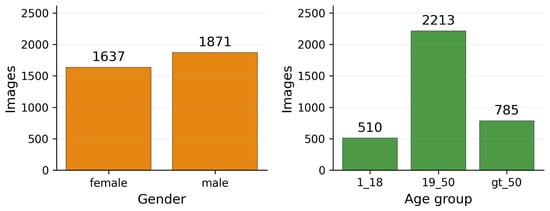
From these folder-level labels, two independent classification datasets were derived. For gender classification, the dataset contained 1637 female images and 1871 male images. For age classification, the dataset contained 510 images from the 1_18 class, 2213 images from the 19_50 class, and 785 images from the gt_50 class.
Figure 3 shows the class distribution before splitting the dataset. The gender task is relatively balanced, whereas the age task presents a strong imbalance, with 19_50 being the dominant class. This imbalance motivated the use of imbalance-handling strategies for the age classifier.
Figure 3.
Class distribution before the train/validation/test split. The gender task is relatively balanced, while the age task is dominated by the 19_50 class.
3.5. Dataset Split
The base target-domain dataset was split into training, validation, and test subsets using a stratified strategy based on the six folder-level gender–age groups. This strategy preserves the joint gender–age distribution across the three subsets, while the final models remain two independent classifiers. The resulting split contained 2455 training images, 525 validation images, and 528 test images, corresponding approximately to a 70/15/15 split.
The validation subset was used for model selection, early stopping, and threshold calibration when applicable. The test set was strictly held out and was not used during training, model selection, threshold calibration, or hyperparameter optimization. This split was used for gender evaluation and for the direct age fine-tuning comparison. The final age model also used a separate externally balanced age split described in Section 3.8.
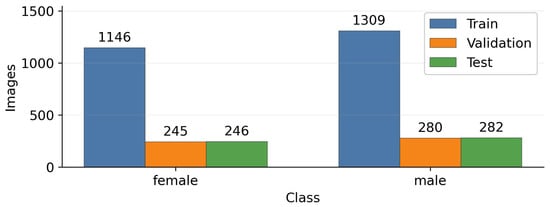
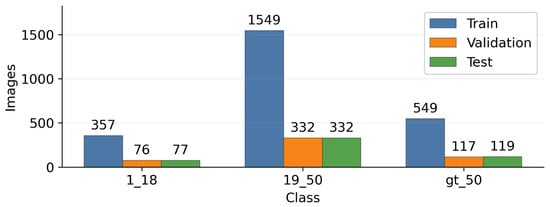
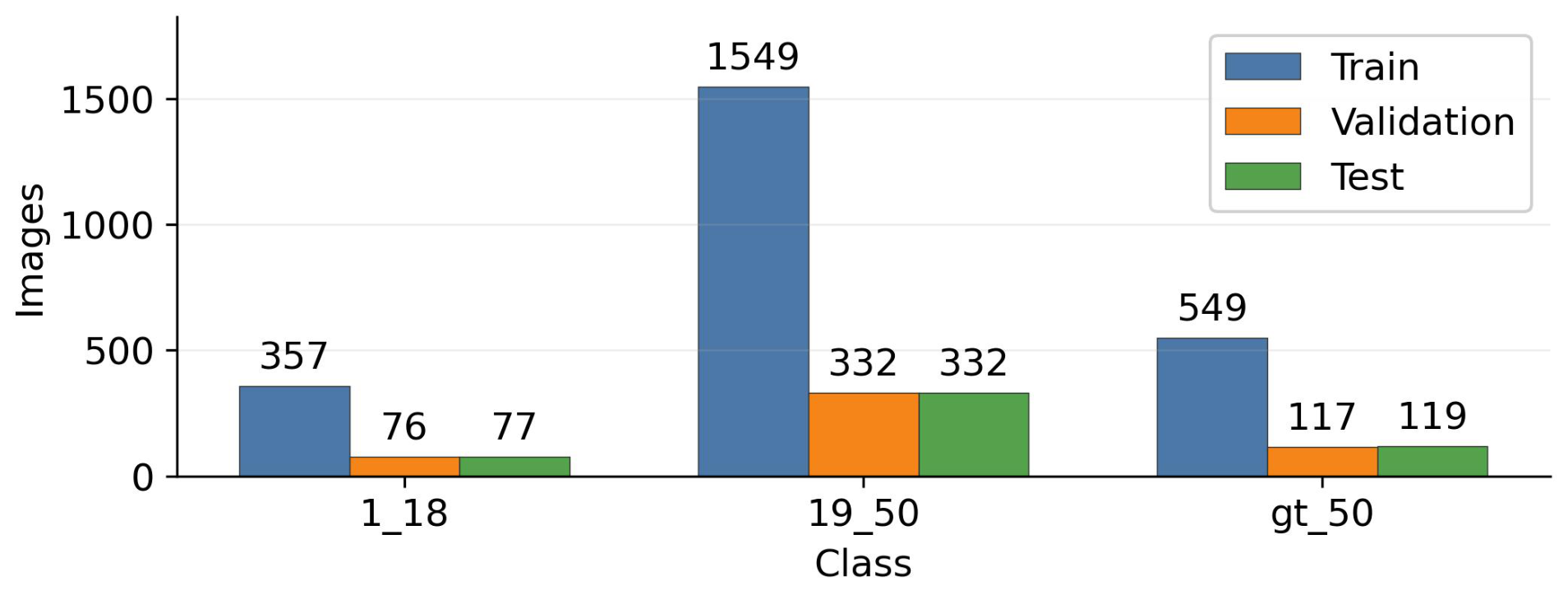
Figure 4 and Figure 5 show the resulting train/validation/test distributions for the gender and age classification tasks, respectively.
Figure 4.
Train/validation/test distribution for the gender classification task.
Figure 5.
Train/validation/test distribution for the age classification task. The class imbalance observed in the full dataset is preserved across the three subsets.
3.6. Fine-Tuning Procedure
Both demographic classifiers were fine-tuned from pre-trained ResNet18 checkpoints using transfer learning [15]. The checkpoints followed ImageNet-style preprocessing and pre-training conventions commonly used in visual recognition models [16]. Fine-tuning was performed using a two-stage schedule. First, during head training, the ResNet18 backbone was frozen and only the final fully connected layer was optimized. Second, during full fine-tuning, all layers were unfrozen and optimized, using a lower learning rate for the backbone than for the task-specific classification layer.
All images were resized to pixels and normalized according to the preprocessing conventions of the pre-trained checkpoints. Training-time transformations were applied only to the training subset and included random resized cropping, horizontal flipping, and color jitter. The models were trained using cross-entropy loss, stochastic gradient descent with momentum, and early stopping based on validation performance.
Macro-F1 was used as the main model selection metric, while minimum recall was monitored to assess the worst-performing class. These metrics were preferred over accuracy alone because they provide a more informative view under class imbalance. For reproducibility, the internal output-index order of the saved age model was 19_50, 1_18, and gt_50; descriptive plots and tables may present the age groups in chronological order.
3.7. Gender Classifier Optimization and Threshold Calibration
A grid search was performed for the gender classifier over learning rates and training schedule parameters. Since the gender classifier is binary and both classes are relevant for the final analytics system, the selected configuration prioritized validation macro-F1 while also monitoring the minimum recall between female and male.
The selected configuration used a batch size of 32, two head-training epochs, eight full fine-tuning epochs, patience of 3, weight decay of , and SGD momentum of 0.9. The learning rate was set to for head training, for the backbone during full fine-tuning, and for the final fully connected layer.
Because the gender classifier is binary, the operating threshold was calibrated on the validation set. The positive class was male. Thresholds from 0.20 to 0.80 were evaluated by maximizing the minimum class recall; ties were resolved using macro-F1 and balanced accuracy. As shown in Table 3, thresholds 0.48 and 0.50 had the same minimum recall, but 0.48 produced higher macro-F1 and balanced accuracy. The selected threshold was fixed before test evaluation.
Table 3.
Validation-set comparison of the calibrated and default gender thresholds.
Table 4 summarizes the evaluated hyperparameter combinations. All trials used batch size 32, two head-training epochs, eight full fine-tuning epochs, patience 3, weight decay , and SGD momentum 0.9.
Table 4.
Gender model hyperparameter search.
3.8. Age Model: Class-Imbalance-Aware Optimization
As shown in Figure 3 and Figure 5, age classification presented a strong class imbalance, with the 19_50 class being dominant in the base target-domain dataset and across all dataset partitions. Therefore, age optimization was evaluated using both direct fine-tuning and imbalance-handling strategies.
First, the age classifier was fine-tuned directly on the target-domain split using fixed hyperparameters. The direct fine-tuning configuration used a batch size of 32, two head-training epochs, ten full fine-tuning epochs, patience of 4, weight decay of , and SGD momentum of 0.9. The learning rate was set to for head training, for the backbone, and for the fully connected layer. This setting was used to evaluate how much the original age classifier improved when adapted only with target-domain pedestrian crops.
Second, imbalance-aware configurations were evaluated to reduce the dominance of the majority 19_50 class. These configurations included class-weighted cross-entropy, weighted sampling, and refined fine-tuning schedules. Validation macro-F1 was used as the main selection criterion, while minimum recall was monitored to assess the worst-performing age group.
In addition to loss-level and sampling-based strategies, an external data-level balancing experiment was performed for age classification. External age-labeled images were added only to the minority age classes, 1_18 and gt_50, until each split matched the number of images of the majority class in that split. This produced a class-balanced age dataset with 1549 images per class for training, 332 images per class for validation, and 332 images per class for testing. External base identities were not shared across training, validation, and test subsets.
The selected externally balanced age configuration used a ResNet18 model with batch size 32, 2 head-training epochs, 12 full fine-tuning epochs, patience 4, learning rate for head training, learning rate for the backbone, learning rate for the fully connected layer, weight decay , and SGD momentum 0.9. This final experiment corresponds to the external_db_to_max_all_splits_balanced configuration.
Table 5 summarizes the explored configurations. TD configurations used the original target-domain partitions; the final balanced configuration used a separate mixed-source split. Validation macro-F1 was used for checkpoint selection. Longer schedules used early stopping, while shorter exploratory runs used fixed epoch limits.
Table 5.
Age-model optimization results. TD denotes target-domain and MS mixed-source. Reweighting reports class-weighted cross-entropy; max-ratio uses and inverse-frequency uses . Sampling reports the weighted-sampler exponent. A dash indicates that the value was not available in the retained records.
3.9. Experimental Setup
All fine-tuning experiments were implemented in Python 3.11.9 using PyTorch 2.11.0 [17]. Images were resized to pixels and normalized using ImageNet mean and standard deviation values: mean = [0.485, 0.456, 0.406] and standard deviation = [0.229, 0.224, 0.225]. Training used stochastic gradient descent with momentum, weight decay, early stopping, and a two-stage transfer-learning schedule. The experiments were executed on a machine equipped with an NVIDIA GeForce RTX 4050 Laptop GPU.
The gender evaluation used the held-out 528-image target-domain test split. For age classification, the baseline, direct fine-tuned model, and final balanced model were evaluated on the same target-domain test split. The final balanced model was additionally evaluated on a separate 996-image class-balanced, mixed-source test set. Accuracy, macro-F1, balanced accuracy, and minimum recall were computed in both settings.
3.10. Event-Based Evaluation Protocol
The evaluation was conducted at two levels. First, the fine-tuned age and gender classifiers were evaluated offline using their corresponding test splits, as described in the previous sections. Second, the deployed DeepStream pipeline was tested on real-world video sequences to verify end-to-end operation, including pedestrian detection, object tracking, line-crossing event generation, and demographic inference.
In the deployed pipeline, predictions are associated with line-crossing events rather than individual frames. Each counted pedestrian crossing produces one gender prediction and one age-group prediction, which are stored as part of the event metadata. This event-based design aligns the classification output with the final analytics unit of the system and avoids redundant frame-level counting.
A full quantitative event-level evaluation would require manually annotated crossing events and demographic labels for each video sequence. Therefore, the offline test-set results are used as the primary quantitative evaluation in this paper, while video-based testing is reported as a functional integration validation of the complete DeepStream pipeline.
4. Results
4.1. Offline Classification Results
The final offline evaluation used the 528-image held-out target-domain test set for gender and age. The final balanced age model was additionally evaluated on a separate 996-image, class-balanced, mixed-source test set. Test data were not used for training, model selection, or threshold calibration.
Table 6 reports the classification results for the gender baseline and the selected fine-tuned model on the 528-image target-domain test set.
Table 6.
Classification report of the gender baseline and selected best model on the target-domain test set.
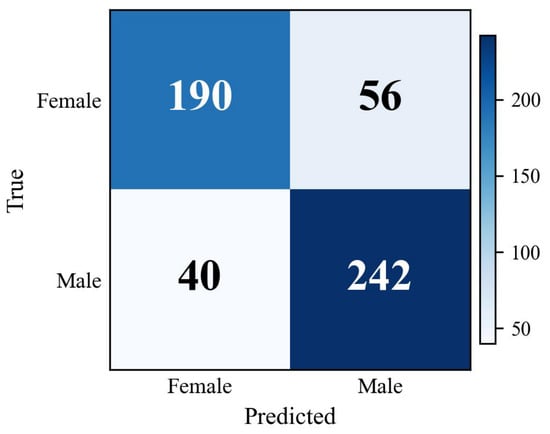
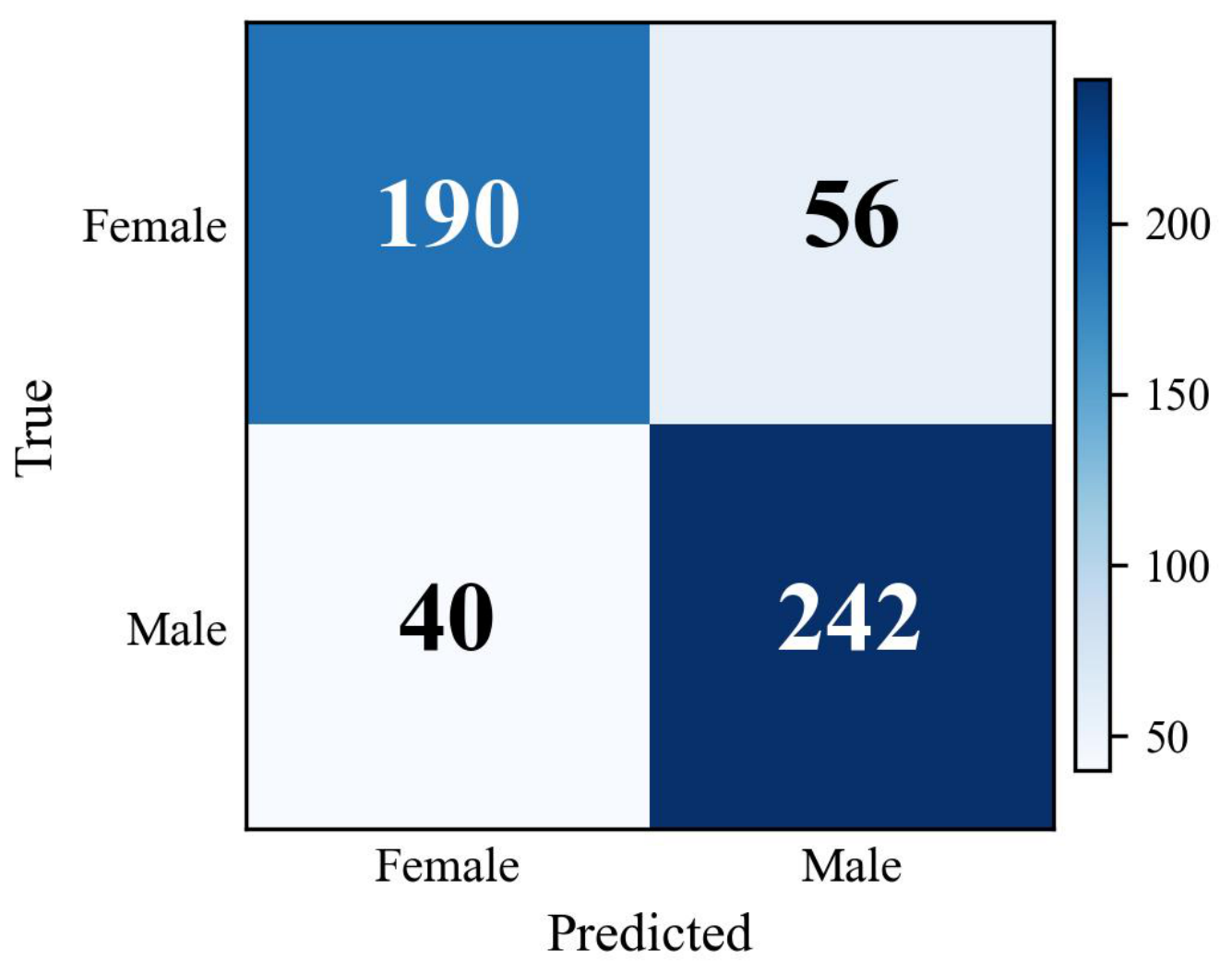
For gender classification, fine-tuning improved performance over the baseline model. The selected model increased accuracy from 0.7247 to 0.8182, macro-F1 from 0.7223 to 0.8164, balanced accuracy from 0.7217 to 0.8153, and minimum recall from 0.6724 to 0.7724. Figure 6 shows the confusion matrix of the fine-tuned gender classifier on the target-domain test set.
Figure 6.
Confusion matrix of the fine-tuned gender classifier on the target-domain test set.
The fine-tuned gender classifier correctly classified 190 female samples and 242 male samples. The main errors were 56 female samples classified as male and 40 male samples classified as female.
Table 7 reports age results on the original 528-image target-domain (TD) test set and the separate 996-image, class-balanced, mixed-source (MS) test set. Results from TD and MS are reported separately because their sources and class distributions differ.
Table 7.
Age classification results on the target-domain (TD) and mixed-source (MS) test sets.
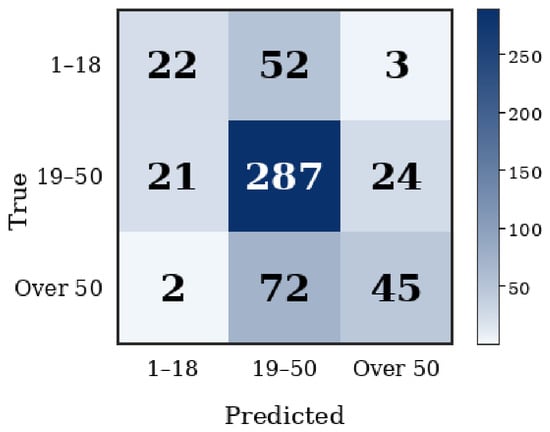
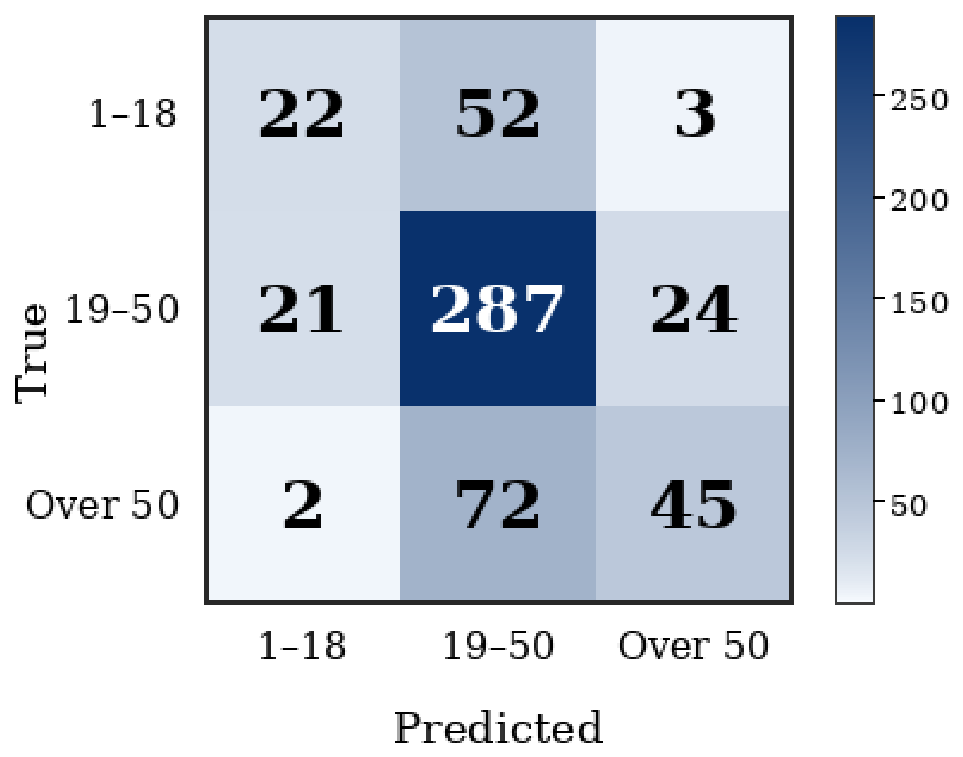
Direct fine-tuning improved target-domain macro-F1 from 0.4410 to 0.5310 and balanced accuracy from 0.4432 to 0.5882. On the same target-domain test set, the final balanced model achieved 0.6705 accuracy, 0.5348 macro-F1, 0.5094 balanced accuracy, and 0.2857 minimum recall. Its class recalls were 0.2857, 0.8645, and 0.3782 for 1_18, 19_50, and gt_50, respectively. Figure 7 shows the confusion matrix of this model on the target-domain test set.
Figure 7.
Confusion matrix of the final balanced age classifier on the target-domain test set.
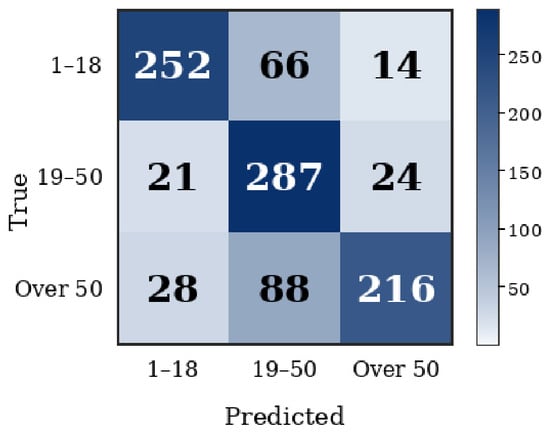
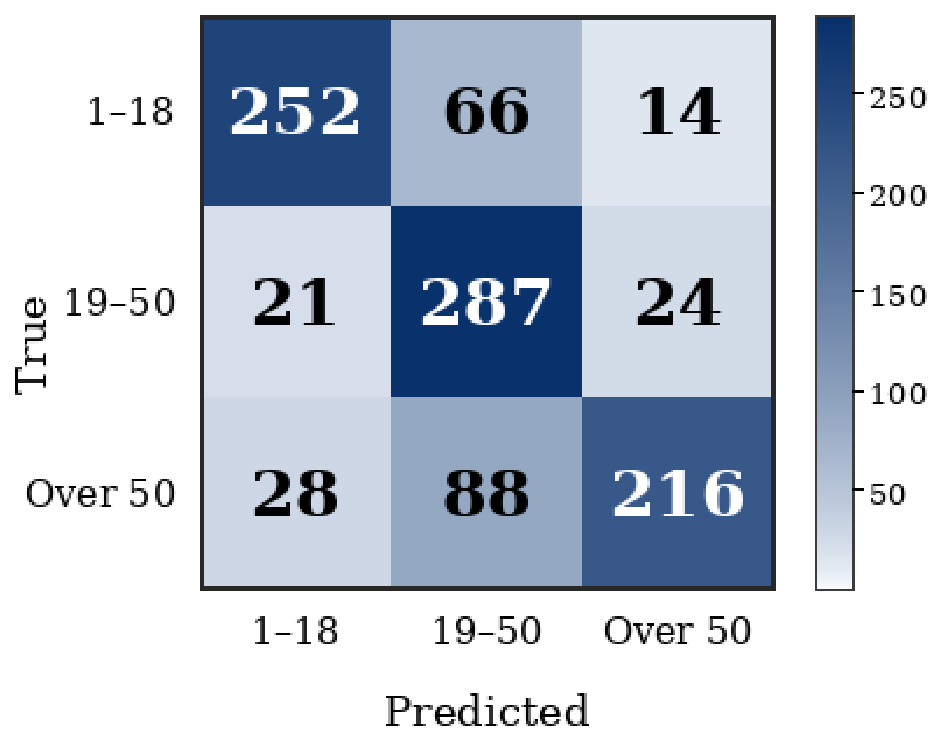
On the separate mixed-source test set, the same model achieved 0.7580 accuracy, 0.7587 macro-F1, 0.7580 balanced accuracy, and 0.6506 minimum recall. This result should not be interpreted as performance on the original target-domain distribution. Figure 8 shows the corresponding confusion matrix for the mixed-source test set.
Figure 8.
Confusion matrix of the final balanced age classifier on the mixed-source test set.
Most target-domain errors assigned minority-class samples to the dominant 19_50 class. The higher mixed-source scores therefore characterize a different evaluation distribution.
4.2. Pipeline Integration Validation
The complete pipeline was tested using 17 assigned 30 min segments from four camera streams, corresponding to approximately 8.5 h of video. Each crossing event produced one gender and one age-group prediction, and the tracked-object identifier prevented repeated frame-level counting of the same crossing.
The retained records do not contain reliable crossing totals, processing FPS, inference latency, GPU utilization, or a manual duplicate-count audit. The pipeline test is therefore reported as functional integration validation rather than a runtime or event-level benchmark.
5. Discussion
The results indicate that target-domain fine-tuning improved offline classification performance compared to the baseline models. This finding highlights the importance of dataset representativeness in real-world deployment scenarios, where pedestrian crops may differ from generic training data in terms of camera viewpoint, image quality, illumination, and scene composition.
The gender classifier improved from a baseline with lower recall for the female class and achieved more balanced behavior across the two gender classes after fine-tuning and validation-based threshold calibration. The improvement in minimum recall suggests that threshold calibration helped reduce the tendency to favor one class over the other, while maintaining competitive overall accuracy.
The age classifier remained more challenging. The final balanced model slightly improved target-domain macro-F1 over direct fine-tuning but reduced balanced accuracy and minority-class recall. Its higher mixed-source scores show that performance depends on both image source and class distribution.
The remaining errors in age classification are consistent with the difficulty of estimating age from pedestrian crops, where facial detail may be limited by camera distance, motion blur, occlusion, and body-pose variation. In particular, errors between adjacent or visually similar age groups are expected because the boundaries between age categories are visually ambiguous.
The event-based design is appropriate for deployment because it assigns demographic labels only when a tracked pedestrian crosses the virtual line. This avoids redundant frame-level counting and aligns the evaluation unit with the final analytics output. However, detection or tracking errors can still propagate to the classification stage in the complete video pipeline.
6. Limitations and Ethical Considerations
This work is limited to one deployment site and heterogeneous camera streams. Age and gender labels are visually inferred, and one primary annotator labeled each segment without an inter-annotator agreement study. The mixed-source age test set is therefore reported separately from the target-domain test set. Detection and tracking errors may also propagate to demographic classification.
The study used existing operational video for retrospective, non-interventional analysis. No individuals were recruited, contacted, or linked to names or persistent identities, and only aggregate model performance is reported. Data minimization retained pedestrian crops and labels rather than publishing complete videos. Access to the consolidated dataset was restricted, exact locations and access details were withheld, and publication images were pixelated and checked for embedded location metadata. The dataset is not publicly distributed. A formal retention interval was not defined in the original procedure; identifiable material should be deleted when no longer required for research verification.
7. Conclusions
This paper presented a DeepStream-based pedestrian analytics pipeline for event-based counting and demographic classification. The system uses two independent ResNet18 classifiers for gender and age-group estimation, which were adapted using pedestrian crops extracted from the target deployment domain. An additional externally balanced split was also evaluated for the final age model to analyze performance under equal class-support conditions.
The fine-tuned gender classifier improved macro-F1 from 0.7223 to 0.8164 on the target-domain test set. Direct age fine-tuning improved macro-F1 from 0.4410 to 0.5310. The final balanced age model achieved 0.5348 macro-F1 on the target-domain test set and 0.7587 on the separate mixed-source test set. These results must be interpreted according to the evaluation source and class distribution.
Future work will focus on full event-level quantitative evaluation using annotated videos, temporal aggregation across multiple frames, larger and more diverse datasets, and deployment-oriented optimization of the fine-tuned models.
Author Contributions
Conceptualization, W.M. and E.C.; methodology, W.M.; software, W.M.; validation, W.M.; formal analysis, W.M.; investigation, W.M.; resources, E.C., M.E.M.-C., P.V., I.R.-C., R.F. and A.C.; data curation, W.M.; writing—original draft preparation, W.M.; writing—review and editing, W.M., E.C., M.E.M.-C., P.V., I.R.-C., R.F. and A.C.; visualization, W.M.; supervision, E.C. and M.E.M.-C.; project administration, E.C. All authors have read and agreed to the published version of the manuscript.
Funding
This research received no external funding.
Institutional Review Board Statement
Not applicable. This study was a retrospective, non-interventional secondary analysis of existing operational surveillance video. No individuals were recruited or identified, and only aggregate model performance is reported.
Informed Consent Statement
Not applicable. The study used existing operational recordings without participant interaction or identification.
Data Availability Statement
The target-domain pedestrian images are not publicly available because they originate from operational surveillance recordings. Derived data may be available from the corresponding author upon reasonable request, subject to privacy and ethical restrictions.
Conflicts of Interest
Author Ricardo Fonseca and Alfonso Cadiz were employed by DIGEVO Company. The remaining authors declare that the research was conducted in the absence of any commercial or financial relationships that could be construed as a potential conflict of interest.
Abbreviations
The following abbreviations are used in this manuscript:
| CNN | Convolutional Neural Network |
| CW | Class-Weighted Cross-Entropy |
| FPS | Frames Per Second |
| GPU | Graphics Processing Unit |
| MS | Mixed-Source |
| PAR | Pedestrian Attribute Recognition |
| RTSP | Real-Time Streaming Protocol |
| SDK | Software Development Kit |
| SGD | Stochastic Gradient Descent |
| TD | Target Domain |
References
- Bewley, A.; Ge, Z.; Ott, L.; Ramos, F.; Upcroft, B. Simple Online and Realtime Tracking. In Proceedings of the IEEE International Conference on Image Processing (ICIP), Phoenix, AZ, USA, 25–28 September 2016; pp. 3464–3468. [Google Scholar]
- Wojke, N.; Bewley, A.; Paulus, D. Simple Online and Realtime Tracking with a Deep Association Metric. In Proceedings of the IEEE International Conference on Image Processing (ICIP), Beijing, China, 17–20 September 2017; pp. 3645–3649. [Google Scholar]
- NVIDIA. NVIDIA DeepStream SDK Documentation. Available online: https://docs.nvidia.com/metropolis/deepstream/dev-guide/ (accessed on 17 May 2026).
- NVIDIA. PeopleNet Model Documentation. Available online: https://docs.nvidia.com/tao/archive/5.3.0/text/model_zoo/cv_models/peoplenet.html (accessed on 17 May 2026).
- Li, D.; Chen, X.; Zhang, Z.; Huang, K. HydraPlus-Net: Attentive Deep Features for Pedestrian Analysis. In Proceedings of the IEEE International Conference on Computer Vision (ICCV), Venice, Italy, 22–29 October 2017; pp. 350–359. [Google Scholar]
- Wang, X.; Zheng, S.; Yang, R.; Zheng, A.; Chen, Z.; Tang, J.; Luo, B. Pedestrian Attribute Recognition: A Survey. Pattern Recognit. 2022, 121, 108220. [Google Scholar] [CrossRef] [Scilit]
- Zhou, Y.; Hu, H.M.; Xiang, Y.; Zhang, X.; Wu, H. Pedestrian Attribute Recognition as Label-Balanced Multi-Label Learning. In Proceedings of the 41st International Conference on Machine Learning, Vienna, Austria, 21–27 July 2024; pp. 61964–61978. [Google Scholar]
- Wang, X.; Jin, J.; Li, C.; Tang, J.; Zhang, C.; Wang, W. Pedestrian Attribute Recognition via CLIP-Based Prompt Vision-Language Fusion. IEEE Trans. Circuits Syst. Video Technol. 2025, 35, 148–161. [Google Scholar] [CrossRef] [Scilit]
- Jin, J.; Wang, X.; Zhu, Q.; Wang, H.; Li, C. Pedestrian Attribute Recognition: A New Benchmark Dataset and a Large Language Model Augmented Framework. In Proceedings of the AAAI Conference on Artificial Intelligence, Philadelphia, PA, USA, 25 February–4 March 2025; Volume 39, pp. 4138–4146. [Google Scholar] [CrossRef] [Scilit]
- Levi, G.; Hassner, T. Age and Gender Classification Using Convolutional Neural Networks. In Proceedings of the IEEE Conference on Computer Vision and Pattern Recognition Workshops (CVPRW), Boston, MA, USA, 7–12 June 2015; pp. 34–42. [Google Scholar]
- He, K.; Zhang, X.; Ren, S.; Sun, J. Deep Residual Learning for Image Recognition. In Proceedings of the IEEE Conference on Computer Vision and Pattern Recognition (CVPR), Las Vegas, NV, USA, 27–30 June 2016; pp. 770–778. [Google Scholar]
- Karkkainen, K.; Joo, J. FairFace: Face Attribute Dataset for Balanced Race, Gender, and Age for Bias Measurement and Mitigation. In Proceedings of the IEEE Winter Conference on Applications of Computer Vision (WACV), Waikoloa, HI, USA, 3–8 January 2021; pp. 1548–1558. [Google Scholar]
- He, H.; Garcia, E.A. Learning from Imbalanced Data. IEEE Trans. Knowl. Data Eng. 2009, 21, 1263–1284. [Google Scholar] [CrossRef] [Scilit]
- Cui, Y.; Jia, M.; Lin, T.Y.; Song, Y.; Belongie, S. Class-Balanced Loss Based on Effective Number of Samples. In Proceedings of the IEEE/CVF Conference on Computer Vision and Pattern Recognition (CVPR), Long Beach, CA, USA, 15–20 June 2019; pp. 9268–9277. [Google Scholar]
- Pan, S.J.; Yang, Q. A Survey on Transfer Learning. IEEE Trans. Knowl. Data Eng. 2010, 22, 1345–1359. [Google Scholar] [CrossRef] [Scilit]
- Russakovsky, O.; Deng, J.; Su, H.; Krause, J.; Satheesh, S.; Ma, S.; Huang, Z.; Karpathy, A.; Khosla, A.; Bernstein, M.; et al. ImageNet Large Scale Visual Recognition Challenge. Int. J. Comput. Vis. 2015, 115, 211–252. [Google Scholar] [CrossRef] [Scilit]
- Paszke, A.; Gross, S.; Massa, F.; Lerer, A.; Bradbury, J.; Chanan, G.; Killeen, T.; Lin, Z.; Gimelshein, N.; Antiga, L.; et al. PyTorch: An Imperative Style, High-Performance Deep Learning Library. In Proceedings of the Advances in Neural Information Processing Systems, Vancouver, BC, Canada, 8–14 December 2019; Volume 32. [Google Scholar]

Disclaimer/Publisher’s Note: The statements, opinions and data contained in all publications are solely those of the individual author(s) and contributor(s) and not of MDPI and/or the editor(s). MDPI and/or the editor(s) disclaim responsibility for any injury to people or property resulting from any ideas, methods, instructions or products referred to in the content. |
© 2026 by the authors. Licensee MDPI, Basel, Switzerland. This article is an open access article distributed under the terms and conditions of the Creative Commons Attribution (CC BY) license.