


Abstract
The deployment of renewable energy technologies is a key pathway for exploiting offshore resources and supporting the transition toward sustainable power generation. Floating offshore structures enable energy extraction in deep-water environments where conventional fixed systems are not feasible. This study presents an evidence-based assessment of the renewable energy potential associated with floating offshore structures in European seas and proposes an integrated framework for evaluating their sustainable design. The analysis is based on a curated dataset of European offshore energy projects, including installed capacity, spatial distribution, and technology-specific development indicators. A statistical approach is applied to characterize regional variability and identify dominant deployment trends. The results show a rapid expansion of floating offshore wind capacity, accompanied by the emergence of floating photovoltaic systems and hybrid wave–wind–solar configurations, while revealing significant regional differences in technological maturity, project scale, and growth rates. Sustainability indicators related to material efficiency, life-cycle performance, environmental impact mitigation, and circular-economy integration are further applied to assess the design of floating structures. The proposed framework highlights performance gaps and technological constraints and provides a structured basis for improving the efficiency and sustainability of future floating offshore systems under European offshore conditions.
1. Introduction
The increasing global demand for energy and the need to mitigate climate change have accelerated the development of renewable energy systems, with offshore resources representing a key area of expansion due to their high energy potential, particularly for wind and wave energy [1,2,3]. Conventional offshore technologies are limited to shallow waters, whereas a significant share of renewable resources is in deep-water regions. This limitation has driven the development of floating offshore structures capable of operating under complex environmental conditions [4,5].
Floating systems enable access to more consistent energy resources and support technologies such as offshore wind, wave energy converters, and floating photovoltaic systems, while hybrid configurations introduce challenges related to performance optimization and system-level design [6,7,8].
This study aims to assess the renewable energy potential associated with floating offshore structures in European seas and to evaluate sustainable design characteristics using an evidence-based approach, focusing on key performance and sustainability indicators relevant to current offshore developments [5,6].
2. Renewable Energy Technologies in Floating Offshore Systems
The development of floating offshore structures has enabled the deployment and integration of multiple renewable energy technologies, allowing for improved utilization of marine resources under deep-water conditions.
Unlike fixed offshore systems, floating platforms can accommodate diverse energy conversion technologies, each characterized by distinct technological maturity, performance profiles, and operational constraints [1,2,3].
2.1. Primary Types of Technologies
Floating Offshore Wind (FOW) is currently the most mature and widely deployed floating renewable technology. Platforms allow access to deep-water areas with higher and more stable wind speeds, leading to increased capacity factors and energy yield compared to fixed-bottom turbines [4,5]. Key advantages include the potential for large-scale farm deployment and the expansion of exploitable offshore wind resources. However, FOW (Floating Offshore Wind) systems still face challenges related to mooring design, platform stability, and LCOE (levelized cost of energy) [4,5].
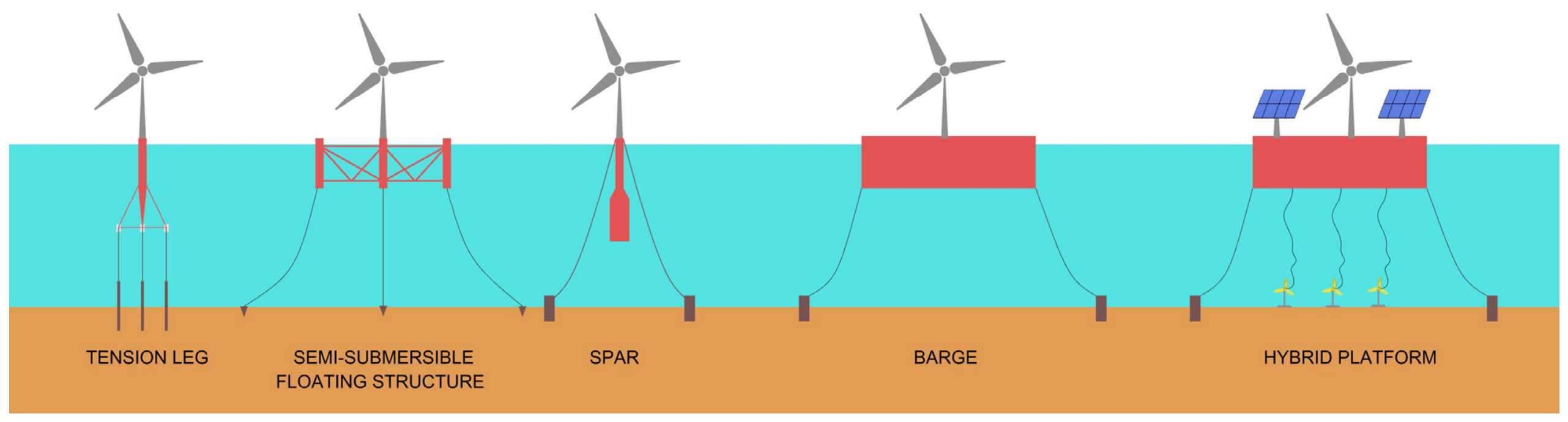
The main floating platform concepts used for offshore renewable applications are illustrated in Figure 1, including tension-leg, semi-submersible, spar, and barge configurations, together with a representative hybrid platform integrating wind, photovoltaic, and wave energy technologies. The hybrid configuration highlights the trend toward multifunctional floating structures capable of combining complementary renewable resources on a shared offshore infrastructure.
Figure 1.
Schematic comparison of floating offshore platform concepts for renewable energy applications (figure designed by the authors based on the reviewed literature).
Wave Energy Converters (WECs) exploit the kinetic and potential energy of ocean waves, offering substantial theoretical energy potential, particularly in high-energy offshore regions [6]. They complement wind generation by producing energy when wind speeds are low, enhancing overall system reliability. Large-scale deployment remains constrained by structural durability, storm survivability, and economic feasibility [6].
Floating Photovoltaic Systems (FPV) are an emerging technology adapted for offshore deployment [7]. While commonly implemented in inland water bodies, recent developments focus on integration with floating wind systems. Co-locating FPV (Floating Photovoltaic Systems) with FOW (Floating Offshore Wind) improves energy yield, optimizes infrastructure use, and reduces space requirements per unit of energy produced. Key challenges include corrosion, biofouling, and stability under harsh marine conditions [7].
Hybrid Offshore Systems. Hybrid platforms integrate multiple renewable energy sources—such as wind, wave, and solar—on a single floating structure [6,7,8]. These configurations reduce the variability of power output, improve reliability, and enable more efficient use of offshore space. Hybrid designs allow synergistic strategies, including shared moorings, coordinated energy control, and integrated storage solutions, enhancing both economic and environmental performance [8].
Beyond electrical integration, hybrid floating offshore systems are increasingly being explored for the production and storage of green hydrogen. Surplus electricity generated by offshore wind, wave, and floating photovoltaic systems can be converted into hydrogen through electrolysis, offering a flexible energy-storage pathway while contributing to the decarbonization of sectors that are difficult to electrify directly. Recent studies have emphasized the growing role of hydrogen as an energy carrier within future offshore energy hubs, while also highlighting the technical and economic challenges associated with large-scale hydrogen production, storage, and transport infrastructure [9]. In parallel, recent research into hybrid offshore energy systems has highlighted the potential benefits of combining hydrogen production and storage with renewable floating platforms, particularly in terms of increasing energy flexibility, improving the management of variable renewable generation, and enabling the development of multifunctional offshore energy infrastructures [10,11].
2.2. Advantages and Limitations of Each Technology
A comparative synthesis of the main renewable energy technologies integrated into floating offshore structures is presented in Table 1, highlighting their principal advantages, limitations, and implications for sustainable design.
Table 1.
Comparative assessment of renewable energy technologies integrated into floating offshore structures, including their advantages, limitations, and sustainability implications [5,6,7,8].
Floating wind is currently the most mature option for large-scale deployment in European seas, whereas wave and floating photovoltaic systems still face significant durability and operational challenges. Hybrid configurations offer the greatest potential for improving energy reliability and resource utilization, although their implementation depends on advanced integration and control strategies.
3. Statistical Analysis of Floating Offshore Projects
The rapid development of European floating offshore projects reflects growing interest in wind, floating solar, and hybrid technologies and provides a basis for assessing technological maturity and future deployment trends [12,13,14].
To identify the dominant technologies, Table 2 provides an overview of the main floating offshore projects developed in Europe, including the country of implementation, the technology type, the project status, the approximate installed capacity, and the official or technical source for each project.
Table 2.
Representative European floating offshore projects.
In addition, there is a high concentration of European floating offshore projects in countries with experience in the offshore sector and access to significant marine resources, such as the United Kingdom, France, Portugal, and Norway [12,15]. At the same time, the distribution of projects shows a predominance of floating offshore wind technology, while floating solar and hybrid projects are still fewer in number and are mainly in the pilot, demonstration, or planning phases [16]. Nearly 67% of all the projects examined are floating offshore wind projects, while floating solar and hybrid solutions remain mainly in the demonstration or development stages. The significant percentage of projects already in operation indicates the gradual maturation of the European floating offshore sector, alongside the emergence of integrated solutions aimed at diversifying renewable energy sources and increasing the sustainability of offshore infrastructure.
Offshore hybrid projects are developed to combine two or more renewable energy sources, such as wind, solar, and wave energy, within a common floating platform or integrated offshore system [12,17]. From an energy and operational perspective, the combination of complementary renewable sources can reduce output variability by balancing different generation profiles, while also improving the utilization of available offshore infrastructure. Furthermore, hybrid configurations allow for the shared use of key offshore infrastructure, including subsea cables, mooring systems, and grid connections. This integrated approach can contribute to a more efficient use of maritime space and improve the overall utilization of existing energy infrastructure.
European case studies [18] on the integration of floating solar systems and offshore wind farms highlight the advantages of sharing electrical infrastructure and show that integrating floating photovoltaic systems into an offshore wind farm can lead to more efficient use of export cables while also identifying the optimal connection points for the solar system to the existing infrastructure.
At the same time, floating solar and hybrid projects are emerging as strategic directions for development, especially in light of the goal to transform European floating structures into sustainable, integrated energy platforms capable of more effectively meeting the future demands of the energy system.
4. Sustainability Considerations in Floating Offshore Design
Sustainability of offshore floating structures relies not only on their ability to generate electricity from renewable sources. The concept must be analyzed through a range of factors, such as interaction with the marine environment, the durability of the materials and structural systems used, and the way design decisions influence energy efficiency and performance throughout the entire life cycle [19,20].
In Europe, floating offshore projects are an important component of the process of decarbonizing energy systems, and ensuring their sustainability poses a multidimensional challenge from a design perspective [19]. In addition to reducing greenhouse gas emissions compared to fossil fuel-based power generation, floating offshore projects help minimize the impact on ecosystems, increase the service life of structures, reduce maintenance requirements, and optimize energy production under the specific conditions of the marine environment. At the same time, climatic conditions need to be considered in the design and long-term operation of marine infrastructure, as variations in wind and wave conditions are particularly relevant for European regions such as the Mediterranean Sea and the Black Sea [21].
The durability of offshore floating structures depends on the selection of materials and structural design appropriate for the cyclic loads induced by wind, waves, and platform movements, as well as protection against corrosion and fatigue [19,20,22]. As such, durability must be assessed over the entire service life, considering the cumulative degradation and the required maintenance interventions.
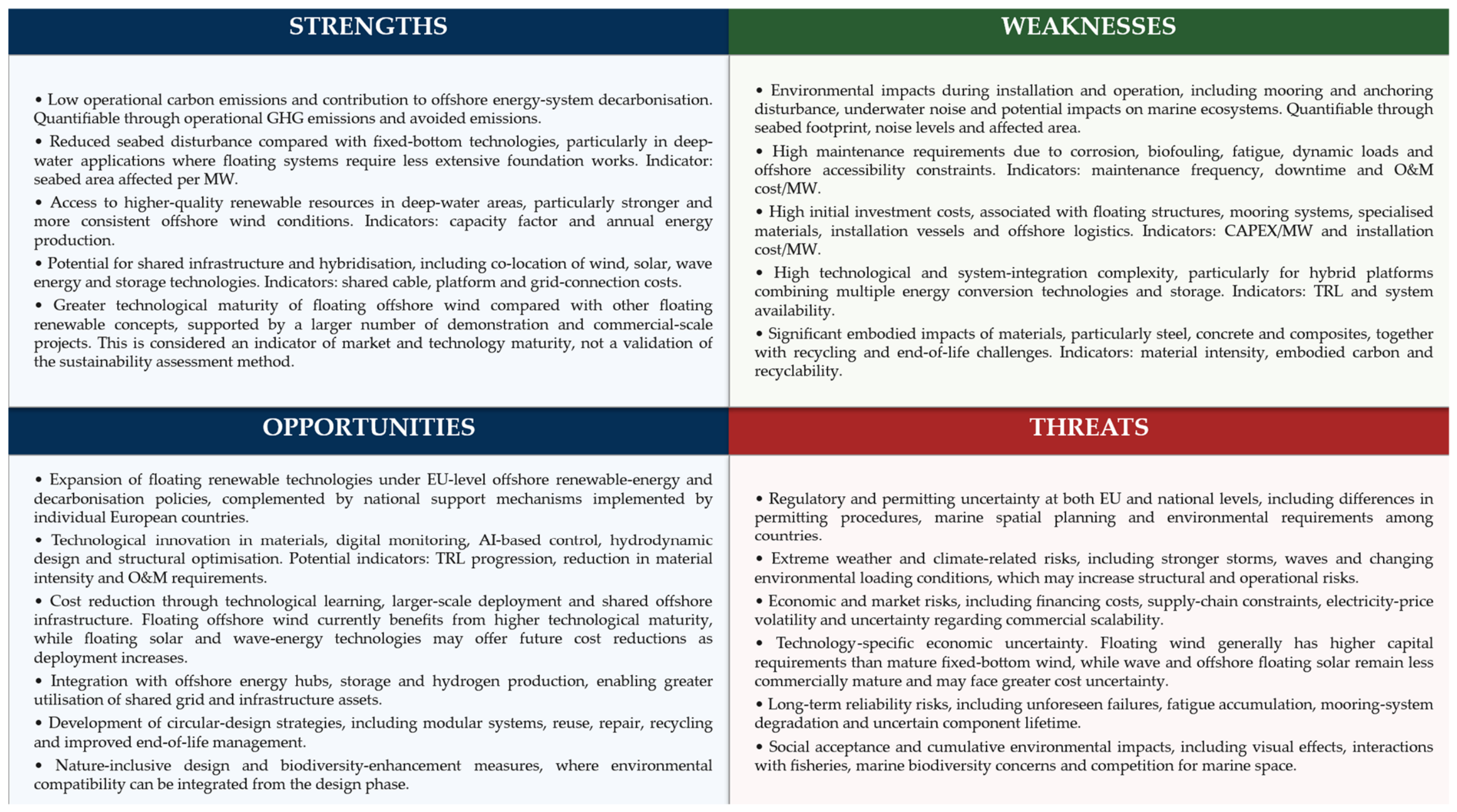
The SWOT (Strengths, Weaknesses, Opportunities, Threats) analysis presented in Figure 2 assesses the sustainability of offshore floating structure designs, emphasizing environmental performance, structural durability, technological integration, and long-term system efficiency. As such, the main advantages are outlined, while the weaknesses and threats that may limit their large-scale implementation and their long-term contribution to the development of a more sustainable European offshore energy sector are also identified.
Figure 2.
SWOT analysis. Sustainability of floating offshore design.
Floating offshore systems offer low operational emissions, access to deep-water renewable resources, and compatibility with European decarbonization goals, while enabling the integration of wind, solar, and hybrid technologies. However, high investment costs, structural complexity, maintenance requirements, regulatory uncertainty, extreme weather, and environmental concerns may limit large-scale deployment, requiring sustainability to be evaluated through a full life-cycle perspective that considers technical, environmental, economic, and social factors.
5. Conclusions
The assessment of the main renewable technologies used on offshore floating structures highlights that floating wind energy is currently the most technologically mature solution, while offshore solar systems and hybrid platforms are undergoing continuous development and optimization. Although each technology offers specific advantages in terms of energy production, their large-scale implementation depends on overcoming challenges related to costs, structural durability, operating conditions, and environmental impact.
The statistical analysis of European projects confirms the predominance of floating offshore wind energy and highlights the sector’s focus on developing integrated energy systems, in which solar and hybrid technologies are playing an increasingly important role. Although floating offshore solar systems and hybrid platforms are still less mature and are largely in the pilot, demonstration, or planning stages, they underscore the trend toward integrated offshore energy systems capable of combining wind, solar, and, potentially, wave energy through the use of a shared marine infrastructure. These developments are particularly relevant in the context of European decarbonization strategies, as they promote a more efficient use of maritime space and the diversification of the renewable energy mix.
An evaluation of sustainability aspects demonstrates that the long-term performance of offshore floating structures depends on the integration of efficient design solutions, durable materials, and measures to minimize environmental impact and maximize energy efficiency throughout the entire life cycle.
Therefore, from a design perspective, the platform’s geometry, the configuration of the mooring system, the selection of materials, the maintenance strategy, and compatibility with hybrid energy systems influence both structural reliability and environmental performance over the entire life cycle, as well as overall energy efficiency. Consequently, the design of offshore floating structures needs to be approached as a multidisciplinary sustainability issue, in which technical, environmental, and economic aspects must be addressed simultaneously.
Author Contributions
Conceptualization, A.B. and A.-M.C.; methodology, A.B., A.-M.C. and E.R.; writing—original draft preparation, A.B. and A.-M.C.; writing—review and editing, A.B., A.-M.C. and E.R.; supervision and writing final version, A.-M.C. and E.R. All authors have read and agreed to the published version of the manuscript.
Funding
This research received no external funding.
Institutional Review Board Statement
Not applicable.
Informed Consent Statement
Not applicable.
Data Availability Statement
The original contributions presented in this study are included in the article. Further inquiries can be directed to the corresponding author.
Conflicts of Interest
The authors declare no conflict of interest.
References
- Maienza, C.; Avossa, A.M.; Picozzi, V.; Ricciardelli, F. Feasibility analysis for floating offshore wind energy. Int. J. Life Cycle Assess. 2022, 27, 796–812. [Google Scholar] [CrossRef] [Scilit]
- Garcia-Teruel, A.; Rinaldi, G.; Thies, P.R.; Johanning, L.; Jeffrey, H. Life cycle assessment of floating offshore wind farms: An evaluation of operation and maintenance. Appl. Energy 2022, 307, 118067. [Google Scholar] [CrossRef] [Scilit]
- Faraggiana, E.; Giorgi, G.; Sirigu, M.; Ghigo, A.; Bracco, G.; Mattiazzo, G. A review of numerical modelling and optimisation of the floating support structure for offshore wind turbines. J. Ocean Eng. Mar. Energy 2022, 8, 433–456. [Google Scholar] [CrossRef] [Scilit]
- Thomas, B.; Costoya, X.; deCastro, M.; Gómez-Gesteira, M. Identifying floating offshore wind farm designs which minimize Levelized Cost of Energy considering intra-array wake effect in Atlantic Europe. Renew. Energy 2025, 254, 123730. [Google Scholar] [CrossRef] [Scilit]
- Ferreira, V.J.; Benveniste, G.; Rapha, J.I.; Corchero, C.; Domínguez García, J.L. A holistic tool to assess the cost and environmental performance of floating offshore wind farms. Renew. Energy 2023, 216, 119079. [Google Scholar] [CrossRef] [Scilit]
- Pulselli, R.M.; Simoncini, E.; Bastianoni, S.; Marchettini, N. Benchmarking marine energy technologies through LCA: Offshore floating wind farms in the Mediterranean. Front. Energy Res. 2022, 10, 902021. [Google Scholar] [CrossRef] [Scilit]
- Sahu, A.; Yadav, N.; Sudhakar, K. Floating photovoltaic power plant: A review. Renew. Sustain. Energy Rev. 2016, 66, 815–824. [Google Scholar] [CrossRef] [Scilit]
- Pérez-Collazo, C.; Greaves, D.; Iglesias, G. A review of combined wave and offshore wind energy. Renew. Sustain. Energy Rev. 2015, 42, 141–153. [Google Scholar] [CrossRef] [Scilit]
- Reda, B.; Elzamar, A.A.; AlFazzani, S.; Ezzat, S.M. Green hydrogen as a source of renewable energy: A step towards sustainability, an overview. Environ. Dev. Sustain. 2024, 27, 29213–29233. [Google Scholar] [CrossRef] [Scilit]
- Chirosca, A.-M.; Popa, V.-I.; Rusu, E. Assessment of green hydrogen production and potential utilization in the hydrodynamic environment of the danube. In Proceedings of the 25th International Multidisciplinary Scientific GeoConference SGEM 2025, Energy and Clean Technologies, Albena, Bulgaria, 29 June–6 July 2025; pp. 21–28. [Google Scholar] [CrossRef] [Scilit]
- Bujor, A.; Chirosca, A.M.; Gasparotti, C.; Rusu, E. Hybrid Energy Solutions: Hydrogen Integration in Floating Production Storageand Offloading Units. In Proceedings of the 25th International Multidisciplinary Scientific GeoConference SGEM 2025, Albena, Bulgaria, 28 June–7 July 2025; Book 4.2; STEF92 Technology: Sofia, Bulgaria, 2025; Volume 25. [Google Scholar]
- Bujor, A.; Chirosca, A.-M.; Rusu, E. A Review of the European Floating Structures for Hybrid Renewable Energy Systems. Energies 2026, 19, 3450. [Google Scholar] [CrossRef] [Scilit]
- Marino, E.; Gkantou, M.; Malekjafarian, A.; Bali, S.; Baniotopoulos, C.; van Beeck, J.; Borg, R.P.; Bruschi, N.; Cardiff, P.; Chatzi, E.; et al. Offshore renewable energies: A review towards Floating Modular Energy Islands—Monitoring, Loads, Modelling and Control. Ocean Eng. 2024, 313, 119251. [Google Scholar] [CrossRef] [Scilit]
- Silion, A.; Chirosca, A.-M.; Rusu, L. European Projects and Strategies for Renewable Energy Development in the Black Sea Area. In Proceedings of the 25th International Multidisciplinary Scientific GeoConference SGEM 2025, Energy and Clean Technologies, Albena, Bulgaria, 29 June–6 July 2025; pp. 51–60. [Google Scholar] [CrossRef] [Scilit]
- Ryenbakken, M.N.; Nieuwenhout, C.T. Efficient floating offshore wind realization: A comparative legal analysis of France, Norway and the United Kingdom. Energy Policy 2023, 183, 113801. [Google Scholar] [CrossRef] [Scilit]
- European Commission. Marine Renewable Energy. EU Blue Economy Observatory. Available online: https://blue-economy-observatory.ec.europa.eu/eu-blue-economy-sectors/marine-renewable-energy_en (accessed on 27 July 2026).
- Song, H.; Yu, T.; Tong, X.; Zhao, X.; Zhang, Z.; Lun, Z.; Wang, L.; Wang, Z. Hybrid Offshore Wind and Wave Energy Systems: A Review. Energies 2026, 19, 739. [Google Scholar] [CrossRef] [Scilit]
- Delbeke, O.; Bastianel, G.; Yurtseven, K.; Ergun, H.; Moschner, J.D.; Driesen, J. Hybrid offshore solar-wind farms: The potential of integrating floating photovoltaics with offshore wind. Appl. Energy 2026, 410, 127486. [Google Scholar] [CrossRef] [Scilit]
- Marino, E.; Gkantou, M.; Malekjafarian, A.; Bali, S.; Baniotopoulos, C.; van Beeck, J.; Borg, R.P.; Bruschi, N.; Cardiff, P.; Chatzi, E.; et al. Offshore renewable energies: Exploring floating modular energy islands—Materials, construction technologies, and life cycle assessment. J. Ocean Eng. Mar. Energy 2025, 11, 1157–1182. [Google Scholar] [CrossRef] [Scilit]
- Yildiz, N.; Baniotopoulos, C. Assessing the life cycle environmental performance of floating wind turbines. J. Mar. Sci. Eng. 2026, 14, 577. [Google Scholar] [CrossRef] [Scilit]
- Ganea, D.; Mereuta, E.; Rusu, L. Estimation of the near future wind power potential in the Black Sea. Energies 2018, 11, 3198. [Google Scholar] [CrossRef] [Scilit]
- Heng, J.; Zhang, J.; Dong, Y.; Kaewunruen, S.; Baniotopoulos, C. Influence of adaptive controlling strategies of floating offshore wind turbine on corrosion fatigue deterioration of supporting towers. In 4th International Conference “Coordinating Engineering for Sustainability and Resilience” & Midterm Conference of CircularB “Implementation of Circular Economy in the Built Environment”; Ungureanu, V., Bragança, L., Baniotopoulos, C., Abdalla, K.M., Eds.; Springer: Cham, Switzerland, 2024; Volume 489, pp. 177–186. [Google Scholar] [CrossRef] [Scilit]

Disclaimer/Publisher’s Note: The statements, opinions and data contained in all publications are solely those of the individual author(s) and contributor(s) and not of MDPI and/or the editor(s). MDPI and/or the editor(s) disclaim responsibility for any injury to people or property resulting from any ideas, methods, instructions or products referred to in the content. |
© 2026 by the authors. Licensee MDPI, Basel, Switzerland. This article is an open access article distributed under the terms and conditions of the Creative Commons Attribution (CC BY) license.