


Abstract
This paper explores the technical, economic, and environmental viability of producing secondary wrought aluminium alloys from post-consumer scrap. The technical review relates to the industrial-level use of laser-induced breakdown spectroscopy (LIBS) in automated scrap sorting under realistic operating conditions. First, process scrap was used to determine the accuracy of LIBS in sorting and separating wrought aluminium alloys, and then the method was applied to post-consumer scrap streams. The melted products were then analyzed, and their chemical compositions were confirmed using optical emission spectroscopy (OES) to meet the established alloy specifications. The economic analysis compares traditional recycling routes of cast alloys with a second route in which recyclers provide already sorted secondary wrought alloys, with a focus on cost and market feasibility. Simultaneously, an environmental analysis using life cycle analysis (LCA) measures the effects of sorting and manufacturing procedures. The results show that LIBS can effectively sort secondary wrought aluminium under controlled input conditions. The process reaches a break-even point in about five years when a 50% price premium for secondary wrought alloys over mixed scrap is assumed. The method is environmentally beneficial, with the global warming potential per kilogram of aluminium reduced by over 95% compared to the global average. The findings highlight the significant potential of combining advanced sorting technologies, new business models, and sustainability-oriented practices to support the implementation of circular material flows in aluminium recycling.
1. Introduction
Aluminium constitutes a pivotal material in advancing low-carbon transportation systems and sustainable construction practices; however, conventional recycling pathways frequently result in the downcycling of post-consumer scrap into mixed cast alloys, thereby constraining its capacity to substitute primary wrought products [1,2]. In response, alloy-selective recycling has emerged as a critical research domain, wherein sensor-based sorting technologies are increasingly employed to preserve alloy integrity and promote circular material flows [3,4]. Among these approaches, LIBS and X-ray transmission (XRT) have demonstrated significant applicability in post-shredder scrap processing. Specifically, XRT facilitates high-throughput segregation of heavy-metal-bearing and cast-dominant fractions, while LIBS provides the requisite elemental resolution for precise alloy-family classification [1,3,5].
Recent technological advancements have enabled the implementation of integrated multi-sensor systems that combine XRT-based pre-concentration with LIBS-driven refinement, thereby enabling the generation of high-purity secondary aluminium streams [1,6]. Concurrently, investigations employing LCA and techno-economic analysis have demonstrated that the environmental and economic performance of such systems is strongly contingent upon parameters including material yield, product purity, processing throughput, and the attainable price premium associated with upgraded material fractions [4,7]. Despite these developments, there is a gap in the existing literature, particularly with respect to comprehensive studies that concurrently integrate technical LIBS performance, foreground LCA modelling, and economic evaluation for industrial-scale production of secondary 6xxx-series aluminium alloys.
Within this framework, the present study systematically evaluates the techno-economic and environmental feasibility of producing secondary wrought aluminium alloys from post-consumer scrap within a Norwegian context. The analysis is grounded in full-scale industrial trials conducted at Metallco Aluminium AS, a Norwegian aluminium recycling facility, in collaboration with Benteler Automotive, a European automotive components manufacturer, and the Norwegian University of Science and Technology (NTNU).
The primary objectives of this study are threefold:
- To assess the technical viability of an integrated XRT–LIBS processing route for the production of a 6xxx-oriented wrought fraction under industrial operating conditions.
- To quantify the associated climate impacts of the multi-stage sorting process using process-based LCA.
- To determine whether large-scale implementation can achieve capital cost recovery within a five-year horizon under realistic operational capacity and pricing assumptions.
2. Materials and Methods
2.1. Case System and Process Chain
The case system is a post-consumer scrap processing route that begins with end-of-life vehicles and mixed metal scrap collected at a scrapyard. The initial processing steps at the Norwegian recycling plant include shredding, followed by magnetic separation and eddy current separation. In the foreground model, 1 t of mixed scrap is processed at the shredding stage, yielding approximately 0.06 t of non-magnetic metals (aluminium-rich zorba), 0.84 t of magnetic metals, and 0.10 t of residual waste. The aluminium-rich zorba fraction is further upgraded through a sequential processing chain comprising two XRT stages followed by an LIBS stage. For the alloy-selective sorting pathway, the model adopts 1 t of zorba as the reference flow.
- XRT 1: The first XRT stage partitions the zorba stream into approximately 85% clean aluminium, 10% heavy metal fractions, and 5% residual waste.
- XRT 2: The second XRT stage separates the clean aluminium fraction into 27% wrought aluminium and 73% cast aluminium.
- LIBS: The LIBS stage further refines the wrought fraction, yielding 33% 6xxx-series aluminium and 67% other wrought aluminium grades.
These parameter values are derived from industrial assumptions established during process planning and pilot-scale trials at the participating recycling facility and automotive manufacturer. They are summarized in Table 1 and are applied consistently across both the LCA and techno-economic modelling frameworks.
Table 1.
Mass balance from mixed scrap to zorba, clean aluminium, wrought, and 6xxx fractions.
2.2. LIBS Sorting Trials and Melt Validation
The technical assessment is based on the integration of three complementary streams. First, a predefined LIBS sorting protocol was implemented to facilitate large-scale classification of 6xxx-series alloys and related wrought aluminium categories within process scrap obtained from an automotive parts manufacturer [1,3]. The sorting framework employed a structured program matrix consisting of multiple classification bins, including low-Si, 5xxx, 7xxx, 6xxx, and other aluminium and metal categories, which were specifically tailored to the observed composition of the scrap stream.
Second, a melt validation experiment was conducted at a Norwegian recycling facility using LIBS-sorted material. Owing to the minimum furnace capacity of 1 t, the validation batch comprised 800 kg of sorted 6xxx-series material and 200 kg of 5xxx-series material. Following remelting, the chemical composition of the resulting alloy was analysed using optical emission spectroscopy (OES).
Third, a dedicated LIBS validation campaign was performed on process scrap samples supplied by the automotive parts manufacturer, with particular emphasis on anodized and painted extruded profiles. The experimental design consisted of four batches, each containing ten samples: 6060 anodized, 6063 anodized, 6082 anodized, and 6060 painted profiles. Each sample was analysed using LIBS and assigned to the corresponding classification bin defined in the sorting program. The classification outcomes were subsequently validated against the known alloy designations to assess sorting accuracy (shown in Table 2).
Table 2.
Test matrix for anodized and painted process-scrap samples from the automotive parts manufacturer.
2.3. Life Cycle Assessment (LCA)
The environmental assessment is conducted using an attributional LCA framework, implemented in SimaPro and based on ecoinvent unit processes within the allocation cut-off system model [8]. The foreground system is represented as a sequence of interconnected unit processes, encompassing scrapyard operations, as well as XRT and LIBS sorting stages. All process flows are defined through mass-balanced inputs and outputs. In this modelling approach, scrap materials and electricity are treated as inputs from the technosphere, while the sorted material fractions are considered outputs to the technosphere.
The energy consumption of sorting equipment is derived from supplier specifications and prior industrial studies on LIBS-based sorting systems [1,3]. The XRT unit is reported to operate at approximately 6 kW with a processing capacity of 3 t/h of aluminium scrap, corresponding to an energy demand of approximately 2 kWh/t [6]. Additionally, the compressed air requirement, estimated at 3 /min at 5 bar, is converted into equivalent electrical energy consumption based on standard compressor efficiency assumptions [9].
Similarly, the LIBS unit is characterised by a power consumption of approximately 9 kW at a throughput of 1.5 t/h, resulting in an energy demand of approximately 6 kWh/t for the sorting operation, in addition to a comparable compressed air requirement [6]. The electricity supply is modelled using a Norwegian medium-voltage grid mix, predominantly based on hydropower, in accordance with national statistics indicating that hydropower and wind collectively account for more than 90% of annual electricity generation [10,11]. Climate impacts are quantified using a midpoint global warming potential (GWP) indicator over a 100-year time horizon.
2.4. Economic Assessment
The economic assessment evaluates a hypothetical investment scenario at a Norwegian recycling facility, with a total investment of 100 MNOK [12], comprising 75 MNOK in capital expenditure (CAPEX) and 25 MNOK in additional operating expenditure (OPEX) over the evaluation period. In the baseline scenario, the facility produces mixed aluminium scrap, which is marketed following shredding, magnetic separation, and eddy-current separation. In contrast, the improved scenario incorporates XRT and LIBS technologies to enable the production of a 6xxx-oriented wrought aluminium fraction (shown in Table 3).
Table 3.
Key economic assumptions and required 6xxx price premium for five-year payback.
The operational framework assumes a two-shift system, providing 15 h of production per day. Accounting for planned maintenance, holidays, and unplanned downtime, the effective operating duration is estimated at approximately 225 days per year, corresponding to 3375 h annually. Assuming that the XRT unit represents the process bottleneck with a throughput of 3 t/h of zorba, the annual processing capacity is estimated at approximately 10,100 t/year. Based on the mass–balance relationships for clean aluminium, wrought fractions, and 6xxx-series output, the corresponding annual production of 6xxx aluminium is estimated to be approximately 767 t/year.
A simple payback period criterion is adopted for the financial evaluation. To recover the total investment of 100 MNOK within a five-year period, the system must generate an average annual margin of approximately 20 MNOK. In this study, the required price premium is interpreted as an effective premium over the mixed zorba scrap price, derived by relating the additional annual margin needed for a five-year payback to the annual output of composition-controlled wrought aluminium. This premium is subsequently added to the benchmark price of mixed aluminium scrap, in alignment with prevailing pricing structures for secondary aluminium alloys in European markets [7,13].
3. Results and Discussion
3.1. Technical Capability of LIBS Sorting
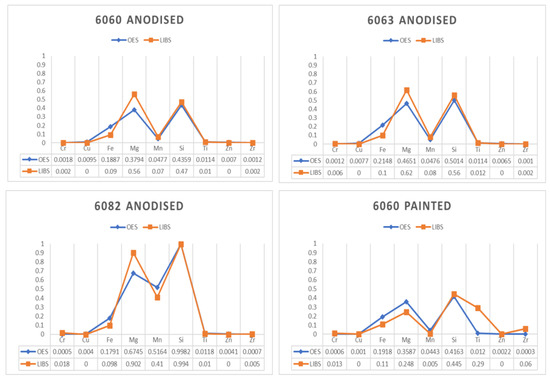
The LIBS trials conducted on process scrap obtained from the automotive parts manufacturer demonstrate that LIBS is capable of classifying 6xxx-oriented scrap with a practically relevant level of accuracy under industrial operating conditions. Among the evaluated batches, the anodized 6082 samples achieved 10 out of 10 correct classifications into the intended 6xxx program box, corresponding to an accuracy of 100%. The anodized 6060 and 6063 batches yielded 8 out of 10 and 6 out of 10 correct classifications, corresponding to accuracies of 80% and 60%, respectively. Similarly, the painted 6060 batch produced 6 out of 10 correct classifications, equivalent to an accuracy of 60%. This reduction in performance suggests that surface coatings adversely influence LIBS-based classification, which is consistent with previous studies on coated aluminium scrap [3,5,14].
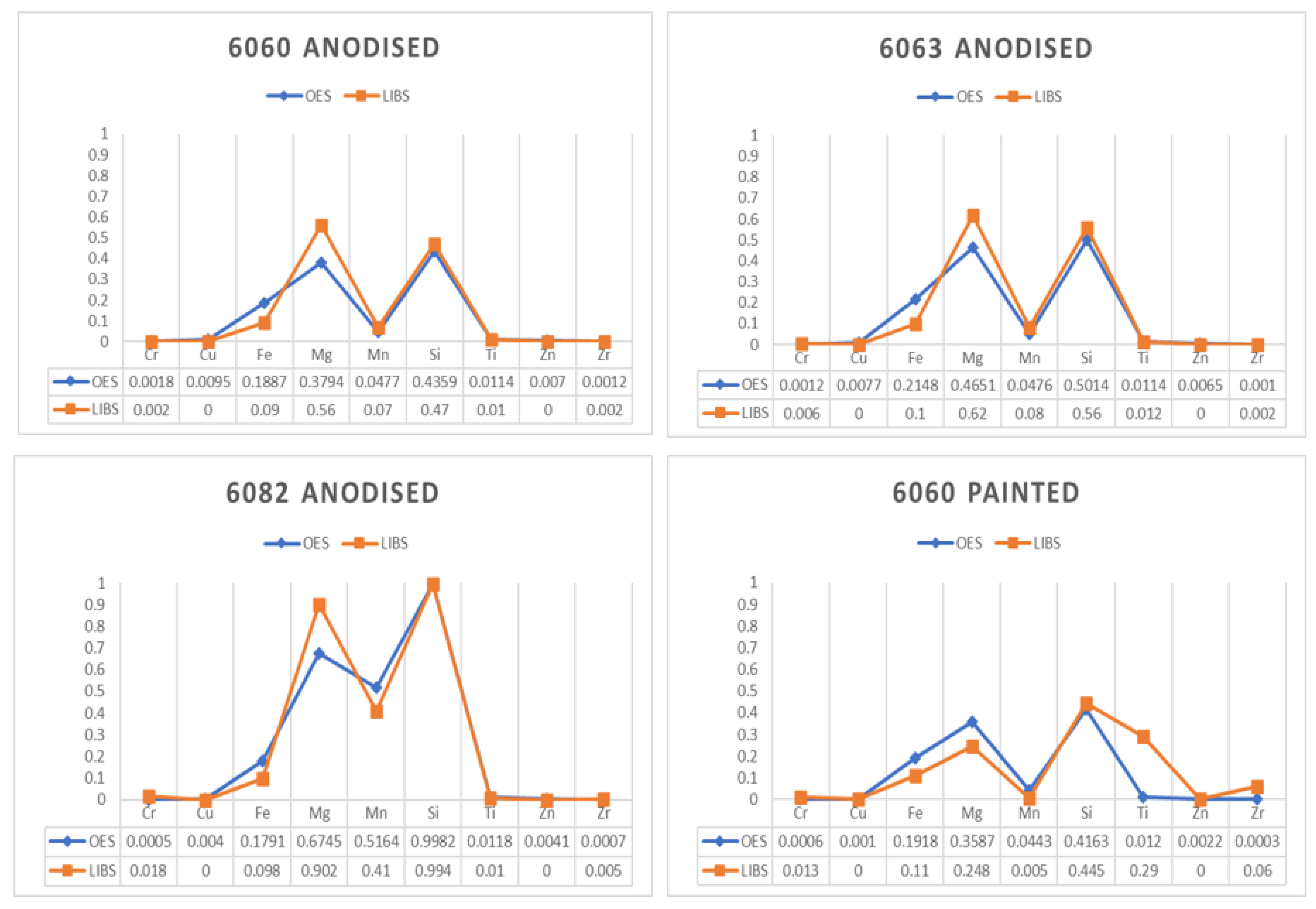
A comparison between LIBS measurements and optical emission spectroscopy (OES) results, as shown in Figure 1, revealed several systematic measurement deviations. Silicon was estimated by LIBS within relatively narrow deviations, which is particularly significant given that Si constitutes a key discriminating element between 5xxx and 6xxx series alloys [3]. In contrast, magnesium was generally overestimated by LIBS, except in the painted samples, whereas iron tended to be underestimated. Titanium exhibited a pronounced overestimation in painted samples, a trend that is consistent with the influence of coatings on plasma formation and spectral response reported in the literature [5,14]. These observations confirm that surface condition and coating characteristics must be explicitly considered in calibration procedures and, where necessary, in pre-treatment strategies.
Figure 1.
LIBS versus OES comparison for selected elements in anodized and painted samples.
The 1 t remelting validation batch processed at the Norwegian recycling facility, comprising 800 kg of LIBS-sorted 6xxx scrap and 200 kg of 5xxx scrap, produced a chemical composition of approximately 0.75 wt.% Si, 0.31 wt.% Fe, 0.076 wt.% Cu, 0.271 wt.% Mn, 1.53 wt.% Mg, 0.050 wt.% Cr, 0.004 wt.% Ni, 0.072 wt.% Zn, and 0.014 wt.% Ti, along with trace concentrations of other elements. These results indicate that the produced alloy composition falls within the acceptable compositional range for 6xxx-series wrought aluminium alloys [3]. Key alloying elements, particularly Si and Mg, were retained within ranges compatible with several 6xxx-series grades, while impurity concentrations such as Fe, Cu, and Zn remained within acceptable limits [2,3]. Collectively, these findings indicate that LIBS sorting possesses sufficient technical robustness to generate a remeltable 6xxx-oriented feedstock under realistic industrial constraints.
3.2. Environmental Performance
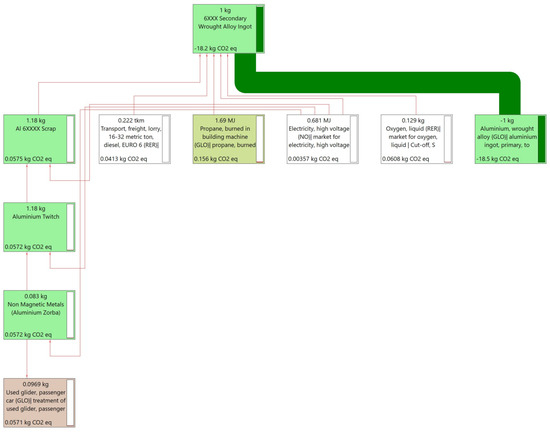
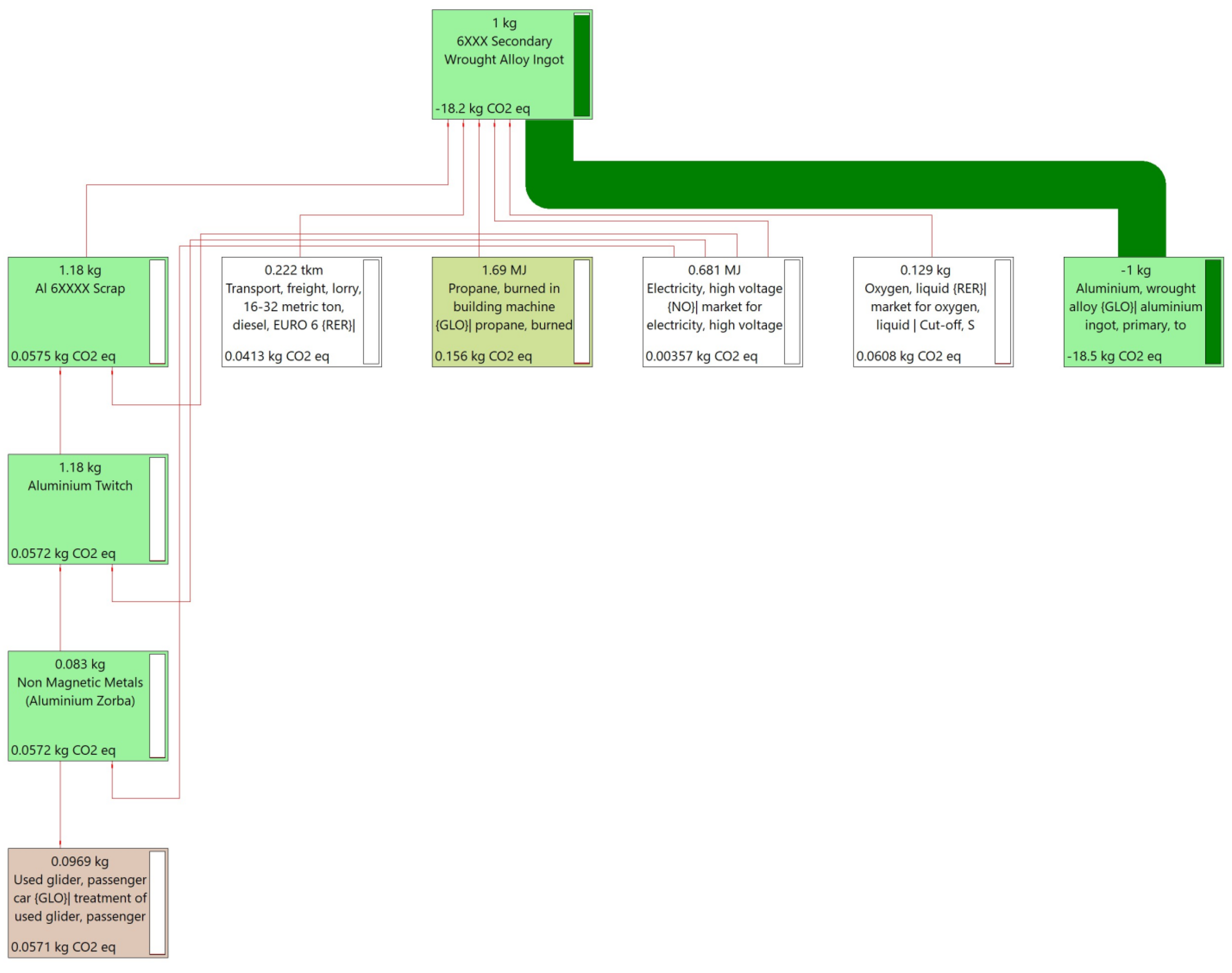
Figure 2 presents the contribution analysis of global warming potential for 1 kg of secondary 6xxx ingot produced via the modelled sorting and remelting route. The sorting chain demonstrates a comparatively low climate impact. For the modelled foreground system, the combined electricity consumption associated with the two XRT stages and the LIBS stage, including compressed-air requirements, results in climate impacts in the range of approximately 0.035–0.05 kg -eq per kilogram of sorted 6xxx product. This finding is consistent with recent studies on advanced aluminium sorting technologies, which indicate that the sorting stage contributes only a minor fraction of total environmental impacts when compared to downstream processes such as remelting and primary aluminium production [4,8].
Figure 2.
Contribution analysis of global warming potential for 1 kg secondary 6xxx ingot.
The predominance of hydropower in the Norwegian electricity mix further reduces the overall climate burden associated with sorting operations. The specific emission factor for Norwegian grid electricity is typically reported within the range of 15–25 g -eq/kWh [11,13]. Consequently, even when energy consumption reaches several tens of kWh per tonne of processed scrap, the resulting climate impacts per tonne remain relatively modest. For the modelled case, the combined climate impact of sorting and remelting is approximately 1.18 kg CO2-eq per kilogram of secondary 6xxx ingot, while the avoided burden from displacing primary wrought alloy production amounts to about −18.2 kg CO2-eq per kilogram.
3.3. Economic Implications
The economic viability of the proposed system is highly sensitive to plant utilization rates and the attainable price premium for 6xxx-series aluminium. Under the assumed operating conditions of 225 days per year and 15 h per day, in conjunction with the previously defined mass–balance relationships, the annual production of 6xxx material is estimated at approximately 767 t/year. To achieve recovery of a total investment of 100 MNOK within a five-year period, the system must generate an additional annual margin of approximately 20 MNOK relative to the baseline mixed-scrap processing route. This requirement corresponds to an effective price premium of around 50% above the mixed zorba scrap price for composition-controlled wrought aluminium under base-case conditions.
In practice, the realization of such a premium is contingent upon prevailing market conditions. When mixed aluminium scrap is priced significantly below primary aluminium or secondary billet, the required premium may only be attainable if end-users are willing to pay for composition-controlled wrought feedstock. Such feedstock can enable downstream manufacturers to reduce reliance on primary alloying additions and to lower their overall carbon footprint [9,12,14]. Conversely, under conditions of reduced market demand or lower plant utilization, the investment payback period may increase substantially.
These findings are consistent with recent market analyses, which highlight both the opportunities and risks faced by secondary aluminium producers as demand for low-carbon materials continues to evolve [9,14]. The results underscore that the economic feasibility of advanced sorting technologies is dependent not only on technical performance but also on the establishment of robust business models and stable off-take agreements capable of supporting a sustained price premium for sorted wrought aluminium products.
4. Conclusions
This study has examined the techno-economic and environmental feasibility of producing secondary wrought aluminium alloys from post-consumer scrap through an integrated processing chain comprising shredding, XRT, and LIBS within a Norwegian context. The principal findings are summarized as follows:
- LIBS-based sorting demonstrated high classification accuracy for clean anodized 6xxx-series process scrap, achieving up to 100% accuracy for 6082 alloys, and moderate accuracy for anodized and painted 6060/6063 samples. These results confirm the technical feasibility of LIBS sorting while highlighting the significant influence of surface coatings on classification performance.
- A 1 t validation melt, consisting of 800 kg of LIBS-sorted 6xxx material and 200 kg of 5xxx material, produced a chemical composition within a realistic 6xxx alloy range. This outcome indicates that the sorted material stream can serve as a viable wrought-oriented feedstock for remelting applications.
- The environmental impact of the sorting chain is relatively low, with climate impacts of approximately 0.05 kg -eq per kilogram of sorted 6xxx product under a hydropower-dominated Norwegian electricity mix. This contribution is minor compared with the impacts associated with remelting and primary aluminium production.
- The economic assessment suggests that achieving payback of a 100 MNOK investment within a five-year period requires both high utilization of the sorting infrastructure and the realization of a substantial price premium for composition-controlled 6xxx material relative to mixed scrap. This finding underscores the necessity of aligning technical advancements with an appropriate and sustainable business model.
Advanced multi-sensor sorting technologies exhibit considerable potential to support circular aluminium supply chains. However, the realization of this potential is contingent upon the effective integration of industrial process performance, environmental advantages, and favourable market conditions.
Author Contributions
Conceptualization, M.A.A., R.H. and G.R.; methodology, M.A.A. and R.H.; software, M.A.A.; validation, M.A.A., R.H. and G.R.; formal analysis, M.A.A.; investigation, M.A.A.; resources, R.H. and G.R.; data curation, M.A.A.; writing—original draft preparation, M.A.A.; writing—review and editing, M.A.A., R.H. and G.R.; visualization, M.A.A.; supervision, R.H. and G.R.; project administration, R.H. and G.R.; funding acquisition, R.H. and G.R. All authors have read and agreed to the published version of the manuscript.
Funding
This work was supported by the Norwegian Research Council through the KSP Aluminium Green Platform project (Project No. 328843).
Institutional Review Board Statement
Not applicable.
Informed Consent Statement
Not applicable.
Data Availability Statement
All data supporting the findings of this study has been included in the article.
Acknowledgments
The authors gratefully acknowledge Metallco Aluminium AS for providing access to operational infrastructure, scrap materials, and process data. The European automotive parts manufacturer Benteler Automotive is also acknowledged for supplying representative process scrap samples. In addition, the authors extend their appreciation to equipment suppliers and colleagues at the Norwegian University of Science and Technology (NTNU) for their technical support and valuable contributions. The authors used generative artificial intelligence tools (Perplexity, powered by GPT-5.1) solely to assist with language polishing and consistency checking during manuscript preparation. All technical content, data analysis, interpretations, and conclusions were developed and verified by the authors, who take full responsibility for the scientific integrity of the work.
Conflicts of Interest
The authors declare that they have no conflicts of interest.
References
- Akram, M.A.; Holthe, R.; Ringen, G. Rapid Sorting of Post-consumer Scrap Aluminium Alloys Based on Laser-Induced Breakdown Spectroscopy (LIBS). In Advances in Production Management Systems. Production Management Systems for Responsible Manufacturing, Service, and Logistics Futures; IFIP AICT; Springer: Cham, Switzerland, 2023; pp. 241–255. [Google Scholar] [CrossRef] [Scilit]
- Akram, M.A.; Dastgeer, G.; Ringen, G. Lifecycle Assessment of an Aluminium Crash Management System: Manufacturing Impact with Comparison between Open-Loop and Closed-Loop Recycling. Mater. Circ. Econ. 2026; in press. [CrossRef] [Scilit]
- Akram, M.A.; Holthe, R.; Ringen, G. Industrial Steinert LIBS-Based Sorting of Post-Consumer Wrought Aluminum Alloys for Automotive Applications. JOM 2026, 78, 6113–6127. [Google Scholar] [CrossRef] [Scilit]
- Liu, G.; Müller, D.B. Addressing sustainability in the aluminum industry: A critical review of life cycle assessments. J. Clean. Prod. 2012, 35, 108–117. [Google Scholar] [CrossRef] [Scilit]
- Díaz-Romero, D.; Van den Eynde, S.; Zaplana, I.; Zhou, C.; Sterkens, W.; Goedemé, T.; Peeters, J. Classification of aluminum scrap by laser induced breakdown spectroscopy (LIBS) and RGB + D image fusion using deep learning approaches. Resour. Conserv. Recycl. 2023, 190, 106865. [Google Scholar] [CrossRef] [Scilit]
- Efe, M.; Rohatgi, A.; Dai, Q.; Stapleton, B.; Rader, K.; Lipson, A.L.; Spangenberger, J.S. Alloy selective optical sorting of mixed post-consumer aluminum scrap streams. Resour. Conserv. Recycl. 2025, 223, 108500. [Google Scholar] [CrossRef] [Scilit]
- Siriro, W. Sustainability Assessment and Optimization of Aluminum Production for Electric Vehicle Manufacturing Using Life Cycle Assessment and Predictive Modeling. Master’s Thesis, Politecnico di Torino, Turin, Italy, 2025. [Google Scholar]
- Wernet, G.; Bauer, C.; Steubing, B.; Reinhard, J.; Moreno-Ruiz, E.; Weidema, B. The ecoinvent database version 3 (part I): Overview and methodology. Int. J. Life Cycle Assess. 2016, 21, 1218–1230. [Google Scholar] [CrossRef] [Scilit]
- Chen, X.; Saada, M.B.; Lavisse, B.; Ammar, A. Recent advances in the remelting process for recycling aluminium alloy chips: A critical review. Int. J. Mater. Form. 2025, 18, 42. [Google Scholar] [CrossRef] [Scilit]
- Barros, M.V.; Salvador, R.; Piekarski, C.M.; de Francisco, A.C.; Freire, F.M.C.S. Life cycle assessment of electricity generation: A review of the characteristics of existing literature. Int. J. Life Cycle Assess. 2020, 25, 36–54. [Google Scholar] [CrossRef] [Scilit]
- Jorge, R.S.; Hertwich, E.G. Environmental evaluation of power transmission in Norway. Appl. Energy 2013, 101, 513–520. [Google Scholar] [CrossRef] [Scilit]
- Metallco Aluminium AS. Metallco Invests 100 Million NOK in the Circular Economy at Øra. NCCE News, 6 December 2023. Available online: https://ncce.no/en/metallco-investerer-100-millioner-i-sirkulaerokonomien-pa-ora-2/ (accessed on 5 June 2026).
- Anna, N.; Camil, T.; Constantin, I.; Doina, R.; Violeta, M.L. Recycled versus primary aluminum in European automotive industry: Trends, challenges, and opportunities. Recycling 2026, 11, 19. [Google Scholar] [CrossRef] [Scilit]
- Bernat, Ł.; Jurtsch, T.; Moryson, G.; Moryson, J.; Wiczyński, G. Effect of surface condition on the results of chemical composition measurements of scrap copper alloys. Recycling 2024, 9, 14. [Google Scholar] [CrossRef] [Scilit]

Disclaimer/Publisher’s Note: The statements, opinions and data contained in all publications are solely those of the individual author(s) and contributor(s) and not of MDPI and/or the editor(s). MDPI and/or the editor(s) disclaim responsibility for any injury to people or property resulting from any ideas, methods, instructions or products referred to in the content. |
© 2026 by the authors. Licensee MDPI, Basel, Switzerland. This article is an open access article distributed under the terms and conditions of the Creative Commons Attribution (CC BY) license.