


Abstract
This paper aims to provide a numerical estimate of the capacity of a battery in a photovoltaic system. The battery’s capacity is calculated numerically based on the current operating state of the load in the grid. This evaluation can help designers to use the appropriate battery capacity. In the case of a large capacity, part of the battery will not be used, which reduces the efficiency of the photovoltaic design and operations. A low battery capacity will limit the operational use of the photovoltaic system. An analytical assessment and recommendations for the battery condition are provided using real data from the operation of the photovoltaic system.
1. Introduction
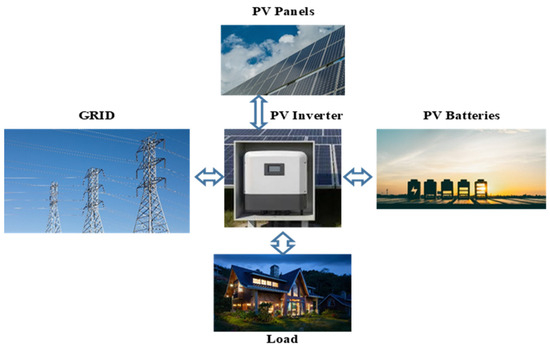
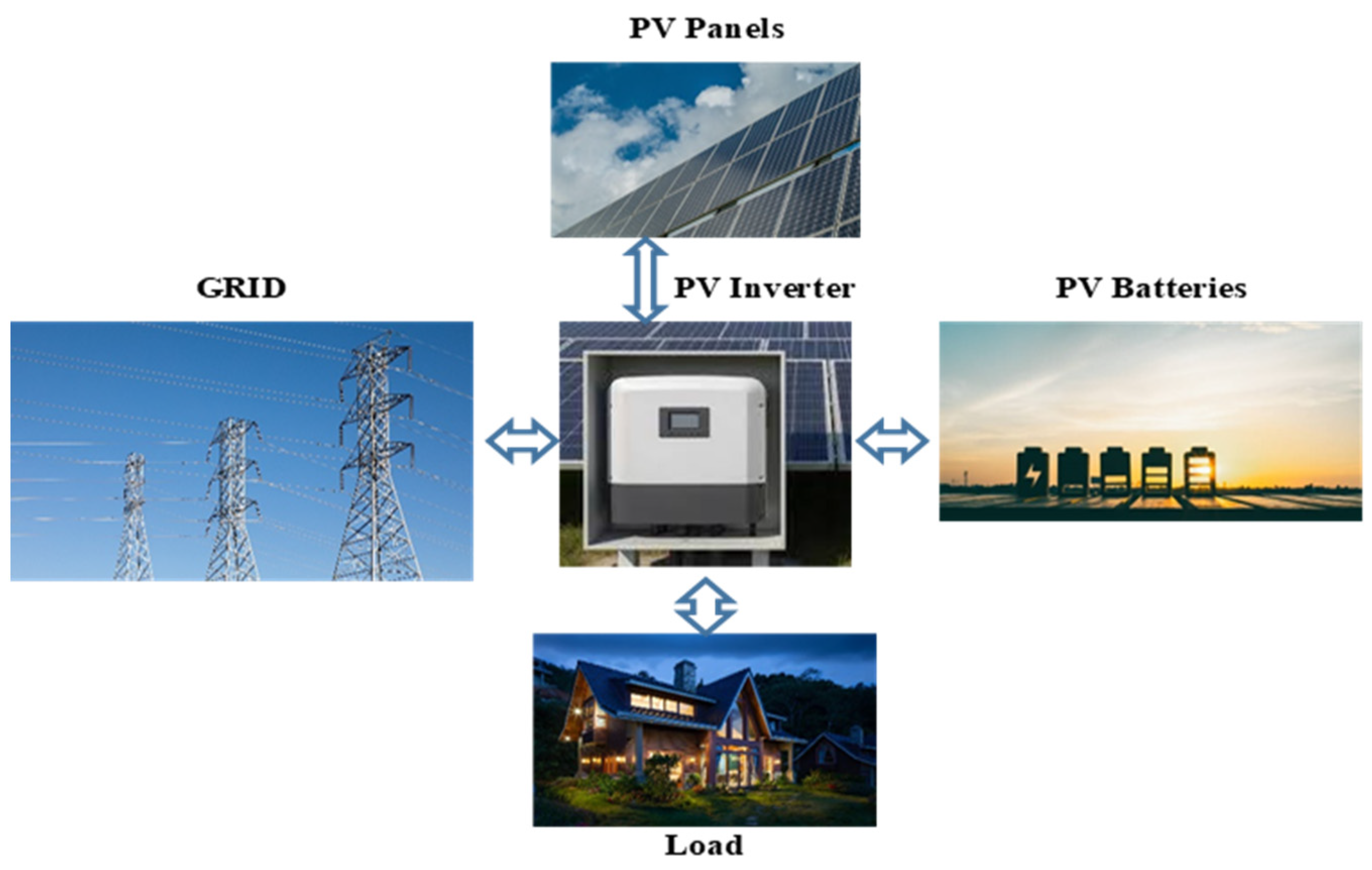
Currently, there is a trend towards wider implementation and exploitation of photovoltaic systems. The benefit of their practical application comes from the technological requirements for obtaining sustainable and “green” energy. Photovoltaic systems transform free resources from solar radiation, which accounts for a major portion of the cost of the energy produced. Furthermore, this production is not associated with harmful emissions that harm human health and the environment. The need for low-cost production and clean technologies without an ecological footprint has led to the widespread use of photovoltaic systems [1]. From an operational point of view, photovoltaic systems are classified into two categories: stand-alone and grid-connected [2]. A photovoltaic system contains well-defined components, which can briefly be summarized as solar panels, an inverter, and a battery (Figure 1). The role of the battery gives the user a certain degree of independence, both from changes in solar radiation and from changes in consumption and power supply from the grid [3]. The technological behavior of the battery allows it to operate in two ways: as an energy generator for the grid and supporting the load, and as a consumer of electricity from the grid as an additional load. Therefore, the battery has two dynamic states of use: charging and discharging its capacity [4]. The dual function of the battery makes it important to design its capacity in relation to load conditions, photovoltaic generation, and grid requirements. A low battery capacity will have a negligible effect on the load and grid maintenance needs. Alternatively, a high battery capacity can remain unused and increase the cost of the photovoltaic system. Analytical relations for formalizing the processes in a battery can be found in [5]. Since, in [6], there are logical dependencies for describing the nature of battery-related processes, neural networks have been applied for their formalization. In [7], discrete evaluations of battery behavior in discrete time in a MATLAB (R2015a) environment are applied. In [3], the optimization is aimed at attaining optimal battery energy storage planning for a grid-connected photovoltaic system. The optimization is aimed at minimizing the energy costs associated with the cost of the battery and its safe state during operation. These are contradicting requirements since energy costs can decrease with a high battery capacity. However, to extend its life, the storage process must be low-current, which increases storage time, and this is not acceptable for the load and the grid.
Figure 1.
Block diagram of a photovoltaic system.
In this paper, battery capacity is considered an important parameter. For its evaluation and assessment, formal modeling of battery-charging processes is applied. The behavior of the load and the grid is assumed to be real data for a specific organization that supports the welfare of wild animals and birds. The goal of implementing a photovoltaic system for this organization is to reduce the cost of electricity that the organization uses to power refrigerators for storing food for wild birds and other animals. The resulting formal model provides relationships between the required load, photovoltaic production, and technological constraints for charging the batteries. This dependence allows the estimation of the optimal value of battery capacity according to the defined constraints. This paper mainly presents dependences for battery charging, since, in this case, the battery is an additional load for the grid, and reducing this addition is beneficial for the user load.
2. Materials and Methods
To formally describe the battery-charging process, we use the battery parameter “Charge and Discharge Rate” defined in [8]. This rate is related to the amount of energy used to charge or discharge the battery. Assuming that the maximum battery capacity is denoted by , the charging volume in hours (h) is the multiplication
where the charging rate per hour (h) varies between 0 and 1:
Considering the power balance in Figure 1, the following analytical relationship is applied:
where is the power of the load consumed by the users, in watts [W];
is the photovoltaic production in [W];
is battery-charging power, [W];
is the power balance taken from the grid;
h is the time period for the power balance.
These parameters are time-dependent. But for the period of one hour, they are assumed to be constant with their corresponding values.
The relationship between the power produced and energy is expressed as follows:
where is the energy stored in the battery for a period of time h.
In this study, we use h = 1 [hour]. This allows us to modify (3) as follows:
Relation (5) allows for estimating the battery capacity for given power requirements for the grid the required power of the consumer , and the power of photovoltaic production . These values are a reference for a suitable time period of 1 h. The unknown value of the charging rate v(h) must be derived from additional constraints. In the present case, considerations for healthy battery operation are taken into account. From (5), the charging rate must be as follows:
We will look at a healthy mode of operation for charging the battery. This is achieved by reducing the charging current delivered to the battery. This reduction allows more time to charge the battery, and the consequence is that battery life is preserved for a longer time. The energy capacity of the battery required for it to charge to its maximum value is estimated by the ratio
where is the voltage between the output nodes of the battery and the load applied to them, is the manufacturer’s recommended maximum value of the charge/discharge current, and is the time in hours [h] required for a full discharge of the battery.
Since we are considering the charging rate for one hour, the charging energy for one hour must obey Equation (7) or
For Relation (8), the time taken to fully discharge the battery depends on the current load on the battery. An analytical estimate of this time can be expressed as follows:
where the coefficient takes into account the efficiency of the inverter during charging and discharging, as well as the operations.
Substituting (9) into (8) gives the dependence of the charging rate on the current load or
Relations (6) and (10) dictate that the loading rate satisfies two constraints simultaneously. We assume that these constraints must have a common upper bound. This assumption is based on the notion that both constraints apply to the same battery. Furthermore, they are based on different energy parameters, which must correspond to a common battery parameter. Assuming there is equality between the right-hand sides of Constraints (6) and (10), this gives
By rearranging the ratio (11) to the battery capacity its maximum capacity can be recommended:
Relation (12) recommends the selection of the battery capacity of a photovoltaic system, taking into account the load power that the photovoltaic system must cover, the power produced by the photovoltaic system , and the efficiency of the charging and operating inverter . Relation (12) also takes into account the parameters for healthy battery charging .
3. Result and Discussion
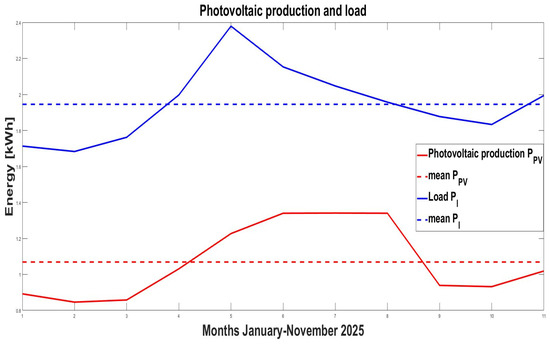
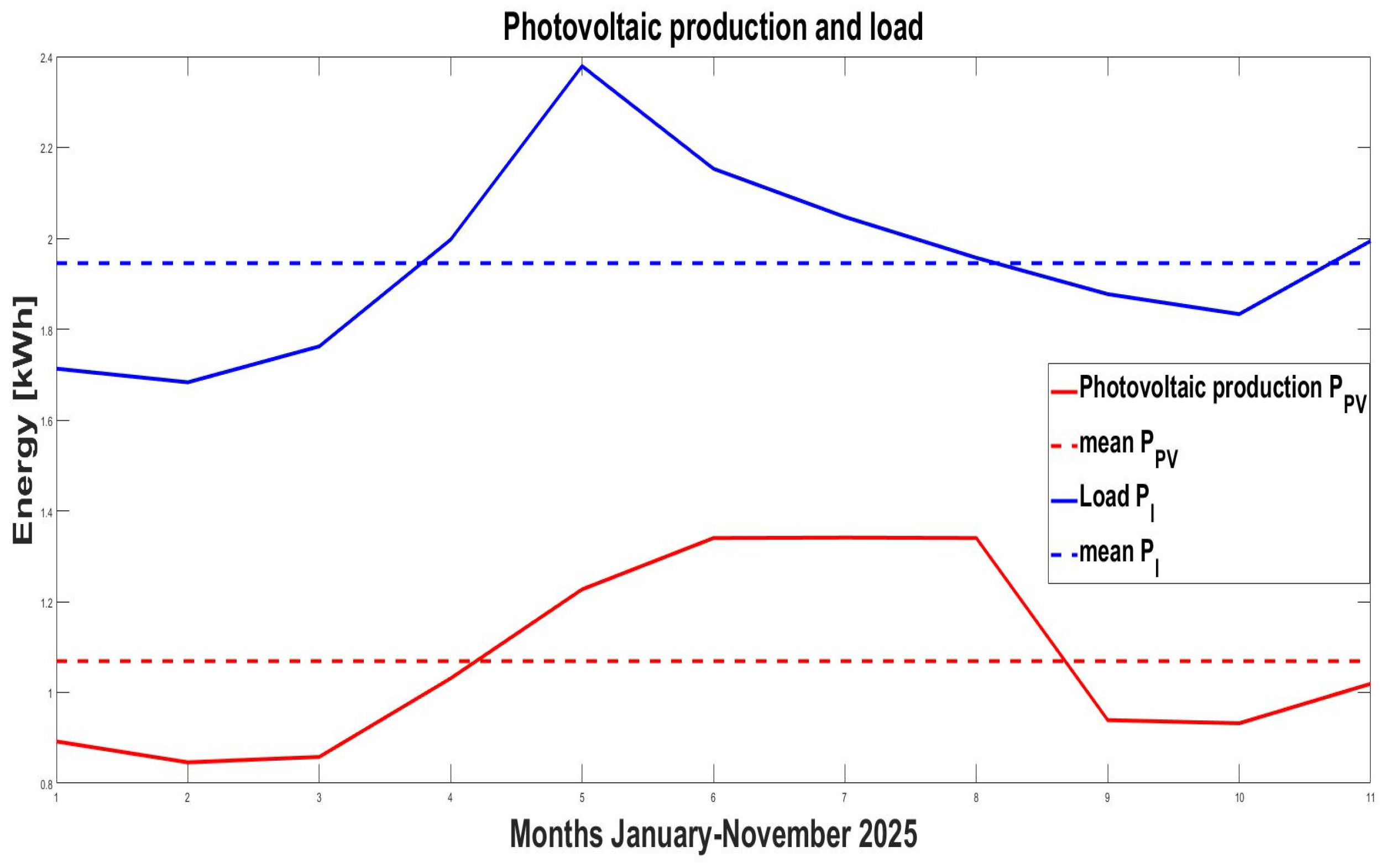
The resulting analytical relationship is applied to estimate the maximum battery capacity recommended according to Relationship (12), taking into account the load power, photovoltaic generation power, and healthy battery-charging requirements. Here are the operating data of a working photovoltaic system. The system data was taken from the inverter for the period from 1 to 11 August for the load Pl and the production PPV per day. The numerical data are given in Table 1 and graphically presented in Figure 2.
Table 1.
Production and load data of the photovoltaic system (1–11 August 2025).
Figure 2.
Graphical presentation of the load and production of the photovoltaic system.
The battery capacity is estimated with the corresponding average data:
mean() = 1.069 [kW], mean() = 1.945 [kW], , the save charge/discharge current , and the voltage between the battery nodes .
The recommended maximum battery capacity is E_bmax = 3.547 [kW]. Considering the available business- and technology-supported solutions, the battery capacity can be set to Ebmax = 4 [kW].
Therefore, the analytical estimates made using Equation (12) recommend the battery capacity that can be considered during the design stage of the photovoltaic system and its use in a predetermined energy load condition. The correct implementation decision is usually influenced by the batteries available on the market and their technological parameters for charging and discharging. The obtained relationship can prove that the high-capacity battery in question will not work effectively in the case of low solar irradiation, so a higher average photovoltaic production level of cannot be achieved. The same is true for the lower power consumption . In the opposite case, i.e., higher and the battery capacity should be increased, which will be beneficial for the use of green energy.
4. Conclusions
This study derives an analytical relationship for recommending the maximum battery capacity in a photovoltaic system. The battery capacity is evaluated according to the energy load Pl, that the photovoltaic system must support. The energy generation capacity of the photovoltaic system is also taken into account by the design and operational requirements, which take into account technological and environmental requirements. These operational parameters are taken into account when recommending the maximum battery capacity. The resulting analytical dependence allows one to easily, without computational overload, estimate the appropriate value of the maximum battery capacity. A potential extension of this result could be to increase the rate of healthy charging and discharging of batteries. This could benefit photovoltaic power generation and reduce the share of electricity drawn from the grid.
Author Contributions
Conceptualization, T.S.; methodology, T.S.; software, K.S.; formal analysis, T.S. and K.S.; writing—original draft preparation, T.S. and K.S.; writing—review and editing and supervision, T.S. and K.S. All authors have read and agreed to the published version of the manuscript.
Funding
This research received funding from contract number BG-RRP-2.017-0031-C01, “Research and development of a smart Energy system for eco-charging of electric vehicles, using renewable energy sources”–RENEW and Clean Technologies “Mechatronics, Innovation, Robotics, Automation and Clean Technologies”—MIRACle, with the financial support of contract No. BG16RFPR002-1.014-0019-C01, funded by the European Regional Development Fund (ERDF) through the Program “Research, Innovation and Digitalization for Smart Transformation” (PRIDST) 2021–2027.
Institutional Review Board Statement
Not applicable.
Informed Consent Statement
Not applicable.
Data Availability Statement
Data is contained within the article.
Conflicts of Interest
The authors declare no conflicts of interest.
References
- Osman, M.G.; Lazaroiu, G.; Hamad, S.A.; Messaoud, H.; Mohammed, D.; Stoica, D. Analysis of Photovoltaic Systems with Battery Storage, Electric Vehicle Charging, and Smart Energy Management. Sustainability 2025, 17, 3887. [Google Scholar] [CrossRef] [Scilit]
- Baharudin, N.H.; Mansur, T.M.N.T.; Hamid, F.A.; Ali, R.; Misrun, M.I. Topologies of DC-DC Converter in Solar PV Applications. Indones. J. Electr. Eng. Comput. Sci. 2017, 8, 368–374. [Google Scholar] [CrossRef] [Scilit]
- Bhoi, S.K.; Nayak, M.R. Optimal scheduling of battery storage with grid tied PV systems for trade-off between consumer energy cost and storage health. Microprocess. Microsyst. 2020, 79, 103274. [Google Scholar] [CrossRef] [Scilit]
- Bonkoungou, D.; Beramgoto, T.; Koalaga, Z.; Zougmoré, F. Modeling, Simulation and Experimental Analysis of a Photovoltaic PV/Battery Power System. Int. J. Renew. Energy Res. 2016, 2, 37–47. [Google Scholar] [CrossRef] [Scilit]
- Kapoor, A.; Sharma, A. Optimal Charge/Discharge Scheduling of Battery Storage Interconnected with Residential PV System. IEEE Syst. J. 2019, 14, 3825–3835. [Google Scholar] [CrossRef] [Scilit]
- Ezzitouni, J.; Mouhsen, A.; Mohammed, L.; Ayoub, K. Management of battery charging and discharging in a photovoltaic system with variable power demand using artificial neural networks. E3S Web Conf. 2021, 297, 01037. [Google Scholar] [CrossRef] [Scilit]
- Nicola, A.; Vitan, C.; Aron, C.; Matei, D.; Grecea, I. Study of photovoltaic systems using modelling and simulation. MATEC Web Conf. 2021, 342, 03007. [Google Scholar] [CrossRef] [Scilit]
- A Guide to Understanding Battery Specifications. MIT Electric Vehicle Team, December 2008. Available online: https://web.mit.edu/evt/summary_battery_specifications.pdf (accessed on 14 July 2026).

Disclaimer/Publisher’s Note: The statements, opinions and data contained in all publications are solely those of the individual author(s) and contributor(s) and not of MDPI and/or the editor(s). MDPI and/or the editor(s) disclaim responsibility for any injury to people or property resulting from any ideas, methods, instructions or products referred to in the content. |
© 2026 by the authors. Licensee MDPI, Basel, Switzerland. This article is an open access article distributed under the terms and conditions of the Creative Commons Attribution (CC BY) license.