


Abstract
This paper reports a documentary analysis and applied methodological modeling study on electromagnetic compatibility (EMC) management in medical institutions in the Republic of Moldova. The analysis integrates strategic health and energy documents, the European regulatory framework, and literature on clinically relevant electromagnetic interference (EMI). The main scientific result is the formalization of the six-step Site-EMC framework; the applied result is an auditable pathway for assessment, control, and governance. No original in situ measurements are claimed; instead, a reproducible protocol for pilot validation is proposed.
1. Introduction
In medical institutions, electromagnetic compatibility (EMC) is not merely a product-level property. It is a prerequisite for the safe operation of a technical ecosystem in which sensitive biomedical devices coexist with wired and wireless networks, clinical information systems, the Internet of Things (IoT), uninterruptible power supplies (UPS), and power electronics. In such environments, electromagnetic interference (EMI) may affect patient monitoring, telemetry, data exchange, and service continuity.
In the Republic of Moldova, this issue must be considered alongside healthcare digitalization and energy modernization [1]. The National Program for Digitalization and Innovation in Health introduces the Electronic Health Record (EHR; Romanian: Dosarul Electronic de Sănătate, DES) as the secure data core and promotes the HL7 FHIR standard developed by Health Level Seven International for interoperable data exchange [2]. In parallel, energy documents discuss architectures such as the Advanced Distribution Management System (ADMS), Head-End System (HES), and interoperable Geographic Information System (GIS) [3]. Directive 2014/30/EU, IEC 60601-1-2, and Regulation (EU) 2017/745 provide the compliance framework [4,5,6], but they do not replace site-level EMC assessment. This paper explains why EMC must be treated as a system-level issue and formalizes the authors’ proposed Site-EMC framework.
2. Materials and Methods
This paper uses integrated documentary analysis and applied methodological modeling. The corpus included strategic health and energy documents [1,2,3], the European framework on EMC and medical devices [4,5,6], and studies on clinically relevant EMI and in situ EMC testing [7,8]. The analysis extracted quantitative indicators, mapped the source-coupling path-receptor-critical function relationship, and defined auditable deliverables for implementation, verification, and governance. Results are presented as evidence, interpretation, and implications.
3. Results and Discussion
3.1. Results of the Documentary Analysis and Literature Synthesis
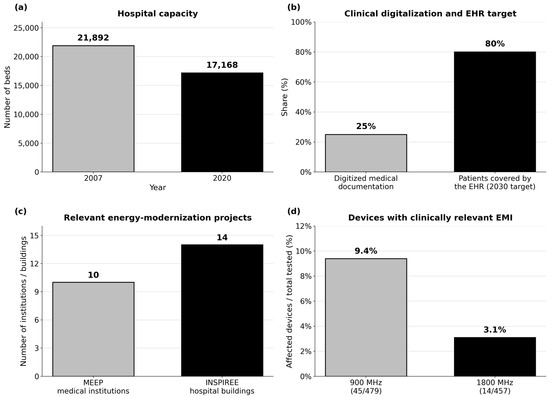
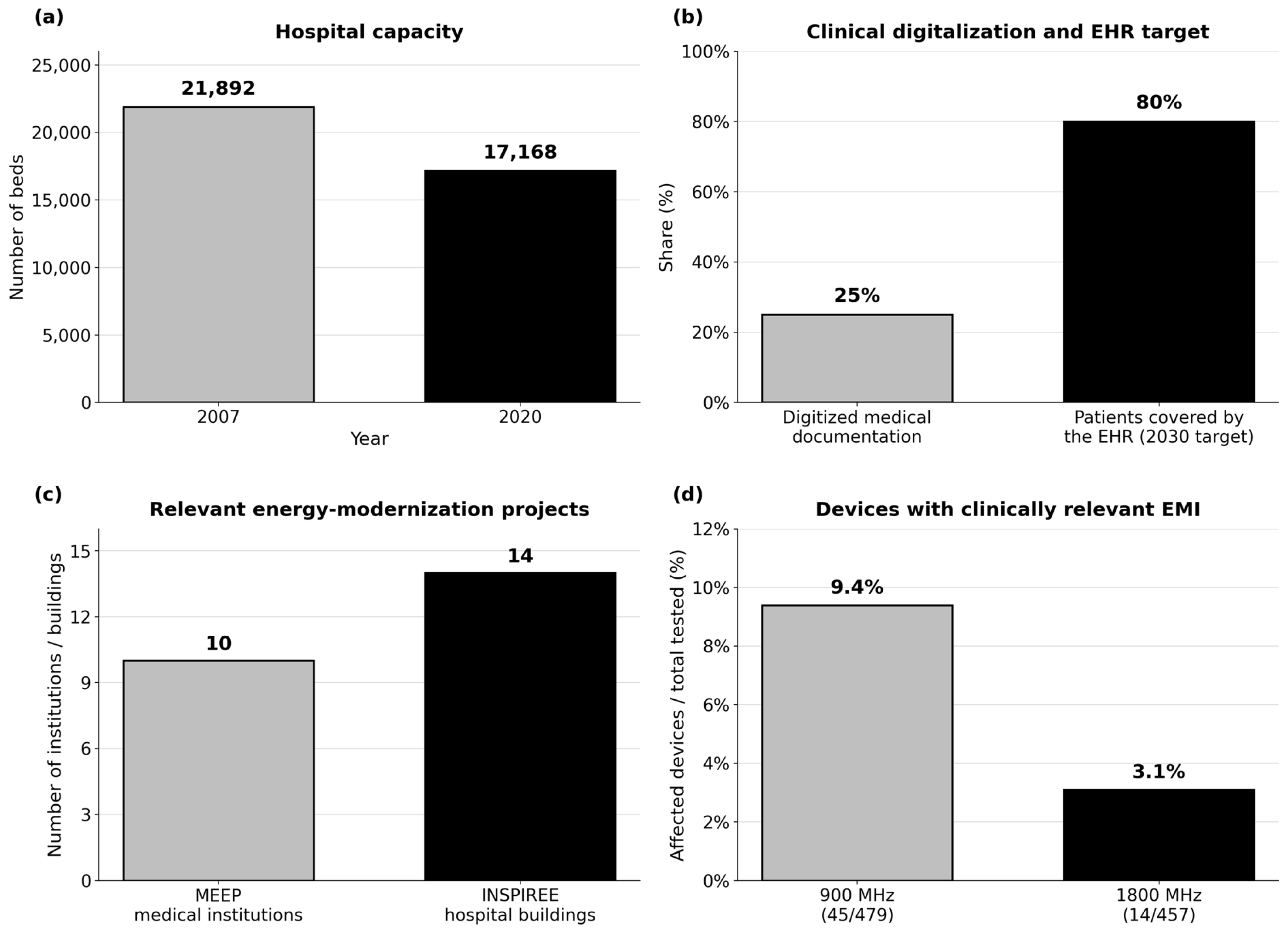
The documentary analysis reveals three EMC-relevant trends. First, hospital infrastructure is being reconfigured: the number of hospital beds fell from 21,892 in 2007 to 17,168 in 2020 [1]. Second, clinical digitalization remains incomplete: only 25% of medical documentation is fully digitized, whereas the program’s target is EHR-based management of the minimum data set for 80% of patients interacting with the public system [2]. Third, energy modernization is advancing: the Energy Efficiency in the Republic of Moldova Project (MEEP) covers 10 medical institutions, while the Initiative for Sustainable Public Infrastructure Development through Energy Efficiency Renovations (INSPIREE) covers 14 district-hospital buildings [3].
Several recurrent hospital situations highlight the need for a site-level EMC framework. In intensive care units, patient monitors, ventilators, infusion pumps, telemetry modules, mobile terminals, and Wi-Fi gateways coexist at short distances. In this context, the relevant issue is not only the presence of electromagnetic fields but also the possible degradation of monitoring, alarm transmission, or device-to-device communication. In operating rooms, electrosurgical units, anesthesia workstations, patient monitors, and dense cable bundles create a high-intensity source-victim environment in which both radiated and conducted coupling can produce artifacts, nuisance alarms, or temporary functional degradation. In medical imaging areas and adjacent technical rooms, high-power equipment, shielded rooms, auxiliary information-technology systems, and grounding/ equipotential-bonding interfaces make cable routing, circuit separation, and infrastructure organization particularly important. Finally, hospital energy infrastructures, especially UPSs, converters, and transfer-switching arrangements, may introduce conducted disturbances or transient events capable of affecting critical clinical loads. These heterogeneous situations show why EMC in hospitals cannot be reduced to individual device compliance and instead requires a structured institution-level methodology.
The literature synthesis confirms the existence of clinically relevant EMI: the systematic review by Lawrentschuk and Bolton reports EMI in 45 of 479 devices tested at 900 MHz and in 14 of 457 devices tested at 1800 MHz [7]. Seidman and Guag further show the usefulness of ad hoc, on-site EMC testing for non-implantable medical devices [8].
3.2. Normative Implications and Regulatory Boundaries
The data in Figure 1 should be interpreted together with the regulatory framework. Directive 2014/30/EU requires limitation of emissions and an adequate level of immunity, IEC 60601-1-2 details EMC requirements for medical electrical equipment, and Regulation (EU) 2017/745 requires reduction in risks associated with electromagnetic disturbances [4,5,6]. More broadly, recent concerns regarding metrological traceability in medical devices also reinforce the need for documented verification, auditable controls, and robust technical governance in hospital technology management [9]. In addition, NIS2 and the Critical Entities Resilience (CER) Directive emphasize obligations related to risk management and operational continuity [10,11]. EMC can therefore no longer be treated separately from procurement, maintenance, cybersecurity, and change management.
Figure 1.
Quantitative indicators supporting the relevance of the electromagnetic compatibility problem in medical institutions [1,2,3,7]: (a) hospital capacity expressed as number of beds; (b) current level of clinical digitalization and the target coverage by the Electronic Health Record (EHR); (c) relevant energy-modernization projects with potential impact on the electromagnetic infrastructure, including the Energy Efficiency in the Republic of Moldova Project (MEEP) and the Initiative for Sustainable Public Infrastructure Development through Energy Efficiency Renovations (INSPIREE); (d) share of devices reported with clinically relevant electromagnetic interference in the literature.
3.3. The Site-EMC Methodological Framework
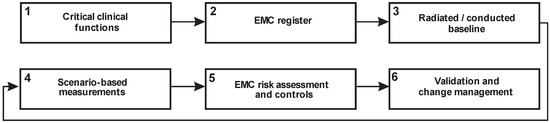
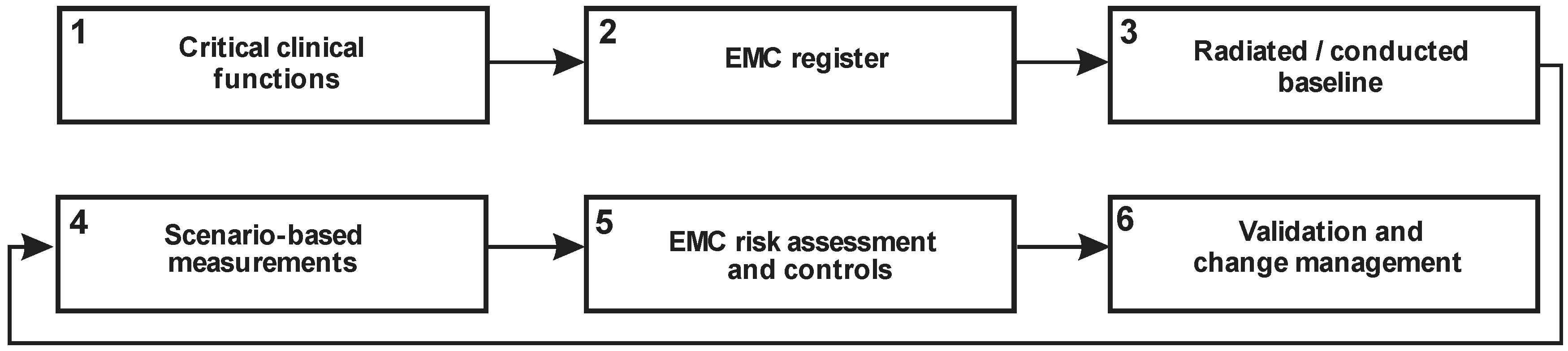
The main methodological result of the paper is the formalization of the Site-EMC framework, shown in Figure 2. It treats electromagnetic compatibility as an emergent property of the entire hospital site, shaped by the coexistence of sensitive medical equipment, energy infrastructure, and digital and telecommunications infrastructure.
Figure 2.
Site-EMC conceptual framework.
The order of the six steps is intentional and follows a dependency logic rather than a merely descriptive sequence. Step 1 defines the clinical functions that must be protected. Without this anchor, subsequent measurements may be physically correct but clinically irrelevant. Step 2 establishes the real boundaries of the source-coupling path-receptor system. Without it, the EMC register, the baseline, and the test scenarios would remain incomplete. Step 3 provides the reference state of the electromagnetic environment and infrastructure against which abnormal events and post-intervention improvements can be interpreted. Step 4 then follows logically, because scenario-oriented measurements require prior knowledge of where and when EMC stress is most likely to occur. Step 5 transforms the evidence obtained into risk assessment and control measures, so that prioritization is data-driven rather than hypothetical. Step 6 is placed last because validation, monitoring, and integration into institutional governance become meaningful only after interventions have been defined and implemented. Overall, the proposed sequence moves from clinical relevance to system characterization, then to evidence acquisition, risk-informed intervention, and finally institutional governance.
In such an environment, individual device conformity does not by itself guarantee safe operation under real-use conditions; therefore, the methodology follows a reproducible workflow from the definition of critical clinical functions to risk control through measurement, intervention, and continuous governance. Step 1: Definition of scope and critical clinical functions. The process begins with explicit delimitation of the spaces and services where EMI/EMC effects may become clinically and operationally relevant. A realistic initial scope is recommended, usually a high-criticality area—such as the intensive care unit (ICU), operating room, or medical imaging—or a complete clinical pathway. At this stage, “unacceptable degradation” is defined in measurable terms. Step 2 inventories the institution’s actual electromagnetic ecosystem. Potential disturbance sources, susceptible receptors, and the coupling paths between them are documented; the output is the EMC register.
Step 3 establishes the baseline of the electromagnetic environment and infrastructure. It has two complementary dimensions: the radiated component, relevant to wireless coexistence, and the conducted component, relevant in the presence of nonlinear loads, power electronics, and power-continuity systems. The baseline is not treated as a laboratory exercise, but as a characterization of the actual state of the site. Step 4 is a scenario-based measurement and operational-testing campaign. Measurements are not simple point readings; they are correlated with real operating scenarios, such as UPS switching events, start-up and shutdown of power loads, wireless-traffic peaks, network reconfiguration, or intensive simultaneous equipment use. A distinctive feature of the method is correlation with operational data, such as energy and network logs.
Step 5 transforms the data obtained into an EMC risk assessment applied to critical clinical functions. Each scenario is assessed according to probability and consequence severity, and control measures are designed in proportion to risk priority and implementation feasibility. The methodology balances technical interventions—route separation, grounding improvement, filtering, cable management, radio-infrastructure configuration, and coupling reduction—with organizational interventions, such as rules for wireless-device use in sensitive areas, installation and maintenance procedures, explicit EMC requirements in procurement, and clear responsibilities. Step 6 ensures validation, continuous monitoring, and integration of EMC into institutional governance.
To anchor the methodological framework in the operational reality of the hospital, Table 1 summarizes the main equipment categories, the dominant EMC exposures, and their potential consequences for clinical functions.
Table 1.
Representative hospital equipment categories and EMC-related operational risks.
The operational result of the framework is illustrated in Table 2, which synthesizes prototypical scenarios derived from the source-coupling path-receptor-critical function relationship. These are not exhaustive experimental results, but an analytical model supporting managerial decision-making.
Table 2.
Illustrative EMC risk matrix.
Operationally, EMC control must be integrated with procurement, installation, maintenance, cybersecurity, and operational-continuity procedures. This is precisely where the convergence with NIS2 and CER becomes relevant: EMC is no longer an isolated technical detail, but a component of technological-risk governance [10,11].
Implementation of the framework is envisaged as a staged pilot process. First, the institution appoints a multidisciplinary EMC team composed of biomedical engineering, electrical maintenance, information-technology and network administration, a clinical representative from the pilot area, and a risk-management representative. Second, one high-criticality area, such as the ICU or operating room, is selected as the initial scope, and the EMC register and local baseline characterization are produced for that area. Third, scenario-based measurements are conducted both during ordinary operation and under controlled conditions, such as UPS switching events, wireless-traffic peaks, or post-installation conditions after the introduction of new equipment. Fourth, the identified risks are prioritized and matched with corrective actions, after which post-intervention verification is performed. Finally, the same workflow is embedded into the institution’s procurement, installation, maintenance, and change-management procedures, so that any major modification of the medical, information-technology, or power infrastructure triggers an EMC review. The implementation outputs are the EMC register, the local baseline report, the prioritized risk matrix, the mitigation plan, and the post-intervention verification report. This staged approach is designed to be scalable from one pilot area to the whole institution.
4. Conclusions
The study shows, through documentary analysis and the construction of an applicable methodological framework, that EMC management in medical institutions must be approached as a system-level problem rather than as an isolated property of individual devices. The relevance of this conclusion increases in the context of the accelerating digitalization of critical infrastructures and energy modernization [1,2,3].
The main scientific result of the paper is the formalization of the six-step Site-EMC framework, which operationalizes the relationship among sources, coupling paths, receptors, and critical clinical functions and turns a topic often treated only normatively into a reproducible, evidence-based process. Practically, the paper argues for an internal EMC-management mechanism with clear responsibilities, EMC requirements in procurement, post-intervention verification, and periodic auditing.
The main limitation of the study is the absence of an original in situ measurement campaign. The next research stage should validate the framework through pilot projects in one or two medical institutions, with scenario-oriented measurements correlated with information-technology and energy logs, so that local thresholds and the effectiveness of mitigation measures can be calibrated empirically and later replicated at a larger scale.
Author Contributions
Conceptualization, A.C. and M.B.; methodology, A.C.; software, A.C.; validation, A.C., M.B. and A.B.; formal analysis, A.C. and A.B.; investigation, A.C.; resources, M.B. and A.B.; data curation, A.C.; writing—original draft preparation, A.C.; writing—review and editing, A.C., M.B. and A.B.; visualization, A.C.; supervision, M.B. and A.B.; project administration, A.C. All authors have read and agreed to the published version of the manuscript.
Funding
This research received no external funding. The APC was funded by the authors.
Institutional Review Board Statement
Not applicable.
Informed Consent Statement
Not applicable.
Data Availability Statement
No new datasets were generated during this study. The public documents and literature data supporting the reported results are available in the cited references.
Acknowledgments
During the preparation of this manuscript, the authors used OpenAI’s ChatGPT (GPT-5.5 Pro) solely for English-language editing and terminology consistency checking. The authors reviewed and edited all outputs and take full responsibility for the content of this publication.
Conflicts of Interest
The authors declare no conflict of interest.
References
- Government of the Republic of Moldova. National Health Strategy “Health 2030”. Government Decision No. 387/2023; (In Romanian). Available online: https://www.legis.md/cautare/getResults?doc_id=138493&lang=ro (accessed on 26 April 2026).
- Government of the Republic of Moldova. National Program for Digitalization and Innovation in Health 2025–2030. Government Decision No. 556/2025; (In Romanian). Available online: https://www.legis.md/cautare/getResults?doc_id=150979&lang=ro (accessed on 26 April 2026).
- Ministry of Energy of the Republic of Moldova. Energy Strategy of the Republic of Moldova 2025–2050; draft; 2025; (In Romanian). Available online: https://gov.md/sites/default/files/media/documents/sedinte-de-guvern/2025-08/694-MEn-2025.pdf (accessed on 27 April 2026).
- Directive 2014/30/EU on Electromagnetic Compatibility. 2014. Available online: https://eur-lex.europa.eu/eli/dir/2014/30/oj/eng (accessed on 27 April 2026).
- IEC 60601-1-2:2014+A1:2020; Medical Electrical Equipment—EMC Requirements and Tests. International Electrotechnical Commission: Geneva, Switzerland, 2020. Available online: https://webstore.iec.ch/en/publication/67554 (accessed on 26 April 2026).
- Regulation (EU) 2017/745 on Medical Devices. 2017. Available online: https://eur-lex.europa.eu/eli/reg/2017/745/oj/eng (accessed on 28 April 2026).
- Lawrentschuk, N.; Bolton, D.M. Mobile phone interference with medical equipment and its clinical relevance: A systematic review. Med. J. Aust. 2004, 181, 145–149. [Google Scholar] [CrossRef] [Scilit] [PubMed]
- Seidman, S.J.; Guag, J.W. Adhoc electromagnetic compatibility testing of non-implantable medical devices and radio frequency identification. Biomed. Eng. Online 2013, 12, 71. [Google Scholar] [CrossRef] [Scilit] [PubMed]
- Bescupschi, A.; Chiciuc, A.; Milici, L.D.; Parkhomenko, N.; Curdov, A.; Croitor, L. Optical Absorbance Liquid Filters as a New Path to Metrological Traceability in Medical Devices. In Proceedings of the 2025 International Conference on Electromechanical and Energy Systems (SIELMEN), Iași, Romania, 15–17 October 2025; pp. 320–323. [Google Scholar] [CrossRef] [Scilit]
- Directive (EU) 2022/2555 (NIS2). 2022. Available online: https://eur-lex.europa.eu/eli/dir/2022/2555/oj/eng (accessed on 26 April 2026).
- Directive (EU) 2022/2557 (CER). 2022. Available online: https://eur-lex.europa.eu/eli/dir/2022/2557/oj/eng (accessed on 26 April 2026).

Disclaimer/Publisher’s Note: The statements, opinions and data contained in all publications are solely those of the individual author(s) and contributor(s) and not of MDPI and/or the editor(s). MDPI and/or the editor(s) disclaim responsibility for any injury to people or property resulting from any ideas, methods, instructions or products referred to in the content. |
© 2026 by the authors. Licensee MDPI, Basel, Switzerland. This article is an open access article distributed under the terms and conditions of the Creative Commons Attribution (CC BY) license.