1. Introduction
In recent years, 3D printing has emerged as a transformative technology across various industries, including dentistry, healthcare, and engineering. While the printing process technology often receives significant attention, material selection is essential in determining the quality and functionality of the final product. Similarly, in the industrial field, the resin must respond in a predictable manner to mechanical loads or environmental exposure. Although an increasing number of resin types are available, there is still a lack of knowledge regarding how specific resin properties influence material characteristics. 3D printing has revolutionized digital dentistry, offering superior precision and reproducibility over analog methods by eliminating human and chemical errors associated with traditional techniques. Although milling was initially the dominant method, 3D-printed restorations are gaining ground, although current research still indicates challenges regarding marginal adaptation of crowns compared to plaster models [
1,
2].
Recently, the transition to environmentally friendly solutions has led to the development of water-washable resins, which eliminate the need for toxic organic solvents such as isopropyl alcohol (IPA). These WW resins allow the dispersion of uncured fragments directly in water, improving the safety of the working environment without, theoretically, compromising the physicochemical properties.
The clinical performance of resins is governed by the interaction between washing time, cleaning agent, and UV post-curing cycle. Studies show that:
- -
Water is a sustainable and effective alternative to alcohol for cleaning dental abutments, ensuring optimal cell viability without affecting flexural strength [
3,
4].
- -
Extending the washing time improves biocompatibility by reducing cytotoxicity, although it may slightly decrease the elastic modulus [
5]. Also, the choice of solution directly influences the hardness and surface quality [
6].
- -
Conventional resins (NWW) tend to be more stable in the long term (90 days) than WW ones, although the use of methyl ether solvent (MES) can improve the stability of water-soluble variants [
7].
Given the limited comparative data on long-term durability, this study investigates the effects of water-based versus alcohol-based cleaning on the physical, mechanical, and morphological characteristics (mass variation, CIE Lab* color stability, microtopography, and compressive strength) of dental resins. The null hypothesis is that water-processed WW resins exhibit equal or superior characteristics to standard alcohol-processed WW resins.
2. Materials and Methods
2.1. Material Selection and Digital Workflow
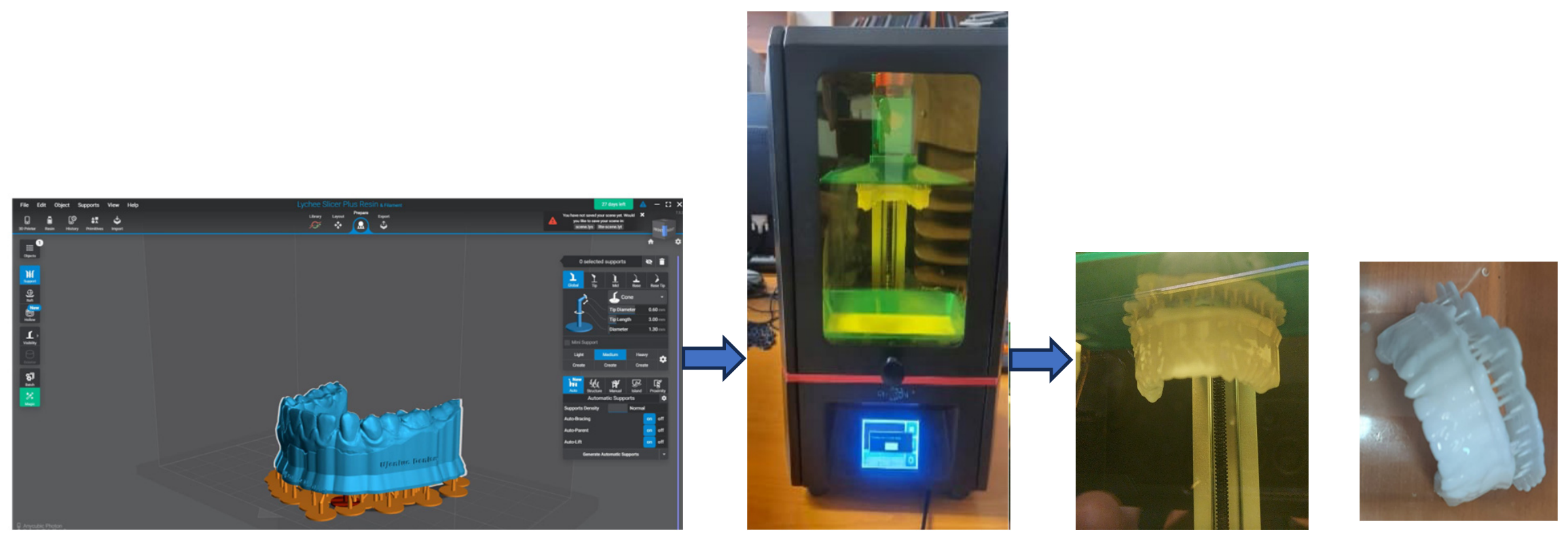
Two types of white photopolymer resins from the same manufacturer (Anycubic, Shenzhen, China) were utilized for specimen fabrication: a standard Non-Water-Washable (NWW) resin requiring isopropyl alcohol (IPA) cleaning and a Water-Washable (WW) resin. The digital geometry was derived from intraoral scans and exported as standard tessellation language (.stl) files. The photopolymer resins used in this study (Anycubic, Shenzhen, China) are optimized for a wavelength range of 365–405 nm, compatible with the mSLA light source of the Anycubic Photon printer (Anycubic, Shenzhen, China) (
Figure 1). According to the manufacturer’s technical data sheets, the material exhibits a tensile strength of 36–52 MPa and a Shore hardness of 84D. The printed models in this study demonstrated a structural rigidity consistent with these mechanical benchmarks.
2.2. 3D Printing Parameters
All specimens were fabricated using a masked stereolithography (mSLA) printer (Anycubic Photon, Anycubic, Shenzhen, China). Virtual models were prepared using Lychee Slicer software version 7.6.5 (Mango 3D, Toulouse, France) for orientation and support generation. To ensure consistency and adhere to the manufacturer’s specifications, the following printing parameters were implemented: Layer Thickness: 0.05 mm; Exposure Time: 3.6 s; Bottom Exposure Time: 25 s; Light-off Time: 0.5 s; Bottom Layers: 4; Anti-aliasing Level: 1; Z-axis Lift Distance: 8 mm; Lift/Retract Speed: 20 mm/s.
2.3. Post-Processing Protocol
Following the printing cycle, models were subjected to their respective cleaning protocols: 1. NWW Group: Rinsed in 99% IPA, and 2. WW Group: Rinsed in deionized water. All specimens underwent a standardized post-curing phase in a UV curing chamber for 7 min to ensure optimal polymerization and surface stabilization.
2.4. Tests and Analysis
To evaluate the microstructural integrity and surface characteristics of the printed models, a non-destructive analysis was performed using a MahrSurf confocal microscope (Mahr GmbH, Göttingen, Germany). This advanced imaging technique allowed for a high-resolution characterization of the specimens at both micrometric and sub-micrometric scales. The mass of each specimen was accurately quantified using a high-precision Kern analytical balance (Kern & Sohn GmbH, Balingen, Germany). Color stability and coordinate parameters were determined using a Chroma Meter CR-400 colorimeter (Konica Minolta, Tokyo, Japan). Measurements were performed based on the CIE L*a*b* color space system, which provides an objective numerical description of color consistent with human visual perception. The system evaluates three primary axes: L*: Brightness/Luminosity (ranging from black 0 to white 100); a*: Color position on the red-green axis; b*: Color position on the yellow-blue axis. Prior to testing, the equipment was calibrated using the manufacturer-provided white calibration plate, with the following baseline values: L* = 93.62, a* = −0.71, and b* = 4.15. This standardized calibration ensured the accuracy and reproducibility of the colorimetric data across all resin groups.
The mechanical resistance of the 3D-printed models was evaluated using a high-precision experimental setup integrated into an industrial CNC machining center. This configuration ensured superior control over displacement and axial alignment during the compression tests. A calibrated Kistler piezoelectric dynamometer type 9257B was rigidly mounted on the CNC worktable to record compressive loads. A customized spherical-end plunger (indenter) with a 3 mm radius was secured in the CNC spindle. Each 3D-printed model was positioned on the dynamometric plate to ensure standardized contact between the plunger and the target area—specifically, the central occlusal fossa. To capture the precise material behavior up to the point of structural failure, a quasi-static loading protocol was implemented. The plunger was lowered coaxially in precise 0.01 mm increments. A standardized approach speed of approximately 2 mm/min was maintained to minimize dynamic artifacts and allow for the accurate mapping of the force–displacement curve. Data acquisition was managed via the DynaWare software version 2.6.5.16 Kistler Group, Winterthur, Switzerland ), which enabled: high-frequency recording of the compressive force (Fz), precise identification of the fracture point (ultimate strength), and visualization of the elastic and plastic deformation stages of the resin.
3. Results and Discussion
The physical properties of the specimens, including mass and CIE L*a*b* color coordinates, are summarized in
Table 1. All values are expressed as Mean ± Standard Deviation.
There is a significant mass difference (~4.92 g). The WW resin has a higher density or better ability to maintain structural integrity, while the alcohol could cause a mass loss by partially dissolving unpolymerized monomers on the surface.
Colorimetric evaluation indicates that while overall luminosity (L) and the green-red axis (a) remained stable regardless of the solvent, a significant chromatic shift occurred on the yellow-blue axis (b). Alcohol-washed specimens exhibited a markedly higher b value (5.82 ± 0.43) compared to the water-washed group (1.96 ± 0.45), representing a pronounced yellowing effect. This shift likely results from superficial chemical interactions between isopropyl alcohol (IPA) and the resin’s photo-initiators, altering surface light absorption. Although the total color change remained within clinically acceptable limits, the significant shift in the b* coordinate—moving toward the yellow spectrum—merits attention. In dental models, this chromatic drift can affect the visualization of fine anatomical details or the perception of fit. Our results indicate that while 10 min post-curing stabilizes the material, it also induces a baseline chromatic shift that practitioners must account for. Given that 3D-printed resins are susceptible to chromatic instability during post-processing [
8], these findings suggest that water-based cleaning better preserves aesthetic fidelity. Due to the absence of a reference baseline or control specimen, differences were observed in individual color coordinates, and the results must be interpreted as relative comparisons between groups. For clinical applications, the use of sealing materials is recommended to stabilize these properties and protect the microstructure from environmental degradation.
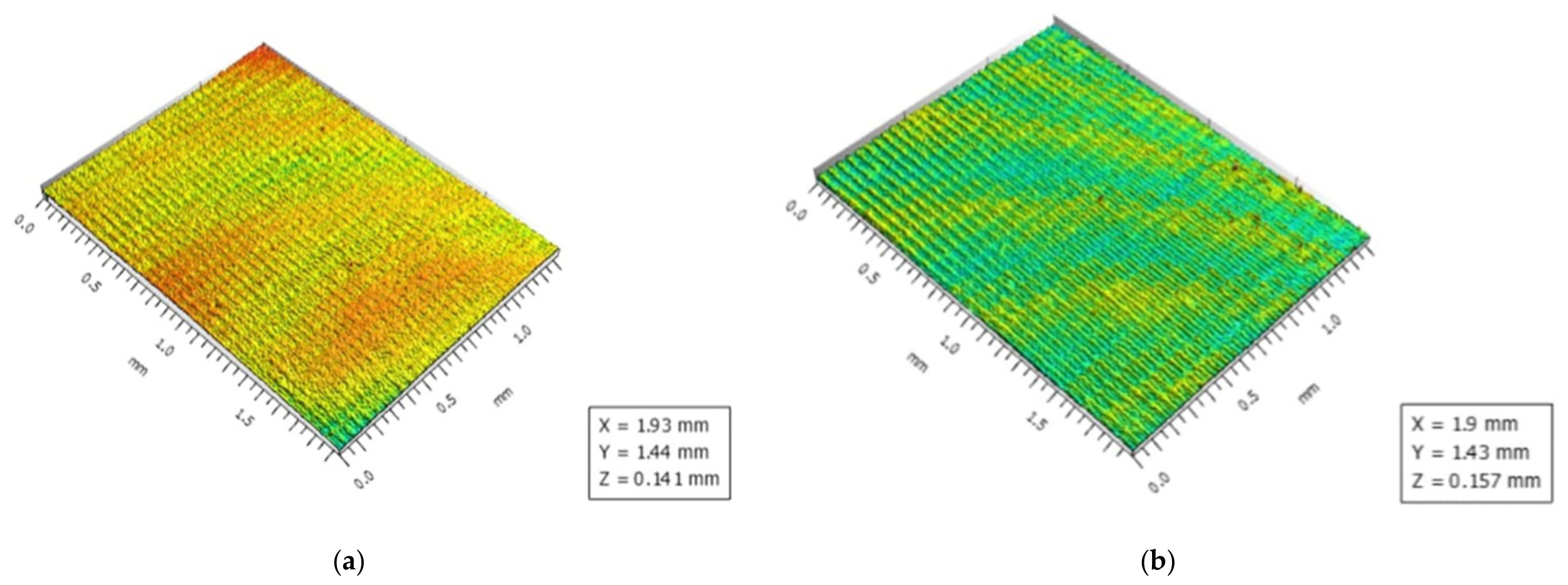
Surface micro-morphology was evaluated through 3D topographic mapping (
Figure 2). The confocal microscopy analysis revealed distinct visual characteristics based on the post-processing solvent used. The surface shows a prominent “stair-stepping” effect characteristic of the layer-by-layer additive manufacturing process. The color gradient (green-to-blue) indicates a specific peak-to-valley distribution, where the alcohol cleaning might have exposed the underlying polymer matrix more aggressively, resulting in a slightly higher vertical amplitude (Z = 0.157 mm). For the case of Water-Processed Specimens (
Figure 2b), the topography appears more uniform and “dense” in the yellow-to-orange spectrum. The lower vertical range (Z = 0.141 mm) compared to the IPA group suggests that water-based cleaning is less abrasive to the surface layers, preserving a smoother transition between the printed layers. While both samples maintain the structural integrity dictated by the 0.05 mm layer thickness, the water-processed resin (
Figure 2a) shows a more cohesive surface morphology. The absence of visible micro-cracks or solvent-induced degradation in both samples confirms that the 7 min UV post-curing cycle was sufficient to stabilize the surface, regardless of the solvent type. The lower Z-amplitude observed in water-processed specimens (0.141 mm vs. 0.157 mm for IPA) supports the conclusion that water is a gentler cleaning agent. This preservation of surface integrity correlates directly with the superior mechanical durability found during the compressive strength tests performed with the CNC-Kistler setup.
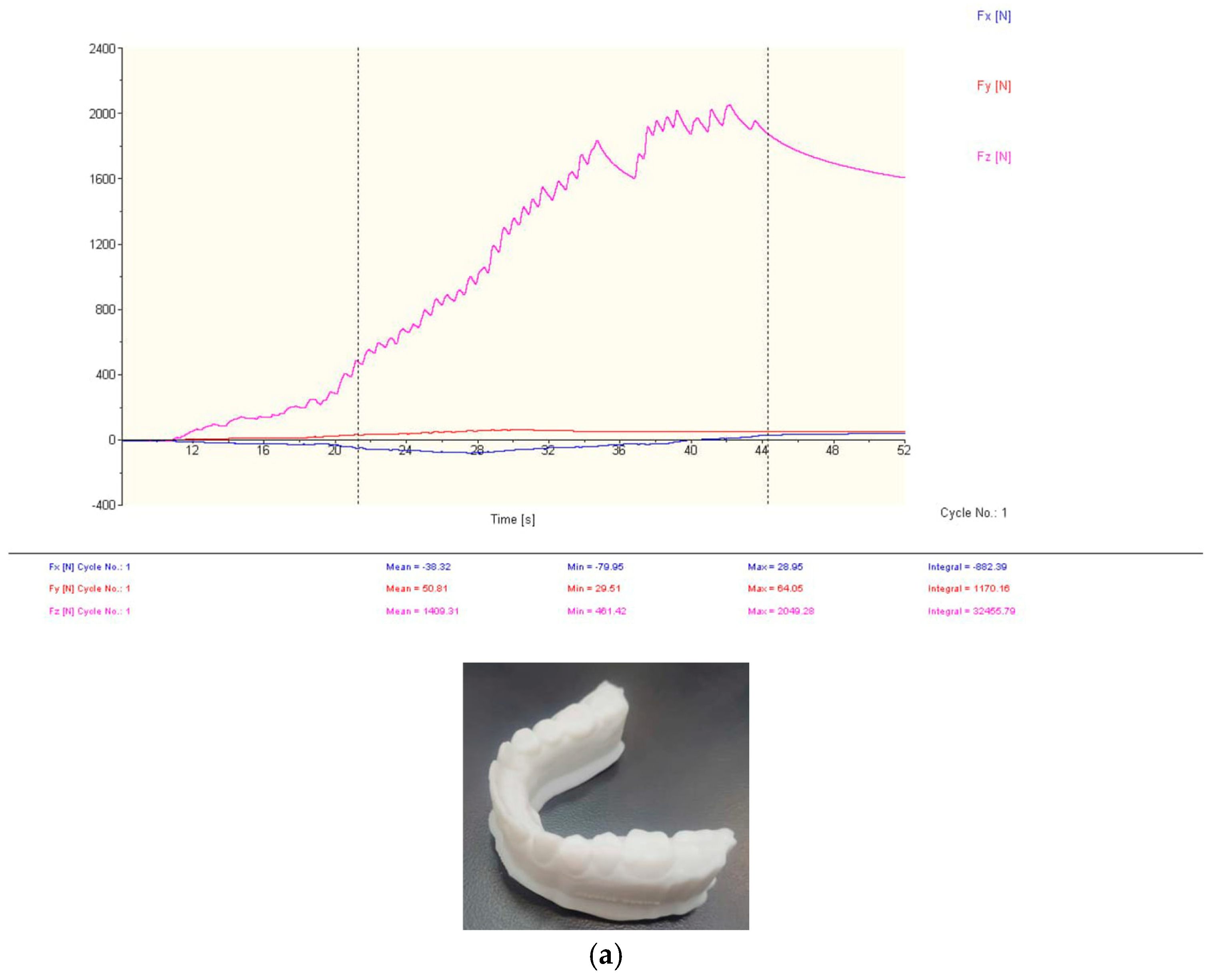
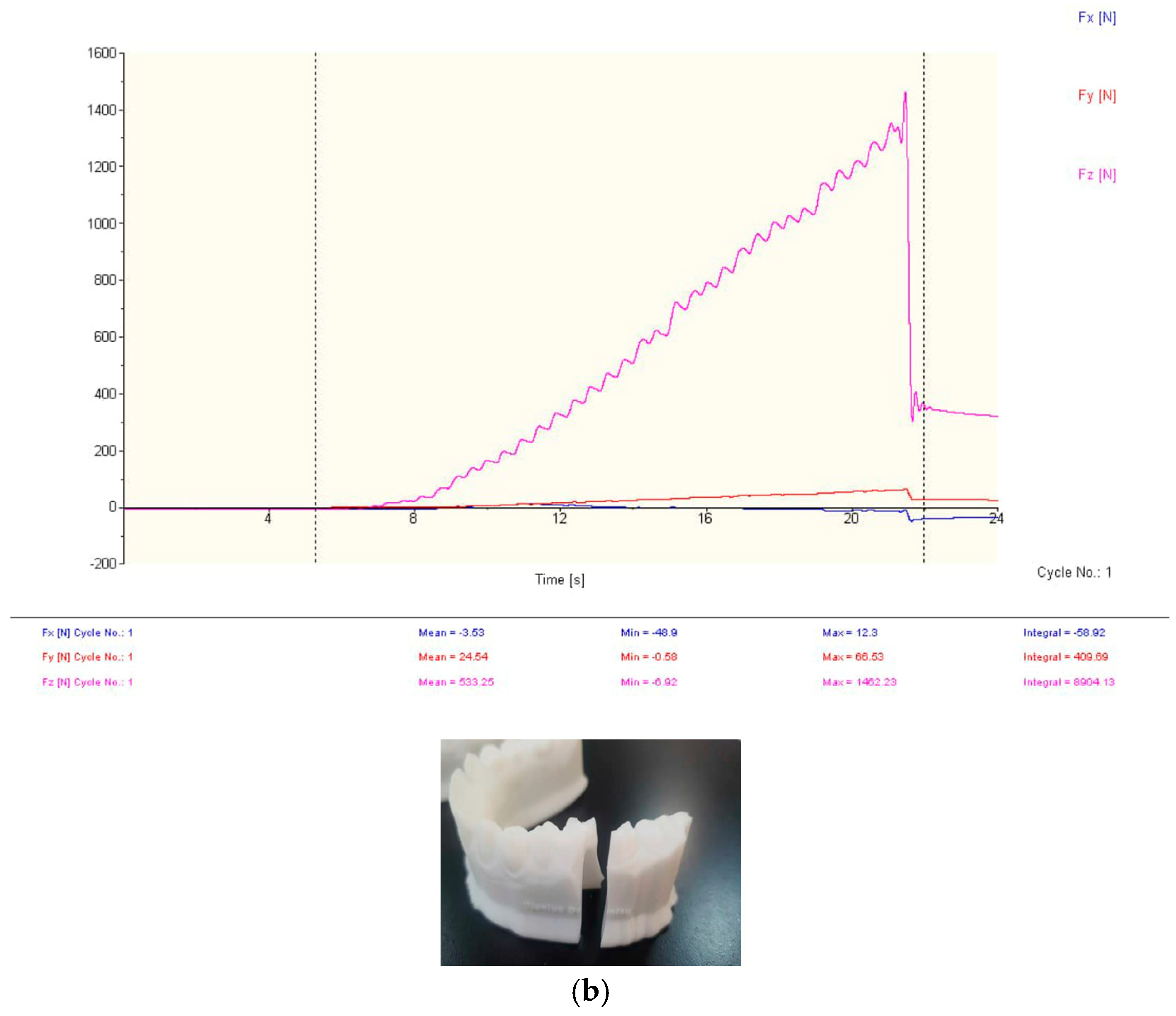
The force–time curve highlights divergent mechanical profiles between the two resin types. The standard resin (IPA washed) reached a maximum compressive force of approximately 1450 N, about 30% lower than the threshold of over 2000 N recorded by the WW variant (water washed). The Standard resin (IPA) shows a sudden and catastrophic collapse of force immediately after reaching the peak (at approximately 22 s), a classic indicator of brittle fracture. Macroscopically (
Figure 3a), the model fractured into multiple large fragments, suggesting an inability to plastically deform and rapid crack propagation under high internal stress. The WW resin (Water) demonstrated superior resilience, sustaining the load for over 40 s and showing a gradual decrease in post-peak force. Failure was only localized at the contact point (occlusal fossa), with the structural integrity of the model remaining intact (
Figure 3b), indicating an optimal energy dissipation capacity. The inferior performance of the alcohol-processed samples suggests that IPA induces surface embrittlement. This observation correlates with confocal microscopy data (Z = 0.157 mm), the hypothesis being that the aggressive nature of IPA penetrates the polymer network, causing the leaching of unreacted monomers (creating micro-voids) and dehydration of the matrix. In contrast, post-processing with water preserves structural integrity, demonstrating that this method is not only an ecological option but a technical necessity for obtaining dental models with superior durability and fracture resistance.
4. Conclusions
Within the limits of this study, the following conclusions can be drawn regarding the impact of post-processing on 3D resins: roughness, microstructure and color stability were not influenced by the type of solvent used, indicating that morphology and aesthetics are primarily determined by the chemical composition of the resin and the photopolymerization protocol. Physical properties: The samples cleaned with water showed a slightly higher mass compared to those treated with IPA, a phenomenon attributed to residual moisture retention and low water evaporation rate. Mechanical performance: The major difference was recorded at the level of structural strength, where post-processing with water ensured superior properties. This prevents excessive dehydration and the formation of micro-fractures associated with alcohol exposure. Study limitations: As different resin types were evaluated using distinct cleaning protocols, the individual effects of resin formulation and cleaning method could not be fully isolated. Furthermore, future studies should include a standardized reference for ΔE and assessment of clinical perceptibility. As this study investigated resins from a single manufacturer, future studies should include a broader range of materials and manufacturers to validate the findings.
Author Contributions
Conceptualization, R.G., A.N. and I.B.B.; methodology, R.G., A.N. and I.B.B.; formal analysis, R.G., A.N. and I.B.B.; investigation, R.G., A.N. and I.B.B.; writing—original draft preparation, R.G., A.N. and I.B.B.; writing—review and editing, R.G., A.N. and I.B.B. All authors have read and agreed to the published version of the manuscript.
Funding
This work was supported by the project titled “Modern strategies for correcting dento-maxillary anomalies using personalized surgical guides”, financed by the North-East Regional Program 2021–2027, Priority PRNE_P1: A more competitive, more innovative region, under the contract number 743/31.07.2025, SMIS Code 338520.
Institutional Review Board Statement
Not applicable.
Informed Consent Statement
Not applicable.
Data Availability Statement
The data supporting the findings of this study are available within the article.
Conflicts of Interest
The authors declare no conflicts of interest.
Abbreviations
The following abbreviations are used in this manuscript:
| 3D | Tridimensional |
| IPA | Isopropyl Alcohol |
| mSLA | Masked Stereolithography |
| MES | Methyl Alcohol Solvent |
| NWW | Non-Water-Washable |
| WW | Water-Washable |
References
- Tian, Y.; Chen, C.; Xu, X.; Wang, J.; Hou, X.; Li, K.; Lu, X.; Shi, H.; Lee, E.S.; Jiang, H.B. A Review of 3D Printing in Dentistry: Technologies, Affecting Factors, and Applications. Scanning 2021, 2021, 9950131. [Google Scholar] [CrossRef] [PubMed]
- Zarean, P.; Zarean, P.; Sendi, P.; Neuhaus, K.W. Advances in the Manufacturing Process of Space Maintainers in Pediatric Dentistry: A Systematic Review from Traditional Methods to 3D-Printing. Appl. Sci. 2023, 13, 6998. [Google Scholar] [CrossRef]
- Liu, Y.; Jin, G.; Lim, J.H.; Kim, J.E. Effects of washing agents on the mechanical and biocompatibility properties of water-washable 3D printing crown and bridge resin. Sci. Rep. 2024, 14, 9909. [Google Scholar] [CrossRef] [PubMed]
- Seifert, A.P.; Molinero-Mourelle, P.; Cakmak, G.; Paula, M.S.; Kahveci, Ç.; Yilmaz, B.; Dönmez, M.B. Additively manufactured water-washable resin dies cleaned with nonhazardous solutions: Can dimensional and positional trueness be ensured? J. Prosthodont. 2025, 1–9. [Google Scholar] [CrossRef] [PubMed]
- Hwangbo, N.-K.; Nam, N.-E.; Choi, J.-H.; Kim, J.-E. Effects of the Washing Time and Washing Solution on the Biocompatibility and Mechanical Properties of 3D Printed Dental Resin Materials. Polymers 2021, 13, 4410. [Google Scholar] [CrossRef] [PubMed]
- Çakmak, G.; Sabatini, G.P.; de Paula, M.S.; Orgev, A.; Kahveci, Ç.; Revilla-Léon, M.; Yilmaz, B. Can nonhazardous postprocessing cleaning solutions enable adequate surface properties for printed dental casts in different resins? J. Prosthet. Dent. 2025, 133, 893–902. [Google Scholar] [CrossRef] [PubMed]
- Jeong, Y.G.; Lee, W.S.; Lee, K.B. Accuracy evaluation of dental models manufactured by CAD/CAM milling method and 3D printing method. J. Adv. Prosthodont. 2018, 10, 245–251. [Google Scholar] [CrossRef] [PubMed]
- Catelan, A.; Briso, A.; Sundfeld, R.; Dos Santos, P. Color stability of sealed composite resin restorative materials after ultraviolet artificial aging and immersion in staining solutions. J. Prosthet. Dent. 2011, 105, 236–241. [Google Scholar] [CrossRef] [PubMed]
| Disclaimer/Publisher’s Note: The statements, opinions and data contained in all publications are solely those of the individual author(s) and contributor(s) and not of MDPI and/or the editor(s). MDPI and/or the editor(s) disclaim responsibility for any injury to people or property resulting from any ideas, methods, instructions or products referred to in the content. |