


Abstract
In general dynamic reliability problems, the input excitation often exhibits non-Gaussian characteristics. In practice, both the parameters of the excitation power spectral density (PSD) model and the structural parameters may exhibit randomness. Considering the uncertainty in both sources is therefore essential for a rational dynamic reliability analysis. The point-estimation method (PEM) is widely used in structural reliability analysis. When combined with Hermite-type quadrature for dynamic reliability evaluation, most existing PEM-based approaches employ fixed integration points, thereby neglecting the functional relationships among them. To achieve higher computational efficiency while maintaining reasonable accuracy, in this paper, a dynamic reliability approach for stochastic structural systems with random PSD parameters is developed by combining the PEM with adaptive Bayesian quadrature (ABQ). First, the moment spectra of structural responses are derived while simultaneously accounting for the randomness of PSD model parameters and structural parameters. Subsequently, an unconditional reliability point-estimation method is developed for the case of one random variable and then extended to multivariate cases. Finally, the effectiveness and computational efficiency of the proposed method are validated through the dynamic reliability analysis of a six-story structure.
1. Introduction
To ensure structural safety and reliability throughout the design lifetime, dynamic reliability analysis must provide appropriate safety and failure criteria. Since Rice’s [1] pioneering work in 1944, which introduced a probabilistic formulation for dynamic response analysis, there has been substantial progress in the field of structural dynamic reliability. According to the sources of uncertainty, randomness in engineering problems can generally be classified into external randomness, such as wind and seismic excitations, and internal randomness, such as variations in material properties and geometric dimensions. Significant advances have been achieved in deterministic dynamic reliability analysis that considers only external randomness while neglecting internal uncertainty [2,3,4,5,6,7]. Yang and Zhang [7] conducted dynamic reliability analysis for deterministic structures by employing a Markov process model based on the variance of structural response, and validated the accuracy of the approach using a dynamic reliability case study of a continuous bridge. In parallel, extensive studies have focused on composite random vibration systems that account for both structural randomness and excitation randomness, leading to notable developments in this area [8,9,10]. Li and Chen [11] analyzed the dynamic reliability of structures considering the uncertainties associated with seismic excitation and material properties by using the generalized probability density evolution method, and showed that the variability of material parameters has a significant influence on structural dynamic reliability.
When PSD models are employed to characterize random excitation, the PSD parameters themselves may also exhibit randomness [12]. For example, the spectral parameters of the widely used Kanai–Tajimi model for seismic excitation are often described by probability distributions related to site conditions. Simultaneously considering structural randomness, excitation randomness, and PSD parameter uncertainty can therefore yield a more realistic and reliable dynamic reliability assessment. Since these sources of uncertainty follow different physical mechanisms, the PEM provides an efficient framework for addressing such problems.
In engineering practice, PEM is widely used to evaluate multidimensional integrals with a limited number of integration points and weights. Zhao and Ono [13], combined with the Rosenblatt transformation, employed a univariate reduction approximation to represent multivariate functions and adopted Gauss–Hermite quadrature to evaluate statistical moments, resulting in practical computational formulations. Building on this work, Qiao and Lu [14] developed a point-estimation approach for the mean and variance of unconditional reliability under non-stationary random excitation and verified its accuracy using a seven-point-estimation scheme applied to a fifteen-bar structure. It should be noted that Gauss–Hermite quadrature relies on fixed integration points determined by predefined rules and is independent of the target integrand. This limitation can be alleviated by ABQ, which establishes a functional relationship between the integrand and the integration points. Zhou and Peng [15] applied ABQ in conjunction with a generalized lognormal displacement model to estimate fourth-order response moments, demonstrating both accuracy and efficiency through numerical examples.
In general, existing dynamic reliability analysis methods are mainly focused on structures considering random excitation and structural parameter randomness, while studies on structural dynamic reliability that account for the randomness of excitation power spectral parameters are relatively scarce. On this basis, the present study builds upon the Hermite-based PEM and incorporates the ABQ technique to establish a point estimation approach to analyze an unconditional dynamic reliability problem for linear structures subjected to non-stationary random excitation and to obtain the mean and variance. The proposed approach explicitly accounts for the uncertainties in both the PSD model parameters and the structural parameters. Section 1 and Section 2 describe the formulation and implementation of the method in detail. Subsequently, a dynamic reliability analysis is performed on a simple frame structure, and the results are compared with Monte Carlo simulation outcomes to confirm the effectiveness of the proposed method.
2. Non-Stationary Random Response Analysis Based on the Virtual Excitation Method
For structural dynamic reliability evaluation, it is first necessary to determine the time-varying statistical moments of the structural response. In practical engineering applications, many random excitations exhibit pronounced non-stationary characteristics. In addition, both the parameters of the excitation PSD and the structural parameters may involve inherent randomness. Accordingly, the motion equation of a linear stochastic structural system with s degrees of freedom can be written as:
In this case, and represent the dimensional mass, damping, and stiffness matrices, respectively; represents the random structural parameters; means the number of random parameters; denotes the power spectral random parameters; denotes the number of power spectral random parameters; Q is the steady-state vector; is the time modulation function; and is a zero-mean stationary normal random process.
Considering that the random structural parameters, power spectral parameters, and random excitation follow different physical laws, the randomness of these three sources can be regarded as independent of each other. Therefore, by employing the concept of conditional expectation, the uncertainties associated with the structural parameters, power spectral parameters, and excitation in Equation (1) can be addressed through a two-step procedure: first, the expectation of the moment function of is determined when takes specific values, and then the expectation of this function is taken with respect to . To evaluate the power spectral response of a deterministic structure subjected to non-stationary random excitation, the virtual excitation method is adopted. The corresponding equation is as follows.
When the structural parameters and power spectral parameters take specific values, the following form of virtual excitation is constructed:
By substituting Equation (2) into the right side of Equation (1), the following expression is obtained:
The deterministic equation given above can be solved by means of a conventional step-by-step integration method to obtain any virtual response of interest. The corresponding time-varying PSD of the non-stationary random response is then given by:
where is the conditional moment spectrum function. By taking the expectation of this function with respect to , the structural moment spectrum function is obtained as:
Here, represents the joint probability density function corresponding to , represents a similar functional relationship to .
The time-varying moment spectrum of the structure for each order is given by:
Once Equation (6) is obtained, the structural dynamic reliability analysis can be performed.
3. Dynamic Reliability Analysis of Linear Structures Under Non-Stationary Random Excitation, Considering the Randomness of Both the Power Spectral Model Parameters and Structural Parameters
3.1. Unconditional Reliability of Linear Structures Considering the Randomness of Both the Power Spectral Model Parameters and Structural Parameters Under Random Excitation
The dynamic reliability of deterministic structural response can be assessed when the time-varying moments of the structural response are determined [12]. To overcome the limitation of the Poisson process method, which assumes that crossing events are mutually independent, the modified formulation proposed by Vanmarcke is adopted in this study. This formulation assumes that the number of crossings follows a Markov process and is employed to assess the structural dynamic reliability. The corresponding expression is given as follows:
where:
where is the specified threshold value of the displacement response.
Equation (7) gives the expression for calculating the dynamic reliability of a deterministic structure. By combining Equations (5) and (7), the mean value of the dynamic reliability of a linear structure under non-stationary random excitation, while accounting for the uncertainties in both the power spectral model parameters and structural parameters, can be given as:
where is the mean probability of no failure of the stochastic structure over the time interval , and is the conditional reliability when the power spectral model parameters and structural parameters take the values and , respectively.
For integrals in the form of Equation (10), the PEM provides an efficient solution. It approximates the probability integral of a function by employing a limited number of weighted evaluation points. Based on the PEM framework, the mean value of the dynamic reliability of a linear structure under non-stationary random excitation is derived below, while accounting for the uncertainties in both the power spectral model parameters and structural parameters.
3.2. The PEM for the Unconditional Reliability of a Stochastic Structural System, Considering the Randomness of Power Spectral Parameters
For random variables in the power spectral model parameters or structural parameters that are non-standard normal, they should first be transformed into standard normal random variables using the Rosenblatt transformation. Let us first consider the case where is a single standard normal distribution random variable. Based on Equation (10), the mean and variance of the unconditional reliability can be expressed as:
The integrals in the above expressions can be evaluated using the Gauss–Hermite quadrature formula:
where represents the integration points and represents the weights. In the calculation of Equation (13), the usual approach is to subjectively select specific integration points and weights for computation, neglecting the functional relationships between the different points. Based on this, in this paper, we use the ABQ method to consider the process in Equation (13), treating it as a probabilistic problem. Specifically, the ABQ set a Gaussian Process (GP) prior on the integrand function . The GP prior is related to the observation vector , resulting in the posterior distribution of , which can then be used to compute the integral in Equation (11). Subsequently, the optimal integration points are determined by minimizing the uncertainty associated with the integral. In the following, the single-variable case is taken as an example, and the ABQ method is introduced to derive Equation (13).
For a one-dimensional standard normal random variable, a GP model can be fully parameterized by its mean and covariance :
In this study, the mean function is set to zero. The covariance function characterizes the smoothness and scale properties relating to the GP model. Generally, the commonly adopted form is the squared exponential covariance function:
where represents the hyperparameters. For a given set of sample points , according to the GP prior, we have:
Equation (11) can be expressed as:
where , , is covariance vector.
The initial set of points is denoted as . The formula for selecting new integration points is as follows:
Weight coefficients:
The convergence criterion is given by:
Thus:
Thus, through Equations (23) and (24), the variance and mean of the unconditional dynamic reliability of a structure, when both the power spectral model parameters and structural parameters are single variables, are obtained.
Referring to Equations (23) and (24), for the case where the power spectral model parameters and structural parameters are multi-random variables, when contains variables, the mean and variance of the unconditional dynamic reliability of a structure can be given as follows:
Through Equations (25) and (26), the variance and mean of the unconditional dynamic reliability of a structure, when both power spectral model parameters and structural parameters are multi-random variables, are obtained.
4. Dynamic Reliability Analysis of a Six-Story Shear-Frame Structure
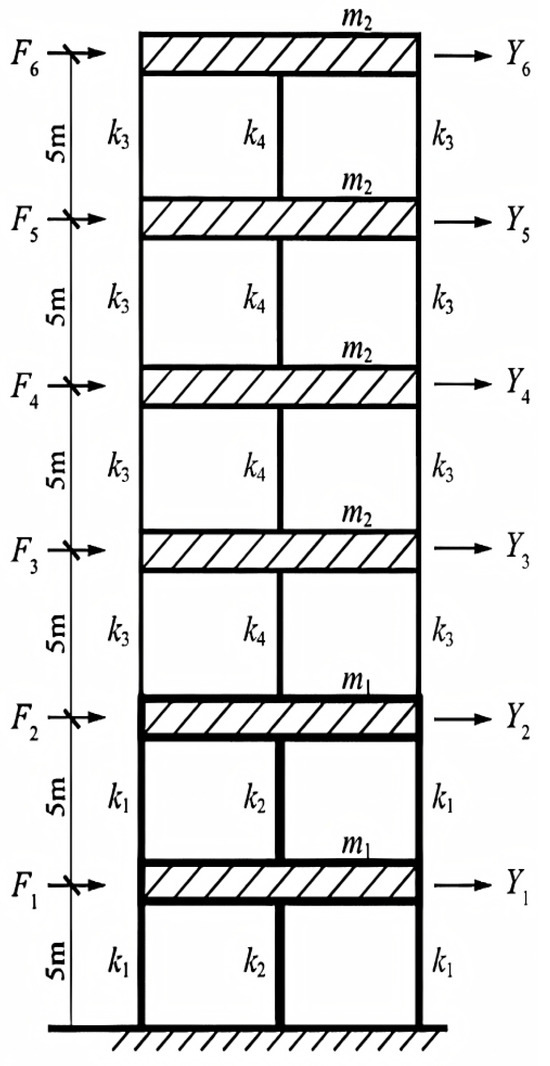
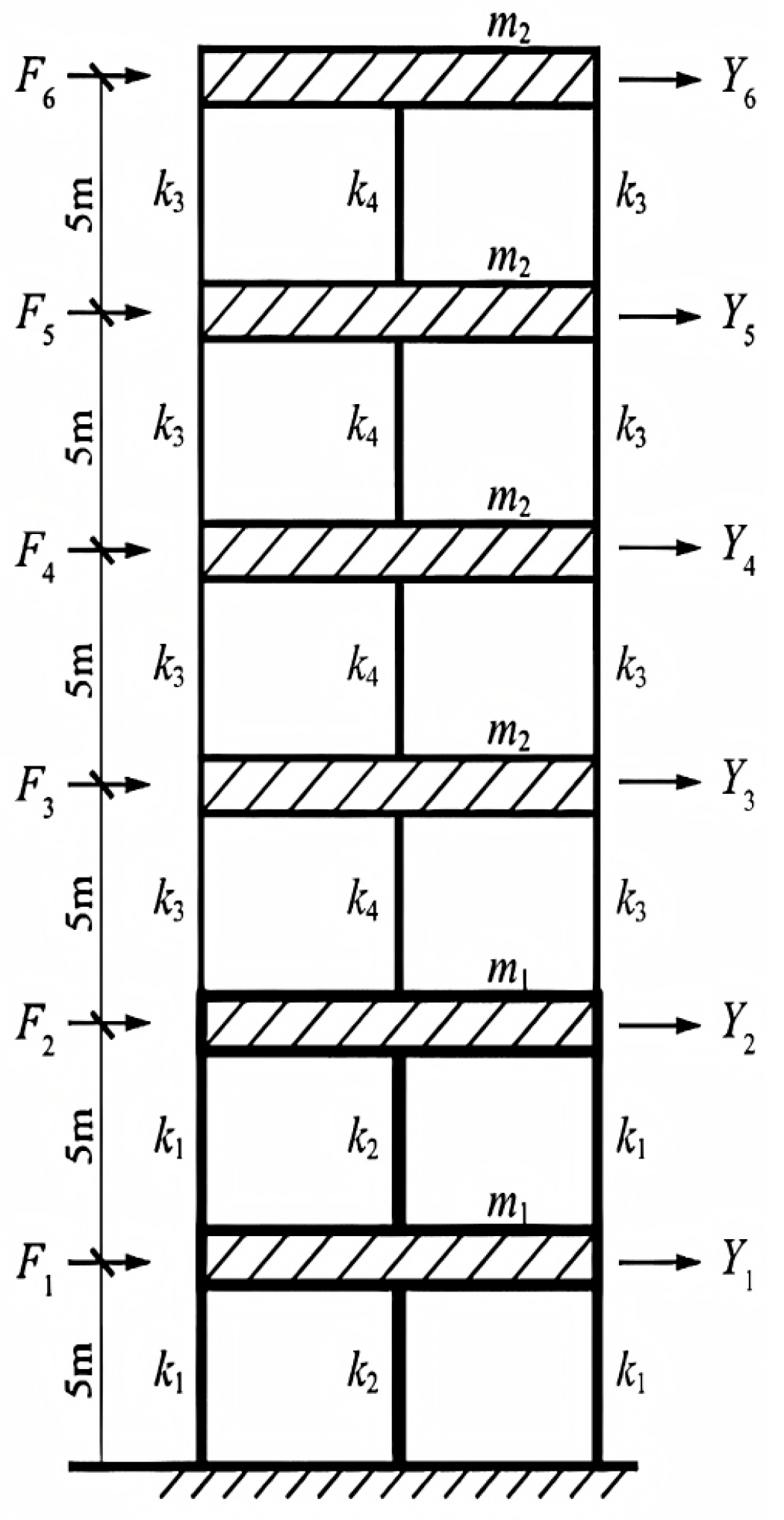
To evaluate the efficiency and accuracy of the method mentioned in 2.2, a dynamic reliability analysis of a six-story structure is conducted in this section. The results, particularly with respect to the selection of integration points, are compared with those obtained using the traditional fixed integration point method. Consider a six-story frame structure. Each story is subjected to the same uniformly modulated non-stationary Gaussian excitation, as shown in Figure 1.
Figure 1.
Six-story shear-type frame structure.
The auto-PSD of the excitation is:
The uniform modulation function is:
where , , .
The parameters in the PSD, together with the structural parameters M, C, and K, are treated as independent variables. Their mean and corresponding coefficients of variation (COV) are shown in Table 1.
Table 1.
Statistical characteristics of the parameters in the PSD and structural parameters for Example 1.
In this example, the frequency domain range is defined as [0, 4π] rad/s, with a frequency interval of Δω = 4π/800 rad/s. The pseudo response is computed using an explicit time-domain method. For reference, the mixed precision quadrature formula (MDCF) method [16] with algebraic accuracy ranging from five to seven orders and the Monte Carlo method are adopted. The Monte Carlo method is implemented with 20,000 samples. Structural responses are obtained using the Newmark-β method. For MCM, the frequency interval is 4π/100 rad/s, and the simulation time span is [0, 400] s with a time step of Δt = 0.05 s. At the sixth story of the structure, the dynamic reliability analysis of displacement is performed, with a two-sided displacement limit of 0.04 m, , and an adaptive Bayesian convergence threshold of .
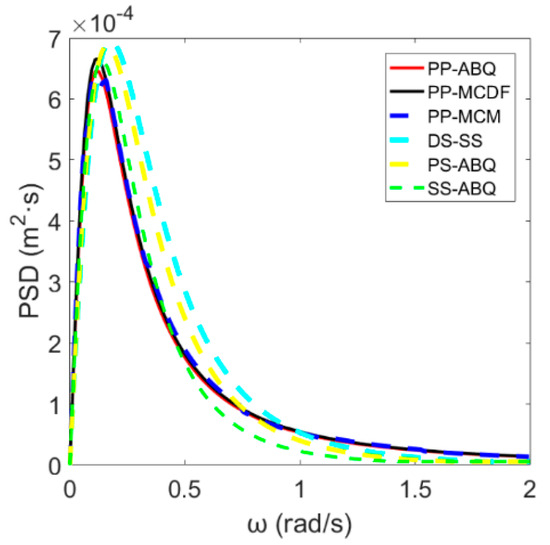
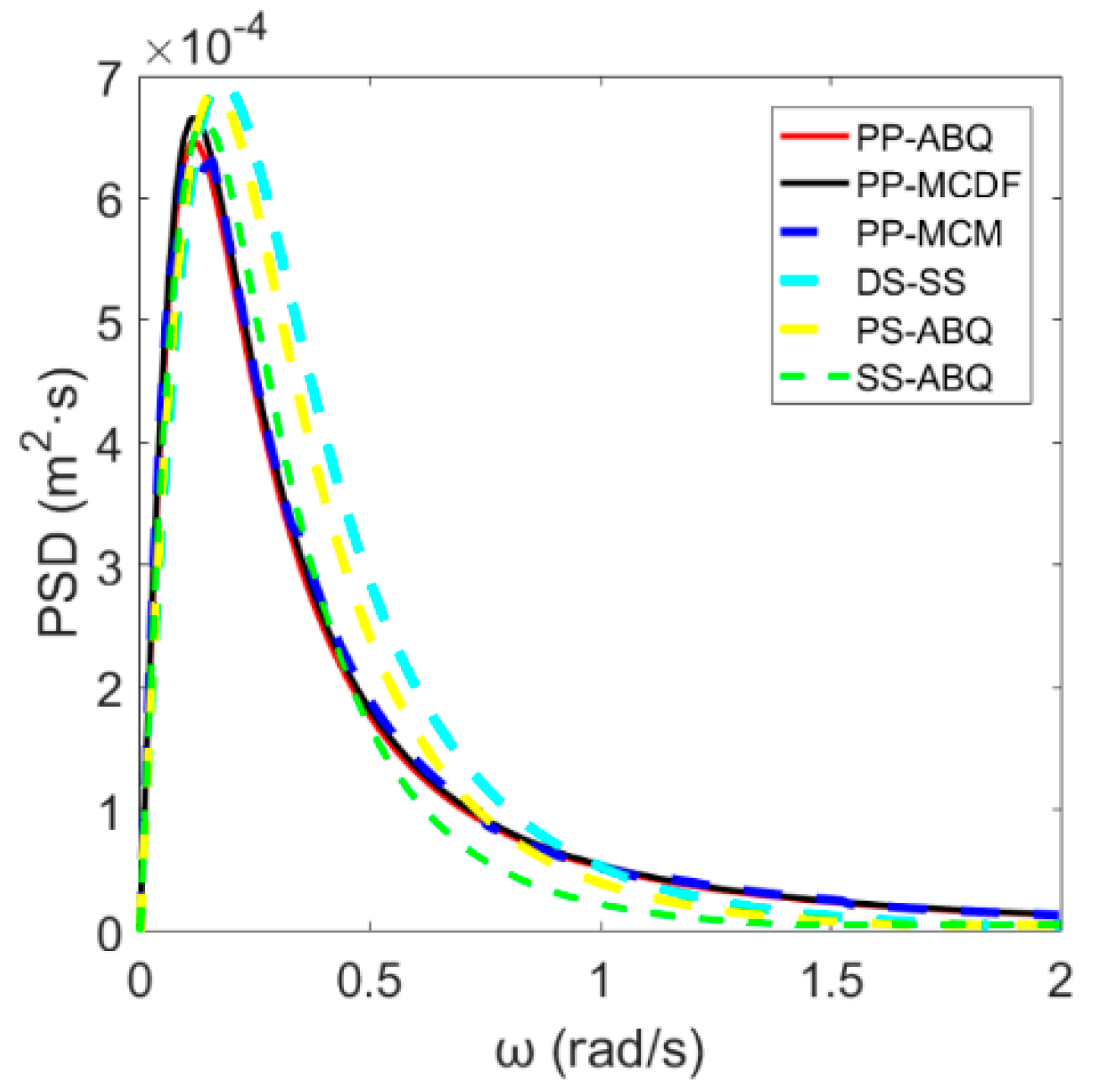
Figure 2 shows the PSD of the structural response at , where: DS-SS represents the result when all random parameters are considered at their mean values. SS-ABQ represents the result when only structural parameter randomness is considered. PS-ABQ represents the result when only the power-spectral-parameter randomness is considered. PP-ABQ represents the result when both power spectral and structural parameter randomness are considered. PP-MCDF represents the result using the MCDF method. PP-MCM represents the result of the Monte Carlo simulation.
Figure 2.
The second-order spectrum of the structural response.
From Figure 2, it can be observed that the randomness of both the power spectral and structural parameters significantly impacts the structural analysis. Table 2 shows the mean and variance of structural dynamic reliability obtained using six different methods, together with the relative errors with respect to the MCM results. As shown in Table 2, both the randomness of the power spectral parameters and that of the structural parameters have a noticeable influence on the dynamic reliability evaluation of the structure under non-stationary excitation. The relative error of the proposed method is 0.6%, which confirms its applicability and accuracy. Table 3 reports the number of structural analyses required by each method. It can be observed that PP-ABQ achieves comparable accuracy with fewer integration points than PP-MCDF, indicating the higher effectiveness and computational efficiency of the approach proposed in this paper.
Table 2.
Structural dynamic reliability.
Table 3.
Number of structural analyses.
5. Conclusions
In engineering applications, certain parameters of the excitation PSD may exhibit randomness. Incorporating the uncertainty of PSD model parameters into the reliability analysis of composite random vibrations can therefore lead to a more rational assessment of structural reliability. When Hermite integration is employed to evaluate structural dynamic reliability, most existing approaches rely on fixed integration points and thus neglect the functional relationships among them. By integrating adaptive Bayesian quadrature with Hermite-based point estimation, the method proposed in this study accounts for the randomness of PSD parameters and provides an unconditional reliability estimation framework for stochastic structural systems. The proposed method shows an acceptable compromise between efficiency and accuracy, making it a valid option in the analysis of the dynamic reliability of structures under non-stationary excitation.
Author Contributions
Conceptualization, R.Z. and W.F.; methodology, R.Z. and W.F.; software, R.Z.; validation, R.Z.; formal analysis, R.Z.; investigation, R.Z. and W.F.; resources, R.Z. and W.F.; data curation, R.Z.; writing—original draft preparation, R.Z.; writing—review and editing, R.Z. and W.F.; visualization, R.Z.; supervision, W.F.; project administration, W.F.; funding acquisition, W.F. All authors have read and agreed to the published version of the manuscript.
Funding
This research received no external funding.
Institutional Review Board Statement
Not applicable.
Informed Consent Statement
Not applicable.
Data Availability Statement
The data that support the findings of this study are available from the corresponding author upon reasonable request.
Conflicts of Interest
The authors declare no conflict of interest.
References
- Rice, S.O. Mathematical analysis of random noise. Bell Syst. Tech. J. 1944, 23, 282–332. [Google Scholar] [CrossRef] [Scilit]
- Zhou, K.; Zhou, D.; Wang, X.; Guo, Y.; Chen, H. Vibration Characteristic Analysis and Dynamic Reliability Modeling of Multi-Rotor UAVs. Machines 2025, 13, 697. [Google Scholar] [CrossRef] [Scilit]
- Liu, Y.; He, M. Dynamic reliability estimation of onshore wind turbine tower based on frequency-domain method. Vib. Control 2025, 31, 4527–4541. [Google Scholar] [CrossRef] [Scilit]
- Jia, Y.; Chen, X.; Zhang, L.; Ning, C. Dynamic characteristics and reliability analysis of parallel mechanism with clearance joints and parameter uncertainties. Meccanica 2023, 58, 813–842. [Google Scholar] [CrossRef] [Scilit]
- Chen, J.; Chen, L.; Qian, L.; Chen, G.; Miao, W. Dynamic reliability analysis of gear transmission system based on sparse grid numerical integration and saddle-point approximation method. Qual. Reliab. Eng. Int. 2023, 39, 25–46. [Google Scholar] [CrossRef] [Scilit]
- Xiao, Q.; Chen, C.; Liu, Z.; Zhou, L.; Liu, Y.; Jiang, Z.; Yang, B.; Tang, L. Temperature-induced response reconstruction for the dynamic reliability assessment of bridge girders. Structures 2023, 58, 105374. [Google Scholar] [CrossRef] [Scilit]
- Yang, B.; Zhang, C.; Luo, F.; Liu, S.; Jia, S.; Wei, Z. Dynamic Reliability Analysis of Continuous Girder Bridge with Fractional Order Dampers Under Non-Stationary Random Excitation. Struct. Stab. Dyn. 2026, 26, 2650040. [Google Scholar] [CrossRef] [Scilit]
- Kubica, J.; Ahmed, B.; Muhammad, A.; Aslam, M.U. Dynamic reliability calculation of random structures by conditional probability method. Eksploat. Niezawodn. 2024, 26, 181133. [Google Scholar] [CrossRef] [Scilit]
- Weng, Y.-Y.; Zhang, X.-Y.; Lu, Z.-H.; Zhao, Y.-G. A conditional extreme value distribution method for dynamic reliability analysis of stochastic structures. Struct. Saf. 2024, 106, 102398. [Google Scholar] [CrossRef] [Scilit]
- Wu, Z.; Li, A.; Sun, Q.; Zheng, S.; Zhao, J.; Liu, P.; Gu, W. Multistage reliability-constrained stochastic planning of diamond distribution network: An approximate dynamic programming approach. Int. J. Electr. Power Energy Syst. 2024, 156, 109701. [Google Scholar] [CrossRef] [Scilit]
- Li, X.; Chen, K.; Pang, R.; Hu, W.; Xu, B. Dynamic reliability assessment for high CFRDs incorporating ground motion and material parameter variability via GPDEM. Structures 2024, 69, 107430. [Google Scholar] [CrossRef] [Scilit]
- Dickinson, B.W.; Gavin, H.P. Parametric Statistical Generalization of Uniform-Hazard Earthquake Ground Motions. J. Struct. Eng. 2011, 137, 410–422. [Google Scholar] [CrossRef] [Scilit]
- Zhao, Y.G.; Ono, T. New point estimates for probability moments. J. Eng. Mech. 2000, 126, 433–436. [Google Scholar] [CrossRef] [Scilit]
- Qiao, H.; Lü, Z. Dynamic reliability analysis of stochastic structures under non-stationary random excitation. J. Solid Mech. 2008, 29, 36–40. (In Chinese) [Google Scholar] [CrossRef]
- Zhou, T.; Peng, Y. Adaptive Bayesian quadrature based statistical moments estimation for structural reliability analysis. Reliab. Eng. Syst. Saf. 2020, 198, 106902. [Google Scholar] [CrossRef] [Scilit]
- Yang, X.; Fan, W.; Li, Z. Higher-order analysis for random vibration of stochastic structures under Gaussian stationary excitation. Probabilistic Eng. Mech. 2022, 68, 103222. [Google Scholar] [CrossRef] [Scilit]

Disclaimer/Publisher’s Note: The statements, opinions and data contained in all publications are solely those of the individual author(s) and contributor(s) and not of MDPI and/or the editor(s). MDPI and/or the editor(s) disclaim responsibility for any injury to people or property resulting from any ideas, methods, instructions or products referred to in the content. |
© 2026 by the authors. Licensee MDPI, Basel, Switzerland. This article is an open access article distributed under the terms and conditions of the Creative Commons Attribution (CC BY) license.