


Abstract
Nonlinear technological processes are difficult to control because of strong nonlinear dynamics, parameter uncertainties, transport delays, and external disturbances, which can degrade the performance of conventional control strategies. This study proposes a Quantum-Inspired Fuzzy Inference Controller (QIFIC) that combines Mamdani fuzzy reasoning with an online adaptive probabilistic decision mechanism. Unlike conventional fuzzy controllers, which directly aggregate activated rules into a deterministic output, the proposed method preserves multiple candidate control actions and dynamically adjusts their relative probabilities according to the tracking error and its variation. The updated probabilities are combined with fuzzy-rule firing strengths to generate the final control signal, enabling online adaptation without modifying or retraining the original fuzzy knowledge base. A conditional Lyapunov-based analysis is used to establish the uniform ultimate boundedness of the tracking error under bounded modeling uncertainties and time-varying disturbances within the considered operating region. The proposed controller is evaluated using a nonlinear boiler temperature-control benchmark and quantitatively compared with PID and classical fuzzy controllers, while an adaptive fuzzy controller is included as an additional methodological benchmark for positioning the proposed adaptation strategy. Comparative simulations demonstrate improved transient response, disturbance rejection, and control smoothness, confirming the effectiveness of the proposed online probability-weighted inference mechanism.
1. Introduction
Nonlinear technological processes play a fundamental role in modern industrial sectors, including chemical production, thermal power generation, petroleum refining, advanced manufacturing, and energy conversion systems. These processes are inherently characterized by nonlinear dynamics, strong multivariable interactions, transport delays, parameter uncertainties, and continuously varying operating conditions. Such characteristics considerably complicate controller design and often degrade control accuracy, operational stability, and energy efficiency. Consequently, the development of intelligent control strategies capable of maintaining high performance under uncertain and time-varying conditions has become an important research topic in automation and control engineering [1].
Conventional proportional–integral–derivative (PID) controllers remain the dominant industrial control solution owing to their simple structure, straightforward implementation, and reliable operation. Nevertheless, their performance strongly depends on accurate mathematical models and appropriate parameter tuning. In nonlinear systems affected by disturbances and parameter variations, PID controllers frequently exhibit excessive overshoot, prolonged settling time, oscillatory responses, and reduced disturbance rejection capability [2,3]. These limitations have motivated extensive research into intelligent and adaptive control techniques capable of improving control performance in complex industrial environments.
Among intelligent control approaches, fuzzy inference systems (FIS) have proven particularly effective because they integrate expert knowledge through linguistic IF–THEN rules without requiring highly accurate mathematical models. Fuzzy controllers have therefore been successfully applied to chemical processes, thermal systems, robotics, renewable energy systems, and industrial automation applications [4].
Despite these advantages, conventional fuzzy controllers generally rely on fixed membership functions, predefined rule bases, and deterministic rule aggregation mechanisms. Their adaptability is consequently limited when process dynamics change rapidly or when multiple competing control actions must be evaluated simultaneously under uncertain operating conditions [5].
Recent advances in computational intelligence have demonstrated that quantum-inspired algorithms provide an efficient computational framework for optimization and decision-making while remaining fully executable on conventional digital computers. These algorithms emulate selected quantum principles, including probabilistic state representation, adaptive probability evolution, and parallel evaluation of multiple candidate solutions, without requiring specialized quantum hardware [6,7].
Recent studies have increasingly investigated quantum-inspired and quantum-fuzzy computational approaches for intelligent control, optimization, and decision-making. These studies have demonstrated the usefulness of probabilistic state representations, quantum-inspired search mechanisms, and hybrid fuzzy architectures for controller-parameter tuning, membership-function optimization, rule-base optimization, and robust decision-making under uncertainty. Importantly, these developments indicate that the use of probabilistic or quantum-inspired mechanisms in fuzzy and intelligent control is not, by itself, unique to the present study [8].
However, an important methodological distinction concerns where and when the quantum-inspired mechanism operates within the control architecture. In many existing quantum-inspired fuzzy control approaches, quantum-inspired computation is primarily employed for offline optimization of controller parameters, membership functions, rule weights, or other design variables. Once the optimization stage is completed and the controller is deployed, the fuzzy inference mechanism generally operates using the resulting fixed or previously optimized parameters. Consequently, such approaches provide limited capability for continuously redistributing the relative importance of competing fuzzy control actions according to the instantaneous closed-loop tracking condition during real-time operation.
In contrast, the proposed QIFIC differs from such offline-optimization approaches by embedding the adaptive probabilistic mechanism directly within the online fuzzy inference and decision stage. At each sampling instant, the activated fuzzy rules generate multiple candidate control actions rather than being immediately aggregated into a single deterministic output. The relative probabilities of these candidate actions are updated online according to the instantaneous tracking error and its variation and are subsequently combined with the corresponding fuzzy-rule firing strengths to construct the final control action. Thus, the probabilistic adaptation remains active throughout closed-loop operation and dynamically redistributes the contribution of competing control actions without retraining or restructuring the underlying Mamdani rule base. Accordingly, the methodological novelty of the proposed QIFIC lies not in the use of quantum-inspired probabilistic concepts per se but in their integration as an online inference-level adaptation mechanism for real-time fuzzy control of nonlinear processes.
Based on the identified research gap, this study develops a Quantum-Inspired Fuzzy Inference Controller (QIFIC) for nonlinear technological processes operating under uncertainty [9]. The proposed framework combines an interpretable Mamdani fuzzy inference system with an online adaptive probabilistic decision layer. The fuzzy subsystem generates candidate control actions from the tracking error and its variation, while the probabilistic layer dynamically adjusts their relative contributions using real-time closed-loop information. This architecture is designed to enhance adaptability to changing operating conditions while retaining the original fuzzy knowledge base and remaining fully executable on conventional digital control platforms [10,11].
The effectiveness of the proposed controller is verified using an industrial boiler temperature control system, which represents a typical nonlinear thermal process characterized by transport delay, thermal inertia, parameter uncertainty, and external disturbances. The proposed controller is comparatively evaluated against conventional PID and classical fuzzy controllers under identical operating conditions [12].
The principal scientific contributions of this study are summarized as follows:
- An online quantum-inspired probabilistic inference mechanism is introduced into the Mamdani fuzzy control framework. Unlike conventional fuzzy controllers, which directly aggregate activated rules into a deterministic control output, and existing quantum-inspired approaches that are primarily employed for offline optimization of controller parameters, membership functions, or rule weights, the proposed QIFIC embeds probabilistic adaptation directly within the online fuzzy inference and decision stage. This enables the relative priorities of multiple candidate control actions to be continuously updated during closed-loop operation.
- An adaptive probability-weighting mechanism is developed to dynamically prioritize competing fuzzy control actions using the tracking error and its variation. In contrast to conventional fixed-rule aggregation and static weighting strategies, the proposed mechanism combines fuzzy-rule firing strengths with continuously updated candidate-action probabilities while preserving the original Mamdani membership functions and rule base. Therefore, online adaptation is achieved without retraining or restructuring the underlying fuzzy knowledge base.
- A stability-oriented formulation is established for the proposed probability-weighted fuzzy control architecture. Unlike approaches whose effectiveness is demonstrated primarily through numerical performance comparisons, the present formulation explicitly relates the adaptive probability-weighted control action to an effective local closed-loop gain and derives conditions for uniform ultimate boundedness of the tracking error under bounded modeling uncertainties and time-varying disturbances. This provides a theoretical characterization of the conditions under which the proposed online adaptation remains bounded within the considered operating region.
The remainder of this paper is organized as follows: Section 2 presents the proposed controller architecture and mathematical formulation. Section 3 discusses the simulation results and comparative performance evaluation. Finally, Section 4 summarizes the conclusions and outlines future research directions [13].
2. Methodology
2.1. Overall Architecture of the Proposed Quantum-Inspired Fuzzy Inference Controller
The proposed Quantum-Inspired Fuzzy Inference Controller (QIFIC) is developed to achieve robust and adaptive control of nonlinear technological processes operating under parameter uncertainties, external disturbances, and time-varying conditions. Unlike conventional fuzzy controllers, which employ deterministic rule aggregation, the proposed controller incorporates a quantum-inspired probabilistic decision-making mechanism that dynamically adjusts the priority of candidate control actions according to the current process state. This architecture improves control adaptability while preserving the transparency and computational efficiency of classical Mamdani fuzzy inference.
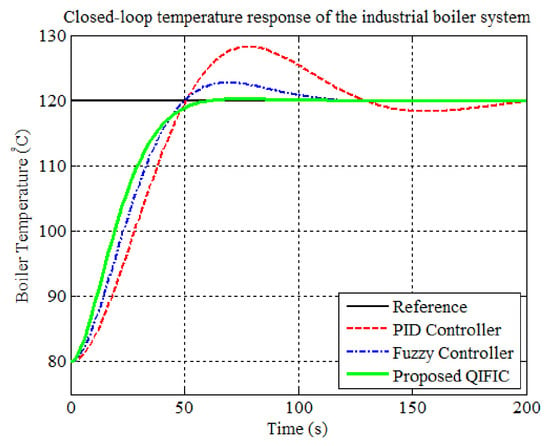
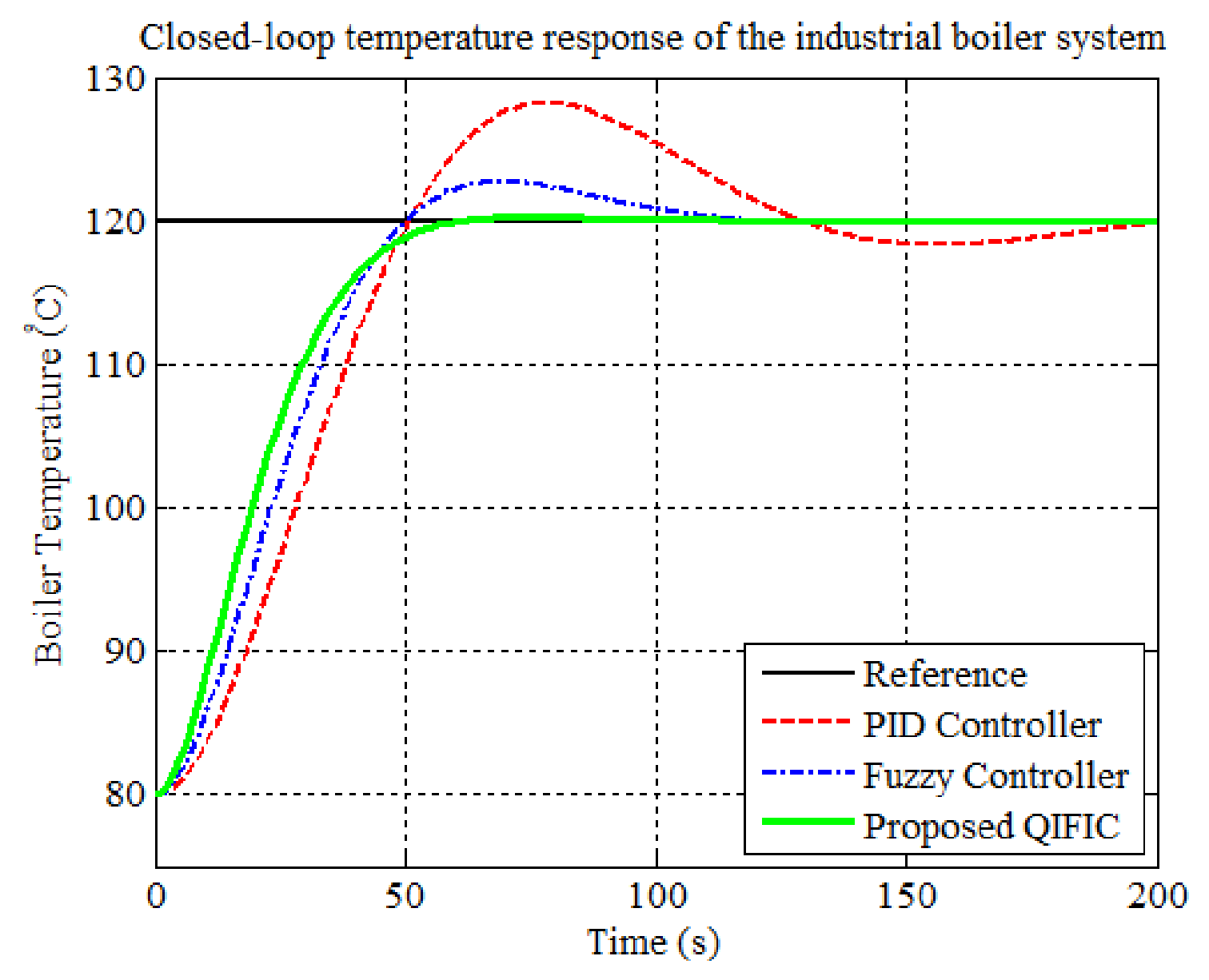
The overall control framework consists of five functional modules: process monitoring, fuzzy inference, quantum-inspired probabilistic decision-making, adaptive weighting, and control signal generation, as illustrated in Figure 1. These modules operate sequentially within a closed-loop control structure to continuously regulate the nonlinear process [14].
Figure 1.
Closed-loop temperature responses of the industrial boiler system under PID, fuzzy, and proposed QIFIC control strategies.
At each sampling instant k, the measured process output y(k) is compared with the desired reference signal r(k). The tracking error and its rate of change are calculated as
where denotes the instantaneous tracking error and Δ represents its temporal variation. These variables form the controller input vector
The fuzzy inference module transforms the numerical input variables into linguistic variables using Gaussian membership functions and evaluates the predefined Mamdani rule base. Each activated rule generates an individual candidate control action together with its corresponding firing strength. Unlike conventional fuzzy controllers, these candidate actions are not immediately aggregated but are forwarded to the quantum-inspired probabilistic decision module for further evaluation.
Within the quantum-inspired module, each candidate control action is represented by an adaptive probabilistic state. The probability associated with every candidate action is continuously updated according to the current tracking performance, allowing multiple control alternatives to be evaluated simultaneously during each control cycle. This adaptive probabilistic mechanism reinforces the most effective control actions while suppressing less appropriate alternatives, thereby improving controller flexibility and robustness under varying operating conditions.
The adaptive weighting module combines the fuzzy rule activation strengths with the updated probabilistic states to determine the contribution of each candidate control action. After normalization, the final control signal applied to the nonlinear process is expressed as
where denotes the controller output, represents the adaptive probability vector, and denotes the nonlinear mapping implemented by the proposed QIFIC framework.
The generated control signal is applied to the plant, while the resulting process output is continuously fed back to the controller for the next sampling interval. Consequently, the probabilistic decision mechanism is updated online using real-time process information without modifying the underlying fuzzy rule base. This strategy preserves computational efficiency while improving tracking accuracy, disturbance rejection capability, and closed-loop robustness.
Methodological Innovation of the Proposed QIFIC: The methodological innovation of the proposed QIFIC does not lie in the Mamdani fuzzy inference structure itself, which is intentionally retained as an interpretable baseline, nor in the general use of quantum-inspired concepts. The innovation lies in embedding a quantum-inspired adaptive probabilistic mechanism directly into the online fuzzy inference and decision stage. In a conventional Mamdani controller, activated fuzzy rules are aggregated directly according to their firing strengths to obtain a deterministic control action. In the proposed QIFIC, the activated rules instead generate multiple candidate control actions whose relative priorities are represented by adaptive probabilistic states. These probabilities are updated at each sampling instant according to the current tracking error and its variation and are then combined with the corresponding fuzzy-rule firing strengths to construct the final control signal. Therefore, unlike quantum-inspired approaches used primarily for offline optimization of membership functions, rule weights, or controller parameters, the proposed mechanism remains active throughout closed-loop operation and continuously redistributes the contributions of competing control actions without retraining or restructuring the underlying fuzzy rule base. Thus, the principal innovation is an online inference-level probability adaptation mechanism, rather than a new fuzzy rule base or a physical quantum-control implementation.
2.2. Nonlinear Process Modeling
An industrial boiler temperature control system was selected as the benchmark nonlinear technological process for evaluating the proposed Quantum-Inspired Fuzzy Inference Controller (QIFIC). Industrial boiler systems represent a challenging control application because their dynamic behavior is influenced by strong nonlinearities, thermal inertia, transport delay, uncertain operating parameters, and continuously varying external disturbances. These characteristics make boiler temperature regulation an appropriate benchmark for assessing the effectiveness of advanced intelligent control strategies [15]. The nonlinear process is represented using the following continuous-time state-space model
where denotes the system state vector, is the control input, represents external disturbances, contains uncertain process parameters, and denotes the measurable process output.
To represent modeling inaccuracies and unmodeled nonlinear dynamics, the process model is extended as
where represents bounded model uncertainties, parameter variations, and external perturbations that cannot be accurately described by the nominal mathematical model.
The primary control objective is to ensure accurate reference tracking while maintaining closed-loop stability despite disturbances and parameter uncertainties. This objective can be formulated as
or, under practical industrial operating conditions,
where is the desired reference signal and denotes the maximum acceptable steady-state tracking error.
For boiler temperature regulation, the manipulated variable corresponds to the fuel valve control signal, whereas the controlled variable is the boiler outlet steam temperature. Load variations, combustion fluctuations, and environmental influences are treated as external disturbances acting on the nonlinear process. These disturbances continuously modify the process dynamics and therefore require adaptive control actions to preserve satisfactory tracking performance.
Unlike conventional control approaches that rely on fixed process parameters, the proposed QIFIC framework continuously adapts its decision strategy according to real-time process measurements. Consequently, satisfactory control performance can be maintained even when the nonlinear process characteristics change during operation.
The nonlinear process model described in this study serves as a general benchmark representation for intelligent controller evaluation rather than an exact physical model of a specific industrial boiler. This generalized formulation enables the proposed control methodology to be readily extended to other nonlinear technological systems exhibiting similar dynamic characteristics, including thermal processes, chemical reactors, and energy conversion systems [16].
2.3. Fuzzy Inference System Design
The fuzzy inference subsystem constitutes the knowledge-based decision core of the proposed Quantum-Inspired Fuzzy Inference Controller (QIFIC). A Mamdani-type fuzzy inference system was adopted because of its high interpretability, robustness, and widespread use in industrial control applications. Compared with data-driven black-box models, Mamdani fuzzy systems allow expert knowledge to be incorporated directly into the control strategy through linguistic IF-THEN rules while maintaining transparent decision-making [17].
The controller employs two input variables: the tracking error e(k) and the error variation Δe(k). These variables describe both the instantaneous deviation from the reference signal and the dynamic behavior of the controlled process. The controller output is the normalized control action u(k), which is subsequently processed by the quantum-inspired decision module [18].
Selection of Controller Input Variables: The tracking error e(k) and error increment Δe(k) are selected as the controller input variables because they provide complementary information required for closed-loop feedback decision-making.
The tracking error e(k) = r(k) − y(k) quantifies the instantaneous magnitude and direction of the deviation from the desired reference and therefore indicates the required corrective action. However, e(k) alone does not indicate whether the controlled output is approaching the reference or moving away from it. The error increment Δe(k) = e(k) − e(k − 1) provides this dynamic information by describing the local evolution of the tracking error between consecutive sampling instants. Consequently, the pair [e(k), Δe(k)]T enables the controller to distinguish between operating conditions having similar instantaneous errors but different transient tendencies. This distinction is particularly important in QIFIC because the online probabilistic adaptation mechanism updates the relative priorities of candidate control actions according to both the magnitude of the tracking deviation and its short-term evolution. Moreover, both variables are directly calculated from the reference and measured process output, avoiding the need to estimate unmeasured internal plant states. Therefore, e(k) and Δe(k) provide a compact and practically measurable feedback representation for the proposed online decision mechanism.
To improve numerical stability and ensure uniform inference performance, the input variables are normalized to the interval
Each normalized input is represented using seven Gaussian membership functions corresponding to the linguistic variables
where NB, NM, NS, ZE, PS, PM, and PB denote Negative Big, Negative Medium, Negative Small, Zero, Positive Small, Positive Medium, and Positive Big, respectively.
{NB, NM, NS, ZE, PS, PM, PB},
Gaussian membership functions are selected because of their smoothness and continuous differentiability, which reduce abrupt transitions between neighboring fuzzy regions and improve controller stability. The membership degree of the iii-th fuzzy set is defined as
where and σi denote the center and width of the corresponding membership function.
The complete fuzzy knowledge base consists of 49 IF–THEN rules, generated from all possible combinations of the seven linguistic values associated with the two controller inputs. A typical fuzzy rule is expressed as
where , , and denote the antecedent and consequent fuzzy sets.
For each activated rule, the firing strength is calculated using the minimum t-norm operator
which determines the degree of rule activation according to the current process state.
Unlike conventional Mamdani controllers, the activated rule consequents are not immediately aggregated into a single deterministic control signal. Instead, every activated rule generates an individual candidate control action together with its corresponding firing strength. These candidate actions are transferred to the quantum-inspired probabilistic decision module, where their priorities are dynamically adjusted according to real-time process information [19,20].
This architecture represents the principal difference between the proposed QIFIC framework and classical fuzzy controllers. Rather than relying on static rule aggregation, the proposed controller preserves multiple competing control alternatives during each control cycle, thereby enabling adaptive probabilistic decision-making under uncertain operating conditions.
After probabilistic weighting has been completed, the resulting fuzzy output is converted into a crisp control signal using the centroid (center-of-gravity) defuzzification method
where denotes the aggregated output membership function and represents the universe of discourse of the output variable.
The centroid method was selected because it provides smooth control actions, good numerical stability, and high robustness against measurement noise, making it particularly suitable for nonlinear industrial process control.
Consequently, the fuzzy inference subsystem provides an interpretable knowledge-based representation of process behavior, while the subsequent quantum-inspired probabilistic module enhances decision adaptability without modifying the original fuzzy rule base. This hybrid structure preserves the transparency of classical fuzzy control while significantly improving robustness and real-time decision flexibility [21,22].
2.4. Quantum-Inspired State Representation
The principal novelty of the proposed Quantum-Inspired Fuzzy Inference Controller (QIFIC) lies in incorporating adaptive probabilistic reasoning into the fuzzy inference process. Unlike conventional fuzzy controllers, which directly aggregate activated rules into a single deterministic control action, the proposed framework preserves multiple candidate control actions and evaluates them simultaneously using a quantum-inspired probabilistic representation. This strategy enhances decision adaptability while remaining fully compatible with conventional digital control platforms.
Assume that the fuzzy inference system activates N fuzzy rules, each producing an individual candidate control action. The corresponding probabilistic state is represented by
where denotes the probability amplitude associated with the i-th candidate control action. The amplitudes satisfy the normalization condition
and the probability assigned to each control action is calculated as
The probability amplitudes are adaptively updated according to the current tracking error and its variation. The adaptive rotation angle is defined as
where and are positive adaptation coefficients.
To explicitly define the evolution of the probabilistic state, the rotation angle is applied to the amplitude representation at each sampling instant. For the i-th candidate control action, the complementary amplitude is defined as
The amplitude pair is then updated using the rotation transformation
Accordingly, the updated probability associated with the i-th candidate control action is
After updating all candidate states, the probabilities are normalized as
Interpretation of the quantum-inspired formulation: The term quantum-inspired in the proposed QIFIC refers to an algorithmic analogy rather than to a physical quantum-control implementation. The formulation adopts selected mathematical concepts associated with quantum-state representation, namely normalized amplitude-like variables, squared-amplitude probability mapping, and rotation-based state updating. However, the controller is implemented entirely using classical numerical computation and does not involve physical qubits, entanglement, quantum measurement, or Schrödinger-equation-based state evolution. The tracking-error-dependent rotation angle and the resulting redistribution of candidate-action probabilities should therefore be interpreted as heuristic adaptive probability-weighting mechanisms inspired by quantum-state mathematics rather than as direct implementations of quantum–mechanical postulates.
The updated probabilities are combined with the corresponding fuzzy rule firing strengths to determine the adaptive weighting coefficients,
where denotes the activation level of the i-th fuzzy rule.
The final control signal is obtained as
where is the candidate control action generated by the corresponding fuzzy rule.
Unlike deterministic fuzzy aggregation, the proposed QIFIC continuously redistributes the contribution of candidate control actions according to real-time operating conditions. Consequently, the controller improves tracking performance, disturbance rejection capability, and robustness while preserving the computational efficiency required for real-time industrial implementation without requiring specialized quantum hardware [21,23].
2.5. Boundedness Analysis Under an Effective Closed-Loop Error Model
Because the proposed QIFIC contains nonlinear fuzzy inference and time-varying probability-weighted aggregation, deriving an exact global closed-loop error model directly from the nonlinear boiler dynamics would require additional structural assumptions that are not established in the present simulation study. Therefore, the following analysis is not presented as a complete global stability proof of the boiler-QIFIC closed-loop system. Instead, it provides a conditional boundedness analysis based on an effective local closed-loop error representation within the considered operating region.
Assumption 1.
The reference signal r(t) and the measurable process variables are bounded within the considered operating region.
Assumption 2.
The combined effect of modeling errors, parameter variations, unmodeled nonlinear dynamics, and time-varying external disturbances is represented by d(t) and is bounded as
To connect the boundedness analysis with the QIFIC decision mechanism, recall that the control input is constructed from the probability-weighted candidate control actions defined in Section 2.4. Accordingly, K(t) is introduced here as an effective local closed-loop control gain representing the aggregate sensitivity of the probability-weighted QIFIC control action to the tracking error within the considered operating region. Thus, K(t) is not an independently designed controller gain; rather, it summarizes the combined local effect of the fuzzy-rule firing strengths, normalized adaptive probabilities, candidate control actions, and process input sensitivity.
Assumption 3.
Within the considered operating region, the effective local gain induced by the probability-weighted QIFIC action is positive and bounded,
where
and
are positive constants. This assumption represents a sufficient condition for the subsequent boundedness argument and is not claimed to constitute a global property of the nonlinear boiler-QIFIC closed-loop system.
To relate the effective error model to the closed-loop boiler-QIFIC system, the tracking error is defined as e(t) = r(t) − y(t). Differentiating yields .
For the piecewise-constant reference intervals considered in the simulations, except at reference switching instants. Within each interval, the combined local effect of the nonlinear boiler dynamics and the probability-weighted QIFIC control action is represented by the effective gain , whereas model uncertainty, parameter variations, unmodeled dynamics, and external disturbances are grouped into the bounded term d(t). Accordingly, the effective local tracking-error dynamics are represented as
where d(t) denotes the bounded lumped uncertainty and disturbance term.
Consider the Lyapunov candidate function
which is positive definite for and satisfies V(0) = 0. Its derivative along the closed-loop trajectories is
Using Assumptions 2 and 3 yields
Therefore,
Under Assumptions 1–3 and the effective local error representation in Equation (28), the tracking error satisfies a uniform ultimate boundedness (UUB) condition within the considered operating region. Specifically, after a finite transient interval, the error enters and remains within the region
This result is conditional on the validity of the effective local error model and the stated boundedness assumptions and should not be interpreted as a global stability guarantee for the complete nonlinear boiler-QIFIC closed-loop system.
In the nominal case without modeling uncertainty or external disturbances, d(t) = 0, the Lyapunov derivative satisfies
Under the assumed effective local error model and for K(t) ≥ > 0, this relation indicates asymptotic convergence of the tracking error to zero in the nominal disturbance-free case. This conclusion is conditional on the validity of the local error representation and is not claimed as a global asymptotic stability result for the complete nonlinear boiler-QIFIC closed-loop system.
Robustness under modeling errors and time-varying disturbances: The above analysis explicitly shows that bounded modeling errors, parameter variations, unmodeled dynamics, and time-varying disturbances do not violate the UUB property as long as their combined magnitude remains bounded by dˉ. The guaranteed tracking-error region is directly proportional to the uncertainty bound dˉ and inversely proportional to the minimum effective control gain Kmin. Thus, increasing uncertainty or disturbance magnitude enlarges the ultimate error bound, whereas maintaining a sufficiently large positive Kmin improves disturbance attenuation. The adaptive probabilistic mechanism of QIFIC continuously redistributes the contributions of candidate control actions in response to the current tracking condition; however, the adaptation parameters are constrained to bounded admissible ranges to preserve the stability condition.
Performance–Robustness Trade-Off: The stability result also reveals an inherent trade-off between transient performance and robustness. Increasing the adaptation strength or effective control gain can accelerate tracking-error reduction and disturbance recovery; however, excessively aggressive adaptation may increase control activity and sensitivity to measurement variations. Conversely, conservative adaptation generally produces smoother control actions and improved tolerance to measurement variations but may lead to slower convergence. Similar performance–robustness trade-offs have been emphasized in advanced process-control strategies that explicitly account for unmodeled dynamics [24]. Therefore, the QIFIC parameters are selected within bounded admissible ranges to balance tracking speed, disturbance rejection, and control smoothness while maintaining the stability condition in Equation (32) [25].
Overall, the analysis provides a conditional boundedness argument for the proposed QIFIC under the stated assumptions and within the considered operating region. It shows that, provided the effective probability-weighted closed-loop gain remains positive and bounded and the lumped uncertainty term is bounded, the corresponding effective local error model satisfies a uniform ultimate boundedness condition. In the nominal disturbance-free case, the same local model indicates asymptotic error convergence. These results are intended to complement the numerical closed-loop evaluation and should not be interpreted as a rigorous global stability proof of the complete nonlinear boiler-QIFIC system [17,26].
2.6. Controller Parameter Determination
To ensure a fair and reproducible evaluation, the proposed QIFIC was quantitatively compared with a conventional PID controller and a classical Mamdani fuzzy controller under identical simulation conditions. The PID controller was selected as a conventional industrial benchmark, whereas the classical Mamdani fuzzy controller was used as the direct structural baseline for isolating the contribution of the proposed probability-weighted inference mechanism. An adaptive fuzzy controller (AFC) was additionally considered as a methodological benchmark for distinguishing conventional online fuzzy adaptation from the proposed adaptation strategy. Once determined, all controller parameters were kept unchanged throughout the comparative simulations.
The PID controller parameters were determined through preliminary closed-loop tuning using the same nonlinear process model and operating conditions employed in the comparative simulations. The tuning procedure was performed iteratively to obtain stable closed-loop operation while balancing settling time, overshoot, disturbance-recovery performance, and control effort. Once selected, the PID parameters were kept unchanged throughout all comparative tests.
For the classical Mamdani fuzzy controller, the input variables were the tracking error e(k) and error increment Δe(k). Seven Gaussian membership functions were assigned to each input, resulting in a complete 49-rule fuzzy rule base. The input variables were normalized to their corresponding admissible operating ranges prior to fuzzy inference, and the resulting control action was mapped to the admissible actuator range. The same fuzzy input structure, membership functions, and rule base were retained in QIFIC to ensure that the comparison isolates the effect of the proposed adaptive probabilistic decision mechanism.
For QIFIC, the probabilistic adaptation parameters were selected through preliminary closed-loop simulations while satisfying the boundedness conditions established in Section 2.5. Candidate parameter values were restricted to admissible bounded ranges to prevent excessively aggressive probability updates. The parameter selection was guided by the simultaneous consideration of settling time, maximum overshoot, disturbance-recovery time, and control-signal smoothness. In particular, the error-related adaptation coefficient Ke was evaluated through a sensitivity analysis over its prescribed admissible range, and the final value was selected as a compromise between transient performance, disturbance recovery, and control variation. The remaining adaptation parameters were determined using the same bounded preliminary tuning procedure. Once selected, all QIFIC parameters were kept unchanged throughout the comparative simulations.
For the adaptive fuzzy controller (AFC), the same two-input Mamdani structure, Gaussian membership functions, and 49-rule knowledge base were employed to ensure structural consistency with the classical fuzzy and QIFIC controllers. Unlike the classical fuzzy controller, the input/output scaling factors of the AFC were adjusted online according to the instantaneous tracking error and its variation. The adaptation gains were selected through preliminary closed-loop simulations and were kept unchanged for all comparative tests after tuning. This AFC configuration is included as a methodological adaptive benchmark for architectural comparison; however, the quantitative simulation results reported in Section 3 focus on PID, classical fuzzy, and QIFIC under identical operating conditions.
The controller configurations, parameter settings, and selection procedures used for the comparative analysis are summarized in Table 1.
Table 1.
Controller configuration and parameter-selection procedure.
3. Results and Discussion
Selection of benchmark controllers: The quantitative closed-loop evaluation reported in this section compares the proposed QIFIC with two baseline strategies: a conventional PID controller and a classical Mamdani fuzzy controller. PID control is included as a widely established industrial benchmark, whereas the classical fuzzy controller provides a direct structural baseline for evaluating the contribution of the proposed probability-weighted inference mechanism. The adaptive fuzzy controller (AFC) described in Section 2.6 is retained as an additional methodological benchmark for positioning the proposed online adaptation strategy, but it is not included in the quantitative simulation figures presented in this section. Recent adaptive, quantum-inspired, and intelligent control approaches reported in the literature are additionally discussed to position the proposed method relative to current developments.
3.1. Closed-Loop Tracking Performance
The closed-loop tracking performance of the proposed Quantum-Inspired Fuzzy Inference Controller (QIFIC) was evaluated using the industrial boiler temperature control system described in Section 2. The controller was compared with conventional PID and classical fuzzy controllers under identical operating conditions to ensure a fair performance assessment. The objective was to achieve accurate reference tracking while minimizing overshoot, settling time, and oscillatory behavior.
Figure 1 presents the temperature responses obtained using the three control strategies. The conventional PID controller exhibited the slowest transient response and noticeable overshoot due to its limited adaptability to nonlinear process dynamics. The classical fuzzy controller improved the response by reducing oscillations and shortening the settling time; however, small fluctuations remained during the transient period.
In contrast, the proposed QIFIC achieved the fastest convergence to the reference value with a smooth transient response and negligible overshoot. The improved tracking performance results from the adaptive probabilistic weighting mechanism, which continuously prioritizes the most appropriate candidate control actions according to the current process state. Consequently, the controller responds more effectively to nonlinear process variations while maintaining stable closed-loop operation.
Overall, the obtained results demonstrate that the proposed QIFIC provides superior reference-tracking capability compared with both conventional PID and classical fuzzy controllers, indicating its suitability for real-time control of nonlinear industrial processes.
3.2. Disturbance Rejection Analysis
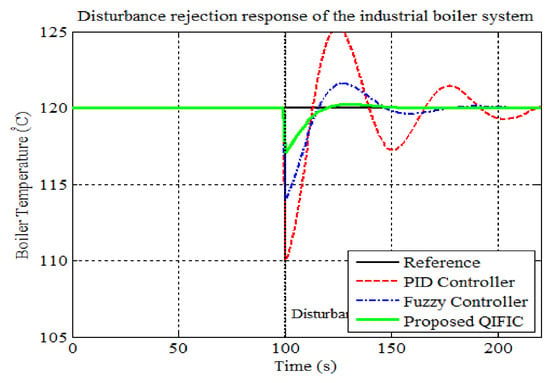
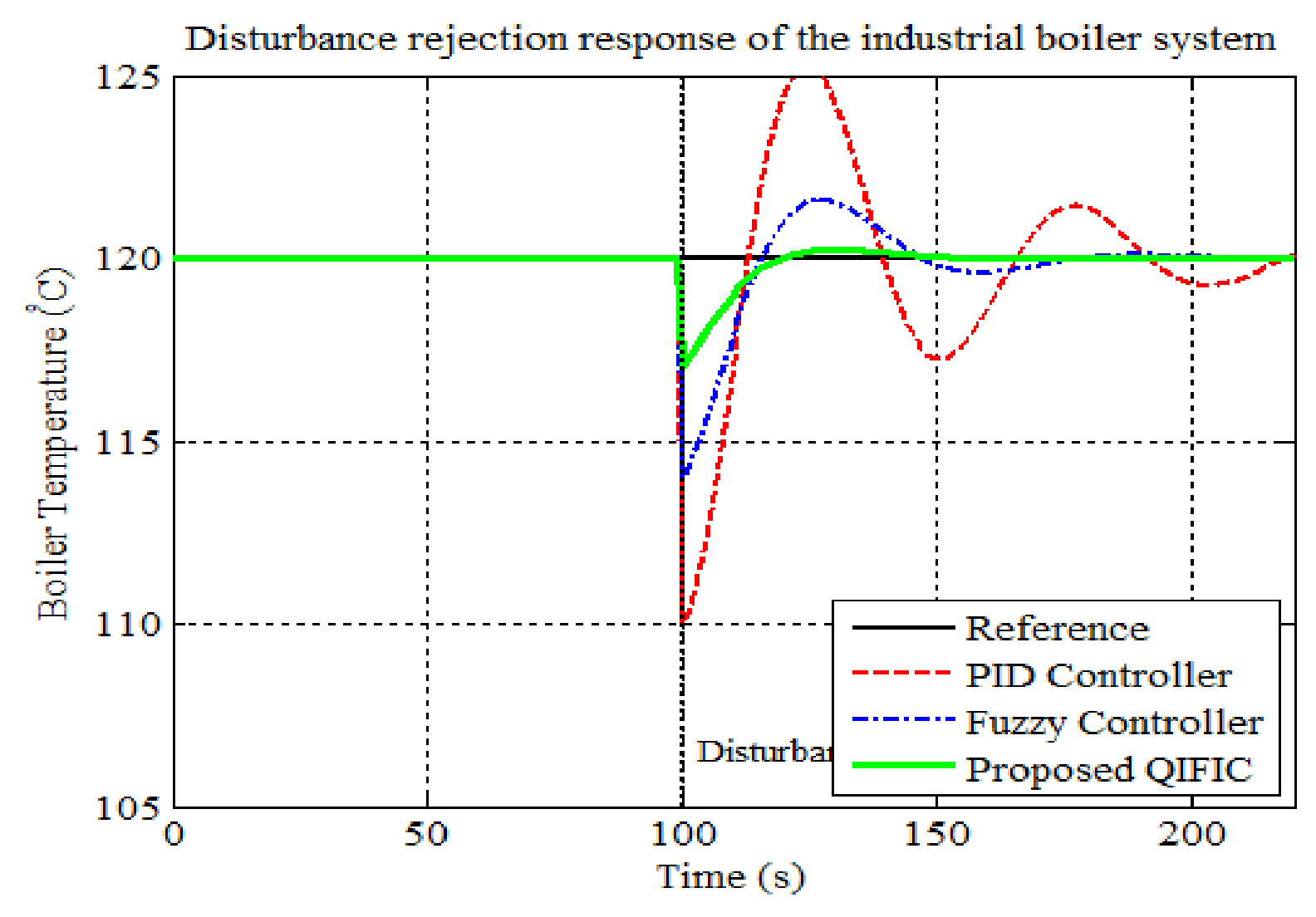
The robustness of the proposed QIFIC was further evaluated by introducing a ±20% load disturbance during closed-loop operation. The responses of the proposed controller were compared with those of the conventional PID and classical fuzzy controllers under identical simulation conditions. Figure 2 illustrates the disturbance rejection performance of the three control strategies.
Figure 2.
Disturbance rejection performance of the PID, classical fuzzy, and proposed QIFIC controllers under a ±20% load disturbance.
Following the disturbance, the PID controller exhibited the largest deviation from the reference trajectory and required the longest recovery time to restore steady-state operation. The classical fuzzy controller reduced the disturbance effect and improved the recovery process; however, noticeable oscillations remained before the system reached a new equilibrium.
In contrast, the proposed QIFIC rapidly compensated for the disturbance and restored the process output with minimal oscillation. This improvement is primarily attributed to the adaptive probabilistic weighting mechanism, which continuously adjusts the contribution of candidate control actions according to the current process conditions. As a result, the controller effectively suppresses disturbance propagation while maintaining stable and accurate reference tracking.
Overall, the results demonstrate that the proposed QIFIC provides superior disturbance rejection capability and faster recovery than both conventional PID and classical fuzzy controllers, confirming its robustness for nonlinear industrial process control under uncertain operating conditions.
3.3. Control Signal Behavior
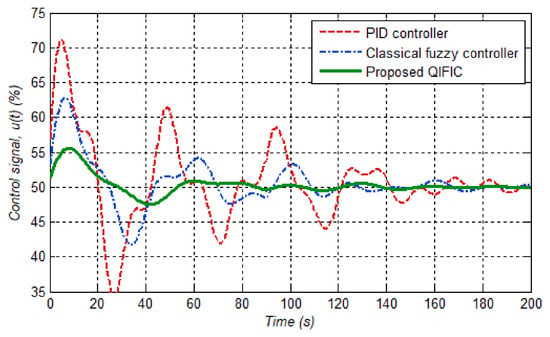
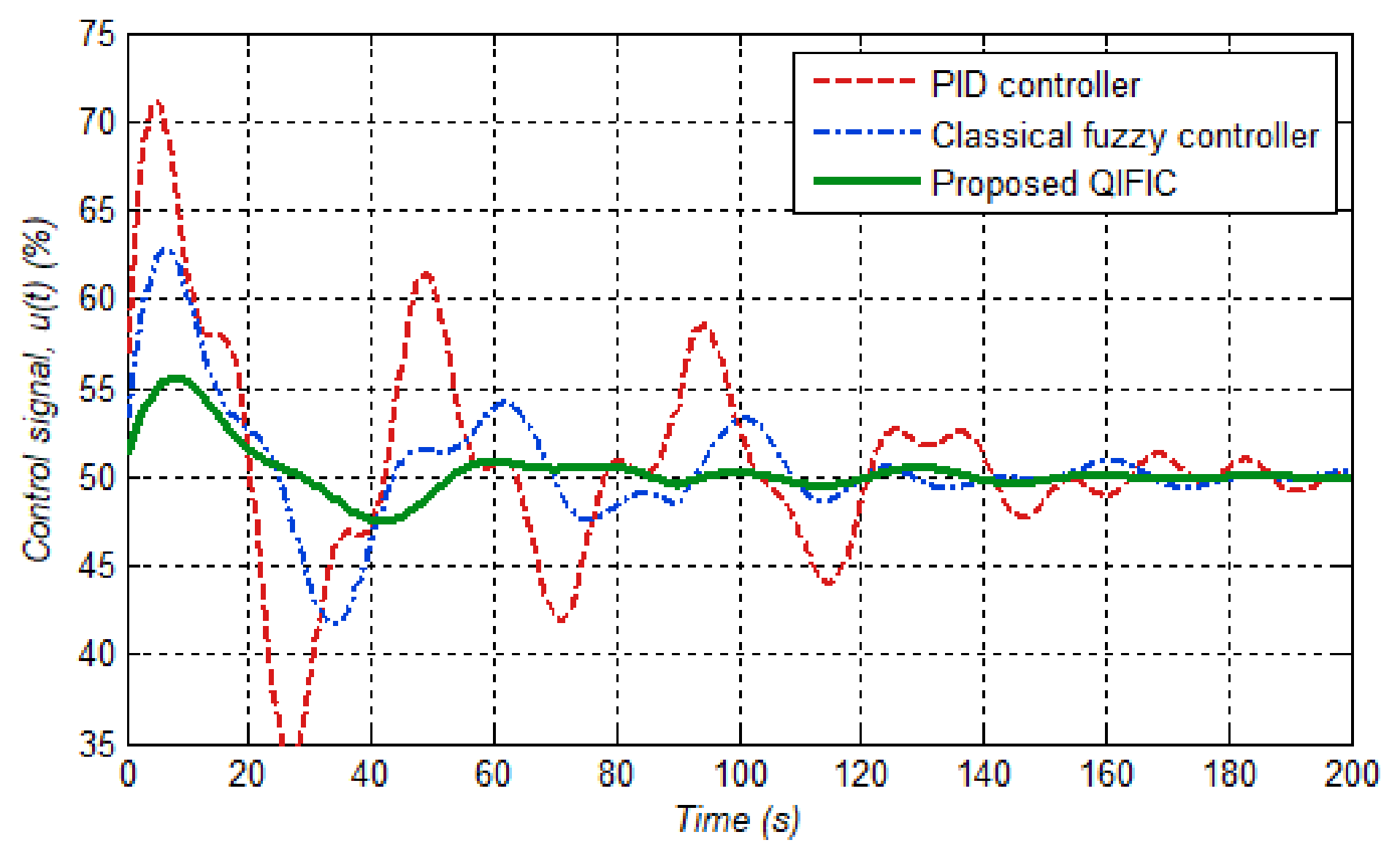
The control signals generated by the three controllers were analyzed to evaluate actuator smoothness and control efficiency during closed-loop operation. Figure 3 presents the corresponding control profiles obtained under identical simulation conditions.
Figure 3.
Control signals generated by the PID, classical fuzzy, and proposed QIFIC controllers during closed-loop operation.
The conventional PID controller produced relatively aggressive control actions characterized by large amplitude variations during the transient response. Although this behavior accelerated the initial system response, it may increase actuator wear and energy consumption in practical industrial applications. The classical fuzzy controller generated smoother control signals than the PID controller; however, abrupt control variations were still observed when the operating conditions changed rapidly.
The proposed QIFIC exhibited the smoothest control profile among the evaluated controllers. The adaptive probabilistic decision mechanism continuously redistributed the contribution of candidate control actions, preventing unnecessary fluctuations while preserving rapid system response. Consequently, the controller achieved stable regulation with reduced control effort and improved actuator operating conditions.
These results indicate that the proposed QIFIC not only improves tracking performance but also produces smoother and more stable control actions, making it well suited for real-time implementation in nonlinear industrial processes where actuator reliability and operational efficiency are critical.
3.4. Probability Evolution and Decision Adaptation
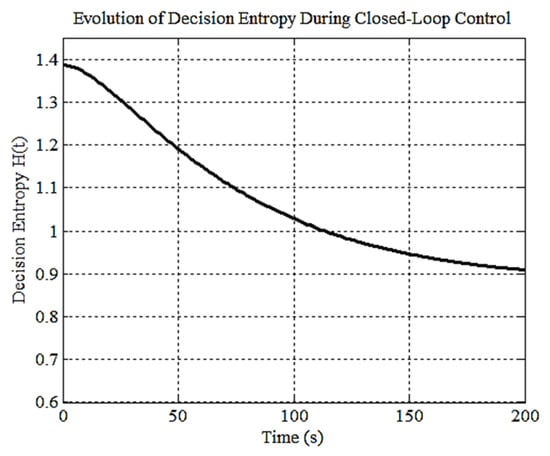
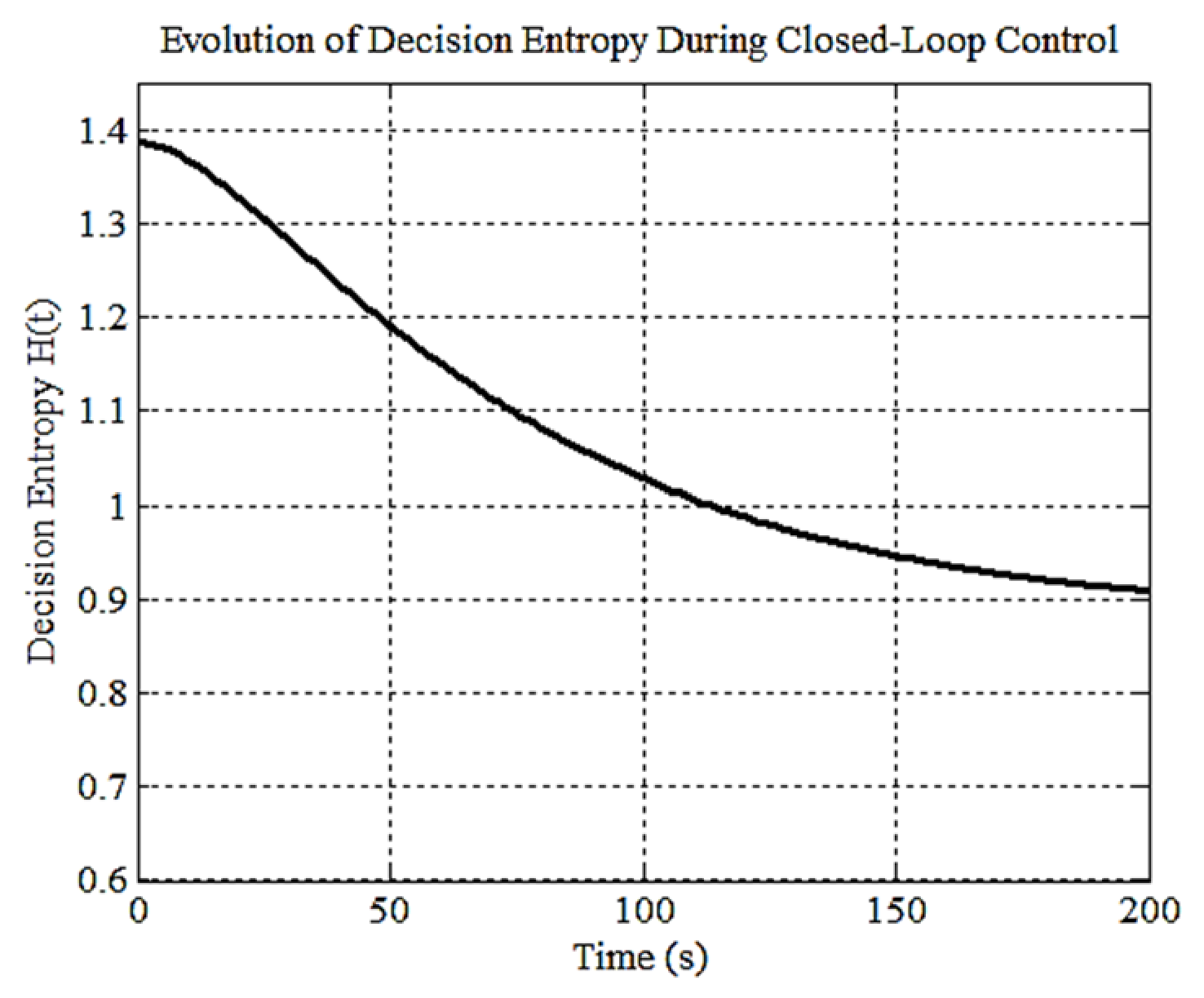
The adaptive behavior of the proposed QIFIC was further investigated by analyzing the evolution of the probability distribution assigned to the candidate control actions. Figure 4 illustrates the variation of the adaptive probabilities throughout the closed-loop control process.
Figure 4.
Evolution of quantum-inspired probabilities associated with competing control actions during closed-loop control.
At the beginning of the control process, the candidate control actions exhibited similar probability values, reflecting the absence of prior preference among the activated fuzzy rules. As the process evolved, the adaptive probability update mechanism progressively increased the contribution of control actions that improved tracking performance while reducing the influence of less effective alternatives. Consequently, the probability distribution continuously adapted to the current operating conditions without modifying the original fuzzy rule base.
This adaptive redistribution of decision priorities enables the controller to respond effectively to nonlinear dynamics, parameter uncertainties, and external disturbances. Unlike conventional fuzzy controllers employing fixed rule aggregation, the proposed QIFIC continuously updates the relative importance of candidate control actions according to real-time process information. As a result, the controller maintains stable decision-making and improved adaptability under varying operating conditions.
The results demonstrate that the proposed probabilistic decision mechanism enhances controller flexibility while preserving computational efficiency, thereby contributing to the superior closed-loop performance observed in the previous tracking and disturbance rejection analyses.
3.5. Comparative Performance Evaluation
Parameter Sensitivity Analysis: The influence of the probability-adaptation gain Ke was investigated by varying its value from 0.02 to 0.06 while keeping all other controller parameters and simulation conditions unchanged. The corresponding performance results are summarized in Table 2.
Table 2.
Sensitivity analysis of the probability-adaptation gain Kc on the closed-loop performance of the proposed QIFIC controller.
The sensitivity results show that the settling time remained essentially unchanged at 59.10 s over the investigated range of Ke, indicating that the initial convergence rate was relatively insensitive to this parameter. Increasing Ke reduced the maximum overshoot from 3.940% to 3.323%, but this improvement was accompanied by an increase in control-signal variation, with TVu increasing from 132.97 to 146.19. The shortest disturbance-recovery time of 2.00 s was obtained at Ke = 0.03. Therefore, Ke = 0.03 was selected as the final value because it provided the most favorable compromise among overshoot, disturbance-recovery performance, and control smoothness within the investigated range.
The results indicate that the proposed QIFIC consistently outperformed the conventional PID and classical fuzzy controllers across all evaluation criteria. Compared with the PID controller, the proposed approach improved the transient response, reduced overshoot, and achieved faster recovery following external disturbances. In comparison with the classical fuzzy controller, QIFIC provided smoother control actions and improved tracking accuracy while maintaining superior robustness under varying operating conditions.
The observed performance improvement is mainly attributed to the integration of fuzzy reasoning with adaptive probabilistic decision-making. Unlike conventional fuzzy controllers employing fixed rule aggregation, the proposed QIFIC continuously updates the contribution of candidate control actions according to real-time process information. This adaptive mechanism enables more effective compensation for nonlinearities, parameter uncertainties, and external disturbances without increasing computational complexity.
Overall, the comparative evaluation confirms that the proposed QIFIC provides a robust and computationally efficient control strategy for nonlinear technological processes. The consistent improvement observed across all performance metrics demonstrates the effectiveness of the proposed quantum-inspired probabilistic decision mechanism for real-time industrial control applications.
From a performance–robustness perspective, the improved transient response of QIFIC should be interpreted together with the stability conditions established in Section 2.5. Increasing the effective adaptation strength can accelerate tracking and disturbance recovery, whereas excessively aggressive adaptation may increase control activity and sensitivity to measurement variations. Conversely, conservative adaptation favors smoother control actions but may result in slower transient convergence. Therefore, the adaptation parameters are restricted to bounded admissible ranges to preserve the stability condition while balancing tracking speed, disturbance rejection, and control smoothness.
Limitations and experimental validation: The present study is limited to numerical closed-loop validation using the nonlinear boiler benchmark model. Hardware-in-the-loop, PLC-based, or embedded real-time implementation was not performed in the current work. Therefore, the reported results should be interpreted as simulation-based evidence of the proposed control strategy rather than as experimental validation of industrial implementation. Hardware-in-the-loop and PLC/embedded implementation under realistic measurement noise, communication delays, actuator constraints, and computational limitations will be addressed in future work.
4. Conclusions
This study proposed a Quantum-Inspired Fuzzy Inference Controller (QIFIC) for nonlinear technological processes subject to uncertainty and external disturbances. The proposed method extends conventional Mamdani fuzzy control by incorporating an online probability-weighted decision mechanism that adaptively prioritizes competing control actions while preserving the original fuzzy knowledge base. Comparative simulations demonstrated improved transient response, disturbance rejection, and control smoothness relative to the quantitatively evaluated PID and classical fuzzy baselines. The boundedness analysis further showed that, under the stated assumptions, the effective local tracking-error model satisfies a uniform ultimate boundedness condition in the presence of bounded modeling uncertainties and time-varying disturbances. These findings support the effectiveness of online probabilistic adaptation for nonlinear process control. Future work will focus on experimental validation and real-time implementation.
Author Contributions
Conceptualization, K.U. and S.S.; methodology, K.U. and N.Y.; formal analysis, N.Y.; investigation, S.S. and F.S.; resources, K.U.; data curation, N.Y.; writing—original draft preparation, S.S.; writing—review and editing, F.S. and N.Y.; visualization, K.U. and S.S.; supervision, N.Y. All authors have read and agreed to the published version of the manuscript.
Funding
This research received no external funding.
Institutional Review Board Statement
Not applicable.
Informed Consent Statement
Not applicable.
Data Availability Statement
The data presented in this study are available on request from the corresponding author.
Conflicts of Interest
The authors declare no conflicts of interest.
References
- Ansari, T.S.; Taqvi, S.A.A. State-of-the-Art Review on the Applications of Nonlinear and Artificial Intelligence-Based Controllers in Petrochemical Processes. ChemBioEng Rev. 2023, 10, 884–906. [Google Scholar] [CrossRef] [Scilit]
- Hu, N. The Limitations of Traditional PID Controllers and Modern Optimization Methods. ACE 2025, 147, 238–244. [Google Scholar] [CrossRef] [Scilit]
- Li, Y.; Ang, K.H.; Chong, G. PID control system analysis and design. IEEE Control Syst. 2006, 26, 32–41. [Google Scholar] [CrossRef] [Scilit]
- Baczyński, M.; Grzegorzewski, P.; Mesiar, R.; Helbin, P.; Niemyska, W. Fuzzy implications based on semicopulas. Fuzzy Sets Syst. 2017, 323, 138–151. [Google Scholar] [CrossRef] [Scilit]
- Liao, R.F.; Chan, C.W.; Hromek, J.; Huang, G.H.; He, L. Fuzzy logic control for a petroleum separation process. Eng. Appl. Artif. Intell. 2008, 21, 835–845. [Google Scholar] [CrossRef] [Scilit]
- Yang, Y.; Zhou, C. Robust adaptive fuzzy tracking control for a class of perturbed strict-feedback nonlinear systems via small-gain approach. Inf. Sci. 2005, 170, 211–234. [Google Scholar] [CrossRef] [Scilit]
- Yakubova, N.; Usmanov, K.; Sadikova, F.; Sadikova, S. Adaptive Fuzzy Control of Petroleum Extraction Columns Using Quantum-Inspired Optimization. Eng. Proc. 2025, 117, 45. [Google Scholar] [CrossRef] [Scilit]
- Guesmi, T.; Alshammari, B.M.; Welhazi, Y.; Abdallah, H.H.; Toumi, A. Robust Fuzzy Control for Uncertain Nonlinear Power Systems. Mathematics 2022, 10, 1463. [Google Scholar] [CrossRef] [Scilit]
- Litvintseva, L.V.; Ulyanov, S.V.; Ulyanov, S.V. Robust PID Controller Design on Quantum Fuzzy Inference: Imperfect KB Quantum Self-Organization Effect-Quantum Supremacy Effect. Artif. Intell. Adv. 2020, 2, 59–70. [Google Scholar] [CrossRef] [Scilit]
- Liu, X.; Dai, J.; Chen, J.; Zhang, C. A fuzzy α -similarity relation-based attribute reduction approach in incomplete interval-valued information systems. Appl. Soft Comput. 2021, 109, 107593. [Google Scholar] [CrossRef] [Scilit]
- Essa, F.A.; Elaziz, M.A.; Elsheikh, A.H. An enhanced productivity prediction model of active solar still using artificial neural network and Harris Hawks optimizer. Appl. Therm. Eng. 2020, 170, 115020. [Google Scholar] [CrossRef] [Scilit]
- Du, M.; Yu, H.; Zhu, Y.; Chen, J.; Zhang, X.; Wang, Q.; Niu, Y. A refined control-oriented model for the subcritical boiler-turbine system based on novel hybrid modeling method. Appl. Therm. Eng. 2026, 282, 128806. [Google Scholar] [CrossRef] [Scilit]
- Yakubova, N.; Siddiqov, I.; Usmanov, K.; Turakulov, Z.; Akramkhodjayev, Y. Quantum-Fuzzy Adaptive Control Architecture for Nonlinear Dynamic Systems in Industrial Automation. Eng. Proc. 2026, 124, 102. [Google Scholar] [CrossRef] [Scilit]
- Fazilat, M.; Zioui, N. Quantum-Inspired Sliding-Mode Control to Enhance the Precision and Energy Efficiency of an Articulated Industrial Robotic Arm. Robotics 2025, 14, 14. [Google Scholar] [CrossRef] [Scilit]
- Janta-Lipińska, S.; Shkarovskiy, A.; Chrobak, Ł. Improving the Fuel Combustion Quality Control System in Medium Power Boilers. Energies 2024, 17, 3055. [Google Scholar] [CrossRef] [Scilit]
- Altafini, C.; Ticozzi, F. Modeling and Control of Quantum Systems: An Introduction. IEEE Trans. Autom. Control 2012, 57, 1898–1917. [Google Scholar] [CrossRef] [Scilit]
- Vidal-Martínez, R.; García-Martínez, J.R.; Rojas-Galván, R.; Álvarez-Alvarado, J.M.; Gozález-Lee, M.; Rodríguez-Reséndiz, J. A Review of Mamdani, Takagi–Sugeno, and Type-2 Fuzzy Controllers for MPPT and Power Management in Photovoltaic Systems. Technologies 2025, 13, 422. [Google Scholar] [CrossRef] [Scilit]
- Angelov, P.P.; Models, E.R.-B. Evolving Rule-Based Models; Studies in Fuzziness and Soft Computing; Physica: Berlin/Heidelberg, Germany, 2002; Volume 92. [Google Scholar] [CrossRef] [Scilit]
- Yakubova, N.; Istanbullu, A.; Siddiqov, I.; Usmanov, K. Hybrid Quantum-Fuzzy Control for Intelligent Steam Heating Management in Thermal Power Plants. Eng. Proc. 2025, 117, 33. [Google Scholar] [CrossRef] [Scilit]
- Park, J.B.; Lee, J.Y. Nonlinear Adaptive Control based on Lyapunov Analysis: Overview and Survey. J. Inst. Control Robot. Syst. 2014, 20, 261–269. [Google Scholar] [CrossRef] [Scilit]
- Liu, C.; Liu, X.; Wang, H.; Lu, S.; Zhou, Y. Adaptive Control and Application for Nonlinear Systems with Input Nonlinearities and Unknown Virtual Control Coefficients. IEEE Trans. Cybern. 2022, 52, 8804–8817. [Google Scholar] [CrossRef] [Scilit]
- Zhao, W.; Liu, Y.; Liu, L. Observer-Based Adaptive Fuzzy Tracking Control Using Integral Barrier Lyapunov Functionals for ANonlinear System with Full State Constraints. IEEE/CAA J. Autom. Sin. 2021, 8, 617–627. [Google Scholar] [CrossRef] [Scilit]
- Jiang, D.; Jiang, W.; Zhu, X.; Yin, X. Adaptive control for full-states constrained nonlinear systems with unknown control direction using Barrier Lyapunov Functionals. Trans. Inst. Meas. Control 2022, 44, 2967–2977. [Google Scholar] [CrossRef] [Scilit]
- Peng, B.; Shi, H.; Chai, T.; Su, C.; Li, P. Improved Predictive Functional Control Based on Unmodeled Dynamics Compensation for Ethylene Cracking Furnace. IEEE Trans. Ind. Electron. 2026, 1–13. [Google Scholar] [CrossRef] [Scilit]
- Bobyr, M. Design and implementation of a fuzzy MISO system with quantum computing analogies. Quantum Inf. Process. 2025, 24, 318. [Google Scholar] [CrossRef] [Scilit]
- Amilo, D. A quantum-inspired neural fuzzy sliding mode control framework for fractional-order modeling of intraocular pressure regulation and optic nerve damage in glaucoma. Sci. Rep. 2025, 15, 23438. [Google Scholar] [CrossRef] [Scilit]

Disclaimer/Publisher’s Note: The statements, opinions and data contained in all publications are solely those of the individual author(s) and contributor(s) and not of MDPI and/or the editor(s). MDPI and/or the editor(s) disclaim responsibility for any injury to people or property resulting from any ideas, methods, instructions or products referred to in the content. |
© 2026 by the authors. Licensee MDPI, Basel, Switzerland. This article is an open access article distributed under the terms and conditions of the Creative Commons Attribution (CC BY) license.