


Abstract
An AI-driven visual effect generation system was developed and evaluated. The system showed a throughput of over 30 assets/hour. Analytic hierarchy process modeling revealed that feedback-driven engineering support dominated user technical competence (weight ). Directed guidance scaffolding was significantly and inversely related to realized technical competence (), while reflective debugging evaluation negatively impacted creative asset generation (). To optimize skill acquisition, adaptive training systems must prioritize structured, automated feedback over open-ended heuristic discussion to mitigate cognitive bottlenecks.
1. Introduction
With the rapid proliferation of generative AI, the technical workflows of the media and cinematographic industries are undergoing a profound change. Modern visual effects (VFX) production increasingly relies on machine learning models as core functional nodes, necessitating their seamless integration into automated, software-defined media pipelines and cloud-based computational design infrastructures [1,2]. This change reflects trends in engineering informatics, where intelligent automation and deep neural architectures are reshaping simulation, rendering, and rapid prototyping across complex industrial environments [3].
In media engineering, the transition from manual, script-based digital asset creation to deep-learning-guided synthesis introduces significant systems-engineering challenges, particularly in ensuring runtime computational reliability, validating outputs, and optimizing human–computer interaction efficiency. In contemporary media content development, procedural generation tasks are governed by design heuristics, systematic operational criteria that enable developers to manage data uncertainty, validate generative fidelity, and maintain pipeline stability. However, there is a challenge in deploying generative AI in educational and professional training environments. Novice operators lack the technical framework required to evaluate structural anomalies in AI outputs, which leads to compounding errors during downstream rendering and compositing stages [4]. To address this issue, specialized software engines are used, capable of abstract generation and structured, procedural rendering systems [5].
To overcome this challenge, we developed and evaluated an interactive AI-driven VFX asset generation system that embeds text-to-image and procedural refinement algorithms within a modular framework. This system enables students to engage with complex asset pipelines through a structured, iterative design loop, thereby enhancing both technical competency and creative fluency. The system supports media engineering informatics by formulating a systems-oriented framework that integrates generative AI models directly into modular educational VFX, quantifying the impact of human-in-the-loop diagnostic heuristics on engineering proficiency, creative output, and cognitive load, and establishing an optimization model based on the analytic hierarchy process (AHP) for the development of adaptive computer-assisted training systems.
2. Background Knowledge: AI in Learning
When embedding AI-generated content in technical workflows, the issue is no longer whether practitioners can use AI but whether they can use it effectively. Therefore, AI literacy has become an engineering competency. It requires a basic understanding of algorithmic processes and the ability to assess output quality, detect errors, and apply AI tools within system constraints. This connects to heuristic approaches, which emphasize guided discovery, questioning, and active reasoning rather than one-way instruction. In engineering practice, heuristics extend to human–AI collaboration, where practitioners must learn to frame precise technical queries, validate AI-generated artifacts, and recognize system limitations. AI literacy is thus a prerequisite for reliable integration of generative systems into engineering design and production pipelines [6].
In AI-supported learning, communication remains central to knowledge transfer. Access to AI tools does not guarantee clarity or effectiveness; much depends on how instructors frame problems, respond to uncertainty, and sustain meaningful interaction. Studies show that AI can augment dialogic teaching rather than replace it, enabling new forms of collaborative discourse between humans and machines [7]. Conversational design frameworks shape how teachers and learners engage with AI outputs [8], while AI-based discourse analysis tools provide feedback loops for instructional refinement [9]. Technical interruptions can even support learning by creating opportunities for explanation or system-level redirection [10]. The challenge is not simply whether AI enters classroom dialogue, but whether language strategies ensure that human–AI interaction remains interpretable, responsive, and technically grounded.
The cognitive load theory (CLT) is used to explain how instructional designs support learning more effectively than others. Because working memory is limited, instructional workflows must reduce unnecessary cognitive burden and optimize knowledge acquisition. CLT distinguishes intrinsic, extraneous, and germane load, each relevant to complex technical training. Content segmentation, worked examples, and staged demonstrations reduce extraneous load and improve performance [11,12]. In AI-supported and interdisciplinary engineering contexts, CLT is especially relevant because learners often face unfamiliar technical content and tools simultaneously. From a systems perspective, CLT guides scaffolding, task calibration, and the balance between challenge and support, ensuring that AI integration does not overwhelm cognitive resources [13].
Interdisciplinary teaching is widely used in engineering education, but it requires learners to acquire new content knowledge and adapt to unfamiliar reasoning modes. Structured course design and scaffolding are therefore essential to support critical thinking, metacognition, and knowledge transfer. Well-organized interdisciplinary teaching improves adaptability and performance, particularly when technical and creative demands converge. In this study, integrating visual effects into broader learning environments is not simply adding technical skills to non-technical majors; it represents a complex interaction of creative practice, technical terminology, and cognitive demands. From an engineering perspective, examining the relationship among language strategies, heuristic processes, and performance outcomes helps explain why some learners adapt successfully while others experience cognitive overload. This understanding supports the development of scalable frameworks for interdisciplinary engineering education and system-level design integration [14].
3. Materials and Methods
3.1. System Architecture
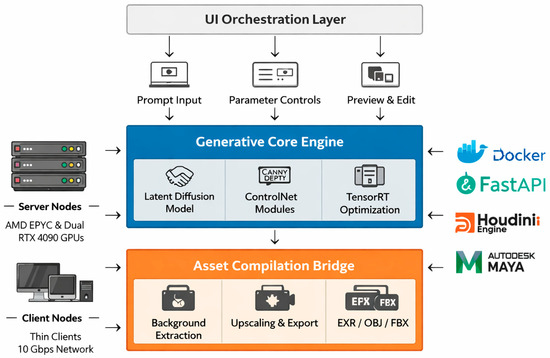
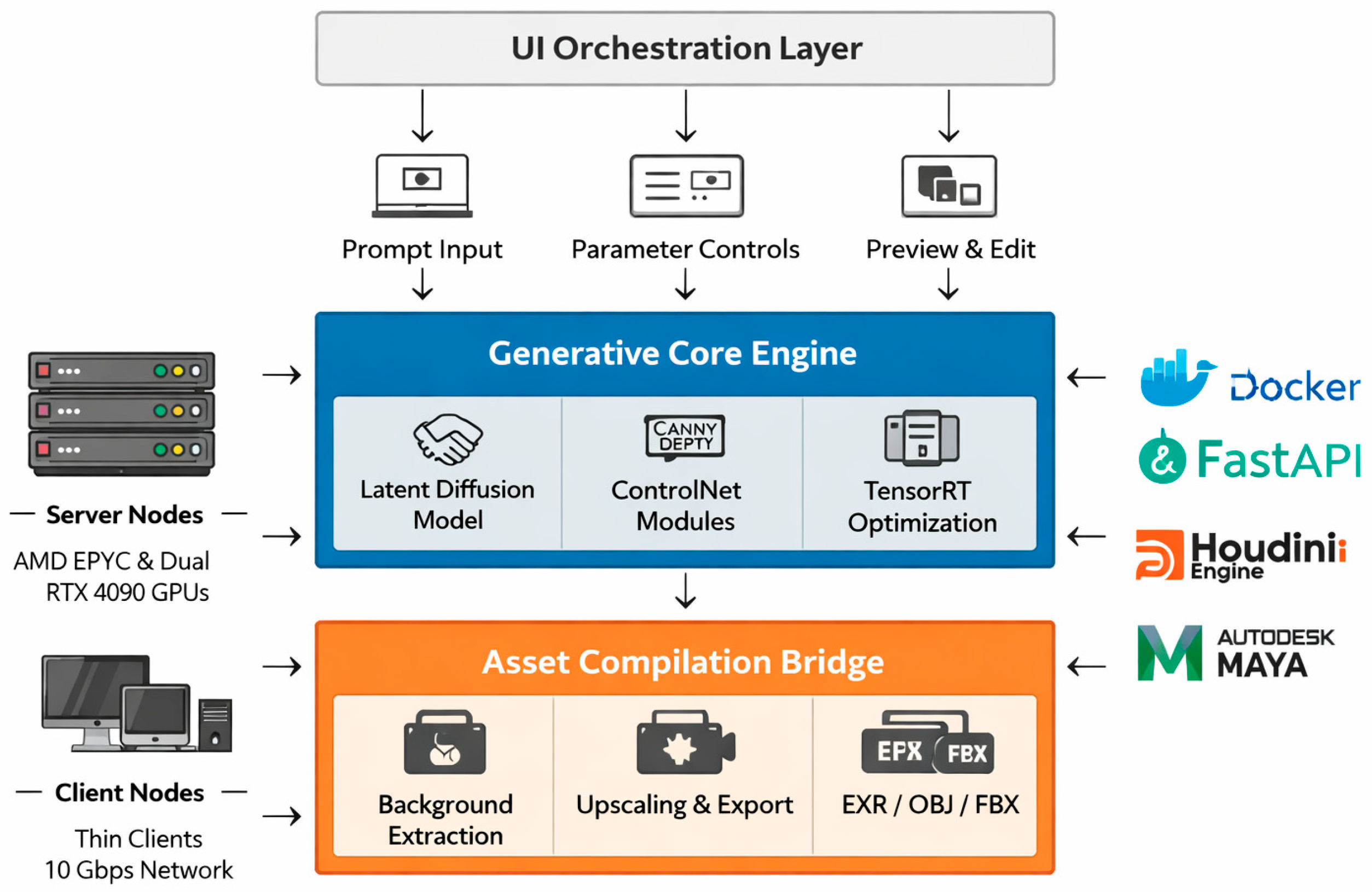
For rapid asset prototyping and technical competency acquisition, a specialized, client server AI-driven VFX asset generation engine was developed and integrated into the production workflow. The system comprises three core functional layers: the user interface (UI) orchestration layer, the generative core engine, and the downstream asset compilation bridge (Figure 1).
Figure 1.
Architectural diagram of the developed AI-based VFX system (GPU: graphics processing unit).
- UI orchestration layer is built using a lightweight Web UI framework, providing an integrated development environment for prompt engineering, negative prompt configurations, and hyperparameter tuning for classifier-free guidance scales and denoising strengths;
- Generative Engine is built upon an open-source latent diffusion architecture (Stable Diffusion XL) and optimized using NVIDIA TensorRT execution engines. It includes modular ControlNet pipelines to enforce structural, edge-based (), and depth-based () constraints on generated outputs;
- Downstream asset compilation: A dedicated automation layer written in Python 3.10 that handles automated background extraction, high-resolution upscaling (via Real-ESRGAN), and formatted file export, such as OpenEXR layers or OBJ/FBX point-cloud boundaries, for standard VFX rendering.
Through this automated pipeline, operators can synthesize high-fidelity concept assets, achieving a generation throughput of over 30 production-ready asset sketches per hour, compared to the manual bottleneck of traditional pre-visualization workflows.
The VFX generative engine was deployed in a high-performance local area network (LAN) computing environment to ensure minimum latency and cross-platform reliability. The hardware environment included dedicated deep learning server nodes equipped with AMD EPYC 7763 processors (64 cores, 2.45 GHz), 256 GB of Error-Correcting Code Double Data Rate 4, and dual enterprise-grade NVIDIA RTX 4090 GPUs (24 GB graphics double data rate 6x video random access memory) connected via NVLink. Client nodes were implemented as thin-client workstations linked through a 10 Gbps fiber network switch, which minimized data packet delivery delays during high-resolution asset inference.
The software was operated on an Ubuntu 22.04.3 Long Term Support, running Compute Unified Device Architecture Toolkit 12.2 and PyTorch 2.1. Service deployment was managed through Docker containers, orchestrated by a Python-based Fast application programming interface (API) gateway. Integration with standard digital content creation software was achieved through the Houdini Engine API and specialized machine-learning compositing nodes in Autodesk Maya.
3.2. Performance Evaluation
To evaluate the system’s operational efficiency, stability, and its impact on technical capability acquisition, a survey was conducted within a university media engineering pipeline. The experimental group included 56 fourth-year interdisciplinary students (10 males, 46 females; mean age = 21) enrolled in a visual effects production course. In the group, 14.3% (8 students) possessed prior formal coursework in media production, establishing an ideal cohort to test the engine’s capability to mitigate the “knowledge threshold” barrier.
The system’s performance and instructional reliability were assessed using a structured user questionnaire survey distributed immediately after the asset generation pipeline sprint. In the questionnaire survey, a 5-point Likert scale was used. System usability and interaction strategy were assessed using the Teacher Language Strategy Perception Scale, which measures open questioning, discussion guidance, feedback encouragement, and peer interaction guidance. This captured how human-in-the-loop instructional inputs influenced pipeline operation. Cognitive architecture and workflow usability were examined through the heuristic teaching experience scale, which evaluates intentionality, guided inquiry, reflective discussion, and media practice and identifies the extraneous and intrinsic cognitive load imposed by the software engine. Technical performance was measured with the learning effectiveness self-assessment scale, which includes indicators of technical competence (TC), creative thinking (CAT), collaborative competence (CSC), and metacognitive competence (MRC).
To rank the technical and instructional variables that govern optimal engine utilization, AHP was used. A panel of 15 experts, comprising senior VFX pipeline engineers, core system instructors, and media informatics researchers, completed a pairwise comparison matrix using Saaty’s 1–9 scale method. The relative importance vectors () were calculated by solving the characteristic equation:
Here, represents the expert judgment matrix and is the maximum eigenvalue. To guarantee structural validity, the consistency index () and consistency ratio () were computed:
Only matrices passing the consistency verification threshold () were aggregated into the final engineering optimization model, ensuring that the prioritized operational pathways were sound.
4. Results and Discussions
The internal consistency and construct validity of the multi-dimensional system evaluation framework were mathematically verified using Cronbach’s . The HITL Instructional Interfacing scale demonstrated high internal consistency with an overall , with sub-dimensional variables ranging from for open query support (OQS) to for directed guidance scaffolding (DGS). The heuristic system usability scale (overall ) and the user competency self-assessment scale (overall ) both comfortably exceeded the standard statistical reliability threshold of . These diagnostic metrics confirm that the user survey design provides highly reliable, stable data suitable for modeling and optimizing operator competency within AIGC-enhanced VFX production environments.
Pearson correlation analyses indicate significant, highly systematic interrelationships among the human-in-the-loop instructional interface variables (). As detailed in Table 1, the peak correlation observed between DGS and feedback-driven engineering support (FES) () suggests that these two control loops function as a unified, cohesive instructional interface during complex asset compilation tasks.
Table 1.
Correlations among dimensions of questionnaires in the teacher language strategy.
In contrast, the sub-dimensions of the heuristic system usability framework exhibit strong statistical independence from one another, with weak, statistically non-significant correlations ranging from to (). This structural orthogonality (Table 2) validates the decision to treat these heuristic dimensions as separate, independent input parameters within the downstream Analytic Hierarchy Process (AHP) systems optimization model.
Table 2.
Correlations among dimensions of questionnaires in the heuristic teaching experience.
An analysis of the user competency self-assessment metrics (Table 3) shows that subjective gains in TC, CAT, and MRC are significantly and positively co-dependent (0.436 ≤ r ≤ 0.823). This demonstrates that within deep-learning-supported VFX pipelines, high-level structural understanding of software execution and spatial visualization are tightly coupled with hands-on mechanical execution.
Table 3.
Correlations among dimensions of questionnaires in the learning effectiveness self-assessment.
Significant negative correlations between unstructured, high-intensity human-in-the-loop verbal interventions and technical pipeline execution were observed (Table 4). DGS was significantly and inversely related to the operators’ realized TC (r = −0.424, p = 0.001). For novices, excessive verbal prompting and open-ended pedagogical discussion act as cognitive bottlenecks that degrade task execution efficiency and lower user confidence within automated generative systems.
Table 4.
Correlations between teacher language strategies and learning effectiveness dimensions.
Reflective debugging evaluation (RDE) was negatively correlated with CAT (r = −0.378, p = 0.004) (Table 5). Similarly, active media pipeline training engagement (MPTE) negatively impacted CSC (r = −0.303, p = 0.023). These results indicate that unstructured heuristic tasks and open-ended, unscaffolded design explorations introduce extraneous cognitive load. Instead of enhancing creativity, these open-ended exercises degrade performance by confusing non-specialist operators, resulting in a breakdown in collaborative asset compilation and system validation workflows.
Table 5.
Correlation between heuristic teaching experiences and learning outcomes dimensions.
To prioritize variables and establish an optimized system-level control framework, the AHP weights were evaluated. FES was identified as the primary driver for maximizing TC, exhibiting a dominant priority weight of 0.38. This was followed by structured DGS with an engineering priority weight of 0.29. Conversely, RDE yielded the lowest contribution to asset generation and system optimization, with a priority weight of only 0.12. The hierarchy derived from AHP provides a concrete, quantitative blueprint for structuring adaptive computer-assisted media engineering systems. The results suggest that system developers and curriculum designers must prioritize automated, real-time feedback loops and structured step-by-step pipeline guidance (high-weight parameters) over open-ended, reflective debugging tasks (low-weight parameters) to optimize user technical competency.
5. Conclusions
We examined how human-in-the-loop instructional strategies, heuristic system usability, and user performance interact in AI-enhanced VFX engineering. Using a custom-built client–server generative engine, we developed a quantitative, systems-oriented framework to analyze how automated asset compilation and human intervention jointly shape skill acquisition. The results reveal statistically verified relationships that challenge conventional pedagogical models in interdisciplinary engineering contexts.
A strong inverse relationship was found between unstructured, high-intensity verbal scaffolding and hands-on performance. DGS showed a significant negative correlation with TC (), indicating that excessive verbal prompting during automated execution creates cognitive bottlenecks that reduce task efficiency and operator confidence. RDE was negatively correlated with CAT (), suggesting that open-ended reflective tasks impose extraneous cognitive load and hinder creative output among novice operators. Similarly, MPTE negatively affected CSC (), showing that unstructured practice sessions can isolate operators and disrupt coordinated asset validation workflows.
AHP analysis results provided a mathematical basis for addressing these challenges. FES received the highest priority weight (), followed by structured DGS (), and reflective debugging contributed least to system optimization (0.12). This result demonstrates that maximizing engineering competency and asset validation throughput, at over 30 high-fidelity drafts per hour with our engine, requires prioritizing automated, real-time feedback loops and progressive task staging. These strategies reduce the knowledge threshold barrier and enhance pipeline reliability for non-specialist users.
The study’s limitations include a modest sample size (N = 56), a single-course context, and reliance on self-reported performance data. The developed system needs to be expanded to larger, multi-institutional groups by integrating objective data and implementing adaptive features. However, the results of this study indicate that machine-learning-driven scaffolding systems dynamically manage cognitive load in real time.
Author Contributions
Conceptualization, M.-Y.F. and C.-C.C.; methodology, M.-Y.F. and C.-C.C.; software, C.-C.C.; validation, M.-Y.F., C.-C.Z. and C.-C.C.; investigation, C.-C.Z.; data curation, M.-Y.F., C.-C.Z. and Y.C.; writing—original draft preparation, M.-Y.F.; writing—review and editing, C.-C.C.; supervision, C.-C.C. All authors have read and agreed to the published version of the manuscript.
Funding
This research received no external funding.
Institutional Review Board Statement
The study was conducted in accordance with the Declaration of Helsinki, and approved by the Ethics Committee of Dongguan City University (protocol code 2026-0001 and 9 March 2026 of approval).
Informed Consent Statement
Informed consent was obtained from all subjects involved in the study.
Data Availability Statement
Prior to the formal administration of the survey, this study strictly adhered to institutional research ethics guidelines. A detailed informed consent statement was provided at the beginning of the questionnaire, explicitly informing participants of the research objectives, completion instructions, and terms of participation. Participation was entirely voluntary, and respondents reserved the right to withdraw at any stage without penalty. To ensure participant confidentiality, data collection was conducted anonymously, with no personally identifiable information collected. All retrieved data were subject to rigorous access controls and encrypted storage, restricted solely to the research team for aggregate statistical analysis, with strict safeguards against unauthorized access or commercial use. The raw survey data supporting the findings of this study are available from the corresponding author upon reasonable request at g7190313@gmail.com.
Conflicts of Interest
The authors declare no conflict of interest.
References
- University of Wisconsin-Stout. Available online: https://www.uwstout.edu/about-us/news-center/vanguard-artificial-intelligence-filmmaking-course-emerges-uw-stout (accessed on 14 April 2026).
- Sánchez-Ruiz, L.M.; Llobregat-Gómez, N.; Vega-Fleitas, E.; Moll-López, S. AI Competency Assessment and Ranking: A Framework for Higher Education. Appl. Sci. 2025, 15, 12248. [Google Scholar] [CrossRef] [Scilit]
- Jin, W.; Wang, N.; Zhang, L.; Tian, X.; Shi, B.; Zhao, B. A Review of AI-Driven Automation Technologies: Latest Taxonomies, Existing Challenges, and Future Prospects. Comput. Mater. Contin. 2025, 84, 3961–4018. [Google Scholar] [CrossRef] [Scilit]
- Chen, P.-K.A. Guiding or misleading: Challenges of artificial intelligence-generated content in heuristic teaching: ChatGPT. Eng. Proc. 2025, 103, 1. [Google Scholar] [CrossRef] [Scilit]
- Rubio Tamayo, J.L.; Serna Bernal, M.A. Development of a Generative AI-Based Workflow for the Design and Integration of 3D Assets in XR Environments for Research. Multimedia 2026, 2, 6. [Google Scholar] [CrossRef] [Scilit]
- Joshi, S.S.; Rambola, K.R.; Churi, P. Evaluating Artificial Intelligence in Education. Phys. Conf. Ser. 2021, 1714, 012039. [Google Scholar] [CrossRef] [Scilit]
- Li, K.; Wang, P.; Chen, G. How can AI be integrated into teacher professional development programs? A systematic review based on an adapted technology-based learning model. Teach. Teach. Educ. 2025, 168, 105219. [Google Scholar] [CrossRef] [Scilit]
- Chen, S.; Molnar, I.R.; Li, P.; Acunin, A.; Hua, T.; Ambrose, A.; Chawla, N.V.; Metoyer, R. Exploring Conversational Design Choices in LLMs for Pedagogical Purposes: Socratic and Narrative Approaches for Improving Instructor’s Teaching Practice. arXiv 2025. [Google Scholar] [CrossRef] [Scilit]
- Wang, D.; Chen, G. Evaluating the use of BERT and Llama to analyse classroom dialogue for teachers‘ learning of dialogic pedagogy. Br. J. Edu. Technol. 2025, 56, 2671–2704. [Google Scholar] [CrossRef] [Scilit]
- Jakonen, T.; Duran, D.; Peltonen, P. Situated L2 pronunciation instruction during small-group robot-assisted language learning activities. Lang. Teach. Res. 2025, 30, 13621688251367852. [Google Scholar] [CrossRef] [Scilit]
- Mehta, N.; Benjamin, J.; Agrawal, A.; Valanci, S.; Masters, K.; MacNeill, H. Addressing educational overload with generative AI through dual coding and cognitive load theories. Med. Teach. 2025, 48, 1113–1115. [Google Scholar] [CrossRef] [Scilit] [PubMed]
- Zou, L.; Zhang, Z.; Mavilidi, M.; Chen, Y.; Herold, F.; Ouwehand, K.; Paas, F. The synergy of embodied cognition and cognitive load theory for optimized learning. Nat. Hum. Behav. 2025, 9, 877–885. [Google Scholar] [CrossRef] [Scilit] [PubMed]
- Sweller, J.; van Merriënboer, J.J.G.; Paas, F. Cognitive Architecture and Instructional Design. Educ. Psychol. Rev. 1998, 10, 251–296. [Google Scholar] [CrossRef] [Scilit]
- Frodeman, R.; Klein, J.T.; Pacheco, R.C.S. The Oxford Handbook of Interdisciplinarity; Oxford University Press: Oxford, UK, 2017; pp. 1–20. Available online: https://dokumen.pub/the-oxford-handbook-of-interdisciplinarity-9780198733522-0198733526.html (accessed on 14 April 2026).

Disclaimer/Publisher’s Note: The statements, opinions and data contained in all publications are solely those of the individual author(s) and contributor(s) and not of MDPI and/or the editor(s). MDPI and/or the editor(s) disclaim responsibility for any injury to people or property resulting from any ideas, methods, instructions or products referred to in the content. |
© 2026 by the authors. Licensee MDPI, Basel, Switzerland. This article is an open access article distributed under the terms and conditions of the Creative Commons Attribution (CC BY) license.