


Abstract
The integration of solar photovoltaic (PV) systems on offshore platforms has emerged as a promising solution to reduce reliance on diesel-based power generation and associated with greenhouse gas emissions. However, the combined influence of environmental and installation factors, particularly tilt angle and fouling, remains insufficiently explored in offshore conditions. This study aims to evaluate the interaction between tilt angle and fouling on PV system performance under practical offshore constraints. A series of simulations was conducted using PVsyst by varying tilt angles (10°, 26°, and 40°) and fouling factors (0%, 5%, and 10%). The results indicate that fouling has a significantly greater impact on system performance than tilt angle variation. Increasing fouling from 0% to 10% leads to energy yield reductions of approximately 9%, while variations in tilt angle within the tested range result in differences of less than 3%. The highest energy yield was achieved at a tilt angle of 26°, reaching approximately 179 MWh/year, whereas performance ratio shows a slight increase with higher tilt angles. These findings suggest that, under offshore environmental conditions, operational strategies such as fouling mitigation and maintenance play a more critical role than geometric optimization. This study provides practical insights for improving the reliability and energy efficiency of offshore PV systems.
1. Introduction
The increasing demand for sustainable energy solutions in offshore oil and gas operations has driven the integration of renewable energy technologies, particularly solar photovoltaic (PV) systems, as a complementary power source. Offshore platforms are traditionally powered by diesel generators, which are associated with high operational costs and significant greenhouse gas emissions [1,2,3]. The adoption of PV systems offers a promising pathway to reduce fuel consumption and improve environmental performance.
PV system performance is strongly influenced by environmental and operational factors such as solar irradiance, operating temperature, and system losses, which directly affect energy conversion efficiency [4]. Despite the high solar irradiance potential in the Middle East region, the performance of PV systems in offshore environments is challenged by harsh operating conditions, including elevated temperatures, high humidity, salt deposition, and airborne dust. These factors contribute to performance degradation, particularly through fouling mechanisms that reduce the transmittance of solar radiation to the PV surface [5,6].
Tilt angle is another critical parameter influencing PV performance, as it determines the amount of incident solar irradiance received by the module. In conventional onshore systems, the tilt angle is typically optimized based on geographical latitude to maximize solar energy capture. However, several studies have shown that deviations from the optimal tilt angle may result in relatively small energy losses [7,8]. In offshore applications, structural constraints, space limitations, and installation considerations often restrict the ability to achieve optimal tilt configurations.
Previous studies have extensively investigated the effects of tilt angle and fouling independently. However, limited research has addressed the interaction between these two factors, especially in offshore environments where both geometric constraints and environmental exposure play significant roles [8,9]. This lack of integrated analysis creates uncertainty in determining whether system performance should be optimized through geometric design (tilt angle) or operational strategies (fouling mitigation).
Therefore, this study aims to evaluate the combined impact of tilt angle and fouling factors on PV system performance using PVsyst simulations. By explicitly quantifying their relative influence under offshore constraints, this study provides practical insights for optimizing PV system performance in challenging environments.
2. Materials and Methods
2.1. Study Area
This study represents an offshore platform located in the Middle East region, characterized by high solar irradiance and harsh environmental conditions, including elevated temperatures, high humidity, dust accumulation, and saline air exposure. These environmental factors are known to significantly affect photovoltaic (PV) performance, particularly through fouling mechanisms.
The simulation was conducted using Typical Meteorological Year (TMY) data integrated within PVsyst, which provides representative solar irradiance and climatic conditions for the selected region. This approach allows for a realistic assessment of PV system performance under offshore environmental conditions.
2.2. System Configuration
A fixed-tilt PV system was modeled to represent typical offshore installation constraints. The system consists of mono-crystalline silicon PV modules with a nominal installed capacity of 500 kWp, representing a medium-scale PV installation suitable for offshore platforms with space and structural limitations.
A standard inverter configuration was applied, with an assumed efficiency in the range of 96–98%, consistent with typical commercial inverter performance. The simulation considers key system losses, including temperature losses and fouling losses, as modeled within PVsyst.
2.3. Variable and Simulation Scenarios
Two main variables were analyzed in this study: tilt angle and fouling factor. The selected tilt angles were 10°, 26°, and 40°, representing low, moderate, and relatively high tilt configurations under offshore structural constraints.
The fouling factors were set at 0%, 5%, and 10%, representing clean, moderate, and severe fouling conditions. These values are consistent with reported soiling losses in coastal and arid environments, where dust accumulation and salt deposition significantly affect PV performance.
A total of nine simulation scenarios were developed by combining the selected tilt angles and fouling levels, as summarized in Table 1.
Table 1.
Simulation scenarios of tilt angle and fouling factor.
2.4. Variable Definition
Two primary variables were analyzed in this study:
Tilt Angle (β)
Tilt angle represents the inclination of the PV module relative to the horizontal plane. Three tilt angles were selected:
- 10° (low tilt configuration)
- 26° (moderate tilt configuration)
- 40° (high tilt configuration)
These values were selected to represent practical offshore installation conditions, where structural constraints often limit the ability to achieve the optimal tilt angle based on geographical latitude.
Fouling Factor (Ff)
Fouling factor represents the reduction in solar irradiance due to the accumulation of dust, salt, and airborne particles on the PV surface. Three levels of fouling were considered:
- 0% (clean condition)
- 5% (moderate fouling)
- 10% (severe fouling)
These values are consistent with reported soiling losses in coastal and arid environments, particularly in regions with high dust exposure.
2.5. Performance Indicators
The performance of the PV system was evaluated using two key indicators: annual energy yield and performance ratio (PR), which represent the total energy production and overall system efficiency, respectively.
The annual energy yield () is defined as:
where is the annual AC energy output (kWh) and is the nominal installed capacity (kWp).
The performance ratio (PR) is defined as:
where is the reference yield, defined as:
where is the total in-plane solar irradiation (kWh/m2) and is the reference irradiance (1 kW/m2).
These indicators are widely used in photovoltaic performance analysis [10].
3. Results
3.1. Energy Yield Under Clean Conditions
The annual energy yield and performance metrics under clean conditions (0% fouling) are presented in Table 2.
Table 2.
Annual energy yield for different tilt angles under clean conditions.
As shown in Table 2, the highest energy yield is achieved at a tilt angle of 26°, reaching 179 MWh/year, followed by 40° (175 MWh/year) and 10° (174 MWh/year). The difference between the lowest and highest energy yield is approximately 2.9%, indicating that tilt angle variation within the range of 10° to 40° has a relatively minor impact on energy production under clean conditions.
In terms of performance ratio (PR), a slight increase is observed with increasing tilt angle, from 0.838 at 10° to 0.842 at 40°. This suggests that higher tilt angles may slightly improve system efficiency, although the effect on total energy yield remains limited.
3.2. Effect of Fouling on Energy Yield
Table 3.
Effect of fouling factor on energy yield.
Figure 1.
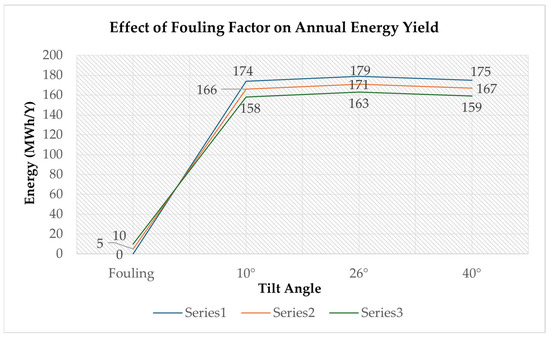
Effect of fouling factor on annual energy yield for different tilt angles. Source: PVsyst simulation results (2025).
As shown in Table 3, increasing the fouling factor from 0% to 10% results in a significant reduction in energy yield. At a tilt angle of 26°, the energy yield decreases from 179 MWh/year to 163 MWh/year, corresponding to a reduction of approximately 8.9%.
Similarly, the performance ratio decreases from 0.840 to 0.762, indicating a substantial increase in system losses due to reduced solar irradiance reaching the PV modules.
This trend is consistent across all tilt angles, confirming that fouling has a strong negative impact on both energy production and system efficiency.
The effect of fouling is more pronounced than tilt variation, as illustrated in Figure 1.
Figure 1 shows a consistent decrease in energy yield as fouling increases across all tilt angles, indicating that fouling has a dominant impact compared to tilt variation.
As the fouling factor increases from 0% to 10%, energy yield decreases proportionally across all scenarios. This trend confirms that fouling directly reduces the effective solar irradiance received by the PV modules.
3.3. Interaction Between Tilt Angle and Fouling
The combined effects of tilt angle and fouling on system performance are summarized in Table 4.
Table 4.
Interaction effect of tilt angle and fouling factor on annual energy yield.
As shown in Table 4, the impact of fouling is consistently more pronounced than the effect of tilt angle variation. For example, at 10° tilt, the energy yield decreases from 174 MWh/year to 158 MWh/year when fouling increases from 0% to 10%, corresponding to a reduction of approximately 9.2%.
In comparison, under clean conditions, the variation in energy yield between different tilt angles is relatively small (less than 3%), indicating that geometric optimization plays a secondary role compared to environmental factors.
Interestingly, higher tilt angles tend to maintain slightly higher performance ratios under fouling conditions. At 10% fouling, the PR at 40° (0.764) is slightly higher than at 10° (0.760), suggesting that steeper tilt angles may help reduce the accumulation of dust and improve system efficiency.
4. Discussion
The results demonstrate that fouling has a significantly greater impact on photovoltaic (PV) system performance than tilt angle variations under offshore environmental conditions. While variations in tilt angle within the range of 10° to 40° result in relatively minor differences in energy yield (less than 3%), increasing fouling levels from 0% to 10% leads to energy losses of up to approximately 9%.
This difference can be explained by the underlying physical mechanisms governing PV performance. Fouling directly reduces the transmittance of solar irradiance reaching the PV surface, thereby limiting the number of photons available for electricity generation. In offshore environments, this effect is further intensified by the combined presence of dust, salt deposition, and high humidity, which accelerate the accumulation of particles on the module surface.
In contrast, tilt angles primarily influence the geometric orientation of the PV modules relative to incoming solar radiation. Although an optimal tilt angle can improve incident irradiance, the range of tilt angles considered in this study does not produce substantial variations in total energy capture. This explains why the differences in energy yield between 10°, 26°, and 40° remain relatively small under clean conditions.
Interestingly, higher tilt angles exhibit slightly higher performance ratios, particularly under fouling conditions. This may be attributed to improved self-cleaning effects, where steeper module surfaces reduce particle accumulation due to gravitational forces and environmental exposure such as wind. As a result, higher tilt angles can partially mitigate the negative effects of fouling, although not sufficiently to compensate for the overall energy loss.
These findings highlight a critical trade-off between geometric optimization and operational maintenance. While tilt angle adjustment can marginally improve system efficiency, the benefits are relatively limited compared to the substantial impact of fouling. Therefore, in offshore PV applications, performance optimization should prioritize fouling mitigation strategies, such as regular cleaning or anti-soiling coatings, rather than relying solely on tilt angle optimization.
From a practical perspective, these results provide important implications for offshore PV system design and operation. Given the structural constraints and space limitations typically encountered on offshore platforms, achieving the optimal tilt angle may not always be feasible. However, the results suggest that maintaining module cleanliness can deliver greater performance improvements than modifying the tilt configuration.
Overall, this study confirms that environmental factors play a dominant role in determining PV system performance in offshore conditions. The findings emphasize that effective operational strategies are essential to ensure long-term system efficiency and energy production.
5. Conclusions
This study evaluated the combined effects of tilt angle and fouling on the performance of photovoltaic (PV) systems under offshore environmental conditions using PVsyst simulations. The results show that fouling has a significantly greater impact on system performance than tilt angle variations.
Quantitatively, increasing fouling levels from 0% to 10% resulted in energy losses of up to approximately 9%, whereas variations in tilt angle within the range of 10° to 40° produced relatively minor changes in energy yield, typically below 3%. These findings indicate that environmental factors play a dominant role in determining PV system performance in offshore applications.
Although higher tilt angles slightly improve performance ratio due to reduced particle accumulation and potential self-cleaning effects, this improvement is not sufficient to offset the overall energy loss caused by fouling. Therefore, tilt optimization alone cannot ensure optimal system performance in offshore conditions.
From a practical perspective, the results suggest that operational strategies, particularly fouling mitigation measures such as regular cleaning or anti-soiling technologies, should be prioritized over geometric optimization. This is especially relevant for offshore platforms, where structural constraints often limit the flexibility of tilt angle design.
The findings of this study provide useful insights for the design and operation of offshore PV systems, emphasizing the importance of maintenance strategies in improving long-term performance and energy output.
Future work may include the integration of economic analysis to evaluate the cost-effectiveness of cleaning strategies, as well as the investigation of advanced mitigation techniques such as hydrophobic coatings or automated cleaning systems under offshore conditions.
Author Contributions
Conceptualization, M.T.; methodology, M.T.; software, M.T.; validation, M.T.; formal analysis, M.T.; investigation, M.T.; data curation, M.T.; writing—original draft preparation, M.T.; writing—review and editing, M.T.; visualization, M.T.; supervision, J.W. and N.D. All authors have read and agreed to the published version of the manuscript.
Funding
This research received no external funding.
Institutional Review Board Statement
Not applicable.
Informed Consent Statement
Not applicable.
Data Availability Statement
The data used in this study are available from the corresponding author upon reasonable request.
Conflicts of Interest
The authors declare no conflicts of interest.
References
- Wang, J.; Lund, P.D. Review of Recent Offshore Photovoltaics Development. Energies 2022, 15, 7462. [Google Scholar] [CrossRef] [Scilit]
- Oliveira-Pinto, S.; Rosa-Santos, P.; Taveira-Pinto, F. Assessment of the Potential of Combining Wave and Solar Energy Resources to Power Supply Worldwide Offshore Oil and Gas Platforms. Energy Convers. Manag. 2020, 223, 113299. [Google Scholar] [CrossRef] [Scilit]
- Shezan, S.A.; Kamwa, I.; Ishraque, M.F.; Muyeen, S.M.; Hasan, K.N.; Saidur, R.; Rizvi, S.M.; Shafiullah, M.; Al-Sulaiman, F.A. Evaluation of Different Optimization Techniques and Control Strategies of Hybrid Microgrid: A Review. Energies 2023, 16, 1792. [Google Scholar] [CrossRef] [Scilit]
- Hasan, K.; Yousuf, S.B.; Tushar, M.S.H.K.; Das, B.K.; Das, P.; Islam, M.S. Effects of Different Environmental and Operational Factors on the PV Performance: A Comprehensive Review. Energy Sci. Eng. 2022, 10, 656–684. [Google Scholar] [CrossRef] [Scilit]
- Sanz-Saiz, C.; Polo, J.; Martín-Chivelet, N.; Alonso-García, M.d.C. Soiling Loss Characterization for Photovoltaics in Buildings: A Systematic Analysis for the Madrid Region. J. Clean. Prod. 2022, 332, 130041. [Google Scholar] [CrossRef] [Scilit]
- Bessa, J.G.; Micheli, L.; Almonacid, F.; Fernández, E.F. Monitoring Photovoltaic Soiling: Assessment, Challenges and Perspectives of Current and Potential Strategies. iScience 2021, 24, 102165. [Google Scholar] [CrossRef] [Scilit] [PubMed]
- Mansour, R.B.; Mateen Khan, M.A.; Alsulaiman, F.A.; Mansour, R.B. Optimizing the Solar PV Tilt Angle to Maximize the Power Output: A Case Study for Saudi Arabia. IEEE Access 2021, 9, 15914–15928. [Google Scholar] [CrossRef] [Scilit]
- Chen, X.M.; Li, Y.; Zhao, B.Y.; Wang, R.Z. Are the Optimum Angles of Photovoltaic Systems So Important? Renew. Sustain. Energy Rev. 2020, 124, 109791. [Google Scholar] [CrossRef] [Scilit]
- Fan, S.; Ma, Z.; Liu, T.; Zheng, C.; Wang, H. Innovations and Development Trends in Offshore Floating Photovoltaic Systems: A Comprehensive Review. Energy Rep. 2025, 13, 1950–1958. [Google Scholar] [CrossRef] [Scilit]
- Marion, B.; Adelstein, J.; Boyle, K.; Hayden, H.; Hammond, B.; Fletcher, T.; Canada, B.; Narang, D.; Shugar, D.; Wenger, H.; et al. Performance Parameters for Grid-Connected PV Systems. In Conference Record of the IEEE Photovoltaic Specialists Conference; IEEE: New York, NY, USA, 2005. [Google Scholar] [CrossRef] [Scilit]

Disclaimer/Publisher’s Note: The statements, opinions and data contained in all publications are solely those of the individual author(s) and contributor(s) and not of MDPI and/or the editor(s). MDPI and/or the editor(s) disclaim responsibility for any injury to people or property resulting from any ideas, methods, instructions or products referred to in the content. |
© 2026 by the authors. Licensee MDPI, Basel, Switzerland. This article is an open access article distributed under the terms and conditions of the Creative Commons Attribution (CC BY) license.