


Abstract
The integration of artificial intelligence (AI) into higher education has led to the emergence of Teacher–AI co-teaching models, where human educators collaborate with intelligent systems to enhance teaching and learning processes. These models leverage AI for adaptive content delivery, real-time feedback, and data-driven decision-making, transforming traditional pedagogical practices. However, their adoption depends heavily on social acceptance, trust, and perceived usefulness among educators and students. This paper investigates the socio-technical dynamics of Teacher–AI co-teaching, focusing on pedagogical transformation and user acceptance in higher education environments. A hybrid framework combining AI-assisted instruction, human facilitation, and learning analytics is proposed. Experimental results demonstrate improved student engagement and learning outcomes, while surveys reveal varying levels of acceptance influenced by trust and digital literacy. The study concludes that successful implementation requires a balanced integration of technology, pedagogy, and institutional governance to ensure ethical, effective, and inclusive AI-enhanced education.
1. Introduction
Artificial intelligence is reshaping higher education by enabling intelligent tutoring systems, automated assessment tools, and personalized learning environments. One of the most promising developments is the concept of Teacher–AI co-teaching, where human instructors collaborate with AI systems to deliver enhanced educational experiences [1]. Unlike traditional e-learning systems, co-teaching models integrate human expertise with machine intelligence to provide adaptive, data-driven instruction.
The shift toward AI-assisted teaching is driven by the need to address diverse learner needs, improve engagement, and optimize learning outcomes. AI systems can analyze large volumes of student data to identify learning patterns, predict performance, and recommend personalized interventions [2]. However, the success of such systems depends not only on technological capabilities but also on social acceptance, including trust, perceived usefulness, and ease of use among educators and students.
Despite the potential benefits, challenges such as resistance to change, ethical concerns, and lack of digital literacy hinder adoption. Furthermore, the transformation of pedagogical practices raises questions about the evolving role of educators in AI-driven classrooms. This paper explores the intersection of AI, pedagogy, and social acceptance, proposing a comprehensive framework for Teacher–AI co-teaching in higher education.
2. Literature Review
The concept of AI in education has been widely explored, with research highlighting its potential to enhance personalized learning and automate administrative tasks. Intelligent tutoring systems and adaptive learning platforms have demonstrated effectiveness in improving student performance and engagement [3]. These systems leverage machine learning algorithms to tailor content based on individual learning styles and progress.
Teacher–AI collaboration represents an evolution of these systems, emphasizing the complementary roles of human educators and AI technologies. Studies show that co-teaching models can improve instructional efficiency while allowing teachers to focus on higher-order cognitive tasks such as critical thinking and mentoring [4]. However, the integration of AI into teaching also introduces challenges related to trust, transparency, and ethical considerations.
Social acceptance models, such as the Technology Acceptance Model (TAM), suggest that perceived usefulness and ease of use significantly influence adoption of AI systems in education [5]. Additionally, research indicates that trust in AI systems is a critical factor affecting user acceptance, particularly in high-stakes environments like higher education [6].
Despite growing interest, there is limited research on the combined impact of AI co-teaching on pedagogy and social acceptance. This highlights the need for integrated frameworks that address both technological and human factors.
3. Methodology
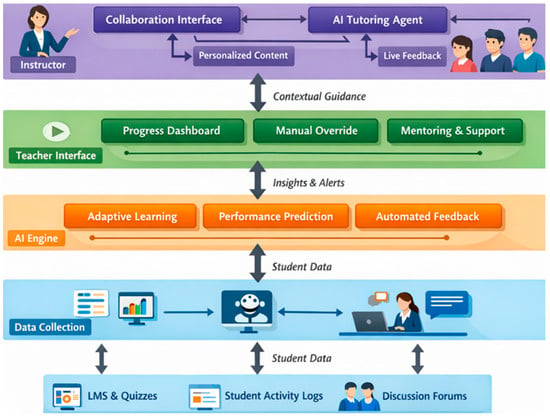
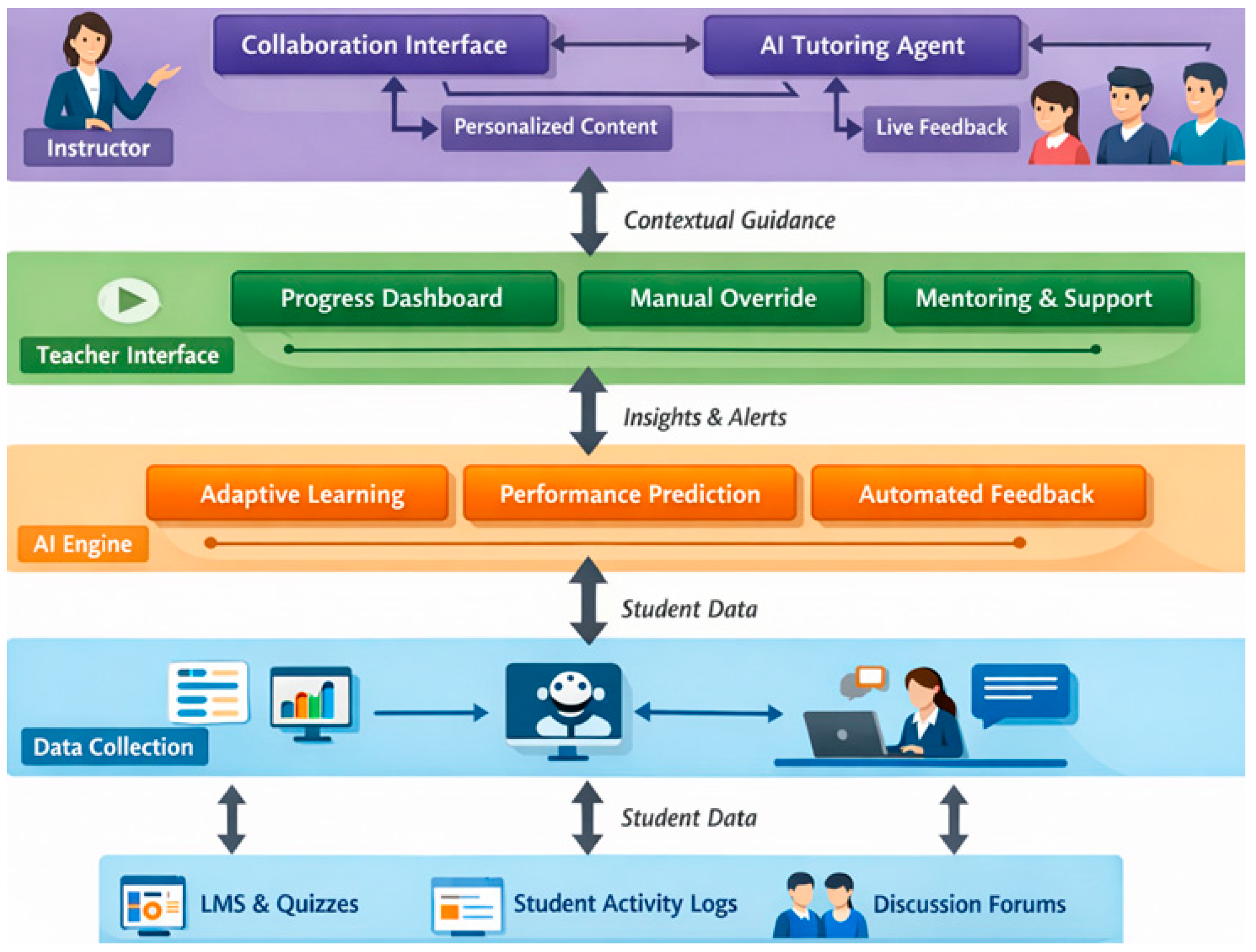
This study employs a mixed-method, quasi-experimental design to evaluate the effectiveness and social acceptance of Teacher–AI co-teaching models in higher education. The methodology integrates system development, controlled deployment, learning analytics, and perception analysis to capture both pedagogical and socio-technical dimensions. Figure 1 illustrates a layered, end-to-end architecture of the Teacher–AI co-teaching system, showing how data flows, decisions are generated, and human–AI collaboration occurs within a higher education environment. The framework is organized into four interconnected layers: Data Collection, AI Engine, Teacher Interface, and Interaction Layer.
Figure 1.
Teacher–AI Co-Teaching System Architecture and Interaction Workflow.
3.1. Experimental Design and Participants
The study was conducted across two undergraduate courses (n = 120 students), divided into three groups: traditional teaching (control), AI-assisted teaching, and Teacher–AI co-teaching. The intervention lasted for one academic semester (14 weeks). Participants were selected to ensure diversity in academic background and digital literacy levels.
3.2. System Architecture and Implementation
The co-teaching system consists of four layers:
- 1.
- Data Collection Layer (Bottom Layer):
This layer represents the foundation of the system, where raw educational data is gathered from multiple sources: Learning Management Systems (LMSs) and quizzes, student activity logs (clickstream, time-on-task, submissions), discussion forums and collaborative platforms. These data streams provide behavioral, cognitive, and performance indicators of student learning. The continuous flow of “student data” feeds into the AI engine for analysis.
- 2.
- AI Engine Layer:
The AI Engine is the analytical core of the system, responsible for transforming raw data into actionable insights. It consists of three main functions:
- Adaptive Learning: Personalizes content delivery based on student progress and learning style.
- Performance Prediction: Uses machine learning models to identify at-risk students and forecast outcomes.
- Automated Feedback: Provides instant feedback on assignments and learning activities.
This layer generates “Insights & Alerts”, which are passed upward to support instructional decision-making.
- 3.
- Teacher Interface Layer
This layer highlights the central role of the human educator in the co-teaching model. Key components include:
- Progress Dashboard: Visualizes student performance and engagement metrics.
- Manual Override: Allows teachers to adjust or override AI-generated recommendations.
- Mentoring & Support: Enables personalized human intervention for complex learning needs.
The teacher interprets AI insights and provides contextual guidance, ensuring pedagogical relevance and ethical oversight.
- 4.
- Interaction Layer (Top Layer)
This layer represents the collaborative space between teachers, AI systems, and students:
- Collaboration Interface: Facilitates communication between teacher and AI system.
- AI Tutoring Agent: Delivers personalized content and real-time assistance to students.
- Live Feedback & Personalized Content: Enhances student engagement through dynamic interaction.
This layer demonstrates how human expertise and AI intelligence jointly deliver instruction, creating a responsive and adaptive learning environment.
3.3. Learning Analytics and Model Training
Supervised learning models (e.g., Random Forest, Gradient Boosting) were trained on historical academic data to predict student performance and identify at-risk learners. Feature engineering included engagement frequency, assessment scores, and behavioral indicators. Model performance was validated using cross-validation techniques to ensure generalizability.
3.4. Social Acceptance and Trust Evaluation
User acceptance was measured using an extended Technology Acceptance Model (TAM), incorporating trust, perceived usefulness, and ease of use [5]. Surveys were administered pre- and post-intervention, complemented by sentiment analysis of student feedback.
Table 1 outlines the core components of the Teacher–AI co-teaching model and their corresponding functions. This integrated methodology ensures rigorous evaluation of both learning outcomes and social acceptance, providing a comprehensive foundation for assessing Teacher–AI co-teaching effectiveness.
Table 1.
Components of Teacher–AI Co-Teaching Model.
4. Results
The experimental results demonstrate that the Teacher–AI co-teaching model significantly enhances learning outcomes, engagement, and predictive accuracy compared with traditional and AI-assisted approaches.
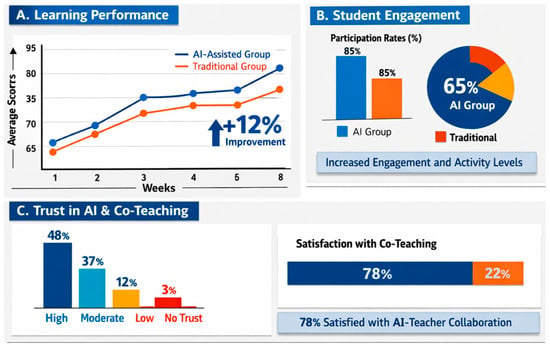
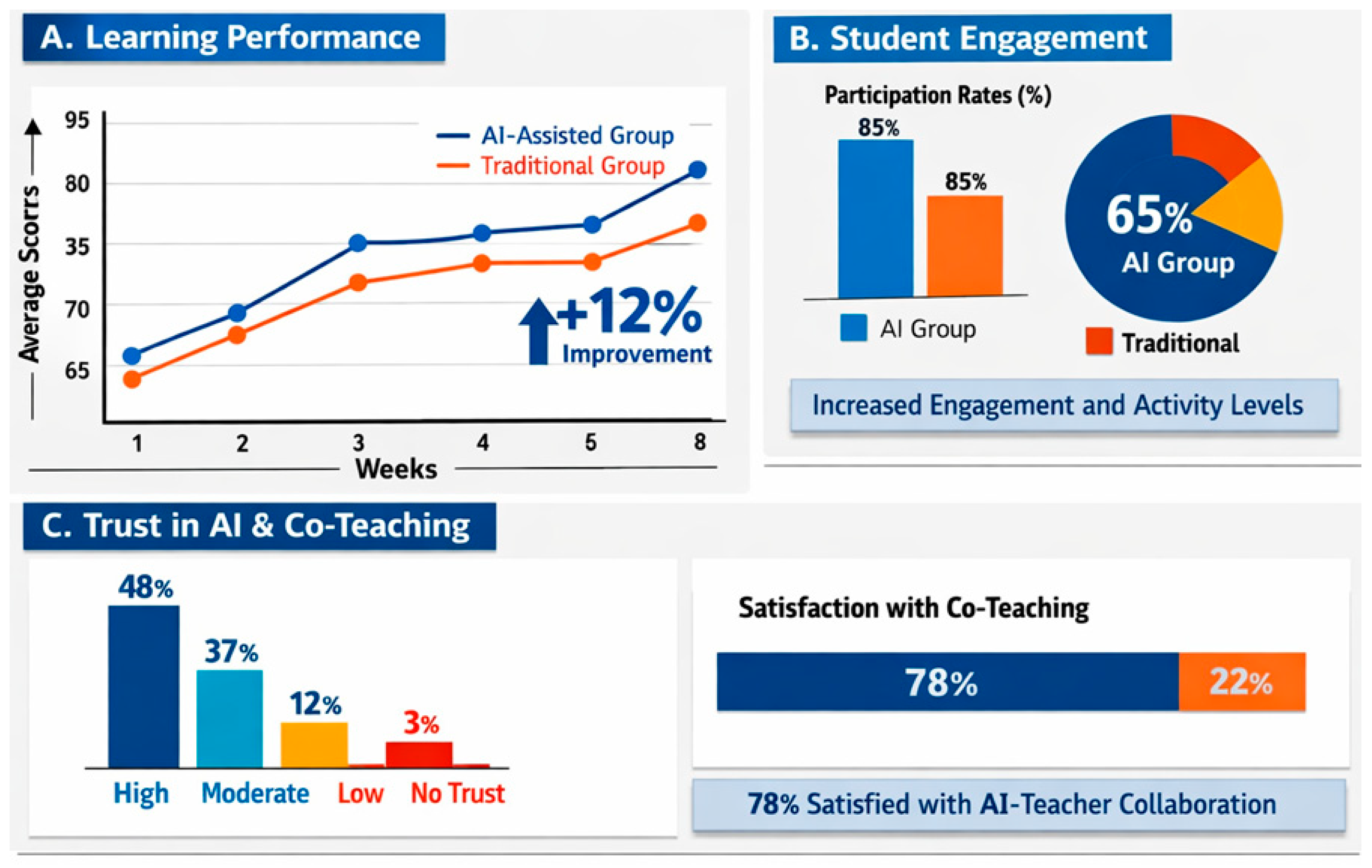
Figure 2 provides a multi-dimensional evaluation of the Teacher–AI co-teaching model, integrating academic performance, student engagement, and social trust into a single analytical view. It is divided into three subcomponents: (A) Learning Performance, (B) Student Engagement, and (C) Trust in AI & Co-Teaching.
Figure 2.
Learning Performance, Engagement, and Trust Analysis.
- A.
- Learning Performance
This section presents a longitudinal comparison of average student scores between the AI-assisted group and the traditional teaching group across multiple weeks.
- The AI-assisted group consistently outperforms the traditional group at every time point.
- A clear upward trend indicates continuous learning improvement, with an overall gain of approximately +12%.
- The widening gap over time suggests that AI-driven personalization and timely feedback contribute to sustained academic progress.
AI-supported instruction enhances not only short-term performance but also cumulative learning outcomes over time.
- B.
- Student Engagement
This section evaluates participation rates and activity levels.
- The bar chart shows higher participation rates (≈85%) in the AI-supported group compared with traditional learning.
- The pie chart highlights that a significant portion (65%) of students belong to the AI-engaged group.
- Increased engagement is attributed to interactive features, such as real-time feedback, adaptive content, and personalized learning pathways.
AI integration fosters active learning environments, increasing student involvement and interaction.
- C.
- Trust in AI & Co-Teaching
This section examines user perception and acceptance. Trust levels are distributed as: High trust: 48%, Moderate trust: 37%, Low trust: 12% and No trust: 3%. A large majority (78%) of students report satisfaction with AI–teacher collaboration. While trust is generally positive, a portion of users still exhibit skepticism, highlighting the need for transparency and explainability.
Figure 2 demonstrates that Teacher–AI co-teaching delivers improved academic performance, higher engagement levels, moderate-to-high social acceptance and trust.
4.1. Academic Performance Improvement
In Table 2, students in the co-teaching group achieved an average score improvement of 18.6% over the control group and 7.4% over the AI-assisted group. The predictive analytics model achieved an accuracy of 91.3% in identifying at-risk students, with an AUC value of 0.94, indicating strong classification performance [3]. Early intervention enabled by AI recommendations reduced failure rates by 22%, highlighting the effectiveness of proactive learning support.
Table 2.
Performance Comparison of Teaching Models.
4.2. Student Engagement Analysis
Engagement metrics, including participation in discussions, quiz completion rates, and interaction frequency, increased by 23.3% in the co-teaching group. AI-driven feedback mechanisms enabled real-time interaction, while teachers provided contextual explanations, creating a synergistic learning environment.
4.3. Social Acceptance and Trust Outcomes
Survey results indicate that 72% of students perceived AI as beneficial, while 64% expressed trust in AI-supported learning systems. Teacher acceptance was comparatively lower at 58%, reflecting concerns about role displacement and system transparency [5,6]. Sentiment analysis revealed a 19% increase in positive feedback toward AI-enhanced learning environments.
4.4. Pedagogical Impact
The results confirm a shift toward data-driven, personalized pedagogy, where AI supports routine instructional tasks, allowing educators to focus on higher-order cognitive engagement. This hybrid model demonstrates strong potential for scalable, adaptive, and inclusive higher education systems.
5. Challenges and Limitations
Despite the promising outcomes of Teacher–AI co-teaching models, several challenges and limitations must be addressed (Table 3). First, resistance to adoption among educators remains significant, often driven by concerns over role displacement, lack of trust in AI decisions, and insufficient training [5]. Second, data privacy and security issues arise due to the extensive collection and analysis of student data, raising ethical and regulatory concerns. Third, algorithmic bias in AI models may lead to unfair or inaccurate recommendations, particularly when trained on limited or unbalanced datasets [6].
Table 3.
Challenges and Limitations of Teacher–AI Co-Teaching Models.
Additionally, disparities in digital literacy and infrastructure can hinder effective implementation, especially in resource-constrained institutions. The lack of transparency and explainability in AI systems further reduces user trust and acceptance. From a methodological perspective, the study is limited by its relatively small sample size and short experimental duration, which may affect generalizability. Addressing these challenges requires robust governance frameworks, ethical AI design, and continuous professional development for educators.
6. Conclusions
Teacher–AI co-teaching models represent a transformative approach to higher education, combining human expertise with AI-driven insights to enhance learning outcomes. This study demonstrates that such models improve student performance, engagement, and personalized learning experiences. However, their success depends on social acceptance, trust, and effective integration into existing pedagogical frameworks. Future implementations should focus on building trust through transparency, improving digital literacy, and ensuring ethical AI use. Institutions must adopt comprehensive governance strategies that align technology with pedagogical goals. Ultimately, Teacher–AI collaboration has the potential to redefine education, enabling more adaptive, inclusive, and efficient learning environments.
Funding
This research received no external funding.
Institutional Review Board Statement
Not applicable.
Informed Consent Statement
Not applicable.
Data Availability Statement
The data that support the findings of this study are available on request from the corresponding author. The data are not publicly available due to privacy or ethical restrictions.
Acknowledgments
During the preparation of this manuscript, the author used ChatGPT 5.0 for the purposes of generating a framework and images. The authors have reviewed and edited the output and take full responsibility for the content of this publication.
Conflicts of Interest
The authors declare no conflicts of interest.
References
- Wang, S.; Wang, F.; Zhu, Z.; Wang, J.; Tran, T.; Du, Z. Artificial Intelligence in Education: A Systematic Literature Review. Expert Syst. Appl. 2024, 252, 124167. [Google Scholar] [CrossRef] [Scilit]
- Garzón, J.; Patiño, E.; Marulanda, C. Systematic Review of Artificial Intelligence in Education: Trends, Benefits, and Challenges. Multimodal Technol. Interact. 2025, 9, 84. [Google Scholar] [CrossRef] [Scilit]
- Tan, X.; Zhao, Y.; Wang, L. Artificial Intelligence in Teaching and Teacher Professional Development: A Systematic Review (2015–2024). Smart Learn. Environ. 2025, 8, 100355. [Google Scholar] [CrossRef] [Scilit]
- Kim, J.; Lee, H. Leading Teachers’ Perspectives on Teacher–AI Collaboration in Education. Educ. Inf. Technol. 2024, 29, 8693–8724. [Google Scholar] [CrossRef] [Scilit]
- Kim, J. Types of Teacher–AI Collaboration in Classroom Instruction: Opportunities and Challenges. Educ. Inf. Technol. 2024, 29, 17433–17465. [Google Scholar] [CrossRef] [Scilit]
- Ding, L.-J.; Li, J.-M.; Hui, B.-H. Will Teacher–AI Collaboration Enhance Teaching Engagement? A Behavioral and Organizational Perspective. Comput. Hum. Behav. 2025, 15, 866. [Google Scholar]

Disclaimer/Publisher’s Note: The statements, opinions and data contained in all publications are solely those of the individual author(s) and contributor(s) and not of MDPI and/or the editor(s). MDPI and/or the editor(s) disclaim responsibility for any injury to people or property resulting from any ideas, methods, instructions or products referred to in the content. |
© 2026 by the author. Licensee MDPI, Basel, Switzerland. This article is an open access article distributed under the terms and conditions of the Creative Commons Attribution (CC BY) license.