


Abstract
The study introduces a portable sliding sand sieve, transforming traditional stationary systems into an innovative solution for sand separation in the construction industry. This innovative tool offers improved mobility, durability, and operational efficiency, particularly for construction workers, civil technology students, and educators in areas with limited access to advanced equipment. Utilizing a developmental research design, the study involved the conceptualization, fabrication, and evaluation of the prototype. The design incorporated locally available materials, including phenolic boards, mesh screens, steel tubing, and a sliding mechanism supported by bearings and brackets. The Input–Process–Output (IPO) model guided the development, ensuring focus on functionality, affordability, and user safety. To address this gap, the researchers aimed to design, develop, and evaluate a portable sliding sand sieve to enhance sand sieving in construction settings. Expert and student evaluators highly rated the portable sliding sand sieve for its design simplicity, functionality, durability, modularity, and ergonomics. It was praised for its ease of use, time-saving capability, and adaptability to various work environments. The sliding feature enabled continuous sand flow, enhancing productivity and reducing physical strain.
1. Introduction
Sand sieving is a fundamental process in construction as it removes impurities and produces uniformly graded sand suitable for structural and finishing applications. The quality of fine aggregates significantly influences the strength, durability, and overall performance of concrete and masonry works. Previous studies have emphasized that particle size distribution plays a critical role in material performance and quality assurance across construction and related industries [1,2]. Moreover, sieving remains essential not only in infrastructure projects but also in agricultural processing and laboratory-based material testing [3,4].
Despite its widespread importance, sand sieving in many small-scale construction sites and academic laboratories continues to rely on traditional stationary or manually shaken sieve systems. These conventional setups—often suspended or manually operated—are characterized by poor structural stability, inconsistent particle separation, and slow processing rates. Studies have reported that manual sieving is labor-intensive, time-consuming, and physically demanding, resulting in reduced operational efficiency and variability in output quality [5,6]. While recent innovations have introduced motorized and vibration-based sieve machines to improve performance, many of these systems remain costly, electrically dependent, or impractical for remote construction sites and instructional laboratories [7,8].
A clear research gap therefore exists between low-cost traditional manual sieves, which lack efficiency and ergonomic stability, and advanced mechanized systems, which may not be economically or contextually feasible for small-scale contractors and educational institutions. In particular, inefficient sieving methods in civil and construction technology laboratories limit instructional time, reduce experimental accuracy, and restrict students’ hands-on technical development. The absence of a portable, stable, and cost-effective intermediate solution highlights the need for design innovation.
To address this gap, the present study proposed the development of a portable sliding sand sieve that integrates mobility, structural stability, and a controlled sliding mechanism to improve sand flow and reduce repetitive manual shaking. By enhancing operational efficiency while maintaining affordability and construction simplicity, the device aims to support both field practitioners and academic laboratories. This innovation contributes to improving material preparation processes, promoting safer, more ergonomic operations, and strengthening the acquisition of technical skills among construction students and workers.
2. Methodology
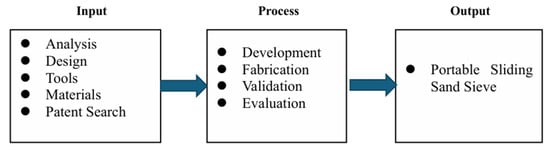
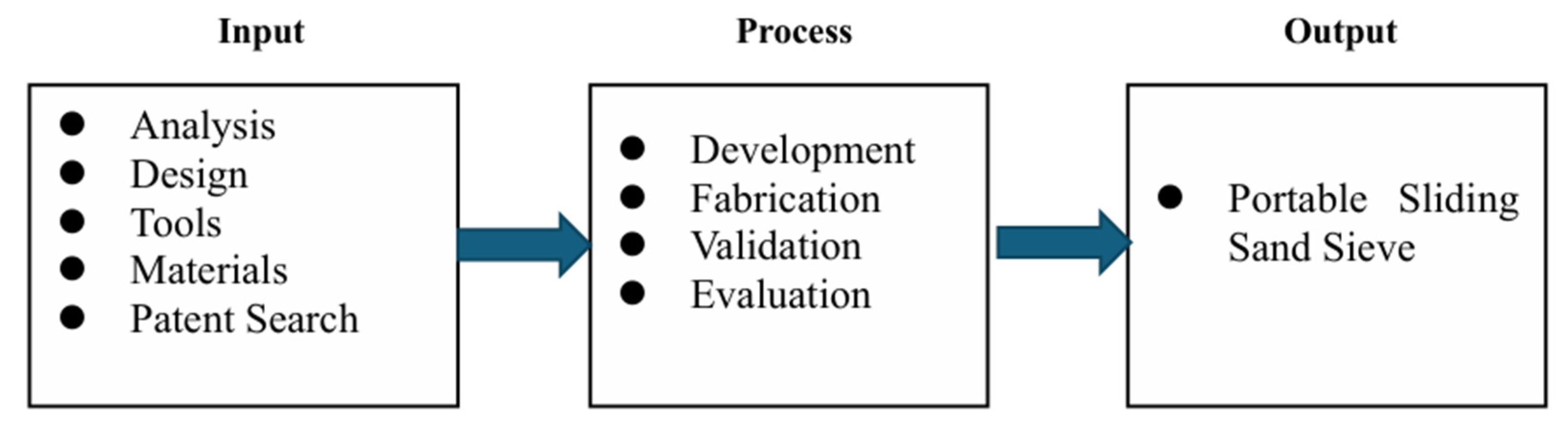
The researchers used the Input–Process–Output Model in this study, as shown in the schematic diagram (Figure 1). This framework helps the researchers to systematically approach the development process, ensuring the final product meets the needs of users in the construction industry. The Input refers to the identification of the problem, so that all necessary resources, information, and requirements are gathered to inform the product’s design process. This includes conducting a survey to understand the problems faced by construction workers, analyzing the gathered data, planning and sketching initial designs, searching for effective patterns, and identifying the materials, tools, equipment, and features required for the product, ensuring a comprehensive, well-informed foundation for the development process. The process refers to the development and evaluation of the product. Lastly, the output refers to the finished product after multiple design and assembly processes.
Figure 1.
Schematic Diagram of the Study.
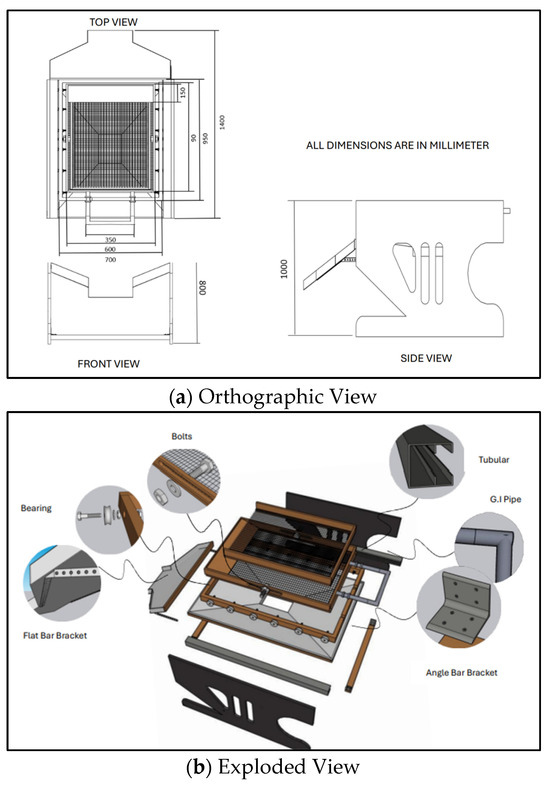
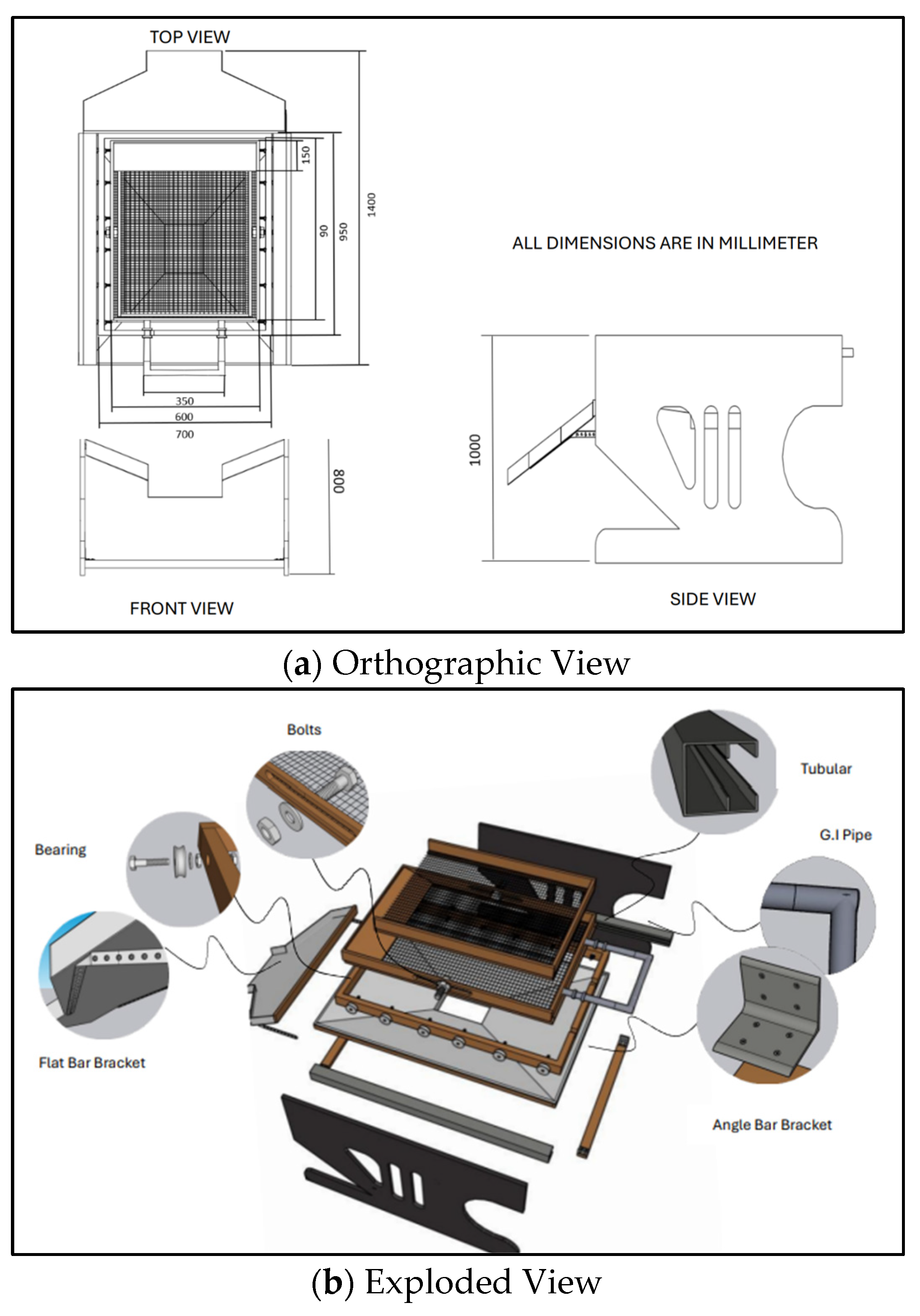
This research study applied the Technical Developmental Research Method, a term for developing projects, prototypes, fabrications, programs, systems, and the like [9]. The fabrication of the project is applied to this study. Figure 2 presents the orthographic and exploded views of the proposed portable sliding sand sieve. (a) The orthographic views illustrate the dimensional specifications, alignment, and spatial relationships of major components, including the structural frame, mesh screen, and sliding mechanism. These technical drawings ensured measurement accuracy, structural consistency, and reproducibility of the prototype. (b) The exploded view, on the other hand, depicts the device’s components in a sequentially separated arrangement, clarifying the device’s modular configuration and assembly hierarchy. This representation supports replicability, maintenance planning, and future design modifications. The development phase began with the identification and procurement of required materials and components, including marine plywood, a sleeve-bearing runner, a standardized sieve mesh screen, and steel support brackets to enhance structural stability and durability. Material selection was based on strength, availability, cost-efficiency, and suitability for repetitive mechanical movement. The fabrication process followed a structured and sequential procedure: (1) dimensional measurement and precision cutting of materials according to the technical drawings; (2) frame assembly and structural reinforcement through fastening and welding; (3) installation of the sieve mesh within the frame ensuring uniform tension and alignment; (4) integration of the sliding mechanism using sleeve-bearing runners to facilitate controlled horizontal motion; and (5) surface finishing, including sanding and protective coating application, to improve durability and aesthetic quality. Subsequently, the project underwent evaluation by experts and end-users to assess its overall design, functionality, usability, durability, modularity, and ergonomics, ensuring it met the intended design goals.
Figure 2.
Design of the Portable Sliding Sand Sieve.
3. Results and Discussion
The evaluation of the sliding sand sieve presents the expert evaluators’ findings, highlighting its compliance with industry standards and identifying areas for possible enhancement in future versions. The evaluation employed a four-point Likert scale with the following response options: Strongly Agree (SA), Agree (A), Disagree (D), and Strongly Disagree (SD) to gauge participants’ perceptions of the sand sieve’s effectiveness.
Based on the data presented in Table 1, the expert’s evaluation indicated strong agreement on the product meets the design and construction standards, with an overall mean score of 3.52. High ratings for safety features and locally available materials (3.90) suggest that the prototype balances structural integrity with accessibility, a key factor in small-scale construction and laboratory contexts. Beyond simply meeting criteria, these results indicate the feasibility of locally sourced materials in producing cost-effective, durable equipment, supporting sustainability and scalability. This highlighted that high-quality industrial design must integrate safety, cost-efficiency, and material accessibility [10].
Table 1.
Experts’ rating in terms of Design, Construction, and Availability of Materials.
As shown in Table 2, the evaluation of the experts in terms of product functionality was rated positively (mean = 3.25), with the highest score for operational efficiency (3.50). This confirms that the sliding mechanism effectively reduces repetitive manual effort while consistently separating sand particles, demonstrating that mechanical enhancements can significantly improve workflow in both academic and field environments. The relatively lower score for multi-function capability (2.80) suggests that while the sieve performs its primary function effectively, expanding its versatility for other materials or sieving tasks could enhance overall utility. These findings support a study [11] that emphasized the importance of practical, field-adapted innovations in sand sieving equipment. The results indicate that incremental mechanical improvements, such as the sliding mechanism, can achieve performance levels comparable to more complex or expensive motorized systems while maintaining affordability and simplicity.
Table 2.
Experts’ rating in terms of Functionality.
As shown in Table 3, usability received an overall mean of 3.42, reflecting strong expert approval. The highest-rated indicator (3.80) emphasizes the product’s ability to stimulate technical engagement and precision. The lower score (3.00) on operational intuitiveness highlights a minor learning curve for first-time users. The results suggest that the device is largely user-friendly and appropriate for vocational training, but small ergonomic or instructional enhancements could further reduce initial adaptation challenges. This reinforces the potential for integrating such tools in hands-on learning environments, where efficiency and safety are essential [12].
Table 3.
Experts’ Rating in terms of Usability.
Table 4 presents the product’s durability was rated by the experts at 3.34 (SD = 0.53), with material quality scoring highest at 3.50. This demonstrates that the chosen components withstand repeated use and maintain structural integrity, confirming suitability for typical construction or laboratory conditions. This aligns with a study [13] that highlights that material durability and resistance to wear are essential factors in evaluating equipment used in engineering and construction applications. The results underscore that careful material selection, favoring locally available yet resilient components, can deliver sustainable and cost-effective tools. Durability evaluation supports long-term use without frequent replacements, a critical consideration in low-resource settings [14,15].
Table 4.
Experts’ Rating in terms of Durability.
As presented in Table 5, the product modularity received an overall mean of 3.47, indicating that the design allows for easy disassembly, maintenance, and transport. High modularity suggests the potential for mass production, component standardization, and adaptability across different operational contexts. Beyond convenience, modularity enhances scalability and promotes repairability, which is especially valuable in remote or resource-limited construction sites [16,17]. The findings indicate that thoughtful design can reduce lifecycle costs and facilitate wider adoption.
Table 5.
Experts’ Rating in terms of Modularity.
As shown in Table 6, the Ergonomics received a mean score of 3.39, with high marks for safe and efficient task execution (3.70). The lower score (3.00) highlights the opportunity to reduce fatigue during prolonged use further. These results indicate that while the device effectively reduces physical strain compared to manual sieving, ergonomic refinements, such as adjustable handle height or grip optimization, could further enhance usability and user comfort, aligning with industry safety standards [18].
Table 6.
Experts’ Rating in terms of Ergonomics.
The Table 7 shows the summary evaluation of the product, with an overall mean of 3.40, reflects strong agreement that the product meets the intended design objectives. While functionality received the lowest relative score, all dimensions, design, usability, durability, modularity, and ergonomics show robust performance. Collectively, these findings demonstrate that the portable sliding sand sieve successfully addresses the limitations of traditional manual sieves, providing a reliable, user-friendly, and cost-effective solution suitable for both field and academic applications. The results highlight the potential of locally fabricated innovations to achieve performance comparable to that of industrial systems while maintaining affordability, portability, and ease of use. This finding aligns with the principles of appropriate technology, which emphasize the development of locally produced, cost-effective technologies that are practical and accessible for community and small-scale applications [19].
Table 7.
Summary Evaluation of the Product.
4. Conclusions
This study successfully developed and validated a portable sliding sand sieve using affordable and locally available materials, incorporating a bearing-supported sliding mechanism to enhance operational efficiency and reduce repetitive manual effort. Compared to traditional stationary or hand-shaken sieves, the prototype demonstrated smoother sand flow, improved stability, reduced physical strain, and overall suitability for both construction fieldwork and academic laboratories. Expert evaluation confirmed strong performance across multiple criteria, including design integrity, functionality, usability, durability, modularity, and ergonomics, with an overall mean score of 3.40, indicating high acceptability. While the prototype effectively addresses key limitations of conventional sieving methods, several constraints were noted. The product currently accommodates only standard sand particle sizes, limiting its flexibility for materials with coarser or finer grades. Additionally, while the manual sliding mechanism reduces physical strain compared to hand shaking, continuous operation may still require moderate effort, and long-term durability under extreme field conditions has not yet been fully tested. To enhance the device’s performance and applicability, future improvements may include mechanization through motor-assisted sliding or vibration integration, adjustable screens to accommodate varied particle sizes, and further ergonomic optimization to reduce user fatigue. Incorporating lightweight, corrosion-resistant materials could improve portability and longevity, while modular adaptations could facilitate scalability and mass production for wider distribution. This study contributes to the construction and educational fields by demonstrating that locally fabricated innovations can achieve reliable, industry-aligned performance while remaining cost-effective and user-friendly. By addressing both operational inefficiencies and instructional limitations, the portable sliding sand sieve presents a practical, scalable solution for material preparation in low-resource environments. The forward-looking design and potential mechanization pathways provide a foundation for further research, commercialization, and innovation in sand sieving technologies.
Author Contributions
Conceptualization, R.V.P., M.S.H.B.U., R.P. and O.B.; methodology, R.V.P. and J.E.; validation, and formal analysis, investigation, resources, writing, M.S.H.B.U., R.P. and O.B.; original draft preparation, R.V.P., M.S.H.B.U., R.P. and O.B.; writing—review and editing R.V.P., J.E., M.S.H.B.U., R.P. and O.B.; visualization, M.S.H.B.U., R.P. and O.B.; supervision, R.V.P. and J.E.; project administration, R.V.P., M.S.H.B.U., R.P. and O.B. All authors have read and agreed to the published version of the manuscript.
Funding
This research received no external funding.
Institutional Review Board Statement
Not applicable.
Informed Consent Statement
Not applicable.
Data Availability Statement
The data presented in this study are available on request from the corresponding author at reperang@csucc.edu.ph.
Acknowledgments
The researchers would like to thank the Research, Development, and Innovation and Extension Office for its financial support and application of its scholarly works.
Conflicts of Interest
The authors declare no conflicts of interest.
References
- Krishnan, P.K.; Alrisi, B.Z.H. Design and Development of an Electronic Sieving for Sand Separation using Node MCU System. J. Mod. Mech. Eng. Technol. 2025, 8, 31–36. [Google Scholar] [CrossRef] [Scilit]
- Pawar, N.; Umavane, S.; Khateghare, S.; Bothra, L. Design and Fabrication of Multi-Stage Automatic Sand Separator. SSRN Electron. J. 2022, 6, 2. [Google Scholar] [CrossRef] [Scilit]
- Adejugbe, I.T.; Olowonubi, J.A.; Aigbovbiosa, J.O.; Komolafe, O.; Ogunkoya, A.K.; Alasoluyi, J.O.; Olusunle, S.O.O. Design and Development of a Low Cost Laterite Sieving Machine. Phys. Sci. Int. J. 2022, 29–38. [Google Scholar] [CrossRef] [Scilit]
- Khadivi, K.; Hejri, S.; Vosoughi, S. Robust Sieve Analysis Using Sieve-By-Sieve Method. J. Sci. Perspect. 2020, 4, 83–98. [Google Scholar] [CrossRef] [Scilit]
- Meshram, H.; Bawankar, N.; Nikhar, Y.; Khan, D.; Petkar, L.; Aziz, M.K.A.; Khan, U.; Shakebuddin, M. Design and Fabrication of Multi-Sieve Sand Sieving Machine. Int. J. Res. Appl. Sci. Eng. Technol. 2022, 10, 1606–1613. [Google Scholar] [CrossRef] [Scilit]
- Poullet, P.; Muñoz-Perez, J.J.; Poortvliet, G.; Mera, J.; Contreras, A.; Lopez, P. Influence of Different Sieving Methods on Estimation of Sand Size Parameters. Water 2019, 11, 879. [Google Scholar] [CrossRef] [Scilit]
- Begum, S. Understanding Multipurpose Sieving Machine Through Literature Review. Int. J. Res. Publ. Rev. 2022, 1500–1504. [Google Scholar] [CrossRef] [Scilit]
- Azhar, A.; Kamaruzzaman, D.; Azuan, M.Y.K. Mechanical Sieve Grading of Silica Sand from Tin Mining for Metal Casting Mould. In Proceedings of the 2nd Regional Conference on Mechanical and Marine Engineering (ReMME 2018), Ipoh, Malaysia, 7–9 November 2018. [Google Scholar]
- Richey, R.C.; Klein, J.D.; Nelson, W.A. Developmental Research: Studies of Instructional Design and Development. In Handbook of Research on Educational Communications and Technology, 2nd ed.; Jonassen, D.H., Ed.; Lawrence Erlbaum Associates Publishers: Mahwah, NJ, USA, 2004; pp. 1099–1130. [Google Scholar]
- Kurnia, G.; Yulianto, B.; Jamari, J.; Bayuseno, A.P. Evaluation in Conceptual Design of Human Powered Sand Sieving Machine. E3S Web Conf. 2019, 125, 03001. [Google Scholar] [CrossRef] [Scilit]
- Asaolu, A. Development of a 5—Layer Multipurpose Sieving Machine. Int. J. Innov. Sci. Eng. Technol. Res. 2025, 13, 244–254. [Google Scholar] [CrossRef]
- Lewis, J.R.; Sauro, J. Usability and User Experience: Design and Evaluation. In Handbook of Human Factors and Ergonomics; Wiley: Hoboken, NJ, USA, 2021; pp. 972–1015. [Google Scholar] [CrossRef] [Scilit]
- Bijen, J. Durability of Engineering Structures: Design, Repair and Maintenance. ResearchGate 2003, 1–262. Available online: https://www.researchgate.net/publication/291804541_Durability_of_Engineering_Structures_Design_Repair_and_Maintenance (accessed on 1 January 2026).
- Firoozi, A.A.; Firoozi, A.A.; Oyejobi, D.O.; Avudaiappan, S.; Flores, E.S. Emerging Trends in Sustainable Building Materials: Technological Innovations, Enhanced Performance, and Future Directions. Results Eng. 2024, 24, 103521. [Google Scholar] [CrossRef] [Scilit]
- Granados-Sarmiento, M.; Tarabein-Omairi, J.; Gomez, H.; Mesa, J.A. Proposing a material selection indicator for the design of extended lifespan products. Sci. Rep. 2025, 15, 37331. [Google Scholar] [CrossRef] [Scilit] [PubMed]
- Bouchard, S.; Gamache, S.; Abdulnour, G. Strategy using modularity tools to operationalize mass customization in manufacturing small and medium-sized enterprises. Clean. Logist. Supply Chain. 2023, 9, 100123. [Google Scholar] [CrossRef] [Scilit]
- Coskun, C.; Lee, J.; Xiao, J.; Graff, G.; Kang, K.; Besiktepe, D. Opportunities and Challenges in the Implementation of Modular Construction Methods for Urban Revitalization. Sustainability 2024, 16, 7242. [Google Scholar] [CrossRef] [Scilit]
- Iyer, H.; Kim, E.; Nam, C.S.; Jeong, H. A scoping review on emerging technologies and automation of musculoskeletal ergonomic assessments. Ergonomics 2025, 1–26. [Google Scholar] [CrossRef] [Scilit] [PubMed] [PubMed Central]
- Yasar, M.; Foo, J.; Idris, N.D.M. Appropriate Technology: Concept Evolution and Development Direction. JATAED J. Appropr. Technol. Agric. Environ. Dev. 2025, 3, 45–51. [Google Scholar] [CrossRef] [Scilit]

Disclaimer/Publisher’s Note: The statements, opinions and data contained in all publications are solely those of the individual author(s) and contributor(s) and not of MDPI and/or the editor(s). MDPI and/or the editor(s) disclaim responsibility for any injury to people or property resulting from any ideas, methods, instructions or products referred to in the content. |
© 2026 by the authors. Licensee MDPI, Basel, Switzerland. This article is an open access article distributed under the terms and conditions of the Creative Commons Attribution (CC BY) license.