


Abstract
The rapid development of AI Technology has significantly influenced digital art and triggered widespread discussion on social media platforms, particularly X. The use of AI in generating visual artworks and digital content has elicited diverse public responses, ranging from support for technological innovation to concerns regarding originality and the role of human artists. In this study, a total of 1737 tweets were collected through a data crawling process using relevant keywords and processed using RapidMiner through preprocessing stages to analyze user sentiment on the X platform toward the application of AI in digital art. The data include data cleaning, text normalization, and tokenization, before being classified into positive and negative sentiments. Three classification algorithms, Naïve Bayes, support vector machine (SVM), and decision tree, were applied to compare sentiment distributions. The results show that the Naïve Bayes model classified 30.5% of tweets as positive and 69.5% as negative, while the SVM and Decision Tree models showed a stronger bias toward negative sentiment, with 93.3% and 88.8% negative classifications, respectively. These findings indicate that negative sentiment toward AI in digital art is more dominant among users.
1. Introduction
The rapid development of AI has reshaped artistic practices and the creative industries in profound ways. AI systems no longer function merely as technical tools; they have evolved into collaborative media capable of generating visual artworks, music, and various forms of digital content either autonomously or semi-autonomously [1]. This shift has sparked extensive debate regarding the position and role of human artists, particularly as computational models increasingly demonstrate the ability to imitate human creativity [2].
Previous research highlights that interactions between artists and algorithms introduce new dynamics to the creative process, where AI becomes not only a facilitator but also a creative actor that contributes to shaping aesthetic outcomes [3]. Studies on artist–AI collaboration further emphasize that AI enhances visual exploration, accelerates creative workflows, and offers novel approaches unattainable through traditional techniques [4]. Nevertheless, the integration of AI into artistic production also raises critical concerns related to originality, plagiarism, artistic value, and the potential marginalization of human creative labor [5]. Many artists argue that AI-generated works blur the distinction between human expression and algorithmic output, giving rise to ethical and aesthetic tensions in contemporary art [6].
Similar phenomena are observed among fine arts students, who generally acknowledge AI’s potential as an innovative tool while exhibiting ambivalence toward its implications for creative identity, art education, and future career prospects. While students regard AI as a means to broaden visual experimentation, others fear that reliance on such technology may diminish fundamental artistic skills essential to human creativity [7].
From the perspective of digital and design creators, the growing use of AI is often met with skepticism rather than dogmatism. Although many acknowledge its usefulness in speeding up production and offering visual variations, there is concern that these conveniences come at a creative cost. Designers increasingly worry that AI-driven outputs encourage standardized aesthetics and quick solutions, which can limit originality and reduce the depth of creative exploration [8]. When design decisions rely heavily on automated systems, the role of personal interpretation and intentional choice risks being weakened.
Beyond artistic communities, public discourse on social media has become increasingly active in responding to the rise of AI-generated art. Platforms such as X serve as dynamic spaces where users express diverse opinions, concerns, and support related to the use of AI in digital art [9]. Prior studies on public sentiment in Twitter-based discussions indicate that social media plays a significant role in capturing collective perceptions and emotional reactions toward emerging technologies, making sentiment analysis a relevant method for understanding public opinion within the context of technological change [10].
Given the growing intensity of online debates and the polarized attitudes toward AI’s role in digital art, examining user sentiment on X has become increasingly important [11]. The results of this study provide a reference to understand public perceptions of AI within the creative domain, contributing to the methodological development of machine-learning-based sentiment analysis, which holds broader applicability across various social and technological contexts.
2. Literature Review
2.1. Text Mining
Text mining is the process of analyzing text-based data to extract meaningful information from unstructured sources [12]. This technique is becoming increasingly important because most digital data is in the form of text, such as social media posts, reviews, articles, and online conversations. The text mining process involves several stages, from data acquisition, text cleaning, and transformation, to feature extraction using specific methods [13]. With text mining, text data that was originally random and unstructured can be converted into relevant information for further analysis.
Text mining is used to uncover hidden patterns, trends, and relationships within large volumes of textual data that would be difficult to analyze manually. By applying techniques such as tokenization, stemming or lemmatization, term frequency analysis, and natural language processing (NLP), text mining supports tasks, including sentiment analysis, topic modeling, and text classification [14]. These outputs can then be used to support decision-making, improve services or products, and gain deeper insights into public opinions and behaviors. As a result, text mining not only enhances the efficiency of data analysis but also adds strategic value by transforming raw textual data into actionable knowledge.
In scientific research, text mining is widely used to detect patterns, trends, or opinions from a group of users. When applied to social media, text mining allows researchers to understand the dynamics of public discussions on a particular issue, including public perceptions of technological developments such as AI [15]. This technique is also a key foundation in machine learning-based analysis, as it provides data in a form that is ready to be processed for classification or prediction.
Furthermore, text mining is also used to process large-scale and real-time data efficiently, especially in fast-evolving platforms like social media, where information changes rapidly. By combining text mining with machine learning algorithms, researchers can monitor shifts in public sentiment, identify emerging topics, and detect anomalies or misinformation related to AI and other technologies [16]. This integration enhances the reliability and depth of analysis, enabling more accurate interpretations of societal responses and supporting evidence-based conclusions in scientific studies.
2.2. Sentiment Analysis
Sentiment analysis is conducted to identify emotional or opinion trends in a text, which are generally classified into positive, negative, or neutral categories. This technique is applied in marketing, politics, education, and technology because it provides a quantitative overview of public attitudes toward specific topics or issues [17]. By analyzing large volumes of textual data, sentiment analysis helps researchers and organizations understand how people emotionally respond to products, policies, or technological developments.
In research based on short texts such as tweets, sentiment analysis presents particular challenges. Users often express their opinions briefly and informally, frequently using slang, abbreviations, emojis, or metaphorical language. These characteristics can make it difficult for analytical models to accurately interpret the true sentiment, especially when sarcasm or implicit meaning is involved. As a result, careful preprocessing and model selection are crucial to improve analysis accuracy [18].
Sentiment analysis methods adopt two approaches: lexicon-based and machine learning-based methods. The lexicon-based approach relies on predefined dictionaries of words with associated sentiment values, while the machine learning approach learns sentiment patterns directly from labeled data [19]. Currently, machine learning methods are favorable because they are more flexible and capable of capturing complex linguistic patterns within textual data.
In digital art, sentiment analysis using AI plays an important role in assessing public responses to the use of AI in creative processes. It helps determine whether public opinion tends to support, reject, or critically evaluate the role of AI in the creative world. The insights generated from this analysis are valuable for understanding societal acceptance and concerns, which may influence future industry development, policy decisions, and artistic practices [20].
2.3. X Platform as Data Source
X, formerly known as Twitter, is a text-based social media platform that provides an open space for public discussion on a wide range of issues. Its real-time and publicly accessible nature allows users to instantly share opinions, reactions, and information, making the platform highly dynamic. These characteristics make X particularly suitable for research that focuses on public discourse and opinion formation [21].
One of the main advantages of X is its concise text format, which encourages users to express ideas briefly and directly. This creates a large volume of short text data that is rich in opinions and emotional expressions. For researchers, this format is valuable for analyzing how public sentiment emerges and evolves in response to specific events or topics [22]. In addition, features such as hashtags, mentions, and retweets play an important role in shaping conversations on X. Hashtags help categorize discussions and identify trending topics, while mentions and retweets allow interactions and information diffusion among users. These features enable researchers to trace conversation flows, detect dominant themes, and map relationships between topics and users [23].
Furthermore, X has a diverse user base that represents a wide range of social, cultural, and professional backgrounds. On technology-related topics such as AI, users often engage in interactive exchanges that bring together different perspectives. Using X as a data source, therefore, allows researchers to capture the dynamics of public opinion more accurately, particularly in debates on the development of AI in digital art [24].
2.4. Crawling Data on Social Media
Data crawling is used to collect data from the internet or specific digital platforms through scripts or specialized software [25]. In social media–based public opinion research, data crawling functions as a primary method for gathering large volumes of textual data, such as posts, comments, and user interactions [26]. This automated approach enables researchers to efficiently obtain datasets that would be impractical to collect manually, especially when dealing with real-time or large-scale data sources.
Through data crawling, specific parameters such as keywords, hashtags, user accounts, or topics of interest can be defined [27]. This targeted collection process ensures that the retrieved data is relevant to the research objectives and appropriate for further analysis. As a result, crawling plays a crucial role in preparing raw data that can later be processed through text mining, sentiment analysis, or machine learning techniques.
In research on Platform X, data crawling is essential because the content is dynamic and continuously updated. Researchers apply filters such as time range, language, and geographic indicators to capture discussions within a specific context. These settings help maintain the relevance and consistency of the dataset, enabling more accurate analysis of public opinion over time.
Despite its advantages, data crawling also presents challenges. Limitations imposed by platform APIs, frequent changes in platform structures, and the presence of noise or irrelevant data can reduce data quality [28]. Additional preprocessing and filtering steps are performed to improve reliability. Nevertheless, data crawling remains a fundamental stage in text mining and sentiment analysis, as it provides the essential foundation for subsequent analytical process.
2.5. Decision Tree (DT)
A DT is a classification algorithm that divides data into a branching structure resembling a DT [29]. Each node in the tree represents a condition or feature, while each branch shows the result of testing that condition. This model is considered easy to understand because it reflects human decision-making logic, making it appropriate as a baseline in machine learning research. In text analysis, decision trees distinguish linguistic patterns that indicate positive or negative sentiment.
Despite its simplicity, DTs have weaknesses such as a tendency to overfit, especially with high-dimensional data such as text. However, when combined with optimization techniques such as pruning, their performance can improve significantly. In social media research, DTs are used to understand which features most influence sentiment classification [30]. This makes DTs relevant as a comparison to other more complex algorithms, such as Naïve Bayes.
In addition, DTs offer a level of interpretability that often lacks in more complex machine learning models. DTs enable the observation of how specific features contribute to classification outcomes, which is valuable in text-based studies where understanding the reasoning behind a prediction is as important as the prediction itself. This transparency allows analysts to identify key words, phrases, or linguistic structures that strongly affect sentiment, thereby supporting more meaningful qualitative interpretations of quantitative results [31].
Furthermore, DTs are relatively efficient in terms of computation and do not require extensive parameter tuning compared to advanced models. This makes them practical for exploratory analysis or for studies with limited computational resources. Although their predictive accuracy may be lower than that of more sophisticated algorithms, DTs remain useful as a benchmark model, providing a clear point of reference when evaluating the performance and added complexity of alternative approaches [32].
2.6. Support Vector Machine (SVM)
SVM is a popular classification algorithm in text processing due to its ability to handle high-dimensional data and non-linear classification [33]. SVM classifies data by identifying the optimal hyperplane that maximizes the separation between classes. In sentiment analysis, SVM is effective because it can detect complex patterns in text representations such as TF-IDF vectors or word embeddings. Its strong generalization ability has made SVM one of the most widely used algorithms in natural language processing research. SVM is also robust against overfitting, particularly with sparse and high-dimensional text data [34]. By applying kernel functions, which are linear, polynomial, or radial basis functions, SVM transforms input data into higher-dimensional spaces where complex class boundaries can be more easily separated [35]. This flexibility enables SVM to adapt to diverse text representations and sentiment distributions, making it suitable for different research contexts.
Another advantage of SVM is its strong performance even with relatively small training datasets compared to other machine learning algorithms [36]. This characteristic is useful in sentiment analysis, where labeled data are often limited or costly to obtain. Due to its theoretical foundation and consistent results, SVM remains a reliable benchmark method in sentiment analysis and broader NLP research. Furthermore, linear, polynomial, and radial basis kernel functions allow SVM to handle nonlinear data patterns effectively. With tweet data, which are typically short and information-dense, SVM has demonstrated high performance in previous studies [37]. Therefore, SVM is used as a comparison model when evaluating the performance of other algorithms in sentiment classification against DT.
2.7. Naïve Bayes (NB)
NB is commonly used in text mining due to its conceptual simplicity and efficiency in handling large-scale textual data. The algorithm predicts expected outcomes based on patterns observed in previous data through Bayes’ Theorem, a probabilistic approach that calculates the likelihood of an event based on prior knowledge of related conditions. In text mining, NB is applied to classify documents into specific categories, such as positive or negative sentiment, by analyzing the distribution of words within each class [38].
In practice, the implementation of NB for text classification involves several structured stages. The process begins with preprocessing, where raw text is prepared through tokenization, stopword removal, and stemming to retain only relevant linguistic features. This is followed by feature weighting, in which word frequencies are calculated to represent the characteristics of each document. Using labeled training data, the model then estimates the probability of each class based on these features, forming the basis for classifying new, unseen text [39].
Despite its efficiency and structured workflow, NB has conceptual limitations. The assumption that each word contributes independently to classification does not fully reflect the nature of human language, where meaning often arises from word combinations and contextual relationships [40]. Consequently, NB may struggle to interpret complex linguistic patterns such as negation, irony, or implicit sentiment, reducing its effectiveness in nuanced text analysis tasks [41,42,43].
In text mining, the is commonly written as
Mathematically, NB is grounded in Bayes’ Theorem, which calculates the probability of an event based on prior probabilities and observed evidence. In programming applications, the probability of event A given event B is determined by the probability of B occurring when A happens, multiplied by the probability of A, and divided by the probability of B. In text classification, this formulation is adapted to estimate the probability of a class given a document, with the class of highest probability selected as the prediction.
3. Methodology
3.1. Algorithms
We employed a quantitative research approach based on text mining and supervised machine learning techniques to analyze public sentiment toward the use of AI in digital art. Social media data served as the primary source of information, as platforms such as X (Twitter) provide rich and spontaneous expressions of public opinion. The methodology consisted of data collection, text preprocessing, sentiment labeling, feature extraction, sentiment classification, and performance evaluation. A comparative analysis was conducted using NB, SVM, and DT algorithms to determine their effectiveness in classifying sentiment polarity.
The research was designed in a supervised learning framework, in which labeled textual data were used to train and evaluate classification models. A comparative analysis was conducted by implementing three widely used machine learning algorithms in sentiment analysis: NB, SVM, and DT. The workflow began with data crawling from social media, followed by preprocessing to reduce noise and improve data quality. Sentiment labels were then assigned to the dataset, textual features were extracted using statistical weighting techniques, and classification models were developed. The final stage involved evaluating and comparing the performance of the models using standard metrics.
3.2. Data Collection and Process
Data were collected from the X platform through a crawling process implemented in Google Colab. Twitter was chosen due to its widespread use and its role as a platform for public discourse on emerging technologies, including AI and digital art. Tweets containing the keyword ‘AI generative art’ were retrieved to ensure relevance to the research topic. The data collection period spanned from January 2020 to November 2025, enabling the analysis of public sentiment across different stages of AI development and adoption. A total of approximately 1737 tweets were obtained as the initial dataset.
Data were preprocessed to prepare the raw textual data for analysis and modeling. Since the collected tweets were written in English, preprocessing focused on standard text normalization procedures. These included case folding to convert all text to lowercase, text cleaning to remove URLs, user mentions, hashtags, emojis, and special characters, and tokenization to split the text into individual words or terms. These steps reduced noise and ensured that the textual data were represented in a consistent and structured format suitable for feature extraction and machine learning classification.
Sentiment labeling was performed using a hybrid approach that combined manual annotation and automated techniques. A subset of 329 tweets was manually labeled into two categories, positive and negative, serving as a gold standard for training and validating the models. To efficiently label the remaining tweets, a lexicon-based sentiment analysis tool was applied. This combination of manual and automated labeling balanced accuracy and scalability, which is particularly important when working with large social media datasets.
3.3. Feature Extraction
Feature extraction was conducted to transform the preprocessed textual data into numerical representations for machine learning algorithms. The Term Frequency–Inverse Document Frequency (TF-IDF) method was employed to generate feature vectors. TF-IDF assigns weights to terms based on their frequency within a tweet and their inverse frequency across the dataset, allowing important words to receive higher weights. This method is widely adopted in sentiment analysis research due to its effectiveness in representing textual information and reducing the impact of common but less informative terms.
4. Results and Discussion
This study was conducted using NB, SVM, and DT algorithms, which were implemented through RapidMiner. The first step involved defining the research topic, namely sentiment analysis toward the use of AI in digital art among users in Singapore and the Philippines. Data were collected from the X platform using relevant keywords such as AI generative art, digital art, and AI, in English for both countries.
4.1. Data Crawling
The data crawling process was carried out through several interconnected stages. The initial stage began with entering the Twitter auth token, which is an authentication code obtained from each user’s Twitter account. This token serves as access, allowing the account to be used in the tweet collection process. The next stage involved configuring the data search parameters. The search keyword parameter was used to specify the keywords to be searched, such as AI generative art and digital art, so that only tweets containing these keywords would be collected. Next, the since and until parameters were used to limit the time range of the tweets collected, ensuring that the data matched the research period, from January 2020 to November 2025. Additionally, the parameter was applied to filter tweets based on the English language, making the data relevant for Singapore and the Philippines.
To control the number of tweets collected, the limit parameter was set as the maximum number of tweets to be retrieved in a single crawling process. After the data were successfully collected, the next step was initial data processing using the pandas library, using the command import pandas as pd. This library facilitates data cleaning, grouping, and storage in the comma-separated value format, preparing the data for further analysis.
The main stages of the data collection process are summarized as follows.
- Account authentication: Enter the Twitter auth token obtained from the user’s account to authenticate and enable data crawling.
- Keyword selection: Set the search_keyword to specify the topic of tweets to be collected, such as AI generative art and digital art.
- Time range selection: Configure the since and until parameters to limit the time range of collected tweets according to the research period (January 2020–November 2025).
- Language selection: Use the lang parameter to filter tweets in English to ensure relevance for Singapore and the Philippines.
- Data limit: Set the limit as the maximum number of tweets to be collected in a single crawling session.
- Initial data processing: Use the pandas library to manage the collected data, including cleaning and grouping.
- Data storage: Save the collected data in CSV format as a basis for further analysis.
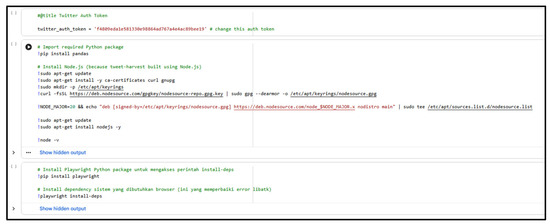
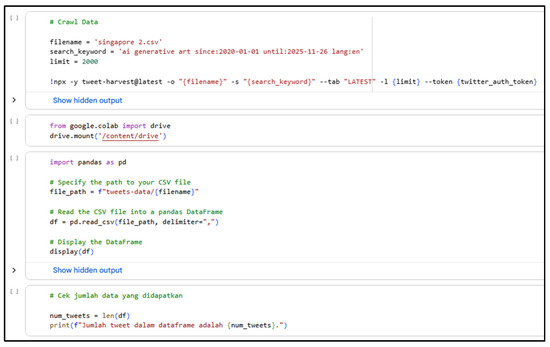
To implement the data collection process, a series of commands were executed in a notebook environment, as illustrated in Figure 1 and Figure 2. Figure 1 shows the environment setup stage, including the installation of required Python ver 3.9 libraries such as pandas, Node.js dependencies, and Playwright for browser automation. This step ensures that the system is properly configured to perform tweet crawling.
Figure 1.
Python code for installing required libraries and setting up the crawling environment, including pandas, Node.js dependencies, and Playwright for browser automation.
Figure 2.
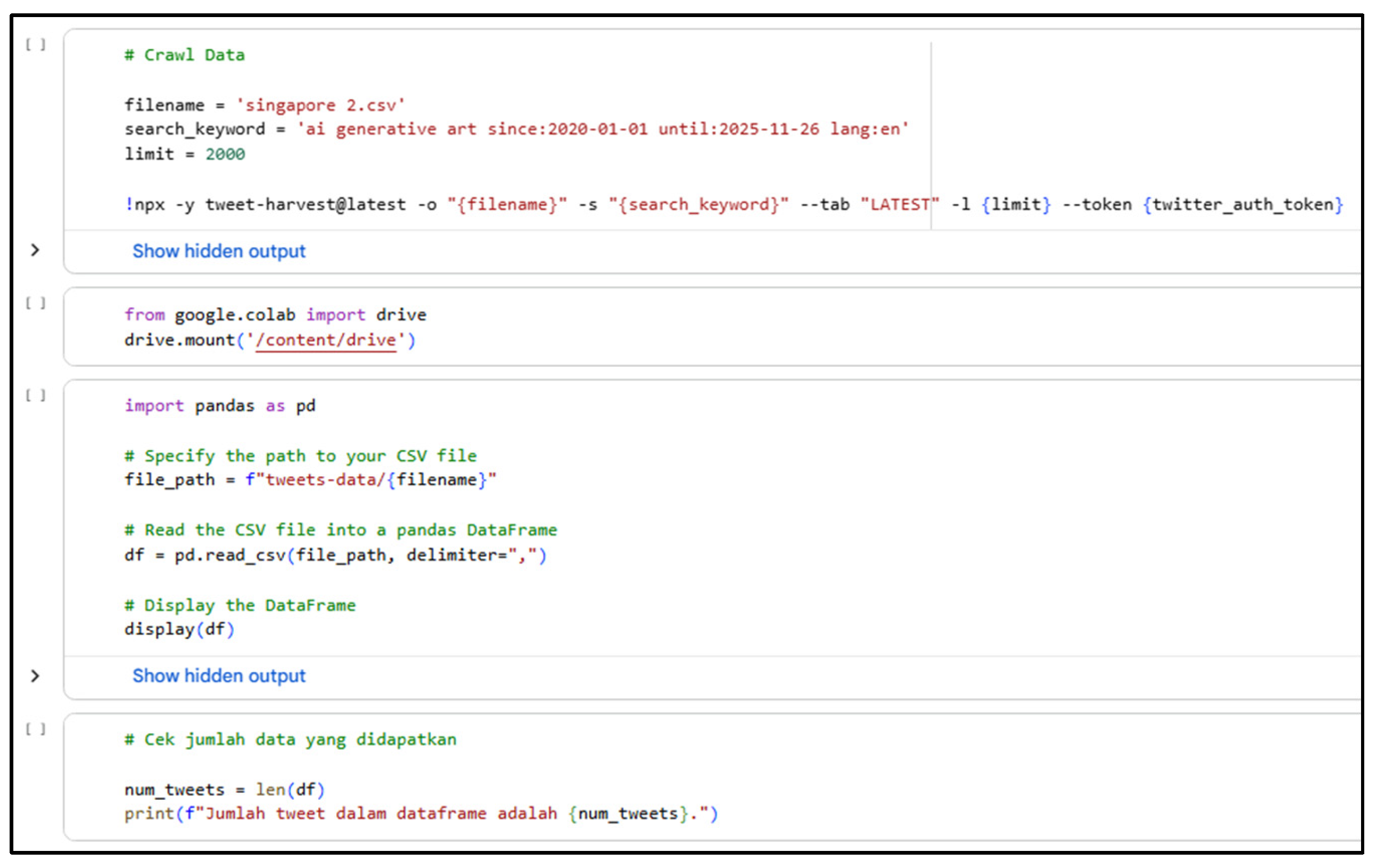
Crawling data Python code.
The code in Figure 1 installs the tweet-harvest library and its dependencies, which enable automated data collection from the X platform. The Playwright library is configured to handle browser-based interactions required for authentication and data retrieval.
Figure 2 presents the data crawling and initial processing workflow. In this stage, the Twitter authentication token is defined, followed by specifying the search parameters such as keywords, time range, language, and data limit. The crawling process is executed using the tweet-harvest tool, and the collected data are stored in CSV format. Subsequently, the pandas library is used to read, display, and compute the number of collected tweets, enabling preliminary data inspection before further analysis.
As shown in Figure 2, the Twitter authentication token is first defined to authorize data access. Search parameters such as keywords (‘AI generative art’, ‘digital art’), time range (January 2020 to November 2025), language (English), and data limit are then specified. The tweet-harvest tool executes the crawl, and collected data are saved as a CSV file. The pandas library is subsequently used to read and display the dataset, confirming the total number of tweets collected.
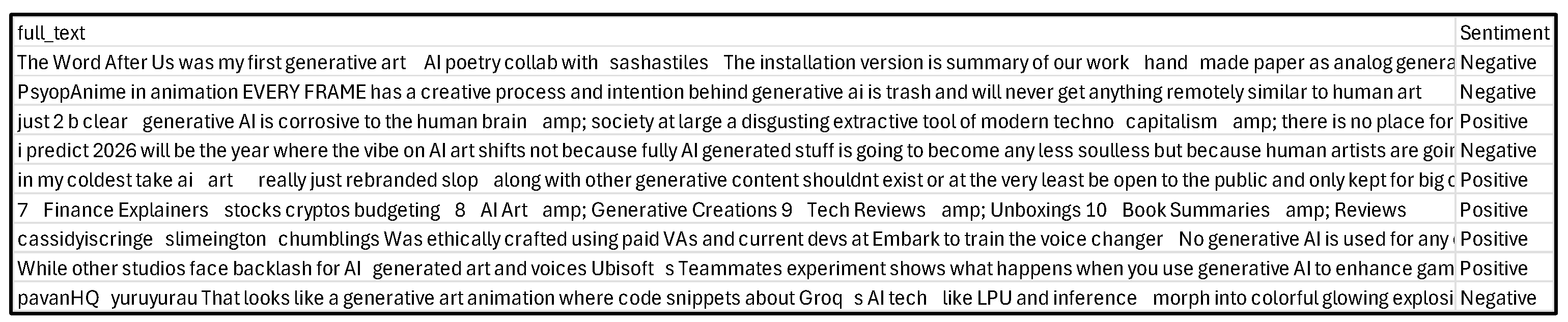
Table 1 presents sample tweets from the raw dataset collected from the X platform, illustrating the variety of user expressions, including opinions on AI-generated art, personal experiences, and discussions about digital creativity.
Table 1.
Data set.
4.2. Data Preparation
At this stage, the crawled data is processed so that it is ready for analysis using the NB classifier, SVM, and DT algorithms (Figure 3). Preprocessing is carried out through several interrelated steps, including data cleaning, tokenization, and feature transformation.
Figure 3.
Data cleaning process in Rapid Miner.
Data cleaning is performed to remove noise and irrelevant information from the raw tweets. This step includes eliminating URLs, mentions (@user), hashtags (#topic), punctuation, numbers, and special characters. In addition, all text is converted to lowercase to ensure consistency, and duplicate or empty tweets are removed. This process helps improve the quality of the dataset and ensures that only meaningful textual information is retained for analysis.
After cleaning, tokenization is applied to split the text into individual words or tokens. These tokens are then transformed into numerical features using appropriate techniques, making them suitable for classification using NB, SVM, and DT algorithms.
Figure 3 illustrates the preprocessing pipeline in RapidMiner. The workflow begins with reading the raw CSV data, followed by a series of cleaning operators including URL removal, mention removal, hashtag removal, symbol removal, trimming, duplicate removal, tokenization, case transformation, stopword filtering, and token length filtering. Each operator prepares the text for subsequent feature extraction and classification.
4.2.1. URL Removal
This step aims to remove uniform resource locators (URLs) from the text, as URLs have no meaning in sentiment analysis (Table 2).
Table 2.
URL removal results.
4.2.2. Mention Removal
This step is used to remove mentions (@username) so that the analysis focuses only on the content of the tweet (Table 3).
Table 3.
Mention removal results.
4.2.3. Hashtag Removal
This step removes hashtags from the text so that they do not affect keyword analysis (Table 4).
Table 4.
Hashtag removal results.
4.2.4. Symbols Removal
This step removes symbols so that the text is cleaner and easier to process (Table 5).
Table 5.
Symbols removal results.
4.2.5. Trimming
Trimming is conducted to remove unnecessary spaces at the beginning and end of text (Table 6).
Table 6.
Trimming results.
4.2.6. Remove Duplicates
Duplicate removal ensures that each tweet is unique so that the model results are not biased due to data duplication (Table 7).
Table 7.
Remove duplicate results.
4.2.7. Tokenization
Tokenization divides sentences or documents into word units so that the text can be processed and analyzed (Table 8).
Table 8.
Tokenization results.
4.2.8. Transformation
The transform case function is used to convert all text to lowercase to avoid variations in uppercase and lowercase letters that affect the analysis (Table 9).
Table 9.
Transform code removal results.
4.2.9. Filter Stopwords
Stopwords are common words that have no significant meaning, such as “i” and “and that”, so they need to be removed so that the analysis focuses on meaningful words (Table 10).
Table 10.
Filter stopword removal results.
4.2.10. Filter Token by Length
This filter filters out irrelevant tokens, such as numbers, symbols, or URLs, so that only meaningful tokens are used in the analysis (Table 11).
Table 11.
Filter Token by Length.
4.3. Modelling
After completing the data cleaning process through the various removal steps described earlier, the next stage involved modeling the dataset to classify tweets into positive and negative sentiments.
4.3.1. Manual Sentiment Labeling
Before conducting automated sentiment analysis using RapidMiner, manual labelling was applied to the initial 329 tweets (Figure 4). Positive labels were assigned to tweets that conveyed helpfulness or ease, while negative labels were assigned to tweets that contained criticism or negative expressions. The purpose of this manual stage is to provide initial training for the system. With manually labelled data, RapidMiner can learn the pattern of sentiment labelling so that when automated analysis is applied to a larger dataset, the software can classify sentiment more accurately. Once manual labelling was completed, the data were stored in RapidMiner to be used for training the model.
Figure 4.
Manual sentiment result.
As depicted in Figure 4, each tweet in the manually labeled subset was reviewed and assigned either a ‘positive’ or ‘negative’ label. Positive labels were given to tweets expressing support, appreciation, or perceived benefits of AI in digital art, while negative labels were assigned to tweets containing criticism, concern, or rejection of AI-generated art. This labeled dataset served as the ground truth for training the NB, SVM, and DT classifiers.
4.3.2. Data Training in RapidMiner
The data storage stage prepares the 329 manually labelled tweets as the basis for initial model training. The process includes the following steps:
- Using the nominal-to-text operator to convert attributes from nominal to categorical;
- Applying filters to select sentiment data that is not missing (is not missing), ensuring only manually labelled data is used;
- Using process documents to transform raw text into numerical features suitable for the NB, SVM, and DT algorithms;
- The NB, SVM, and DT operators are used to train the classification model based on features generated from process documents;
- After training, store model and store data are used to save the trained model and the manually labelled dataset, making it ready for automated sentiment analysis on the remaining unlabelled data.
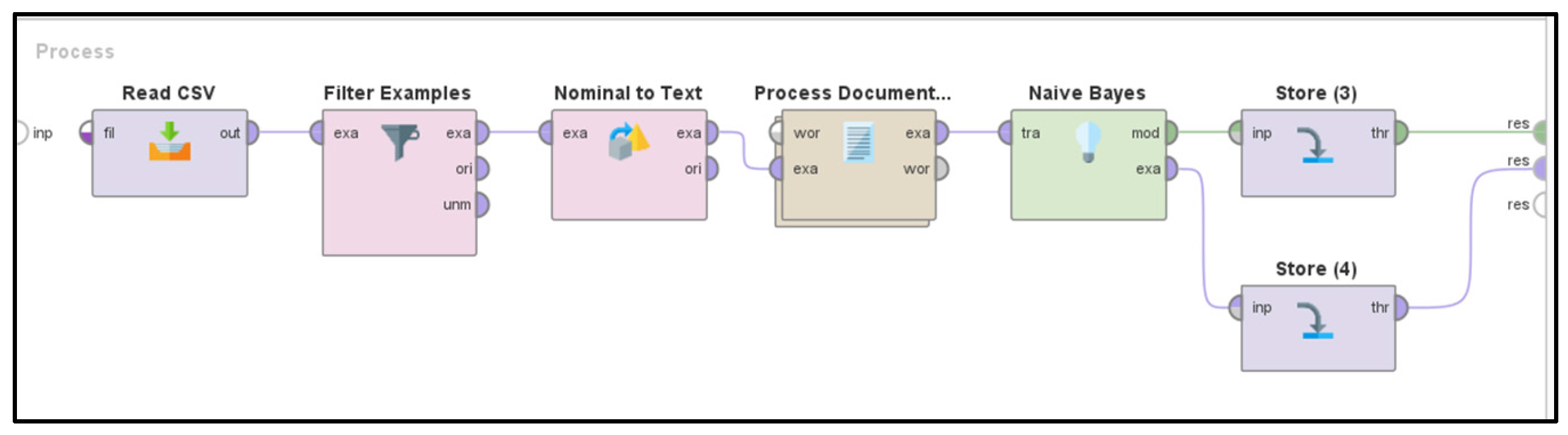
The workflow in Figure 5 begins with reading the manually labeled dataset. The ‘Filter Examples’ operator selects only tweets with non-missing sentiment labels. ‘Nominal to Text’ converts categorical attributes into text format. The ‘Process Documents’ operator performs tokenization, case conversion, stopword removal, and TF-IDF transformation. The Naïve Bayes operator then trains the classification model, which is saved using ‘Store Model’ for later application to unlabeled data.
Figure 5.
NB for training in RapidMiner.
Figure 5 shows the RapidMiner training workflow for the Naïve Bayes classifier. The workflow begins by loading the manually labeled dataset of 329 tweets. The “Process Documents” operator performs text preprocessing, including tokenization, case conversion, stopword removal, and token length filtering. Preprocessed text is then converted into numerical feature vectors using TF-IDF. The “Naïve Bayes” operator applies Bayes. Theorem to calculate the probability of positive or negative sentiment based on word distributions. Finally, the trained model is saved using “Store Model” for later application to unlabeled data.
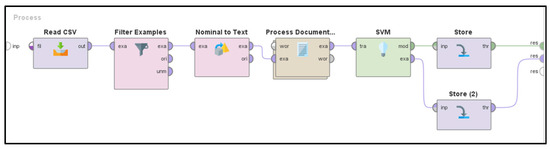
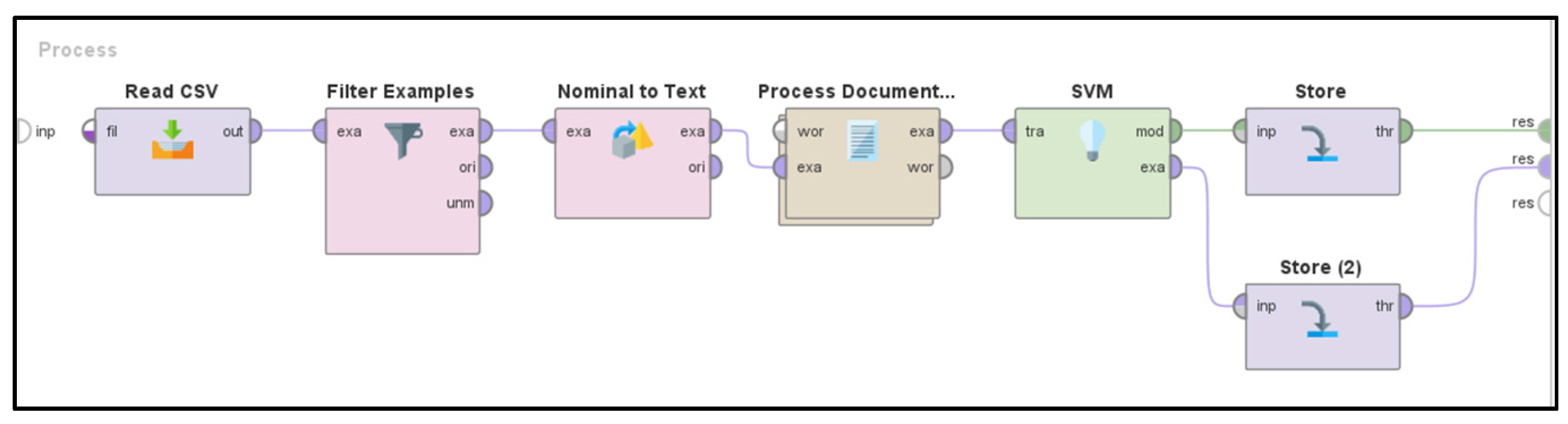
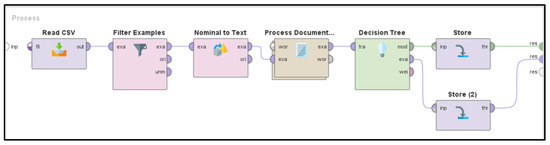
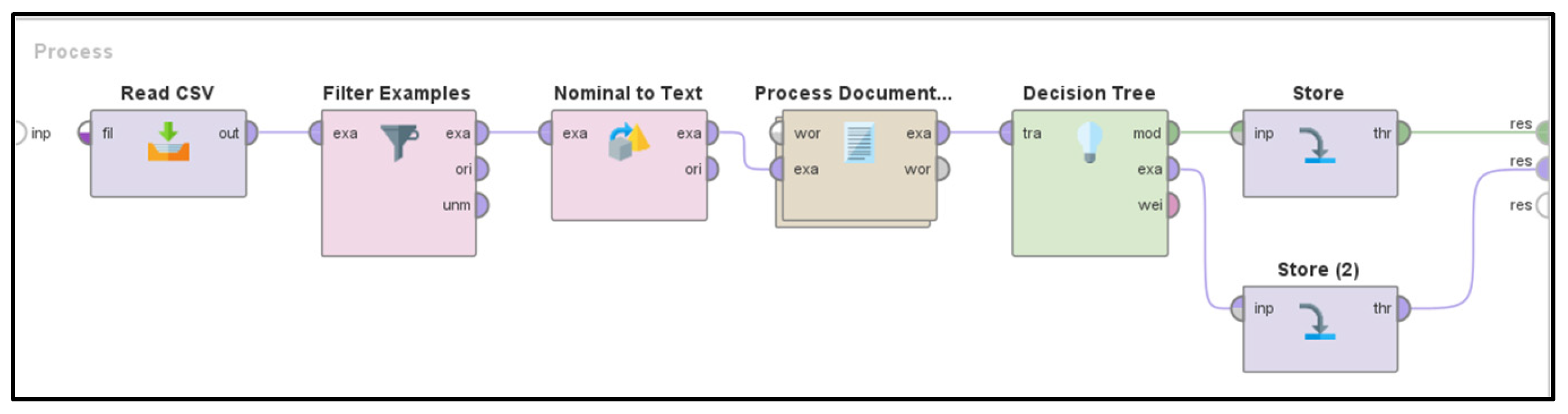
Figure 6 illustrates the SVM classification workflow, starting from reading the dataset and filtering relevant data, followed by data transformation and text preprocessing. The processed data are then classified using the SVM algorithm, and the results are stored for further analysis. For Figure 6 and Figure 7, the SVM/DT training workflow follows the same structure as Figure 5, with the respective algorithm operator substituted for Naïve Bayes.
Figure 6.
SVM for training in RapidMiner.
Figure 7.
DT for training in RapidMiner.
Figure 7 illustrates the DT classification workflow, starting from reading the dataset and filtering relevant data, followed by data transformation and text preprocessing. The processed data are then classified using the DT algorithm, and the results are stored for further analysis.
4.3.3. Data Test in RapidMiner
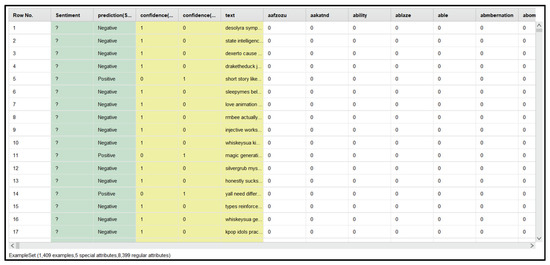
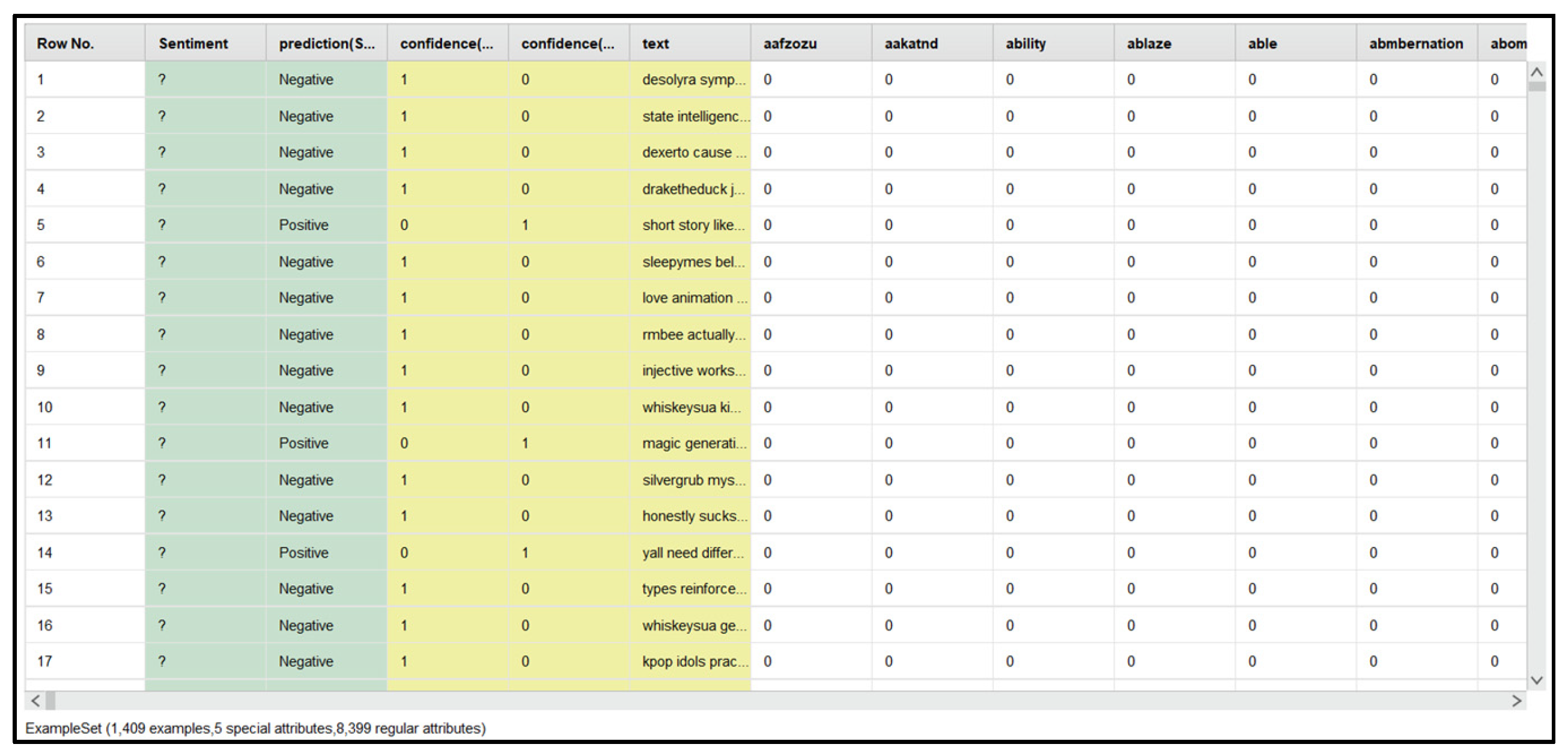
Figure 8 and Figure 9 show the sentiment classification data results of the testing data. The model classified 530 tweets as positive sentiment and 1207 tweets as negative sentiment. This result indicates that negative sentiment toward AI in digital art is more dominant among users, although positive opinions remain present.
Figure 8.
NB for test in RapidMiner.
Figure 9.
Prediction result NB in RapidMiner.
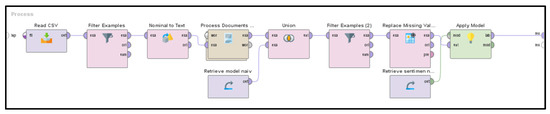
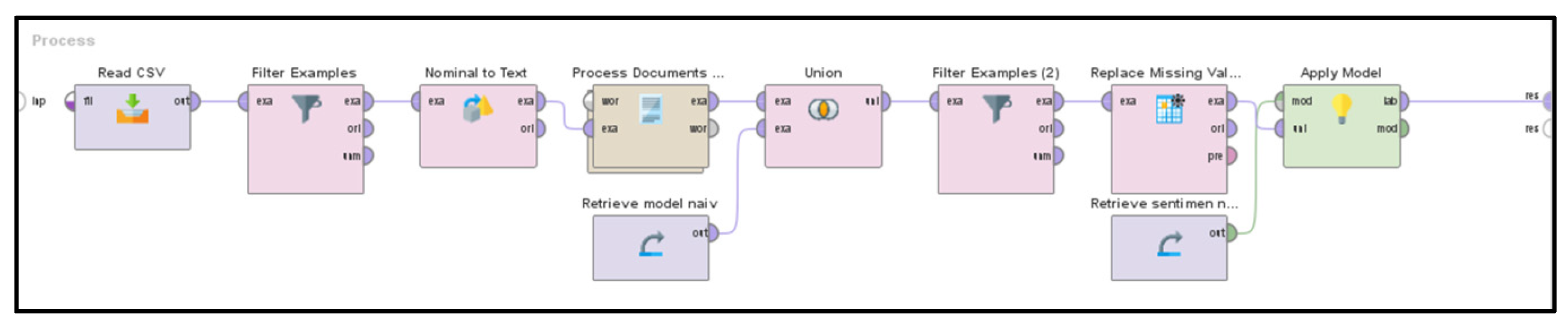
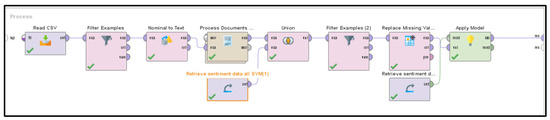
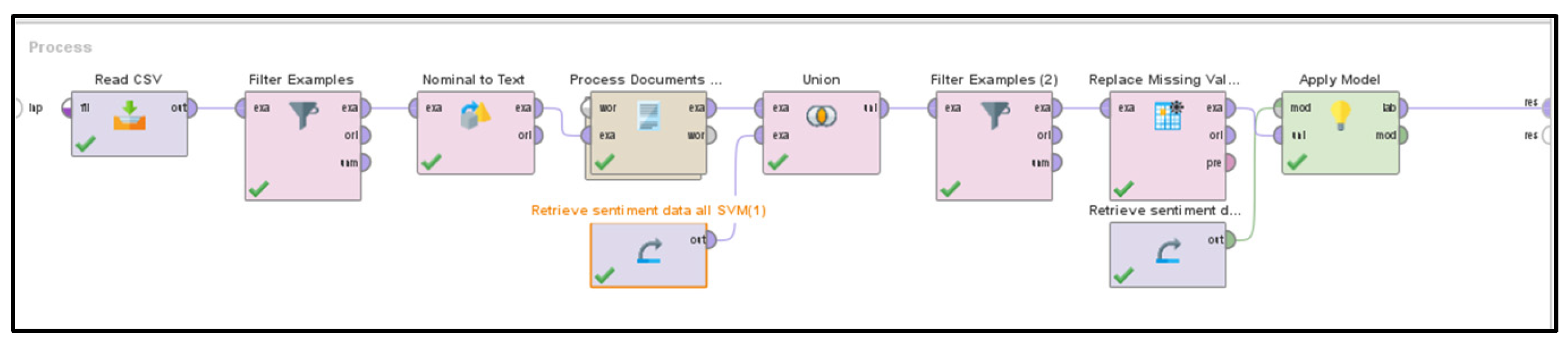
As shown in Figure 8, the testing workflow reads the full dataset (both labeled and unlabeled), filters to select only tweets without manual labels, applies the same text preprocessing and TF-IDF transformation used during training, and then applies the saved Naïve Bayes model to predict sentiment. Results are stored for analysis.
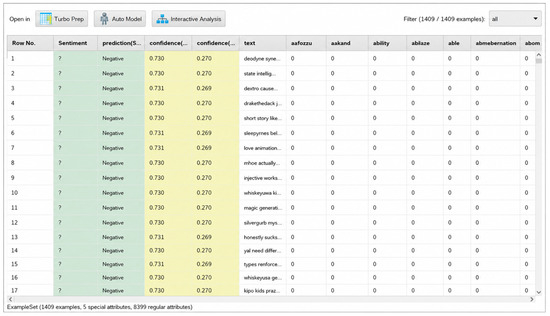
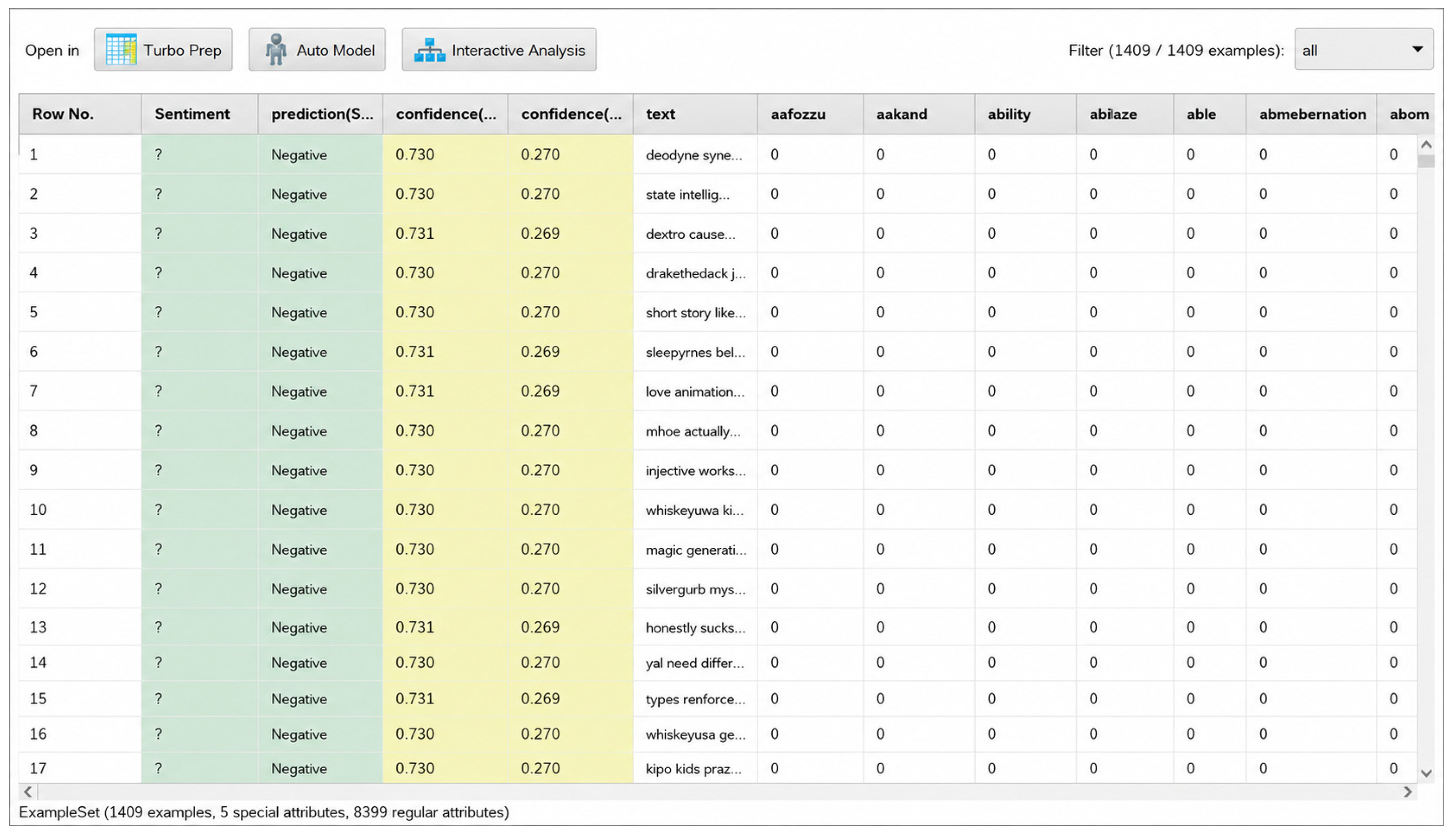
Figure 10 and Figure 11 present the sentiment classification data and results obtained using the SVM model. The figures show that the majority of tweets in the testing dataset were classified as negative sentiment, with 1621 tweets labeled as negative and only 116 tweets classified as positive. This result indicates that the SVM model exhibited a strong bias toward the negative class, resulting in a highly imbalanced sentiment distribution.
Figure 10.
SVM for test in RapidMiner.
Figure 11.
Prediction result data test SVM in RapidMiner.
Figure 10 shows the RapidMiner workflow for applying the trained SVM model to unlabeled test data.
Figure 11 displays the SVM prediction output. Compared to Naïve Bayes, the SVM model produced a much stronger bias toward negative sentiment, classifying only 6.7% of tweets as positive. This suggests that the default SVM parameters may be suboptimal for this imbalanced short-text dataset.
Figure 12 shows the sentiment classification results of the testing data using the DT model. The model classified 195 tweets as positive sentiment and 1542 tweets as negative sentiment, indicating that negative sentiment dominates the dataset.
Figure 12.
Prediction result data test DT in RapidMiner.
The Decision Tree results in Figure 11 show an intermediate distribution between Naïve Bayes and SVM, with 11.2% positive classification. While less biased than SVM, the Decision Tree still favored negative sentiment, reflecting the underlying class imbalance in the dataset and the model’s sensitivity to feature distribution.
Once all the algorithms were trained, the next step was to automatically classify sentiment for tweets without labels. This process involves the following.
- Read CSV: Loading the cleaned dataset, including manually labelled tweets and the remaining unlabelled tweets.
- Filter Examples: Selecting only the unlabelled tweets (is missing) so that already labelled data is not processed again.
- Nominal to Text: Converting categorical attributes into text for further processing.
- Process Documents: Transforming text into numerical representations using TF-IDF, which evaluates the importance of a word within a tweet relative to the entire dataset.
- Tokenize: Splitting sentences into individual words.
- Transform Case: Converting all text to lowercase for consistency.
- Filter Stopwords: Removing common words with little semantic meaning.
- Filter Tokens by Length: Removing tokens that are too short or irrelevant.
- Union: Combining the training and testing datasets so that the model processes all data consistently.
- Filter Examples (again): Processing the unlabelled data after merging datasets.
- Replace Missing Value: Filling missing values with zero to prevent model errors during execution.
- Apply Model: Applying the trained NB, SVM, and DT models to the testing data to predict positive and negative sentiment.
Through these steps, the entire dataset can be analyzed automatically based on sentiment, enabling the NB, Support Vector Machine (SVM), and DT models to efficiently and accurately classify tweets as positive or negative.
4.4. Results
Figure 9 presents the sentiment classification results of the first model. The model identified 530 tweets (≈30.5%) as positive and 1207 tweets (≈69.5%) as negative. These findings suggest that negative sentiment toward AI in digital art is more prevalent, although a notable portion of positive sentiment remains, reflecting perceptions of AI-generated art as beneficial for creativity and efficiency. Figure 11 shows the results obtained using the SVM model. The majority of tweets were classified as negative, with 116 (≈6.7%) labeled positive and 1621 (≈93.3%) labeled negative. This outcome indicates that the SVM model displayed a strong bias toward the negative class, highlighting a limitation of SVM in short-text sentiment analysis when parameter tuning or data balancing is insufficient. Figure 12 illustrates the classification results of the DT model. It identified 195 tweets (≈11.2%) as positive and 1542 (≈88.8%) as negative. While DT captured more positive sentiment than SVM, negative sentiment still dominated, suggesting that the model was also affected by data imbalance and feature distribution, which limited its ability to separate classes effectively.
Collectively, the comparison across Figure 9, Figure 11 and Figure 12 show that different algorithms produce varying sentiment distributions. Although all models reveal a predominance of negative sentiment, the degree of bias differs, underscoring the importance of algorithm selection and parameter optimization in sentiment analysis.
The comparative results demonstrate that NB produced a more balanced sentiment distribution compared with SVM and DT (Table 12 and Table 13). Meanwhile, SVM and DT tended to favor the negative class, indicating potential limitations related to parameter configuration and data imbalance. These findings suggest that NB is more suitable for sentiment analysis of short social media texts in this study, while SVM and DT require further optimization to achieve comparable performance.
Table 12.
Algorithm comparison of sentiment results.
Table 13.
Advantages and limitations of classification algorithms.
As shown in Table 12, the terms “positive” and “negative” refer to the sentiment classification results of user tweets related to digital art on X. Positive sentiment indicates that a tweet expresses favorable opinions or support toward digital art, whereas negative sentiment reflects criticism or unfavorable opinions. The “Positive” and “Negative” columns represent the total number of tweets classified into each sentiment category by each algorithm. Meanwhile, “Positive (%)” and “Negative (%)” indicate the proportion of tweets in each category relative to the total dataset, expressed as percentages, allowing for easier comparison of classification outcomes across algorithms.
Table 13 summarizes the key advantages and limitations of the Naïve Bayes, SVM, and Decision Tree algorithms based on their performance in this sentiment analysis study.
5. Conclusions
Public sentiment toward the use of AI in digital art on the X platform is predominantly negative. Among the three classification algorithms applied, NB produced the most balanced results, classifying 530 tweets as positive and 1207 as negative. In contrast, SVM and DT showed a strong bias toward negative sentiment, identifying only 116 and 195 positive tweets, respectively. These outcomes suggest that NB is more suitable for sentiment analysis of short and sparse social media texts. The performance limitations observed in SVM and DT highlight challenges related to class imbalance and feature representation. Future research may therefore focus on optimizing SVM parameters, applying data balancing techniques, and exploring advanced feature extraction or deep learning models to improve sentiment classification performance in the context of AI-generated digital art.
Author Contributions
Conceptualization, R.M.S., V.C.W., J.A.G., K.G. and I.M.S.; methodology, V.C.W., J.A.G., V.T., F.P.S.S., and K.G.; software, V.C.W. and I.M.S.; validation, R.M.S.; formal analysis, V.C.W., J.A.G. and K.G.; investigation, V.C.W. and I.M.S.; resources, V.C.W. and I.M.S.; data curation, V.C.W. and D.A.A.L.; writing original draft preparation, V.C.W.; writing review and editing, J.A.G., K.G. and I.M.S.; visualization, V.C.W., J.A.G. and I.M.S.; supervision, R.M.S.; project administration, R.M.S. All authors have read and agreed to the published version of the manuscript.
Funding
This research received no external funding.
Institutional Review Board Statement
Not applicable.
Informed Consent Statement
Not applicable.
Data Availability Statement
Data is unavailable due to privacy.
Conflicts of Interest
The authors declare no conflict of interest.
References
- AlBadani, B.; Shi, R.; Dong, J. A Novel Machine Learning Approach for Sentiment Analysis on Twitter Incorporating the Universal Language Model Fine-Tuning and SVM. Appl. Syst. Innov. 2022, 5, 13. [Google Scholar] [CrossRef] [Scilit]
- Amro, A.; Al-Akhras, M.; El Hindi, K.; Habib, M.; Abu Shawar, B. Instance Reduction for Avoiding Overfitting in Decision Trees. J. Intell. Syst. 2021, 30, 438–459. [Google Scholar] [CrossRef] [Scilit]
- Asyaky, M.S.; Al-Husaini, M.; Lukmana, H.H. Sentiment Analysis on Short Social Media Texts Using DistilBERT. J. Comput. Netw. Archit. High Perform. Comput. 2025, 7, 524–533. [Google Scholar] [CrossRef] [Scilit]
- Bolaj, K. Text Categorization System for English Text Documents using NB Classifier. Int. J. Comput. Appl. 2020, 177, 7–10. [Google Scholar]
- Bonacchi, C.; Krzyzanska, M.; Acerbi, A. Positive sentiment and expertise predict the diffusion of archaeological content on social media. Sci. Rep. 2025, 15, 11234. [Google Scholar] [CrossRef] [Scilit] [PubMed]
- Chakraborty, K.; Bhattacharyya, S.; Bag, R. A Survey of Sentiment Analysis from Social Media Data. IEEE Trans. Comput. Soc. Syst. 2020, 7, 450–464. [Google Scholar] [CrossRef] [Scilit]
- Jijo, B.T.; Abdulazeez, A.M. Classification Based on Decision Tree Algorithm for Machine Learning. J. Appl. Sci. Technol. Trends 2021, 2, 20–28. [Google Scholar] [CrossRef] [Scilit]
- Custode, L.L.; Iacca, G. Evolutionary Learning of Interpretable Decision Trees. IEEE Access 2020, 11, 2169–3536. [Google Scholar] [CrossRef] [Scilit]
- Dervenis, C.; Kanakis, G.; Fitsilis, P. Sentiment analysis of student feedback: A comparative study employing lexicon and machine learning techniques. Stud. Educ. Eval. 2024, 83, 101406. [Google Scholar] [CrossRef] [Scilit]
- Du, K.-L.; Jiang, B.; Lu, J.; Hua, J.; Swamy, M.N.S. Exploring Kernel Machines and Support Vector Machines: Principles, Techniques, and Future Directions. Mathematics 2024, 12, 3935. [Google Scholar] [CrossRef] [Scilit]
- Epstein, Z.; Hertzmann, A. The Investigators of Human Creativity. Art and the science of generative AI. Science 2023, 380, 1110–1111. [Google Scholar] [CrossRef] [Scilit]
- Feng, W.; Li, Y.; Ma, C.; Yu, L. From ChatGPT to Sora: Analyzing Public Opinions and Attitudes on Generative AI in Social Media. IEEE Access 2025, 13, 14485–14498. [Google Scholar] [CrossRef] [Scilit]
- Feuerriegel, S.; Hartmann, J.; Janiesch, C.; Zschech, P. Generative AI. Bus. Inf. Syst. Eng. 2023, 66, 111–126. [Google Scholar] [CrossRef] [Scilit]
- Fu, Y.; Bin, H.; Zhou, T.; Wang, M. Creativity in the Age of AI: Evaluating the Impact of Generative AI on Design Outputs and Designers’ Creative Thinking. arXiv 2024, arXiv:2411.00168. [Google Scholar] [CrossRef] [Scilit]
- Mukherjee-Gandhi, A.; Muellerklein, O. When Algorithms Meet Artists: Topic Modeling the AI-Art Debate, 2013–2025. arXiv 2025, arXiv:2508.03037. [Google Scholar] [CrossRef] [Scilit]
- Han, Y.; Yu, J.; Zhang, N.; Meng, C.; Ma, P.; Zhong, W.; Zou, C. Leverage Classifier: Another Look at Support Vector Machine. Stat. Sin. 2023, 33, 1605–1625. [Google Scholar] [CrossRef] [Scilit]
- Hassani, H.; Beneki, C.; Unger, S.; Mazinani, M.T.; Yeganegi, M.R. Text Mining in Big Data Analytics. Big Data Cogn. Comput. 2020, 4, 1. [Google Scholar] [CrossRef] [Scilit]
- Ma, J.; Fan, L.; Tian, W.; Miao, Z. Research on Data Classification Method of Optimized Support Vector Machine Based on Gray Wolf Algorithm. Int. J. Grid High Perform. Comput. 2023, 15, 1–14. [Google Scholar] [CrossRef] [Scilit]
- Jukanti, M. Understanding Natural Language Processing (NLP) Techniques. J. Comput. Sci. Technol. Stud. 2025, 7, 1005–1012. [Google Scholar] [CrossRef] [Scilit]
- Punitha, K.; Raja Shree, S.; Cruz Antony, J. A Systematic Review of Sentiment Analysis Approaches and Techniques. In Proceedings of the 2025 6th International Conference on Mobile Computing and Sustainable Informatics (ICMCSI), Goathgaun, Nepal, 7–8 January 2025; pp. 603–607. [Google Scholar]
- Klusowski, J.M.; Tian, P.M. Large Scale Prediction with DTs. J. Am. Stat. Assoc. 2021, 119, 525–537. [Google Scholar] [CrossRef] [Scilit]
- Kumar, R.; Goswami, B.K.; Mhatre, S.M.; Agrawal, S. Naive Bayes in Focus: A Thorough Examination of its Algorithmic Foundations and Use Cases. Int. J. Innov. Sci. Res. Technol. 2024, 9, 2078–2081. [Google Scholar] [CrossRef] [Scilit]
- Fitrana, L.A.; Linawati, S.; Herlinawati, N.; Sa’adah, R.; Seimahuria, S. Analysis of Twitter User Sentiment Towards the Indosat Brand Using the Naïve Bayes Classifier Method (Analisis Sentimen Pengguna Twitter Terhadap Brand Indosat Menggunakan Metode Naïve Bayes Classifier). J. Mhs. Tek. Inform. 2024, 8, 4291–4297. (In Indonesian) [Google Scholar]
- Lee, K.-P.; Song, S. Developing insights from the collective voice of target users in Twitter. J. Big Data 2022, 9, 45. [Google Scholar] [CrossRef] [Scilit]
- Pradeep, M.; Sasivardhan, T.; Bodana, G.; Shilpa, K.; Savalapurapu, K.; Babu, G.C. Natural Language Processing for Literacy Text Mining: Extracting Knowledge From British National Corpus. In Proceedings of the 2025 6th International Conference on Inventive Research in Computing Applications (ICIRCA), Coimbatore, India, 25–27 June 2025; pp. 1816–1821. [Google Scholar]
- Martín, M.S.; Chen, F.-W.; Urbistondo, P.A. Application of the LDA model to identify topics in telemedicine conversations on the X social network. BMC Health Serv. Res. 2025, 25, 369. [Google Scholar] [CrossRef] [Scilit] [PubMed]
- Messer, U. Co-creating art with generative AI: Implications for artworks and artists. Comput. Hum. Behav. Artif. Hum. 2024, 2, 100056. [Google Scholar] [CrossRef] [Scilit]
- Mujahid, M.; Kına, E.; Rustam, F.; Villar, M.G.; Alvarado, E.S.; Diez, I.D.L.T.; Ashraf, I. Data oversampling and imbalanced datasets: An investigation of performance for machine learning and feature engineering. J. Big Data 2024, 11, 87. [Google Scholar] [CrossRef] [Scilit]
- Musyarofah, A.M.; Prasetyo, R.F. The Perception of Fine Arts Students at Semarang State University towards Artificial Intelligence in the Field of Business and Fine Arts Education to the General Public (Persepsi Mahasiswa Seni Rupa Universitas Negeri Semarang terhadap Kecerdasan Buatan di Ranah Bisnis dan Pendidikan Seni Rupa kepada Masyarakat Umum). J. Majemuk 2024, 3, 387–400. (In Indonesian) [Google Scholar]
- Nordström, P.; Lundman, R.; Hautala, J. Evolving Coagency between Artists and AI in the Spatial Cocreative Process of Artmaking. Ann. Am. Assoc. Geogr. 2023, 113, 2203–2218. [Google Scholar] [CrossRef] [Scilit]
- Ohme, J.; Araujo, T.; Boeschoten, L.; Freelon, D.; Ram, N.; Reeves, B.B.; Robinson, T.N. Digital Trace Data Collection for Social Media Effects Research: APIs, Data Donation, and (Screen) Tracking. Commun. Methods Meas. 2023, 18, 124–141. [Google Scholar] [CrossRef] [Scilit]
- Puadi, M.F.; Hashim, M.E.A.; Albakry, N.S. Between Control and Collaboration: Artistic Autonomy in AI-Generated Visual Artworks. Semarak Int. J. Creat. Art Des. 2025, 4, 1–11. [Google Scholar] [CrossRef] [Scilit]
- Wahyuni, P.; Romli, M.A. Comparison of Naïve Bayes Classifier and Decision Tree Algorithms for Sentiment Analysis on the House of Representatives’ Right of Inquiry on Twitter. J. Appl. Inform. Comput. 2024, 8, 523–530. [Google Scholar] [CrossRef] [Scilit]
- Quirita, V.A.A.; Cárdenas, J.D.; Aliaga, W.; Palacios, A.; Sierra, R.B. Peruvian Presidential Debates in the Elections of 2021 in Twitter/X: A Sentiment Analysis Approach. IEEE Access 2024, 12, 138386–138398. [Google Scholar] [CrossRef] [Scilit]
- Rezaeenour, J.; Ahmadi, M.; Jelodar, H.; Shahrooei, R. Systematic review of content analysis algorithms based on deep neural networks. Multimed. Tools Appl. 2022, 82, 17879–17903. [Google Scholar] [CrossRef] [Scilit]
- Stracqualursi, L.; Agati, P. Twitter users perceptions of AI-based e-learning technologies. Sci. Rep. 2024, 14, 5927. [Google Scholar] [CrossRef] [Scilit]
- Tang, J.; Liu, X. ‘NO TO AI GENERATED IMAGES’: Fan art creators contesting AI integration on social media platforms. Media Int. Aust. 2025, 197, 137–151. [Google Scholar] [CrossRef] [Scilit]
- Uzun, E. A Novel Web Scraping Approach Using the Additional Information Obtained From Web Pages. IEEE Access 2020, 8, 61726–61740. [Google Scholar] [CrossRef] [Scilit]
- Van Atteveldt, W.; Van der Velden, M.A.C.G.; Boukes, M. The Validity of Sentiment Analysis: Comparing Manual Annotation, Crowd-Coding, Dictionary Approaches, and Machine Learning Algorithms. Commun. Methods Meas. 2021, 15, 121–140. [Google Scholar] [CrossRef] [Scilit]
- Van Der Veen, A.M.; Bleich, E. The advantages of lexicon-based sentiment analysis in an age of machine learning. PLoS ONE 2025, 20, e0313092. [Google Scholar] [CrossRef] [Scilit]
- Wan, W.; Huang, R. Deep Learning-Driven Public Opinion Analysis on the Weibo Topic about AI Art. Appl. Sci. 2024, 14, 3674. [Google Scholar] [CrossRef] [Scilit]
- Wankhade, M.; Rao, A.C.S.; Kulkarni, C. A survey on sentiment analysis methods, applications, and challenges. Artif. Intell. Rev. 2022, 55, 5731–5780. [Google Scholar] [CrossRef] [Scilit]
- Zakharia, A.; Hasanah, H.; Srirahayu, A. Public Sentiment Analysis on Twitter About the Use of AI in Digital Art Using CNN (Analisis Sentimen Publik di Twitter Tentang Pemanfaatan AI dalam Seni Digital Menggunakan CNN). J. Inform. Tek. Elektro Terap. 2025, 13, 536–545. (In Indonesian) [Google Scholar]





Disclaimer/Publisher’s Note: The statements, opinions and data contained in all publications are solely those of the individual author(s) and contributor(s) and not of MDPI and/or the editor(s). MDPI and/or the editor(s) disclaim responsibility for any injury to people or property resulting from any ideas, methods, instructions or products referred to in the content. |
© 2026 by the authors. Licensee MDPI, Basel, Switzerland. This article is an open access article distributed under the terms and conditions of the Creative Commons Attribution (CC BY) license.