Modeling and Simulation of a Distributed-Electric Propulsion System with PROOSIS †

Abstract
1. Motivation
2. Methodology
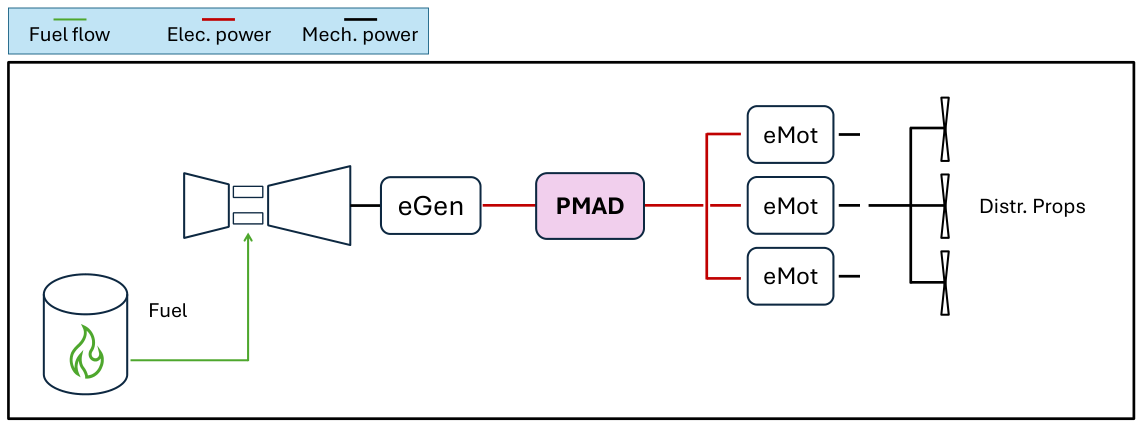
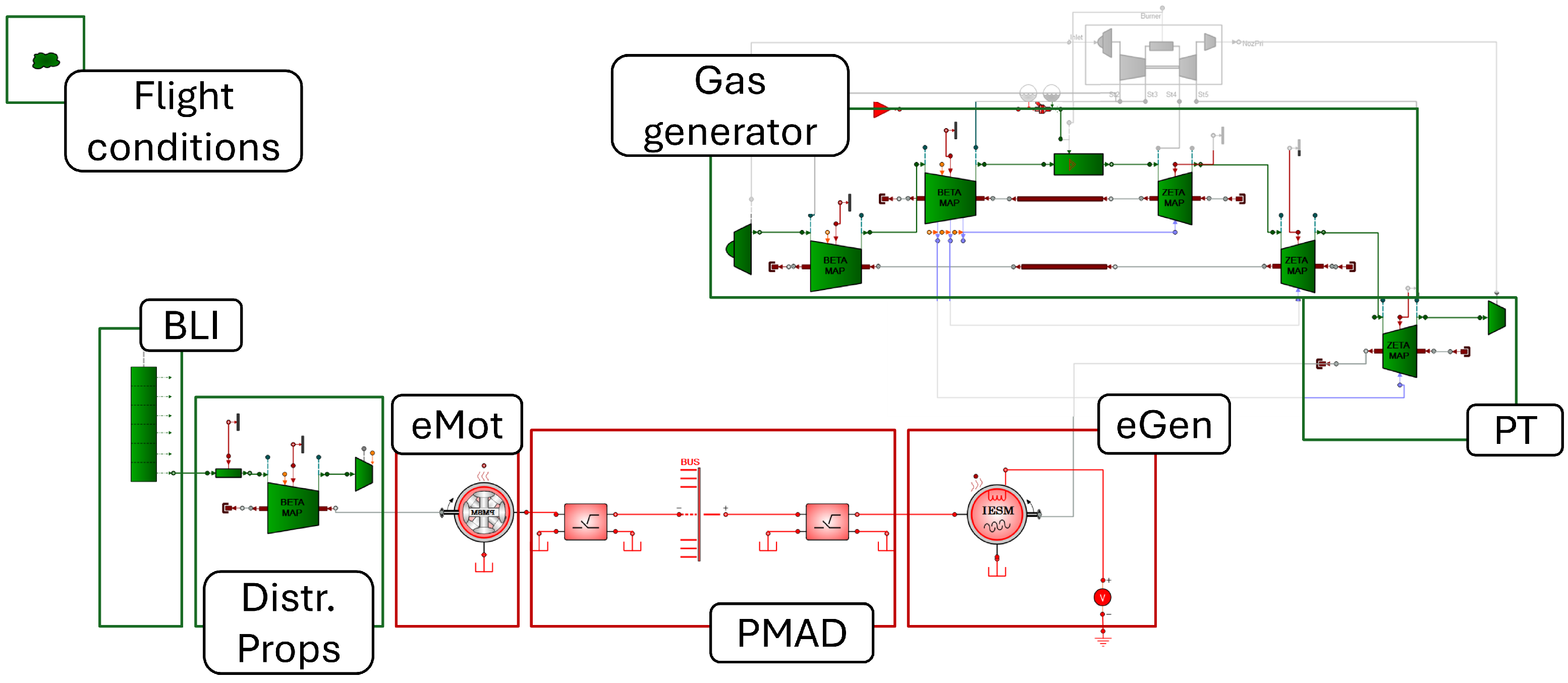
Model Description
- Engine operating regime (power output), controlled via the turbine fuel flow.
- Fans’ rotational speed, controlled by means of the electric motors’ operating frequency.
- Bypass ratio, modified via the variable outlet area of the fans’ nozzles.
- Converter/bus allocations, which are determined by the excitation voltage of the electric generator.
3. Results
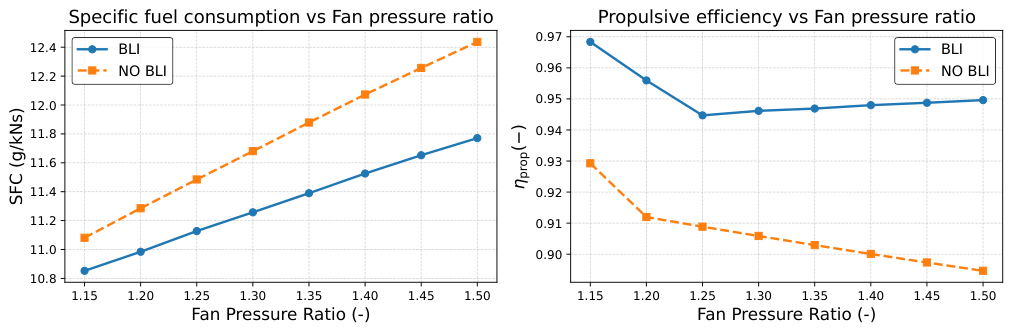
3.1. Design Point Results
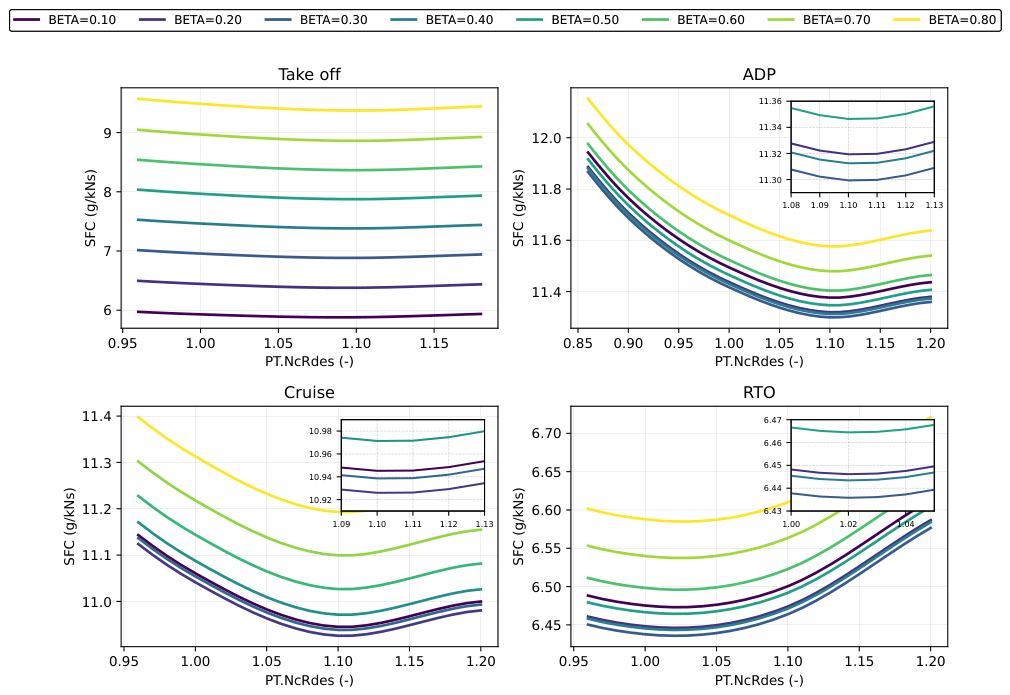
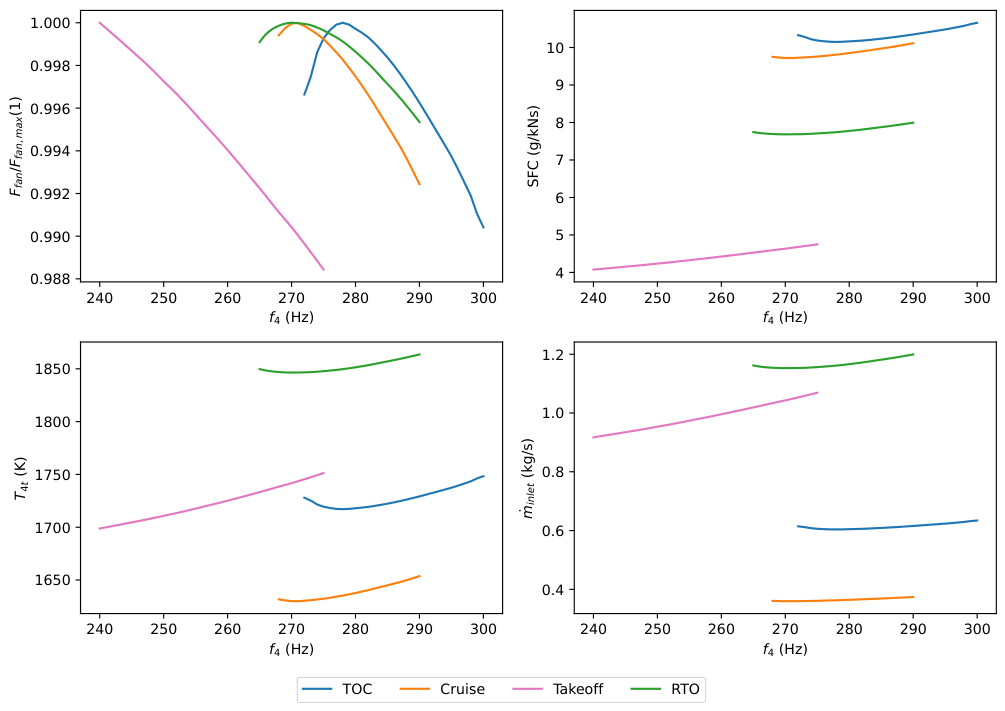
3.2. Off-Design and Parametric Studies
3.3. Integrated Mission Simulation
4. Conclusions
Author Contributions
Funding
Institutional Review Board Statement
Informed Consent Statement
Data Availability Statement
Conflicts of Interest
References
- Clean Hydrogen Joint Undertaking. Strategic Research and Innovation Agenda 2021–2027; Technical Report; Clean Hydrogen Partnership: Brussels, Belgium, 2022; Available online: https://european-union.europa.eu/institutions-law-budget/institutions-and-bodies/search-all-eu-institutions-and-bodies/clean-hydrogen-joint-undertaking_en (accessed on 1 October 2025).
- Bradley, M.; Droney, C.; Dallara, E. Subsonic Ultra Green Aircraft Research (SUGAR) Phase I Final Report; Technical Report; National Aeronautics and Space Administration: Hampton, VA, USA, 2011. Available online: https://ntrs.nasa.gov/api/citations/20110011321/downloads/20110011321.pdf (accessed on 1 October 2025).
- Forsberg, D. World Fleet Forecast 2017–2036; Technical Report; Avolon: Dublin, Ireland, 2017; Available online: https://dm1es2gjsclbk.cloudfront.net/old_data/newsroom_and_thoughts/2018/07/Avolon_White-paper_Digital-27.10.17.pdf (accessed on 1 October 2025).
- Felder, J.; Kim, H.; Brown, G. Turboelectric Distributed Propulsion Engine Cycle Analysis for HybridWingBody Aircraft. In Proceedings of the 47th AIAA Aerospace Sciences Meeting Including the New Horizons Forum and Aerospace Exposition, Orlando, FL, USA, 5–8 January 2009. [Google Scholar] [CrossRef]
- Greitzer, E.M.; Bonnefoy, P.; DelaRosaBlanco, E.; Dorbian, C.; Drela, M.; Hall, D.; Hansman, R.; Hileman, J.; Liebeck, R.; Levegren, J.; et al. N+3 Aircraft Concept Designs and Trade Studies; Technical Report; National Aeronautics and Space Administration: Cleveland, OH, USA, 2010. Available online: https://ntrs.nasa.gov/api/citations/20100042401/downloads/20100042401.pdf (accessed on 1 October 2025).
- Felder, J.; Kim, H.; Brown, G.; Kummer, J. An examination of the effect of boundary layer ingestion on turboelectric distributed propulsion systems. In Proceedings of the 49th AIAA Aerospace Sciences Meeting Including the New Horizons Forum and Aerospace Exposition, Orlando, FL, USA, 4–7 January 2011. [Google Scholar] [CrossRef]
- Kim, H.; Felder, J. Control Volume Analysis of Boundary Layer Ingesting Propulsion Systems with or Without Shock Wave Ahead of the Inlet. In Proceedings of the 49th AIAA Aerospace Sciences Meeting Including the New Horizons Forum and Aerospace Exposition, Orlando, FL, USA, 4–7 January 2011. [Google Scholar] [CrossRef]
- Masson, P.; Soban, D.; Upton, E.; Pienkos, J.; Luongo, C. HTS motors in aircraft propulsion: Design considerations. IEEE Trans. Appl. Supercond. 2005, 15, 2218–2221. [Google Scholar] [CrossRef]
- Pienkos, J.E. Cooling, Thermal Design, and Stability of a Superconducting Motor. Ph.D. Thesis, Florida State University, Tallahassee, FL, USA, 2009. [Google Scholar]
- Gieras, J.F. Superconducting Electrical Machines—State of the Art. Prz. Elektrotechniczny 2009, 85, 1–19. Available online: https://www.researchgate.net/profile/Jacek-Gieras/publication/228619785_Superconducting_Electrical_Machines_State_of_the_Art/links/00b4951d4cc0bc5a02000000/Superconducting-Electrical-Machines-State-of-the-Art.pdf (accessed on 1 October 2025).
- Patel, A.; Climente-Alarcon, V.; Baskys, A.; Glowacki, B.A.; Reis, T. Design considerations for fully superconducting synchronous motors aimed at future electric aircraft. In Proceedings of the 2018 IEEE International Conference on Electrical Systems for Aircraft, Railway, Ship Propulsion and Road Vehicles & International Transportation Electrification Conference (ESARS-ITEC), Nottingham, UK, 7–9 November 2018. [Google Scholar] [CrossRef]
- Berg, F.; Palmer, J.; Bertola, L.; Miller, P.; Dodds, G. Cryogenic system options for a superconducting aircraft propulsion system. IOP Conf. Ser. Mater. Sci. Eng. 2015, 101, 012085. [Google Scholar] [CrossRef]
- Armstrong, M.; Blackwelder, M.; Bollman, A.; Ross, C.; Campbell, A.; Jones, C.; Norman, P. Architecture, Voltage, and Components for a Turboelectric Distributed Propulsion Electric Grid; Technical Report; National Aeronautics and Space Administration: Cleveland, OH, USA, 2015. Available online: https://ntrs.nasa.gov/api/citations/20150014237/downloads/20150014237.pdf (accessed on 1 October 2025).
- Armstrong, M.J.; Ross, C.A.; Blackwelder, M.J.; Rajashekara, K. Trade studies for NASA N3-X turboelectric distributed propulsion system electrical power system architecture. SAE Int. J. Aerosp. 2012, 5, 325–336. [Google Scholar] [CrossRef]
- Toniato, P. Numerical Investigation of Aerodynamic Effects of Distributed Propulsion. Ph.D. Thesis, Università degli Studi di Padova, Padua, Italy, 2014. [Google Scholar]
- Liebeck, R. Design of the Blended Wing Body Subsonic Transport. J. Aircr. 2004, 41, 10–25. [Google Scholar] [CrossRef]
- Zamboni, J.; Vos, R.; Emeneth, M.; Schneegans, A. A method for the conceptual design of hybrid electric aircraft. In Proceedings of the AIAA Scitech 2019 Forum, San Diego, CA, USA, 7–11 January 2019. [Google Scholar] [CrossRef]
- Steiner, H.J.; Seitz, A.; Wieczorek, K.; Plötner, K.; Isikveren, A.; Hornung, M. Multi-disciplinary Design and Feasibility Study of Distributed Propulsion Systems. In Proceedings of the 28th Congress of the International Council of the Aeronautical Sciences 2012, ICAS 2012, Brisbane, Australia, 23–28 September 2012; Available online: https://www.icas.org/icas_archive/ICAS2012/PAPERS/803.PDF (accessed on 1 October 2025).
- Duffy, K.P.; Jansen, R. Partially Turboelectric and Hybrid Electric Aircraft Drive Key Performance Parameters. In Proceedings of the 2018 AIAA/IEEE Electric Aircraft Technologies Symposium, Cincinnati, OH, USA, 9–11 July 2018. [Google Scholar] [CrossRef]
- Nøland, J.K.; Nuzzo, S.; Tessarolo, A.; Alves, E. Excitation System Technologies for Wound-Field Synchronous Machines: Survey of Solutions and Evolving Trends. IEEE Access 2019, 7, 109699–109718. [Google Scholar] [CrossRef]
- Wang, Y.; Nuzzo, S.; Zhang, H.; Zhao, W.; Gerada, C.; Galea, M. Challenges and Opportunities for Wound Field Synchronous Generators in Future More Electric Aircraft. IEEE Trans. Transp. Electrif. 2020, 6, 1466–1477. [Google Scholar] [CrossRef]
- Palmer, J.; Shehab, E. Modelling of cryogenic cooling system design concepts for superconducting aircraft propulsion. IET Electr. Syst. Transp. 2016, 6, 170–178. [Google Scholar] [CrossRef]
- Felder, J.L.; Brown, G.V.; DaeKim, H.; Chu, J. Turboelectric Distributed Propulsion in a Hybrid Wing Body Aircraft; Technical Report; National Aeronautics and Space Administration: Cleveland, OH, USA, 2011. Available online: https://ntrs.nasa.gov/api/citations/20120000856/downloads/20120000856.pdf (accessed on 1 October 2025).



| OEW (kg) | PL (kg) | FW (kg) | MTOW (kg) | Savings | |
|---|---|---|---|---|---|
| B777-200 LR [23] | 154,584 | 53,500 | 126,915 | 348,676 | - |
| N3X-PROOSIS | 121,472 | 53,500 | 43,226 | 222,590 | 66% |
Disclaimer/Publisher’s Note: The statements, opinions and data contained in all publications are solely those of the individual author(s) and contributor(s) and not of MDPI and/or the editor(s). MDPI and/or the editor(s) disclaim responsibility for any injury to people or property resulting from any ideas, methods, instructions or products referred to in the content. |
© 2026 by the authors. Licensee MDPI, Basel, Switzerland. This article is an open access article distributed under the terms and conditions of the Creative Commons Attribution (CC BY) license.
Share and Cite
Rosales, M.A.; Sánchez de León, L. Modeling and Simulation of a Distributed-Electric Propulsion System with PROOSIS. Eng. Proc. 2026, 133, 197. https://doi.org/10.3390/engproc2026133197
Rosales MA, Sánchez de León L. Modeling and Simulation of a Distributed-Electric Propulsion System with PROOSIS. Engineering Proceedings. 2026; 133(1):197. https://doi.org/10.3390/engproc2026133197
Chicago/Turabian StyleRosales, Maria Aranda, and Luis Sánchez de León. 2026. "Modeling and Simulation of a Distributed-Electric Propulsion System with PROOSIS" Engineering Proceedings 133, no. 1: 197. https://doi.org/10.3390/engproc2026133197
APA StyleRosales, M. A., & Sánchez de León, L. (2026). Modeling and Simulation of a Distributed-Electric Propulsion System with PROOSIS. Engineering Proceedings, 133(1), 197. https://doi.org/10.3390/engproc2026133197