


Abstract
As global energy demands rise and concerns about environmental sustainability intensify, renewable energy sources like solar photovoltaic (PV) systems have gained significant attention. An integrated approach is proposed, leveraging spatial analysis using Helioscope, a 3D solar design tool, incorporated with Geographic Information System (GIS) data. This study conducted a spatial analysis of Cape Peninsula University of Technology (CPUT) Bellville campus’s potential for renewable energy, and the results are promising. The research indicated that the campus has enough rooftop space to optimally place solar panels with a capacity of 7.8 megawatts, which is more than the campus’s total energy needs of 6.3 megawatts. This study identified 13,249 modules that can be optimally placed to achieve this.
1. Introduction
As the global energy sector is transforming under the pressure of increasing energy needs, the urgency of reducing carbon emissions due to climate change, and the imperative for sustainability, renewable sources of energy have become the foundation to achieve a low-carbon future [1]. Solar PV systems have been widely accepted due to their scalability, reduced costs, and potential to capture abundant solar power [2]. Of these, rooftop PV systems hold promise for residential, commercial, and institutional buildings to tap efficient generation and utilization of the generated power [3]. By harnessing solar energy at peak generating hours during high-sunlight hours and storing that for utilization during high-demand or low-sun hours, PV systems achieve greater reliability in energy supply, mitigate the reliance on fossil fuel-based grids, and curb greenhouse gas emissions.
In the case of South Africa, where energy security is an acute challenge due to load shedding, old infrastructure, and its dependence on coal-fired power, a rooftop PV system is an attractive solution for institutions. Large campuses and universities are ideal for rooftop PV systems due to their space, diverse energy loads, and commitment to sustainability [4,5]. Cape Peninsula University of Technology (CPUT), located in the high-solar-irradiance region according to “ProfileSolar.com,” is in an appropriate position to harness rooftop PV systems to supply its requirements, minimize its costs of operation, and support national initiatives for the diversification of the power supply mix towards carbon neutrality. Nonetheless, maximization of the performance of rooftop PV systems for campus deployment is a challenging process. Rooftop PV systems at the CPUT Bellville campus face challenges due to irregular building topologies and shading, complicating panel placement, storage, and sizing. This research evaluates spatial factors to optimize rooftop PV system performance, considering the campus’s unique rooftop shapes and sizes. Spatial analysis using Helioscope and GIS tech was applied to navigate CPUT’s complex rooftops, mapping features like HVAC systems and barriers to identify prime spots for solar panels, maximizing energy output.
2. Literature Review
2.1. Evolutionary Computation Optimization Methods
The researchers in [6] used a genetic algorithm to optimize solar panel and battery sizing, minimizing costs for a prosumer system. For a 4.5 kW peak demand system, they found 14 solar panels and 8 kWh battery capacity optimal, with 88.9% grid availability and 4.8% loss of load probability.
Particle Swarm Optimization (PSO), introduced by Dr. Eberhard and Dr. Kennedy in 1995, outperformed GA in optimizing renewable energy systems [7]. PSO achieved faster convergence, identifying optimal configurations as 56 PV modules with 7 batteries for max NPV or 66 PV modules with 10 batteries for min LPSP [7]. PSO has proven its effectiveness multiple times in renewable energy system applications through studies conducted after initial evaluations. Research on optimizing renewable energy systems has utilized various techniques. For instance, refs. [8,9] employed genetic algorithms, achieving a 78.6% performance ratio through NSGA-II-TOPSIS integration. The PSO algorithm has also been applied to optimize PV–battery systems in residential settings, lowering energy costs [10,11]. PSO proved reliable for designing integrated PV and battery systems considering technical and economic factors. Advanced tools like MATLAB/Simulink [12], System Advisor Model [13], and RETScreen [14,15] support system modelling and optimization. Recent studies have integrated Quantum PSO with Q-learning, addressing shading effects [16,17]. Further development is needed for peak demand management, scalability, and cost–environmental assessments [18].
2.2. Parametric Optimization Methods
Research utilizing PVSyst software showed promising results for rooftop PV systems. Studies demonstrated performance ratios ranging from 75.16% to 92.9%, with annual averages around 86.2% [19,20,21]. PVSyst proved effective for shading assessment, orientation analysis, and optimizing tilt and azimuth angles [22,23]. For instance, a 52.5 kW commercial rooftop system achieved 80.30% PR and 1043.88 kWh/kWp annual production, while a large power plant generated 60,513,314 kWh/year with 75.16% PR [20,21].
Helioscope, a 3D modelling platform, also delivered efficient results for commercial and institutional applications, optimizing system performance and studying shading impacts [20,24]. Studies showcased its effective optimization of PV systems: a 4 MW industrial plant achieved a 0.7 performance ratio with 10+ daily solar hours and 3.2 MW average output using PVSyst [24]. Community health centre systems were optimized with 1650 W–2400 W arrays and 606 Ah storage at five locations [25]. A 19.1 kW on-grid system was designed to generate 25 MWh/year, accounting for losses [26]. Helioscope’s 3D modelling and Google Earth integration enabled accurate shading analysis and performance optimization for PV system rooftop design [27], and an on-grid system with 96 monocrystalline panels produced 84.08 MWh/year with 82.1% PR, proving its economic feasibility [27]. These studies highlight the importance of optimizing system design and orientation to minimize losses and maximize performance.
Helioscope has proven valuable for critical architectural analyses, demonstrating its ability to optimize technical performance and financial efficacy across various commercial and large-scale facility installations. With performance ratios ranging from 77.4 to 82.1%, Helioscope’s 3D modelling and empirical validation capabilities make it an effective tool for challenging installations where shading is a concern [24,28]. Its usefulness extends to verifying the impact of roof orientation, tilt angles, and surrounding obstructions on energy efficiency [29]. Other tools, like K2 Base software, have also shown effectiveness in optimizing rooftop systems, with a reported 60.75 kWp output achieved through tilt angle adjustments [30,31]. Additionally, innovative solutions like solar photovoltaic trees have been developed, occupying minimal space while producing significant energy [32,33]. Advanced detection methods, including satellite-based assessments, have also been explored, achieving high accuracy in rooftop segmentation [34,35,36].
3. Methodology
To optimize rooftop PV system deployment, an integrated approach is proposed, leveraging spatial analysis using web-based Helioscope and GIS. This combination accurately assesses rooftop solar potential, accounting for shading, orientation, and irradiance patterns. The methodology involves a precise placement and sizing method to address challenges with irregular features, shading, and variable load patterns:
- Creating 3D Rooftop Models: Use Helioscope with Google Earth to create 3D rooftop models, assessing solar accessibility, shading, and energy potential across the campus.
- Integrating Helioscope with GIS: Combine Helioscope’s 3D models with GIS data to analyze rooftops and identify optimal areas for PV installation, prioritizing those with high solar potential and minimal shading.
- Assessing Shading Patterns and Roof Characteristics: Evaluate shading, roof orientation, irradiance, and structural integrity to optimize panel placement and sizing.
- Evaluating Energy Production and Loss Levels: Assess energy production and losses using Helioscope, then optimize the PV system design to minimize losses and maximize energy production.
- Assumptions: This research assumes CPUT’s electrical load profile is stable, the data is accurate, and rooftops are structurally suitable for PV installation. Components are commercially available, and the grid can support the system.
4. System Design and Simulation
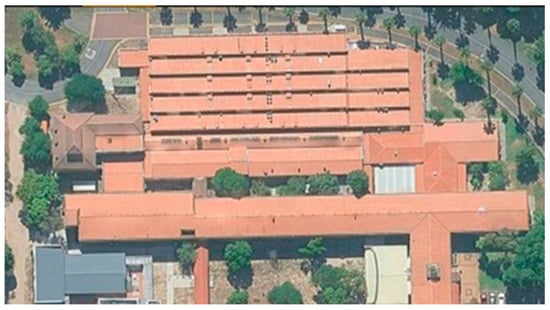
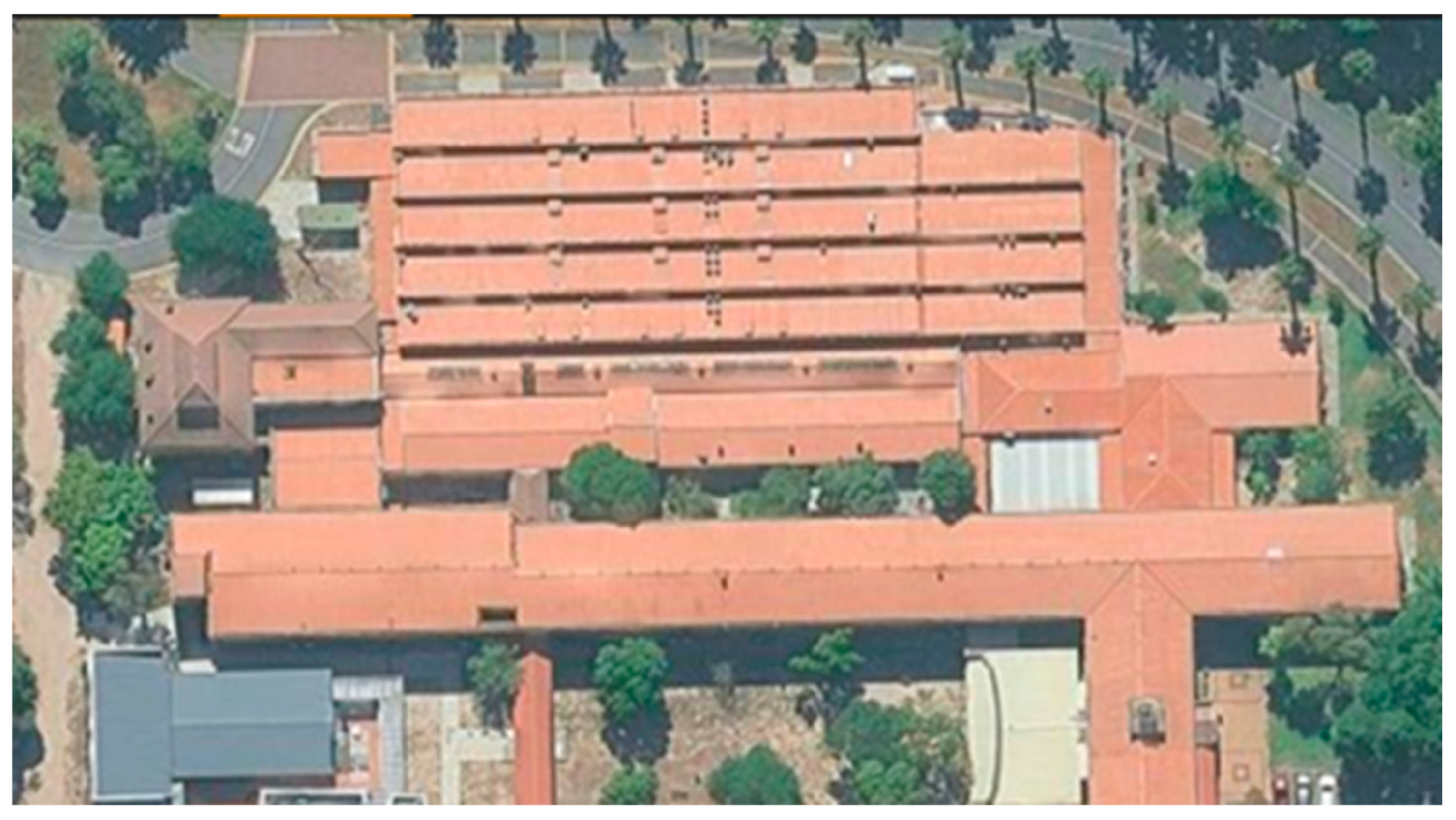
This chapter gives a detailed description of the spatial evaluation of rooftop PV systems in the Bellville campus of CPUT. Considering space limitations in the geographical area, rooftops were selected as one of the possible locations where solar panels would be installed. Rooftops at CPUT Bellville campus are different in shape and size, and this may significantly influence the layout of solar panels and the energy production; see Figure 1.
Figure 1.
Rooftop irregularity.
The CPUT Bellville campus rooftop PV system design leveraged Helioscope software and GIS tech for spatial analysis, optimizing solar panel placement considering obstacles, weather data, shading, panel angle, and rooftop geometry. The campus’s 6.3 MW power demand was subdivided into substations, matching building load profiles with optimal panel placement. Fixed-tilt and flush mount racking options were chosen for flat and gable roofs, using monocrystalline PV panels. Notably, Substation 3 has excess capacity (562.27 kWp) compared to its 202 kWp load profile, allowing for energy offset or grid feed-in.
Spatial analysis and GIS tech modeled Bellville campus’s rooftop PV potential, optimizing energy production and reducing grid dependency. Components like inverters were selected on the electrical tab, targeting a 1.1–1.4 DC/AC ratio for optimal sizing [37]. Table 1 illustrates Substation 3’s system components and the system size.
Table 1.
Substation 3 system components.
Shading analysis was conducted to assess the impact of partial shade from adjacent buildings, trees, and nearby PV panels on the system’s output. This analysis helped determine the extent to which shading contributes to total system losses, informing strategies to minimize these losses and optimize energy production. The shading analysis highlighted the importance of considering cutoff points, as the literature suggests that panels experiencing losses exceeding 10% should be removed from the network to optimize overall system performance. As the CPUT Bellville campus buildings are supplied by different substations, spatial analysis was conducted on all buildings served by these substations, considering their unique characteristics and energy demands.
5. Findings, Results, and Discussion
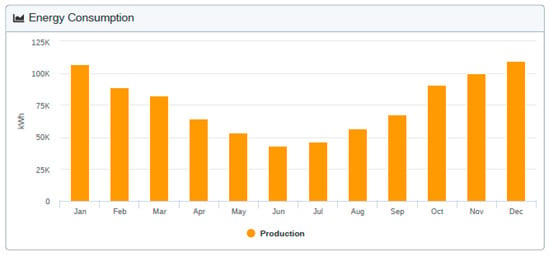
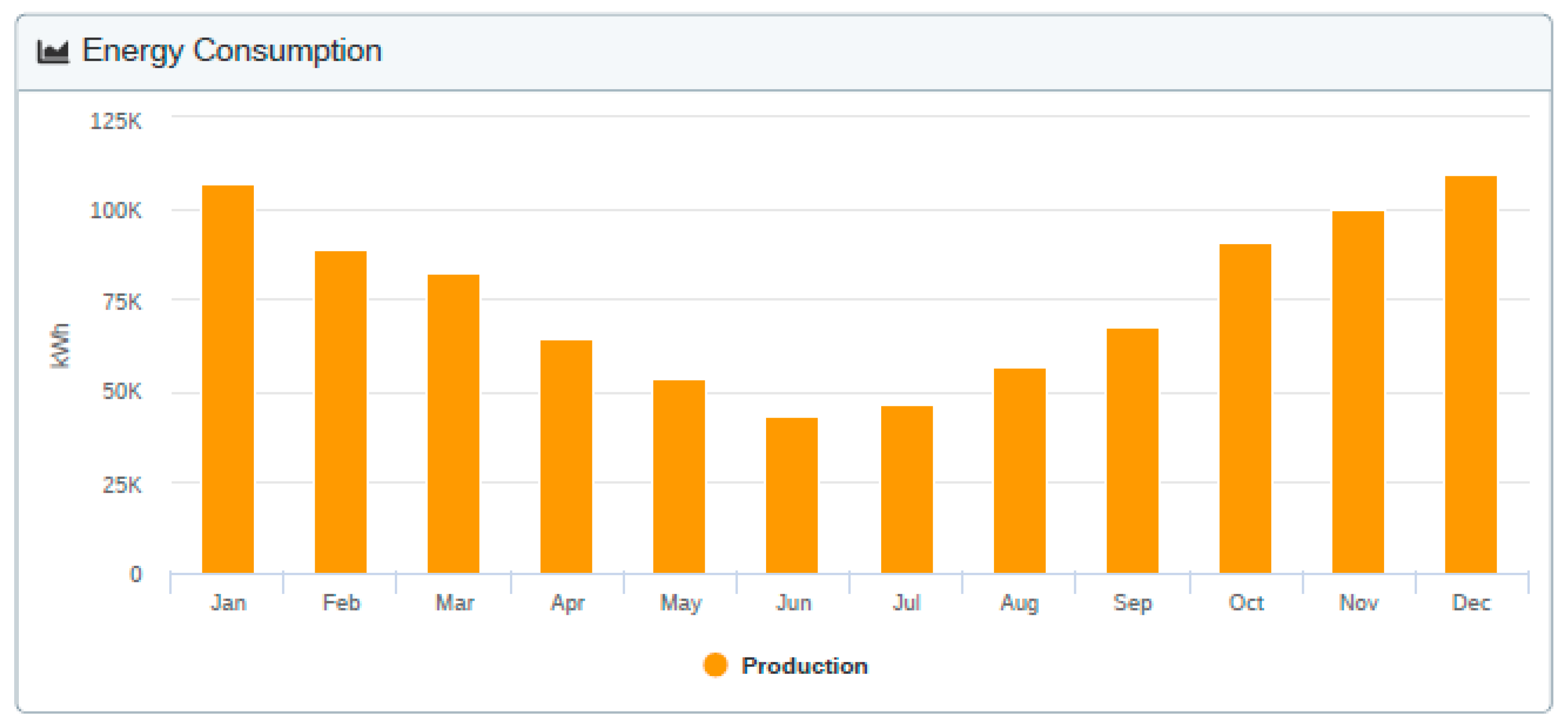
This chapter shows the results of the spatial analysis performed in this paper, which are the production reports of all the substations and the shading reports of the total losses of each substation. The findings offer valuable information on the solar potential of the CPUT Bellville campus, informing the opportunities and possibilities to improve and optimize it. Substation 3’s report shows solar potential, energy production, and shading losses, serving as a representative example for the CPUT Bellville campus’s optimization opportunities. Substation 3 generates the most power in summer (Dec, Jan, Feb) and the least in winter (Jun, Jul, Aug) due to solar irradiance. The system produces moderate power in spring and autumn. Longer days and clear skies in summer boost energy generation; see Figure 2.
Figure 2.
Monthly energy production.
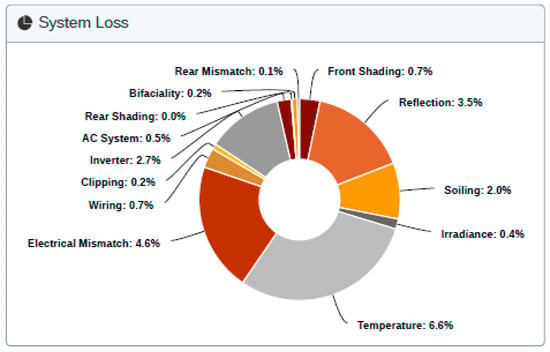
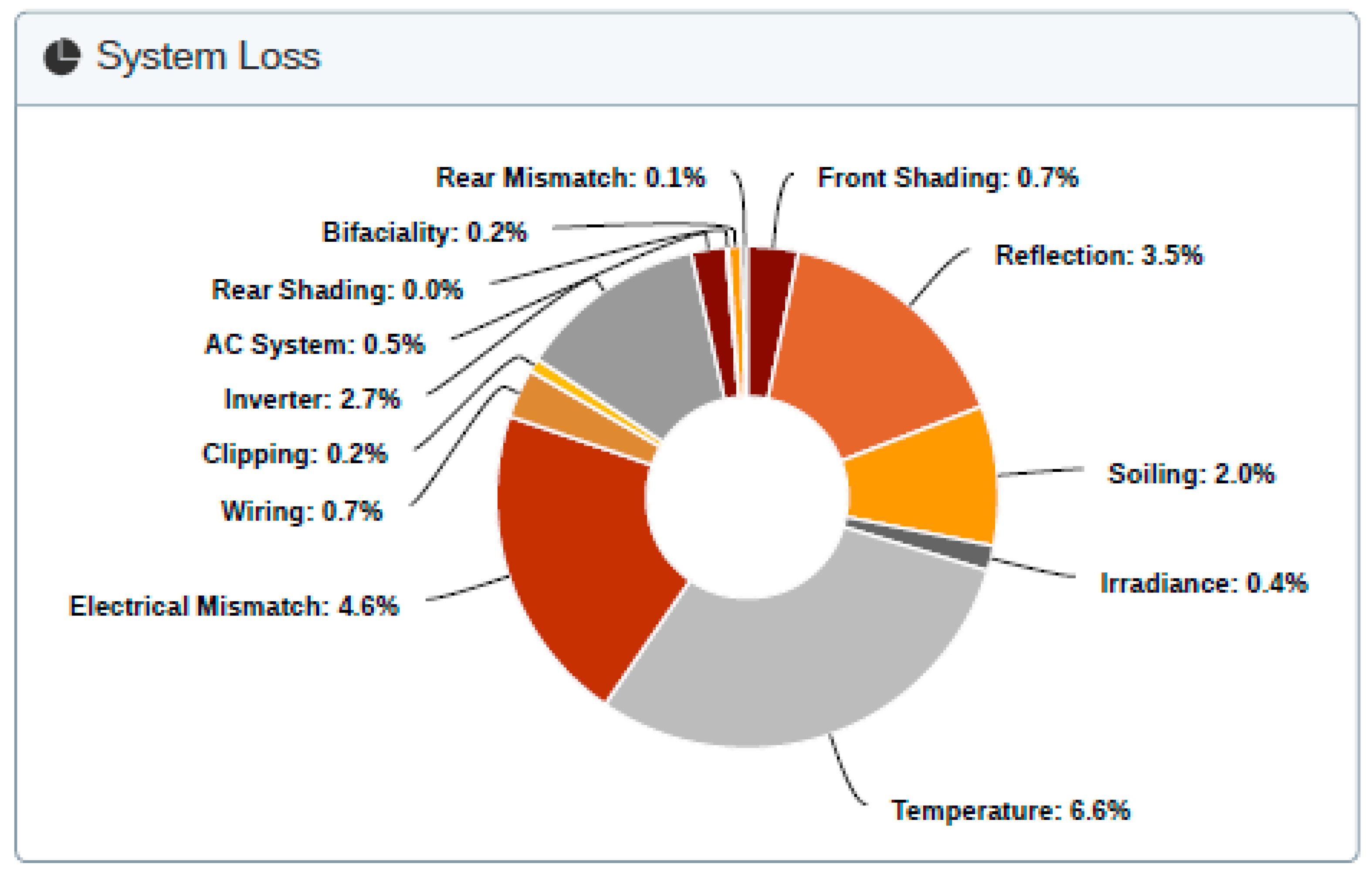
Figure 3 indicates Substation 3’s system losses, which are significantly impacted by temperature, given the region’s high average temperature and the monocrystalline modules’ temperature coefficient (−0.3% to −0.5% per °C). For every 1 °C increase above 25 °C STC, power loss occurs, highlighting the need for temperature-related loss mitigation strategies. Other contributors to system loss include shading, soiling, inverter inefficiencies, and mismatch losses. Total system losses of the system are 22.2%, see Figure 3.
Figure 3.
System losses for substation 3.
Table 2 shows CPUT Bellville campus’s 13 substations’ PV system performance ratios. Substation 3 is highest at 80.5%, while Residence Substation lags at 75.3%. Factors like shading, orientation, and soiling affect performance. The optimal system size is 7.8 MW, with 13,249 modules placed on rooftops. Upgrades should be prioritized at the Residence substation.
Table 2.
Total system size and performance ratios of all 13 CPUT Bellville campus substations.
6. Conclusions
This study optimized rooftop PV systems for the CPUT Bellville campus, addressing irregular roof shapes and shading. Using Helioscope, GIS, and Meteonorm data, it modelled 13 substations, identifying 7.8 MWp potential capacity with 13,249 PV modules. Performance ratios varied (75.3–85.5%), with Substation 3 showcasing a 911.4 MWh/year energy yield and 80.5% PR. CPUT Bellville campus has huge potential for renewable energy usage, with a total cumulative system size of 7.8 MWp compared to the present load of 6.3 MW. The analysis indicated that production potential and performance ratios varied considerably, with the best PR (around 80.5%) in Substation 3 and the worst PR (around 75.3%) in Residence substation due to shading and roof orientation limitations. Temperature, shading, and mismatch were found to be the most influential factors in poor system performance.
Author Contributions
Conceptualization, Y.N. and M.R.; methodology, Y.N. and M.R.; investigation, Y.N. and M.R.; writing—original draft preparation, Y.N.; writing—review and editing, Y.N. and M.R.; supervision, M.R.; funding acquisition, M.R. All authors have read and agreed to the published version of the manuscript.
Funding
This research was partly funded by the Eskom Tertiary Education Support Programme, South Africa (Ref: Eskom TESP2025).
Institutional Review Board Statement
Not applicable.
Informed Consent Statement
Not applicable.
Data Availability Statement
The raw data underlying this article will be made available to readers on request.
Acknowledgments
During the preparation of this manuscript/study, the authors used Grammarly v1.2.231.1817 for the purposes of correcting language. The authors have reviewed and edited the output and take full responsibility for the content of this publication.
Conflicts of Interest
The authors declare no conflicts of interest. The funders had no role in the design of the study; in the collection, analyses, or interpretation of data; in the writing of the manuscript; or in the decision to publish the results.
Abbreviations
The following abbreviations are used in this manuscript:
| POS | Particle Swarm Optimization |
| GA | Genetic Algorithm |
| GIS | Geographic Information System |
| PV | Photovoltaic |
References
- Renner, M.; Daniel, K.; Samadov, Z.; Cagnazzo, C.; Nicolas, J.; Boscolo, R.; Bastani, H.; Hwwitt, C.; Steanski, R.; Troccoli, A.; et al. 2023 Year in Review: Climate-driven Global Renewable Energy Potential Resources and Energy Demand. Available online: https://www.irena.org/-/media/Files/IRENA/Agency/Publication/2025/Mar/IRENA_WMO_ECMWF_PAR_2023_Year_in_review_2025.pdf (accessed on 13 May 2025).
- Masters, G.M. Renewable and Efficient Electric Power Systems, 2nd ed.; Wiley: Hoboken, NJ, USA, 2013. [Google Scholar]
- Orlando, M.; Bottaccioli, L.; Patti, E.; MacIi, E.; Vinco, S.; Poncino, M. Optimal Configuration and Placement of PV Systems in Building Roofs with Cost Analysis. In Proceedings—2020 IEEE 44th Annual Computers, Software, and Applications Conference, COMPSAC 2020; Institute of Electrical and Electronics Engineers Inc.: New York, NY, USA, 2020; pp. 1411–1416. [Google Scholar] [CrossRef] [Scilit]
- Hidayat, I. Optimizing Rooftop Solar Panel Deployment: A GIS-Based Analysis at KFUPM. MUSTEK ANIM HA 2024, 13, 79–86. [Google Scholar]
- Vroon, T.; Teunissen, E.; Drent, M.; Negro, S.O.; van Sark, W.G.J.H.M. Escaping the Niche Market: An Innovation System Analysis of the Dutch Building Integrated Photovoltaics (BIPV) Sector; Elsevier Ltd.: Amsterdam, The Netherlands, 2022. [Google Scholar] [CrossRef] [Scilit]
- Premadasa, P.N.D.; Silva, C.M.M.R.S.; Chandima, D.P.; Karunadasa, J.P. Optimal Sizing of Solar Photovoltaics and Battery Storage for Domestic Prosumers Using Genetic Algorithm. In Moratuwa Engineering Research Conference, MERCon; Institute of Electrical and Electronics Engineers Inc.: New York, NY, USA, 2023; pp. 131–136. [Google Scholar] [CrossRef] [Scilit]
- Khenissi, I.; Fakhfakh, M.A.; Sellami, R.; Neji, R. A New Approach for Optimal Sizing of a Grid Connected PV System Using PSO and GA Algorithms: Case of Tunisia. Appl. Artif. Intell. 2021, 35, 1930–1951. [Google Scholar] [CrossRef] [Scilit]
- Gonçalves, A.; Cavalcanti, G.O.; Feitosa, M.A.F.; Dias Filho, R.F.; Pereira, A.C.; Jatobá, E.B.; de Melo Filho, J.B.; Marinho, M.H.N.; Converti, A.; Gómez-Malagón, L.A. Optimal Sizing of a Photovoltaic/Battery Energy Storage System to Supply Electric Substation Auxiliary Systems under Contingency. Energies 2023, 16, 5165. [Google Scholar] [CrossRef] [Scilit]
- Asrami, R.F.; Sohani, A.; Saedpanah, E.; Sayyaadi, H. Towards achieving the best solution to utilize photovoltaic solar panels for residential buildings in urban areas. Sustain. Cities Soc. 2021, 71, 102968. [Google Scholar] [CrossRef] [Scilit]
- Khanal, S.; Khezri, R.; Mahmoudi, A.; Kahourzadeh, S. Optimal capacity of solar photovoltaic and battery storage for grid-tied houses based on energy sharing. IET Gener. Transm. Distrib. 2023, 17, 1707–1722. [Google Scholar] [CrossRef] [Scilit]
- Javeed, I.; Khezri, R.; Mahmoudi, A.; Yazdani, A.; Shafiullah, G.M. Optimal sizing of rooftop pv and battery storage for grid-connected houses considering flat and time-of-use electricity rates. Energies 2021, 14, 3520. [Google Scholar] [CrossRef] [Scilit]
- Abed, M.; Reddy B, A.; Jyothsna, T.R.; Mohammed, N. Optimal sizing and performance assessment of stand-alone PV systems using optimum hybrid sizing strategy. Results Eng. 2025, 25, 103793. [Google Scholar] [CrossRef] [Scilit]
- Rosma, I.H.; Zulkarnain, Z.; Ali, I.T.; Sukma, D.Y. Technical Analysis of Development of Rooftop Solar Photovoltaic Generation System. In Proceedings—2022 2nd International Conference on Electronic and Electrical Engineering and Intelligent System, ICE3IS 2022; Institute of Electrical and Electronics Engineers Inc.: New York, NY, USA, 2022; pp. 79–83. [Google Scholar] [CrossRef] [Scilit]
- N’Tsoukpoe, K.E. Effect of orientation and tilt angles of solar collectors on their performance: Analysis of the relevance of general recommendations in the West and Central African context. Sci. Afr. 2022, 15, e01069. [Google Scholar] [CrossRef] [Scilit]
- Merrington, S.; Khezri, R.; Mahmoudi, A. Optimal planning of solar photovoltaic and battery storage for electric vehicle owner households with time-of-use tariff. IET Gener. Transm. Distrib. 2022, 16, 535–547. [Google Scholar] [CrossRef] [Scilit]
- Poornima, P.U.; Dhineshkumar, K.; Kumar, C.K.; Sumana, S.; Sundari, M.R.; Sivaraman, P.; Shuaib, M.; Rajaram, A. Optimising rooftop photovoltaic adoption in urban landscapes: A system dynamics approach for sustainable energy transitions. Biomed. Signal Process. Control 2025, 100, 107071. [Google Scholar] [CrossRef] [Scilit]
- El Kontar, R.; Jin, X. A Framework for Optimal Placement of Rooftop Photovoltaic: Maximizing Solar Production and Operational Cost Savings in Residential Communities. J. Eng. Sustain. Build. Cities 2020, 1, 041006. [Google Scholar] [CrossRef] [Scilit]
- Nematirad, R.; Pahwa, A.; Natarajan, B. A Novel Statistical Framework for Optimal Sizing of Grid-Connected Photovoltaic–Battery Systems for Peak Demand Reduction to Flatten Daily Load Profiles. Solar 2024, 4, 179–208. [Google Scholar] [CrossRef] [Scilit]
- Khan, M.M.; Ahmad, S.; Raza, A.; Hassan, R.G.; Tariq, U.; Sikandar, H.; Shafi, M.A. Optimized Photovoltaic System Using PV Syst Software for Residential Building Energy in Multan. South. J. Eng. Technol. 2024, 2, 63–78. [Google Scholar]
- Damiri, D.J.; Legino, S.; Amboro, S. Engineering design development of 52,5 KiloWatt peak solar photovoltaic system for industrial Rooftop building. J. Phys. Conf. Ser. 2019, 1402, 033087. [Google Scholar] [CrossRef] [Scilit]
- Serat, Z.; Fatemi, S.A.Z.; Shirzad, S. Design and Economic Analysis of On-Grid Solar Rooftop PV System Using PVsyst Software. Arch. Adv. Eng. Sci. 2023, 1, 63–76. [Google Scholar] [CrossRef] [Scilit]
- Jamal, J.; Mansur, I.; Rasid, A.; Mulyadi, M.; Marwan, M.D.; Marwan, M. Evaluating the shading effect of photovoltaic panels to optimize the performance ratio of a solar power system. Results Eng. 2024, 21, 101878. [Google Scholar] [CrossRef] [Scilit]
- Abraham, A.K.; Sebastian, S.; Kp, P.; Gopi, A.; Koshy, D.E. Experimental and Numerical Analysis of the Impact of Placement of PV Panels on the Performance of a Rooftop Plant. In 2020 IEEE International Conference on Power Electronics and Renewable Energy Applications, PEREA 2020; Institute of Electrical and Electronics Engineers Inc.: New York, NY, USA, 2020. [Google Scholar] [CrossRef] [Scilit]
- Zarezadeh, M. Feasibility Construction of a 4 MW PV Power Plant to Provide Sustainable Electricity to Bandar Abbas Industrial Estate. J. Sol. Energy Res. 2023, 8, 1250–1263. [Google Scholar] [CrossRef]
- Ali, A.; Volatier, M.; Darnon, M. Optimal Sizing and Assessment of Standalone Photovoltaic Systems for Community Health Centers in Mali. Solar 2023, 3, 522–543. [Google Scholar] [CrossRef] [Scilit]
- Satpathy, P.R.; Sharma, R.; Panda, S. Optimal sizing, placement and shading analysis of a 19.2kW grid-tied residential roof-top PV system. In 1st Odisha International Conference on Electrical Power Engineering, Communication and Computing Technology, ODICON 2021; Institute of Electrical and Electronics Engineers Inc.: New York, NY, USA, 2021. [Google Scholar] [CrossRef] [Scilit]
- Ariella, S.S.; Dhofir, M.; Wibawa, U. Rooftop Solar Power Plant (PLTS) Design of Cita Buana School as a Nearly Zero Energy Building (nZEB) Development. 2024. Available online: https://jurnaleeccis.ub.ac.id/ (accessed on 17 May 2025).
- Li, Z.; Xie, Y.; Zhu, H. Influence of Battery Life Degradation on PV Battery Capacity Configuration in Urban Industrial Park in Shanghai. Available online: https://ssrn.com/abstract=4791801 (accessed on 4 April 2025).
- Damiri, D.J.; Lamania, R.R.L. Design and Simulation of On-Grid Rooftop Solar Power Plant (Rooftop PV) System on Office Buildings with a PLN Grid System. ELKOMIKA J. Tek. Energi Elektr. Tek. Telekomun. Tek. Elektron. 2023, 11, 231. [Google Scholar] [CrossRef] [Scilit]
- Iskandar, H.R.; Taryana, E.; Zainal, Y.B. Modelling and analysis of rooftop PV as an energy optimization of flat roof and gable roof mounting system. Sinergi 2024, 28, 1–12. [Google Scholar] [CrossRef] [Scilit]
- Iskandar, H.R.; Heryana, N.; Winanti, N.; Setia, G.A.; Ridwanulloh, R.; Alfarizi, M.R. Optimal Design of Rooftop PV Systems for Electrical Engineering Department Laboratory. In 2021 3rd International Conference on High Voltage Engineering and Power Systems, ICHVEPS 2021; Institute of Electrical and Electronics Engineers Inc.: New York, NY, USA, 2021; pp. 349–354. [Google Scholar] [CrossRef] [Scilit]
- Zhong, Q.; Nelson, J.R.; Tong, D.; Grubesic, T.H. A spatial optimization approach to increase the accuracy of rooftop solar energy assessments. Appl. Energy 2022, 316, 119128. [Google Scholar] [CrossRef] [Scilit]
- Chowdhury, S.; Vyas, M.; Verma, A.; Jain, V.K. A Rooftop Solar Photovoltaic Tree Solution for Small-Scale Industries. Sustainability 2024, 16, 9901. [Google Scholar] [CrossRef] [Scilit]
- Jiang, H.; Yao, L.; Lu, N.; Qin, J.; Liu, T.; Liu, Y.; Zhou, C. Geospatial assessment of rooftop solar photovoltaic potential using multi-source remote sensing data. Energy AI 2022, 10, 100185. [Google Scholar] [CrossRef] [Scilit]
- Liu, J.; Wu, Q.; Lin, Z.; Shi, H.; Wen, S.; Wu, Q.; Zhang, J.; Peng, C. A novel approach for assessing rooftop-and-facade solar photovoltaic potential in rural areas using three-dimensional (3D) building models constructed with GIS. Energy 2023, 282, 128920. [Google Scholar] [CrossRef] [Scilit]
- Aslani, M.; Seipel, S. Rooftop segmentation and optimization of photovoltaic panel layouts in digital surface models. Comput. Environ. Urban Syst. 2023, 105, 102026. [Google Scholar] [CrossRef] [Scilit]
- Vermeer, W.; Mouli, G.R.C.; Bauer, P. Optimal Sizing and Control of a PV-EV-BES Charging System Including Primary Frequency Control and Component Degradation. IEEE Open J. Ind. Electron. Soc. 2022, 3, 236–251. [Google Scholar] [CrossRef] [Scilit]

Disclaimer/Publisher’s Note: The statements, opinions and data contained in all publications are solely those of the individual author(s) and contributor(s) and not of MDPI and/or the editor(s). MDPI and/or the editor(s) disclaim responsibility for any injury to people or property resulting from any ideas, methods, instructions or products referred to in the content. |
© 2026 by the authors. Licensee MDPI, Basel, Switzerland. This article is an open access article distributed under the terms and conditions of the Creative Commons Attribution (CC BY) license.