


Abstract
Translating diverse stakeholders’ needs for tourism into precise technical requirements for mobile resilience applications is a significant challenge, especially for at-risk coastal communities. Therefore, we developed a structured decision-support framework that uses the Analytic Hierarchy Process (AHP) combined with Multi-Criteria Decision Analysis (MCDA) to systematically identify and prioritize functional features for a disaster-resilient tourism application called AuTour. The framework was validated through a case study in Aurora Province, Philippines, involving 152 diverse stakeholders, including government officials, tourism operators, and technology students. The AHP analysis results revealed that safety infrastructure (a mean weight of 0.5256) was the dominant design criterion, far outweighing environmental sustainability (0.2480) and community preparedness (0.1241). The MCDA ranked key functional modules using these criteria to determine an optimal system architecture. The highest-priority features identified were a real-time Disaster Preparedness Alert module, a geospatial Smart Tourism Guide, and a participatory Health Surveillance module. The analysis results confirmed high utility for features incorporating AI-powered chatbots (a mean score of 4.1921) and multi-dialect communication capabilities (4.1513). The developed scalable, data-driven framework can be used for user-centered design in the critical domain of disaster-resilient technology. By translating stakeholder priorities into a ranked set of technical specifications, the framework contributes to the development of resilient mobile systems, supporting the achievement of Sustainable Development Goals for innovation (SDG 9) and resilient infrastructure (SDG 11).
1. Introduction
The Philippines is one of the countries that heavily relies on tourism. In 2024, a review by the World Travel and Tourism Council [1] found that tourism pumped Philippine peso (PHP) 5.3 trillion into the national economy and helped sustain 11.2 million jobs. Local spending surged to PHP 3.6 trillion, while international visitors contributed PHP 644.8 billion, showing that the sector is rebounding rapidly and setting the stage for the record-breaking numbers expected in 2025. Regions that rely on tourism are more at risk from the adverse effects of climate change disasters, and there are limited tools to prioritize tourism attributes in consideration of stakeholders and disaster resilience.
The Philippines is frequently affected by typhoons, earthquakes, and flooding, making this gap particularly important. Although there has been a global advancement in mobile applications and decision-support systems (DSS), the use of these technologies in locally participatory resilience tourism planning remains very limited. The lack of technology has crucial implications for whether areas such as Aurora can attain fundamental Sustainable Development Goals (SDGs) about resilient communities (SDG 11), climate action (SDG 13), and economic growth (SDG 8). The research presents the Aurora Tourism App, or AuTour, a mobile decision-support system that utilizes multi-criteria decision analysis (MCDA) to prioritize tourism attributes in disaster-prone destinations. This response addresses the need for scalable, stakeholder-informed tools that integrate tourism growth with disaster risk reduction (DRR).
Several researchers in the Philippines have investigated the connections between mobile technologies and disaster preparedness. However, very few examined tourism-specific decision-support systems. Kalliomäki and Männistö [2] highlighted the gaps in tourist awareness and preparedness in the Philippines, as well as the need for real-time, location-specific tools. The Global System for Mobile Communications Association (GSMA) [3] highlighted how mobile emergency services contribute to overall system resilience, while the Pacific Disaster Centre [4] laid out a data-driven foundation for assessing national preparedness. Looking specifically at tourism, Cabiles and colleagues [5], along with Baraero-Era and Del Rosario [6], explored how establishments can recover from COVID-19, stressing the importance of flexible, tech-enabled recovery strategies.
Research on mobile DSS for disaster resilience has been undertaken globally. Oh et al. [7] created a post-disaster resilience DSS interface, while Syukrona et al. [8] developed a comprehensive review on disaster support apps. Cicek and Kantarci [9] examined mobile crowdsensing for disaster management, and Abdelmalak, F. [10] investigated smart tourism and disaster resilience. Other studies using the Analytic Hierarchy Process (AHP) and MCDA methods focused on the prioritization of tourism features within disaster-affected areas [11,12]. Geographic Information System (GIS) and crowdsourced data for risk assessment were highlighted by Yan, Y. et al. [13], and by Mei, Ashley Wang Sze et al. [14]. App usability for crises was assessed by Ritchie B. W. et al. [15] and Grundy et al. [16], who found that the design of the AuTour framework incorporates participatory prioritization, mobile accessibility, and disaster resilience.
There is a notable gap in previous research. Previous works have concentrated on interfaces that deal with responses after a disaster, smart tourism frameworks in a general sense, or independent prioritization studies. However, there is still a lack of a systematic, stakeholder-oriented prioritization system. More specifically, the existing frameworks, such as those relying solely on AHP for general prioritization, typically fail to establish a clear, numerical connection between broad, qualitative resilience parameters, such as safety infrastructure, and the weighted technical development of specific mobile app features for a disaster. Hence, we developed the AuTour framework: a unique integrated AHP-MCDA model that captures the various interests of stakeholders and produces a measurable and prioritized multitude of technical aspects in mobile disaster-resilience systems. This integration links the AHP criteria weights (wc) as constant, empirically derived factors within the MCDA scoring calculation (Sf), ensuring that feature prioritization is directly driven by stakeholder-defined resilience importance.
AuTour addresses a significant need in disaster-resilient tourism planning and offers a mobile, stakeholder-centered tool to identify tourism aspects of disaster-prone areas, such as the Aurora Province in the Philippines.
2. Materials and Methods
2.1. Participants
This study was conducted in Aurora Province, Philippines, which is a coastal region vulnerable to climate-related hazards and disruptions in tourism. A total of 152 stakeholders participated, including local government officials, tourism stakeholders and operators, information and communications technology developers, and students in tourism-related programs. The varied respondents’ pool ensured that a multi-perspective evaluation was undertaken regarding disaster-resilient tourism priorities. The profiles of the 152 participants across the stakeholders’ roles are presented in Table 1.
Table 1.
Participants in this study (N = 152).
We employed purposive sampling, a non-probability technique that is widely used in stakeholder-centered research, to ensure relevance and research depth. This approach allows the selection of the participants based on their expertise, institutional roles, and lived experience [16]. Using this method, we selected participants based on their direct involvement with tourism operations, disaster risk reduction, ICT development, the tourists, and local governance. This method ensures the collection of rich, contextually grounded data that aligns with the decision-support objectives of the AuTour framework. To maintain this data richness and relevance, the following inclusion criteria were applied.
- Students (IT/Hotel/Tourism): The inclusion of 3rd- and 4th-year students (33.55% of the total sample) was intentional. IT students contribute insights into feasibility and technical implementation, while Hotel and Tourism students represent the future workforce and end-users, assessing usability and adoption barriers. Their strong representation ensures the AuTour framework reflects not only current government and operator needs but also the perspectives of early adopters and future system maintainers.
- Tourism stakeholders: They are resort owners/managers, licensed tour operators, the Department of Tourism-accredited guides, or the providers of other tourism-related services.
- LGU officials: Incumbent elected officials (Mayor or Councilors) actively engaged in local governance.
- Tourists (local/international): Visitors who have stayed in Aurora Province for tourism purposes.
- ICT and academic experts: ICT developers, IT professionals, or instructors/professors in IT, Hotel, or Tourism Management programs.
- Tourism officers/personnel: Current employees of municipal or provincial tourism offices.
- DRRM officers/personnel: Officials or employees of the Municipal or Provincial Disaster Risk Reduction and Management Office.
2.2. AHP-Based Criteria Prioritization
For categorizing design criteria related to the AuTour mobile application, we used AHP, a structured decision-making technique developed by Saaty [17]. AHP is widely used in disaster risk reduction and tourism planning, among others, to quantify multi-stakeholder preferences and establish a ranking of priorities [17]. Based on the literature review and expert consultation, five criteria were selected: safety infrastructure, community preparedness, environmental sustainability, tourist accessibility, and emergency response capacity. Safety Infrastructure aligns with resilient systems [17]; community preparedness aligns with SDG 11 and national assessments [18]; environmental sustainability advances climate action and resource protection [19]; tourist accessibility ensures access is inclusive, and mobility is smart [20]; and emergency response capacity reinforces health and safety systems [17,18]. These criteria were validated by local experts as shown in Table 2.
Table 2.
AHP criteria definitions and SDG-based justification.
The collected responses were performed for pairwise comparisons using Saaty’s 1–9 scale. Each respondent’s scores were converted into a reciprocal matrix, and priority weights were computed using the geometric mean method.
To assess judgment reliability, the consistency ratio (CR) was calculated as follows.
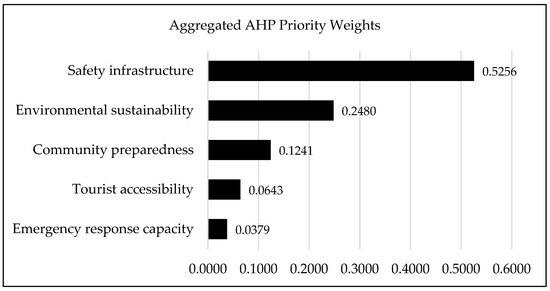
Here, is the principal eigenvalue and RI is the random index. A CR value below 0.10 was acceptable. Aggregated weights across all respondents revealed safety infrastructure as the dominant criterion (a mean weight of 0.5256), followed by environmental sustainability (0.2480) and community preparedness (0.1241).
2.3. MCDA Feature Prioritization Using AHP Weights
To translate the high-level AHP criteria into actionable system features, we applied a weighted MCDA. This method complements AHP by using the aggregated criteria weights (wc) as a quantitative scoring mechanism. These weights, derived from the 152 consistent AHP results were applied as the constant weighting factors in the MCDA calculation. The final priority score (Sf) for each feature was then computed as a weighted sum, mathematically linking the AHP and MCDA results: Sf = ∑c = 15(wc × Cˉf,c). Responses of CR > 0.10 were filtered out from the AHP dataset to ensure the reliability of the judgments. After consistency validation, an exceptional retention rate was achieved, indicating a high consistency rate across the participants’ pool for the derivation of the aggregated AHP weights. This high level of consistency among diverse stakeholders validates the clarity and structure of the comparison instrument. The process was as follows.
- Feature compilation: A list of 10 potential mobile features (e.g., disaster preparedness alert, smart tourism guide, health surveillance, among others) was compiled from the literature and expert consultations.
- Contribution rating: Stakeholders rated each feature’s potential contribution to each of the five AHP criteria using a 1–5 Likert-type scale (where 1 = very low contribution and 5 = very high contribution).
- Weighted sum calculation: The mean contribution score for each feature ( against each criterion was calculated. The final priority score (Sf) for each feature was then computed as a weighted sum, mathematically linking the AHP and MCDA results:
This equation is used to characterize the AuTour prioritization function. Specifically, wc represents the aggregated criteria weight exclusively from the AHP, and Cˉf,c is the mean perceived contribution score of feature f against criterion c (rated 1–5 in the MCDA survey). This mathematical association guarantees that the final priority score (Sf) is a direct, data-driven synthesis of multi-stakeholder preference and engineering utility.
2.4. Data Analysis and Technical Implementation
All data analysis and validation were conducted in Python 3.10 using custom scripts within a Jupyter Notebook (version 7.5) environment to ensure transparency and reproducibility. A structured questionnaire was employed to promote accessibility, inclusivity, and reliability in data collection, fostering trust, improving response accuracy, and aligning with local cultural practices. The raw dataset of 152 responses was exported to Excel (2019) and cleaned using the pandas library (version 2.3.3), which involved standardizing column labels and addressing missing values. The analytical workflow comprised the following steps.
- AHP matrix operations: The numpy library (version 2.3.5) was used for matrix computations. For each respondent, reciprocal matrices were generated, and priority weights were derived using the geometric mean method.
- Consistency validation: CR was calculated for every respondent. Responses with CR > 0.10 were excluded to ensure the reliability of judgments.
- MCDA scoring: The weighted sum model (described in Section 2.3) was applied to integrate stakeholder ratings with AHP-derived weights.
- Visualization: Aggregated weights, municipal-level profiles, and feature rankings were visualized using matplotlib and seaborn.
All analyses were performed on a Windows 11 laptop equipped with an Intel Core i5 processor and 8 gigabyte random access memory.
3. Results and Discussions
3.1. Respondent Demographics
Table 2 summarizes the respondents’ positions and roles, and Table 3 details their gender, years of experience, and municipality.
Table 3.
Respondent demographics summary.
The demographic distribution indicates that a majority of respondents were female (55.9%), reflecting the strong participation of women in the global tourism workforce [21]. Notably, 26.3% of respondents selected the prefer-not-to-say category (Table 3). While this respects participant privacy, it constrains the ability to conduct fine-grained demographic analyses to assess potential biases in usability or adoption barriers. The sample included tourism stakeholders, LGU officials, DRRM personnel, and ICT professionals, demonstrating diverse, multi-sector representation consistent with disaster risk reduction frameworks that emphasize inclusive stakeholder engagement [22]. A large proportion of respondents (61.2%) reported 0–3 years of professional experience, suggesting a predominantly early-career population. Such groups are generally more receptive to digital and mobile-based systems [23], which is particularly relevant for evaluating tourism-focused disaster applications. All municipalities in the Aurora Province were represented, ensuring geographically grounded perspectives. This is critical, as hazard awareness and risk perception often vary across localities [24]. The demographic profile reflects a balanced and diverse respondent pool characterized by digital receptiveness and firsthand familiarity with tourism dynamics—providing a strong foundation for assessing technology-based resilience interventions.
3.2. AHP Aggregated Criteria Weights
Table 4 presents the specific criteria, definitions, and calculated weights, highlighting Safety Infrastructure as the dominant design criterion. This serves as the basis for Figure 1, which illustrates the AHP aggregated criteria weights across all respondents and shows how participants evaluated the five criteria related to tourism resilience.
Table 4.
AHP criteria definitions and aggregated weights.
Figure 1.
The aggregated AHP criteria weights of all respondents.
Table 4 shows that the mean of AHP aggregated criteria weights (wc) results revealed that safety infrastructure presented the highest priority weight (0.5256), substantially exceeding all other criteria. This indicates that respondents considered structural safety measures, such as evacuation routes, hazard-resistant facilities, and early-warning systems, as the most critical component of tourism resilience [25]. Environmental sustainability ranked second (0.2480), consistent with prior studies emphasizing that environmental protection is integral to long-term tourism sustainability in hazard-prone areas [26]. Community Preparedness followed with a weight of 0.1241. The remaining two criteria, tourist accessibility (0.0643) and emergency response capacity (0.0379), received comparatively lower weights, respectively, suggesting that while important, they were perceived as less central to resilience compared to infrastructure and sustainability considerations.
To analyze the comparative value of disaster-resilient tourism factors, the Analytic Hierarchy Process (AHP) was applied. The results shown in Figure 1.
Figure 1 shows the aggregate relevance of the criteria as indicated by the dotted blue line which shows the addition of the weights of the criteria. It begins with safety infrastructure which comprises the highest percentage; then, there is the line with the inclusion of environmental sustainability, preparedness of the community, visitor accessibility, and emergency preparedness. This increasing trend will help visualize the contribution of each of the factors to the overall prioritization, as the individual weights will be more readily visible, as well as the total effect of them on the decision-making prioritization of the mobile features of AuTour.
3.3. MCDA Feature Prioritization
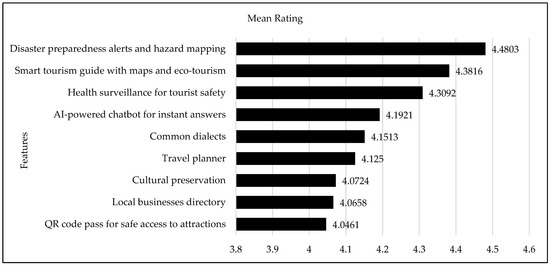
The MCDA results show that disaster preparedness alerts and hazard mapping achieved the highest mean score (m = 4.4803) (Figure 2). This indicates a strong preference among respondents for features that enhance real-time safety and risk awareness. The findings are consistent with existing literature, which emphasizes that early-warning systems and hazard mapping significantly reduce disaster impacts, particularly in tourism-dependent regions [22]. These features are recognized as critical components of smart resilience frameworks, contributing to improved community readiness and positively shaping visitor risk perception [27].
Figure 2.
The MCDA feature prioritization.
Smart features such as the tourism guide with maps and eco-tourism information (m = 4.3816) and health surveillance for tourist safety (m = 4.3092) followed the top-ranked modules. The latter reflects a global trend toward integrating digital navigation, sustainable tourism information, and health monitoring within smart tourism ecosystems, thereby creating safer and more informed visitor experiences [28]. Post-pandemic tourism research further highlights that travelers increasingly favor destinations with robust health surveillance and technologies that provide safety assurances [29].
AI-powered chatbots for instant answers (m = 4.1921) and common dialect support (m = 4.1513) also ranked highly, underscoring the value of real-time communication and multilingual accessibility. Prior studies confirm that chatbots enhance visitor engagement and accessibility [30], while language support reduces communication barriers that often hinder tourism safety and satisfaction [31]. Mid-tier features such as travel planner, cultural preservation, and local business directory (M = 4.125–4.0658) reveal stakeholder interest in applications that balance safety with cultural immersion and economic inclusivity. Evidence supports that digital platforms promoting cultural awareness and local commerce contribute to sustainable, community-centered tourism development [32].
Finally, the Quick Response (QR) code pass for safe access to attractions received the lowest mean score (M = 4.0461), though it was still rated favorably. While QR-based systems were widely adopted during the pandemic, the recent literature suggests that visitors are shifting toward integrated, automated verification systems rather than stand-alone QR passes [33].
Overall, the prioritization pattern reflects strong user preference for risk reduction, health security, real-time information, and smart navigation—findings that align with the broader literature on technology-driven disaster resilience and smart tourism transformation. These insights provide a robust foundation for developing a tourism resilience mobile application that is both locally adaptive and user-centered.
4. Conclusions
We validated AuTour as a decision-support model that integrates AHP and MCDA to prioritize functional features of a disaster-resilient mobile tourism application. The methodology addresses a critical gap in existing frameworks by offering a systematic, stakeholder-oriented prioritization system that establishes clear numerical linkages between broad qualitative resilience parameters and specific mobile app features. The AuTour model translates diverse stakeholder needs into a ranked set of technical specifications, providing direct guidance for the development of resilient mobile systems. In doing so, it supports SDG 9 (Industry, Innovation, and Infrastructure) and SDG 11 (Sustainable Cities and Communities).
The case study in Aurora Province, Philippines, involving 152 diverse stakeholders, validated the framework’s efficiency and revealed local resilience priorities. AHP analysis identified safety infrastructure as the dominant design criterion (a mean weight of 0.5256), significantly surpassing environmental sustainability (0.2480) and community preparedness (0.1241). MCDA results, weighted accordingly, ranked disaster preparedness alerts and hazard mapping (M = 4.4803) as top-priority features, followed by the smart tourism guide (M = 4.3816) and health surveillance (M = 4.3092). AI-powered chatbots (M = 4.1921) and common dialect communication (M = 4.1513) also demonstrated strong perceived utility, highlighting the importance of real-time communication and multilingual support. However, the deployment of such AI features must be carefully managed to mitigate risks of over-dependence during critical disaster situations.
5. Future Work
The results of this study provide a foundation for the further development and deployment of the AuTour mobile application, beginning with a focus on system implementation and validation. This requires prototyping high-priority features, such as disaster preparedness alerts, smart tourism guides, and health surveillance, to validate their effectiveness in enhancing tourist awareness and testing system resilience under simulated disaster scenarios in Aurora Province.
Beyond basic implementation, it is required to investigate advanced feature integration, specifically the technical architecture and user trust dynamics of AI-powered chatbots. Such studies are necessary to address potential drawbacks such as over-reliance on AI during crises while ensuring the accuracy, ethical deployment, and reliability of information. To ensure the framework’s scalability, the integrated AHP-MCDA model needs to be extended to other disaster-prone tourism destinations with diverse geographic and socio-cultural contexts and tested for its cross-regional applicability to generalize its utility beyond the initial case study. Finally, a longitudinal impact assessment is necessary to evaluate the sustained influence of AuTour on local economic growth and resilient community development in alignment with SDG 8 and SDG 11. This longitudinal approach enables the identification of system requirements to assess how effectively the platform protects both tourists and host communities when a disaster strikes.
Author Contributions
Research conceptualization, S.B.G.; methodology, S.B.G.; data curation, S.B.G.; formal analysis, S.B.G.; investigation, S.B.G.; visualization, S.B.G.; writing—original draft preparation, S.B.G.; writing—review and evaluation, T.D.P.; supervision, T.D.P.; project administration, S.B.G. All authors have read and agreed to the published version of the manuscript.
Funding
This research did not receive external funding for developing the mobile application; it was personally funded. However, funding for presentation and publication was provided by Aurora State College of Technology. This institutional support does not have a specific grant number associated with it.
Institutional Review Board Statement
Not applicable.
Informed Consent Statement
The researcher engaged with real people who answered the surveys on a voluntary basis. The College Research Ethics Committee (CREC) of the Aurora State College of Technology (ASCOT) has reviewed and accepted the research design as adjusted, pursuant to Memorandum Order No. 2025-175 dated 8 October 2025. The research was carried out in accordance with the ethical considerations of the institution and the Data Privacy Act of the Philippines (Republic Act No. 10173), ensuring that privacy, consent, and ethical use of information were observed.
Data Availability Statement
The data are available from the corresponding author upon written academic request.
Acknowledgments
The researchers would like to express their gratitude to Aurora State College of Technology for allowing the conduct of the questionnaire. Special thanks are also given to the author’s wife, who helped administer the survey across the eight municipalities of Aurora and accompanied the author in meetings with provincial and municipal officials. The research was drafted and revised by the author with the used of AI-assisted tools for language refinement.
Conflicts of Interest
The authors declare no conflict of interest.
Abbreviations
The following abbreviations are used in this manuscript:
| AuTour | Aurora Tourism |
| DSS | Decision-Support System |
| AHP | Analytic Hierarchy Process |
| MCDA | Multi-Criteria Decision Analysis |
| SDG | Sustainable Development Goals |
| DRR | Disaster Risk Reduction |
References
- World Travel and Tourism Council. Available online: https://wttc.org/news/philippines-travel-tourism-sector-set-to-inject-a-record-php-5-point-9tn-to-the-economy-2025 (accessed on 8 September 2025).
- Kalliomäki, P.; Männistö, T. Preparedness and Awareness Among Tourists About Natural Disasters in the Philippines: A Field Study. Master’s Degree, Laurea University of Applied Sciences, Vantaa, Finland, 2025. [Google Scholar]
- GSMA. Available online: https://www.gsma.com/solutions-and-impact/connectivity-for-good/mobile-for-development/wp-content/uploads/2022/06/PhilippinesEWS_R_Web.pdf (accessed on 8 September 2025).
- Pacific Disaster Center. Available online: https://www.pdc.org/wp-content/uploads/NDPBA_PHL_Final_Report.pdf (accessed on 8 September 2025).
- Cabiles, E.G.; Onrubia, A.; Oruga, S. Contributing Factors to Tourism Establishments’ Resiliency and Adaptation. LPU Laguna J. Int. Tour. Hosp. Manag. 2022, 1, 32–42. [Google Scholar]
- Era, J.S.B.; Del Rosario, J.M. Examining Tourism Resilience Practices as basis for a Post-Covid 19 Recovery in the Philippines. ASEAN J. Hosp. Tour. 2020, 18, 1–12. [Google Scholar] [CrossRef] [Scilit]
- Oh, J.-Y.; Guevara, J.; Alvarado, S.; Yilmazer, N. Developing post-disaster resilience decision support system user interface for enhancing post-disaster response. Issues Inf. Syst. 2025, 26, 394–402. [Google Scholar]
- ResearchGate. Available online: https://www.researchgate.net/publication/382178486_A_Comprehensive_Study_of_Disaster_Support_Mobile_Apps/fulltext/6690a05eb15ba55907538ee6/A-Comprehensive-Study-of-Disaster-Support-Mobile-Apps.pdf (accessed on 8 September 2025).
- Cicek, D.; Kantarci, B. Use of Mobile Crowdsensing in Disaster Management: A Systematic Review. Sensors 2023, 23, 1699. [Google Scholar] [CrossRef] [Scilit] [PubMed]
- Abdelmalak, F. Smart tourism destinations: Governance and resilience the use of ICTs in destination governance and its impact on resilience. J. Smart Tour. 2024, 4, 35–45. [Google Scholar] [CrossRef] [Scilit]
- Fan, P.; Zhu, Y.; Ye, Z.; Zhang, G.; Gu, S.; Shen, Q.; Meshram, S.G.; Alvandi, E. Identification and prioritization of tourism development strategies using SWOT, QSPM, and AHP: A case study of Changbai Mountain in China. Sustainability 2023, 15, 4962. [Google Scholar] [CrossRef] [Scilit]
- Singh, B.; Patel, R. Multi-Criteria Decision Analysis for Tourism Resilience. IEEE Trans. Syst. Man Cybern. 2022, 52, 1234–1245. [Google Scholar]
- Yan, Y.; Eckle, M.; Kuo, C.-L.; Herfort, B.; Fan, H.; Zipf, A. Monitoring and Assessing Post-Disaster Tourism Recovery Using Geotagged Social Media Data. ISPRS Int. J. Geo-Inf. 2017, 6, 144. [Google Scholar] [CrossRef] [Scilit]
- Sze Mei, A.W.; Ling Hong, P.; Keikhosrokiani, P.; Xin, C.H.; Xue Ying, T.; Samat, N. A GIS-based Mobile Application to Improve Tourism Experience: A Case Study of Terengganu, Malaysia. In Proceedings of the 2021 International Congress of Advanced Technology and Engineering (ICOTEN), Taiz, Yemen, 4–5 July 2021. [Google Scholar]
- Ritchie, B.W.; Yawei, J. Risk, crisis and disaster management in hospitality and tourism: A comparative review. Int. J. Contemp. Hosp. Manag. 2021, 33, 3465–3493. [Google Scholar] [CrossRef] [Scilit]
- Ahmad, M.; Wilkins, S. Purposive sampling in qualitative research: A framework for the entire journey. Qual. Quant. 2025, 59, 1461–1479. [Google Scholar] [CrossRef] [Scilit]
- Saaty, T.L. Decision making—The analytic hierarchy and network processes (AHP/ANP). J. Syst. Sci. Syst. Eng. 2024, 13, 1–35. [Google Scholar] [CrossRef] [Scilit]
- Mazilu, I.M. SDG 11: Sustainable Cities and Communities. In Innovation, Resilience, Leadership and Sustainability in Higher Education; Springer Nature: Cham, Switzerland, 2025; pp. 157–174. [Google Scholar]
- Elkhatat, A.; Al-Muhtaseb, S. Climate change and energy security: A comparative analysis of the role of energy policies in advancing environmental sustainability. Energies 2024, 17, 3179. [Google Scholar] [CrossRef] [Scilit]
- Fernández-Díaz, E.; Jambrino-Maldonado, C.; Iglesias-Sánchez, P.P.; de las Heras-Pedrosa, C. Digital accessibility of smart cities-tourism for all and reducing inequalities: Tourism agenda 2030. Tour. Rev. 2023, 78, 361–380. [Google Scholar] [CrossRef] [Scilit]
- United Nations Tourism. Available online: https://www.untourism.int/publication/global-report-women-tourism-2-edition (accessed on 8 September 2025).
- United Nations Office for Disaster Risk Reduction. Available online: https://www.undrr.org/publication/sendai-framework-disaster-risk-reduction-2015-2030 (accessed on 8 September 2025).
- Zhao, Y.; Zhang, T.; Dasgupta, R.K.; Xia, R. Narrowing the age-based digital divide: Developing digital capability through social activities. Inf. Syst. J. 2023, 33, 268–298. [Google Scholar] [CrossRef] [Scilit]
- Dirie, A.N.; Rahmat, S.R.; Tarmizi, N.A.A. Enhancing disaster preparedness: Evaluating factors influencing the use of proposed mobile disaster management application for risk reduction. In Proceedings of the Conference on Accounting and Business (ICAB2024), Perak, Malaysia, 18–19 September 2024. [Google Scholar]
- IZA Institute of Labor Economics. Available online: https://www.iza.org/publications/dp/1051/experience-and-technology-adoption (accessed on 3 November 2025).
- Gaillard, J.; Mercer, J. From Knowledge to Action: Bridging Gaps in Disaster Risk Reduction. Prog. Hum. Geogr. 2013, 37, 93–114. [Google Scholar] [CrossRef] [Scilit]
- World Health Organization. Available online: https://www.who.int/emergencies/risk-communications (accessed on 6 November 2025).
- Park, S. Big data in smart tourism: A perspective article. J. Smart Tour. 2021, 1, 3–5. [Google Scholar] [CrossRef] [Scilit]
- Gössling, S.; Scott, D.; Hall, C.M. Pandemics, Tourism and Global Change: A Rapid Assessment of COVID-19. J. Sustain. Tour. 2021, 29, 1–20. [Google Scholar] [CrossRef] [Scilit]
- Choi, I.Y.; Ryu, Y.U.; Kim, J.K. A recommender system based on personal constraints for smart tourism city. Asia Pac. J. Tour. Res. 2021, 26, 440–453. [Google Scholar] [CrossRef] [Scilit]
- Żywiołek, J.; Matulewski, M. Social challenges and barriers in implementing AI chatbots as part of customer service digital transformation. In Proceedings of the 33rd International Conference on Information Systems Development (ISD) 2025, Belgrade, Serbia, 3–5 September 2025. [Google Scholar]
- Richards, G. Cultural tourism: A review of recent research and trends. J. Hosp. Tour. Manag. 2018, 36, 12–21. [Google Scholar] [CrossRef] [Scilit]
- Wahab, N.A.; Jamil, N. A web-based travel package management system integrated with qr code. J. Comput. Res. Innov. 2024, 9, 130–139. [Google Scholar] [CrossRef] [Scilit]

Disclaimer/Publisher’s Note: The statements, opinions and data contained in all publications are solely those of the individual author(s) and contributor(s) and not of MDPI and/or the editor(s). MDPI and/or the editor(s) disclaim responsibility for any injury to people or property resulting from any ideas, methods, instructions or products referred to in the content. |
© 2026 by the authors. Licensee MDPI, Basel, Switzerland. This article is an open access article distributed under the terms and conditions of the Creative Commons Attribution (CC BY) license.