1. Introduction
The safety of lithium-ion batteries in electric vehicles (EVs) has become essential as incidents related to battery fire and structural failure have been reported in recent years. Among various battery-system components, the battery pack case (BPC) plays a critical role in preventing mechanical intrusion into the battery cells during external impact events such as road debris strikes, curb collisions, and underbody impacts [
1].
If a BPC is excessively deformed, compressive interaction with internal cells may occur, increasing the likelihood of electrical short circuits and subsequent thermal runaway [
2,
3]. As a result, vehicle manufacturers have strengthened mechanical requirements for BPC design in parallel with the expansion of lightweight materials [
4,
5]. While several studies have assessed module-level and crash-level battery integrity, experimental investigations on localized impact resistance of full-scale BPC structures remain limited.
To address this problem, we evaluated the drop-impact response of a commercial BPC subjected to severe vertical loading. Both experimental tests and finite element method (FEM) simulations were carried out under consistent conditions. The primary objective was to confirm whether the BPC can maintain sufficient mechanical integrity to protect cells during a drop-like impact scenario and to verify whether FEM analysis can be reliably used in the structural design stage.
2. Finite Element Analysis of Drop-Weight Impact
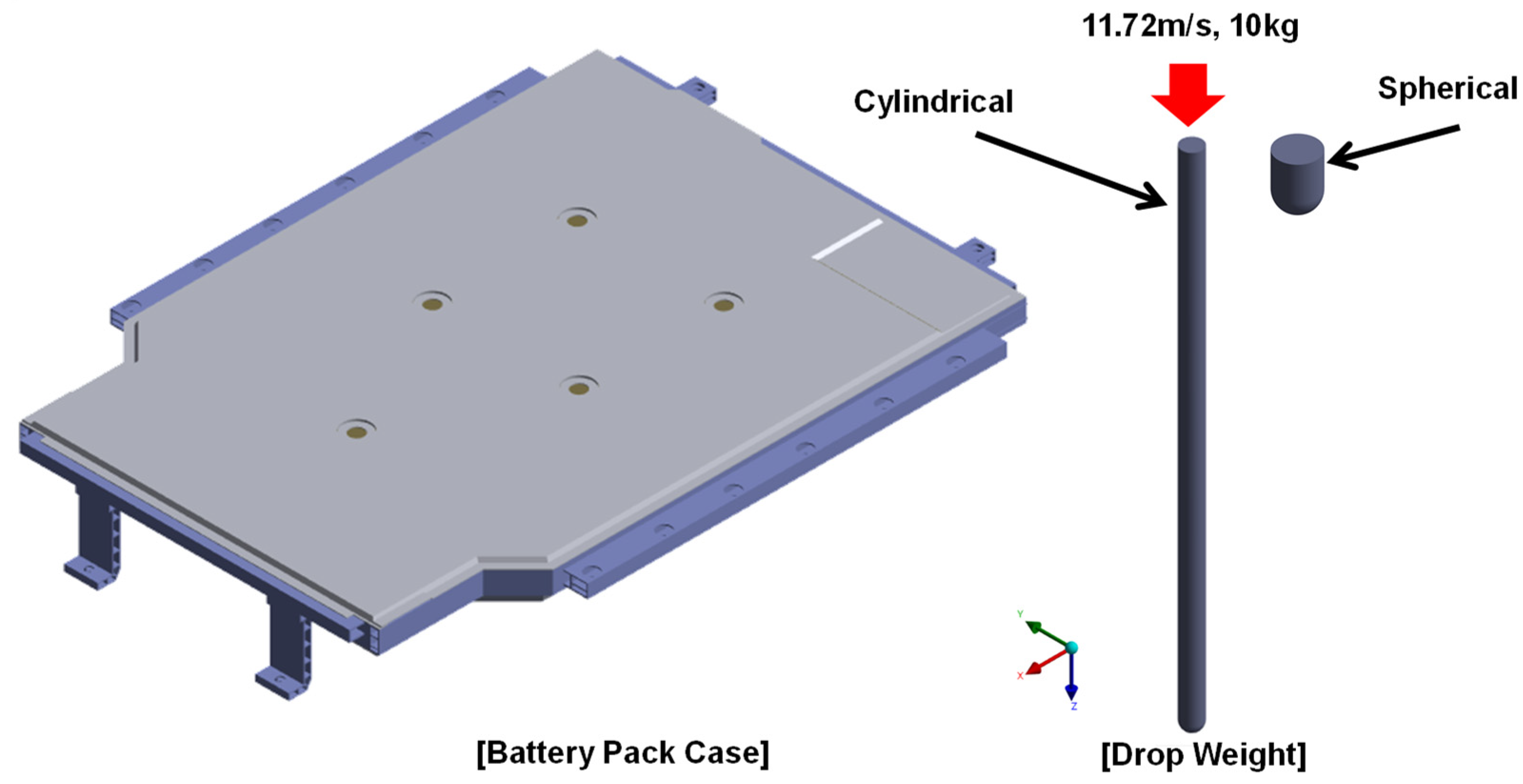
To analyze the impact response of BPC under drop-weight loading, a finite element analysis was performed using the Explicit Dynamics module in ANSYS Workbench 2024 R2 (ANSYS Inc., Canonsburg, PA, USA) Workbench. The analysis model constructed for the drop simulation is shown in
Figure 1.
A commercially manufactured BPC model was used, and both a spherical and a cylindrical impactor were assumed to strike the BPC. The material properties applied to the analysis are summarized in
Table 1, and these material data were provided by the BPC manufacturer. Although the drop height was intended to be 7 m, directly modeling a free fall from this height significantly increases computation time. Therefore, the free-fall velocity calculated using Equation (1) was applied as the initial velocity condition, where
is the free-fall velocity,
is the gravitational acceleration, and
is the drop height.
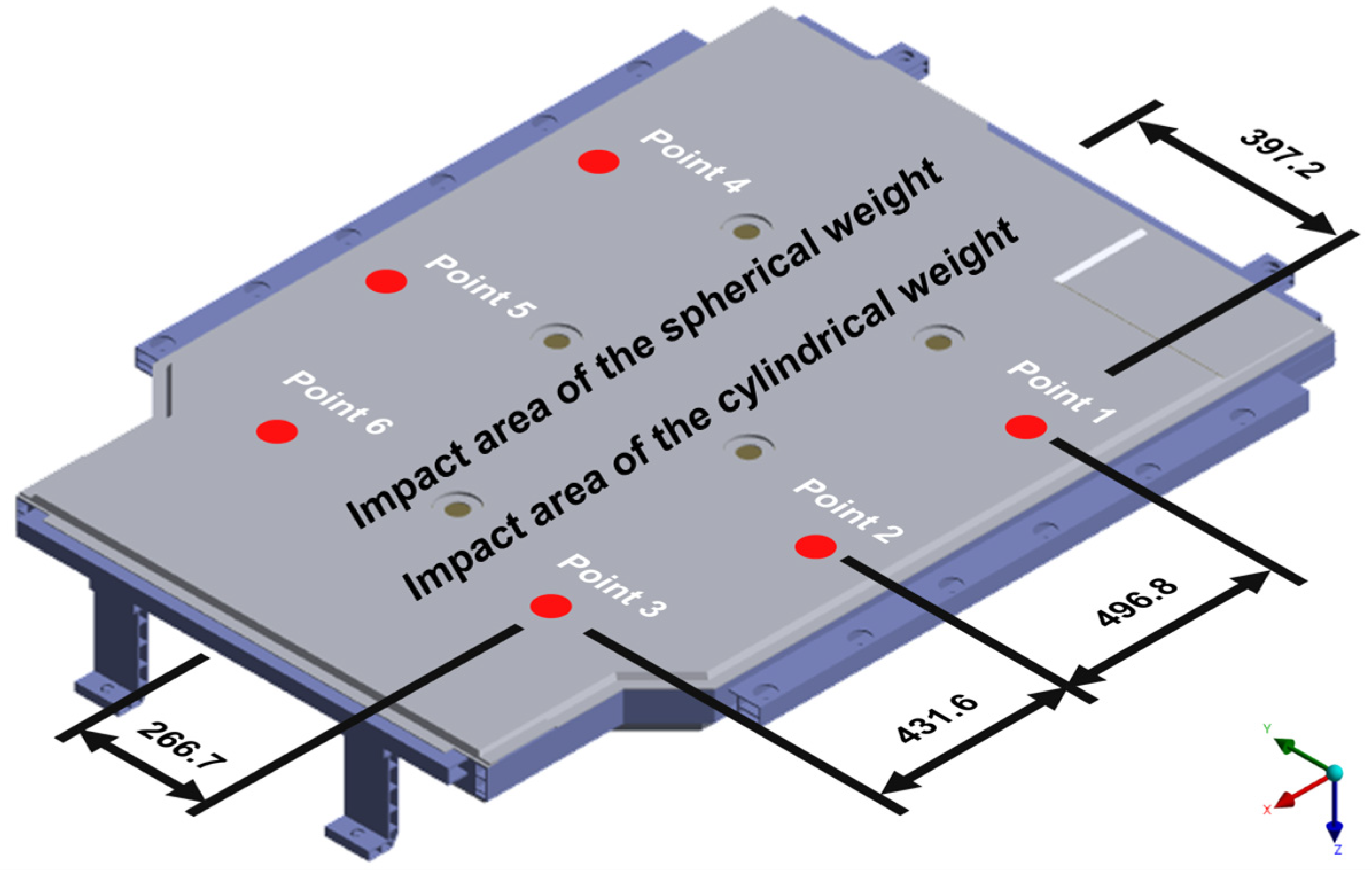
Each impactor had a mass of 10 kg, and the six impact points used in the simulation are shown in
Figure 2.
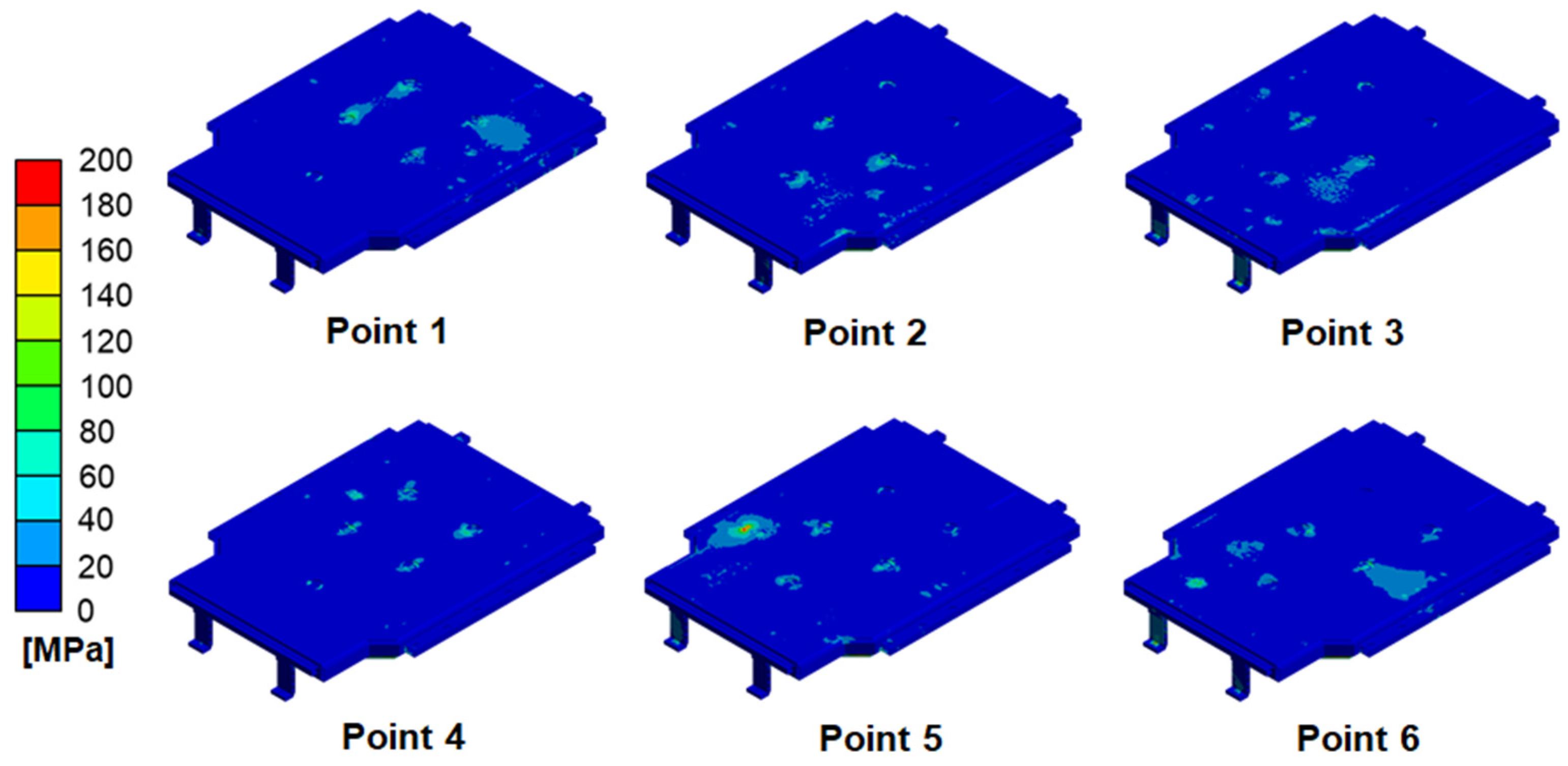
The analysis results indicate that stresses exceeding the yield strength occurred at all impact points, suggesting that permanent deformation would be expected during actual testing (
Figure 3). However, the predicted stresses did not exceed the material’s tensile strength, implying that fracture or catastrophic failure of the BPC is unlikely.
3. Drop-Weight Impact Test
To evaluate the response of BPC under drop-induced impact, a series of drop-weight impact tests was conducted. Two types of impactors, a hemispherical weight and a cylindrical weight, were used, each with a mass of 10 kg and a drop height of 7 m. Although the commonly adopted drop height in industry is approximately 5 m, a more severe condition was selected in this study to assess the structural robustness of the BPC.
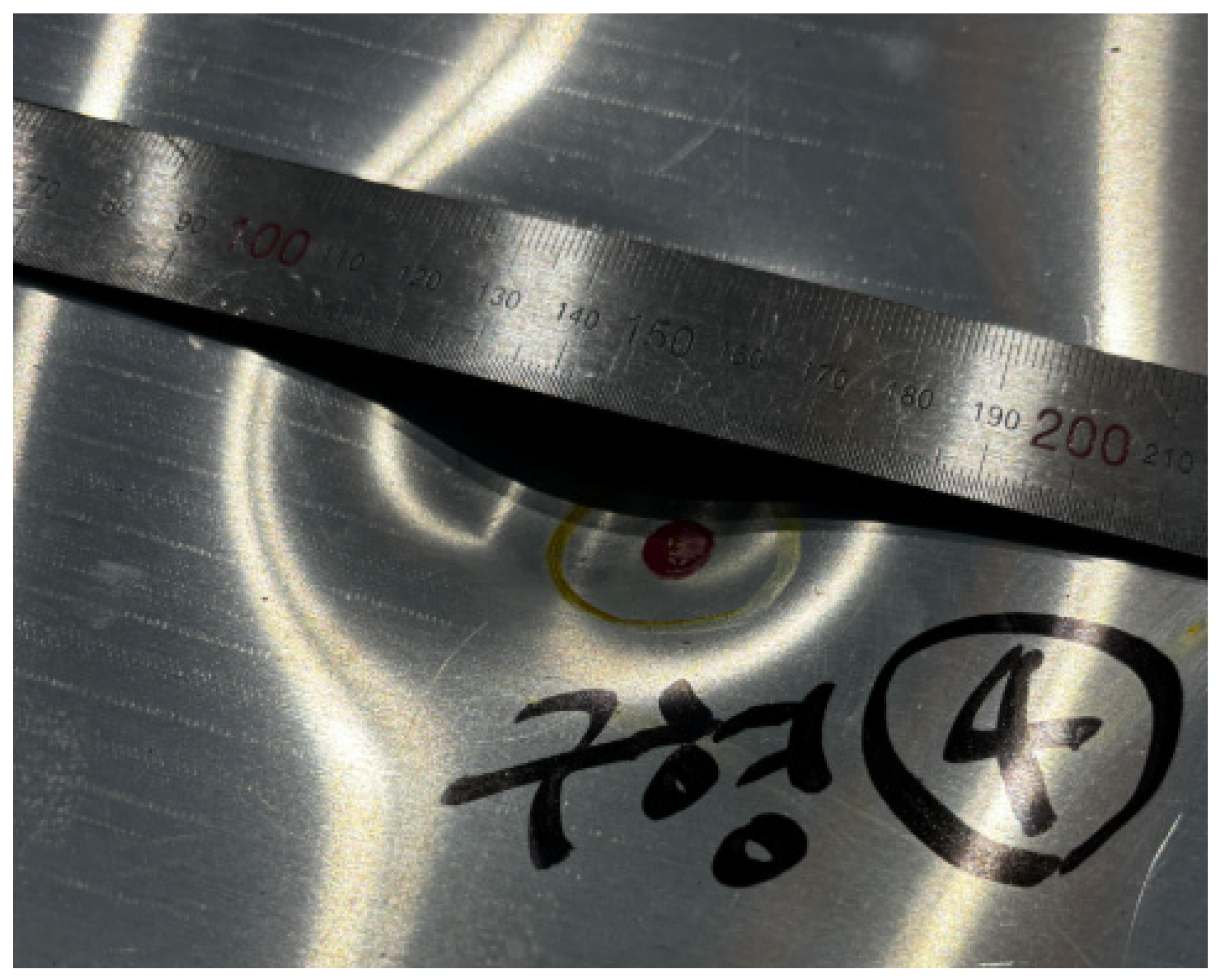
A total of six impact points were designated on the BPC, and each weight type was dropped on three points. As a result, deformation was observed at all impact locations, with the largest deformation occurring at position No. 4, where the spherical weight was dropped. Approximately 10 mm of deformation was observed in the lower cover of the BPC, which may potentially damage the cooling channels located beneath the cover (
Figure 4). In
Figure 4, the non-English annotation refers to impact position No. 4, where the spherical weight was dropped. However, no adverse effects were observed on the battery cells inside the pack.
4. Results and Discussion
In this study, the drop-impact behavior of the BPC was investigated through both finite element analysis and drop-weight impact testing. In the numerical analysis, the impact of 10 kg spherical and cylindrical impactors dropped from a height of 7 m was simulated using ANSYS Explicit Dynamics. The free-fall velocity calculated from the drop height was applied as the initial condition. The results showed that the equivalent stress exceeded the yield strength at all impact locations, indicating that permanent deformation could occur under actual impact conditions. However, the maximum stress remained below the tensile strength, suggesting that fracture of the BPC is unlikely under the investigated conditions.
The drop-weight impact tests showed approximately 10 mm of deformation in the lower cover of the BPC. This trend was generally consistent with the analysis results, which also predicted local permanent deformation rather than catastrophic failure. These results indicate that the lower cover can absorb impact energy through local deformation under severe impact loading.
From a structural safety perspective, the results suggest that although the lower cover may deform and potentially affect the cooling channels beneath it, the deformation did not reach the battery cells and no cell damage was observed in the present tests. This implies that the investigated BPC has a certain level of structural robustness against severe drop impact.
However, several limitations should be noted. The material properties used in the numerical analysis were provided by the BPC manufacturer, and the simulation applied an initial impact velocity instead of directly modeling the full free-fall motion. In addition, only limited impact locations and two impactor shapes were considered. Therefore, further studies are needed to evaluate a wider range of impact conditions and to assess possible effects on cooling performance and long-term structural reliability.
5. Conclusions
This study evaluated the drop-impact resistance of a commercially manufactured BPC through finite element analysis and drop-weight impact testing. The results showed that severe impact can cause permanent deformation of the lower cover, but a fracture of the BPC and direct damage to the internal battery cells were not observed under the investigated conditions. These findings indicate that the BPC has a certain level of structural robustness against drop impact. However, the results should be interpreted with consideration of the simplified numerical conditions and limited impact scenarios used in this study.
Author Contributions
Conceptualization, M.C. and J.K.; methodology, M.C.; software, M.C.; validation, M.C., E.H. and Y.K.; formal analysis, M.C.; investigation, M.C.; resources, J.K.; data curation, M.C.; writing—original draft preparation, M.C.; writing—review and editing, M.C., E.H., Y.K., S.K. and J.K.; visualization, M.C.; supervision, J.K.; project administration, J.K.; funding acquisition, J.K. All authors have read and agreed to the published version of the manuscript.
Funding
This study has been conducted with the support of Ministry of Trade, Industry and Energy (MOTIE, Korea), Robot Industry Core Technology Development Project “Development of AI autonomous manufacturing system for the production of high-difficulty curved ship blocks (RS-2024-00511865).
Institutional Review Board Statement
Not applicable.
Informed Consent Statement
Not applicable.
Data Availability Statement
The data presented in this study are available on reasonable request from the corresponding author. The data are not publicly available due to institutional and project restrictions.
Conflicts of Interest
The authors declare no conflict of interest.
References
- Saravana Kumar, M.; Prabhahar, M.; Prakash, S.; Hari Krishnan, H.R.; Vijay, B. Improvement of a Battery Pack Enclosure Fabricated from a Polymer Composite Material for Electric Vehicles. In Advancements in Materials Processing Technology; Sahu, R., Sutradhar, G., Krishna, R., Eds.; AMPT 2023; Springer Proceedings in Materials; Springer: Singapore, 2025; Volume 3. [Google Scholar] [CrossRef] [Scilit]
- Hu, L.L.; Zhang, Z.W.; Zhou, M.Z.; Zhang, H.J. Crushing behaviors and failure of packed batteries. Int. J. Impact Eng. 2020, 143, 103618. [Google Scholar] [CrossRef] [Scilit]
- Sheikh, M.; Elmarakbi, A.; Elkady, M. Thermal runaway detection of cylindrical 18650 lithium-ion battery under quasi-static loading conditions. J. Power Sources 2017, 370, 61–70. [Google Scholar] [CrossRef] [Scilit]
- Arora, S.; Kapoor, A.; Shen, W. Application of robust design methodology to battery packs for electric vehicles: Identification of critical technical requirements for modular architecture. Batteries 2018, 4, 30. [Google Scholar] [CrossRef] [Scilit]
- Hooper, J.M.; Marco, J. Characterising the in-vehicle vibration inputs to the high voltage battery of an electric vehicle. J. Power Sources 2014, 245, 510–519. [Google Scholar] [CrossRef] [Scilit]
| Disclaimer/Publisher’s Note: The statements, opinions and data contained in all publications are solely those of the individual author(s) and contributor(s) and not of MDPI and/or the editor(s). MDPI and/or the editor(s) disclaim responsibility for any injury to people or property resulting from any ideas, methods, instructions or products referred to in the content. |