


Abstract
Management strategies for reducing the environmental impact of water distribution systems often rely on pressure management to limit demand. Yet, dissipated or recovered stream power in valves and pumps as turbines accounts for only part of the supplied energy, while friction, leakage, and excess pressure contribute additional inefficiencies. This work introduces an optimization model that minimizes global excess stream power by explicitly incorporating environmental considerations. Applied to a real water distribution network, the approach identifies optimal valve and turbine placement. Results highlight technical feasibility, environmental benefits, and economic viability, confirming the model’s effectiveness in sustainable water network management.
1. Introduction
In recent years, water distribution networks (WDNs) have adopted sustainable strategies to address growing environmental and economic challenges [1]. Water scarcity, variable recharge, and leakage cause significant waste of resources and energy. Pressure management, often via pressure reducing valves (PRVs), reduces water demand but dissipates considerable stream power, raising efficiency concerns [2]. To overcome these limitations, advanced solutions such as efficient pumps, variable speed drives, and pumps as turbines (PATs) have been extensively explored [3]. Parallel to these technical developments, several performance indicators have been introduced in the literature to evaluate WDN efficiency. Traditional indicators often focus on reliability or the ratio between supplied and required energy, while recent contributions propose more comprehensive measures accounting for energy demand, dissipation, and excess pressure. Among them, the Global Excess Power (GEP) index has emerged as a robust performance measure, quantifying the gap between supplied and required power [4].
This paper adopts the recently proposed GEP indicator as a novel optimization objective for device placement in WDNs. The proposed approach balances energy supply and demand while accounting for environmental and economic impacts, thereby reducing both the carbon footprint and operational costs. The methodology is validated on a real case study network, with results demonstrating technical feasibility, economic viability, and substantial environmental benefits.
2. The Optimization Procedure
The optimization problem addresses the joint placement of pressure-reducing valves (PRVs) and pumps as turbines (PATs) in a water distribution network (WDN), with the goal of minimizing the Global Excess Power (GEP), which represents the rate of total excess stream power with respect to the minimum power delivered within the system.
The problem formulation is expressed as a mixed-integer nonlinear programming (MINLP), since both binary and continuous variables are involved, together with nonlinear hydraulic constraints. Binary variables define device installation and flow direction, while continuous variables describe pipe discharge, nodal head, and head losses. Compared with traditional approaches that maximize economic indicators (e.g., net present value), this formulation provides a comprehensive and detailed insight into the energy status of the network.
The objective function is defined as the minimization of whose formulation is presented below:
where , and are, respectively, the total water demand, the minimum required pressure and the elevation of the n-th node (n = 1 … N). Moreover, is the excess pressure at the node; γ is the specific weight of water; and represent the leakage flow rate related to the minimum and excess pressure, respectively. Finally, is the minimum delivered power, expressed as:
With reference to the summation in Equation (1), the first term represents the rate of the power absorbed by the water demand in the presence of an excess pressure, while the second and third terms are the rate of the power absorbed by the minimum and excess leakage, respectively, in the presence of an excess pressure. Finally, the sum of all three terms at each node of the network represents the local excess power (LEP).
Hydraulic mass and energy balance equations are included as constraints of the optimization procedure, along with operational limits such as maximum head drops, exclusive installation of a single device per pipe, and an upper bound on the total number of devices. In addition, carbon savings associated with PAT energy recovery are introduced as boundary constraints, linking environmental performance to network operation. More details about the constraint formulation can be found in [4].
3. Application to a Case Study Network
The proposed optimization was applied to a rural WDN located in the Blackstairs region of Ireland. The system comprises 138 links and 126 nodes, supplied by a reservoir with a constant head of 291 m.
In the absence of management strategies (Scenario 0), the Global Excess Power (GEP) reached 1.34, meaning that 34% of the minimum required energy is wasted as excess and can be recovered through pressure management.
The optimization model was implemented in A Mathematica Programming Language (AMPL) and solved with SCIP [5]. Different constraints on carbon savings were considered, leading to multiple optimal solutions. Each solution was also evaluated a posteriori in terms of net present value (NPV) to assess economic viability.
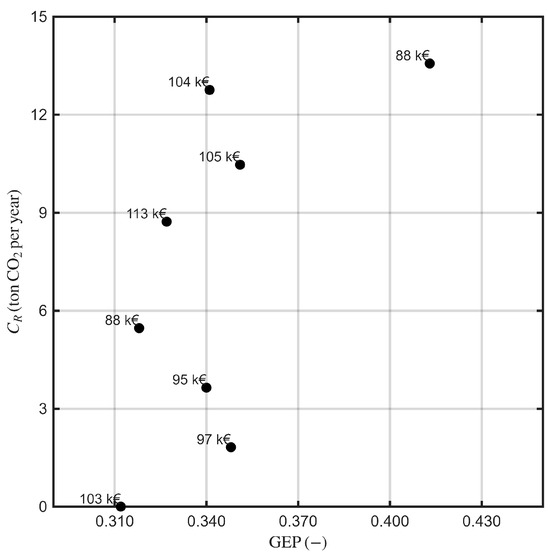
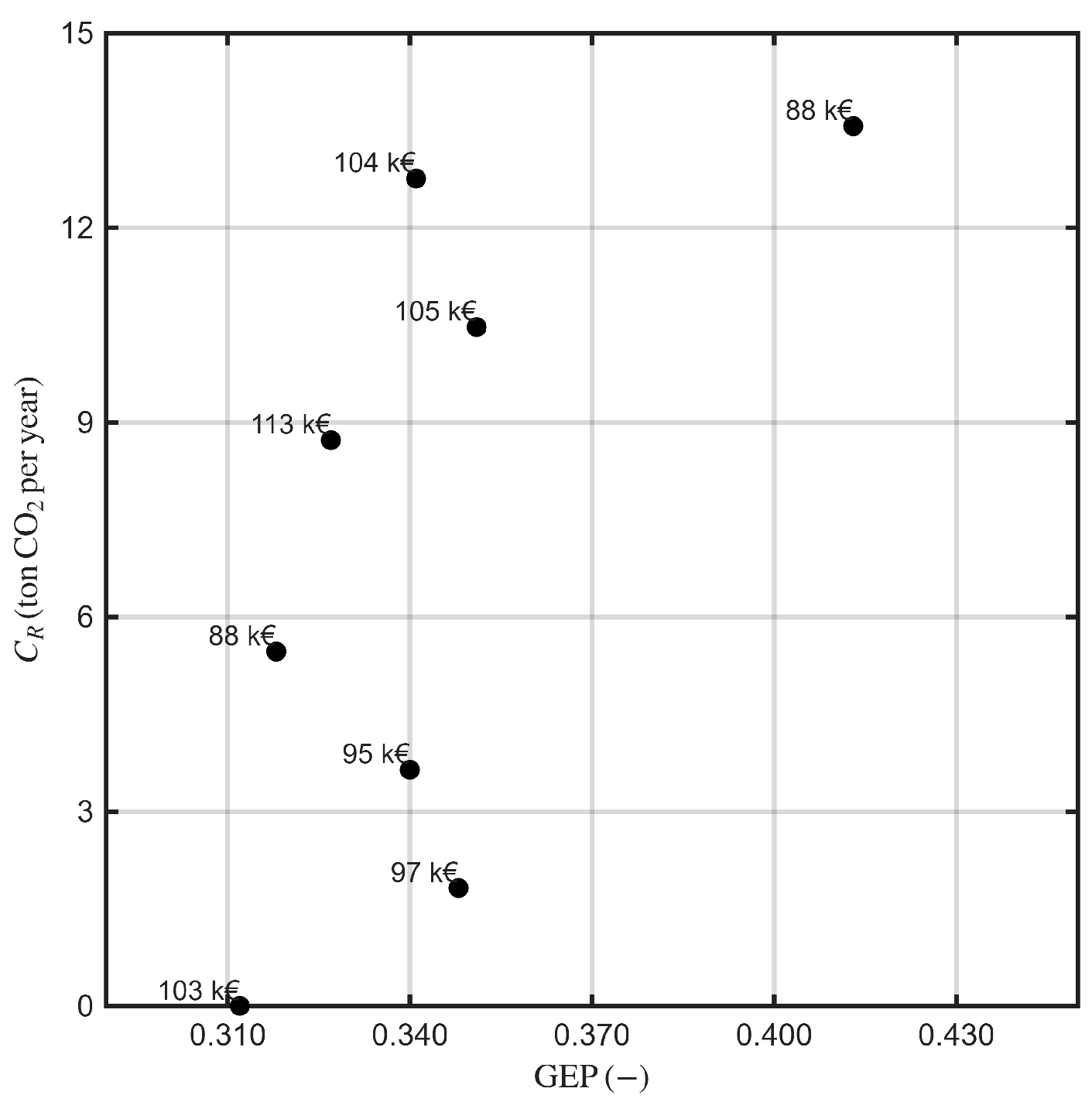
As illustrated in Figure 1, the minimization of the GEP can be achieved through various configurations of hydraulic devices within the network, depending on the constraints imposed. When the emission savings —representing the environmental advantage of the management strategy—are properly bounded, the resulting economic benefits and GEP values differ accordingly. The analysis shows that the most efficient configuration (with a GEP of 0.312) does not correspond either to the scenario with the greatest emission reduction (i.e., of 13.6 tonCO2 per year) or to the most economically favorable solution (with an NPV of 113 k€).
Figure 1.
Solutions resulting from different constraints on the carbon savings .
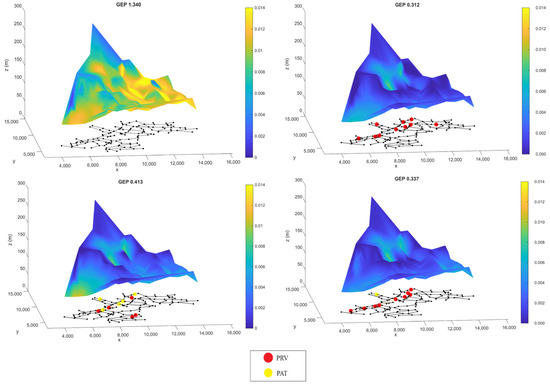
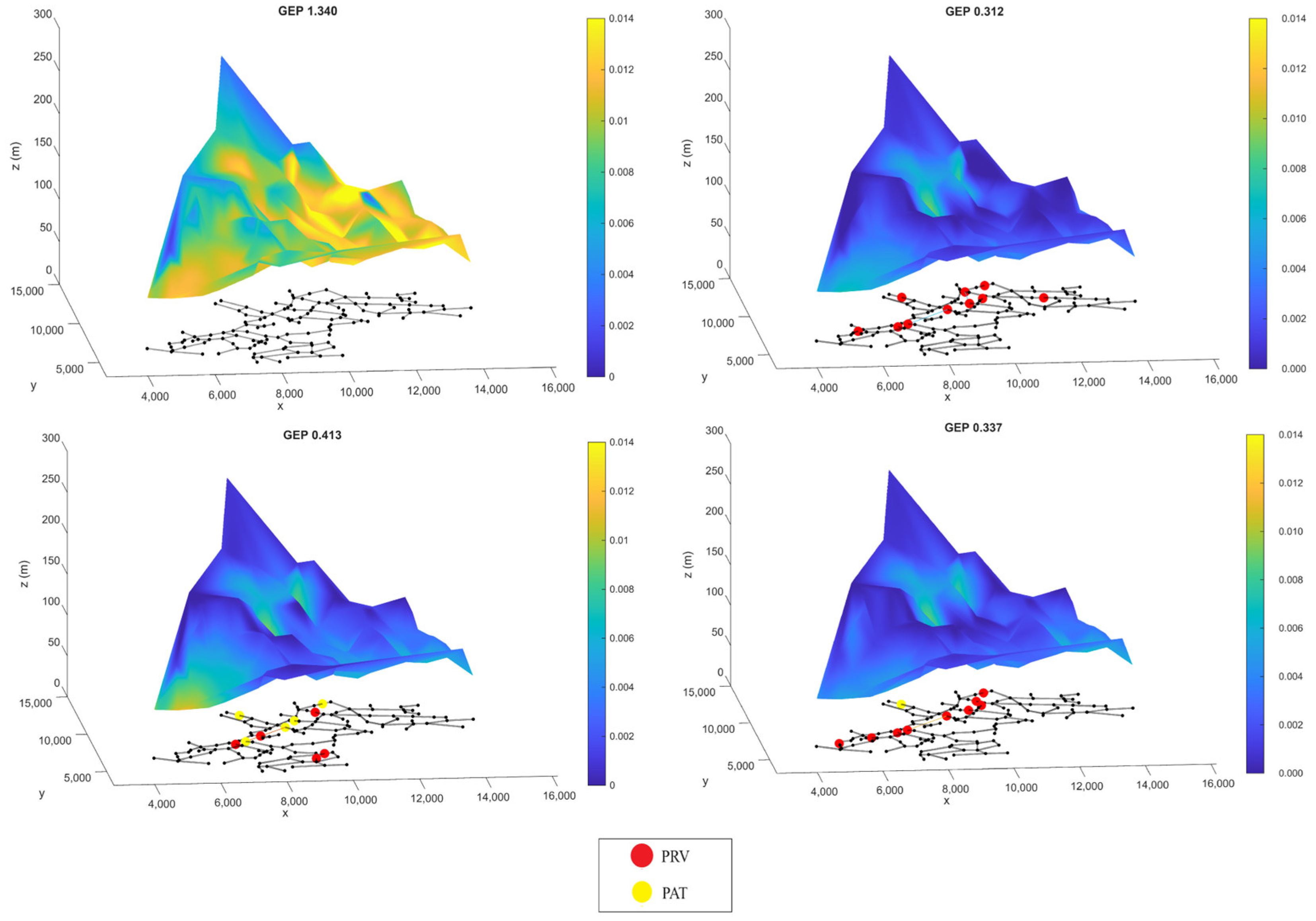
The spatial distribution of LEP values highlights how excess power is managed within the network. As shown in Figure 2, the optimal configurations lead to different LEP distributions compared to Scenario 0 (with a GEP of 1.340), with a clear overall reduction. In addition, all strategies include a dissipating device downstream of the reservoir, lowering network pressure, but the placement and settings of additional devices create variations in LEP and GEP outcomes.
Figure 2.
Devices installation and spatial distribution of LEP values according to the optimal solutions (i.e., GEP values as 0.312, 0.413 and 0.337) and scenario 0 (i.e., GEP as 1.340).
Overall, the results show that no single configuration simultaneously maximizes efficiency, carbon reduction, and economic return. However, the GEP-based optimization framework generates a set of feasible solutions, each emphasizing a different priority.
4. Conclusions
This study proposes a method to optimally place hydraulic devices in water distribution networks by minimizing the Global Excess Power (GEP) while considering carbon footprint constraints. Applied to a rural network, the procedure delivers alternative strategies: the most energy-efficient (GEP = 0.312, increased by +77% compared to the initial scenario), the most profitable (NPV = 113 k€) and the most sustainable (13.6 tonCO2/year saved). The newly proposed approach offers water managers flexible options to balance economic, environmental, and efficiency goals.
Author Contributions
Conceptualization, M.C.M., A.C. and O.F.; methodology, M.C.M., A.C. and O.F.; software, M.C.M., R.M., A.C. and O.F.; formal analysis, O.F. and R.M.; investigation, M.C.M. and R.M.; resources, A.C.; data curation, M.C.M., A.C., O.F. and R.M.; writing—original draft preparation, M.C.M., A.C., O.F. and R.M.; writing—review and editing, M.C.M., A.C., O.F. and R.M.; visualization, M.C.M., A.C., O.F. and R.M.; supervision, A.C. and O.F.; project administration, A.C.; funding acquisition, A.C. All authors have read and agreed to the published version of the manuscript.
Funding
This work is supported by the “Network 4 Energy Sustainable Transition—NEST” project (MUR project code PE000021, Concession Decree No. 1561 of 11 October 2022), in the framework of the NextGenerationEu PNRR plan (CUPE63C22002160007).
Institutional Review Board Statement
Not applicable.
Informed Consent Statement
Not applicable.
Data Availability Statement
Not applicable.
Conflicts of Interest
The authors declare no conflicts of interest.
References
- Morseletto, P.; Mooren, C.E.; Munaretto, S. Circular Economy of Water: Definition, Strategies and Challenges. Circ. Econ. Sustain. 2022, 2, 1463–1477. [Google Scholar] [CrossRef] [Scilit]
- Ferrarese, G.; Malavasi, S. Performances of Pressure Reducing Valves in Variable Demand Conditions: Experimental Analysis and New Performance Parameters. Water Resour. Manag. 2022, 36, 2639–2652. [Google Scholar] [CrossRef] [Scilit]
- Latifi, M.; Farahi Moghadam, K.; Naeeni, S.T. (Omid) Pressure and Energy Management in Water Distribution Net-works through Optimal Use of Pump-As-Turbines along with Pressure-Reducing Valves. J. Water Resour. Plan. Manag. 2021, 147, 04021039. [Google Scholar] [CrossRef] [Scilit]
- Morani, M.C.; Carravetta, A.; Fecarotta, O.; Montillo, R. Detailed Audit of the Energy Efficiency in Water Systems: New Performance Indices. Water Resour. Manag. 2023, 38, 1241–1260. [Google Scholar] [CrossRef] [Scilit]
- Vigerske, S.; Gleixner, A. SCIP: Global Optimization of Mixed-Integer Nonlinear Programs in a Branch-and-Cut Framework. Optim. Methods Softw. 2018, 33, 563–593. [Google Scholar] [CrossRef] [Scilit]
Disclaimer/Publisher’s Note: The statements, opinions and data contained in all publications are solely those of the individual author(s) and contributor(s) and not of MDPI and/or the editor(s). MDPI and/or the editor(s) disclaim responsibility for any injury to people or property resulting from any ideas, methods, instructions or products referred to in the content. |
© 2026 by the authors. Licensee MDPI, Basel, Switzerland. This article is an open access article distributed under the terms and conditions of the Creative Commons Attribution (CC BY) license.