


Abstract
Sustainable Urban Drainage Systems (SuDSs) represent a contemporary and eco-friendly method for managing surface water, with the goal of reducing flooding impacts while preserving the environment and enhancing water quality and biodiversity. In Bari, recurrent flooding stemming from water stagnation, extreme weather, and urban development poses challenges to sustainable growth. This study applies the ‘Sponge city’ concept to address these issues through an evaluation of current urban permeability and the implementation of Nature-Based Solutions (NBSs) to reduce runoff and manage underground flows. By assessing the climatic conditions and hydrological factors contributing to urban stagnation, this project seeks to create a resilient urban environment capable of adapting to climate change and effectively mitigating both significant and minor rainfall events. It aims to reduce runoff, while also promoting groundwater recharge and alleviating saline contamination effects in coastal areas, ultimately enhancing the safety and livability of urban landscapes.
1. Introduction
Italy has faced numerous flooding events in recent years, causing significant damage and droughts, leading to water shortages. This situation highlights the need to improve urban resilience to climate change by managing rainwater, reducing runoff, and minimizing water waste through increased water storage. Many regions and water management companies are now adopting practices based on Hydraulic–Hydrologic Invariance (HHI) [1], which includes initiatives such as the Sustainable Development Goals in Europe and various water management acts in countries such as Australia and the USA.
In Lombardy, specific criteria for maintaining hydraulic and hydrological invariance have been established [2]. To address drought, a recent law introduced measures to enhance the resilience of water systems and reduce water loss. Coastal areas, especially in the Mediterranean, are at risk of saltwater contamination due to water overextraction during summer. Therefore, storing excess rainwater is essential for recharging aquifers and combating saline contamination of groundwater.
The city of Bari faces challenges from both flooding and drought, which hinder its sustainable development. This study examined the urban landscape of Bari and explored green infrastructure and NBSs to improve aquifer recharge and reduce runoff.
2. Application of SUDSs to the Metropolitan City of Bari
Starting from an analysis of the current urban situation in the city of Bari, in terms of the ratio between permeable and impermeable surfaces, several green infrastructures and NBSs were envisaged that, first of all, reduce surface runoff and simultaneously increase infiltration into the subsoil. Simultaneously, meteorological and climatic conditions were examined, along with the water environment and the main causes of urban stagnation. In this regard, Report No. 32 of the National System for Environmental Protection [3] showed that for the city of Bari, the percentage of land consumed by 2021 was 43.10% of the entire municipal area, with a ratio between vegetated and urbanized surfaces of 47.14% and per capita land consumption, in the period 2020–2021, of 0.95 m2/inhabitant/year. Therefore, a densely urbanized area comprising the Libertà, Murat, San Nicola, Picone, Poggiofranco, Carrassi, and San Pasquale neighborhoods was proposed as a case study.
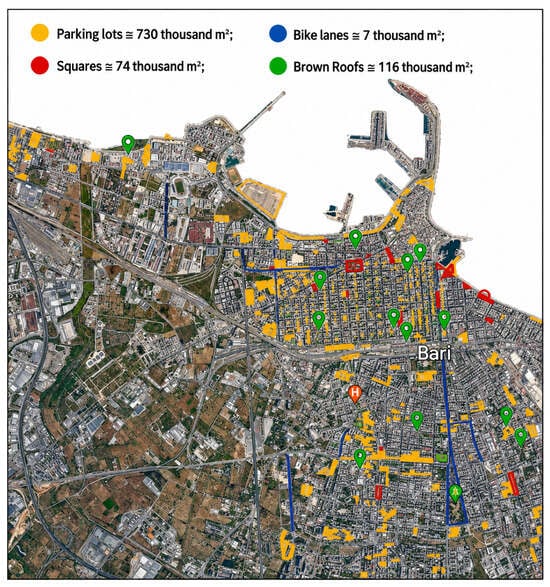
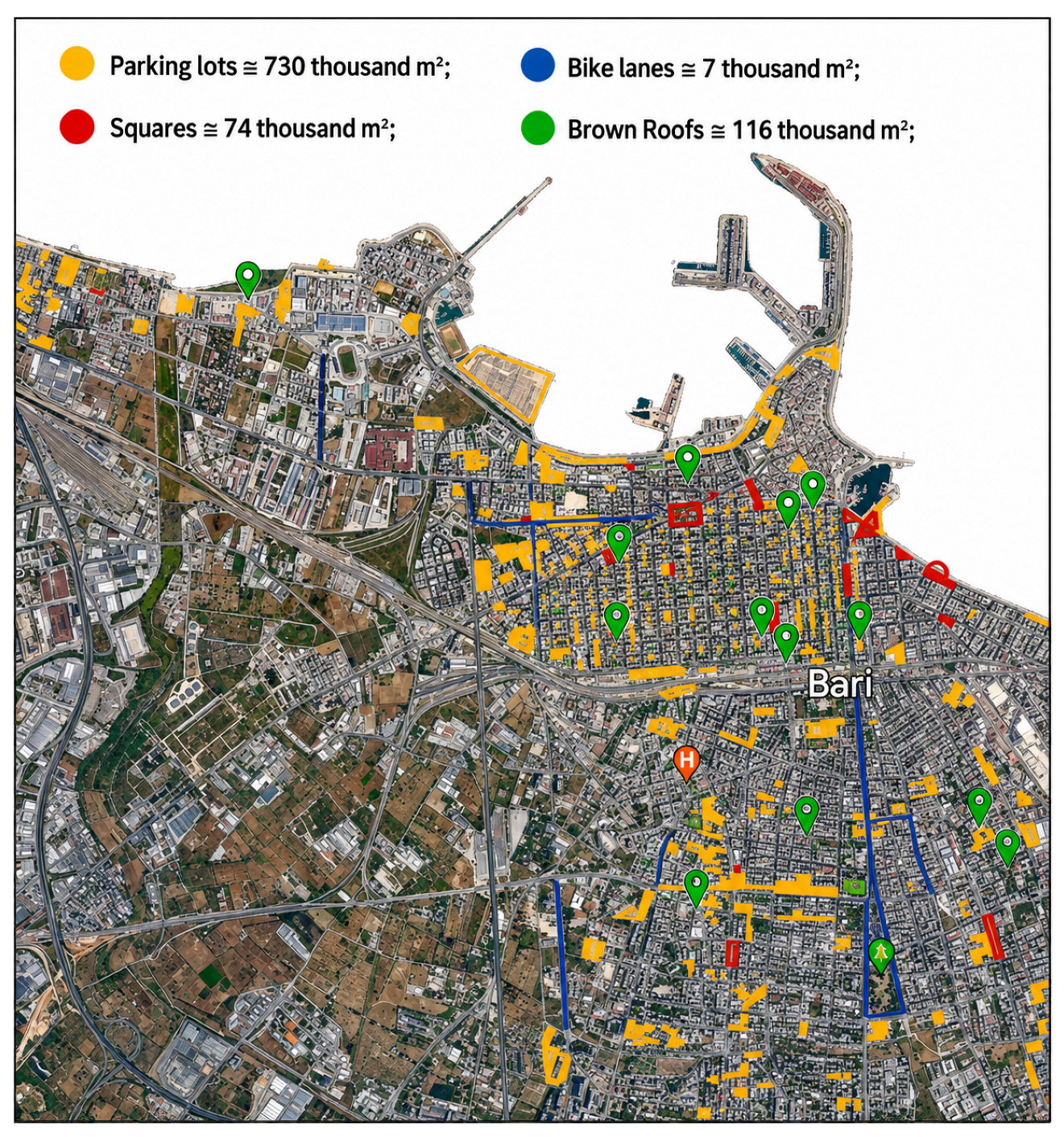
The adopted SuDS technical solutions include permeable pavements, which are mainly applied to parking areas, squares, parks, and cycle paths. These pavements ensure effective rainwater infiltration, reducing the pollution load, which mainly consists of total suspended solids (TSSs), heavy metals, and hydrocarbons [4]. A total area of 807,295 m2 was identified, which can be divided into 726,391 m2 of parking lots, 74,220 m2 of squares, and 6684 m2 of bicycle paths. In addition to the pavements, the creation of brown roofs with native, spontaneous species on existing public buildings was planned, for a total surface area of 116,000 m2 (Figure 1).
Figure 1.
Locations of SUDS areas in Bari.
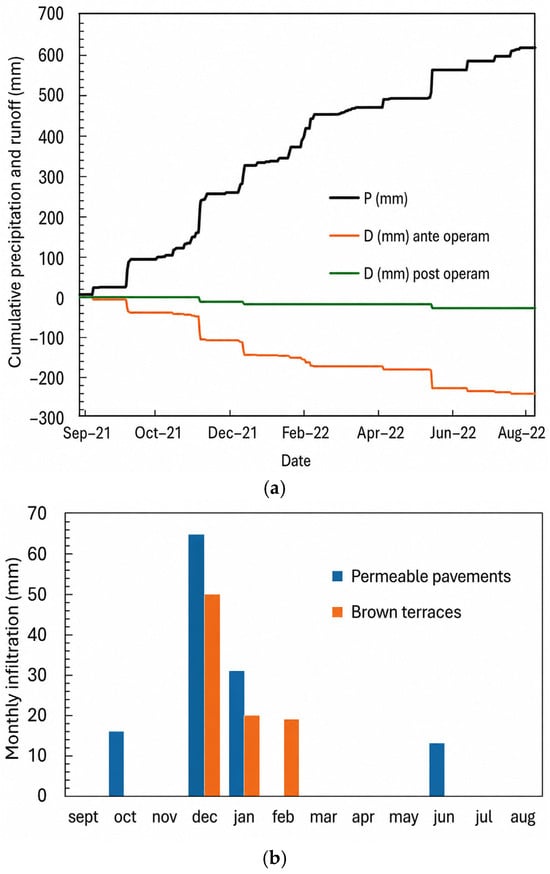
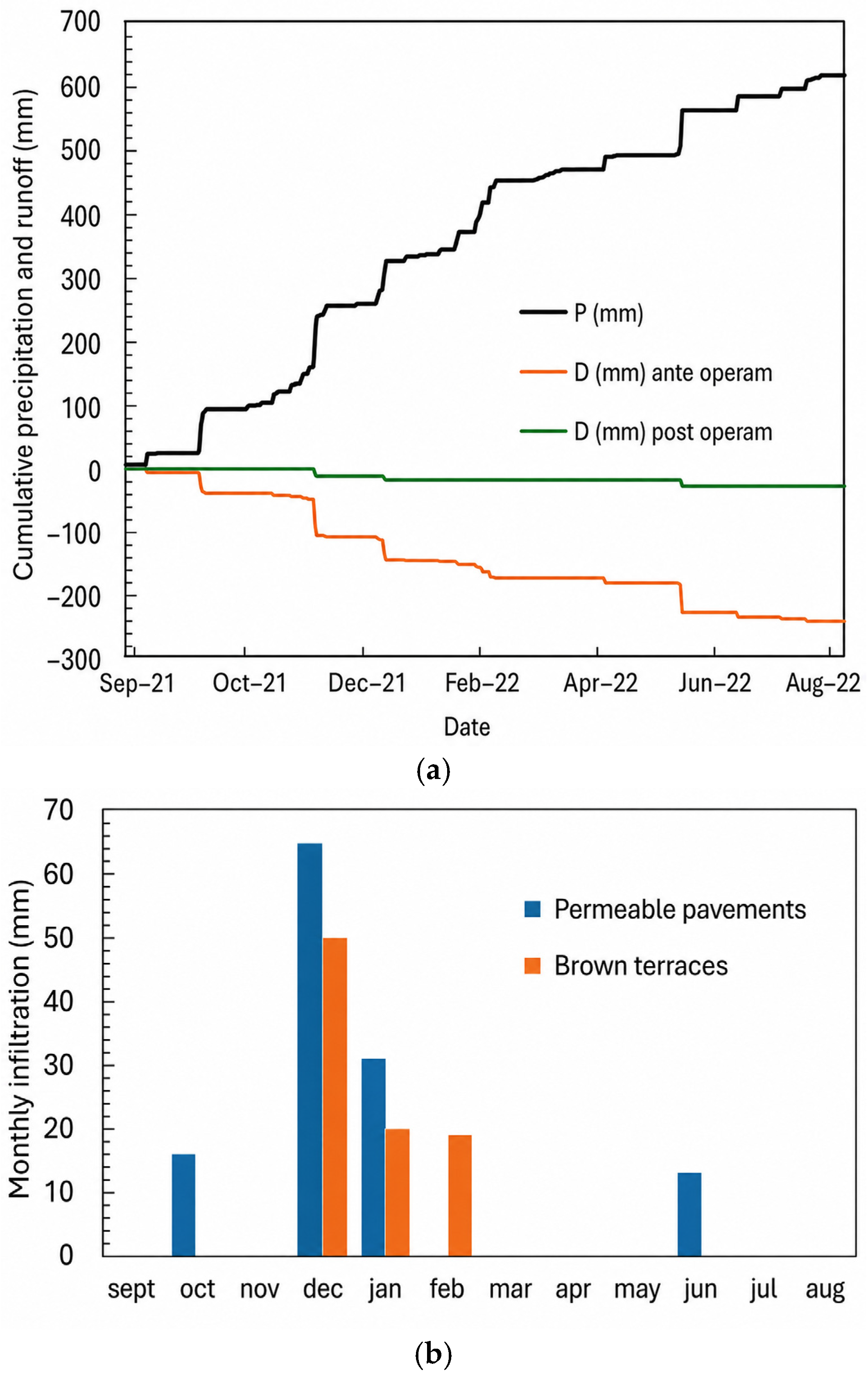
Based on the thermopluviometric data relating to the time interval 2019–2023, obtained from the database for thermopluviometric stations in the metropolitan area of Bari, effective infiltration was calculated using the procedure suggested by Rushton et al. [5], after determining surface runoff with the Curve Number (CN) method–Soil Conservation Service (SCS) [6] and evapotranspiration with the Penman–Monteith analytical method [7], assuming five land use classes for the study area. The verification was carried out in ante operam and post operam conditions, considering the NBSs planned for the project. Following the planned interventions, a 3.4% reduction in the impervious surface area was obtained, accompanied by a decrease of approximately 2.7% in the specific volume of surface runoff. At the scale of the interventions, runoff decreased significantly. As outlined in Figure 2a for the hydrologic year 2021–2022 the runoff in the area of the interventions decreased from 240 mm to 27 mm. Consequently, effective infiltration increased during the reference period to an average value of 53,635 m3. As detailed in Figure 2b, the increase in infiltration was mainly due to the permeable pavements. In contrast, in brown terraces, evapotranspiration plays an important role in runoff reduction. Moreover, the excess water from the brown terraces can be stored for irrigation purposes.
Figure 2.
Effects of interventions at local scale for hydrological year September 2021–August 2022: (a) comparison between cumulative ante operam and post operam precipitation and runoff; (b) monthly effective infiltration from permeable pavements and brown terraces.
3. Conclusions
The implementation of green infrastructures and NBSs in the city of Bari has demonstrated significant potential for improving urban water management. With permeable pavements and brown roofs, the impervious surface area and runoff volume decreased, leading to enhanced infiltration and reduced runoff locally; the proposed interventions resulted in a 3.4% decrease in impervious area and a substantial reduction in surface runoff, showcasing an increase in effective infiltration to an average of 53,635 m3.
These interventions not only mitigate flood risks but also enable water storage for irrigation, demonstrating SuDSs’ potential for urban resilience and sustainable water management. Continued research and implementation of these strategies could further optimize water management in densely urbanized areas. Overall, this case study of Bari serves as a valuable model for other densely populated urban areas grappling with similar hydrological challenges. The findings reinforce the necessity of continued investment in green infrastructure initiatives, which are essential for fostering sustainable urban environments that can adapt to the increasing pressures of climate change and urbanization. This multifaceted approach highlights the interconnectedness of urban design, water management, and ecological sustainability, suggesting that thoughtful integrations of NBSs can lead to significant improvements in urban resilience. By prioritizing permeability and utilizing innovative solutions, cities can transform their landscapes into sustainable, resilient habitats that enhance both environmental quality and the quality of life for their inhabitants.
Author Contributions
Conceptualization, C.C. and G.F.A.; methodology, G.F.A.; software, N.P.; validation, C.C.; formal analysis, G.F.A. and N.P.; investigation, G.F.A.; resources, N.P.; data curation, N.P.; writing—original draft preparation, C.C.; writing—review and editing, N.P. and G.F.A.; visualization, N.P.; supervision, C.C.; project administration, C.C. All authors have read and agreed to the published version of the manuscript.
Funding
This research received no external funding.
Institutional Review Board Statement
Not applicable.
Informed Consent Statement
Not applicable.
Data Availability Statement
The authors confirm that the data that support the findings of this study are not openly available due to privacy restrictions but are available from the corresponding author upon reasonable request.
Conflicts of Interest
The authors declare no conflicts of interest.
References
- BURL—Bollettino Ufficiale Regione Lombardia (2019) Regolamento Regionale 19 Aprile 2019, n. 8: “Disposizioni Sull’applicazione dei Principi di Invarianza Idraulica ed Idrologica. Modifiche al Regolamento Regionale 23 Novembre 2017, n. 7”, 17, Suppl. del 24 Aprile 2019. Available online: https://hosting.pa-online.it/018005/su_ambito/sue/pagina/notizie/page/4/ (accessed on 4 April 2026).
- European Commission. Directive 2007/60/EC of the European Parliament and of the Council of 23 October 2007 on the assessment and management of flood risks Text with EEA relevance. Off. J. Eur. Union 2007, L288, 27–34. [Google Scholar]
- Munafò, M. Consumo di Suolo, Dinamiche Territoriali e Servizi Ecosistemici. Report Sistema Nazionale per la Protezione dell’Ambiente (SNPA) n. 32. 2022. Available online: https://www.snpambiente.it/wp-content/uploads/2022/07/Rapporto_consumo_di_suolo_2022.pdf (accessed on 4 April 2026).
- Li, H.; Li, Z.; Zhang, X.; Li, Z.; Liu, D.; Li, T.; Zhang, Z. The effect of different surface materials on runoff quality in permeable pavement systems. Environ. Sci. Pollut. Res. Int. 2017, 24, 21103–21110. [Google Scholar] [CrossRef] [Scilit] [PubMed]
- Rushton, K.R.; Eilers, V.H.M.; Carter, R.C. Improved soil moisture balance methodology for recharge estimation. J. Hydrol. 2006, 318, 379–399. [Google Scholar] [CrossRef] [Scilit]
- Mishra, S.K.; Singh, V.P. SCS-CN Method. In Soil Conservation Service Curve Number (SCS-CN) Methodology; Water Science and Technology Library; Springer: Dordrecht, The Netherland, 2003; Volume 42, pp. 84–146. [Google Scholar] [CrossRef] [Scilit]
- Zotarelli, L.; Dukes, M.D.; Romero, C.C.; Migliaccio, K.W.; Morgan, K.T. Step by Step Calculation of the Penman-Monteith Evapotranspiration (FAO-56 Method). Inst. Food Agric. Sci. Univ. Fla. 2010, AE459, 1–10. [Google Scholar]
Disclaimer/Publisher’s Note: The statements, opinions and data contained in all publications are solely those of the individual author(s) and contributor(s) and not of MDPI and/or the editor(s). MDPI and/or the editor(s) disclaim responsibility for any injury to people or property resulting from any ideas, methods, instructions or products referred to in the content. |
© 2026 by the authors. Licensee MDPI, Basel, Switzerland. This article is an open access article distributed under the terms and conditions of the Creative Commons Attribution (CC BY) license.