


Abstract
The badminton smash is a decisive scoring technique whose effectiveness depends on adequate preparation and a proper proximal-to-distal sequencing of the kinetic chain. This study integrates a You Only Look Once (YOLO)-based real-time vision detector with five wearable inertial measurement units (IMUs) attached to the right shoulder, right elbow, right wrist, right hip, and right knee of right-handed players. A high-speed camera provides video for shuttlecock and joint localization via YOLO, and the IMUs provide instantaneous joint accelerations at impact. The following four coaching-oriented indicators are defined: (1) rapid lowering of the center of mass after the opponent’s shot; (2) immediate forward acceleration after the shuttle is released; (3) alignment at the hitting position with the right shoulder/hip rotated backward and the left shoulder facing the approaching shuttle; and (4) a proximal-to-distal sequence in which the shoulder leads the elbow and then the wrist. Using two athletes with 15 trials each, the system achieved an overall recognition accuracy above 93% against manually annotated video. The method can provide objective feedback for coaches and players and is suitable for instructional use in physical education classes.
1. Introduction
The smash in badminton creates scoring opportunities and tactical advantages. Its performance is influenced by preparation, footwork initiation, trunk rotation, and the striking kinetic chain. Progress in computer vision and wearable sensing enables on-court, real-time measurement. You Only Look Once (YOLO)-family algorithms perform single-shot detection and have been applied to high-speed shuttle detection [1]. Wearable inertial measurement units (IMUs) measure acceleration and angular velocity in ecological settings and have been used for footwork and stroke recognition [2]. Multimodal fusion of video and inertial sensing improves the robustness of pose/motion estimation and the biomechanical interpretability [3]. In addition, recent surveys have summarized motion capture technologies in sports scenarios and highlighted the feasibility of camera-based capture under practical constraints [4]. Recent research results on badminton-specific YOLOv8-Pose and monocular shot segmentation indicate that single-camera deep learning can effectively analyze match play [5,6]. IMU-based badminton stroke identification using wireless inertial sensors and neural networks has also been reported [7]. Based on the results, we developed a lightweight pipeline centered on YOLO and IMUs, quantified four preparation-to-impact indicators, analyzed their correlations with shuttle exit velocity, and evaluated system accuracy and training feasibility with a small-scale experiment.
2. Materials and Methods
2.1. Participants and Ethics
Two collegiate, right-handed players participated. All completed warm-up and safety briefing. The protocol and data use were reviewed within the institution for educational research purposes, and informed consent was obtained.
2.2. Instruments and Setup
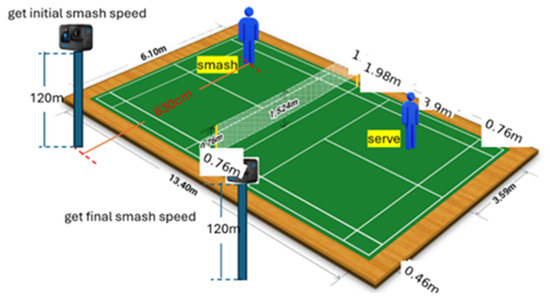
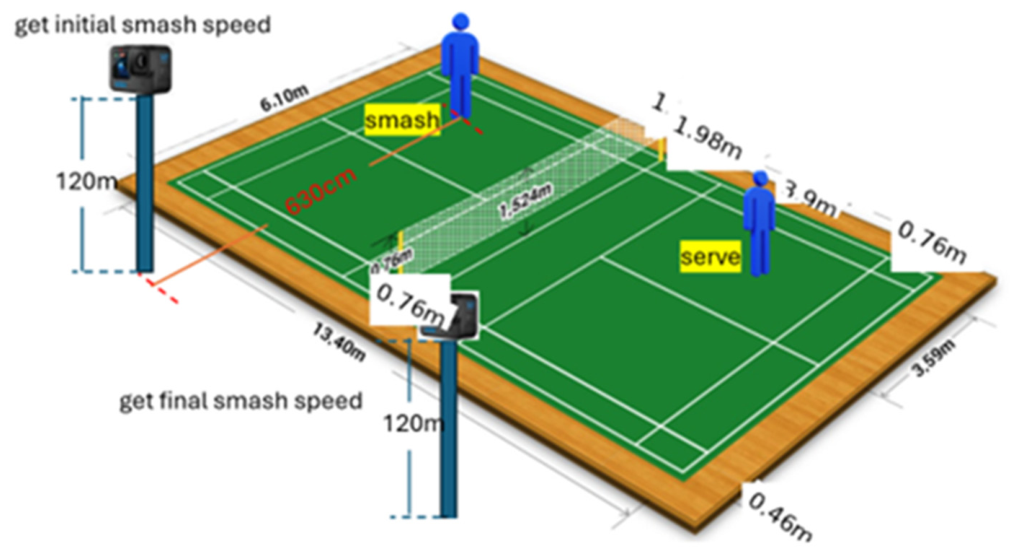
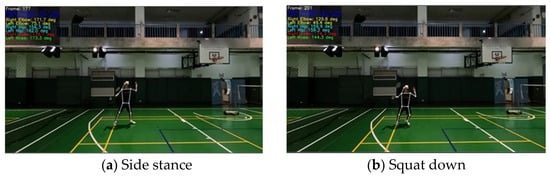
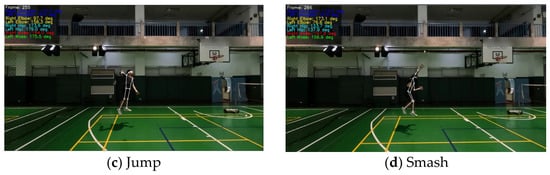
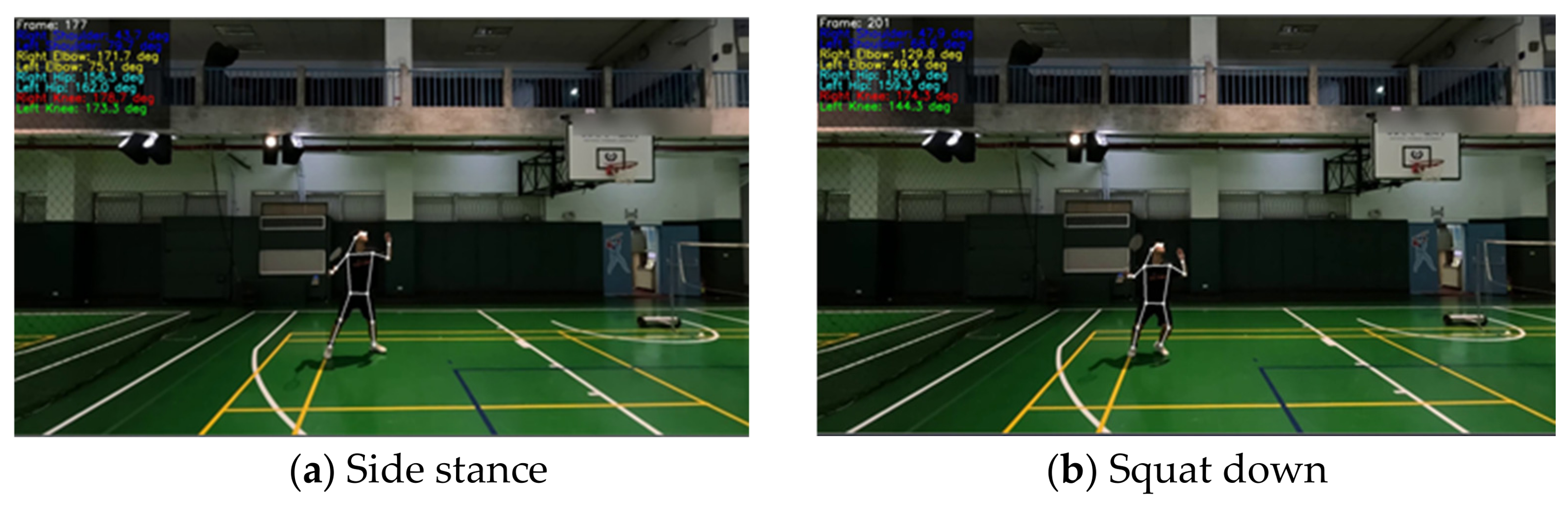
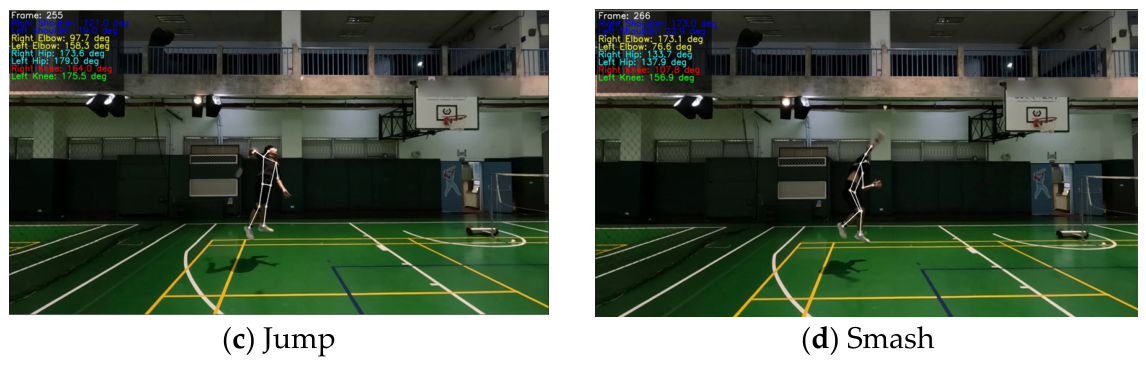
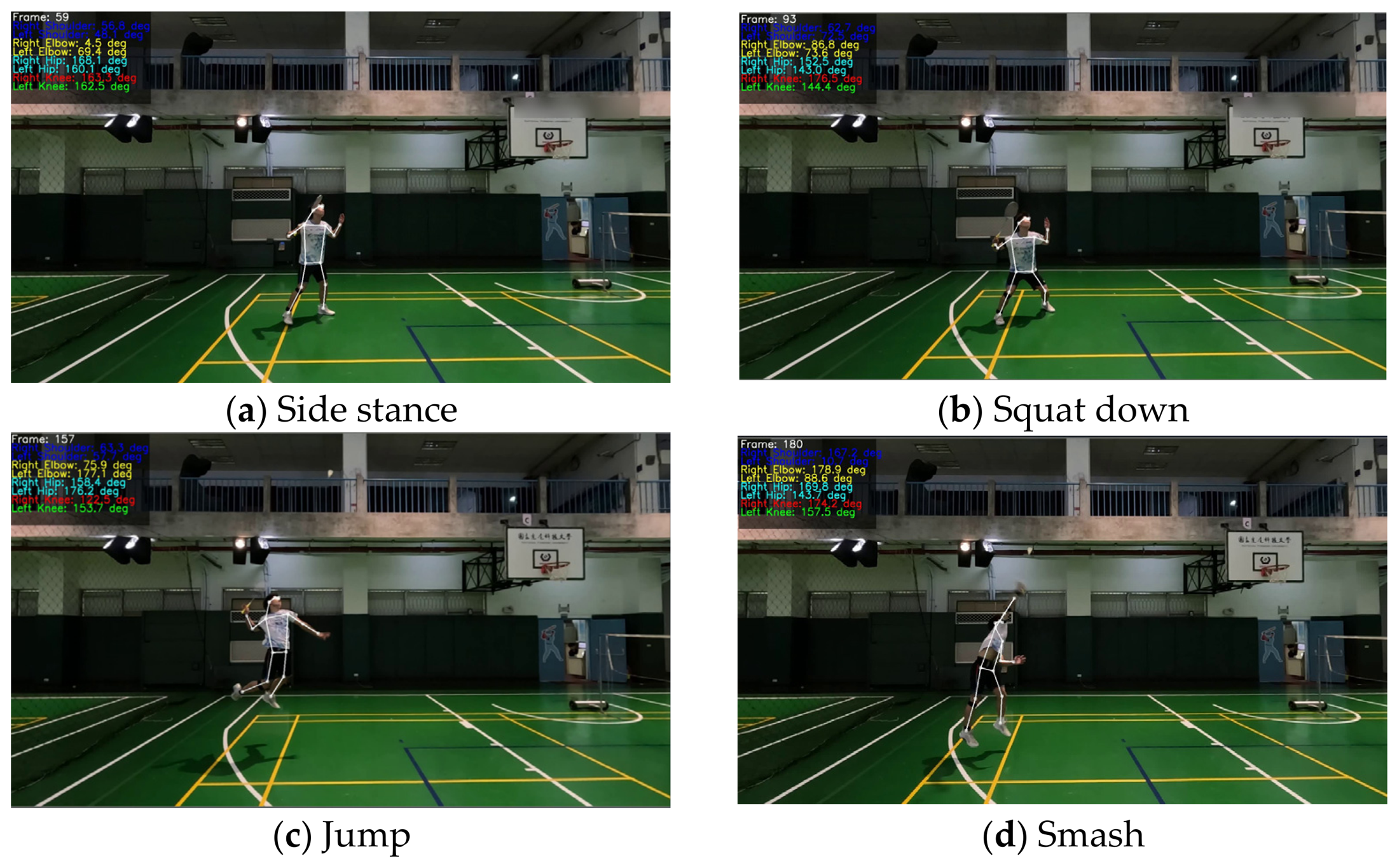
A high-speed camera ((GoPro HERO 11; GoPro, Inc., San Mateo, CA, USA) was used to record video at 1080p/240 frames per second (FPS) and was placed at a front-side distance of approximately 8–10 m to cover the striking upper limb and the net area. Real-time inference was performed on a laptop computer (ASUS; ASUSTeK Computer Inc., Taipei City, Taiwan). Five IMUs ((MetaMotionR; MbientLab Inc., San Jose, CA, USA) sampling at 200 Hz were attached to the right shoulder, right elbow, right wrist, right hip, and right knee using elastic straps and medical tape. Figure 1 shows the capture setup. Four phases of smash for player 1 and player 2 are shown in Figure 2 and Figure 3. In addition, measured smash speed of player 1 and player 2 is shown in Table 1.
Figure 1.
Schematic of the capture setup for smash posture and speed estimation.
Figure 2.
Four phases of smash for player 1.: (a) side stance; (b) squat down; (c) jump; (d) smash.
Figure 3.
Four phases of smash for player 2.: (a) side stance; (b) squat down; (c) jump; (d) smash.
Table 1.
Smash speed of players 1 and 2.
2.3. Video Detection and Pose Estimation (YOLO)
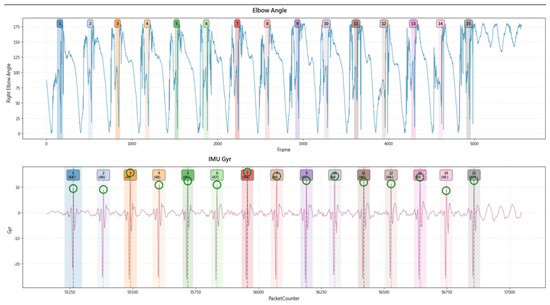
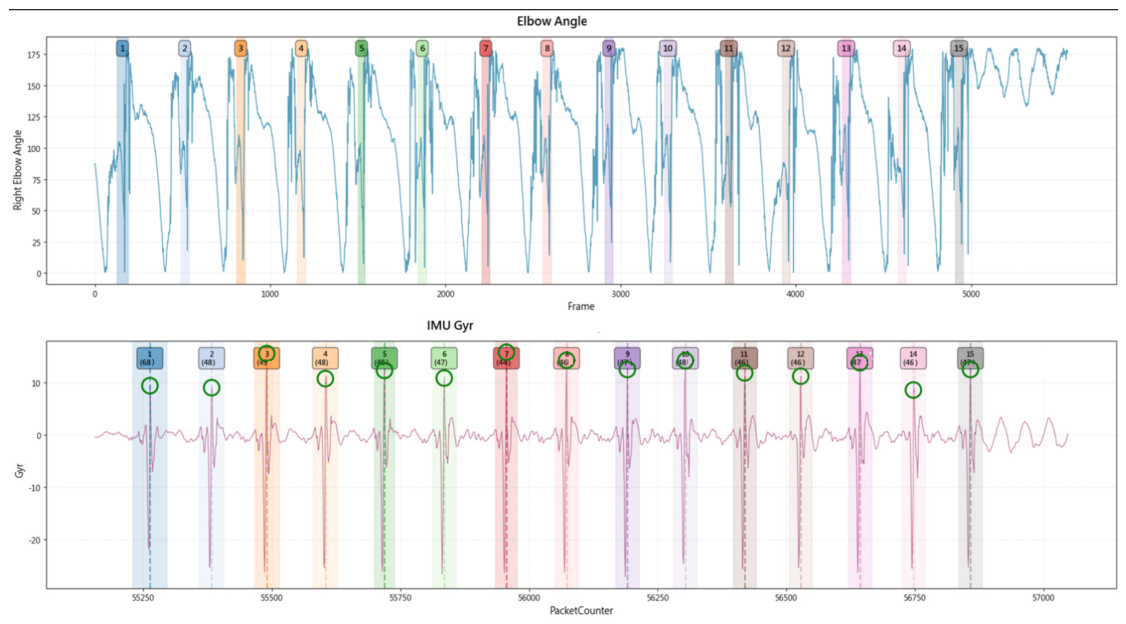
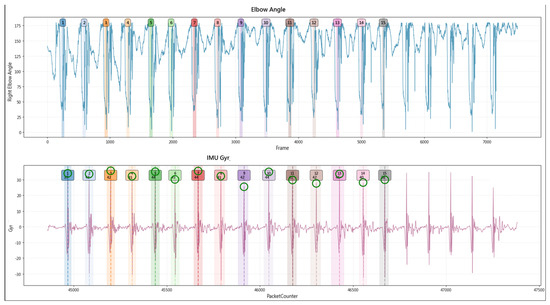
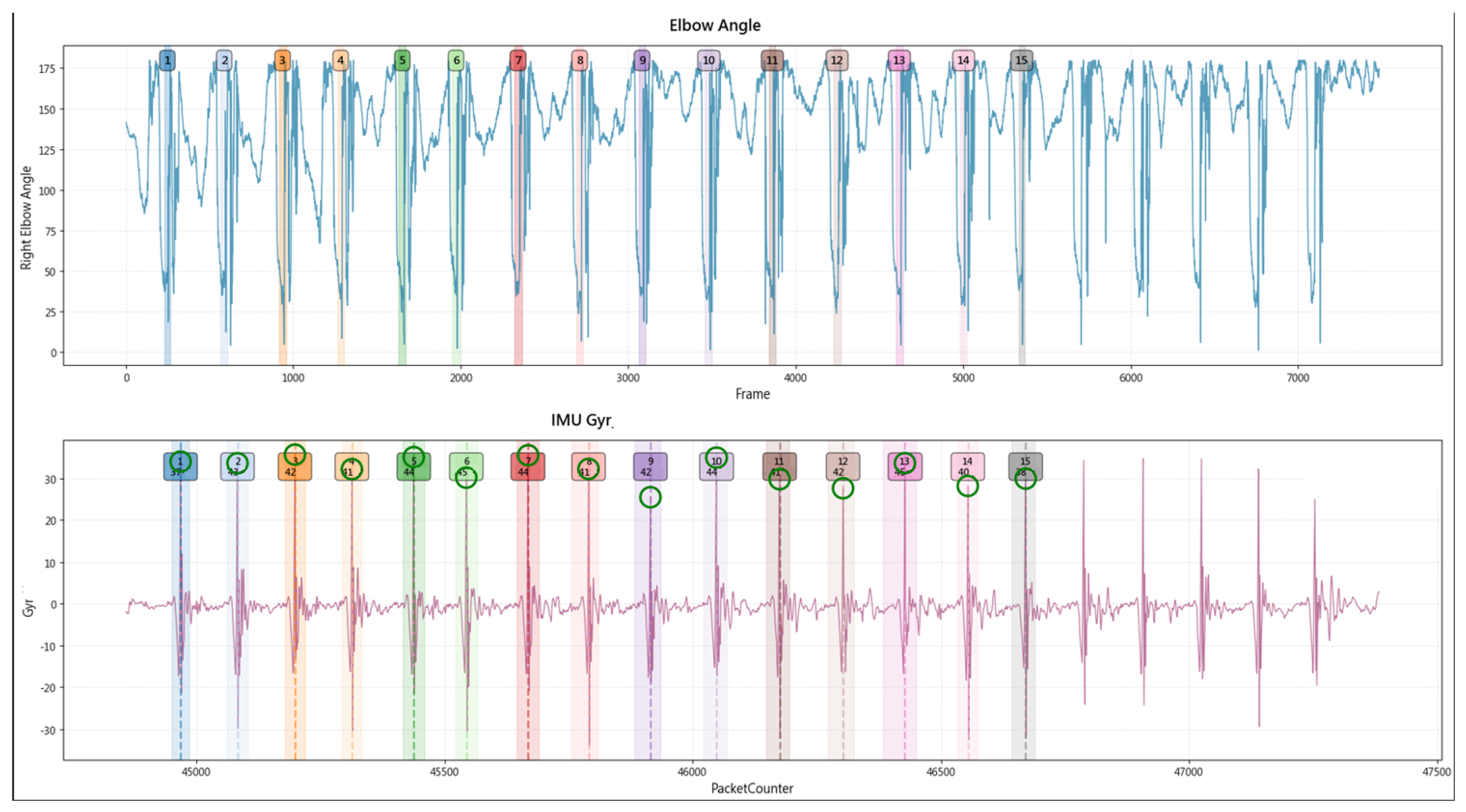
A YOLO-style model (PyTorch 2.7 implementation) detected the shuttlecock and body keypoints. For the fast, small shuttle, high frame rates and exposure optimization reduced motion blur [1,6]. Body joint locations were obtained via a YOLO-Pose branch or an equivalent keypoint model [5]. The calculated right elbow angle of player 1 and player 2 are shown in Figure 4 and Figure 5.
Figure 4.
Right elbow angle and IMU gyroscope (Gyr) signal across 15 smash trials for player 1.
Figure 5.
Right elbow angle and IMU gyroscope (Gyr) signal across 15 smash trials for player 2.
Each IMU recorded tri-axial acceleration. Synchronization used an acoustic peak (racket-shuttle impact) or an LED trigger aligned to the video timeline. For each swing, we computed the peak instantaneous acceleration of each joint at impact and temporal fea-tures (peak latency, rise time, and area). Similar wireless inertial sensing has been used for badminton stroke identification [7]. The collected data from IMU are listed in Table 2. The columns Acc_X, Acc_Y and Acc_Z denote the acceleration of Axis X, Axis Y and Axis Z, and Gyr_X, Gyr_Y and Gyr_Z denote the rotation speed of Axis X, Axis Y and Axis Z.
Table 2.
Collected data from IMU sensor (ankle).
2.4. Indicator Definitions
- The center-of-mass lowering response was measured from the opponent’s shot frame as the time to reach the minimum point of knee flexion or the onset of downward hip and knee acceleration.
- Forward initiation was assessed as the peak forward velocity occurring between shuttle release and the first step, approximated by hip displacement and velocity or by foot-ground contact timing.
- Alignment at the hitting position was evaluated during the final 50–100 ms before impact, based on the angle between the shoulder line and the shuttle approach vector, together with the degree of external rotation of the right shoulder and hip.
- Proximal-to-distal sequencing was determined by calculating the temporal lags between peak speeds or accelerations of the shoulder, elbow, and wrist (Δt shoulder → elbow; Δt elbow → wrist).
2.5. Shuttle Exit Velocity Estimation
Court lines (e.g., baselines and service lines) provided scale for homography-based metric conversion. Initial velocity was estimated from early-frame displacements at high frame rate, then refined by linear/quadratic regression over the first three to five frames to mitigate air-drag effects [6].
2.6. Correlation and Accuracy Analysis
For each trial, Pearson correlations were computed between indicators and shuttle exit velocity. The Spearman rank correlations were used when distributions were non-normal. Accuracy was evaluated by event agreement (impact time and location) relative to manual annotations and by keypoint localization tolerance (e.g., object keypoint similarity or pixel thresholds).
3. Results and Discussions
Each participant performed 15 standardized smashes (N = 60) on an indoor court with competition-grade equipment. Two experienced assistants annotated impact frames and contact locations to serve as ground truth and cross-checked YOLO keypoints and shuttle trajectories. IMU peak timing and amplitude were computed; trials falling within expected ranges were labeled as indicators achieved.
Multimodal fusion achieved an overall recognition accuracy of ≥93% relative to manual annotations, demonstrating reliable detection of impact events and primary joint trajectories. Most swings exhibited a clear shoulder–elbow–wrist sequence and proper alignment, with the left shoulder oriented toward the shuttle. In contrast, center-of-mass lowering and immediate forward initiation showed greater variability across athletes. Sequencing (Indicator d) displayed a moderate positive association with shuttle exit velocity, followed by alignment (Indicator c). Associations for response and initiation (Indicators a and b) were more dependent on individual athlete characteristics.
4. Discussion
The results support the feasibility of on-court, real-time analysis using a monocular camera in combination with a small number of IMUs. YOLO performance on fast, small targets such as the shuttlecock benefits from high frame rates and model tuning [1,6]. The use of badminton-specific datasets and YOLOv8-Pose enhancements further improves keypoint localization accuracy [5]. Dynamic optimization for video–IMU fusion provides more robust biomechanical parameters under conditions of occlusion and constrained viewpoints [3,4]. Limitations of the present study include the small sample size, restriction to right-handed players, and uncontrolled shuttle speed and landing conditions. Future work will expand the participant pool and shot types, incorporate higher-resolution and multi-view capture, and explore attention-based pose models as well as Kalman and particle filters (Table 3).
Table 3.
Analyzed results of smash speed.
5. Conclusions
We present a YOLO- and IMU-based pipeline for analyzing badminton smashes. The method quantifies four preparation-to-impact indicators and estimates shuttle exit velocity. Preliminary validation shows ≥93% accuracy for event detection and keypoint localization, offering actionable feedback for coaching and instruction. The positive association between sequencing/alignment and exit velocity suggests training focus on sequential force transfer and proper alignment.
Author Contributions
Conceptualization, W.-H.L. and Y.-J.L.; methodology, W.-Y.L. and W.-H.L.; software, W.-Y.L.; validation, W.-Y.L., W.-H.L. and Y.-J.L.; formal analysis, W.-Y.L.; investigation, W.-Y.L.; resources, W.-H.L.; data curation, W.-Y.L.; writing—original draft preparation, W.-Y.L.; writing—review and editing, W.-H.L. and Y.-J.L.; visualization, W.-Y.L.; supervision, W.-H.L.; project administration, W.-H.L.; funding acquisition, W.-H.L. All authors have read and agreed to the published version of the manuscript.
Funding
This research received no external funding. The APC was funded by the authors.
Institutional Review Board Statement
The study was conducted in accordance with the Declaration of Helsinki. Ethical review and approval were waived according to the institutional policy of National Formosa University for minimal-risk educational research involving non-invasive motion measurements and de-identified data.
Informed Consent Statement
Informed consent was obtained from all subjects involved in the study. No identifying information is included in this manuscript.
Data Availability Statement
The data presented in this study are available upon request from the corresponding author.
Conflicts of Interest
The authors declare no conflict of interest.
References
- Cao, Z.; Liao, T.; Song, W.; Chen, Z.; Li, C. Detecting the shuttlecock for a badminton robot: A YOLO based approach. Expert Syst. Appl. 2021, 164, 113833. [Google Scholar] [CrossRef] [Scilit]
- Chiu, Y.-L.; Tsai, C.-L.; Sung, W.-H.; Tsai, Y.-J. Feasibility of smartphone-based badminton footwork performance assessment system. Sensors 2020, 20, 6035. [Google Scholar] [CrossRef] [Scilit] [PubMed]
- Pearl, O.; Shin, S.; Godura, A.; Bergbreiter, S.; Halilaj, E. Fusion of video and inertial sensing data via dynamic optimization of a biomechanical model. J. Biomech. 2023, 155, 111617. [Google Scholar] [CrossRef] [Scilit] [PubMed]
- Suo, X.; Tang, W.; Li, Z. Motion capture technology in sports scenarios: A survey. Sensors 2024, 24, 2947. [Google Scholar] [CrossRef] [Scilit] [PubMed]
- Wu, Y.; Chen, Z.; Zhang, H.; Yang, Y.; Yi, W. Enhanced pose estimation for badminton players via improved YOLOv8-Pose with efficient local attention. Sensors 2025, 25, 4446. [Google Scholar] [CrossRef] [Scilit] [PubMed]
- Hsu, Y.-H.; Yu, C.-C.; Cheng, H.-Y. Enhancing badminton game analysis: An approach to shot refinement via a fusion of shuttlecock tracking and hit detection from monocular camera. Sensors 2024, 24, 4372. [Google Scholar] [CrossRef] [Scilit] [PubMed]
- Ooi, J.H.; Gouwanda, D. Badminton stroke identification using wireless inertial sensor and neural network. Proc. Inst. Mech. Eng. Part P J. Sports Eng. Technol. 2023, 237, 291–300. [Google Scholar] [CrossRef] [Scilit]

Disclaimer/Publisher’s Note: The statements, opinions and data contained in all publications are solely those of the individual author(s) and contributor(s) and not of MDPI and/or the editor(s). MDPI and/or the editor(s) disclaim responsibility for any injury to people or property resulting from any ideas, methods, instructions or products referred to in the content. |
© 2026 by the authors. Licensee MDPI, Basel, Switzerland. This article is an open access article distributed under the terms and conditions of the Creative Commons Attribution (CC BY) license.