


Abstract
An algorithm called Dicke state quantum search for the hitting set problem (DSQS-HSP), generates quantum circuits to solve the k-hitting set problem (k-HSP), by initializing the working qubits in an n-qubit Dicke state of exactly k qubits in . The quantum circuit reduces the search space size from to D = , the number of symmetric superposition states in . A quantum-flag oracle checks the hitting condition, and a mirror-readout mechanism projects valid solutions to the output register. The circuit yields two outcome types: the all-zero string with probability (D−M)/D and solution strings, each with probability 1/D, where M is the number of solutions. The resource growth of qubits, gates, circuit depth, and circuit execution repetitions is O(), which remains polynomial in the best case for min(k, n − k) ≪ n/2. Experimental results using IBM Qiskit Aer Simulator confirm that the DSQS-HSP can produce quantum circuits to successfully solve the k-HSP.
1. Introduction
Quantum computing exploits quantum-mechanical principles such as superposition, entanglement, interference, and tunneling [1,2,3]. Because qubits can represent both 0 and 1 simultaneously, n qubits can encode 2n basis states in parallel, providing exponential computational capacity. Among the major quantum algorithms, Grover’s algorithm [4], based on amplitude amplification, is well known for performing quantum search in an unstructured space of 2n states with O() oracle calls, offering a quadratic speedup over classical O(2n) sequential searches.
To extend Grover’s algorithm to solve combinatorial optimization and NP-Complete (NPC) problems, various modifications [5,6,7,8,9,10,11] have been proposed. The original Grover algorithm initializes qubits in a uniform superposition of 2n basis states. Jiang proposed the concept of the Dicke state quantum search (DSQS) [12], which initializes the working qubits in a Dicke state [13]—the symmetric superposition of all n-qubit basis states with exactly k ones. This initialization reduces the search space size from 2n to D = = O(nk), which remains polynomial when min(k, n − k) ≪ n/2. Different from Grover’s algorithm, DSQS requires only one oracle call and no diffuser, while its mirror-readout mechanism can identify all valid solutions with an error probability of less than 1/3 through O(nk) repetitions, which is polynomial in the best case for min(k, n − k) ≪ n/2. However, O() repetitions are required in the worst case when k approaches n/2.
This paper proposes an algorithm, called DSQS-HSP, to generate quantum circuits based on DSQS to solve the k-hitting set problem (k-HSP), or the hitting set problem (HSP) for short. HSP is a classical NPC problem, mentioned in Ref. [14], that asks whether, given a universe and a family F = {} of subsets of , there exists a subset H ⊆ U of size at most k such that H ∩ si ≠ ∅ for every i, 0 ≤ i ≤ m − 1. HSP has broad applications in biomarker selection, network security, facility location arrangement, and resource allocation. The proposed DSQS-HSP initializes working qubits in a Dicke state to generate all hitting set candidates, each of which contains exactly k ones. It then uses an oracle using the controlled quantum flags proposed in [12] to check whether each candidate is a valid hitting set, and employs the DSQS mirror-readout mechanism to project the results onto the mirror qubits. DSQS-HSP generates quantum circuits that avoid exhaustive traversal of 2n states and restricts computation to the Dicke-state subspace of basis states. According to the analyses in Ref. [12], the number of qubits, quantum gates, circuit depth, and the number of circuit execution repetitions of the generated quantum circuit, grow polynomially with n and m for min(k, n − k) ≪ n/2 in the best case. Experimental results based on IBM Qiskit Aer Simulator confirm that the generated quantum circuit can successfully identify valid hitting-set states.
2. Preliminaries
This section provides the background knowledge required for the proposed Dicke State Quantum Search for Hitting Set Problem (DSQS-HSP), including the definition of the hitting set problem and the concept of Dicke states.
2.1. HSP
HSP is a fundamental NPC combinatorial optimization problem. Formally, given a universe of n elements and a family F of m subsets of , and an integer k, the HSP asks whether there exists a k-hitting set of size at most k such that for every . An optimization-version HSP seeks the smallest k for which such an H exists, whereas the search-version HSP considered in this paper is to enumerate all k-hitting sets for a given k. For example, when k = 2, of eight elements and a collection F of five subsets of U, the HSP considered in this paper is to identify all two-element subsets (i.e., 2-hitting sets) of U that intersect every subset in F. Specifically, the 2-hitting sets are , , , and .
The computational hardness of HSP was established by Karp [14], who listed it among the canonical NPC problems. HSP has wide-ranging applications across diverse domains, including computational biology, network design, fault diagnosis, and sensor placement—for example, in biomarker or gene selection and motif discovery in bioinformatics, sensor placement and fault diagnosis in network design, and facility location and coverage analysis in optimization and resource allocation.
2.2. Dicke States
A Dicke state is a class of multipartite symmetric entangled states introduced by Dicke in 1954 in the study of collective atomic emission [13]. An n-qubit Dicke state, denoted as , is defined as the normalized equal superposition of all n-qubit computational basis states that contain exactly k qubits in the state and n − k qubits in the state, as follows:
where wt(x) denotes the Hamming weight of x, i.e., the number of ones in x. The number of basis states in superposition is . For example, comprises four basis states. According to ref. [12], grows polynomially with n for , whereas it becomes O() exponential, when k approaches n/2.
Efficient preparation of Dicke states is crucial for quantum algorithms. Bärtschi and Eidenbenz [15] developed a deterministic quantum circuit for constructing the Dicke state with O(kn) quantum gates and depth O(n) without ancillary qubits, making it compatible with linear-nearest-neighbor (LNN) architectures. Their design has been experimentally verified and is adopted in [12] and this work for Dicke-state generation. Please refer to ref. [12] for details.
3. Proposed Method
The Dicke state quantum search is used for the DSQS-HSP algorithm for constructing a quantum circuit that efficiently solves HSP. We use the DSQS-HSP quantum circuit to refer to the quantum circuit generated by the DSQS-HSP algorithm. Algorithm 1 presents the pseudocode of the DSQS-HSP algorithm, which outlines the overall procedure described.
| Algorithm 1: DSQS-HSP |
|
DSQS-HSP uses the concept of DSQS proposed in [12] to solve HSP. The algorithm begins by preparing n working qubits in the Dicke state . This initialization automatically limits the search domain to , instead of , valid candidate subsets, thereby eliminating the need for quantum counters to enforce the size constraint. Each candidate basis state represents a subset of U that contains exactly k elements.
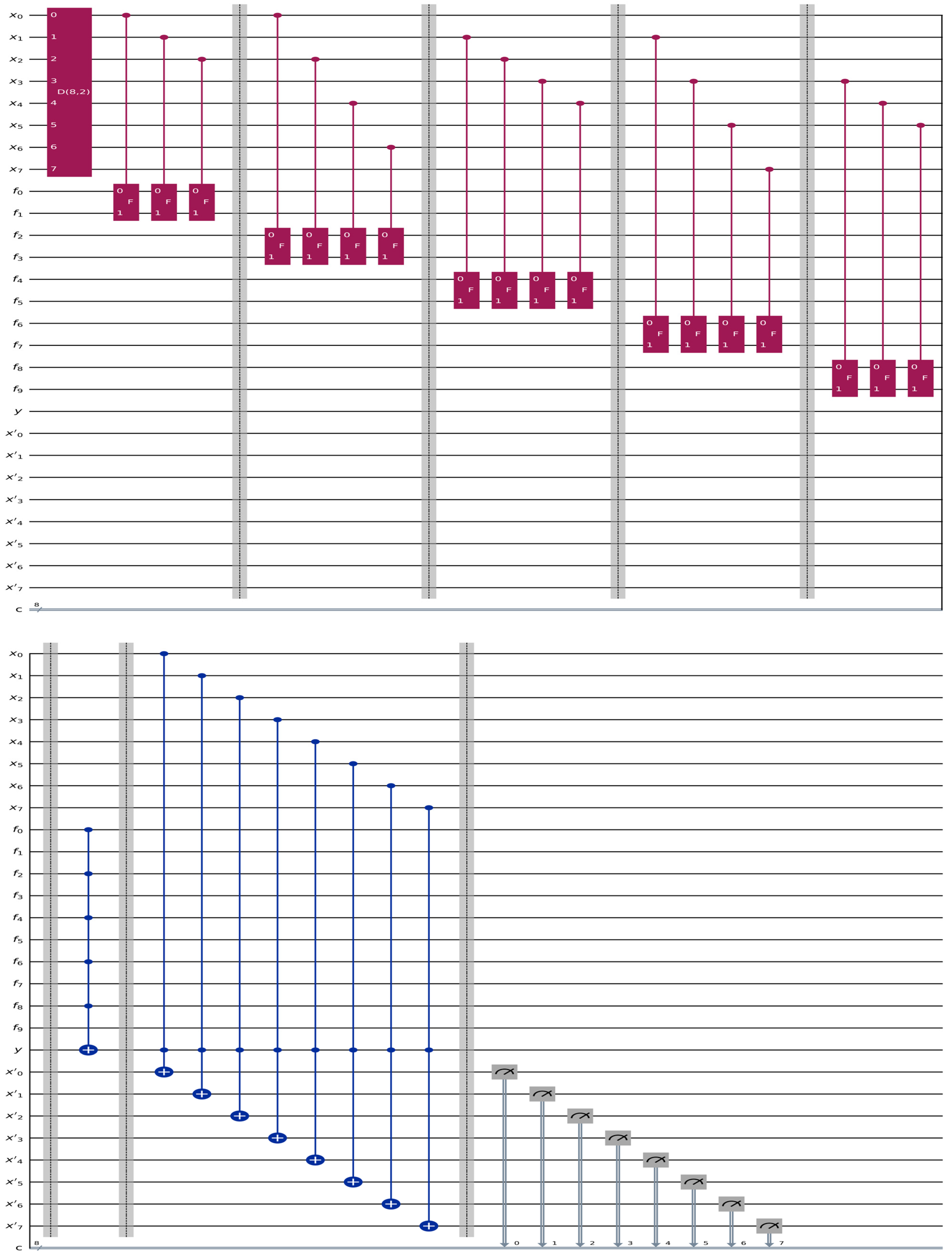
A set of controlled-flag (CF) gates is employed to determine whether every subset (I = 0, …, m − 1) in F is hit by a candidate subset represented by . Each subset uses two flag qubits, and thus 2m flag qubits are required. For every element , the corresponding CF gate is applied to reflect whether the element is present in the candidate subset. Consequently, CF gates are required for all subsets in F.
An MCX (multi-controlled X) gate is then used to verify whether every subset (i = 0, …, m − 1) is hit by candidate subsets. The flag qubits serve as the control qubits, and a decision qubit y acts as the target qubit, which is initially in the state and will be flipped to the state if all subsets in F are hit. Afterwards, n ancilla or mirror qubits are used to read out or mirror the states of working qubits by a set of n CCX gates, each of which takes and y as two control qubits and takes as the target qubit for . Finally, measuring the ancilla qubits reveals the solutions to the given HSP. According to ref. [12], the measurement results of executing the DSQS-HSP quantum circuit contain only two possibilities: one is the all-zero bit string with a measurement probability of (D − M)/D, and the other represents the solution bit strings, each having a measurement probability of 1/D. If the HSP has no solution, then the probability of obtaining the all-zero bit string will be 100%.
4. Results and Discussions
For an HSP instance, we compose a DSQS-HSP quantum circuit and verify that the DSQS-HSP quantum circuit can indeed solve the HSP instance. The quantum circuit is run by IBM Qiskit Aer Simulator. The HSP instance used in our experiment is described as follows.
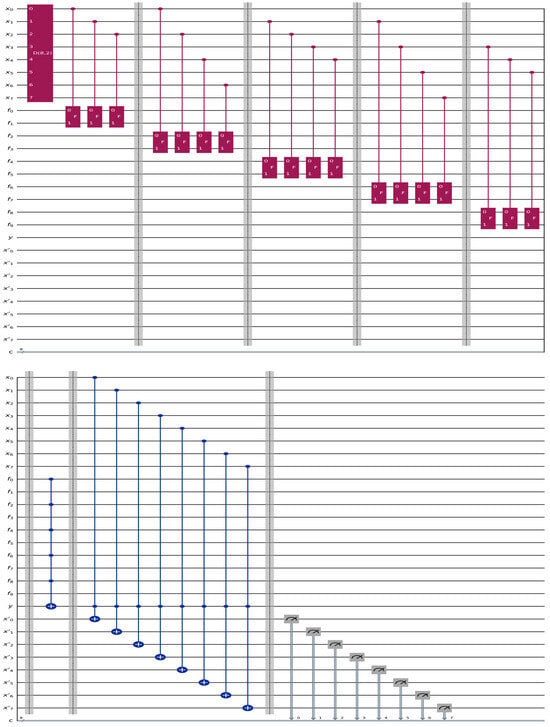
Given k = 2, a universal set U of eight elements, a collection of five subsets of U, the HSP instance is to find all the k-hitting sets (i.e., 2-hitting sets). The DSQS-HSP quantum circuit is shown in Figure 1, where a CF gate is denoted as F for short.
Figure 1.
An example of the DSQS-HSP quantum circuit.
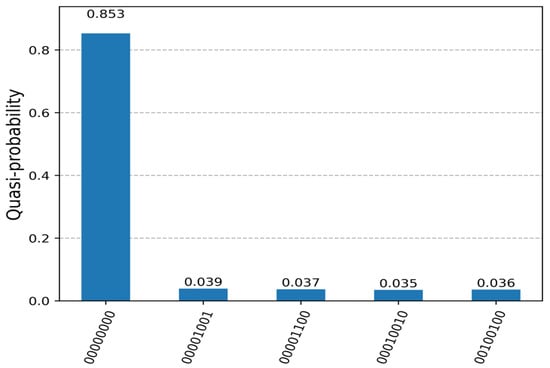
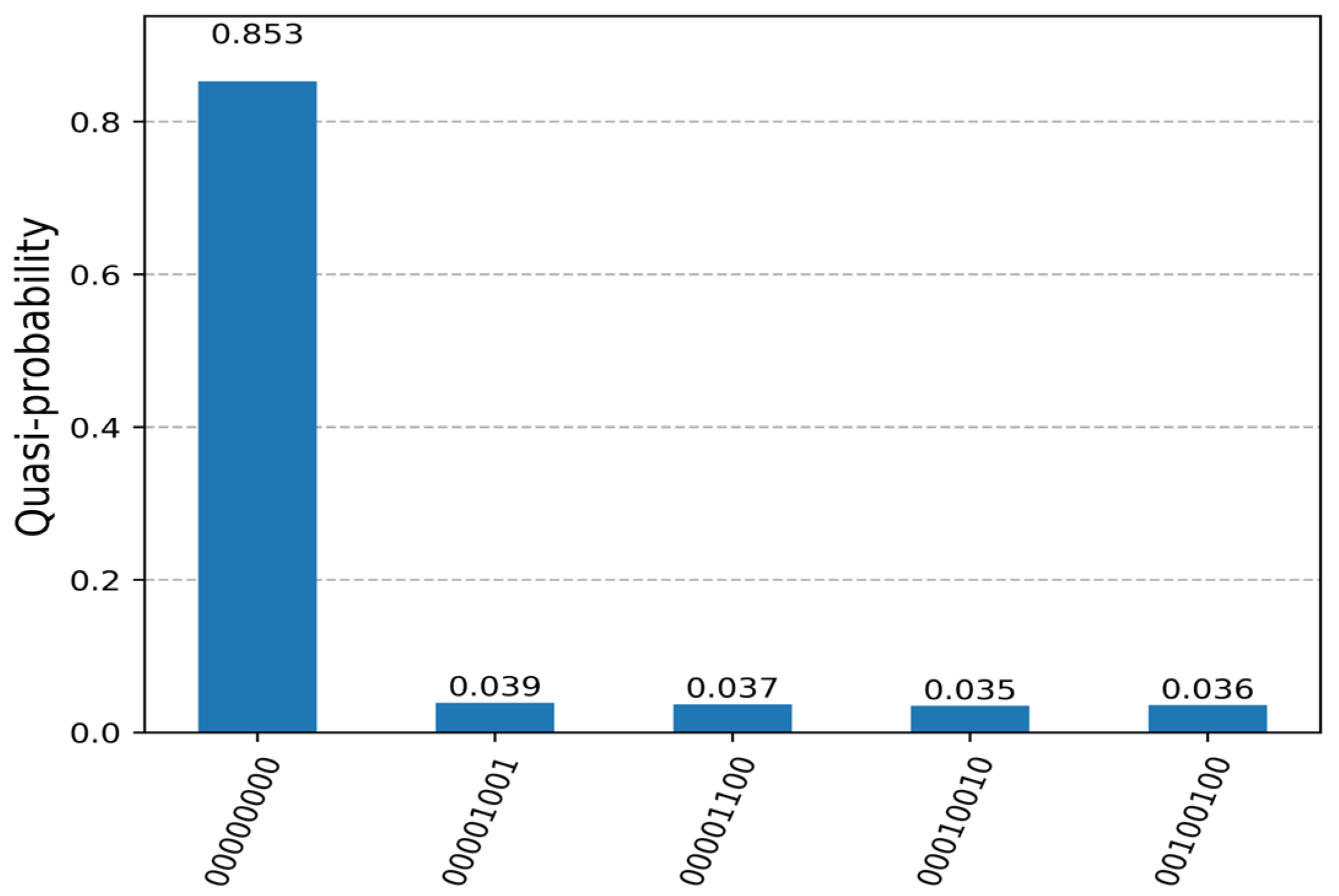
Figure 2 shows the histogram of measurement outcomes obtained from executing the DSQS-HSP quantum circuit on IBM Qiskit Aer Simulator. The results exhibit only two types of outcomes: the all-zero bit string, and several bit strings representing valid k-hitting sets. Each solution bit string appears with probability 1/D = 1/28 ≈ 0.03571, since D = , while the all-zero outcome has probability (D − M)/D = (28 − 4)/28 = 0.85714, since the number M of solutions is 4. This probability distribution confirms that the DSQS-HSP circuit behaves consistently with the theoretical analysis in [12].
Figure 2.
The histogram of the measurement results of the DSQS-HSP quantum circuit.
5. Conclusions
We generate quantum circuits that leverage Dicke-state initialization, a CF-based oracle, and mirror-based readout to solve the NPC k-HSP by introducing DSQS-HSP. Dicke-state initialization limits the search space size from to D = , the number of superposition states within an n-qubit Dicke state of exactly k qubits in . The design eliminates quantum counters for enforcing the size constraint and simplifies the circuit structure. A quantum circuit generated by DSQS-HSP has only two outcome types: the all-zero bit string with probability (D − M)/D, and solution strings, each with probability 1/D, where M is the number of solutions to the HSP. According to the same analyses [12], it is inferred that the resource growth of qubits, gates, circuit depth, and circuit execution repetitions is O(), which remains polynomial in the best case for min(k, n − k) ≪ n/2. Experimental results returned by IBM Qiskit Aer Simulator validate that DSQS-HSP generates quantum circuits solving the k-HSP successfully. In the future, we plan to integrate DSQS with Grover’s algorithm to address the challenge that the probability 1/D becomes too small when D grows exponentially as k approaches n/2.
Funding
This research was supported in part by the National Central University (NCU) and in part by the National Science and Technology Council (NSTC) under Grant 114-2119-M-006-006.
Institutional Review Board Statement
Not applicable.
Informed Consent Statement
Not applicable.
Data Availability Statement
The data presented in this study are available upon request from the author.
Conflicts of Interest
The author declares no conflict of interest.
References
- Jiang, J.-R.; Chu, C.-W. Classifying and Benchmarking Quantum Annealing Algorithms Based on Quadratic Unconstrained Binary Optimization for Solving NP-Hard Problems. IEEE Access 2023, 11, 104165–104178. [Google Scholar] [CrossRef] [Scilit]
- Jiang, J.-R.; Shu, Y.-C.; Lin, Q.-Y. Benchmarks and Recommendations for Quantum, Digital, and GPU Annealers in Combinatorial Optimization. IEEE Access 2024, 12, 125014–125031. [Google Scholar] [CrossRef] [Scilit]
- Chou, K.-C.; Jiang, J.-R. Disturbance Insertion for Improving Quantum and GPU Annealer Performance. In Proceedings of the International Computer Symposium (ICS), Taipei, Taiwan, 24–26 October 2024; pp. 88–93. [Google Scholar]
- Grover, L.K. A Fast Quantum Mechanical Algorithm for Database Search. In Proceedings of the 28th ACM Symposium on Theory of Computing, Philadelphia, PA, USA, 22–24 May 1996; pp. 212–219. [Google Scholar]
- Jiang, J.-R. Quantum Circuit Based on Grover’s Algorithm to Solve Hamiltonian Cycle Problem. In Proceedings of the IEEE 4th Eurasia Conference on IoT, Communication and Engineering (ECICE 2022), Yunlin, Taiwan, 27–29 October 2022. [Google Scholar]
- Jiang, J.-R.; Wang, Y.-J. Quantum Circuit Based on Grover’s Algorithm to Solve Exact Cover Problem. In Proceedings of the 19th VTS Asia Pacific Wireless Communications Symposium (APWCS 2023), Tainan, Taiwan, 23–25 August 2023. [Google Scholar]
- Jiang, J.-R.; Yan, W.-H. Novel Quantum Circuit Designs for the Oracle of Grover’s Algorithm to Solve the Vertex Cover Problem. In Proceedings of the IEEE 5th Eurasia Conference on IoT, Communication and Engineering (ECICE 2023), Yunlin, Taiwan, 27–29 October 2023. [Google Scholar]
- Jiang, J.-R.; Kao, T.-H. Solving Hamiltonian Cycle Problem with Grover’s Algorithm Using Novel Quantum Circuit Designs. In Proceedings of the IEEE 5th Eurasia Conference on IoT, Communication and Engineering (ECICE 2023), Yunlin, Taiwan, 27–29 October 2023. [Google Scholar]
- Jiang, J.-R.; Lin, Q.-Y. Utilizing Novel Quantum Counters for Grover’s Algorithm to Solve the Dominating Set Problem. In Proceedings of the 27th Conference on Quantum Information Processing (QIP 2024), Taipei, Taiwan, 13–19 January 2024. [Google Scholar]
- Jiang, J.-R.; Wang, Y.-J. Using a Simplified Quantum Counter to Implement Quantum Circuits Based on Grover’s Algorithm to Tackle the Exact Cover Problem. Mathematics 2025, 13, 90. [Google Scholar] [CrossRef] [Scilit]
- Jiang, J.-R.; Lin, Q.-Y. Improving Grover’s Algorithm with Dicke States. In Proceedings of the IEEE International Conference on Consumer Electronics—Taiwan (ICCE-TW 2025), Taoyuan, Taiwan, 1–3 July 2025. [Google Scholar]
- Jiang, J.-R. Dicke State Quantum Search for Solving the Vertex Cover Problem. Mathematics 2025, 13, 3005. [Google Scholar] [CrossRef] [Scilit]
- Dicke, R.H. Coherence in Spontaneous Radiation Processes. Phys. Rev. 1954, 93, 99. [Google Scholar] [CrossRef] [Scilit]
- Karp, R.M. Reducibility among Combinatorial Problems. In Proceedings of the Complexity of Computer Computations: Proceedings of a Symposium on the Complexity of Computer Computations, New York, NY, USA, 20–22 March 1972; pp. 85–103. [Google Scholar]
- Bärtschi, A.; Eidenbenz, S. Deterministic preparation of Dicke states. In Proceedings of the International Symposium on Fundamentals of Computation Theory, Copenhagen, Denmark, 12–14 August 2019; pp. 126–139. [Google Scholar]
Disclaimer/Publisher’s Note: The statements, opinions and data contained in all publications are solely those of the individual author(s) and contributor(s) and not of MDPI and/or the editor(s). MDPI and/or the editor(s) disclaim responsibility for any injury to people or property resulting from any ideas, methods, instructions or products referred to in the content. |
© 2026 by the author. Licensee MDPI, Basel, Switzerland. This article is an open access article distributed under the terms and conditions of the Creative Commons Attribution (CC BY) license.