


Abstract
We study the decomposition of large-scale Quadratic Unconstrained Binary Optimization Problems (QUBO) formulations for quantum and quantum-inspired annealers and propose two decomposition mechanisms. The first is one-way-one-hot (1W1H), which replaces a linear inequality with exactly one indicator bank and naturally decomposes the model into many small, parallel subproblems. The second is slack variable range search (SVRS), which introduces a binary-encoded slack and scans restricted windows to balance the number of subproblems and the per-subproblem variable count. Evaluation results using the P08 knapsack problem instance on the Compal Graphic Processing Unit Annealer (CGA) show that SVRS provides a favorable scalability–quality trade-off, while 1W1H remains attractive when the admissible range is small to medium and massive parallelism is available. These results motivate integrating both mechanisms into the National Central University Annealer (NCUA).
1. Introduction
Quantum annealers (QAs) are a specialized type of quantum computer designed to solve combinatorial optimization problems (COPs) using the principles of quantum tunneling and adiabatic evolution [1,2] with the quadratic unconstrained binary optimization (QUBO)/Ising model [3]. The most notable commercial device is the D-Wave Advantage system [4], which integrates more than 5000 qubits with over 35,000 couplers and demonstrates the potential of quantum tunneling to overcome local minima in large optimization landscapes. In parallel, quantum-inspired hardware platforms have gained prominence, demonstrating scalability and practicality for large QUBO instances. The Fujitsu Digital Annealer (DA) [5] exemplifies a CMOS-based architecture capable of simulating annealing processes at room temperature. Its third-generation and fourth-generation systems support up to 100,000 fully connected binary variables.
Another emerging quantum-inspired software platform is the Compal Graphics Processing Unit (GPU) Annealer (CGA), which harnesses heterogeneous CPU-GPU architectures to implement the simulated annealing (SA) algorithm [6] and the diverse adaptive bulk search (DABS) algorithm [7]. Yet another quantum-inspired software platform is the National Central University Annealer (NCUA), a GPU-based annealer developed at National Central University. The first implementation of NCUA was reported in [8]; it is based on the DABS algorithm and is currently under active development toward a distributed CPU-GPU computation platform that integrates devices over network connections to solve large-scale problems. NCUA is expected to support several mechanisms, such as disturbance insertion [3] and problem decomposition mechanisms, to improve performance.
In this article, we present two problem decomposition mechanisms, namely the one-way-one-hot (1W1H) decomposition and the slack variable range search (SVRS) decomposition, which will be incorporated into NCUA in the future. For a linear inequality , 1W1H introduces a bank of one-hot indicator variables—one for each admissible value up to the bound b. It then enforces that exactly one indicator is active and links to the value selected by the indicator through equalities. Therefore, any solution that satisfies these equalities automatically respects the original bound.
This gives a natural decomposition, in which an indicator is fixed to solve the induced independent subproblem, enabling highly parallel execution. Since an extra indicator is required for each value in the feasible range, which in turn leads to one subproblem, 1W1H is best suited to small- or medium-scale constraints. The SVRS mechanism utilizes slack variables to enforce linear inequality constraints in QUBO formulations and decomposes the inequality’s feasible range into smaller, non-overlapping intervals. It thereby reduces both the number of extra variables and the number of quadratic terms when compared with 1W1H. As a result, the decomposed QUBO formulations or subproblems can fit on resource-constrained annealing devices and deliver higher-quality solutions altogether. Since the NCUA solver is under development, we use CGA to evaluate the effectiveness of 1W1H and SVRS. The experiments show that SVRS can indeed solve a very large-scale problem on the CGA platform. Notably, 1W1H and SVRS apply to any QUBO/Ising-based annealer, including the quantum annealer and the quantum-inspired annealers described above.
2. Preliminaries
2.1. QUBO Formulation
QUBO stands for quadratic unconstrained binary optimization. The QUBO formulation and the Ising model are fully interchangeable models for combinatorial optimization. They are widely used to model and solve COPs on quantum annealers and quantum-inspired annealers. A QUBO formulation seeks a binary vector that minimizes an objective function f(x) of the quadratic form.
Here, is upper triangular without loss of generality. Because for binary variables, linear and quadratic terms suffice to encode a wide variety of objective functions for combinatorial optimization.
Although the QUBO objective is unconstrained by definition, practical problems almost always include constraints. A standard approach is to insert the constraint or penalized term into the QUBO formula. The penalized QUBO equation is as follows.
Common penalty terms include (1) the one-way-one-hot constraint and (2) linear inequality constraint, as described in the following.
2.1.1. One-Way-One-Hot (Exactly One-Hot) Constraint Formulation
The one-way-one-hot constraint requires that out of k binary decision variables , …, , exactly one is set to 1 and all others are 0. This is written as the equality.
A standard QUBO encoding enforces this equality via a quadratic penalty on the residual. Let α > 0 be a penalty weight. The constraint penalty is defined as follows.
In practice, we need to choose β large enough to discourage any violation (more than one or zero selections) but not so large that it overwhelms the original objective function f(x).
2.1.2. Linear Inequality Constraint with Slack Variables Formulation
We consider a linear inequality on binary variables It is common to introduce a nonnegative slack S encoded in m binary slack variables (bits) , , …, so that . The inequality is converted to the following equality.
The equality can be enforced by a quadratic penalty term with weight β:
Expanding the square yields only linear and pairwise terms over , …, and , …, (with constant being omitted). The model remains a valid QUBO formula. In practice, we need to choose a proper m to cover the maximal residual b, i.e., . Again, we need to choose β large enough to discourage any violation of the quadratic penalty term without overwhelming the original objective function f(x).
2.2. NCUA
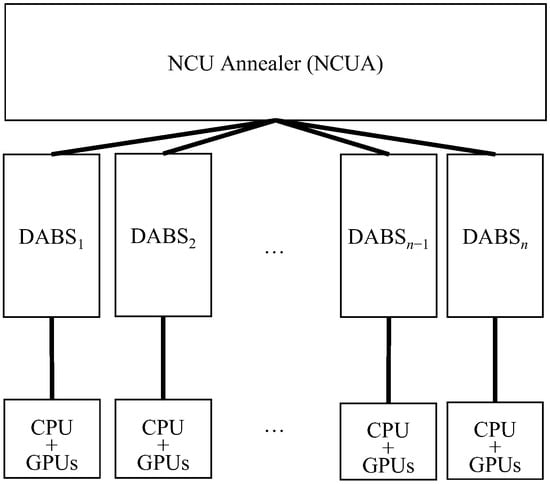
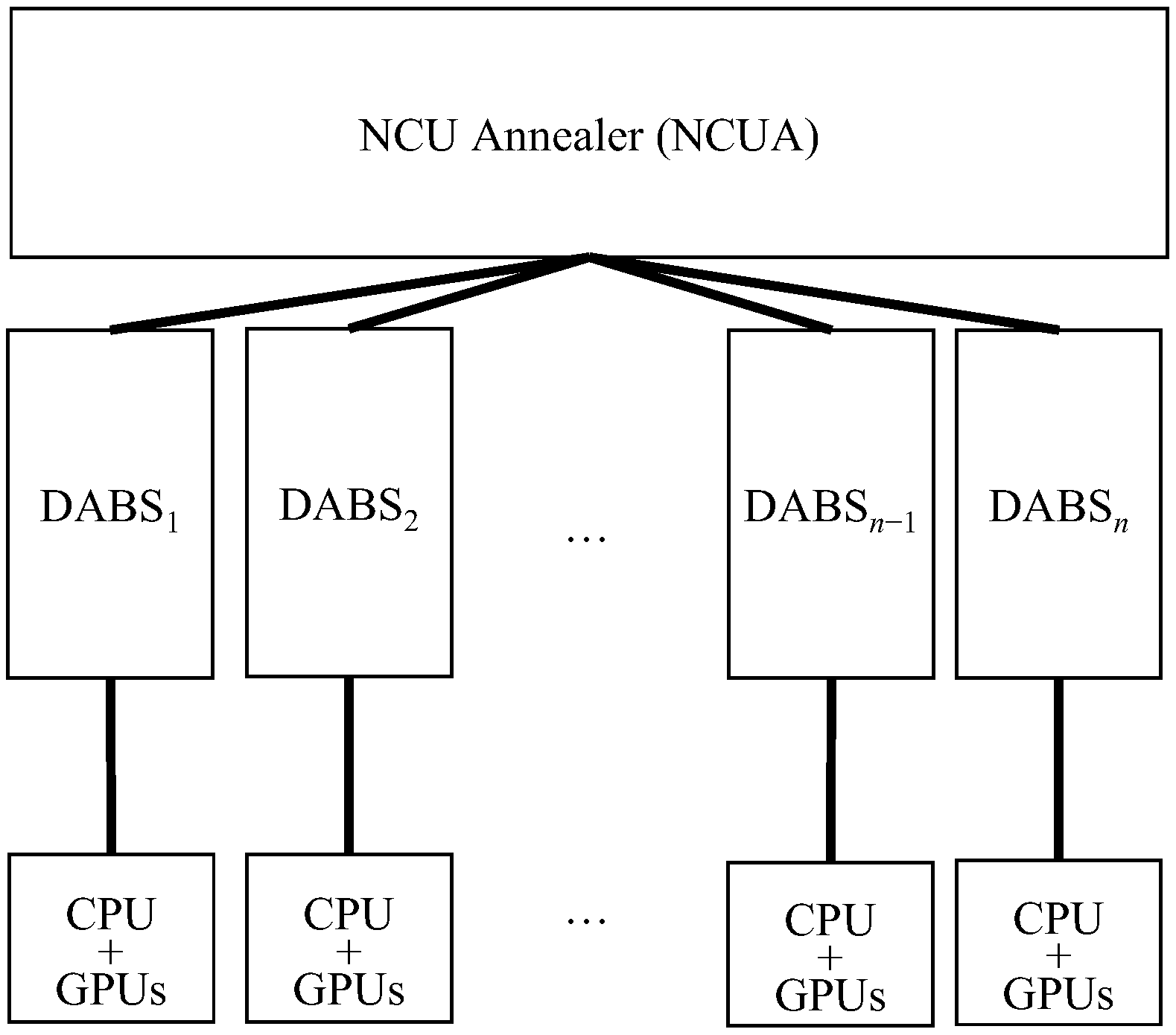
NCUA is a GPU-based, distributed quantum-inspired annealing platform. Figure 1 illustrates the NCUA architecture.
Figure 1.
The architecture of NCUA.
At the system level, NCUA sits at the top as a dispatcher/coordinator. It receives user-submitted QUBO/Ising instances in the form of PyQUBO [9] via a user interface. It then decomposes QUBO problems or formulas and assigns decomposed QUBO subproblems (notably also in the form of PyQUBO to save space) to solver nodes linked by network connections. Each node is equipped with a CPU and multiple GPUs that run the DABS algorithm [7] for solving QUBO subproblems. Finally, each node reports its solution to a QUBO subproblem, and a global solution is obtained from the solutions of all subproblems. This design makes NCUA not just a single solver but a horizontally scalable “meta-solver” for cases with many variables, dense couplings, and/or tight resource constraints.
NCUA enables decomposition mechanisms, such as 1W1H and SVRS, to decompose a QUBO problem or formula into subproblems. NCUA employs the DABS algorithm [7] as its core engine. Each node or host maintains multiple solution pools and combines five local search methods, such as MaxMin, CyclicMin, RandomMin, PositiveMin, TwoNeighbor, with eight genetic operators, such as Mutation, Crossover, Xrossover, Zero, One, IntervalZero, Best, and Random. The invoking frequencies of genetic operators and local search methods are adapted online based on observed improvement rates to emphasize productive moves while avoiding premature convergence. Batched candidates are evaluated on GPUs in parallel, and elite solutions are periodically reseeded across pools to preserve diversity and accelerate convergence.
3. QUBO Problem Decomposition Mechanisms
Two QUBO problem decomposition mechanisms, including 1W1H decomposition and SVRS decomposition, are used for decomposing QUBO formulas of linear inequalities. We consider a knapsack-style linear inequality of the form wTx ≤ C, where x ∈ {0, 1}n denotes selection variables or decision variables, w ∈ Zn is a vector containing item weights or coefficients, and C ∈ Z is the capacity or the upper bound. The two mechanisms are described in the following subsections.
3.1. 1W1H Decomposition
The 1W1H constraint models the total summation of item weights by introducing binary indicators yk for k = 1, …, C, where yk = 1 signifies that the total weight equals k, together with a 1W1H constraint of . Then, the inequality wTx ≤ C is formulated by the following equalities.
The 1W1H decomposition is described as follows. For each k ∈ {1, …, C}, the above QUBO formula is decomposed into a subformula QUBOk, in which yk is fixed to 1, and all other y’s are fixed to 0. Therefore, there are C-independent subformulas or subproblems, each of which is defined as follows.
We can observe that each subproblem contains far fewer variables and far less variable coupling than the monolithic model. It is thus more suitable for parallel execution on resource-constrained annealing backends. However, a very large C implies an extremely large number of subproblems, which may make solving all enumerated subproblems impractical.
Note that the original full QUBO formula and full QUBO subformula should include the objective function. Below, we only show the full QUBO subformula for k, 1 ≤ k ≤ C.
3.2. SVRS Decomposition
An alternative way to enforce the inequality wTx ≤ C is to introduce slack variables , …, to encode slack to convert the inequality into an equality and penalize the difference between S and C. With m slack variables, S is in the range . To cover the full range of [0, C], we need slack variables.
The SVRS mechanism decomposes the original QUBO formula or problem into subproblems with a restricted number of slack variables so that each subproblem corresponds to a small window of 2m admissible values of [0, C]. Thus, the number of subproblems is q = Specifically, the a is of the form for k = 0, 1, …, q − 1:
It is reasonable that when approaches C, the objective function has a high chance to achieve optima. Therefore, we can decompose the original problem into subproblems and solve the subproblems with smaller k values first. When the subproblems are solved “sequentially for k = 0, 1, …” instead of “in a parallel or distributed way”, we can keep track of the best result and can stop the sequential process of solving subproblems if the best result is not updated for p (say, p = 3) subproblems.
SVRS can restrict the slack to a small window, yielding compact subproblems that run easily in parallel on resource-constrained annealers. The window size is tuned by m: a larger m means fewer subproblems with more slack variables, while a smaller m means more subproblems with fewer slack variables. A sequential schedule also enables early stopping after p non-improving windows. There are trade-offs in tuning m and p.
4. Results and Discussions
To evaluate the proposed 1W1H and SVRS problem decomposition mechanisms, a 0/1 knapsack problem dataset instance P08 [10] is used. The P08 dataset instance has the knapsack capacity C = 6,404,180 and 24 items with weights in the range [31,385, 951,111] and values in the range [65,731, 2,067,838]. The known best solution to the problem instance is of the objective function value of 13,549,094. Both mechanisms apply to quantum annealers and quantum-inspired annealers. In this study, CGA is used to solve the problem instance.
Table 1 shows the comparisons of the two mechanisms. For the original QUBO formula with the 1W1H constraint, there is only one subproblem. However, the indicator variable bank scales with C, producing an extremely large variable count of 6,404,204, which cannot be run on CGA. The 1W1H problem decomposition leads to C subproblems, each of which uses 24 variables in the objective function. Each subproblem is easy to solve, but the enormous number of subproblems is impractical for problem-solving. The SVRS decomposition mechanism with m = 10 slack variables restricts search windows of size = 1024. The number of subproblems is 6225, each of which uses 34 variables, which is well-suited to CGA and other annealers. In practice, such a mechanism can easily obtain the best solution of the objective function value of 13,549,094. The SVRS decomposition mechanism with m = 23 slack variables leads to a very wide search window covering the full range, collapsing to a single moderate-size subproblem of 47 variables. However, the coarse window size leads to unsatisfactory solution quality on the P08 dataset instance.
Table 1.
Comparisons of 1W1H and SVRS mechanisms for P08 dataset instance [10].
5. Conclusions
We evaluate 1W1H and SVRS as decomposition mechanisms for QUBO formulas on quantum annealers and quantum-inspired annealers. 1W1H offers rigid feasibility and very simple subproblems, but scales poorly when the admissible range is large. SVRS reduces the total number and size of subproblems by windowing the slack space, enabling efficient runs on resource-constrained devices while retaining solution quality. Evaluation results using CGA to solve the P08 knapsack dataset instance show that SVRS reached the known optimum with far fewer resources than a monolithic 1W1H model, and with a much smaller orchestration burden than exhaustive 1W1H decomposition. Looking ahead, we plan to integrate both mechanisms into NCUA and add adaptive/overlapping search ranges and early-stopping policies for SVRS.
Author Contributions
Conceptualization, J.-R.J. and Q.-Y.L.; methodology, J.-R.J. and Q.-Y.L.; software Q.-Y.L.; validation, J.-R.J. and Q.-Y.L.; formal analysis, J.-R.J. and Q.-Y.L.; investigation, J.-R.J. and Q.-Y.L.; resources, J.-R.J.; data curation Q.-Y.L.; writing—original draft preparation, J.-R.J. and Q.-Y.L.; writing—review and editing, J.-R.J.; visualization, J.-R.J. and Q.-Y.L.; supervision, J.-R.J.; project administration, J.-R.J.; funding acquisition, J.-R.J. All authors have read and agreed to the published version of the manuscript.
Funding
This research was supported in part by the National Central University (NCU) and in part by the National Science and Technology Council (NSTC) under Grant 114-2119-M-006-006.
Data Availability Statement
The data presented in this study are available upon request from the corresponding author.
Conflicts of Interest
The authors declare no conflict of interest.
References
- Jiang, J.-R.; Chu, C.-W. Classifying and Benchmarking Quantum Annealing Algorithms Based on Quadratic Unconstrained Binary Optimization for Solving NP-Hard Problems. IEEE Access 2023, 11, 104165–104178. [Google Scholar] [CrossRef] [Scilit]
- Jiang, J.-R.; Shu, Y.-C.; Lin, Q.-Y. Benchmarks and Recommendations for Quantum, Digital, and GPU Annealers in Combinatorial Optimization. IEEE Access 2024, 12, 125014–125031. [Google Scholar] [CrossRef] [Scilit]
- Chou, K.-C.; Jiang, J.-R. Disturbance Insertion for Improving Quantum and GPU Annealer Performance. In Proceedings of the International Computer Symposium (ICS), Taipei, Taiwan, 24–26 October 2024; pp. 88–93. [Google Scholar]
- D-Wave Systems Inc. Introducing the Advantage System. Available online: https://support.dwavesys.com/hc/en-us/articles/360056364753-Introducing-the-Advantage-System (accessed on 3 October 2025).
- Fujitsu Limited. Digital Annealer Introduction. Available online: https://www.fujitsu.com/ch/de/imagesgig5/da-introduction.pdf (accessed on 3 October 2025).
- Kirkpatrick, S.; Gelatt, C.D.; Vecchi, M.P. Optimization by Simulated Annealing. Science 1983, 220, 671–680. [Google Scholar] [CrossRef] [Scilit] [PubMed]
- Nakano, K.; Takafuji, D.; Ito, Y.; Yazane, T.; Yano, J.; Ozaki, S.; Katsuki, R.; Mori, R. Diverse Adaptive Bulk Search: A Framework for Solving QUBO Problems on Multiple GPUs. In Proceedings of the 2023 IEEE International Parallel and Distributed Processing Symposium Workshops (IPDPSW); IEEE: New York, NY, USA, 2023; pp. 314–325. [Google Scholar]
- Li, J.-S. GPU-Based Implementation and Performance Evaluation of a Quantum-Inspired Solver for QUBO Problems. Master’s Thesis, National Central University, Taoyuan, Taiwan, 2025. [Google Scholar]
- Zaman, M.; Tanahashi, K.; Tanaka, S. PyQUBO: Python Library for Mapping Combinatorial Optimization Problems to QUBO Form. IEEE Trans. Comput. 2023, 71, 838–850. [Google Scholar] [CrossRef] [Scilit]
- Burkardt, J. Data for the 01 Knapsack Problem. Available online: https://people.sc.fsu.edu/~jburkardt/datasets/knapsack_01/knapsack_01.html (accessed on 3 October 2025).

Disclaimer/Publisher’s Note: The statements, opinions and data contained in all publications are solely those of the individual author(s) and contributor(s) and not of MDPI and/or the editor(s). MDPI and/or the editor(s) disclaim responsibility for any injury to people or property resulting from any ideas, methods, instructions or products referred to in the content. |
© 2026 by the authors. Licensee MDPI, Basel, Switzerland. This article is an open access article distributed under the terms and conditions of the Creative Commons Attribution (CC BY) license.