


Abstract
Hammer throw is a complex discipline requiring strength, refined technique, and precise inter-segmental coordination. We developed an IoT-enabled system with inertial measurement units (IMUs) to provide objective, real-time analytics for coaches and athletes. IMUs were mounted on the hip, knee, and ankle to capture tri-axial acceleration and angular velocity during the throwing action. Data were streamed wirelessly and processed to extract rotation rate profiles, joint coordination metrics, and temporal events (winds, turns, and release). Two collegiate athletes performed 10 throws, and the results were compared with video-based analysis. The IMU system captured finer-grained variations in angular velocity and acceleration during rapid rotation phases and achieved an accuracy of 93.5% in classifying higher- and lower-quality throws using cross-validated models. The system developed enables quantitative feedback and continuous progress tracking in training. The feasibility of IMU + IoT integration for hammer throw performance analysis provides a foundation for AI-assisted, on-field decision support.
1. Introduction
Hammer throw performance depends on coordinated whole-body rotation, efficient force transmission, and optimal release conditions. Traditional technique evaluation often relies on video observation and expert judgment, which may miss micro-variations during fast rotations. Wearable sensing and IoT offer an avenue for objective, in situ measurement in training environments [1].
Recent biomechanics research has clarified the determinants of throwing quality, emphasizing linear release velocity, double- vs. single-support timing, and segmental coordination [2]. Meanwhile, studies have demonstrated the feasibility of inertial sensors for capturing hammer throw kinematics and identifying performance-relevant parameters [3]. Beyond optical motion capture, inertial measurement unit (IMU)-based systems tailored to hammer throw have been prototyped for real-time feedback and training support, including wireless sensor systems and AI-enhanced analytics [4,5]. Methodological guidance from the International Society of Biomechanics (ISB) provides recommendations for defining, estimating, and reporting joint kinematics with IMUs, improving rigor and reproducibility [6].
Wearable sensing technology has also advanced event detection in related throwing events; for instance, single-IMU methods can robustly detect release instants in shot put [7], underscoring the utility of IMU analytics in athletics. Motivated by these developments, we propose and evaluate an IMU + IoT system for hammer throw analysis, with a focus on joint-level dynamics in the lower limbs and their relationship with throw quality and distance.
2. Methods
2.1. Participants and Protocol
Two collegiate hammer throwers volunteered for this study. Each athlete completed 10 regulation throws after a standardized warm-up. All trials were conducted on a regulation circle under typical training conditions. Throw distance was measured by field officials using a tape measure; high-speed video was collected for qualitative reference when needed (Table 1).
Table 1.
Study design and instrumentation overview.
2.2. Instrumentation and IoT Architecture
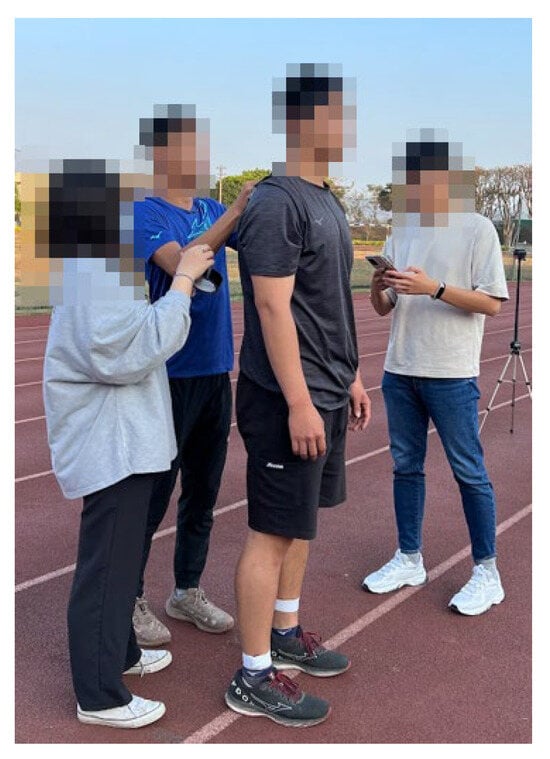
We used Xsens IMUs (The Netherlands) mounted on the dominant limb’s hip, knee, and ankle. Sensors streamed tri-axial acceleration and angular velocity via a wireless link to a local edge computer through a gateway. The IoT device performed time synchronization, packet integrity checks, and secure transmission to a local database for immediate analysis. Sampling rates followed manufacturer recommendations for high-dynamics tasks; all channels were synchronized across devices [3]. Figure 1 depicts the mounting of the IMU on the players.
Figure 1.
IMU mounted on the participant’s body.
2.3. Signal Processing and Feature Extraction
Data processing included orientation estimation, gravity compensation, and coordinate alignment to a global frame consistent with ISB guidelines [6]. We applied band-pass filtering appropriate for rotational movements, segmented actions into winds, turns, and release using gyroscope thresholds, and computed features including: (1) peak and mean angular velocity per joint during each turn; (2) acceleration RMS and jerk; (3) inter-joint phase lags (hip-knee, knee-ankle) via analytic signal phase; (4) single- and double-support durations inferred from characteristic kinematic signatures; and (5) rotation rate growth between consecutive turns [2,3].
2.4. Outcome Measures and Modeling
Primary outcomes included (1) throw distance (meters) and (2) throw quality class (top vs. lower quality) derived from within-athlete performance. We assessed associations between features and distance using within-subject correlation and fitted parsimonious linear models with regularization to mitigate multicollinearity. To classify throw quality, we trained a cross-validated model (logistic regression with nested cross-validation). Model performance was summarized by accuracy. Given the small sample size, all analyses were treated as exploratory and athlete-specific [3,4].
3. Results
IMU-derived kinematics provided smooth rotation rate profiles for all turns and resolved rapid transitions at turn entries and releases. Compared with frame-by-frame video inspection, IMUs captured micro-variations during high-angular-velocity phases that were otherwise difficult to discern, aligning with prior reports on the sensitivity of inertial sensing in rotational sports [3,4]. The IMU data are summarized in Table 2 and Table 3.
Table 2.
IMU data of Player 1.
Table 3.
IMU data of Player 2.
Feature-outcome analysis results indicated that joint-level angular velocities and inter-joint timing metrics were informative for differentiating higher- and lower-quality throws. Models trained on IMU features achieved an accuracy of 93.5% in classifying throw quality using cross-validation. Qualitative inspection suggested that better throws exhibited more consistent hip-knee phase relationships and shorter variability in support-time metrics across turns [2,5]. Distance modeling showed athlete-specific relationships between features and performance, echoing findings that performance-determining parameters can be individual-dependent [3]. Given the limited sample size, these findings should be interpreted as preliminary and hypothesis-generating.
4. Conclusions
The result of this study demonstrates the feasibility and practical value of integrating IMUs with an IoT architecture to analyze the hammer throw technique. By quantifying joint-level rotation dynamics and timing, the system enables objective, near-real-time feedback for athletes and coaches. The classification pipeline reached 93.5% accuracy for distinguishing higher- and lower-quality throws, and qualitative patterns indicated more stable inter-joint coordination in better throws. The sample size needs to be expanded by incorporating cable tension sensing and release detection modules [5,7]. It is also necessary to evaluate edge AI deployment for on-field decision support. Adhering to ISB recommendations for IMU-based kinematics [6] enhances reproducibility and comparability across cohorts.
Author Contributions
Conceptualization, L.-C.Y.; methodology, L.-C.Y.; software, H.-L.H.; validation, L.-C.Y.; formal analysis, L.-C.Y.; investigation, L.-C.Y.; resources, H.-L.H. All authors have read and agreed to the published version of the manuscript.
Funding
This research received no external funding.
Institutional Review Board Statement
Not applicable.
Informed Consent Statement
Informed consent was obtained from all subjects involved in the study.
Data Availability Statement
The original data are unavailable due to privacy or ethical restrictions.
Acknowledgments
The authors thank the participating athletes and coaching staff. This work followed institutional guidelines for data privacy and athlete safety. No personally identifying information is reported.
Conflicts of Interest
The authors declare no conflicts of interest.
References
- Seshadri, D.R.; Li, R.T.; Voos, J.E.; Rowbottom, J.R.; Alfes, C.M.; Zorman, C.A.; Drummond, C.K. Wearable sensors for monitoring the internal and external workload of the athlete. Digit. Med. 2019, 2, 71. [Google Scholar] [CrossRef] [Scilit] [PubMed]
- Castaldi, G.M.; Borzuola, R.; Camomilla, V.; Bergamini, E.; Vannozzi, G.; Macaluso, A. Biomechanics of the hammer throw: Narrative review. Front. Sports Act. Living 2022, 4, 853536. [Google Scholar] [CrossRef] [Scilit] [PubMed]
- Tiedemann, S.; Menrad, T.; Witte, K. Application of inertial sensors to identify performance-relevant parameters in Olympic hammer throw. Int. J. Environ. Res. Public Health 2022, 19, 5402. [Google Scholar] [CrossRef] [Scilit]
- Wang, Y.; Shan, G.; Li, H.; Wang, L. A wearable-sensor system with AI technology for real-time biomechanical feedback training in hammer throw. Sensors 2023, 23, 425. [Google Scholar] [CrossRef] [Scilit]
- Wan, B.; Gao, Y.; Wang, Y.; Zhang, X.; Li, H.; Shan, G. Hammer throw: A pilot study for a novel digital-route for diagnosing and improving its throw quality. Appl. Sci. 2020, 10, 1922. [Google Scholar] [CrossRef] [Scilit]
- Cereatti, A.; Gurchiek, R.; Mündermann, A.; Fantozzi, S.; Horak, F.; Delp, S.; Aminian, K. ISB recommendations on the definition, estimation, and reporting of joint kinematics in human motion analysis applications using wearable inertial measurement technology. J. Biomech. 2024, 173, 112225. [Google Scholar] [CrossRef] [Scilit] [PubMed]
- Kato, T.; Maeda, K.; Mizushima, J.; Ohyama-byun, K.; Adachi, T.; Fukuda, J. A pilot study for detecting release instant using a single inertia measurement unit in shot put. J. Hum. Sport Exerc. 2024, 19, 1042–1051. [Google Scholar] [CrossRef] [Scilit]

Disclaimer/Publisher’s Note: The statements, opinions and data contained in all publications are solely those of the individual author(s) and contributor(s) and not of MDPI and/or the editor(s). MDPI and/or the editor(s) disclaim responsibility for any injury to people or property resulting from any ideas, methods, instructions or products referred to in the content. |
© 2026 by the authors. Licensee MDPI, Basel, Switzerland. This article is an open access article distributed under the terms and conditions of the Creative Commons Attribution (CC BY) license.