Measurement-Based Investigation of Energy-Efficient and Comfortable Air Conditioning in Urban Air Mobility †


Abstract
1. Introduction
2. Methods
2.1. Experimental Environment
2.2. Experimental Design
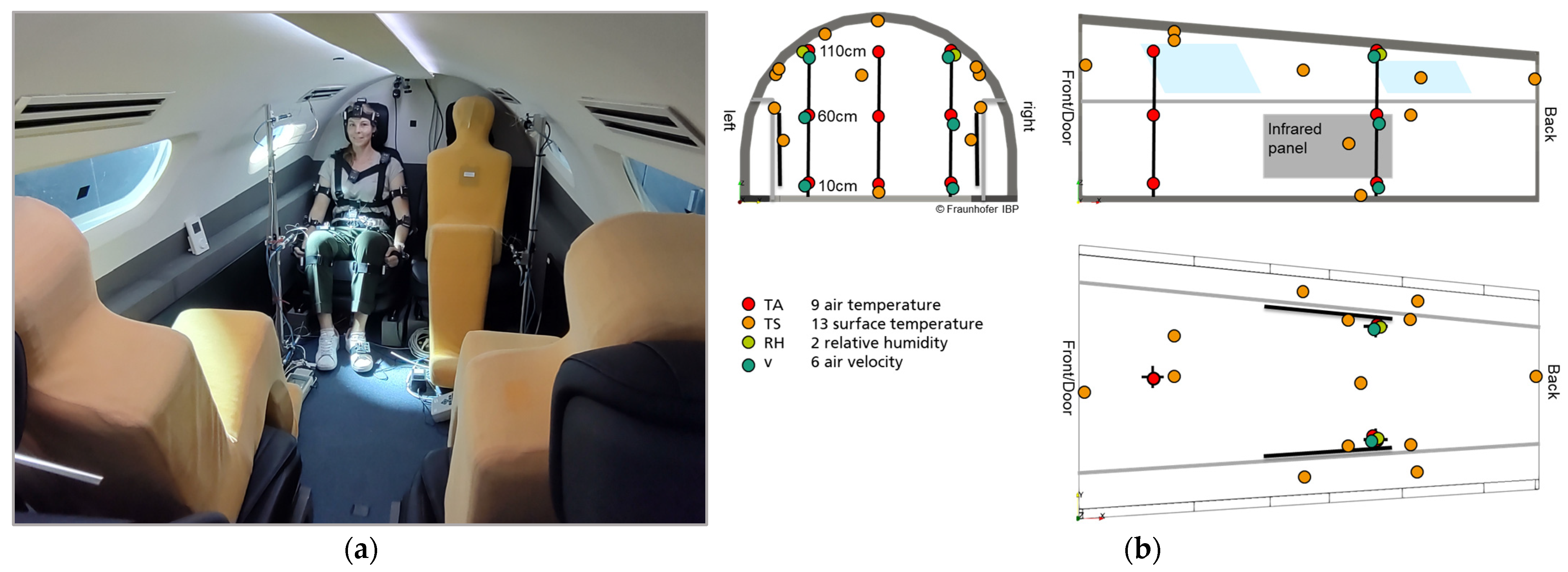
- In the cabin: 9 air temperature sensors and 13 measuring points for surface temperature, 2 air humidity sensors, 6 air velocity sensors (Ahlborn FV A605-TA1; ±1.5%);
- Seat: 6 temperature sensors and 3 heat flux sensors (FluxTeq PHFS-01; ±5%);
- Supply and exhaust air: 4 temperature sensors, 2 humidity sensors, 1 velocity sensor in each duct (Ahlborn FVAD 35 TH5; ±0.01 m/s);
- Ambient conditions: 1 temperature and 1 humidity sensor.
2.3. Data Evaluation
3. Results
3.1. Hot Climate
3.2. Moderate Climate
4. Discussion and Conclusions
Author Contributions
Funding
Institutional Review Board Statement
Informed Consent Statement
Data Availability Statement
Acknowledgments
Conflicts of Interest
Abbreviations
| IBP | Fraunhofer Institute for Building Physics |
| PMV | Predicted Mean Vote |
| PPD | Predicted Percentage of Dissatisfied |
References
- Pak, H.; Asmer, L.; Kokus, P.; Schuchardt, B.I.; End, A.; Meller, F.; Schweiger, K.; Torens, C.; Barzantny, C.; Becker, D.; et al. Can Urban Air Mobility become reality? Opportunities and challenges of UAM as innovative mode of transport and DLR contribution to ongoing research. CEAS Aeronaut. J. 2024, 16, 665–695. [Google Scholar] [CrossRef] [Scilit]
- Shahriar Ahmed, S.; Fountas, G.; Lurkin, V.; Anastasopoulos, P.C.; Zhang, Y.; Bierlaire, M.; Mannering, F. The State of Urban Air Mobility Research: An Assessment of Challenges and Opportunities. IEEE Trans. Intell. Transport. Syst. 2025, 26, 1375–1394. [Google Scholar] [CrossRef] [Scilit]
- Lahlou, A.; Ossart, F.; Boudard, E.; Roy, F.; Bakhouya, M. Optimal Management of Thermal Comfort and Driving Range in Electric Vehicles. Energies 2020, 13, 4471. [Google Scholar] [CrossRef] [Scilit]
- Dreslin, B.D.; Falanga, M.C.; Mai Ngam, J.; Chaparro, A.; Chaparro, B.S. Up in the Air: A Human Factors Approach to Enhancing eVTOL Passenger Experience. In Proceedings of the National Training Aircraft Symposium (NTAS), Daytona Beach, FL, USA, 27 February 2024. [Google Scholar]
- DIN EN ISO 7730; Ergonomics of the Thermal Environment—Analytical Determination and Interpretation of Thermal Comfort Using Calculation of the PMV and PPD Indices and Local Thermal Comfort Criteria (ISO 7730:2025). Beuth Verlag: Berlin, Germany, 2025.
- ASHRAE Standard 161; Air Quality within Commercial Aircraft; American National Standards Institute: Atlanta, GA, USA, 2023.
- Zhou, X.; Lai, D.; Chen, Q. Experimental investigation of thermal comfort in a passenger car under driving conditions. Build. Environ. 2019, 149, 109–119. [Google Scholar] [CrossRef] [Scilit]
- Jahn, P.B. Modellbasierte Applikation der Klimaregelung für Thermischen Komfort im Fahrzeug; Technische Universität München: Munich, Germany, 2021. [Google Scholar]
- Norrefeldt, V.; Pathak, A.; Lemouedda, A.; Siede, M.; Grün, G. Validation of the zonal thermal model VEPZO/RADZO for cold outside conditions on a business jet mock-up. In Proceedings of the AST 2015, Hamburg, Germany, 24–25 February 2025. [Google Scholar]
- Matheis, C.; Norrefeldt, V. Untersuchung Einer Energieeffizienten Klimatisierung eines EVTOLs Durch ein Zonales Raumkabinenmodell und Einen Kabinendemonstrator; Deutsche Gesellschaft Für Luft-und Raumfahrt—Lilienthal-Oberth e.V.: Bonn, Germany, 2024. [Google Scholar]
- Visser, M.; Park, S.; Stratbücker, S.; Norrefeldt, V.; Lindner, A. The DressMAN 3.2-System for evaluation of thermal comfort in the Passenger Cabin Ground Demonstrator. IOP Conf. Ser. Mater. Sci. Eng. 2022, 1226, 12114. [Google Scholar] [CrossRef] [Scilit]
- DIN EN 14505-2; Ergonomics of the Thermal Environment—Evaluation of Thermal Environments in Vehicles—Part 2: Determination of Equivalent Temperature (ISO 14505-2:2006). Beuth Verlag: Berlin, Germany, 2007.




| Areas of Consideration | Parameters | |
|---|---|---|
| Hot Climate | Moderate Climate | |
| Outdoor climate conditions | 40 °C, 900 W/m2 (steady & cool down curve) | 10 °C, 0 W/m2 (steady) |
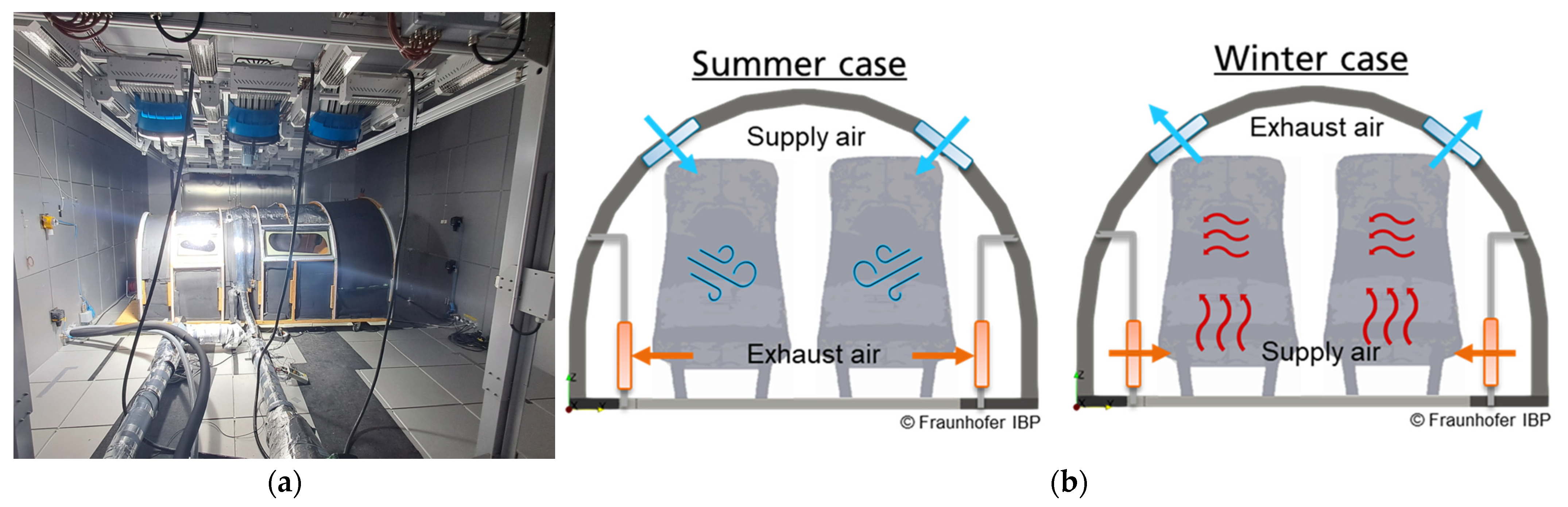
| Climatization systems | Air cooling Seat cooling | Air cooling Seat heating/cooling |
| Control systems | Supply air: volume flow, temperature Seat heating: seat temperature (inside) | |
| Norm | ASHRAE 161 | DIN EN ISO 7730 | DIN EN 14505-2 (Appendix D) |
|---|---|---|---|
| Temperature range | 18.3–26.7 °C | 20–24 °C | 20–30 °C (summer) 18–27 °C (winter) |
| Temperature stratification | <2.8 K (head–feet) | <4 K (head–feet) | Depending on the body segment |
| Air velocity | <0.36 m/s <0.20 m/s for sensitive areas | Depending on air temperature | - |
Disclaimer/Publisher’s Note: The statements, opinions and data contained in all publications are solely those of the individual author(s) and contributor(s) and not of MDPI and/or the editor(s). MDPI and/or the editor(s) disclaim responsibility for any injury to people or property resulting from any ideas, methods, instructions or products referred to in the content. |
© 2026 by the authors. Licensee MDPI, Basel, Switzerland. This article is an open access article distributed under the terms and conditions of the Creative Commons Attribution (CC BY) license.
Share and Cite
Matheis, C.; Norrefeldt, V.; Visser, M. Measurement-Based Investigation of Energy-Efficient and Comfortable Air Conditioning in Urban Air Mobility. Eng. Proc. 2026, 133, 34. https://doi.org/10.3390/engproc2026133034
Matheis C, Norrefeldt V, Visser M. Measurement-Based Investigation of Energy-Efficient and Comfortable Air Conditioning in Urban Air Mobility. Engineering Proceedings. 2026; 133(1):34. https://doi.org/10.3390/engproc2026133034
Chicago/Turabian StyleMatheis, Christina, Victor Norrefeldt, and Michael Visser. 2026. "Measurement-Based Investigation of Energy-Efficient and Comfortable Air Conditioning in Urban Air Mobility" Engineering Proceedings 133, no. 1: 34. https://doi.org/10.3390/engproc2026133034
APA StyleMatheis, C., Norrefeldt, V., & Visser, M. (2026). Measurement-Based Investigation of Energy-Efficient and Comfortable Air Conditioning in Urban Air Mobility. Engineering Proceedings, 133(1), 34. https://doi.org/10.3390/engproc2026133034