


Abstract
The growing need to reduce aviation’s carbon footprint and reliance on fossil fuels has prompted the exploration of alternative propulsion technologies. Fuel cell (FC) systems offer a sustainable solution, generating only water vapor as a by-product. This paper presents a conceptual study, focusing on subsystem integration and safety aspects, for an 80-passenger, hydrogen-powered aircraft developed within the European Union (EU) co-funded NEWBORN (NExt generation high poWer fuel cells for airBORNe applications) Project. The designed configuration incorporates wing-mounted pods housing fuel cells, an electric motor, an inverter, a Thermal Management System (TMS), and Balance of Performance (BoP). This configuration is an effort towards environmentally friendly solutions, addressing climate change and paving the way towards greener aviation.
1. Introduction
For decades, the aviation industry has played a key role in global transportation, enabling the movement of both people and goods across vast distances with unequaled efficiency. Unfortunately, the aeronautic sector is also playing a significant role in climate change, accounting for approximately 2.5% of global carbon dioxide (CO2) emissions and contributing about 4% to global warming due to additional factors like non-CO2 emissions and contrails [1,2,3,4]. The increasing pressure from governments, environmental organizations, and public opinion to face climate change and achieve net-zero emissions forces the aviation sector to urgently find innovative and sustainable solutions to reduce aviation impact on global warming.
Several technologies are under evaluation and development. In particular, FCs have emerged as a promising candidate for aviation decarbonization, since they generate electricity using hydrogen as a fuel source by means of an electrochemical process, producing only water vapor as a by-product [5]. Thus, FC-driven aircraft have the potential to complete their mission of producing zero emissions, meeting both environmental and operational demands. Small aircraft have been successfully demonstrated (e.g., Boeing Fuel Cell Demonstrator [6], DLR (Deutsches Zentrum für Luft- und Raumfahrt) HY4 [7], and ZeroAvia’s Piper M-Class [8]), but the scalability to commercial aviation is not straightforward [9].
The present paper summarizes a conceptual study of an 80-passenger aircraft powered by fuel cells, designed to achieve sustainable and emission-free aviation. The activities have been carried out within the EU co-funded research project NEWBORN [10].
2. Literature Review
2.1. Overview of Sustainable Aviation Efforts
Aircraft decarbonization is a critical priority [11] for both the scientific and industrial communities, since the aviation sector is one of the fastest-growing contributors to greenhouse gas emissions [12,13]. Due to the demanding targets set by the European Green Deal [14], the aviation sector faces significant challenges, which can be addressed only by leveraging Research and Innovation (R&I) activities. R&I in Europe’s current status can be found in [15], which focuses on emissions reduction in aviation and offers insights by conducting a comprehensive assessment of aviation research projects, particularly those aimed at reducing emissions, and includes an in-depth analysis of specific research topics.
Research studies have identified several strategies for reducing aviation’s environmental footprint, including the development of biofuels, electric propulsion systems, and hydrogen-based technologies [16,17]. Each one of the proposed approaches offers unique benefits, but fuel cell-based propulsion systems have the opportunity to potentially offer zero-emission operations and high energy efficiency [18,19,20].
In the framework of the NEWBORN project, it has been decided to focus on the FC propulsion system for an 80-pax regional aircraft.
2.2. Advances in Fuel Cell Technology for Aviation
In recent years, FC technology has evolved significantly, driven by advancements in materials science and engineering. In particular, significant progress has been made in the improvement of Proton-Exchange Membrane Fuel Cells (PEMFCs), which are particularly well-suited for aviation applications due to their high power density and quick startup capabilities [21,22]. In addition to the FC technology improvement, the development of lightweight hydrogen storage systems has allowed us to explore the feasibility of integrating FCs into regional and commuter aircraft [23,24,25].
Demonstration projects (e.g., HY4 aircraft and H2Fly initiatives [26]), provided valuable insights into FC technology opportunities and challenges in real-world operative scenarios.
2.3. Challenges in Implementing Zero-Emission Aircraft
Despite promising progress in the FC technologies for aviation development, some obstacles persist in adopting fuel cell-powered aircraft on a large scale. Key challenges include developing hydrogen production, storage, and distribution systems [27,28].
Furthermore, the integration of fuel cells into aircraft designs requires overcoming engineering constraints related to weight, thermal management, and reliability [29].
Additionally, regulatory and certification frameworks for hydrogen-powered aviation also need to be established to ensure safety and operational feasibility [30,31].
3. Conceptual Design of the 80-Passenger Fuel Cell Aircraft
3.1. Aircraft Specifications and Mission Data
The NEWBORN Project focuses on two different aircraft categories: Certification Specifications 23 (CS-23) [32] for 19-passenger (pax) and Certification Specification 25 (CS-25) [33] for 80-pax categories.
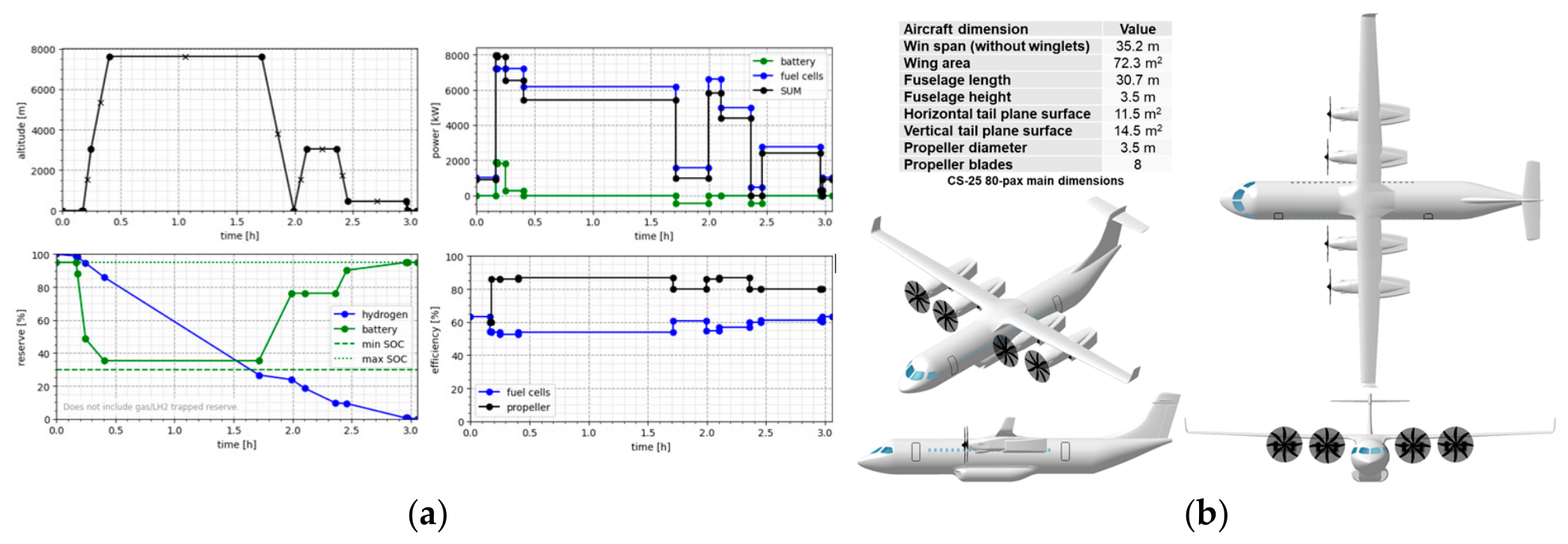
The present paper describes the CS-25 80-pax configuration. The proposed configuration is a high-wing mounted design, with a T-tail configuration, featuring four electrical motors and FC systems housed in four pods (two per half-wing).
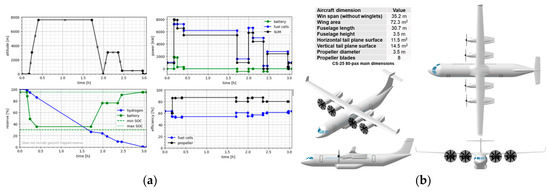
The aircraft’s main characteristics are reported in Table 1. Figure 1 shows the aircraft design mission in terms of the mission profile, power source usage, reserves, and efficiency.
Table 1.
The aircraft’s main characteristics.
Figure 1.
(a) Aircraft design mission and main dimensions. (b) Aircraft view and main dimensions.
3.2. Aircraft Architecture and Configuration
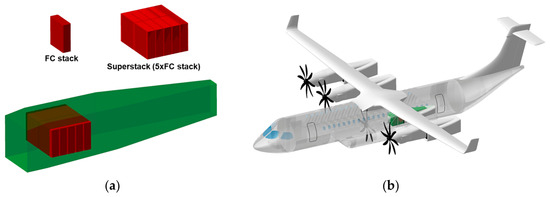
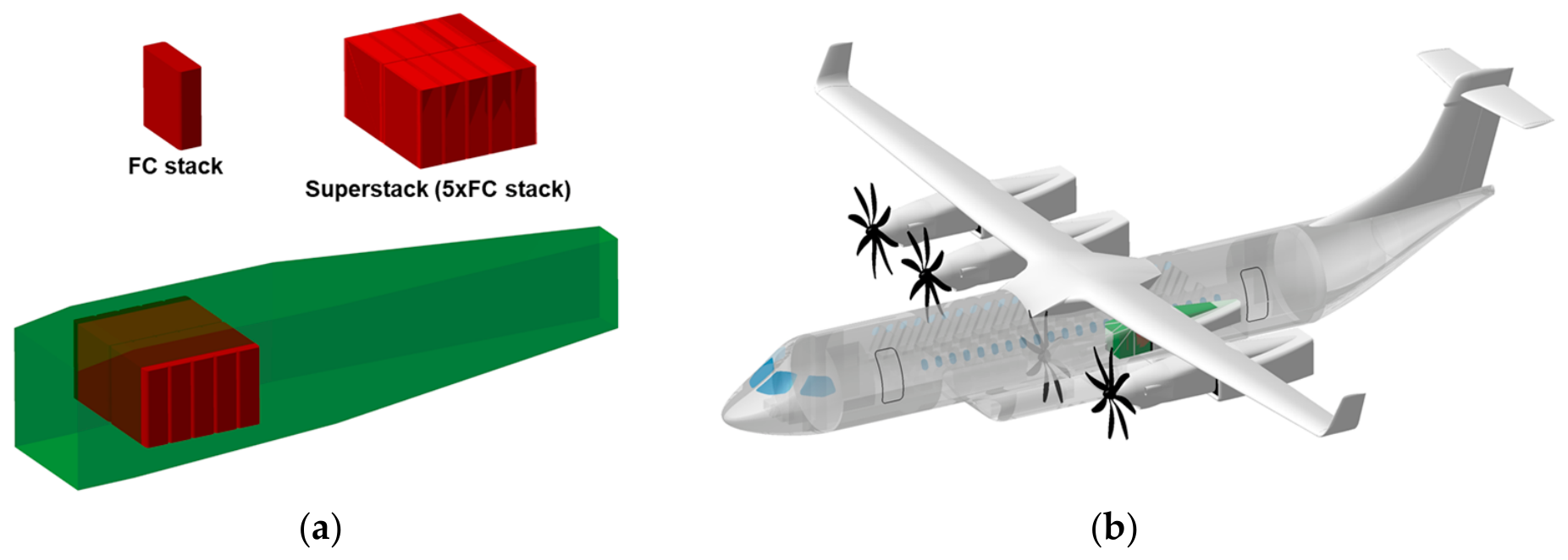
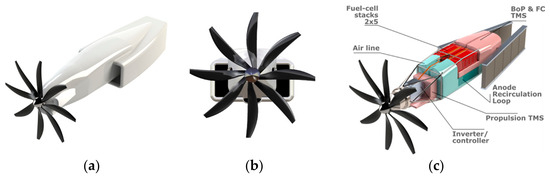
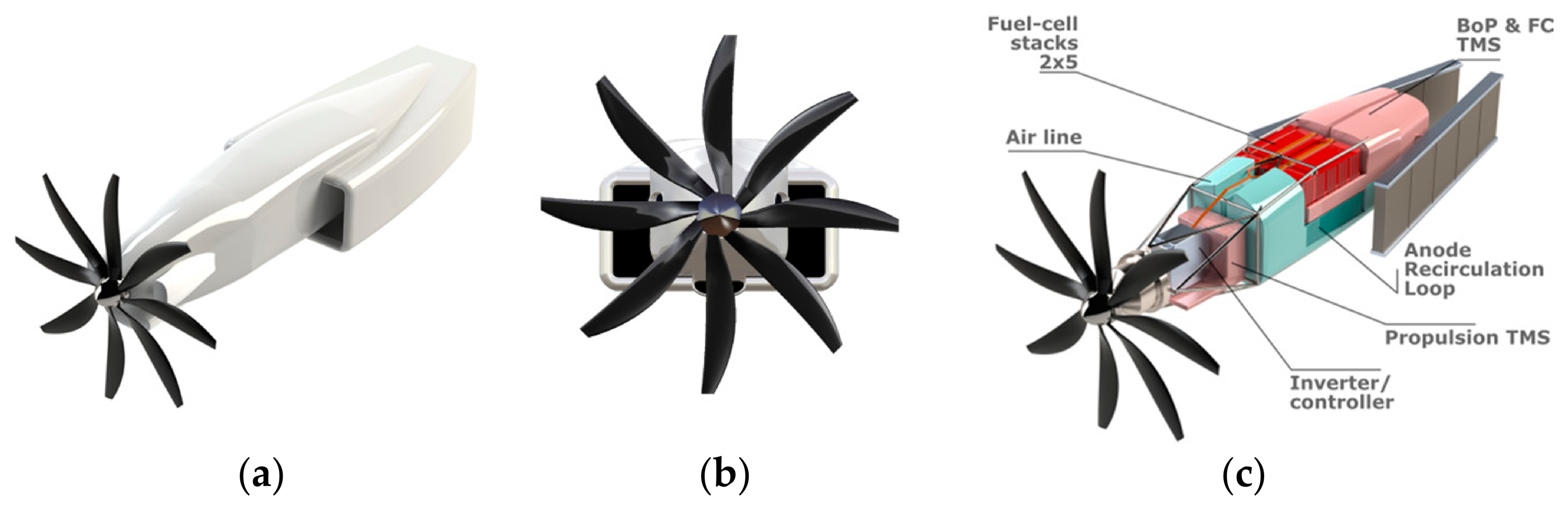
The aircraft has two pods per half wing, each one with a total net power of 2.4 MW. Each pod houses (Figure 2) 2 × 5 FCs superstacks of 0.4 m3, and 4.16 m3 BoP, which consists of an air line, an Anode Recirculation Loop (ARL), a DC/DC (Direct Current/Direct Current) converter, a control system, a High Voltage Junction Box (HVJB), and TMS without Heat Exchangers (HXs).
Figure 2.
(a) Fuel Cell Power System (FCPS), and (b) integrated representation of FCPS within NEWBORN 80-pax aircraft.
Each pod has two rectangular radiators, each one 3.6 m2, tapered towards the rear pod structure to reduce aerodynamic impact. The radiator air intake has a U-shaped design to minimize the aerodynamic impact on the wing. The engine mount has been designed on the basis of previous experience to house BoP, FCs, the electric motor (gold in Figure 3), the inverter (silver in Figure 3), and the electric motor TMS (pink in Figure 3).
Figure 3.
(a) Pod external shape, (b) U-shaped inlet, and (c) pod components.
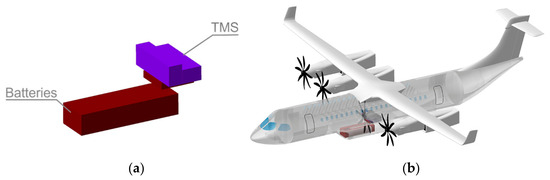
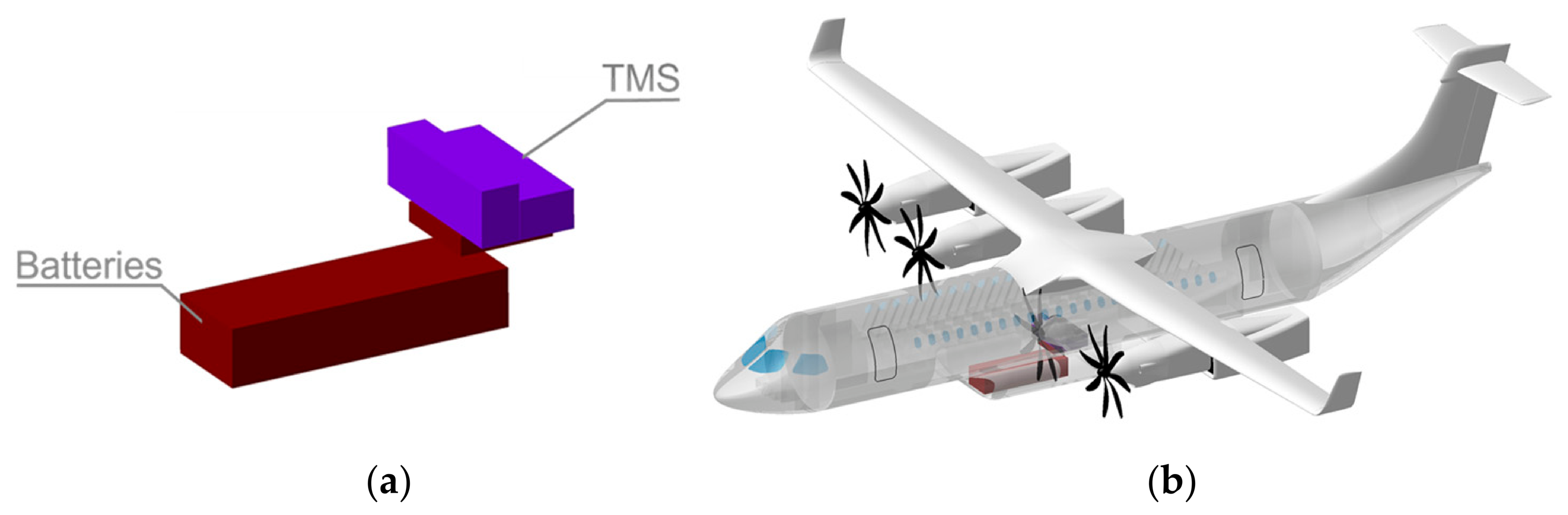
The battery system has a power density of 1.5 kW/kg, an energy density of 0.25 kWh/kg, and a volume of 2.7 m3. It is installed in the aircraft’s belly (Figure 4).
Figure 4.
(a) Aircraft batteries (brown) and TMS (purple), (b) battery installation in the aircraft.
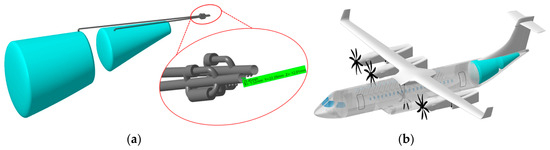
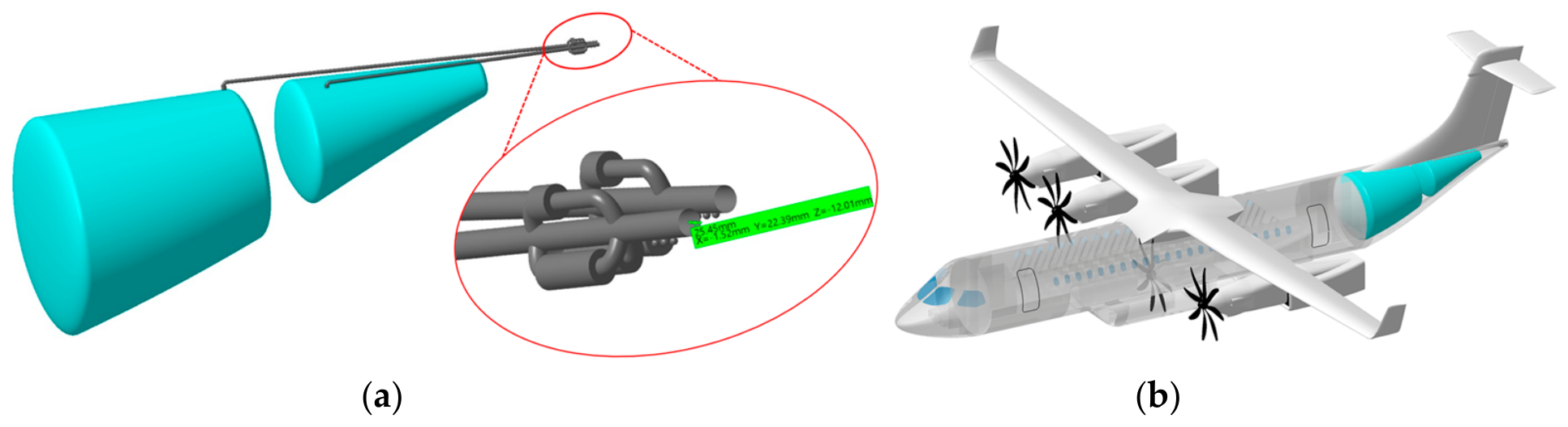
The tank system (see Figure 5) consists of two cryogenic low-pressure double-layer composite tanks with volumes of 18.4 m3 and 3.7 m3, housing a total LH2 volume of 845 kg.
Figure 5.
(a) LH2 fuel tanks and venting system, (b) tank installation in the aircraft.
4. Safety Aspects: Hydrogen Leakage, Ventilation, and Venting Related
The purpose of this section is to present preliminary analyses, mainly based on engineering judgment, of aircraft and system safety, with a focus on hydrogen leakage, permeation, and the venting exhaust location. It introduces the ventilation concept used for the aircraft sections holding the hydrogen-related equipment. This section will examine potential failures of hydrogen-carrying systems and the mitigations currently in place.
The subsystems assessed are: the FC stack, hydrogen distribution, and hydrogen storage.
4.1. Fuel Cell Stack
Minor hydrogen leakage does not significantly reduce safety margins thanks to proper ventilation in affected aircraft zones. Hydrogen monitoring ensures that the supply can be stopped if levels surpass safety thresholds. Redundant fuel cells and distribution lines prevent simultaneous failure. Independent monitoring and mitigations address subsystem failures, though pressure component ruptures may still occur. Material qualification and design safety margins are essential. In case of significant leakage, emergency procedures, including potential stack shutdowns, help prevent hydrogen accumulation, while remaining fuel cells maintain power generation.
Due to the fuel cells’ installation in a pod isolated from the passenger cabin, there is no risk of hydrogen intoxication to passengers in the event of a hydrogen leakage.
4.2. Hydrogen Distribution
Hydrogen distribution failures can lead to leakage in the aircraft’s hull or loss of hydrogen supply to fuel cells, with valve failures—particularly in water valves—risking pipe freezing. Unmitigated failures may cause hydrogen to accumulate in the hull, posing a fire hazard and potentially catastrophic consequences. Mitigations and safety measures to prevent hydrogen buildup in the event of failure are crucial.
Leakage may arise from valve failures, both external and internal, resulting in gaseous hydrogen accumulation within the aircraft. To counter this, proper monitoring and ventilation systems are established. Dual-walled vacuum-insulated pipes are employed to mitigate the risk of piping rupture, and the distribution lines are routed on the top part of the aircraft to minimize the risk of H2 cabin penetration. Minor hydrogen leaks pose no hazard without an ignition source; however, significant leaks require robust fire protection measures, including grounding, fire sleeves, and insulators.
A monitoring system will trigger emergency procedures to manage significant leaks, potentially including stack shutdown and hydrogen purging through a burst disk. Independent valve sets on each of the aircraft’s sides prevent total fuel cell power loss from a single failure. Hydrogen pressure is continually measured, enabling issue detection in pressure regulation. Multiple safety lines ensure safe pressure management, while fire ignition sources are insulated and grounded to avoid sparks, with the bay properly ventilated.
4.3. Hydrogen Storage
Pressure vessel failures can lead to significant hydrogen release into the aircraft, requiring a design to prevent such incidents. Major leak mitigation relies on dual hydrogen containment, achievable with dewar tanks or foam-insulated tanks that can include a hydrogen barrier with ventilation. Cracks and tears, arising from thermal cycles, are monitored through regular checks of the hydrogen system; scheduled parts replacement mitigates undetectable faults. Monitoring hydrogen pressure and concentration helps identify early cracks and leaks; temperature sensors enable rapid responses to potential leaks.
Inner tank electrical evaporator failures could mistakenly increase system pressure, quickly identifiable by pressure sensors that would relieve excess through safety valves. Lower pressure could diminish the hydrogen available for fuel cells, but redundancy exists with electric and passive evaporators. Safety measures activate if sensors malfunction or give erroneous signals, potentially leading to hydrogen purging or pressure reduction.
Structural damage could disrupt hydrogen conditioning and pressure regulation; multiple attachment points ensure the pressure vessel’s stability. Welding failures would trigger emergency responses via pressure and temperature sensors, safely depressurizing the tank to avert explosive conditions. Proper fueling protocols minimize hazards from refueling line failures, and overall, robust redundancy and monitoring systems are in place to prevent explosions or significant hydrogen leaks.
5. Conclusions
The paper summarizes the results obtained within the EU-cofunded research project NEWBORN, whose aim is to develop new regional aircraft with an LH2 propulsion system.
In particular, preliminary allocation studies of the propulsion system’s main components have been carried out together with preliminary safety aspects assessment to verify the feasibility of the proposed concept. The proposed configuration features fuel cells housed in four wing-mounted pods. The pods are designed to reduce the aerodynamic interference between them and the wing. In particular, to reduce blockage, the airscope are located in the rear part of the pods and their inlets are U-shaped. Internal pod components (ARL, air lines, BoP, DC/DC converter, control system, FCs, HVJB, HXs, TMS) are positioned to minimize the volumetric bulk, ensuring the most aerodynamically efficient shape possible.
Li-ion batteries are installed in the belly fairing.
Two cryogenic low-pressure double-insulation layer composite LH2 tanks located in the rear aircraft cone guarantee system redundancy.
As a baseline, it is safe to assume that the zones of the aircraft containing hydrogen shall be isolated and sealed from the zones with passengers, such that no hydrogen leakage could enter the cabin and represent a hazard for the occupants. Moreover, proper monitoring systems and the adoption of redundancy and safety measures, such as ventilation and purging lines, shall be in place to guarantee compliance with the accepted safety hydrogen levels.
Author Contributions
Conceptualization, D.G.R., E.G.B. and G.F.; methodology, D.G.R., E.G.B., R.P., G.F. and G.B.; software, D.G.R., G.F. and G.B.; validation, D.G.R., R.P., G.F. and G.B.; formal analysis, D.G.R., G.F. and G.B.; investigation, D.G.R., E.G.B., R.P., G.F. and G.B.; resources, D.G.R., G.F. and G.B.; data curation, D.G.R., E.G.B. and G.B.; writing—original draft preparation, D.G.R. and G.B.; writing—review and editing, D.G.R., E.G.B., M.B., G.B. and G.F.; visualization, D.G.R.; supervision, D.G.R., E.G.B. and M.B.; project administration, E.G.B.; funding acquisition, E.G.B. All authors have read and agreed to the published version of the manuscript.
Funding
The activities described in this paper have been carried out within the NEWBORN (NExt generation high poWer fuel cells for airBORNe applications) project, which has received funding from the European Union’s Horizon Europe research and innovation program under grant agreement No 101101967.
Data Availability Statement
The authors declare that the data may be available upon request from the interested party.
Acknowledgments
The authors acknowledge all NEWBORN partners for their support.
Conflicts of Interest
The authors declare that Etienne Guillame Behar and Riccardo Premuni are employees of Pipistrel Vertical Solutions d.o.o. The company Pipistrel Vertical Solutions d.o.o. had no role in the design of the study; in the col-lection, analyses, or interpretation of data; in the writing of the manuscript; or in the decision to publish the results. Views and opinions expressed are those of the authors only and do not necessarily reflect those of the European Union or of the granting authority. Neither the European Union nor the granting authority can be held responsible for them.
Abbreviations
The following abbreviations are used in this manuscript:
| ARL | Anode Recirculation Loop |
| BoP | Balance of Plant |
| CO2 | Carbon Dioxide |
| CS-23 | Certification Specifications 23 |
| CS-25 | Certification Specifications 25 |
| DC | Direct Current |
| DLR | Deutsches Zentrum für Luft- und Raumfahrt |
| EU | European Union |
| FC | Fuel Cell |
| FCPSS | Fuel Cell Power System |
| GI | Galvanized Iron |
| HVJB | High Voltage Junction Box |
| HX | Heat Exchanger |
| LH2 | Liquid Hydrogen |
| MSL | Mean Sea Level |
| MTOW | Maximum Take-Off Weight |
| NEWBORN | NExt generation high poWer fuel cells for airBORNe applications |
| PEMFC | Proton-Exchange Membrane Fuel Cells |
| R&I | Research and Innovation |
| TMS | Thermal Management System |
References
- Lee, D.S.; Fahey, D.W.; Skowron, A.; Allen, M.R.; Burkhardt, U.; Chen, Q.; Doherty, S.J.; Freeman, S.; Forster, P.M.; Fuglestvedt, J.; et al. The Contribution of Global Aviation to Anthropogenic Climate Forcing for 2000–2018. Atmos. Environ. 2021, 244, 117834. [Google Scholar] [CrossRef] [Scilit] [PubMed]
- Lai, Y.Y.; Christley, E.; Kulanovic, A.; Teng, C.C.; Björklund, A.; Nordensvärd, J.; Karakaya, E.; Urban, F. Analysing the opportunities and challenges for mitigating the climate impact of aviation: A narrative review. Renew. Sustain. Energy Rev. 2022, 156, 111972. [Google Scholar] [CrossRef] [Scilit]
- Aviation. Available online: https://www.iea.org/energy-system/transport/aviation (accessed on 27 March 2025).
- What Share of Global CO2 Emissions Come from Aviation? Available online: https://ourworldindata.org/global-aviation-emissions (accessed on 27 March 2025).
- Narayanan, S.; Wang, C.; Bauen, A. Fuel Cells for Aircraft Applications: Opportunities and Challenges. Renew. Energy 2023, 204, 350–367. [Google Scholar]
- Lapeña-Rey, N.; Mosquera, J.; Bataller, E.; Ortí, F. First Fuel-Cell Manned Aircraft. J. Aircr. 2010, 47, 1825–1835. [Google Scholar] [CrossRef] [Scilit]
- DLR—World’s First Piloted Flight of Liquid Hydrogen Powered Electric Aircraft Completed. Available online: https://www.dlr.de/en/tt/latest/news/2023/07-september-2023-worlds-first-piloted-flight-of-liquid-hydrogen-powered-electric-aircraft-completed (accessed on 27 March 2025).
- ZeroAvia Flies Hydrogen-Electric Piper M-Series. Available online: https://www.australianflying.com.au/latest/zeroavia-flies-hydrogen-electric-piper-m-series (accessed on 27 March 2025).
- Schmidt, L.; Ritter, M.; Weber, S. Hydrogen-Powered Aviation: Conceptual Design and Operational Analysis. J. Aerosp. Technol. 2022, 27, 145–159. [Google Scholar]
- Next Generation High Power Fuel Cells for Airborne Applications on CORDIS. Available online: https://cordis.europa.eu/project/id/101101967 (accessed on 27 March 2025).
- Jarošová, M.; Pajdlhauser, M. Aviation and Climate Change. Transp. Res. Procedia 2022, 65, 216–221. [Google Scholar] [CrossRef] [Scilit]
- Conesa, J.A.; Mortes, J. The Contribution of Commercial Flights to the Global Emissions of Inorganic and Organic Pollutants. Processes 2025, 13, 995. [Google Scholar] [CrossRef] [Scilit]
- Overton, J. The Growth in Greenhouse Gas Emissions from Commercial Aviation; Environmental and Energy Study Institute (EESI): Washington, DC, USA, 2022. [Google Scholar]
- The European Green Deal. Available online: https://commission.europa.eu/strategy-and-policy/priorities-2019-2024/european-green-deal_en (accessed on 27 March 2025).
- dos Santos, F.M.; Gkoumas, K.; Stepniak, M.; Grosso, M.; Pekar, F. European research in aviation—A focus on emissions reduction. Transp. Res. Procedia 2023, 72, 3680–3687. [Google Scholar] [CrossRef] [Scilit]
- The Future of Sustainable Aviation: Environmental Impacts. Available online: https://www.aaaairsupport.com/the-future-of-sustainable-aviation-environmental-impacts/ (accessed on 27 March 2025).
- EASA. General Aviation Sustainability Roadmap. Available online: https://www.easa.europa.eu/en/domains/environment/eaer/technology-and-design/general-aviation-sustainability-roadmap (accessed on 27 March 2025).
- Gollnow, M.; Scholz, D. Passenger Aircraft Towards Zero Emission with Hydrogen and Fuel Cells; Aircraft Design and Systems Group (AERO), Department of Automotive and Aeronautical Engineering, Hamburg University of Applied Science: Hamburg, Germany, 2022. [Google Scholar]
- Mukhopadhaya, J. Performance Analysis of Fuel Cell Retrofit Aircraft; ICCT WHITE PAPER; International Council on Clean Transportation: Washington, DC, USA, 2023. [Google Scholar]
- Lombardi, L.; Tribioli, L.; Cozzolino, R.; Bella, G. Comparative environmental assessment of conventional, electric, hybrid, and fuel cell powertrains based on LCA. Int. J. Life Cycle Assess. 2017, 22, 1989–2006. [Google Scholar] [CrossRef] [Scilit]
- Deng, X.; Ma, L.; Wang, C.; Ye, H.; Cao, L.; Zhan, X.; Tian, J.; Tong, X. Recent Progress in Materials Design and Fabrication Techniques for Membrane Electrode Assembly in Proton Exchange Membrane Fuel Cells. Catalysts 2025, 15, 74. [Google Scholar] [CrossRef] [Scilit]
- Tellez-Cruz, M.M.; Escorihuela, J.; Solorza-Feria, O.; Compañ, V. Proton Exchange Membrane Fuel Cells (PEMFCs): Advances and Challenges. Polymers 2021, 13, 3064. [Google Scholar] [CrossRef] [Scilit] [PubMed]
- Mazzoni, F.; Accardo, G.; Biga, R.; Brusa, E.; Delprete, C.; Manrique-Escobar, C.A.; Vercella, V. Hydrogen storage system design: Case studies for airborne application. In Proceedings of the 34th ICAS Congress Proceedings, Firenze, Italy, 9–13 September 2024. [Google Scholar]
- Parello, R.; Defoort, S.; Benard, E.; Gourinat, Y. Design and Integration of a Liquid Hydrogen Tank on an Aircraft. In Proceedings of the AIAA SCITECH 2024 Forum, Orlando, FL, USA, 8–12 January 2024. [Google Scholar]
- Huete, J.; Pilidis, P. Parametric Study on Tank Integration for Hydrogen Civil Aviation Propulsion. Int. J. Hydrogen Energy 2021, 46, 37049–37062. [Google Scholar] [CrossRef] [Scilit]
- H2FLY and Partners Complete World’s First Piloted Flight of Liquid Hydrogen Powered Electric Aircraft. Available online: https://www.h2fly.de/2023/09/07/h2fly-and-partners-complete-worlds-first-piloted-flight-of-liquid-hydrogen-powered-electric-aircraft/ (accessed on 27 March 2025).
- Up in the Air…?: The Challenge of Sustainable Aviation. Available online: https://www.lombardodier.com/contents/corporate-news/responsible-capital/2020/november/up-in-the-air-the-challenge-of-s.html (accessed on 27 March 2025).
- Net Zero by 2050: 3 Obstacles Aviation Has to Overcome to Meet Its Sustainability Goal. Available online: https://simpleflying.com/aviation-sustainability-net-zero-2050-obstacles/ (accessed on 27 March 2025).
- Renouard-Vallet, G.M.; Kallo, J.; Friedrich, A.K.; Schirmer, J.; Saballus, M.; Schmithals, G. Fuel Cells for Aircraft Applications. Electrochem. Soc. Trans. 2000, 30, 271–280. [Google Scholar] [CrossRef] [Scilit]
- EASA. First International Workshop on Certifying h2-Powered Aircraft. Available online: https://www.easa.europa.eu/en/newsroom-and-events/press-releases/easa-holds-first-international-workshop-certifying-hydrogen (accessed on 27 March 2025).
- Boulter, D.H. Hydrogen-Fueled Aircraft Safety and Certification Roadmap; Federal Aviation Administration: Washington, DC, USA, 2024.
- CS-23. Available online: https://www.easa.europa.eu/en/document-library/certification-specifications/group/cs-23-normal-utility-aerobatic-and-commuter-aeroplanes (accessed on 27 March 2025).
- CS-25. Available online: https://www.easa.europa.eu/en/document-library/certification-specifications/group/cs-25-large-aeroplanes (accessed on 27 March 2025).

Disclaimer/Publisher’s Note: The statements, opinions and data contained in all publications are solely those of the individual author(s) and contributor(s) and not of MDPI and/or the editor(s). MDPI and/or the editor(s) disclaim responsibility for any injury to people or property resulting from any ideas, methods, instructions or products referred to in the content. |
© 2026 by the authors. Licensee MDPI, Basel, Switzerland. This article is an open access article distributed under the terms and conditions of the Creative Commons Attribution (CC BY) license.