


Abstract
Modern engineering systems may require multidisciplinary design optimization (MDO) to account for the interactions between coupled physical phenomena. When uncertainties affect model parameters or design variables, these analyses must be extended to uncertainty-based MDO (UMDO), in which objectives and/or constraints are expressed as statistical quantities. However, solving UMDO problems is computationally demanding, especially when costly simulators are involved and the budget must be allocated among uncertainty quantification, multidisciplinary coupling resolution, and optimization. This article introduces a generic multi-fidelity strategy, implemented in the open-source GEMSEO framework, to efficiently address UMDO problems. A fidelity level is defined by a number of samples to estimate the statistics; the higher the fidelity, the higher the number. The strategy solves the UMDO problem for each level by using the solution of the previous level as an initial guess. Numerical experiments are deployed on a simplified overall aircraft design (OAD) problem and a hybrid electric regional aircraft (HERA) case. The results show that, with two fidelity levels, restricting samples and iterations at the low-fidelity stage improves overall performance. This allows the multi-fidelity framework to significantly reduce computational cost compared with single-fidelity approaches (up to 45% for OAD and 40% for HERA) while maintaining or improving solution accuracy.
1. Introduction
The growing complexity of modern engineering systems involves using specific optimization techniques capable of managing the interactions of multiple physical phenomena through a multidisciplinary process. This is the context of multidisciplinary design optimization (MDO) [1]. Moreover, certain parameters or design variables of the optimization problem are subject to uncertainties that need to be considered to ensure a robust and reliable solution. Integrating these uncertainties into the optimization problem leads to the resolution of an uncertainty-based MDO (UMDO) problem in which the objectives and constraints are expressed as statistics [2]. The computational budget must then be divided between estimating these statistics, resolving the multidisciplinary couplings and finding the optimum. In the case of complex engineering systems, the simulators are potentially costly, and may render certain methods unaffordable in practice. In this context, multi-fidelity strategies aggregating information from numerical simulators of different fidelity levels have been developed in the literature and have proven their worth [3,4]. They enable the improved accuracy of the optimal solution while controlling the overall computational cost of the method. Among the strategies existing in the literature, Bayesian approaches are popular and have been used in an MDO context [5,6]. Other approaches have also been proposed, such as a switching mechanism in [4] or a gradient-based sequential multi-fidelity strategy based on successive single-fidelity problems [7]. A framework has been developed to solve multi-fidelity MDO problems [8,9,10] using the open-source Python library GEMSEO [11]. This generic tool considers a collection of MDO problems with different levels of fidelity and a specific criterion to switch from one level of fidelity to another according to a cost–accuracy compromise. With this switching strategy, it is thus possible to solve the problem while controlling the computational costs associated with the exploration and exploitation phases. In this framework, a level of fidelity has a broad definition, including the types and accuracies of the simulators, MDO formulation, optimization algorithm, MDA algorithm, etc. In a UMDO context, the fidelity could also be defined by the accuracy of the statistical estimation technique (e.g., Monte Carlo sampling—MC). In this work, we extend the framework of [9] to MC-based UMDO by proposing a multi-fidelity strategy whose fidelity level does not depend on the simulator’s accuracy but on the number of samples used to estimate the statistics.
The outline of this paper is as follows: Section 2 presents the formulation of a problem involving uncertainty quantification and multi-fidelity and multidisciplinary optimization. Section 3 introduces the generic methodology for multi-fidelity UMDO problems, with a description of a refinement strategy based on a switch criterion. Then, Section 4 illustrates the interest in multi-fidelity by comparing several multi-fidelity configurations with a single-fidelity methodology on a simplified overall aircraft design (OAD) problem. Finally, we apply the strategy on the design of a hybrid electric regional aircraft in Section 5.
2. Background and Notations
2.1. Optimization Under Uncertainty
Solving a constrained optimization problem means finding a design vector over a search domain that minimizes an objective function f and satisfies the component-wise inequality constraint , i.e., .
In the case of real-world applications, the functions f and g may be subject to uncertainties affecting various parts of the optimization problem, such as physical constants, boundary conditions, constraint thresholds or design variables. In engineering, uncertainty quantification (UQ) is mainly managed using probability theory [12], with modelled by a random vector with a known probability distribution. Then, the variables of interest and which are now random are replaced by quantities of interest expressed as statistics in the optimization problem. Problem is a typical uncertainty-based optimization problem, considering the expectation for the objective and the margin for the constraints, with being the standard deviation operator and a parameter weighting its contribution. The statistics can be estimated by MC sampling using n independent samples of , e.g., .
2.2. Multidisciplinary Design Optimization
In the context of complex systems, the evaluation of f and g implies the evaluation of N models, called disciplines. The MDO problem can be formulated using an MDO architecture [13], e.g., the popular MDF (multidisciplinary feasible) formulation [14]. In the presence of cycles in the discipline coupling graph, MDF includes a multidisciplinary analysis (MDA) at every to solve the system of coupling equations , where c and are the coupling functions and coupling variables respectively. Under classical regularity assumptions about c, this system is invertible, its solution is an implicit function noted at and the MDF-formulated MDO problem is written as
In this work, we use the MDF formulation, but others are available in GEMSEO.
2.3. Uncertainty-Based Multidisciplinary Design Optimization
Section 2.1 and Section 2.2 introduced two key concepts to consider when dealing with the optimization of complex systems, namely UQ and MDA. In the literature, several approaches and uncertainty modelling strategies have been used to tackle uncertainties in MDO problems [2,15]. When considering uncertainties with the MDF formulation, an MDA has to be carried out for each design value and each realization of , making the coupling variables uncertain. The resulting UMDO problem can be formulated as
3. Multi-Fidelity UMDO Methodology
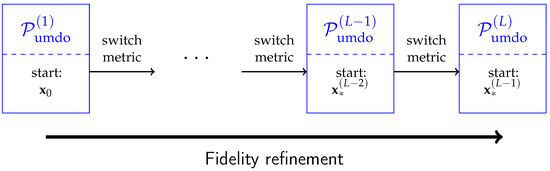
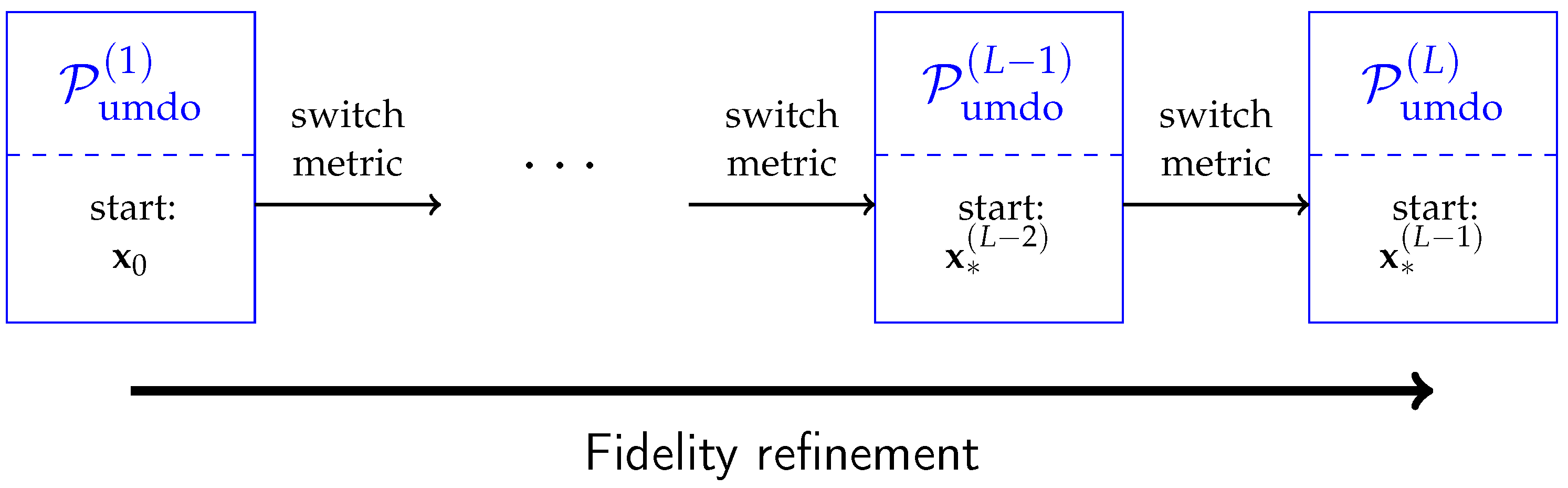
We propose a multi-fidelity strategy with a refinement approach for fidelity management. We define a fidelity level by the number of samples used to estimate the statistics in the UMDO problem ; the higher the fidelity, the higher the number. The disciplines are the same for each level. The strategy starts from an initial guess and solves the UMDO problem at level ℓ, i.e., with statistics estimated by sampling, by using the solution obtained at level as an initial guess. It switches from one level to the next when a stopping criterion is met, up to the highest fidelity UMDO problem . Figure 1 illustrates this methodology.
Figure 1.
Multi-fidelity UMDO framework with a fidelity refinement strategy.
Well defining the switch criterion, i.e., the stopping criterion, is then a critical point of the multi-fidelity strategy to ensure the convergence to the solution of the problem with a reasonable computational cost. For instance, it can be defined as the maximum number of iterations for solving a UMDO problem at any fidelity level or a tolerance to reach on its solution. If so, the multi-fidelity strategy means converging the UMDO problems successively from the lowest to the highest fidelity.
4. Numerical Experiments
4.1. Problem Description
The application case is an overall aircraft design (OAD) problem [16] for a 150-passenger airliner flying at Mach 0.78, powered by a kerosene and a turbofan engine. This case is a simplification of MARILib and is open-source (https://gitlab.com/gemseo/dev/gemseo-oad-training, accessed on 11 April 2026). The problem involves 11 disciplines modelling the physics and components of the aircraft (e.g., geometry, aerodynamics, engine and mass), as well as mission phases (e.g., climb, take-off and approach). These disciplines are coupled with cycles in the coupling graph. The MDO problem aims at minimizing the take-off mass (), subject to several constraints on the take-off field length (), the approach speed (kn), the vertical speed (), the wing span (), the fuselage length () and the fuel margin (%). The design vector is composed of the wing area a (), the wing aspect ratio (-) and the engine sea level static thrust () and . We assume that the aerodynamic, propulsion and structural efficiency factors are uncertain and modelled by the random vector , whose components are independent and distributed according to the triangular distribution , where 0.99, 1 and 1.03 are the minimum, mode and maximum respectively. The MDF-formulated UMDO problem can be written as
4.2. Numerical Settings
The main objective is to validate the interest in using multi-fidelity techniques instead of single-fidelity ones. To this end, we use the open-source Python library GEMSEO [11], the open-source plugin gemseo-umdo (https://gemseo.gitlab.io/dev/gemseo-umdo/latest/, accessed on 11 April 2026) dedicated for UMDO and an in-house gemseo-multifi plugin. As introduced in the previous sections, the multi-fidelity framework is based on a collection of UMDO problems ordered by fidelity. The levels of fidelity are defined by two parameters, namely the number of samples to estimate the statistics and the maximum number of iterations of each subscenario . Let us consider a case where two levels are used, i.e., . Let us denote by "LF" the low-fidelity level and "HF" the high-fidelity level. For all the UMDO scenarios involved in this study, an MDF formulation with MC sampling to compute the statistics is used.
In order to evaluate the gain in performance of the multi-fidelity strategy, a comparison is made with a classical UMDO methodology. We want to study the ability to solve the problem with a given computational budget B. For that, we express this available computational budget B as a function of the number of samples and the maximum number of iterations . In the context of the UMDO approach, it can be written as
For the multi-fidelity framework with , the budget becomes
where a portion is allocated to the LF UMDO problem.
We assume that the HF level is defined by and that we have a computational budget (in terms of the number of discipline evaluations) of . In the case of the UMDO problem, we then have . In order to comply with the constraint , there are several possible configurations for the multi-fidelity method. As the number is set to 90, we have to adjust the parameters to define an acceptable configuration. To investigate several types of configurations by keeping more budget for the HF process, a constrained design of experiments of size 12 is performed on these three parameters, with the three following constraints: (1) , (2) and (3) . A total of 13 methods are then tested on the OAD problem defined in Section 4.1: a classical UMDO methodology (denoted in the rest of the paper as "UMDO") and the 12 multi-fidelity UMDO strategies with the generated configurations (denoted as "MF(i)" for ). Table 1 summarizes the parameters used for each method in terms of the number of samples and maximum number of iterations.
Table 1.
Settings of the single-fidelity and the 12 multi-fidelity UMDO strategies.
The algorithm COBYLA [17] is used to optimize the problem for both levels of fidelity. A relative tolerance of is set for the objective function value and corresponding design vector for all the levels of fidelity. By doing so, the parameter acts as the switch criterion between the LF and HF processes in the cases where the LF process does not reach the required tolerance on the solution. In order to quantify the robustness with respect to the aleatory sampling to estimate the statistics, the experiments are repeated 20 times.
4.3. Numerical Results
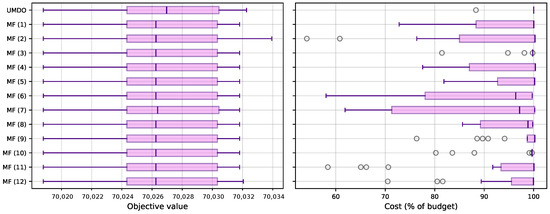
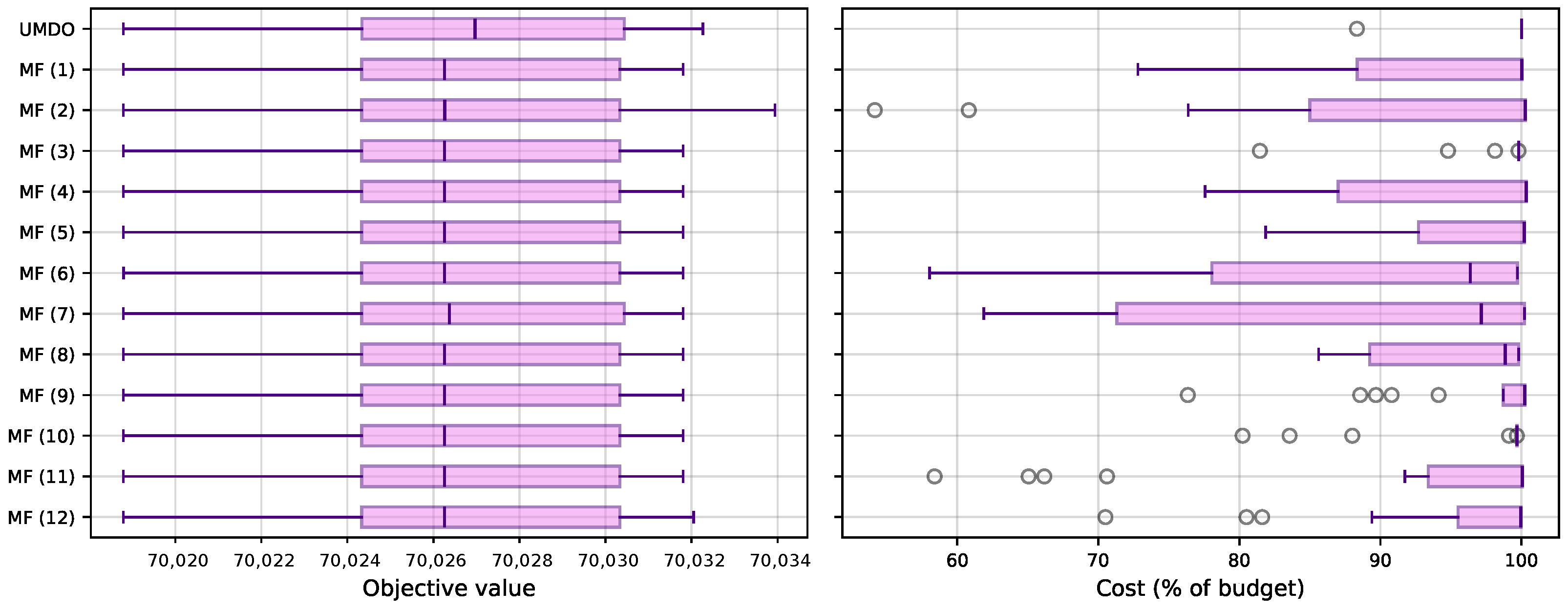
Figure 2 shows the dispersion of the results over the 20 repetitions in terms of the objective function value at the solution and computational cost. The computational cost is given as a percentage of the total available budget B.
Figure 2.
Dispersion of results over the 20 repetitions, with the 12 multi-fidelity configurations denoted MF (i) and the single-fidelity configuration denoted UMDO. (left) Objective function value at solution. (right) Computational cost as a percentage of the total budget.
Two key points are illustrated in Figure 2. On one hand, it seems that all the methodologies tested are able to find a solution with the same level of accuracy, around = 70,026 kg. The objective value of the solution is even improved thanks to multi-fidelity since the median values of the multi-fidelity techniques are lower than the one obtained by UMDO. Only one solution for the second multi-fidelity configuration is higher than the solutions of the other techniques. On the other hand, all the multi-fidelity strategies are able to provide a solution with less budget than the UMDO method, which used 100% of the computational budget for 19 out of 20 repetitions. In the best case scenario, one repetition of the MF(2) configuration even allows for the problem to be solved using only about 55% of the available budget (i.e., 45% of cost reduction). More generally, across all 20 repetitions, it appears that configurations MF(6) and MF(7) are the best configurations for reducing computational costs. This reinforces the interest in using multi-fidelity methods in order to reduce the computational cost of solving a UMDO problem.
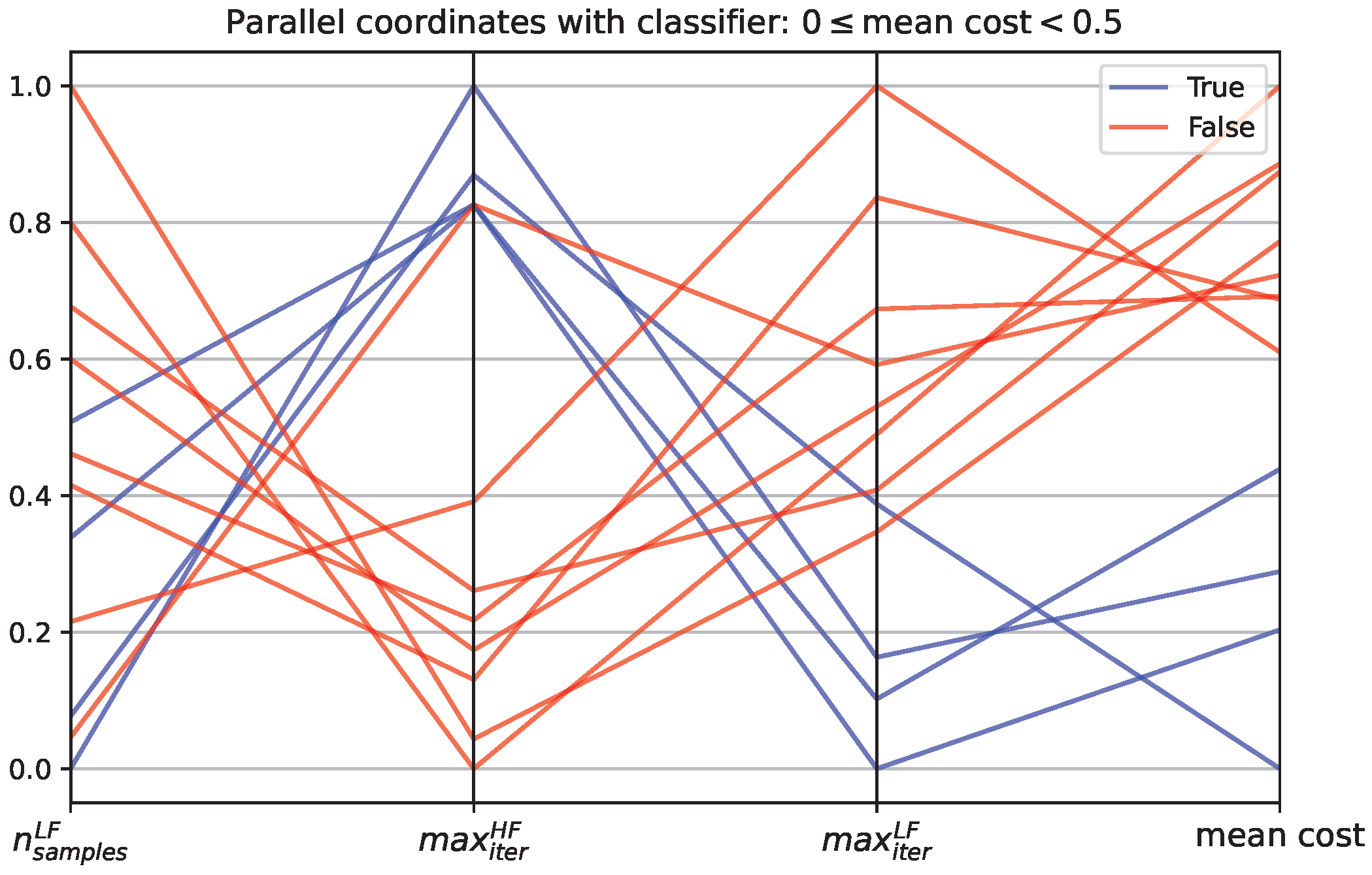
To have more information on the configurations to be preferred, a parallel coordinate plot is generated (Figure 3). The idea is to identify a pattern in terms of choice of the parameters . To classify the different configurations, the computational cost averaged over the 20 repetitions is used for the 12 multi-fidelity configurations.
Figure 3.
Parallel coordinates of the 12 MF configurations. All the values are normalized (between 0 and 1). The blue lines represent the better configurations, leading to an averaged computational cost lower than the mean cost of the 12 configurations (considering normalized values lower than 0.5).
With respect to the results illustrated in Figure 3, a clear pattern appears. It seems that the better configurations in terms of mean computational cost are the ones with a low budget allocated for the LF process (limited number of samples and iterations). By doing so, the HF process has almost all the computational budget to converge, with a better starting point provided by the LF optimization problem to accelerate the process.
5. Design of a Hybrid Electric Regional Aircraft
In the context of the ODE4HERA project (https://www.ode4hera.eu, accessed on 11 April 2026), the proposed framework is deployed for the design of a hybrid electric regional aircraft [18]. In this study, only the electric propulsion architecture is considered (hybridization factor set to fully electric) and is modelled and encapsulated within GEMSEO disciplinary components. This global process involves physical models, including the electric and combustion engines, the power management module, the DC-DC converters, and the ECS (Environmental Control System) and IPS (Ice Protection System). The shaft power demanded by the propeller is fixed to , and we want to size the battery component (to reduce its mass). An uncertainty in the battery flight time () is considered and modelled by the triangular probability distribution . The associated UMDO problem seeks to minimize a margin of the battery weight, subject to operational constraints on electrical design variables (the battery voltage and the voltage coming from a DC-DC converter), such that [510 V, 530 V] and [390 V, 430 V].
Table 2 presents the results of the single-fidelity UMDO methodology and the multi-fidelity strategy referred as "MF-UMDO". The UMDO method is parametrized with and . Based on the conclusions of the OAD application case, a limited number of iterations and samples are given to the LF level, such that and . To respect the same computational budget as UMDO, the HF level for MF-UMDO is such that and .
Table 2.
Results of the hybrid electric regional aircraft application case, in terms of success in solving the problem, number of LF and HF iterations done and cost (as a percentage of the total budget).
Each technique succeeded and found the exact solution of the problem considering the same computational budget (Table 2). The UMDO method reached the maximum number of iterations (40). However, we can see that MF-UMDO converged using only 60% of the budget (i.e., 40% of cost reduction), thanks to the better starting point provided by the LF level. These first results are encouraging and reinforce the conclusions of the OAD study.
6. Conclusions
In this paper, we have presented a generic framework for multi-fidelity UMDO using MC sampling. The idea is to repeat the resolution of an UMDO problem with increasing numbers of samples characterizing the levels of fidelity. The change in fidelity level occurs when a switch criterion is met and the current solution is used as an initial guess for the next resolution. We have shown that the proposed multi-fidelity framework offers a higher performance than an equivalent single-fidelity approach by reducing the computational cost and keeping or even increasing the accuracy of the solution. In addition, in the case where two levels of fidelity are used, limited numbers of samples and numbers of iterations are preferred for the lowest fidelity UMDO problems to ensure a higher global performance.
Future work will focus on applying the methodology on the complete hybrid electric regional aircraft problem including both electric and combustion engines. We could also investigate the definition of advanced switch criteria taking into account both the optimization algorithm convergence and the accuracy of the statistic estimators. Another point would be the extension of the framework to a higher number of fidelity levels.
Author Contributions
Conceptualization, M.D.L. and R.E.; methodology, M.D.L. and R.E.; software, M.D.L. and F.G. (GEMSEO expertise); validation, J.-C.G. and S.B.; formal analysis, R.E.; investigation, R.E.; resources, S.M., T.K., S.B. and J.-C.G.; data curation, S.B. and J.-C.G.; writing—original draft preparation, R.E.; writing—review and editing, M.D.L.; visualization, R.E.; supervision, M.D.L.; project administration, J.-C.G. All authors have read and agreed to the published version of the manuscript.
Funding
This research was co-funded by the European Union. Views and opinions expressed are however those of the authors only and do not necessarily reflect those of the European Union or Clean Aviation Joint Undertaking. Neither the European Union nor the granting authority can be held responsible for them.
Institutional Review Board Statement
Not applicable.
Informed Consent Statement
Not applicable.
Data Availability Statement
The raw data supporting the conclusions of this article will be made available by the authors on request.
Acknowledgments
The project ODE4HERA (project number: 101140510) is supported by the Clean Aviation Joint Undertaking and its members.
Conflicts of Interest
Authors Simone Mancini and Tim Klaproth were employed by the company Airbus Defense and Space. The remaining authors declare that the research was conducted in the absence of any commercial or financial relationships that could be construed as a potential conflict of interest.
References
- Martins, J.R.; Ning, A. Engineering Design Optimization; Cambridge University Press: Cambridge, UK, 2021. [Google Scholar]
- Brevault, L.; Balesdent, M. Uncertainty-Based Multidisciplinary Design Optimization (UMDO). In Aerospace System Analysis and Optimization in Uncertainty; Springer International Publishing: Cham, Switzerland, 2020; pp. 235–292. [Google Scholar]
- Peherstorfer, B.; Willcox, K.; Gunzburger, M. Survey of Multifidelity Methods in Uncertainty Propagation, Inference, and Optimization. SIAM Rev. 2018, 60, 550–591. [Google Scholar] [CrossRef] [Scilit]
- Wang, X.; Liu, Y.; Sun, W.; Song, X.; Zhang, J. Multidisciplinary and multifidelity design optimization of electric vehicle battery thermal management system. J. Mech. Des. 2018, 140, 094501. [Google Scholar] [CrossRef] [Scilit]
- Christensen, D.E. Multifidelity Methods for Multidisciplinary Design Under Uncertainty. Ph.D. Thesis, Massachusetts Institute of Technology, Cambridge, MA, USA, 2012. [Google Scholar]
- Garland, N.; Le Riche, R.; Richet, Y.; Durrande, N. Multi-fidelity for MDO using Gaussian processes. In Aerospace System Analysis and Optimization in Uncertainty; Springer: Berlin/Heidelberg, Germany, 2020; pp. 295–320. [Google Scholar]
- Wu, E.; Mader, C.A.; Martins, J.R. A gradient-based sequential multifidelity approach to multidisciplinary design optimization. Struct. Multidiscip. Optim. 2022, 65, 131. [Google Scholar] [CrossRef] [Scilit]
- Olivanti, R.; Gallard, F.; Brézillon, J.; Gourdain, N. Comparison of generic multi-fidelity approaches for bound-constrained nonlinear optimization applied to adjoint-based CFD applications. In Proceedings of the AIAA Aviation 2019 Forum, Dallas, TX, USA, 17–21 June 2019; p. 3102. [Google Scholar]
- Olivanti, R. Multi-Fidelity Aerodynamic Shape Optimization Considering Flexible Adjoint at Multiple Operating Conditions. Ph.D. Thesis, ISAE, Toulouse, France, 2021. [Google Scholar]
- David, Y. Bi-Level Architectures and Multi-Fidelity Algorithms for Multidisciplinary Optimization in High Dimensions. Ph.D. Thesis, Université de Toulouse, Toulouse, France, 2024. [Google Scholar]
- Gallard, F.; Vanaret, C.; Guénot, D.; Gachelin, V.; Lafage, R.; Pauwels, B.; Barjhoux, P.J.; Gazaix, A. GEMS: A Python library for automation of multidisciplinary design optimization process generation. In Proceedings of the 2018 AIAA/ASCE/AHS/ASC Structures, Structural Dynamics, and Materials Conference, Kissimmee, FL, USA, 8–12 January 2018; p. 0657. [Google Scholar]
- Rackwitz, R. Reliability analysis—A review and some perspectives. Struct. Saf. 2001, 23, 365–395. [Google Scholar] [CrossRef] [Scilit]
- Martins, J.R.; Lambe, A.B. Multidisciplinary design optimization: A survey of architectures. AIAA J. 2013, 51, 2049–2075. [Google Scholar] [CrossRef] [Scilit]
- Cramer, E.J.; Dennis, J.E., Jr.; Frank, P.D.; Lewis, R.M.; Shubin, G.R. Problem formulation for multidisciplinary optimization. SIAM J. Optim. 1994, 4, 754–776. [Google Scholar] [CrossRef] [Scilit]
- Wang, C.; Fan, H.; Qiang, X. A review of uncertainty-based multidisciplinary design optimization methods based on intelligent strategies. Symmetry 2023, 15, 1875. [Google Scholar] [CrossRef] [Scilit]
- Druot, T.Y.; Belleville, M.; Roches, P.; Gallard, F.; Peteilh, N.; Gazaix, A. A multidisciplinary airplane research integrated library with applications to partial turboelectric propulsion. In Proceedings of the AIAA Aviation 2019 Forum, Dallas, TX, USA, 17–21 June 2019; p. 3243. [Google Scholar]
- Powell, M.J. A direct search optimization method that models the objective and constraint functions by linear interpolation. In Advances in Optimization and Numerical Analysis; Springer: Berlin/Heidelberg, Germany, 1994; pp. 51–67. [Google Scholar]
- Granata, D.; Mancini, S.; Mateo Gabin, A.; Zanotti, A. Enhancing a Distributed Electric Propulsion Configuration Aircraft Design with a Multidisciplinary Analysis and Optimization Approach. In Proceedings of the 51st European Rotorcraft Forum (ERF 2025), Venice, Italy, 9–12 September 2025; pp. 1–12. [Google Scholar]

Disclaimer/Publisher’s Note: The statements, opinions and data contained in all publications are solely those of the individual author(s) and contributor(s) and not of MDPI and/or the editor(s). MDPI and/or the editor(s) disclaim responsibility for any injury to people or property resulting from any ideas, methods, instructions or products referred to in the content. |
© 2026 by the authors. Licensee MDPI, Basel, Switzerland. This article is an open access article distributed under the terms and conditions of the Creative Commons Attribution (CC BY) license.