


Abstract
Fire hazards in closed industrial environments pose a significant threat to workers, infrastructure and production processes. Traditional detection systems, such as smoke and heat detectors, often have limitations in their settings, including delayed response time and a tendency for false alarms due to non-fire factors such as dust, humidity and vapors. This paper researches the applicability of gas sensors as an alternative or complementary method for early fire detection. This research presents an experimental evaluation of six gas sensors integrated with a microcontroller. Tests were conducted in a controlled environment, simulating industrial conditions by monitoring the combustion of different materials, such as wood, plastic and textile. Sensor responses were analyzed at horizontal distances of 2 m and 4 m from the fire source. Results show that all sensors detected combustion byproducts, with those at 2 m exhibiting a faster response and higher concentration readings. The findings confirm that a multi-sensor approach significantly increases detection reliability and enables an earlier response compared to conventional systems.
1. Introduction
Fire hazards represent one of the biggest threats to human safety and equipment, especially in industrial environments. In such environments, where a significantly higher amount of flammable material is present, it is essential to implement reliable and high-quality fire detection systems capable of identifying the earliest signs of fire. Traditional approaches with smoke and heat detectors provide effective fire detection, but they possess certain limitations [1]. First, their inherently delayed response time limits their ability to detect the initial indicators of a fire. Next, they are susceptible to false alarms in industrial environments where humidity, dust and vapors are often present and can trigger fire extinguishing systems and cause unnecessary damage. Consequently, there is a clear necessity for an advanced and highly reliable fire detection system that will be able to mitigate the aforementioned drawbacks.
Recently, a notable step toward faster and more reliable fire detection has been made with the use of sensors designed to identify a wide spectrum of combustion products [2]. Gases such as CO, HCN and HCHO represent a portion of common burning products found in industrial environments, which are highly toxic and pose a serious risk to human health and safety [3]. Table 1 shows gases common for industrial environments produced during combustion, their sources and their effects on human health.
Table 1.
Overview of gases released during combustion, their main sources and their effects on human health.
In this work, we intend to experimentally evaluate the effectiveness of six different sensors (MQ-2, MQ-7, MQ-9, MQ-138, SGX-4CO and SCD30), implemented on an ESP32 microcontroller chip, for capturing combustion products of widely used industrial materials (wood, plastic and textile). The experiments were conducted in a controlled environment, and the sensor response was analyzed with respect to the distance from the fire source. Our findings indicate the importance of optimizing the sensor configuration of the sensor node, as well as the importance of the spatial placement of sensors, which plays a pivotal role in effective early detection of fire hazards [4].
2. Fundamentals of Fire Detection and Related Work
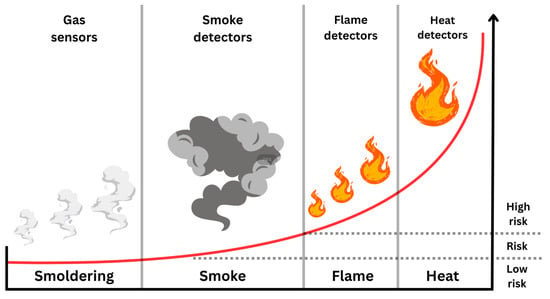
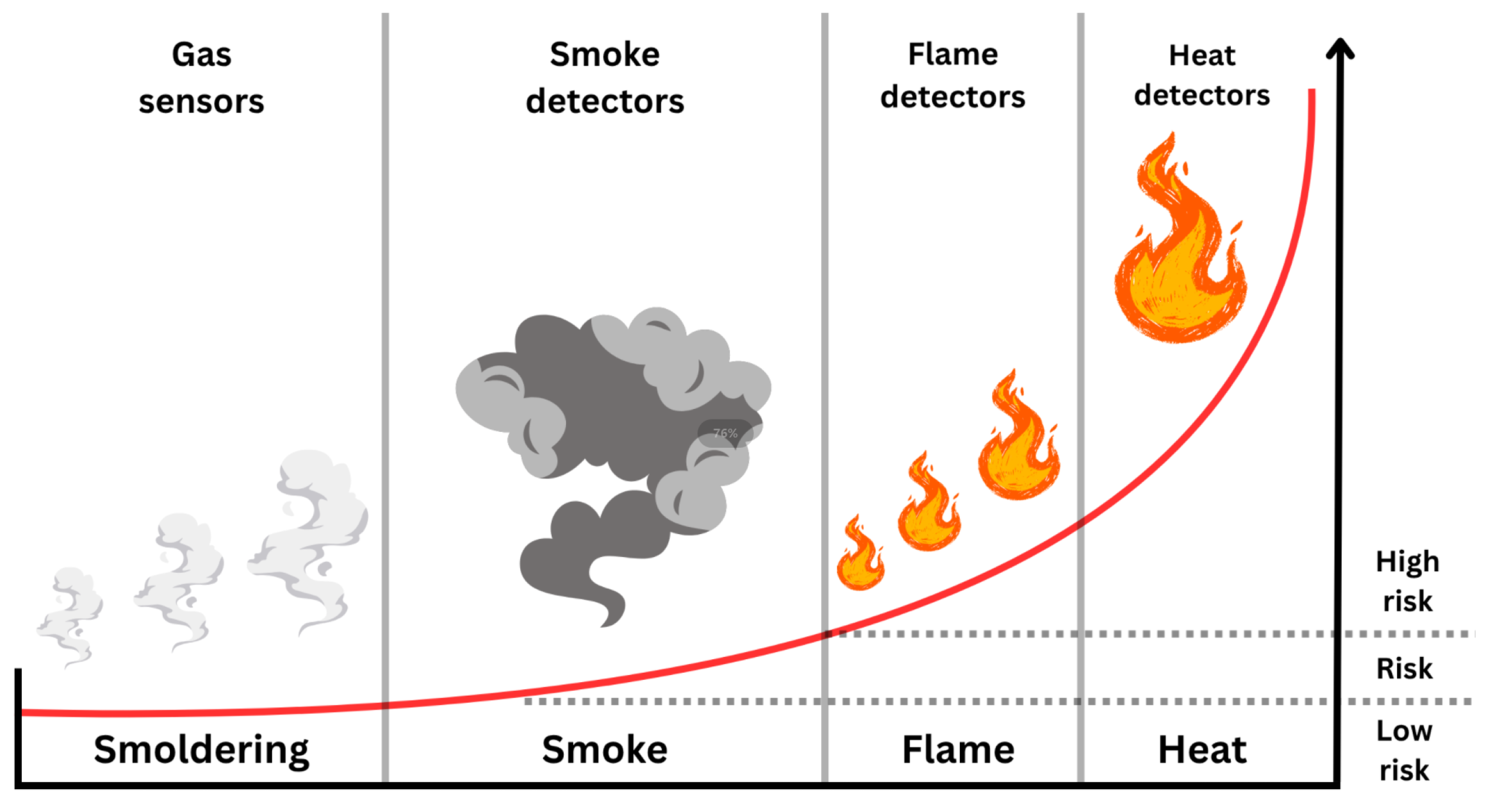
Fire detection represents a process of detecting one or more characteristic signs of fire. Generally, fire development can be categorized into four stages: smoldering, smoke development, initial fire and developed fire. Figure 1 shows the fire development process, along with appropriate technologies used to detect fire in each stage.
Figure 1.
Fire development and detection systems.
As fire extinguishing outcomes are directly correlated with the stage at which fire is detected, a significant amount of research is focused on detecting the earliest signs of fire. One of the most extensive survey papers on sensors in the fire detection domain [3] particularly highlights the importance of response times and diversity of sensor nodes, i.e., their ability to measure multiple different gases released during combustion of various materials. Along these lines, the authors of [1] have created a similar review paper, but with a special focus on gasistor-based sensors. Gasistor-based sensors offer sub-ppm sensitivity and rapid response times for measuring CO, and . These advantages and compatibility with IoT technology make them well-suited for sensor-based fire detection systems. IoT integration was highlighted in [5,6] as a crucial strategy for achieving real-time data fusion, enabling complex machine learning algorithms for accurate fire classification, and minimizing false alarms in dynamic and complex monitoring environments. In addition to the aforementioned sensors, there is a wide spectrum of sensor technologies commonly used in fire monitoring systems. These include optical smoke sensors [7], thermal/infrared imaging sensors [8], graphene-oxide (GO) sensors [9], and ultraviolet (UV) and multi-spectral sensors [10]. To ensure that all sensors used in fire detection systems comply with internationally recognized standards, Table 2 shows an overview of the EN 54 standard family that defines requirements for different categories of fire detection and alarm components.
Table 2.
Overview of EN 54 standards and their application areas in fire detection systems.
With the development of artificial intelligence and deep learning, neural networks have seen an increase in use due to their substantial ability to analyze data and to capture hidden patterns between them. In [11], a neural network was developed for fire detection based on pyro-electric infrared sensor data. Their findings indicate a significant performance increase, as well as the ability to work in real time. Additionally, work presented in [12] investigates the performance of a gas sensor array integrated with sensor fusion algorithms for fire detection. The study points out the importance of sensor placement and data fusion from different measurements. Our work continues in the same vein, by investigating optimal placement strategies to achieve the best possible fire detection results.
3. Experimental Setup
The experimental setup was designed to evaluate the performance of six different gas sensors for early fire detection. The experiments were conducted in a controlled environment in an enclosed container with dimensions of 6 × 2.5 m. The sensors were placed at a height of 1 m and horizontal distances of 2 m and 4 m from the fire source. The fire source consisted of a 140 g mixture of each material commonly found in industrial settings: wood, PP plastic, cardboard and cotton textile. An ignition cube was used to ensure uniform and consistent combustion across tests. All sensors were interfaced with an ESP32 microcontroller, and data was collected and logged on a laptop. The sensor array includes the following:
- MQ-2: Detects flammable gases (LPG, methane, propane) and smoke.
- MQ-7: Detects Carbon Monoxide (CO).
- MQ-9: Detects Carbon Monoxide (CO) and flammable gases (methane, propane).
- MQ-138: Detects Volatile Organic Compounds (VOCs), including formaldehyde, toluene and alcohol.
- SGX-4CO: A high-precision electrochemical sensor for Carbon Monoxide (CO).
- SCD30: A non-dispersive infrared (NDIR) sensor for high-precision Carbon Dioxide (CO2) measurement. The SCD30 sensor was also used to measure ambient temperature and humidity.
Two distinct measurement scenarios were conducted: the first from a horizontal distance of 4 m from the fire source, and the second from a horizontal distance of 2 m from the fire source. Data was recorded in 10 s intervals over a total duration of 11 min and 30 s (11:30) for each test. The combustion phases were manually noted to correlate with the sensor data. Since the same materials, weight and placement of fire source materials were used, the times of the combustion phases were almost identical for both tests. The first smoke appeared at 0:15 (MM:SS) from the ignition of materials, the initial combustion was noted at 1:00, the peak combustion occurred between 2:45 and 3:15, the decline of combustion occurred at 5:15 and smoldering occurred between 7:00 and 7:30. The container was fully ventilated between experiments to restore baseline atmospheric conditions.
4. Results and Analysis
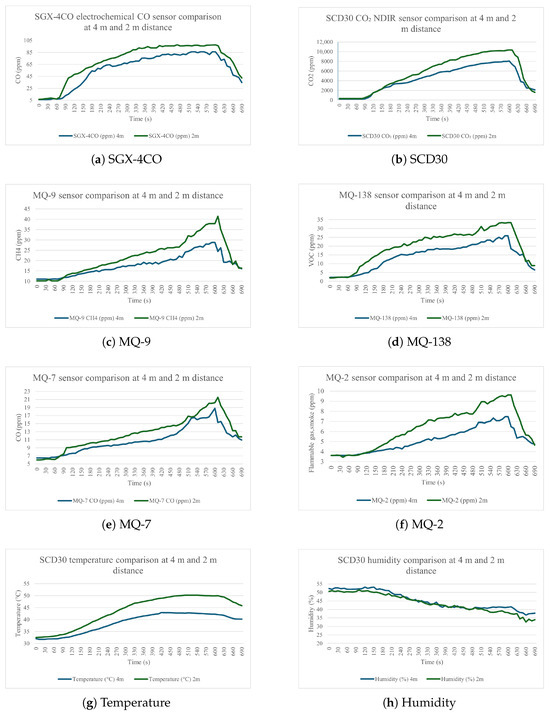
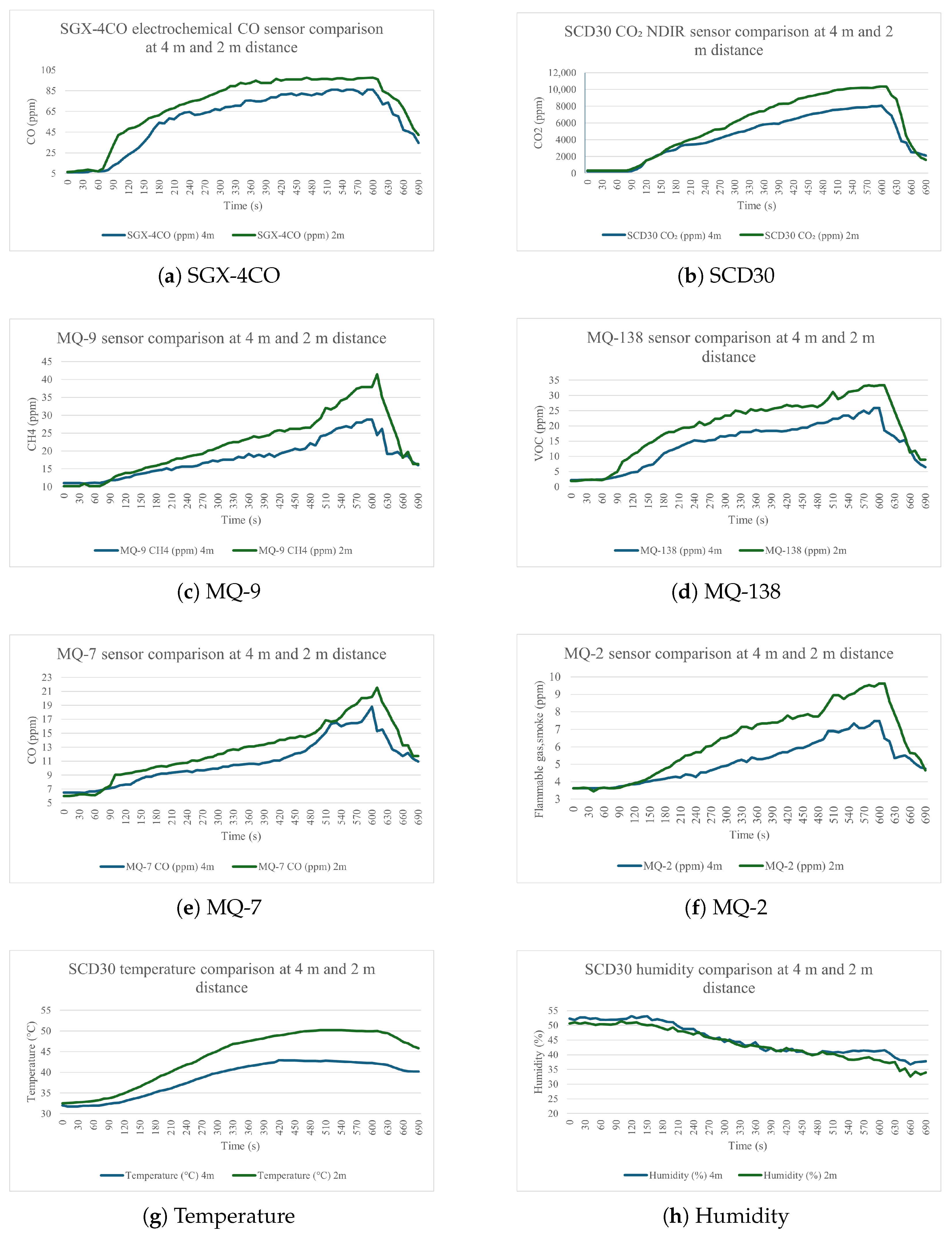
The experimental data provided a clear comparison of sensor effectiveness based on first response time, signal intensity and distance from the fire source. The earliest detection was provided by the SGX-4CO electrochemical sensor, which registered a significant increase at approximately 1:00 at 2 m horizontal distance and 1:30 at 4 m horizontal distance from the fire source, as shown in Figure 2a. The SCD30 CO2 sensor and MQ-9 CH4 sensor both showed a first response at approximately 1:30, regardless of distance, as shown in Figure 2b,c. The MQ-138 VOC sensor and MQ-7 CO sensor both responded at 1:30 at 2 m distance and 2:00 at 4 m distance, as shown in Figure 2d,e. The MQ-2 smoke and LPG sensor was the slowest to have a significant increase and responded at approximately 2:00 in both tests, as shown in Figure 2f. The aforementioned data with time and maximum readings and highlighted fastest detection time and value among sensors can be seen in Table 3. The data collected from the SCD30 detected a temperature increase at 1:30 at 2 m distance and 2:00 at 4 m distance, correlating closely with the initial increase in gas concentrations, as shown in Figure 2g. Also, a uniform and steady decrease in humidity was recorded throughout the combustion process at both distances, as shown in Figure 2h. Analysis of the recorded data shows that the sensors differ in sensitivity and response time, depending on the technology used, cost, the target gas monitored and the distance from the fire source. The majority of the used sensors’ first response times were within 2 min of the initial ignition of the fire source, thus confirming their usability for early fire and smoke detection.
Figure 2.
Comparison of sensor readings at 4 m and 2 m distance from fire source. (a) SGX-4CO, (b) SCD30, (c) MQ-9, (d) MQ-138, (e) MQ-7, (f) MQ-2, (g) Temperature, (h) Humidity.
Table 3.
Summary of sensor response times and peak values.
The results confirm that a multi-sensor approach is recommended for reliable early fire detection. The SGX-4CO electrochemical CO sensor had the fastest first response time compared to other tested sensors, and the SCD30 NDIR CO2 sensor had the highest maximum value and the highest difference between baseline and maximum value in percentage compared to other tested sensors. This can be explained by the fire byproduct gas signature, where CO2 and CO are the main byproducts of burning materials [13]. The MQ sensors had more variable results, which can be justified by their price, but regardless can be used in the detection of fire and smoke. The graphical representation for each sensor measurement, as shown in Figure 2, offers insight into the sensors’ behavior during fire progression. Sensors placed closer to the fire source detect higher gas concentrations and have a slightly faster response. However, in the case of the MQ-2 and SCD30 sensors, the first response occurred at approximately the same time intervals, which indicates that for effective gas detection, placing the sensors at the minimum distance is not necessary.
5. Conclusions
The early detection of fire hazards stands as one of the biggest challenges in the fire detection and prevention domain. Through our work, we aimed to contribute to this field by conducting a study on optimal sensor placement in an industrial environment to obtain the most accurate measurements of combustion products. Our findings suggest that the sensors react differently depending on the type of gas, distance and technology used by the sensor. First, the MQ-2 sensor showcased high sensitivity, but with the cost of a delayed response time when placed relatively far from the fire source. Next, SGX-4CO, SCD30, MQ-7 and MQ-9 are all specialized for measuring a spectrum of carbon-based gases. The results indicate their usability and effectiveness for practical implementation in fire detection and combustion analysis systems. Finally, the MQ-138 sensor, designed to detect VOC gases, proved its efficiency in detecting such compounds with high reliability and sensitivity under the tested conditions. Although sensors demonstrated substantial ability to capture and detect various combustion products, there is no universal solution; rather, these sensors have to be used in combination. Such an approach allows for higher reliability in distinguishing the earliest signs of fire from false alarms.
Author Contributions
D.D. and J.B. conceptualized the research; A.A. conducted the related work research; T.L. conducted the experiments; A.A. and D.D. wrote the manuscript; T.L. and D.D. analyzed the results; J.B. and B.K. organized the paper’s structure and supervised the research; J.B. conducted funding acquisition. All authors have read and agreed to the published version of the manuscript.
Funding
This research was funded by the European Union—NextGenerationEU through the project Efficient multimodal environment for data analysis and anomaly detection using machine learning methods in time-critical applications (ANO-ML), funding number 581-UNIOS-34.
Institutional Review Board Statement
Not applicable.
Informed Consent Statement
Not applicable.
Data Availability Statement
The data presented in this study are available upon request from the corresponding author.
Acknowledgments
The AI-based software Quilbot was used to improve the grammar, technical sound and overall clarity of the manuscript. This work is also supported by the Croatian Science Foundation under the project number DOK-NPOO-2023-10-6527.
Conflicts of Interest
Boris Kos was employed by the Kosmos 42 company. The remaining authors declare that the research was conducted in the absence of any commercial or financial relationships that could be construed as a potential conflict of interest.
References
- Ali, M.; Ahmad, I.; Geun, I.; Hamza, S.A.; Ijaz, U.; Jang, Y.; Koo, J.; Kim, Y.G.; Kim, H.D. A Comprehensive Review of Advanced Sensor Technologies for Fire Detection with a Focus on Gasistor-Based Sensors. Chemosensors 2025, 13, 230. [Google Scholar] [CrossRef] [Scilit]
- Wu, Q.; Ding, Z.; Zhang, W. Research progress on electrochemical gas sensors for fire detection—A review. Int. J. Electrochem. Sci. 2025, 20, 101043. [Google Scholar] [CrossRef] [Scilit]
- Khan, F.; Xu, Z.; Sun, J.; Khan, F.M.; Ahmed, A.; Zhao, Y. Recent Advances in Sensors for Fire Detection. Sensors 2022, 22, 3310. [Google Scholar] [CrossRef] [Scilit] [PubMed]
- Gutmacher, D.; Hoefer, U.; Wöllenstein, J. Gas sensor technologies for fire detection. Sens. Actuators B Chem. 2012, 175, 40–45. [Google Scholar] [CrossRef] [Scilit]
- Jadon, A.; Omama, M.; Varshney, M.; Ansari, M.S.; Sharma, R. FireNet: A Specialized Lightweight Fire & Smoke Detection Model for Real-Time IoT Applications. arXiv 2019, arXiv:1905.11922. [Google Scholar]
- Nagolu, C.; Cheekula, C.; Sai Kiran Thota, D.; Padmanaban, K.; Bhattacharyya, D. Real-Time Forest Fire Detection Using IoT and Smart Sensors. In Proceedings of the 2023 International Conference on Inventive Computation Technologies (ICICT), Lalitpur, Nepal, 26–28 April 2023; pp. 1441–1447. [Google Scholar]
- Barmpoutis, P.; Papaioannou, P.; Dimitropoulos, K.; Grammalidis, N. A Review on Early Forest Fire Detection Systems Using Optical Remote Sensing. Sensors 2020, 20, 6442. [Google Scholar] [CrossRef] [Scilit] [PubMed]
- Ya’acob, N.; Mohd Najib, M.S.; Tajudin, N.; Yusof, A.L.; Kassim, M. Image Processing Based Forest Fire Detection using Infrared Camera. J. Phys. Conf. Ser. 2021, 1768, 012014. [Google Scholar] [CrossRef] [Scilit]
- Khan, F.; Kandola, B.K. Graphene oxide–based wireless sensor in fibre–reinforced hybrid composites for incipient fire detection. Compos. Part B Eng. 2025, 306, 112841. [Google Scholar] [CrossRef] [Scilit]
- Li, Y.; Vodacek, A.; Kremens, R.; Ononye, A.; Tang, C. A hybrid contextual approach to wildland fire detection using multispectral imagery. IEEE Trans. Geosci. Remote Sens. 2005, 43, 2115–2126. [Google Scholar]
- Xavier, K.L.B.L.; Nanayakkara, V.K. Development of an Early Fire Detection Technique Using a Passive Infrared Sensor and Deep Neural Networks. Fire Technol. 2022, 58, 3529–3552. [Google Scholar] [CrossRef] [Scilit]
- Solórzano, A.; Fonollosa, J.; Fernández, L.; Eichmann, J.; Marco, S. Fire detection using a gas sensor array with sensor fusion algorithms. In Proceedings of the 2017 ISOCS/IEEE International Symposium on Olfaction and Electronic Nose (ISOEN), Montreal, QC, Canada, 28–31 May 2017; pp. 1–3. [Google Scholar]
- Padamsey, K.; Liebenberg, A.; Wallace, R.; Oosthuizen, J. Characterising the Chemical Composition of Bushfire Smoke and Implications for Firefighter Exposure in Western Australia. Fire 2024, 7, 388. [Google Scholar] [CrossRef] [Scilit]

Disclaimer/Publisher’s Note: The statements, opinions and data contained in all publications are solely those of the individual author(s) and contributor(s) and not of MDPI and/or the editor(s). MDPI and/or the editor(s) disclaim responsibility for any injury to people or property resulting from any ideas, methods, instructions or products referred to in the content. |
© 2026 by the authors. Licensee MDPI, Basel, Switzerland. This article is an open access article distributed under the terms and conditions of the Creative Commons Attribution (CC BY) license.