


Abstract
Satellite imagery is increasingly being scrutinized through deep learning methodologies for remote sensing applications, particularly focusing on the detection of water bodies. Identification and analysis of rivers, lakes, and reservoirs through segmentation have become feasible, enabling the exploration of their statistical information. During crises such as floods and changes in river pathways, real-time detection of water bodies via remote sensing proves to be highly advantageous. Nevertheless, achieving precise segmentation of water bodies presents a notable challenge, mainly due to the necessity of high-resolution multi-channel satellite images. Existing literature predominantly relies on satellite data from multi-band satellites for water-body extraction. Conversely, the current research emphasizes the segmentation of water-body regions using relatively lower-resolution RGB images without the incorporation of extra multi-spectral channels. To tackle this challenge, a unique methodology is suggested, involving a customized U-Net model integrated with a time-frequency attention network for segmentation. To assess the comprehensive performance of the proposed model, it is evaluated against a publicly available Sentinel-2 satellite dataset, and the outcomes are compared against standard benchmark metrics. The proposed TFA-U-Net model demonstrates superior performance compared to several recent state-of-the-art water-body segmentation models. Experimental results show that the proposed model achieves a precision of 0.94, sensitivity of 0.96, Dice score of 0.93, accuracy of 0.97, and mean IoU of 0.85, indicating its effectiveness for accurate water-body segmentation using low-resolution satellite images.
1. Introduction
Satellites are used in satellite imaging, where images of the Earth are taken. The numerous remote sensing satellites orbiting the Earth make it possible for people to comprehend the material composition of the surface of the planet with the help of aerial photographs taken by these satellites.
Before the 1950s and up until the present, aerial photography has been carried out through the use of balloons and airplanes to cover different regions [1]. Another important aspect in the study of the environment through remote sensing is the use of reflected and emitted radiation [2,3]. The importance of remote sensing has increased in view of the development of satellites that use optical and non-optical sensors, as well as advancements in sensor technology and satellite power. There are many advantages of using satellites, including the ability to cover large regions in real time, unlike airplanes and balloons [4,5].
In fact, water resources provide crucial support for a wide array of environment-related tasks, industrial processes, and agricultural activities. Precise ground detection and definition of the water area are important not only for analysis but for the management of water resources and flood protection as well. Data provided by the Sentinel-1, Sentinel-2, Landsat, and Radarsat satellites, which form a batch of large-scale Earth-coverage satellites, make it possible to constantly monitor the Earth’s ground [6].
2. Literature Survey
The authors of [7] proposed a simple fully connected CNN model for water-body detection from optical VHR images of the GaoFen-2 satellite. A parallel model involving a U-Net with enhanced CRF preprocessing was developed to process VHR images acquired from GaoFen-2 and WorldView-2 satellite data [8]. In another study [9], the authors developed a method for the segmentation of water bodies in SAR imagery. They employed a focal loss function, which compensated for foreground and background pixels. A multi-spectral satellite image water-body detection method, MC-WBDN, was presented in [10], with the ability to segment effectively at different resolutions, making use of multi-spectral information without using an image magnification procedure. The MRSE attention module [11] improved prediction results, in addition to benefits with respect to computational cost and time, yielding more continuous segments of water boundaries.
Yeung et. al. [12] developed a semi-supervised learning-based segmentation methodology for satellite images by using a backbone of features from the Xception architecture to learn multi-resolution features at their native spatial resolutions. In a validation exercise with multi-spectral satellite images, their model was found to perform better than the U-Net model in segmenting images from the DSTL dataset of satellite images from the Kaggle competition [13].
Existing methods for extracting information about water bodies from satellite images depend on multi-band images for extraction of information from different channels. The processing of such data is challenged by its limited availability. To address this issue with the proposed method, we intend to deal with the drawbacks of the U-Net segmentation model proposed in [14,15,16,17] by performing satellite image segmentation using only three channels of the color feature.
Accurate segmentation of water bodies from satellite imagery has become an important research topic in remote sensing due to its applications in environmental monitoring, flood assessment, and water resource management. Traditional image processing methods rely on thresholding, spectral indices, and handcrafted feature extraction techniques. However, these methods often fail to generalize well in complex environments due to variations in illumination, terrain, and background noise.
With the advancement of deep learning, convolutional neural networks (CNNs) have demonstrated significant improvements in semantic segmentation tasks. Ronneberger et al. [14] introduced the U-Net architecture, which became a foundational model for image segmentation due to its encoder–decoder structure and skip connections. Subsequently, Zhang et al. [11] proposed MRSE-Net, which integrates multiscale residual connections and squeeze-and-excitation attention mechanisms to improve the accuracy of water-body segmentation.
Similarly, Yeung et al. [12] proposed a semi-supervised deep learning approach using the Xception architecture for satellite image segmentation. Tandra et al. [18] introduced a Transformer-based U-Net architecture to enhance segmentation performance by capturing long-range feature dependencies.
Recently, attention-based architectures have significantly improved segmentation performance. Liu et al. [19] proposed an attention-guided deep neural network for water-body extraction, demonstrating improved segmentation accuracy by focusing on relevant spatial features. Similarly, Li et al. [20] introduced a multi-scale attention network that effectively captures both global and local features, improving segmentation performance in satellite imagery.
Transformer-based models have also gained popularity due to their ability to capture long-range dependencies. Wang et al. [21] proposed a SegFormer-based water-body segmentation model that integrates Transformer encoders and multi-scale feature fusion. Likewise, Yang et al. [22] developed a Swin Transformer-based segmentation framework that improves feature extraction and segmentation accuracy. Zhang et al. [23] proposed a Transformer-based semantic segmentation model for water-body detection using satellite imagery.
Hybrid CNN–Transformer architectures have also demonstrated strong performance in remote sensing segmentation tasks. Chen et al. [24] proposed a hybrid CNN–Transformer architecture that combines convolutional feature extraction with Transformer-based global context modeling. Similarly, Zhao et al. [25] introduced an attention-based deep learning framework that enhances segmentation performance using spatial and channel attention mechanisms.
Furthermore, recent survey studies [26] highlighted the effectiveness of deep learning and Transformer-based models for water-body segmentation tasks and emphasized the importance of efficient architectures that can operate on limited spectral information. Gupta et al. [27] presented a comprehensive study on deep learning and Transformer-based approaches for water-body mapping using satellite imagery.
Despite these advancements, many existing methods rely on multi-spectral satellite imagery, which increases computational complexity and limits practical deployment in resource-constrained environments. Transformer-based models also require considerable computational resources and large training datasets.
To address these limitations, this work proposes a time-frequency attention-based U-Net model for water-body segmentation using RGB satellite images. The proposed model integrates channel, frequency, and spatial attention mechanisms to enhance feature representation while maintaining computational efficiency. This approach enables accurate segmentation using low-resolution RGB imagery and demonstrates improved performance compared to existing state-of-the-art methods.
The proposed framework incorporates several major contributions. First of all, the U-Net structure captures local and global features from low-resolution images. Second, with the introduction of the TFA module, a new attention weight-based “attention–inattention” framework is developed. Lastly, the TFA module distinguishes between critical components and irrelevant parts, distinguishing water bodies from other elements. TFA also has a very low computational cost. The proposed TFA-U-Net model offers a robust technique for the capture of the global relationships using TFA and simplifies the computational complexity of traditional self-attention incorporating multi-head self-attention.
3. Dataset and Preprocessing
Dataset: The technique employed in the proposed research uses the red–green–blue spectrum of satellite images [13]. The dataset consists of cropped images obtained from the Sentinel-2 satellite and includes a total of 2841 images. The ground-truth images in the dataset are annotated in binary fashion, where white represents foreground intensity and black represents background intensity. The adaptive thresholding technique was used, as well as the Normalized Difference Water Index (NDWI), a widely used spectral index for water-body detection. It is defined as follows:
where G and NIR represent the green and near-infrared spectral bands, respectively. The NDWI enhances water features while suppressing non-water regions. Although the NDWI traditionally uses near-infrared bands, the proposed model performs water-body segmentation using RGB images without requiring spectral indices, demonstrating its applicability to standard satellite imagery.
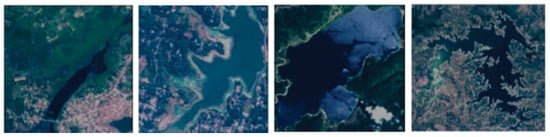
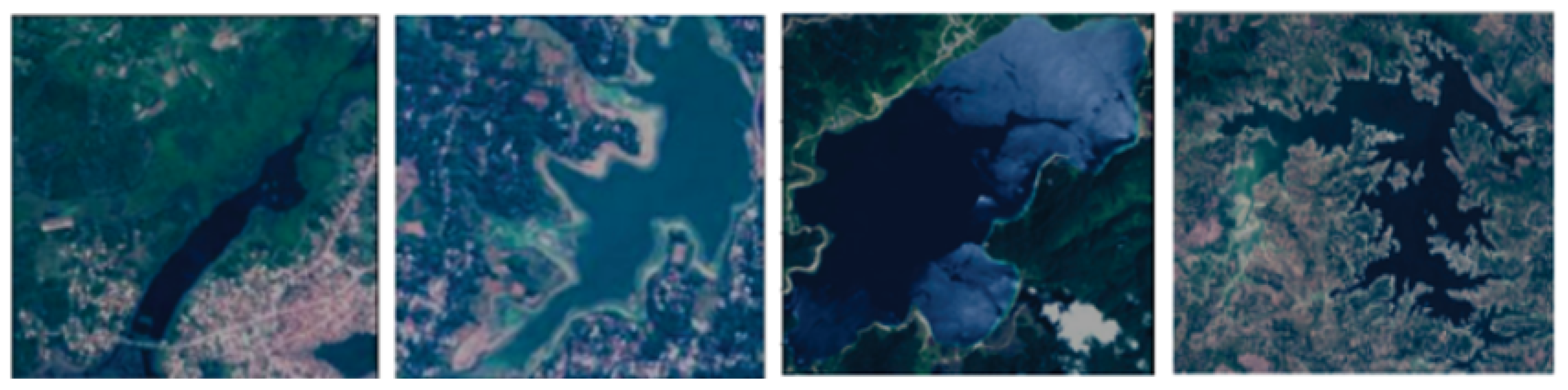
The images include lakes and rivers, along with other elements. The satellite images are shown in Figure 1.
Figure 1.
Sample images from the Sentinel-2 dataset.
Preprocessing: The input dataset comprises satellite images at different spatial resolutions. The dataset was divided into training, validation, and testing sets to ensure proper model evaluation. All images were uniformly resized to a resolution of 200 × 200 pixels and normalized between 0 and 1 to improve training stability and convergence.
The dataset comprises 2686 images selected based on quantitative and qualitative criteria to ensure reliable segmentation performance. Images were selected such that water bodies occupied approximately 5% to 70% of the total image area, enabling the model to learn segmentation of both small and large water bodies. Images with poor visibility, excessive cloud cover, noise, or unclear water boundaries were excluded to maintain dataset quality. Only images with clearly defined water regions and accurate ground-truth masks were included in the final dataset.
These selection criteria ensure that the dataset represents diverse environmental conditions and improve the robustness and generalization capability of the proposed TFA-U-Net model.
Data Augmentation
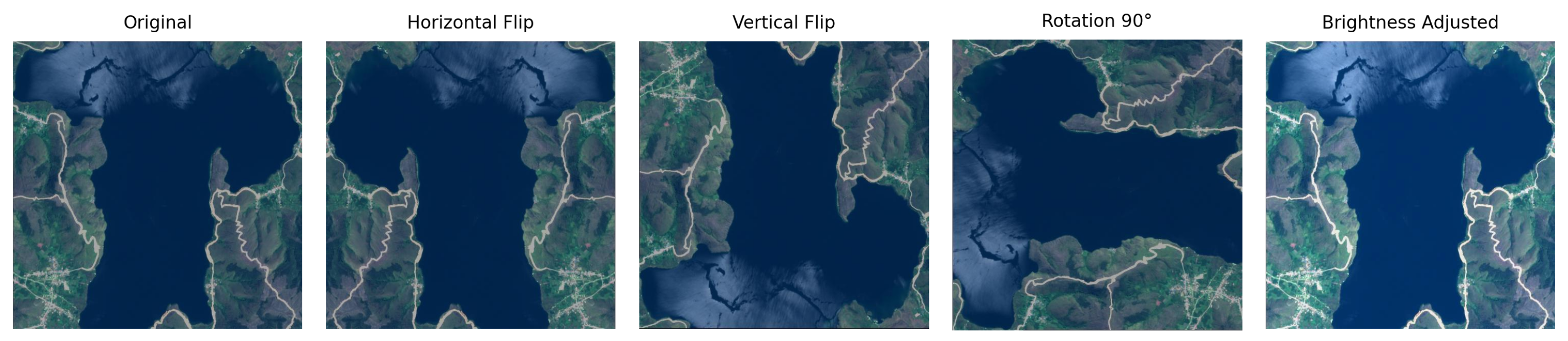
To improve the robustness and generalization capability of the proposed TFA-U-Net model, data augmentation techniques were applied to the training dataset. Data augmentation increases dataset diversity and helps prevent overfitting by exposing the model to different variations of input images.
The following augmentation techniques were applied:
- Horizontal flipping;
- Vertical flipping;
- Rotation (90°);
- Random brightness adjustment.
These augmentation techniques help the model learn invariant feature representations and improve segmentation performance under varying environmental conditions. Data augmentation was applied only to the training dataset, while validation and test datasets were kept unchanged to ensure unbiased performance evaluation.
4. Methodology
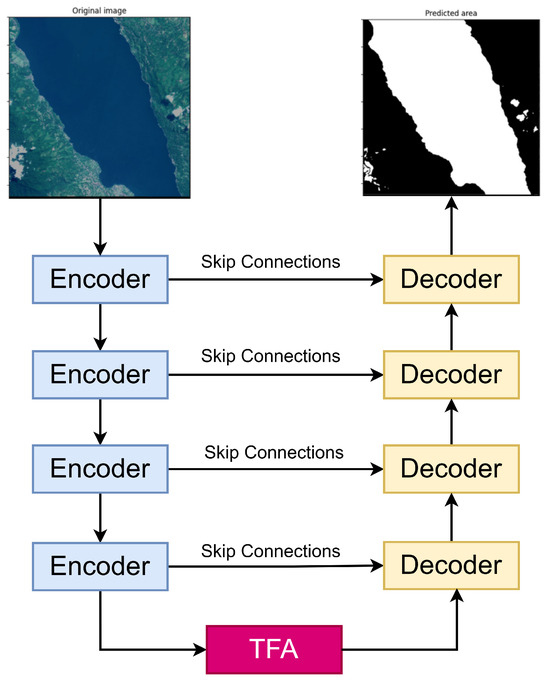
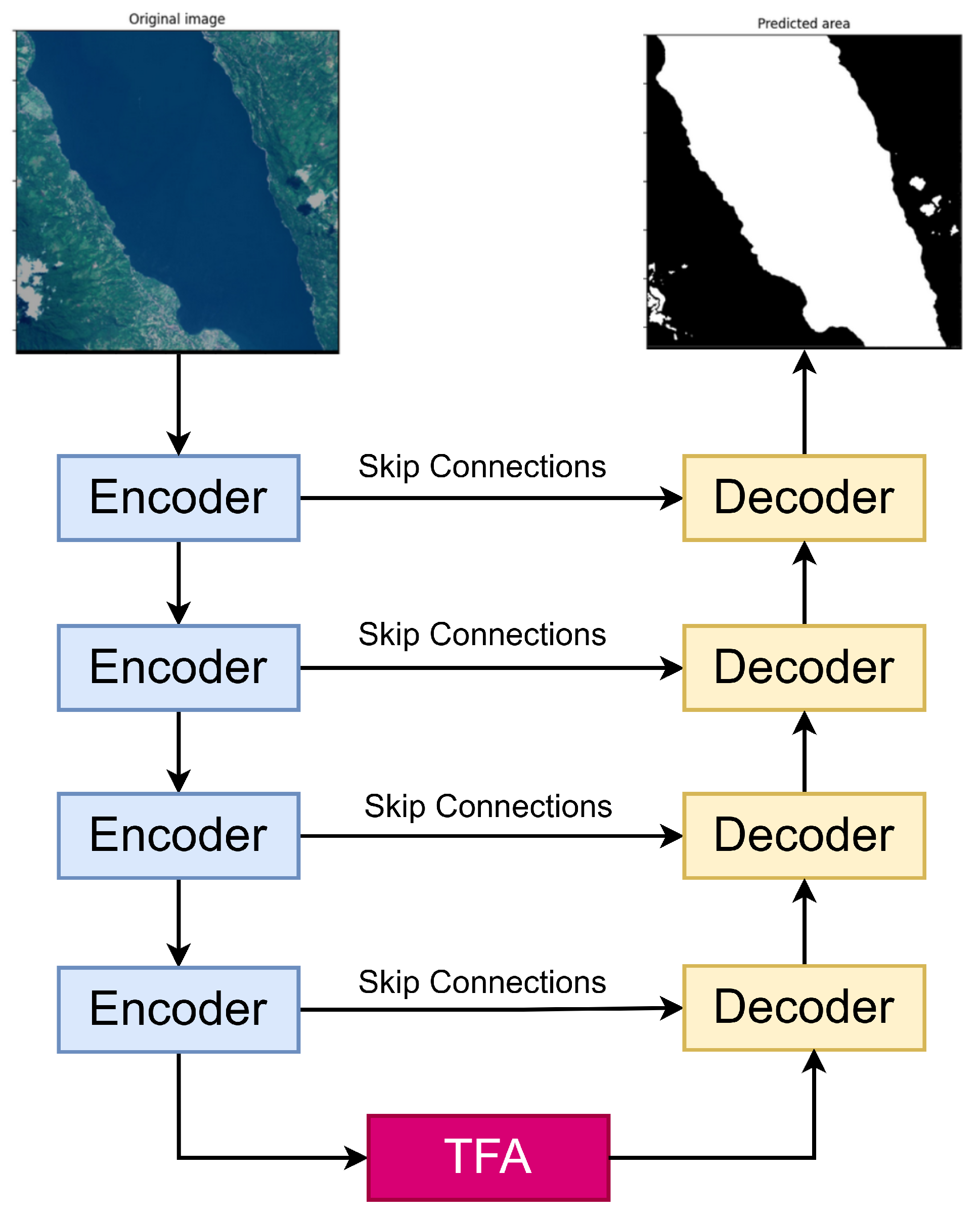
Figure 2 illustrates the design structure of the Time-Frequency Attention (TFA) network-based U-Net model exclusively designed for water-body image segmentation. The design structure of this model consists of an input layer, a U-Net encoder and decoder, TFA, and an output layer. The RGB image acts as input to this model by passing through the input layer to acquire mid-level features. The U-Net encoder helps to acquire context-based features at different scales from the output of the input layer. When exploiting this TFA network model, there is a decrease in complexity, with effective extraction of globally based features. The final output layer is designed to generate segmentation images. In addition to this, given the incorporation of skip connections in the design, there is a significantly improved flow of information among encoder and decoder layers [17].
Figure 2.
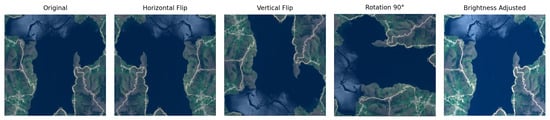
Examples of data augmentation applied to training images. From left to right: original image, horizontal flip, vertical flip, 90° rotation, and brightness adjustment.
4.1. U-Net
In the U-Net architecture, every encoder is implemented using the 2D convolution process, max pooling techniques, and Leaky ReLUs in an attempt to improve the advantages of feature extraction. The U-Net model is organized using a depth value of N, which is fixed at 4; therefore, the U-Net architecture utilizes the services of five encoders and decoders. The choice of the depth of the U-Net architecture is entirely dependent on assessment of the loss values and the total number of trainable parameters in the U-Net architecture. It is important to note that the experimental outcomes of the U-Net architecture reflect improvements in terms of reductions in loss values and the promotion of the advantages of trainable parameters when the value of N is 4 [18].
The encoder part of the U-Net model plays a crucial role in downsampling the input image and, at the same time, capturing essential features across various scales. The encoder module, which consists of a series of convolutional layers followed by pooling for downsampling, effectively extracts relevant information from the input data. In contrast, the decoder module upsamples the image to its original resolution and integrates important features extracted during the encoding process. By concatenating the corresponding feature maps of the encoder block with a series of up-convolutional layers in the decoding process, the U-Net model utilizes the strengths of its encoder in maintaining the integrity of spatial information in the reconstructed image [18]. A deep understanding of the roles of the encoder and decoder within the U-Net network is thus quite crucial for the development of accurate and efficient models for image segmentation [28].
One of the key components of the U-Net architecture is the contracting path, consisting of convolutional layers with filters that have a small receptive field, which captures fine details such as edges and textures from the input image. The number of filters increases along the contracting path, enabling the network to learn complex features in deep layers. Thus, the contracting path is important for feature extraction and reductions in the spatial dimensionality of the U-Net architecture, which is crucial for the proper functioning of the same in segmentation tasks.
4.2. TFA
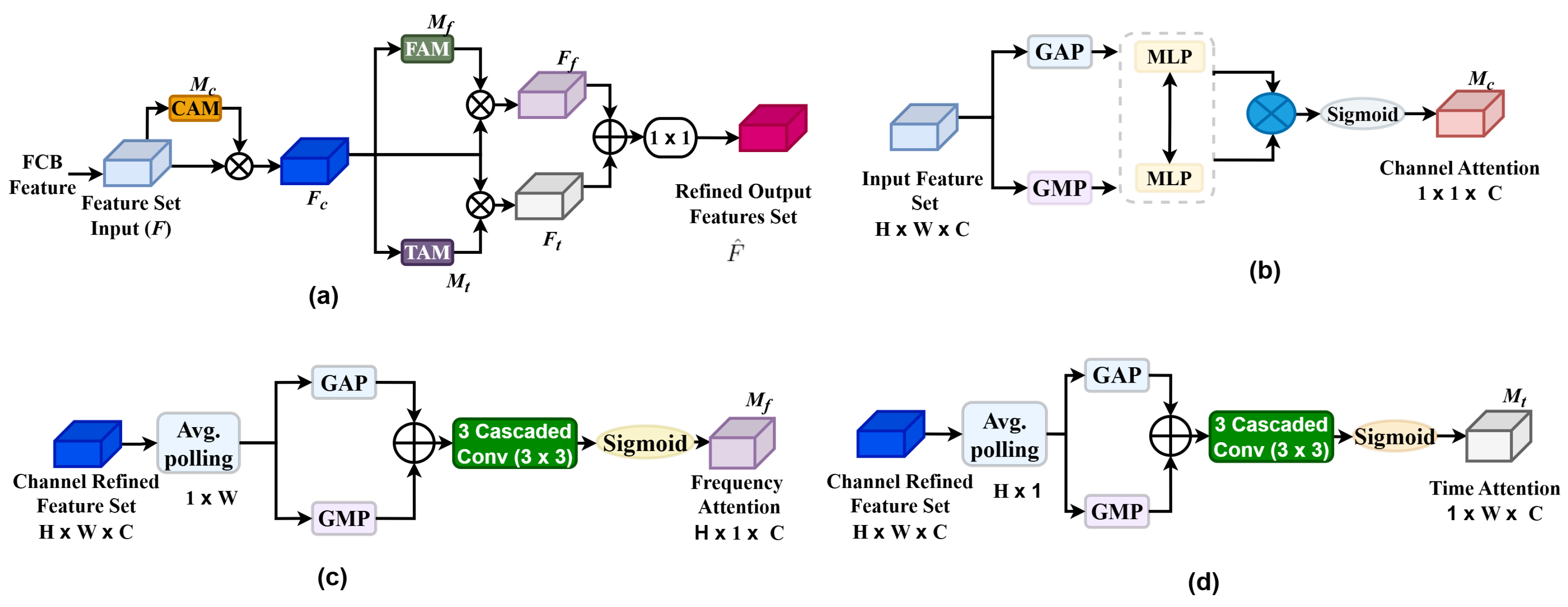
The TFA architecture is intended to identify the vital frequency, time, and channel characteristics in the output of the last encoder. It is through this specific aspect of the data that the TFA architecture derives the unique advantage of having “a much higher amount of computational resources dedicated to the analysis of interest” [15]. Figure 3 shows the proposed TFA architecture, where the TFA module enhances feature maps through sequential channel, time, and frequency attention refinement, followed by feature concatenation and convolution.
Figure 3.
Proposed model architecture.
TFA functions through the use of the rescaled feature set of the FCB, refining the result in the process of using refined feature sets. There are three vital sub-modules in the TFA model: the Channel Attention Module (CAM), the Frequency Attention Module (FAM), and the Time Attention Module (TAM). The CAM is responsible for extracting general information regarding the importance of different channels from the input feature set by analyzing the inter-channel relationships present among the features. The TAM focuses on identifying where time-related information is most pertinent to the refined feature map derived from channel attention, while the FAM highlights areas where frequency-related information holds the most significance. The input to TFA, denoted as , represents the output of preceding convolutional layers, with C representing the channels, W denoting the width, and H indicating the height.
In the TFA process, the input feature set undergoes initial processing through the CAM, referred to as , which generates the refined channel feature set denoted as .
The channel attention weights are computed as follows:
The refined channel feature map is obtained as follows:
where GAP and GMP denote Global Average Pooling and Global Max Pooling, respectively; MLP represents multi-layer perceptron; σ denotes the sigmoid activation function; and ⊗ represents element-wise multiplication.
Subsequently, the TAM and FAM are sequentially applied to , represented by Mt and Mf, respectively. Following these parallel operations, the TAM yields the refined time feature set (). The time attention weights are computed as follows:
The refined time feature map is expressed as follows:
The FAM provides the refined frequency feature set (). The frequency attention weights are computed as follows:
The refined frequency feature map is expressed as follows:
Through a concatenation operation, the two sets of features ( and ) are merged. In the final phase, the concatenated features undergo processing through a convolutional layer to generate the ultimate refined output feature set (), which serves as the input for subsequent layers, with the image size based on the dimensional variations observed in the original patient’s image data.
The final refined output feature map is computed as follows:
where ⊕ denotes feature concatenation.
Thus, the overall time-frequency attention module can be mathematically expressed as follows:
The TFA module introduces minimal additional computational overhead while significantly improving feature representation, making it suitable for efficient water-body segmentation.
4.3. Comparison with Existing Attention Mechanisms
Attention mechanisms such as the Squeeze-and-Excitation Network (SE-Net) [29] and the Convolutional Block Attention Module (CBAM) [30] have been widely used to improve feature representation in deep learning models. SE-Net applies channel attention by recalibrating channel-wise feature responses using global average pooling and fully connected layers. However, SE-Net does not consider spatial or frequency-domain information.
CBAM improves upon SE-Net by sequentially applying channel attention and spatial attention, enabling the network to focus on important spatial regions and feature channels. However, CBAM operates only in the spatial domain and does not explicitly capture frequency-domain characteristics of feature maps.
In contrast, the proposed Time-Frequency Attention (TFA) module integrates a Channel Attention Module (CAM), Time Attention Module (TAM), and Frequency Attention Module (FAM) to enhance feature representation in both the spatial and frequency domains. The Frequency attention module extracts frequency-domain features using convolutional transformations, enabling the model to capture fine-grained structural and boundary information of water bodies.
This frequency-domain feature enhancement is particularly beneficial for water-body segmentation, as water regions often exhibit distinct texture and frequency characteristics compared to surrounding terrain. By integrating channel, spatial, and frequency attention mechanisms, the TFA module provides more comprehensive feature refinement compared to SE-Net and CBAM.
Therefore, the proposed TFA module improves segmentation accuracy by effectively capturing both spatial and frequency-domain information, which is not addressed by conventional attention mechanisms.
Mathematically, the TFA module differs from CBAM and SE-Net by introducing frequency-domain feature refinement. While SE-Net and CBAM compute attention weights only in the spatial domain, the proposed TFA module computes attention weights in the channel, spatial, and frequency domains, enabling enhanced feature discrimination. This multi-domain attention mechanism improves the representation of water-body boundaries and structural features, resulting in improved segmentation performance.
A detailed comparison between SE-Net, CBAM, and the proposed TFA module is presented in Table 1, highlighting the ability of TFA to capture frequency-domain features in addition to spatial and channel attention.
Table 1.
Comparison of attention mechanisms.
4.4. Justification of U-Net Depth
The depth of the U-Net architecture significantly affects segmentation performance, computational complexity, and training stability. To determine the optimal depth, experiments were conducted using U-Net architectures with depths of 3, 4, and 5 encoder–decoder levels. The performance comparison in terms of training loss, accuracy, and trainable parameters is presented in Table 2.
Table 2.
Performance comparison of TFA-U-Net with different network depths.
As shown in Table 2, increasing the network depth from 3 to 4 significantly reduces training loss and improves segmentation accuracy due to enhanced feature extraction capability. Although a depth of 5 achieves slightly lower training loss, it introduces substantially higher computational complexity and more trainable parameters without significant improvement in accuracy. Therefore, a depth of 4 provides the optimal balance between segmentation performance and computational efficiency and was selected for the proposed TFA-U-Net model.
5. Experimental Setup and Baselines
The proposed model was trained on a system designed on an Intel core i7 processor with 16 GB RAM and a 6 GB NVIDIA graphics card. The model was trained for more than 50 epochs with a batch size 32 using an Adam optimizer with a learning rate of 0.001. Data augmentation techniques were applied during training to improve model generalization and reduce overfitting.
To validate the effectiveness of the proposed TFA-U-Net model, comparative experiments were conducted against several recent state-of-the-art water-body segmentation models, including MRSE-Net [11], attention-based segmentation models [19], multi-scale attention networks [20], SegFormer-based models [21], Swin Transformer-based models [22], and hybrid CNN–Transformer architectures [24]. The proposed model achieves superior precision, sensitivity, and accuracy while maintaining a competitive Dice score and mean IoU, demonstrating its effectiveness for water-body segmentation.
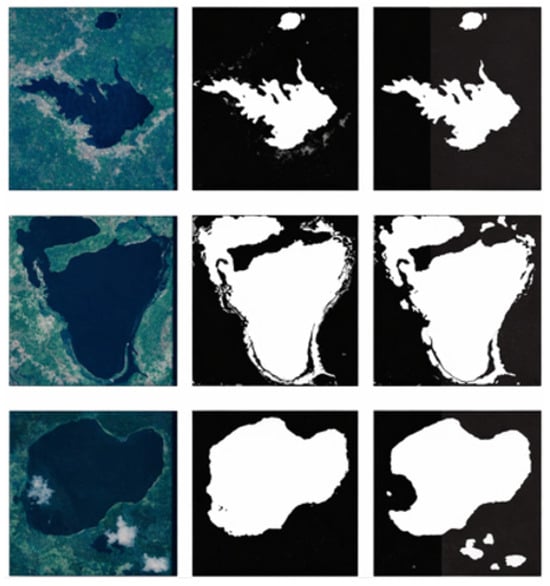
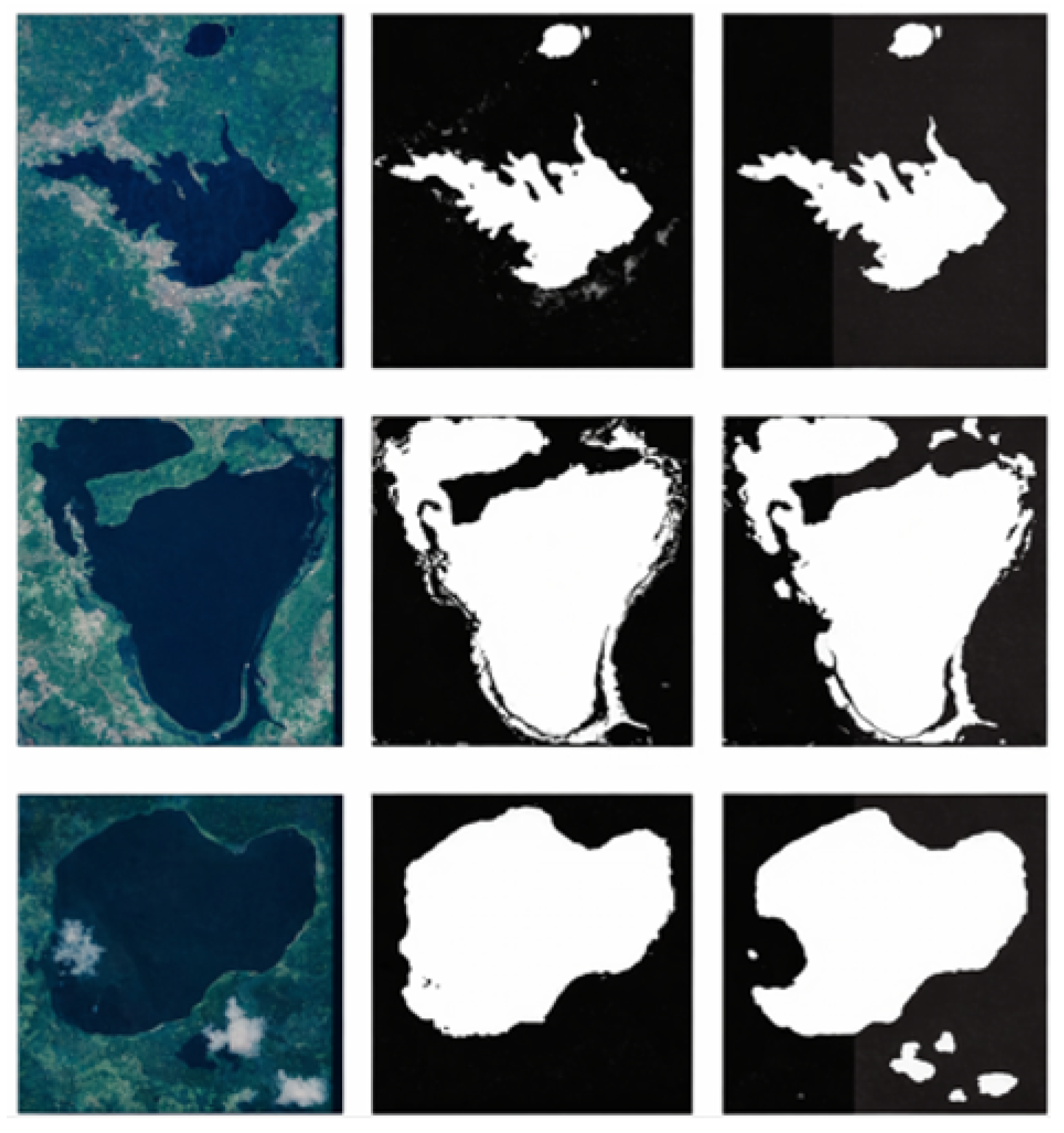
The qualitative segmentation results achieved with the proposed model are shown in Figure 4 and Figure 5. From the results, it can be seen that the segmentation masks predicted by the proposed model qualitatively match the ground-truth segmentation masks. The proposed model is able to accurately identify the target region with clear boundaries. The proposed model shows minimal over-segmentation, with less background noise in comparison to the ground-truth segmentation masks. The model is quite capable of handling target regions of varying sizes. These results validate the performance evaluation parameters that determine the efficacy of the proposed model in performing accurate segmentation of the target region.
Figure 4.
(a) Proposed model architecture. (b) Internal architecture of the CAM. (c) Internal architecture of the FAM. (d) Internal architecture of the TAM.
Figure 5.
Sample segmentation predictions of the proposed model. From left to right: original images, ground-truth masks, and predicted segmentation mask results.
Analysis of Results
As shown in Table 3, the proposed TFA-U-Net model achieves the highest accuracy and a competitive Dice score and mean IoU compared to recent state-of-the-art water-body segmentation models published in the past two years.
Table 3.
Performance comparison with recent state-of-the-art water-body segmentation models.
As shown in Table 4, the proposed TFA-U-Net has significantly lower computational complexity compared to recent Transformer-based and hybrid segmentation models. The proposed model requires fewer parameters and floating-point operations, resulting in faster inference times. This demonstrates the efficiency of the proposed architecture and its suitability for real-time and resource-constrained applications.
Table 4.
Computational complexity comparison of the proposed model with recent state-of-the-art segmentation models.
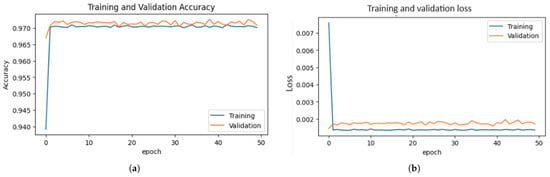
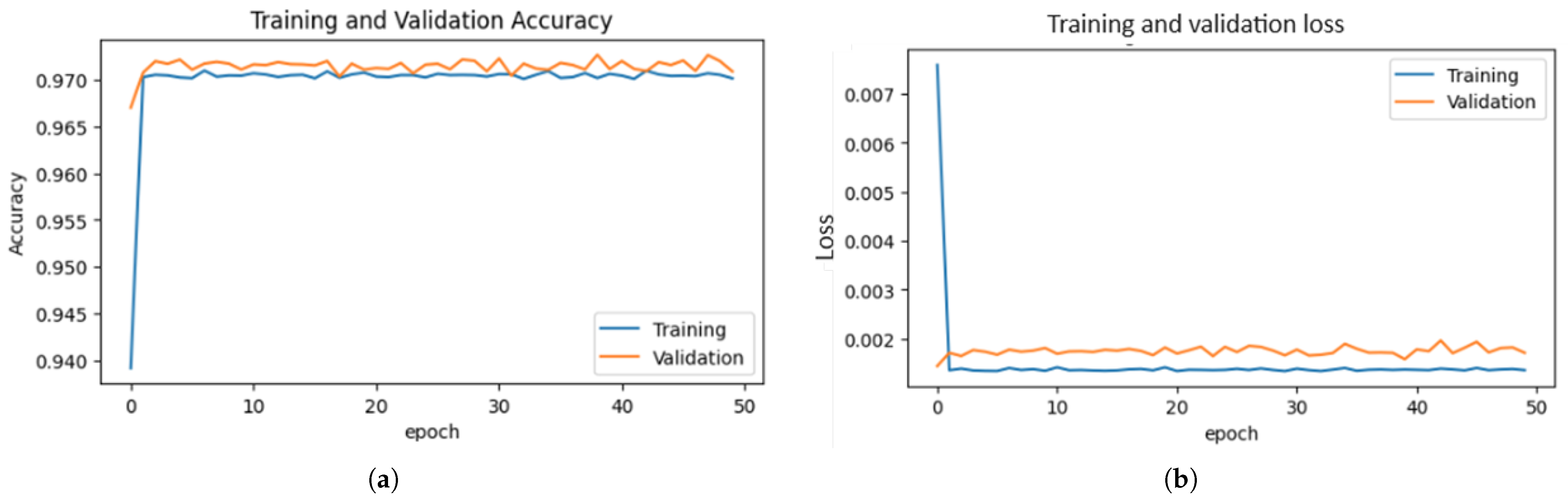
In addition to this, qualitative analysis of model accuracy during segmentation was taken into account. This qualitative assessment took into account various examples, as depicted in the various images in Figure 6a,b. The overall analysis of these images helps to verify the outstanding accuracy of the proposed model in performing foreground segmentation, as well as rejecting background regions.
Figure 6.
(a) Training and validation accuracy curves. (b) Training and validation loss curves.
6. Conclusions
The new approach brings forth an entirely new way of segmenting aquatic scenes using tri-channel satellite images according to the concept of time-frequency attention combined with the concept of the U-Net architecture. Through the combination of these two models, the proposed method hopes to provide an improvement in accuracy in the segmentation task using authentic RGB satellites. To validate the efficiency of the proposed method, the authors used images from the Sentinel-2 dataset, which includes a substantial amount of images, as well as their respective masks. To verify the authenticity of the proposed model in water-body segmentation, the authors used universal benchmarks to provide an in-depth investigation of satellite images with moderate resolution in the RGB spectrum. The authors also performed a comparative investigation task using different baseline models. The proposed TFA-U-Net model achieves a precision of 0.94, sensitivity of 0.96, Dice score of 0.93, accuracy of 0.97, and mean IoU of 0.85, demonstrating its effectiveness for accurate water-body segmentation. Integration of time-frequency attention mechanisms enhances feature representation and improves segmentation performance while maintaining computational efficiency. The proposed technique makes use of a fixed kernel size in the feature extraction phase. In future investigations, we hope to investigate the use of different kernel sizes with the multi-scale feature technique.
Author Contributions
Conceptualization, S.Y. and S.R.; methodology, M.A.; software, S.Y.; validation, S.R., V.K.V. and G.M.; formal analysis, V.S.; investigation, V.S.; resources, G.M.; data curation, V.K.V.; writing—original draft preparation, S.Y. and V.S.; writing—review and editing, S.R.; visualization, M.A. All authors have read and agreed to the published version of the manuscript.
Funding
This research received no external funding.
Institutional Review Board Statement
Not applicable.
Informed Consent Statement
Not applicable.
Data Availability Statement
This work references a publicly available dataset that can be downloaded through the following accessed on 12 February 2025: https://www.kaggle.com/datasets/adityajayshreethakur/water-bodies-data-set.
Conflicts of Interest
The authors declare no conflicts of interest.
Abbreviations
The following abbreviations are used in this manuscript:
| RGB | Red–Green–Blue |
| TFA | Time-Frequency Attention |
| CNN | Convolutional Neural Network |
| CAM | Channel Attention Module |
| TAM | Time Attention Module |
| FAM | Frequency Attention Module |
| IoU | Intersection over Union |
| VHR | Very High Resolution |
| GAP | Global Average Pooling |
| GMP | Global Max Pooling |
| MLP | Multi-Layer Perceptron |
| ReLU | Rectified Linear Unit |
References
- Boike, J.; Yoshikawa, K. Mapping of periglacial geomorphology using kite/balloon aerial photography. Permafr. Periglac. Process. 2003, 14, 81–85. [Google Scholar] [CrossRef] [Scilit]
- Kumar, D.N.; Reshmideci, T.V. Remote sensing applications in water resources. J. Ind. Inst. Sci. 2013, 93, 163–188. [Google Scholar]
- Govender, M.; Chetty, K.; Bulcock, H. A review of hyperspectral remote sensing and its application in vegetation and water resource studies. Water SA 2007, 33, 145–151. [Google Scholar] [CrossRef] [Scilit]
- Abburu, S.; Golla, S.B. Satellite image classification methods and techniques: A review. Int. J. Comput. Appl. 2015, 119, 8. [Google Scholar] [CrossRef] [Scilit]
- Joyce, K.E.; Belliss, S.E.; Samsonov, S.V.; McNeill, S.J.; Glassey, P.J. A review of the status of satellite remote sensing and image processing techniques for mapping natural hazards and disasters. Prog. Phys. Geogr. 2009, 33, 183–207. [Google Scholar] [CrossRef] [Scilit]
- Smith, L.C. Satellite remote sensing of river inundation area, stage, and discharge: A review. Hydrol. Process. 1997, 11, 1427–1439. [Google Scholar] [CrossRef]
- Li, L.; Yan, Z.; Shen, Q.; Cheng, G.; Gao, L.; Zhang, B. Water body extraction from very high spatial resolution remote sensing data based on fully convolutional networks. Remote Sens. 2019, 11, 1162. [Google Scholar] [CrossRef] [Scilit]
- Feng, W.; Sui, H.; Huang, W.; Xu, C.; An, K. Water body extraction from very high-resolution remote sensing imagery using deep UNet and a superpixel-based conditional random field model. IEEE Geosci. Remote Sens. Lett. 2018, 16, 618–622. [Google Scholar] [CrossRef] [Scilit]
- Zhang, J.; Xing, M.; Sun, G.C.; Chen, J.; Li, M.; Hu, Y.; Bao, Z. Water Body Detection in High-Resolution SAR Images with Cascaded Fully Convolutional Network and Variable Focal Loss. IEEE Trans. Geosci. Remote Sens. 2020, 59, 316–332. [Google Scholar] [CrossRef] [Scilit]
- Yuan, K.; Zhuang, X.; Schaefer, G.; Feng, J.; Guan, L.; Fang, H. Deep-learning-basedmultispectral satellite image segmentation for water body detection. IEEE J. Sel. Top Appl. Earth Obs. Remote Sens. 2021, 14, 7422–7434. [Google Scholar] [CrossRef] [Scilit]
- Zhang, X.; Li, J.; Hua, Z. MRSE-Net: Multiscale residuals and SEattention network for water body segmentation from satellite images. IEEE J. Sel. Top Appl. Earth Obs. Remote Sens. 2022, 15, 5049–5064. [Google Scholar] [CrossRef] [Scilit]
- Yeung, H.W.F.; Zhou, M.; Chung, Y.Y.; Moule, G.; Thompson, W.; Ouyang, W.; Cai, W.; Bennamoun, M. Deep-learning-based solution for data deficient satellite image segmentation. Expert Syst. Appl. 2022, 191, 116210. [Google Scholar] [CrossRef] [Scilit]
- Kaggle, DSTL Kaggle Satellite Image Segmentation Dataset. Available online: https://www.kaggle.com/datasets/adityajayshreethakur/water-bodies-data-set (accessed on 12 February 2025).
- Ronneberger, O.; Fischer, P.; Brox, T. U-Net: Convolutional networks for biomedical image segmentation. arXiv 2015, arXiv:1505.04597. [Google Scholar] [CrossRef] [Scilit]
- Yechuri, S.; Komati, T.R.; Yellapragada, R.K.; Vanambathina, S. A Multi-scale Subconvolutional U-Net with Time-Frequency Attention Mechanism for Single Channel Speech Enhancement. Circuits Syst. Signal Process. 2024, 43, 5682–5710. [Google Scholar] [CrossRef] [Scilit]
- Li, J.; Roy, D.P. A global analysis of Sentinel-2A, Sentinel-2B and Landsat-8 data revisit intervals and implications for terrestrial monitoring. Remote Sens. 2017, 9, 902. [Google Scholar] [CrossRef] [Scilit]
- Yechuri, S.; Nandyala, S.; Vanambathina, S.D.; Devi, J.S.; Jannu, C.; Sharma, L.D. Forest Aerial Image Segmentation Through Satellite Images Using Refine U-Net Model. In International Conference on Advances in Distributed Computing and Machine Learning; Springer Nature: Singapore, 2024; pp. 405–417. [Google Scholar]
- Tandra, N.; Jyothirmaye, S.; Yechuri, S. TNU-Net: Water Body Segmentation based on the Transformer Network with U-Net Model. In 2023 6th International Conference on Recent Trends in Advance Computing (ICRTAC); IEEE: Piscataway, NJ, USA, 2023; pp. 205–211. [Google Scholar]
- Liu, H.; Zhao, W.; Sun, J.; Li, M. Attention-Guided Deep Neural Network for Water Body Extraction from Remote Sensing Images. Remote Sens. 2024, 16, 1245. [Google Scholar] [CrossRef] [Scilit]
- Li, Z.; Wang, Y.; Zhao, Q.; Liu, J. Multi-Scale Attention Network for Satellite Image Water Body Segmentation. Remote Sens. 2024, 16, 3120. [Google Scholar]
- Wang, X.; Zhang, T.; Li, Y.; Chen, Q. SegFormer-Based Water Body Segmentation Using Multi-Scale Satellite Data. Remote Sens. 2024, 16, 1987. [Google Scholar] [CrossRef] [Scilit]
- Yang, F.; Zhou, X.; Li, Y.; Chen, Z. Swin Transformer-Based Semantic Segmentation for Remote Sensing Images. Remote Sens. 2022, 14, 5439. [Google Scholar] [CrossRef] [Scilit]
- Zhang, Y.; Chen, L.; Wang, P.; Liu, Q. Transformer-Based Semantic Segmentation for Water Body Detection Using Satellite Imagery. ISPRS J. Photogramm. Remote Sens. 2024, 210, 102–115. [Google Scholar] [CrossRef] [Scilit]
- Chen, J.; Wu, H.; Liu, X.; Zhang, Y. A Hybrid CNN–Transformer Network for Remote Sensing Image Segmentation. IEEE Access 2023, 11, 132941–132953. [Google Scholar]
- Zhao, L.; Chen, X.; Wang, H. Attention-Based Deep Learning Framework for Water Body Extraction from Satellite Images. Remote Sens. 2023, 15, 4597. [Google Scholar]
- Zhou, Y.; Li, X.; Zhang, H.; Wang, R. Water Body Extraction from Remote Sensing Images Using Deep Learning: A Review. Remote Sens. 2023, 15, 3456. [Google Scholar]
- Gupta, R.; Singh, P.; Kumar, S. Deep Learning and Transformer-Based Approaches for Water Body Mapping Using Satellite Images. Sensors 2025, 25, 1456. [Google Scholar]
- Yechuri, S.; Vanambathina, S. A Subconvolutional U-net with Gated Recurrent Unit and Efficient Channel Attention Mechanism for Real-Time Speech Enhancement. Wirel. Pers. Commun. 2025, 145, 491–509. [Google Scholar] [CrossRef] [Scilit]
- Hu, J.; Shen, L.; Sun, G. Squeeze-and-Excitation Networks. In Proceedings of the IEEE Conference on Computer Vision and Pattern Recognition (CVPR), Salt Lake City, UT, USA, 18–23 June 2018; pp. 7132–7141. [Google Scholar]
- Woo, S.; Park, J.; Lee, J.Y.; Kweon, I.S. CBAM: Convolutional Block Attention Module. In Proceedings of the European Conference on Computer Vision (ECCV), Munich, Germany, 8–14 September 2018; pp. 3–19. [Google Scholar]

Disclaimer/Publisher’s Note: The statements, opinions and data contained in all publications are solely those of the individual author(s) and contributor(s) and not of MDPI and/or the editor(s). MDPI and/or the editor(s) disclaim responsibility for any injury to people or property resulting from any ideas, methods, instructions or products referred to in the content. |
© 2026 by the authors. Licensee MDPI, Basel, Switzerland. This article is an open access article distributed under the terms and conditions of the Creative Commons Attribution (CC BY) license.