


Abstract
In early-stage product ideation, generative AI has emerged as a design support tool, yet most prompts still rely on designers’ subjective intent with limited grounding in user context. Therefore, we developed a user-centered prompting method, introducing a context-based prompt derived from field data, alongside narrative-based and keyword-based prompts as controls. Using these prompts, 15 conceptual images of farming tools for elderly users were generated via DALL·E 3 and evaluated by seven seasoned experts across five criteria. The results show that context-based prompts outperformed others, especially in practicality and intent alignment. A thematic analysis of qualitative feedback further reveals that user-grounded prompts enhance design resonance and usability. This workflow offers implications for improving human–AI co-creation, especially in socially sensitive design contexts.
1. Introduction
With advances in AI, generative (GAI) tools have been widely adopted in creative fields such as design [1]. They support rendering, concept development, and data analysis [2], and text-to-image models assist in early ideation [3]. In education, such tools enhance creativity and co-creation potential [4,5]. Applications across fashion [6], healthcare [7], and furniture design [8] illustrate the integration of GAI tools into product development workflows. These examples indicate the increasing relevance of such technologies in early-stage ideation and design-related decision-making.
In this study, we developed a prompt engineering method that utilizes user contextual language to address the gap between generative outputs and design intent. Instead of relying solely on designers’ subjective input, user statements were translated into keyword-, narrative-, and context-based prompts and applied in image generation using DALL·E 3 (via ChatGPT-4o). The resulting concept images were assessed by industrial designers and experienced small-scale farmers to evaluate the effectiveness of context-aware prompting in supporting collaborative design.
2. Literature Review
Designers use various tools like interviews, storyboards, and sticky notes to capture, reflect on, and share user needs and conceptual designs [9]. In recent years, digital whiteboard tools such as Miro have also been replacing physical forms of collaboration, facilitating remote collaboration and increasing the efficiency of virtual co-creation [10].
GAI tools are widely used in the design conceptualization phase, where different cue structures and wordiness affect the quality and relevance of the images produced by GAI tools [11,12]. To improve alignment between generated outputs and original design intentions, a design workflow integrating textual prompts with sketches has been proposed to guide image generation more effectively [13]. In addition, the DesignAID system utilizes semantic expansion to produce initial visual outputs with creative potential, thereby supporting broader and more diverse idea generation in the design process [14].
Existing prompts are based on designers’ subjective inputs, lacking user-specific context. Prior studies have noted that vague prompts can cause semantic drift and reduce design relevance [15,16]. To address this, this study proposes a user-centered prompt workflow that translates contextual insights to better align AI outputs with design intentions.
3. Methodology
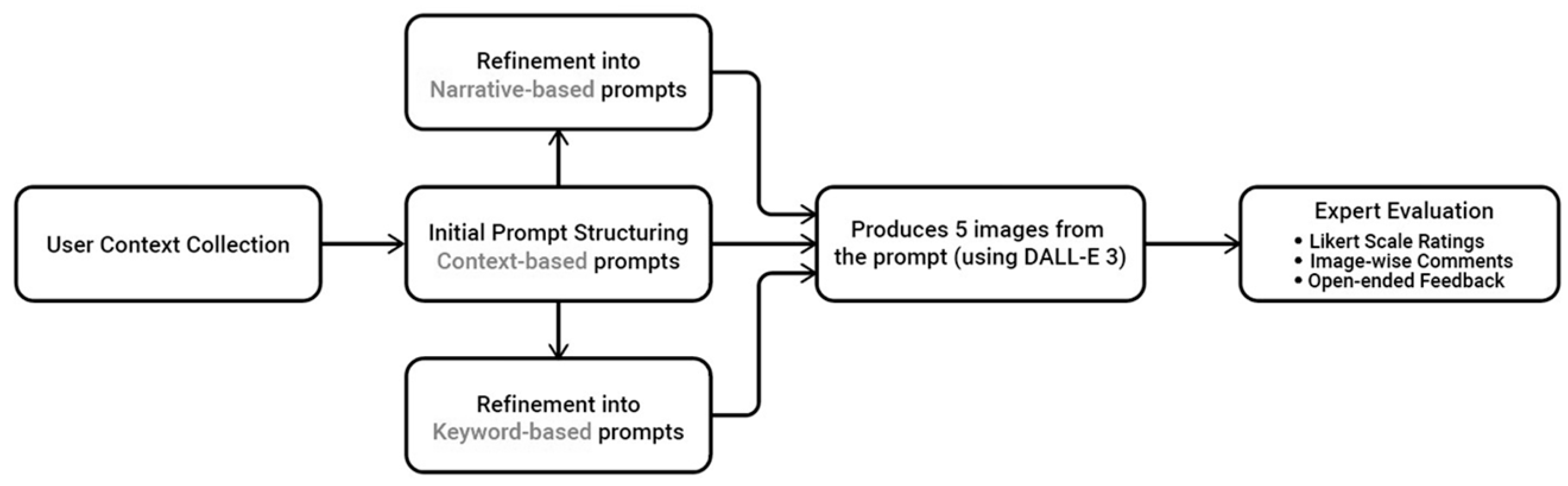
In this study, a user-centered generative design workflow was developed to support early-stage product ideation by designers. As shown in Figure 1, the research methodology consists of a series of sequential steps.
Figure 1.
Research procedure.
3.1. User Context Extraction and Translation of Needs
The product design method developed in this study focused on tool storage solutions for elderly small-scale farmers. We incorporated interviews to capture authentic pain points and user expressions derived from the actual farming experiences of elderly users.
For example, one respondent stated, “I bend over and turn the soil and weeds in the fields every day. After a while, my waist really can’t bear it. It’s not that I can’t move; I just hope that the tools can save some effort. Sometimes I have to carry a bunch of tools with different functions for several trips, which is really troublesome. If there is a tool that can combine several functions, can be easily carried around, and is not too expensive, it will really help a lot. I don’t reject new designs. As long as the operation is simple, I know how to use it at a glance. Even if it looks different from before, I will be happy to use it.”
This statement highlights the need for reduced physical strain, multifunctionality, ease of use, affordability, and openness to new designs if intuitive to operate.
3.2. Prompt Design and Refinement
While previous studies emphasized designers’ subjective inputs [17], we adopted a user-centered approach by transforming interview and observation data into AI prompts. Original user statements served as context-based prompts, which were then used to generate narrative-based and keyword-based versions using ChatGPT with tailored transformation instructions. This process yielded three distinct prompt types: context-based, narrative-based, and keyword-based (Table 1 and Table 2).
Table 1.
Prompt types and their corresponding refinement instructions.
Table 2.
Prompt types and their corresponding outputs.
3.3. Image Generation and Iterative Refinement Strategy
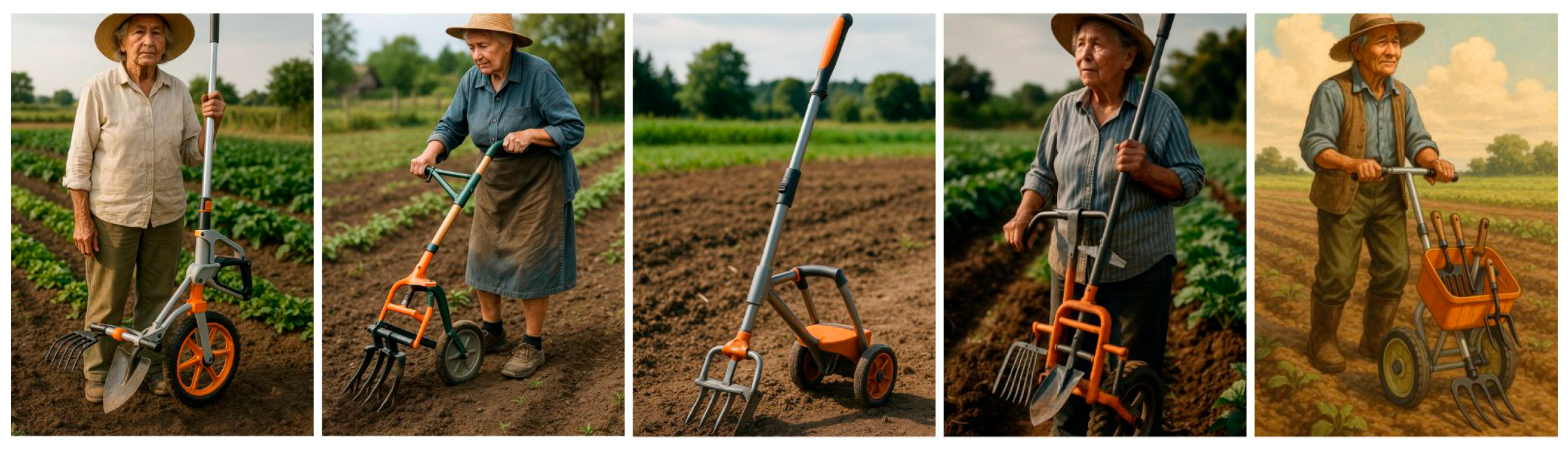
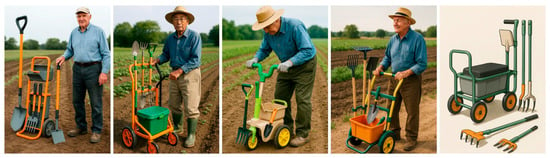
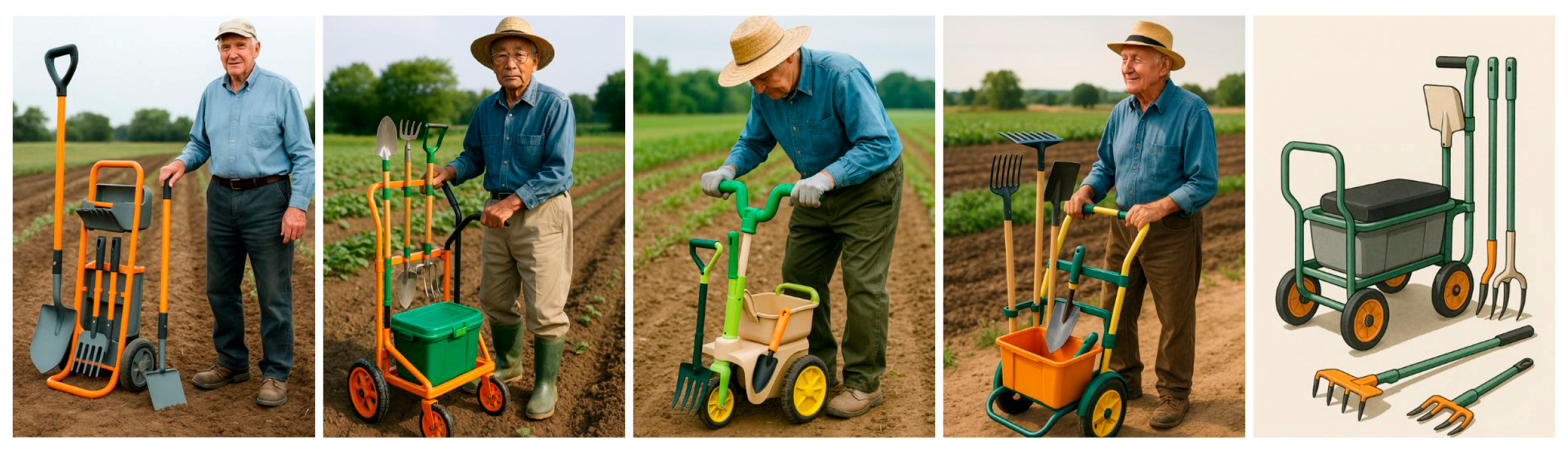
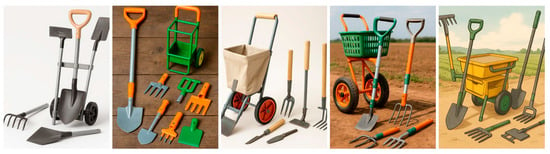
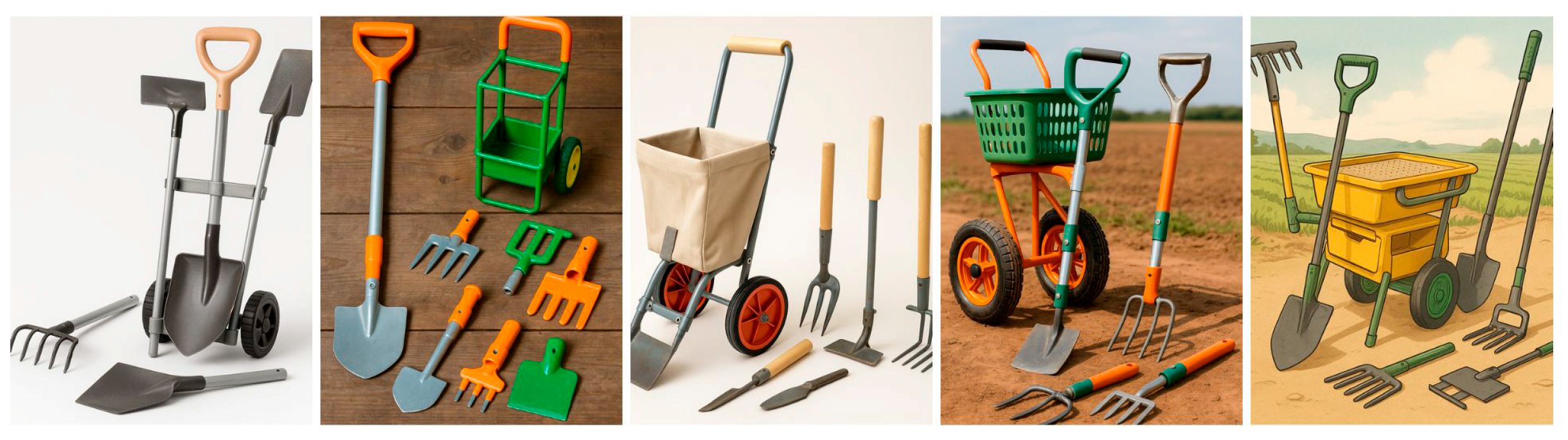
We employed DALL·E 3 to generate concept sketches based on prompts created via ChatGPT-4o. Following prior work recommending 3–9 outputs per prompt [18,19], five images were generated for each of the three prompt types to ensure visual variety. All prompts remained unchanged to maintain experimental control. If outputs deviated from intended goals or style, images were regenerated using the same prompt. Figure 2, Figure 3 and Figure 4 display the final set of 15 images.
Figure 2.
Image outputs generated from the context-based prompt.
Figure 3.
Image outputs generated from the narrative-based prompt.
Figure 4.
Image outputs generated from the keyword-based prompt.
3.4. Expert Evaluation
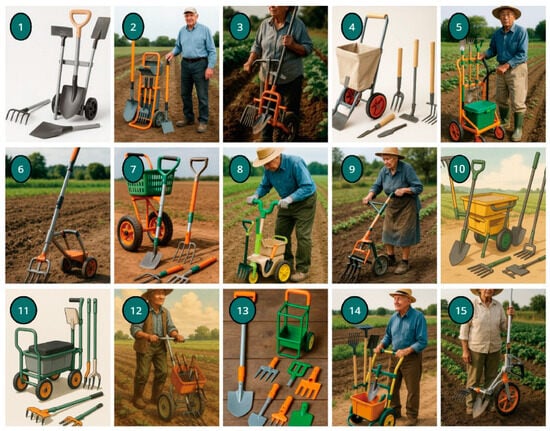
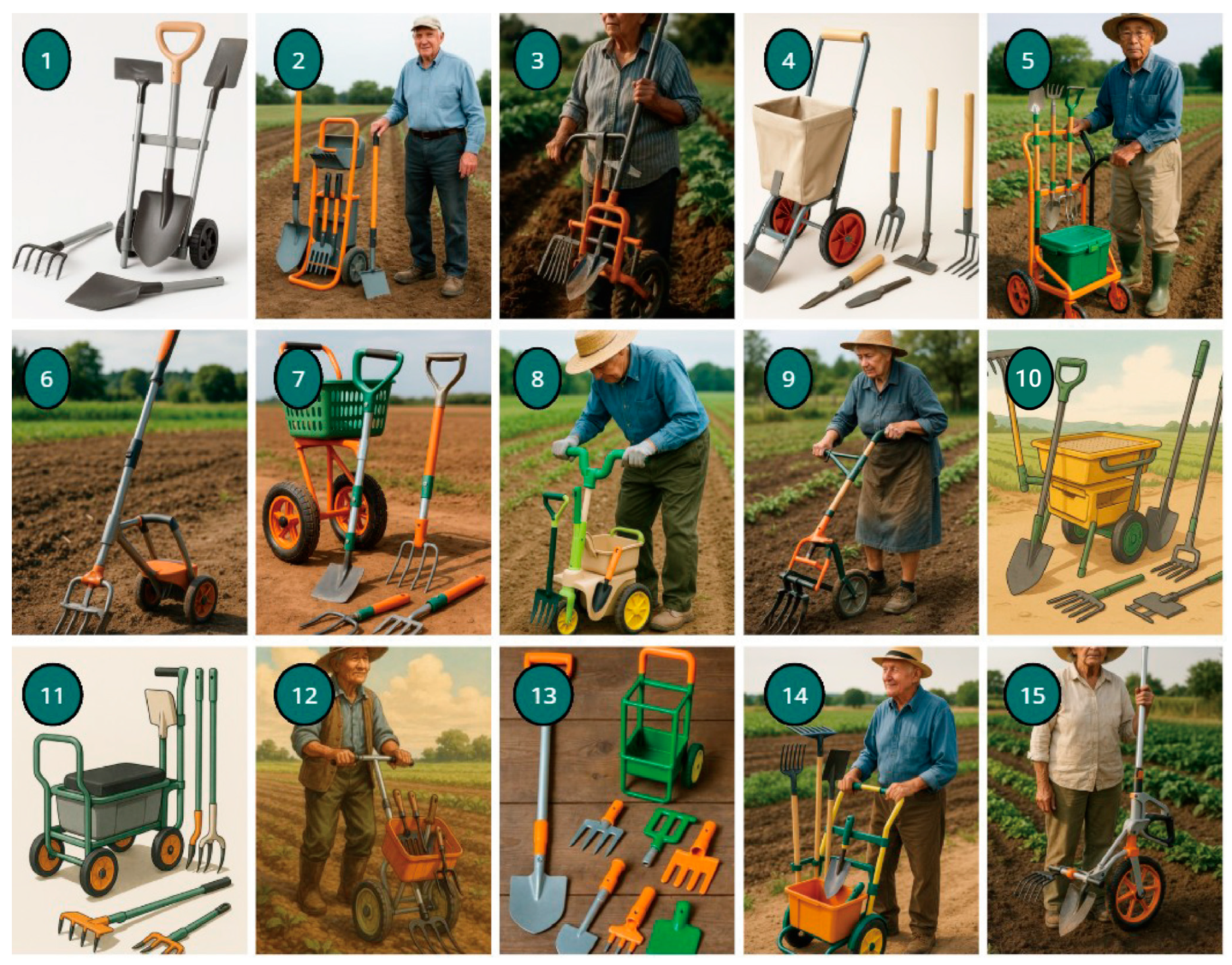
Seven participants, including five industrial design experts and two experienced farmers, evaluated 15 concept images using a five-point Likert scale (ranging from 1 to 5, where 1 is the lowest and 5 is the highest score) across five criteria: creativity, practicality, usability, familiarity, and alignment with design intent. To avoid order effects [20], the sequence of the images was randomized before evaluation (Figure 5). Participants were not informed of the underlying prompt type for each image. The corresponding image numbers for each prompt type were as follows.
Figure 5.
The randomized order of the 15 concept images presented during the expert evaluation. Participants were blind to the prompt types associated with each image.
- Context-based: 3, 6, 9, 12, 15;
- Narrative-based: 2, 5, 8, 11, 14;
- Keyword-based: 1, 4, 7, 10, 13.
Beyond the quantitative ratings, all seven participants offered qualitative comments and answered three open-ended questions regarding overall impressions, image preferences, and views on AI-assisted design. Responses were analyzed using thematic analysis [21] to uncover shared themes and differing perspectives. Representative quotes were used to illustrate key insights. Table 3 summarizes the background information of the participating experts.
Table 3.
Profiles of experts participating in the evaluation.
4. Results
4.1. Quantitative Results
In the descriptive analysis, Images 6, 9, 14, and 15 received the highest scores, with Image 6 achieving 4.0 or above across all aspects. Conversely, Images 1, 10, and 13 scored the lowest, particularly in practicality and alignment. Context-based prompts reached up to 4.43 in alignment, while keyword-based prompts remained from 1.29 to 2.29 (Table 4). These results indicate that context-rich prompts consistently outperformed the other types, especially in usability, familiarity, and alignment, suggesting their potential to improve the quality and relevance of AI-generated design outputs.
Table 4.
Mean scores of 15 concept images across five evaluation criteria.
One-way ANOVA revealed significant differences in the ratings among the three prompt types across all five evaluation criteria: creativity (F(2, 102) = 39.041, p < 0.001), practicality (F(2, 102) = 26.843, p < 0.001), usability (F(2, 102) = 12.074, p < 0.001), familiarity (F(2, 102) = 11.211, p < 0.001), and design alignment (F(2, 102) = 44.607, p < 0.001).
Post hoc Duncan tests indicated that context-based prompts consistently received significantly higher scores than keyword-based and narrative-based prompts, particularly in design alignment (mean = 4.00) and creativity (mean = 4.20), while keyword-based prompts were rated lowest across all dimensions.
4.2. Qualitative Analysis
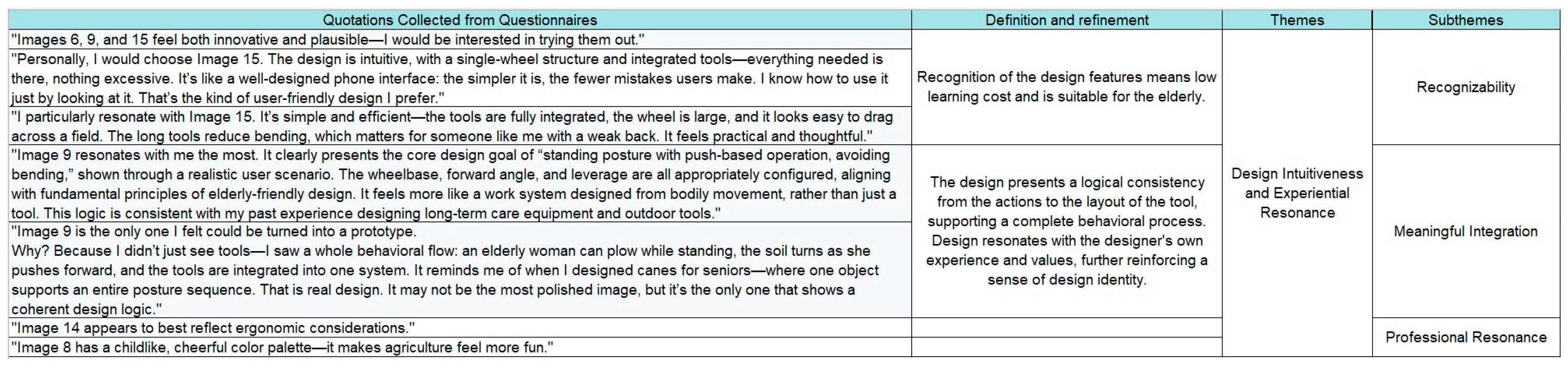
Several images received particular attention in the qualitative feedback. Image 9, Image 14, and Image 15 were frequently praised, while Image 1 and Image 13 drew criticism (Table 5 and Table 6). These insights highlight perceptual differences in design quality and complement aspects not captured by the quantitative analysis.
Table 5.
Key critical comments on high-rated generated images.
Table 6.
Key critical comments on low-rated generated images.
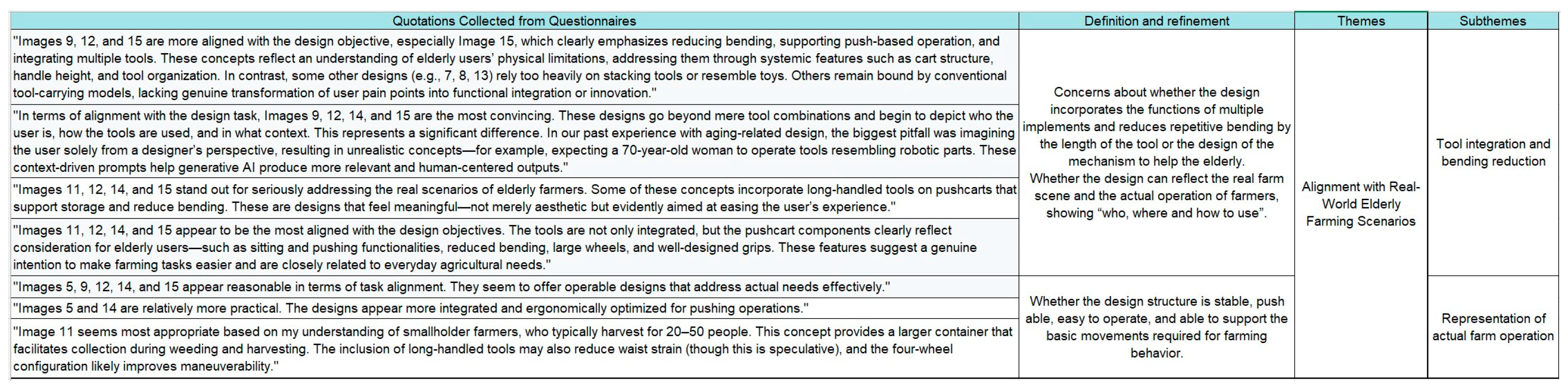
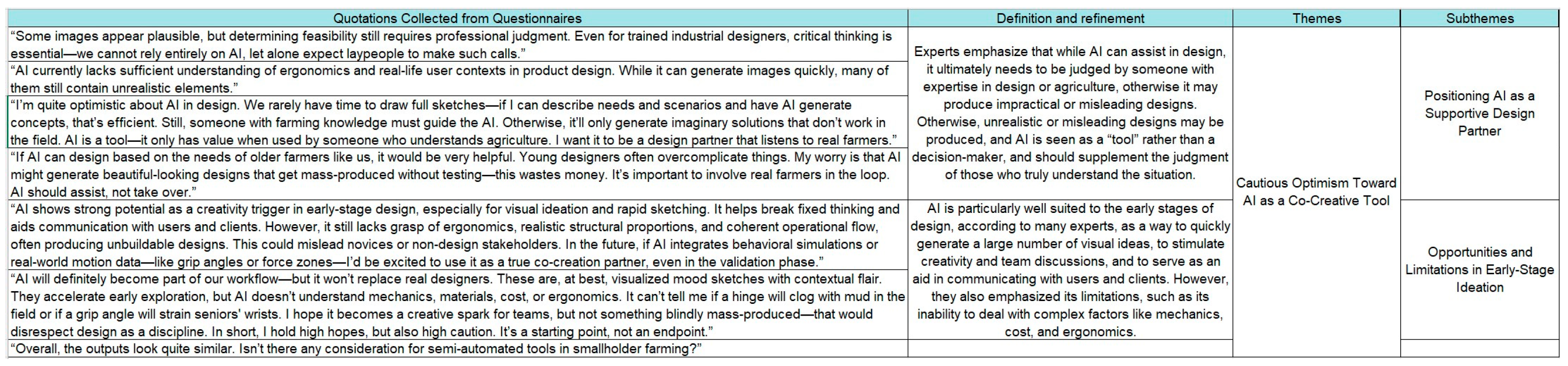
In addition to individual image feedback, open-ended responses were thematically analyzed to extract broader expert perspectives (Figure 6, Figure 7 and Figure 8). Thematic analysis revealed that experts valued designs aligned with elderly farming needs, appreciated intuitive and embodied design features, and viewed AI as a helpful but limited ideation partner requiring human judgment.
Figure 6.
Thematic coding results for Question 1: Design alignment with task objectives.
Figure 7.
Thematic coding results for Question 2: Design preference and resonance.
Figure 8.
Thematic coding results for Question 3: Attitudes toward AI-assisted design.
5. Conclusions
We developed a user-contextual prompting approach to guide GAI in conceptual design for elderly farmers. The results showed that context-based prompts yielded the highest scores across multiple evaluation criteria, especially in creativity and design intent alignment, while keyword-based prompts performed the weakest. The developed workflow, combining structured prompt design with both quantitative and thematic analysis, proved effective in revealing the value of integrating user scenarios into AI generation. The method offers practical insights for early-stage design, especially when addressing overlooked user groups. The workflow highlights the importance of critical engagement with AI outputs and demonstrates that meaningful user input can significantly improve design relevance. Future research should explore interactive evaluation methods and include broader participant perspectives to enhance generalizability.
Author Contributions
Conceptualization, H.-H.W. and Y.-L.H.; methodology, Y.-L.H.; software, Y.-L.H.; validation, H.-H.W. and Y.-L.H.; formal analysis, Y.-L.H.; investigation, Y.-L.H.; resources, Y.-L.H.; data curation, Y.-L.H.; writing—original draft preparation, Y.-L.H.; writing—review and editing, H.-H.W.; visualization, Y.-L.H.; supervision, H.-H.W.; project administration, H.-H.W.; funding acquisition, H.-H.W. All authors have read and agreed to the published version of the manuscript.
Funding
This research was funded by the National Science and Technology Council (NSTC), Taiwan, R.O.C., grant number NSTC 113-2410-H-027-007-MY2.
Institutional Review Board Statement
Not applicable.
Informed Consent Statement
Not applicable.
Data Availability Statement
Data are contained within the article.
Acknowledgments
During the preparation of this manuscript/study, the authors used ChatGPT-4o and DALL·E 3 for the purposes of generating concept sketches. The authors have reviewed and edited the output and take full responsibility for the content of this publication.
Conflicts of Interest
The authors declare no conflict of interest.
References
- Fu, Y.; Bin, H.; Zhou, T.; Wang, M.; Chen, Y.; Lai, Z.G.D.C.; Wobbrock, J.O.; Hiniker, A. Creativity in the Age of AI: Evaluating the Impact of Generative AI on Design Outputs and Designers’ Creative Thinking. arXiv 2024, arXiv:2411.00168. [Google Scholar] [CrossRef] [Scilit]
- Furtado, L.S.; Soares, J.B.; Furtado, V. A Task-Oriented Framework for Generative AI in Design. J. Creat. 2024, 34, 100086. [Google Scholar] [CrossRef] [Scilit]
- Zhou, E.; Lee, D. Generative Artificial Intelligence, Human Creativity, and Art. PNAS Nexus 2024, 3, pgae052. [Google Scholar] [CrossRef] [Scilit] [PubMed]
- Fleischmann, K. Making the Case for Introducing Generative Artificial Intelligence (AI) into Design Curricula. Art Des. Commun. High. Educ. 2024, 23, 187–207. [Google Scholar] [CrossRef] [Scilit]
- Wu, Z.; Ji, D.; Yu, K.; Zeng, X.; Wu, D.; Shidujaman, M. AI Creativity and the Human-AI Co-Creation Model. In Proceedings of the Human-Computer Interaction. Theory, Methods and Tools; Kurosu, M., Ed.; Springer International Publishing: Cham, Switzerland, 2021; pp. 171–190. [Google Scholar]
- Denim Design Reimagined by AI and Brought to Life by G-Star RAW. Available online: https://www.g-star.com/stories/art/artificial-intelligence-fashion (accessed on 18 July 2025).
- The Frontier of MedTech: AI-Driven Medical Devices. Available online: https://www.wipo.int/web/global-health/w/news/2023/news_0021 (accessed on 18 July 2025).
- Ikea’s Generative AI Furniture Designs Are Trippy, Retro, Inspiring. Available online: https://www.fastcompany.com/90871133/ikea-generative-ai-furniture-design (accessed on 18 July 2025).
- Oehlberg, L.; Roschuni, C.; Agogino, A. A Descriptive Study of Designers’ Tools for Capturing, Reflecting on, and Sharing User Needs and Conceptual Designs. In Proceedings of the ASME 2011 International Design Engineering Technical Conferences and Computers and Information in Engineering Conference, Washington, DC, USA, 28–31 August 2011. [Google Scholar]
- Johnson, E.K. Miro, Miro: Student Perceptions of a Visual Discussion Board. In Proceedings of the 40th ACM International Conference on Design of Communication; Association for Computing Machinery: New York, NY, USA, 2022; pp. 96–101. [Google Scholar]
- Chen, T.-L.; Chuang, Y.; Zhu, R. The Impact of Different Prompt Structures and Parts of Speech on the Image Generation Results of Generative AI. In Proceedings of the 2024 6th International Conference on Control and Robotics (ICCR); IEEE: New York, NJ, USA, 2024; pp. 275–280. [Google Scholar]
- Chong, L.; Lo, I.-P.; Rayan, J.; Dow, S.; Ahmed, F.; Lykourentzou, I. Prompting for Products: Investigating Design Space Exploration Strategies for Text-to-Image Generative Models. Des. Sci. 2025, 11, e2. [Google Scholar] [CrossRef] [Scilit]
- Longo, G.; Middleton, D.A.; Albano, S. Elaborating a Framework That Is Able to Structure and Evaluate Design Workflow and Composition of Generative AI Visualizations. In Proceedings of the Human Interaction and Emerging Technologies (IHIET-AI 2024): Artificial Intelligence and Future Applications; AHFE Open Access: Istanbul, Turkey, 2024; Volume 120. [Google Scholar]
- Cai, A.; Rick, S.R.; Heyman, J.L.; Zhang, Y.; Filipowicz, A.; Hong, M.; Klenk, M.; Malone, T. DesignAID: Using Generative AI and Semantic Diversity for Design Inspiration. In Proceedings of the ACM Collective Intelligence Conference; ACM: Delft, The Netherlands, 2023; pp. 1–11. [Google Scholar]
- Hutchinson, B.; Baldridge, J.; Prabhakaran, V. Underspecification in Scene Description-to-Depiction Tasks. arXiv 2022, arXiv:2210.05815. [Google Scholar] [CrossRef] [Scilit]
- Ma, K.; Grandi, D.; McComb, C.; Goucher-Lambert, K. Exploring the Capabilities of Large Language Models for Generating Diverse Design Solutions. arXiv 2024, arXiv:2405.02345. [Google Scholar] [CrossRef] [Scilit]
- Kwon, J.; Jung, E.-C.; Kim, J. Designer-Generative AI Ideation Process: Generating Images Aligned with Designer Intent in Early-Stage Concept Exploration in Product Design. Arch. Des. Res. 2024, 37, 7–23. [Google Scholar] [CrossRef] [Scilit]
- Liu, V.; Chilton, L.B. Design Guidelines for Prompt Engineering Text-to-Image Generative Models. In Proceedings of the 2022 CHI Conference on Human Factors in Computing Systems; Association for Computing Machinery: New York, NY, USA, 2023. [Google Scholar]
- Thampanichwat, C.; Wongvorachan, T.; Sirisakdi, L.; Chunhajinda, P.; Bunyarittikit, S.; Wongmahasiri, R. Mindful Architecture from Text-to-Image AI Perspectives: A Case Study of DALL-E, Midjourney, and Stable Diffusion. Buildings 2025, 15, 972. [Google Scholar] [CrossRef] [Scilit]
- Lucas, C.P. The Order Effect: Reflections on the Validity of Multiple Test Presentations. Psychol. Med. 1992, 22, 197–202. [Google Scholar] [CrossRef] [Scilit] [PubMed]
- Braun, V.; Clarke, V. Using Thematic Analysis in Psychology. Qual. Res. Psychol. 2006, 3, 77–101. [Google Scholar] [CrossRef] [Scilit]

Disclaimer/Publisher’s Note: The statements, opinions and data contained in all publications are solely those of the individual author(s) and contributor(s) and not of MDPI and/or the editor(s). MDPI and/or the editor(s) disclaim responsibility for any injury to people or property resulting from any ideas, methods, instructions or products referred to in the content. |
© 2026 by the authors. Licensee MDPI, Basel, Switzerland. This article is an open access article distributed under the terms and conditions of the Creative Commons Attribution (CC BY) license.