


Abstract
This study evaluated the biogas generation potential of kitchen waste from five restaurants and traditional halls at Kwame Nkrumah University of Science and Technology (KNUST) through anaerobic digestion. A total of 6868 kg of peels from cassava, plantain, and yam were generated and processed during the study period, from which representative samples were collected and analyzed for total solids, volatile solids, and ash content. The waste showed high biodegradability, with methane yields between 0.45–0.52 m3 CH4/kg, surpassing conventional livestock manure. These results demonstrate that institutional kitchen waste offers a sustainable substrate for decentralized biogas production, supporting circular economy initiatives and providing a low-cost solution for energy and waste management in West African campuses.
1. Introduction
Rapid urbanization and growth in tertiary institutions have intensified energy demand and waste generation, particularly organic fractions such as food and vegetable residues [1]. Conventional waste management practices in many African cities still rely heavily on landfilling and open dumping, which contribute to greenhouse gas emissions, odor nuisance, and public health risks while foregoing opportunities for resource recovery [2,3]. At the same time, dependence on biomass and fossil fuels for thermal energy on university campuses drives deforestation, indoor air pollution, and rising energy costs [4,5].
Anaerobic digestion offers an integrated solution by stabilizing organic waste while producing biogas for cooking, heating, or electricity generation and a nutrient-rich digestate suitable for use as biofertilizer [6,7]. Previous studies have primarily focused on livestock manure, sewage sludge, or mixed municipal solid waste as substrates, which are often characterized by lower specific methane yields and logistical challenges related to collection and handling [6,8]. In contrast, source-separated kitchen waste from institutional catering units tends to exhibit a higher moisture content, elevated volatile solids, and lower ash fractions, making it more readily biodegradable and suitable for efficient biomethanation [9,10]. Despite these advantages, there is limited quantitative evidence on the biogas potential of kitchen waste streams in high-density West African institutional settings, and even less on their integration into decentralized campus-scale energy systems [8,9,10].
This study addresses this gap by characterizing the quantity and composition of kitchen waste generated by restaurants and traditional halls at Kwame Nkrumah University of Science and Technology (KNUST), Ghana, and by experimentally determining its methane yield under anaerobic digestion. The work compares kitchen-waste-based performance with conventional manure-based benchmarks and evaluates the implications for waste diversion, emissions reduction, and on-site energy provision. The findings aim to inform the design and scaling of kitchen-waste-fed digesters for universities and similar institutions across the region, contributing to improved waste valorizations, enhanced energy security, and reduced reliance on landfilling and fossil fuels.
2. Materials and Methods
2.1. Study Area, Materials, Feedstock, and Data Collection
This study utilized various kitchen waste types, including cassava peels, plantain peels, yam peels, vegetable waste, fish, and meat waste. This study employed a dual-phase approach consisting of field-based waste quantification and laboratory-scale characterization to assess the viability of kitchen waste for biogas production. These materials were sourced from canteens and restaurants within and around the KNUST campus, specifically Unity Hall Canteen, Queens Hall Canteen, Sambra Restaurant, Accuzi Restaurant, and Daily Bite Restaurant. Waste collection was conducted over a continuous three-week period during the academic semester when campus restaurants and canteens were operating under normal conditions. Daily waste quantities recorded during this period were used to compute the average daily waste generation rate (kg day−1). Monthly and semester waste generation estimates were obtained by extrapolating the mean daily value to 30 days and to the duration of an academic semester, respectively. This approach assumes relatively stable food preparation practices and customer demand across the semester, which is typical for institutional catering services.
Data collection involved providing dust bins and rubber sacks with labels for major kitchen waste types at the selected establishments. Collected waste in rubber sacks was weighed and recorded. Laboratory analysis involved the use of apparatus such as crucibles, weighing balances, ovens, desiccators, muffle furnaces, rubber sacks, dust bins, gloves, and rubber liners. Descriptive statistical analysis was applied to the waste generation data. Daily waste quantities were summarized using mean and standard deviation to describe central tendency and variability over the three-week monitoring period. No inferential statistical analyses were conducted, as the study focused on waste quantification and energy potential estimation rather than hypothesis testing or comparative analysis.
2.2. Total Solid Determination
A crucible of known weight was properly washed and dried in the lab oven at a temperature of 100 °C for an hour and was stored and cooled in a desiccator. The crucible was weighed repeatedly to ensure consistence. The oven was switched on and set at a temperature of 105 °C, and the temperature was maintained throughout the experiment. Afterwards, 5.00 g of the collected sample was sliced into a smaller size, put in the crucible, and weighed. The crucible with the samples was placed in the oven at a temperature of 105 °C, and the substrate was dried to a constant mass for 2 h. The crucible and substrate residue were weighed, and this was done for all the samples collected. The percentage of total solid was calculated using Equation (1).
where %TS = Percentage Total Solid, W1 = weight of dried crucible + dried residue, W2 = weight of the crucible and W3 = weight of wet sample + crucible.
2.3. Total Volatile Solid Determination
The volatile solid is the solids remaining after the evaporation or filtration is dried, weighed, and ignited at 600 °C. The residue obtained from the total solid determination was ignited at 600 °C for two (2) hours, using the muffle furnace, and the residue was then cooled in the desiccator to balance the temperature. The samples were weighed, and the percentage volatile solid was calculated using Equation (2):
where %VS = percentage volatile solid, and W4 = weight of crucible + weight of residues cooled in the desiccator.
2.4. Total Ash Content
Ash content in organic wastes comprises the residue remaining after all moisture has been removed and the fats, protein, carbohydrate, vitamins, organic acids, etc., have been burnt away by ignition at a temperature of 600 °C. Crucibles, which were washed, were dried in an oven at 100 °C and cooled in a desiccator and weighed. Samples of 5.00 g were placed in crucibles and weighed, and then placed in an oven for 2 h at 105 °C, and then cooled in a desiccator for 30 min and weighed. The samples in the crucibles were then placed inside the muffle furnace at 600 °C for 2 h, and the crucibles were cooled in a desiccator for 30 min and then reweighed. The percentage of ash content is determined using Equation (3):
where m1 = weight of the crucible, m2 = weight of crucibles + samples, and m3 = weight of crucibles + samples ignited after 600 °C.
2.5. Anaerobic Digestion Procedure
Anaerobic digestion of the collected kitchen waste was evaluated using a laboratory-scale batch digestion approach based on established mesophilic digestion principles. The digestion assessment focused on estimating biogas production potential from characterized feedstocks rather than continuous reactor operation. Following collection and sorting, the dominant biodegradable fractions of cassava peels, plantain peels, and yam peels were manually reduced to smaller particle sizes (≤20 mm) to enhance microbial accessibility. The substrates were homogenized to obtain a representative feedstock mixture based on their proportional contribution to the overall waste stream. Based on the determined average total solids content (27.78%), the digestion slurry was prepared using a waste-to-water ratio of 1:2 (w/w) to achieve a suitable moisture content for anaerobic microbial activity. This ratio falls within the optimal range for wet anaerobic digestion systems. The digestion process was designed for mesophilic conditions, assuming an operating temperature range of 30–37 °C, which is representative of ambient tropical conditions and commonly applied in small- to medium-scale biogas systems in sub-Saharan Africa. A hydraulic retention time (HRT) of 30 days was selected to allow sufficient degradation of readily biodegradable organic matter, which is consistent with standard retention periods reported for food and peel-based substrates. Biogas yield was estimated based on the volatile solids (VS) content of the feedstock. The average VS concentration of 92.60% indicated high biodegradability. Methane yield values were derived using reported specific methane potentials for kitchen waste substrates (0.45–0.52 m3 CH4 kg−1 VS), enabling an estimation of daily and cumulative biogas production from the measured waste quantities. The digestion performance assessment focused on substrate suitability, expected gas yield, and feasibility for decentralized campus-scale biogas applications rather than direct gas composition measurement. The methodological framework adopted provides a realistic basis for evaluating the energy recovery potential of institutional kitchen waste.
3. Results and Discussion
3.1. Waste Generation from Selected Restaurants/Canteens
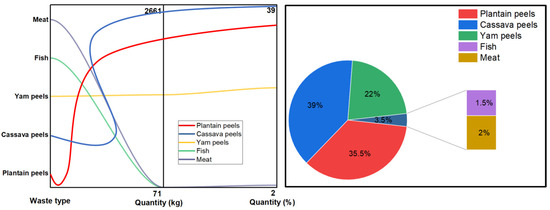
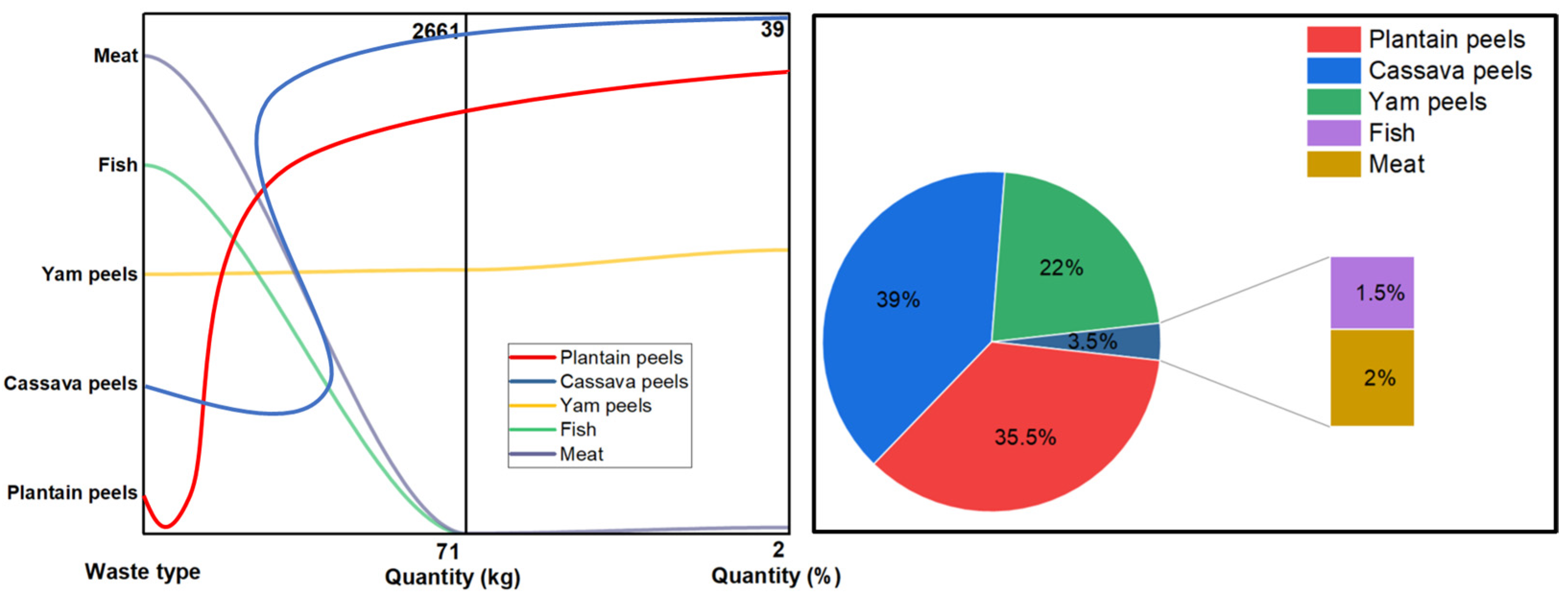
The waste assessment conducted over a three-week period resulted in the quantification of five major categories of kitchen waste: plantain peels, cassava peels, yam peels, fish leftovers, and meat leftovers. Analysis revealed that cassava peels constituted the highest fraction of the waste stream, representing approximately 39% of total waste, as shown in Figure 1. This suggests a high frequency of cassava-based meals within the sampled facilities. Fish leftovers (1.03%) and meat leftovers (1.09%) were the least generated, likely due to lower processing waste or higher utilization efficiency. By computing the average weekly generation (1144.69 kg), projected waste generation per semester and per academic year were estimated as 6104.0 kg and 13,736.3 kg, respectively. These projections demonstrate the substantial volume of biodegradable waste produced within the institution, consistent with findings by Max et al. [11], who reported high fractions of peel-based waste in institutional kitchens in Ghana.
Figure 1.
Quantity of kitchen waste by weight percent.
3.2. Waste Composition and Laboratory Characterization
To assess the suitability of the waste for biogas production, plantain peels, yam peels, and cassava peels, being the highest contributors, were subjected to laboratory analysis. The parameters measured were Total Solids (TS), Volatile Solids (VS), and ash content. These properties serve as indicators of moisture level, organic matter content, and biodegradability.
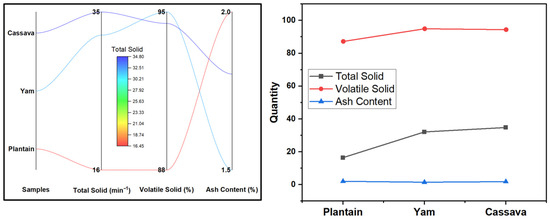
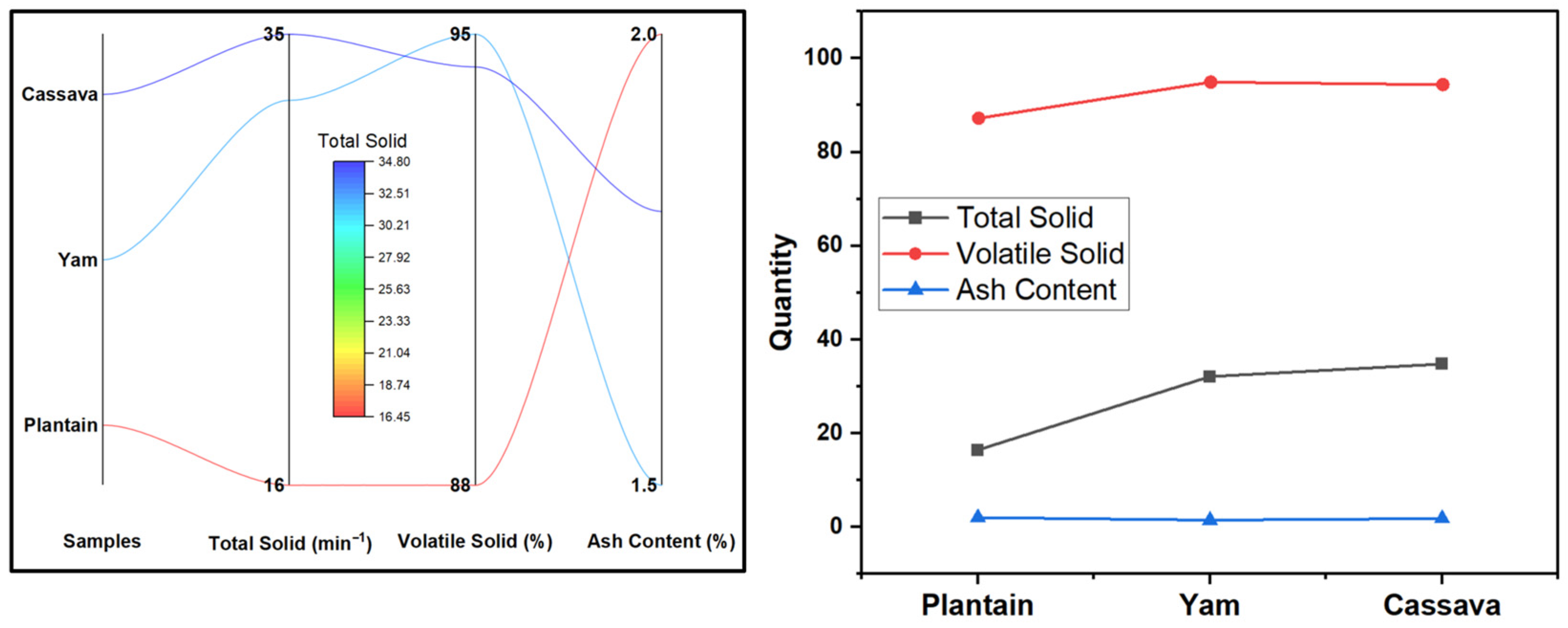
The TS values indicate that yams and cassava peels have significantly lower moisture content relative to plantain peels as shown in Figure 2. High VS values (above 87%) across all samples demonstrate that the wastes contain substantial biodegradable organic matter suitable for anaerobic digestion. This aligns with studies by Meegoda et al. (2018) [8], who reported that peel-based waste streams typically have VS contents exceeding 85%, making them efficient substrates for methane production. The ash content was low (1.47–2.03%), indicating limited inorganic matter. Low ash content is favorable for biogas production because inorganic materials do not contribute to gas yield and can hinder digestion performance.
Figure 2.
Plantain, Yam, and cassava peels total solid, volatility, and ash content determined using indicators of moisture level, organic matter content, and biodegradability. The light purple colour line indicate cassava total solid, volatile solid and ash content. The light blue colour line indicate the Yam total solid, volatile solid and ash content. The light red colour line indicate the plantain total solid, volatile solid and ash content.
Using the weighted averages derived from the waste composition, the overall feedstock characteristics were determined to be 27.78% TS and 92.60% VS. These values fall within the acceptable range for optimal anaerobic digestion, which requires TS levels of 20–40% and VS contents above 70%. The waste-to-water ratio for digestion was set at 1:2, ensuring sufficient content for microbial activity. A 30-day hydraulic retention time (HRT) was selected, consistent with standard mesophilic digestion systems.
3.3. Biogas Amount Estimation
3.3.1. Assumptions and Calculation Procedure
Biogas production estimates in this study were based on experimentally determined feedstock characteristics and literature-supported assumptions commonly applied in kitchen waste anaerobic digestion studies as shown in Table 1. The following assumptions were applied consistently throughout the analysis:
Table 1.
Summary of key assumptions and design parameters used for biogas estimation.
- All collected kitchen waste was assumed to be source-separated and free from significant contamination by inert materials.
- The digestion process was assumed to operate under mesophilic conditions (30–37 °C).
- A waste-to-water mixing ratio of 1:2 (w/w) was used to achieve a suitable slurry consistency.
- A hydraulic retention time (HRT) of 30 days was assumed for the complete degradation of readily biodegradable organic matter.
- Biogas yield was estimated based on volatile solids (VS) content, assuming a methane yield range of 0.45–0.52 m3 CH4 kg−1 VS, consistent with reported values for food and peel-based waste substrates.
- Gas losses due to leakage and system inefficiencies were not considered, representing ideal digestion conditions.
3.3.2. Total Biogas Estimation
Assuming methane constitutes approximately 60% of biogas, total biogas production was estimated accordingly.
The average waste generated per day was estimated to be 342.15 kg/day.
Assuming a mixture ratio of 1:2 of waste and water, respectively:
Assuming a retention period of 30 days:
Feedstock Quality
The average total solid of all waste collected is 27.78% TS, and the average volatile solid of all the waste collected is 92.60% VS.
Amount of Gas
Taking biogas yield as
These results suggest that the waste generated within the institution could sustain a small to medium-scale biogas plant, providing renewable energy for cooking or electricity generation.
3.4. Significance of Findings in Relation to Similar Studies
The estimation of biogas and methane production in this study was based on volatile solids (VS) content and established calculation approaches reported in the anaerobic digestion literature. The daily methane production was calculated by multiplying the mass of volatile solids fed into the digester by the specific methane yield (m3 CH4 kg−1 VS), following widely adopted methods for assessing the biomethane potential of organic waste substrates [8,12]. Specific methane yield values in the range of 0.45–0.52 m3 CH4 kg−1 VS were adopted based on reported yields for food waste and peel-based substrates under mesophilic digestion conditions [5,8]. Total biogas production was subsequently estimated by assuming a methane fraction of approximately 60% in biogas, consistent with typical values reported for kitchen waste digestion systems [12,13,14].
An experimental assessment of cassava, plantain, and yam peel substrates reported biogas yields of 218 ± 19 mL g−1 TS for cassava peels and 468 ± 72 mL g−1 TS for plantain peels under mesophilic conditions (37 ± 0.5 °C), with corresponding theoretical methane potentials in the same range as our study estimates when normalized on a methane basis [15]. These findings confirm that plantain peels tend to exhibit higher methane production relative to cassava peels, likely due to differences in carbohydrate composition and biodegradability [15]. For cassava peels specifically, prior work has documented cumulative methane yields around 178–368 mL CH4 g−1 VS depending on feedstock treatment and co-substrate use, with untreated cassava peels generally showing lower yields compared to co-digestion systems. Plantain peels have also been shown to produce appreciable methane volumes in other mesophilic batch systems, reinforcing that plantain waste is a promising substrate for biogas recovery.
The findings of this study are consistent with previous research demonstrating the suitability of institutional kitchen waste as a high-quality substrate for anaerobic digestion. Studies conducted on university campuses and urban food service facilities have reported total solids contents ranging from 20–35% and volatile solids contents above 80%, values comparable to those obtained in this study [8,12]. The high volatile solids fraction (92.60%) observed in the present work indicates a highly biodegradable feedstock, supporting efficient methane production.
Compared with similar studies on food and peel-based waste digestion, the estimated methane yield range reported here is within or above commonly reported values, underscoring the strong energy recovery potential of source-separated kitchen waste [5,14]. Notably, the scale and context of this study, which focused on a high-density university campus in a developing-country setting, adds to the limited body of data available for West African institutions. This highlights the practical relevance of the results for decentralized waste-to-energy systems aimed at reducing landfill disposal, lowering energy costs, and improving campus sustainability.
4. Conclusions
This study demonstrates that source-separated institutional kitchen waste from the KNUST campus constitutes a highly suitable substrate for anaerobic digestion, given its moderate total solids content, very high volatile solids fraction, and low ash content, all of which indicate strong biodegradability and limited inert material. On this basis, kitchen waste peels from cassava, plantain, and yam can be reliably valorized through biogas systems rather than disposed of via conventional waste pathways. The analysis further indicates that, under typical mesophilic operating conditions and standard design parameters, the quantity and quality of kitchen waste generated at KNUST are sufficient to sustain a small to medium-scale biogas plant that can provide a meaningful contribution to on-campus thermal energy demand. This confirms that institutional catering operations in similar high-density settings have the technical potential to transition part of their energy supply from biomass and fossil fuels to locally produced biogas, thereby supporting cleaner cooking solutions and improved energy security. More broadly, the findings highlight that integrating kitchen-waste-based anaerobic digestion into campus waste management can simultaneously reduce the volume of biodegradable waste sent to landfills, lower associated greenhouse gas emissions, and create a circular resource use pathway within the institution. For universities and comparable institutions in West Africa and other low- and middle-income regions, adopting such systems can therefore serve as a practical step toward sustainable waste management and decentralized renewable energy provision.
Author Contributions
Conceptualization, F.T.; formal analysis, F.T. and D.S.; investigation, F.T.; writing—original draft, F.T. and P.Y.L.; methodology, F.T. and L.O.; validation, F.T., D.S., P.Y.L., M.B. and L.O.; data curation, F.T., D.S., P.Y.L., M.B. and L.O.; writing—review and editing, F.T., D.S., P.Y.L., M.B. and L.O. All authors have read and agreed to the published version of the manuscript.
Funding
This research received no external funding.
Institutional Review Board Statement
Not applicable.
Informed Consent Statement
Not applicable.
Data Availability Statement
The original contributions presented in this study are included in the article. Further inquiries can be directed to the corresponding author.
Acknowledgments
The authors gratefully acknowledge the Department of Agricultural Engineering and the Kwame Nkrumah University of Science and Technology (KNUST) for providing technical and laboratory support.
Conflicts of Interest
The authors declare no conflicts of interest.
References
- Das, S.; Lee, S.; Kumar, P.; Kim, K.; Soo, S.; Sundar, S. Solid waste management: Scope and the challenge of sustainability. J. Clean. Prod. 2019, 228, 658–678. [Google Scholar] [CrossRef] [Scilit]
- Asefi, H.; Shahparvari, S.; Chhetri, P. Advances in sustainable integrated solid waste management systems: Lessons learned over the. J. Environ. Plan. Manag. 2020, 63, 2287–2312. [Google Scholar] [CrossRef] [Scilit]
- Rubangakene, N.O.; Safo, K.; Shokry, H. Enhanced decontamination of cationic and anionic dye from aqueous solutions using Hybrid ultrasonicated eggshell biochar nanomaterial: Statistical optimization model, techno-economic and sustainable approach. Environ. Sci. Pollut. Res. 2025, 32, 12304–12327. [Google Scholar] [CrossRef] [Scilit] [PubMed]
- Mohammadalizadehkorde, M.; Weaver, R. Universities as Models of Sustainable Energy-Consuming Communities ? Review of Selected Literature. Sustainability 2018, 10, 3250. [Google Scholar] [CrossRef] [Scilit]
- Adedeji, P.A.; Akinlabi, S.; Madushele, N. Powering the future university campuses: A mini-review of feasible sources. Procedia Manuf. 2019, 35, 3–8. [Google Scholar] [CrossRef] [Scilit]
- Ren, Y.; Yu, M.; Wu, C.; Wang, Q.; Gao, M.; Huang, Q. Bioresource Technology A comprehensive review on food waste anaerobic digestion: Research updates and tendencies. Bioresour. Technol. 2017, 247, 1069–1076. [Google Scholar] [CrossRef] [Scilit] [PubMed]
- Wang, W.; Lee, D. Bioresource Technology Valorization of anaerobic digestion digestate: A prospect review. Bioresour. Technol. 2021, 323, 124626. [Google Scholar] [CrossRef] [Scilit] [PubMed]
- Meegoda, J.N.; Li, B.; Patel, K.; Wang, L.B. A Review of the Processes, Parameters, and Optimization of Anaerobic Digestion. Int. J. Environ. Res. Public Health 2018, 15, 2224. [Google Scholar] [CrossRef] [Scilit] [PubMed]
- Lohri, C.R.; Diener, S.; Zabaleta, I.; Mertenat, A.; Zurbrügg, C. Treatment technologies for urban solid biowaste to create value products: A review with focus on low- and middle-income settings. Rev. Environ. Sci. Bio/Technol. 2017, 16, 81–130. [Google Scholar] [CrossRef] [Scilit]
- Kadam, R.; Jo, S.; Lee, J.; Khanthong, K.; Jang, H.; Park, J. A Review on the Anaerobic Co-Digestion of Livestock Manures in the Context of Sustainable Waste Management. Energies 2024, 17, 546. [Google Scholar] [CrossRef] [Scilit]
- Rowan, M.; Umenweke, G.C.; Epelle, E.I.; Christianah, I.; Okoye, P.U.; Gunes, B.; Okolie, J.A. Anaerobic co-digestion of food waste and agricultural residues: An overview of feedstock properties and the impact of biochar addition. Digit. Chem. Eng. 2022, 4, 100046. [Google Scholar] [CrossRef] [Scilit]
- Angelidaki, I.; Treu, L.; Tsapekos, P.; Luo, G.; Campanaro, S.; Wenzel, H.; Kougias, P.G. Biogas upgrading and utilization: Current status and perspectives. Biotechnol. Adv. 2018, 36, 452–466. [Google Scholar] [CrossRef] [Scilit] [PubMed]
- 2019 Refinement to the 2006 IPCC Guidelines for National Greenhouse Gas Inventories; IPCC: Geneva, Switzerland, 2019.
- Srivastava, R.K.; Sarangi, P.K.; Sahoo, U.K.; Thakur, T.K.; Singh, H.B.; Subudhi, S. Biocatalysts for biomethanol production: Advancements and future prospects. Chem. Eng. 2024, 7, 2646. [Google Scholar] [CrossRef] [Scilit]
- Kusi, J.Y.; Empl, F.; Müller, R.; Pelz, S.; Poetsch, J.; Sailer, G.; Kirchhof, R.; Sarfo, N.; Derkyi, A.; Attiogbe, F. An Evaluation of Biogas Potential of Cassava, Yam and Plantain Peel Mixtures Using Theoretical Models and Hohenheim Biogas Yield Test-Based Experiments. Energies 2025, 18, 947. [Google Scholar] [CrossRef] [Scilit]

Disclaimer/Publisher’s Note: The statements, opinions and data contained in all publications are solely those of the individual author(s) and contributor(s) and not of MDPI and/or the editor(s). MDPI and/or the editor(s) disclaim responsibility for any injury to people or property resulting from any ideas, methods, instructions or products referred to in the content. |
© 2026 by the authors. Licensee MDPI, Basel, Switzerland. This article is an open access article distributed under the terms and conditions of the Creative Commons Attribution (CC BY) license (https://creativecommons.org/licenses/by/4.0/).