


Abstract
A green and efficient method was developed for the synthesis of 1,8-dioxo-octahydroxanthene derivatives using linear alkylbenzene sulfonic acid (LABSA) as an eco-friendly Brønsted acid catalyst under aqueous reflux conditions. This system combines micellar catalysis and acid activation to afford tricyclic products in high yields and with excellent purity. The transformation proceeds via a Knoevenagel–Michael sequence between dimedone and aromatic aldehydes, followed by intramolecular cyclization. The method exhibits broad substrate tolerance, affording yields between 80 and 92. The simplicity, scalability, and environmental compatibility of this process establish LABSA as a promising alternative to conventional acids for the green synthesis of pharmacologically relevant xanthene derivatives.
1. Introduction
Green chemistry emphasizes the design of sustainable synthetic methodologies that minimize environmental impact by reducing hazardous waste and avoiding toxic reagents [1]. Within this context, the use of catalysts designed to be both biodegradable and non-volatile represents a key strategy in sustainable organic synthesis. This dual characteristic directly addresses the imperatives of safety and eco-design; it eliminates the risk of persistent pollution through natural degradation at the end of their life cycle, and reduces the dangers of exposure and emission during handling. By replacing traditional catalysts that are often toxic, persistent, or volatile, this approach embodies the pursuit of an intrinsically safer chemistry, both for the operator and the ecosystem, while maintaining the necessary catalytic efficiency [2,3]. On the oter hand, heterocyclic compounds, particularly xanthene-based frameworks, are of great pharmacological interest because of their wide range of biological activities, including antibacterial [4], antiviral [5], and antioxidant properties [6,7,8,9]. These important compounds have been synthesized by various routes; many such catalysts, for example are NaHSO4•SiO2 [10], amberlyst-15 [11], and Fe3+-montmorillonite [12], which are solid acid catalysts. Shashi et al. [13] report an efficient, ultrasound-promoted synthesis of xanthenedione derivatives via the condensation of dimedone with aromatic aldehydes, catalyzed by boric acid in an ethanol–water medium. However, many conventional synthetic approaches involve harsh conditions, toxic solvents, or prolonged reaction times. To address these challenges, we investigated the use of linear alkylbenzene sulfonic acid (LABSA) as a biodegradable and non-volatile surfactant-type Brønsted acid catalyst for promoting the condensation of dimedone with aromatic aldehydes in water. LABSA offers dual functionality; proton donation for acid catalysis, and micellar phase-transfer activity, which enhances reaction efficiency in aqueous media. This study reports a green, solvent-free, and operationally simple synthesis of 1,8-dioxo-octahydroxanthene derivatives via aqueous reflux catalyzed by LABSA, demonstrating an eco-friendly alternative to traditional methods.
2. Materials and Methods
All chemicals and solvents used in the synthesis were procured from Sigma Aldrich (Munich, Germany). Chemicals in reagent grade and were employed without further purification. The solvents employed in column chromatography were obtained in technical grade and distilled using standard methods prior to use. All reactions were monitored using thin-layer chromatography (TLC) on silica Merck 60 F254 aluminum plates and were visualized by spraying with a ninhydrin solution (Darmstadt, Germany).
2.1. General Procedure for the Synthesis of 1,8-Dioxo-Octahydroxanthene Derivatives
A mixture of aromatic aldehyde (1.0 mmol) and dimedone (2.0 mmol) was refluxed in distilled water (40 mL) in the presence of linear alkylbenzene sulfonic acid (LABSA, 10 mol%) for six hours under continuous stirring. Reaction progress was monitored by thin-layer chromatography (TLC) using silica gel plates and suitable eluents.
Upon completion, the reaction mixture was cooled to room temperature, and the precipitated solid was filtered under vacuum. The crude product was washed thoroughly with cold water to remove residual catalyst and purified by recrystallization from hot ethanol. The synthesized compounds were characterized by FT-IR, 1H NMR, 13C NMR and MS.
2.2. Spectral Data
3,3,6,6-tetramethyl-9-phenyl-3,4,5,6,7,9-hexahydro-1H-xanthene-1,8(2H)-dione 5a
C22H23O3; MW: 350; yellow powder; m.p.: 203-205 °C. 1H NMR (400 MHz, CDCl3): δ 0.98 (s, 6H, 2CH3), 1.06 (s, 6H, 2CH3), 2.18 (dd, J = 13.6 Hz, J = 16.4 Hz, 4H, 2CH2), 2.46 (s, 4H, 2CH2), 4.80 (s, 1H, CH), 7.17–7.26 (m, 5H, Ar). 13C NMR (CDCl3,100 MHz): δ 27.29, 29.28, 31.46, 32.20, 40.84, 50.69, 115.27, 128.22, 129.77, 132.03, 142.69, 162.41, 196.35. IR (KBr disc, cm−1): 1670 (C=O), 1477 (C=C), 1189 (C–O), 750 (C–H).
3,3,6,6-tetramethyl-9-(4-hydroxyphenyl)-3,4,5,6,7,9-hexahydro-1H-xanthene-1,8 (2H)-dione 5b
C22H26O4; MW: 366; white powder; m.p.: 250-251 °C, IR (KBr) (υmax, cm−1): 1H NMR (400 MHz, CDCl3): δ 0.86 (s, 6H, 2CH3); 1.11 (s, 6H, 2CH3); 2.12-2.24 (dd, 4H, J = 16.6 Hz, 2CH2); 2.45 (4H, s, 2CH2); 4.91 (s, 1H, CH); 6.77 (m, 2H, Ar-H.); 6.93 (m, 2H, Ar-H); IR (KBr disc, cm-1): 3478 (OH), 1690 (C=O), 1577 (C=C), 1266 (C–O).
3,3,6,6-tetramethyl-9-(4-nitrophenyl)-3,4,5,6,7,9-hexahydro-1H-xanthene-1,8(2H)-dione 5c
C22H25NO5; MW: 395; white powder, m.p.: 223-225 °C, 1H NMR(400 MHz, CDCl3): 0.99 (s, 6H, 2CH3), 1.15 (s, 6H, 2CH3), 2.15-2.27 (m, 4H, 2CH2), 2.49 (m, 4H, 2CH2), 4.96 (s, 1H, CH), 7.51 (d, 2H, J = 8.0 Hz, Ar-H), 8.12(d, 2H, J = 8.0 Hz, Ar-H); 13C NMR (100 MHz, CDCl3): 27.70, 29.64, 32.64, 32.79, 41.27, 51.03, 114.96,123.83, 129.78, 146.92, 151.94, 163.36, 196.63.
3,3,6,6-tetramethyl-9-(4-chlorophenyl)-3,4,5,6,7,9-hexahydro-1H-xanthene-1,8(2H)-dione 5d
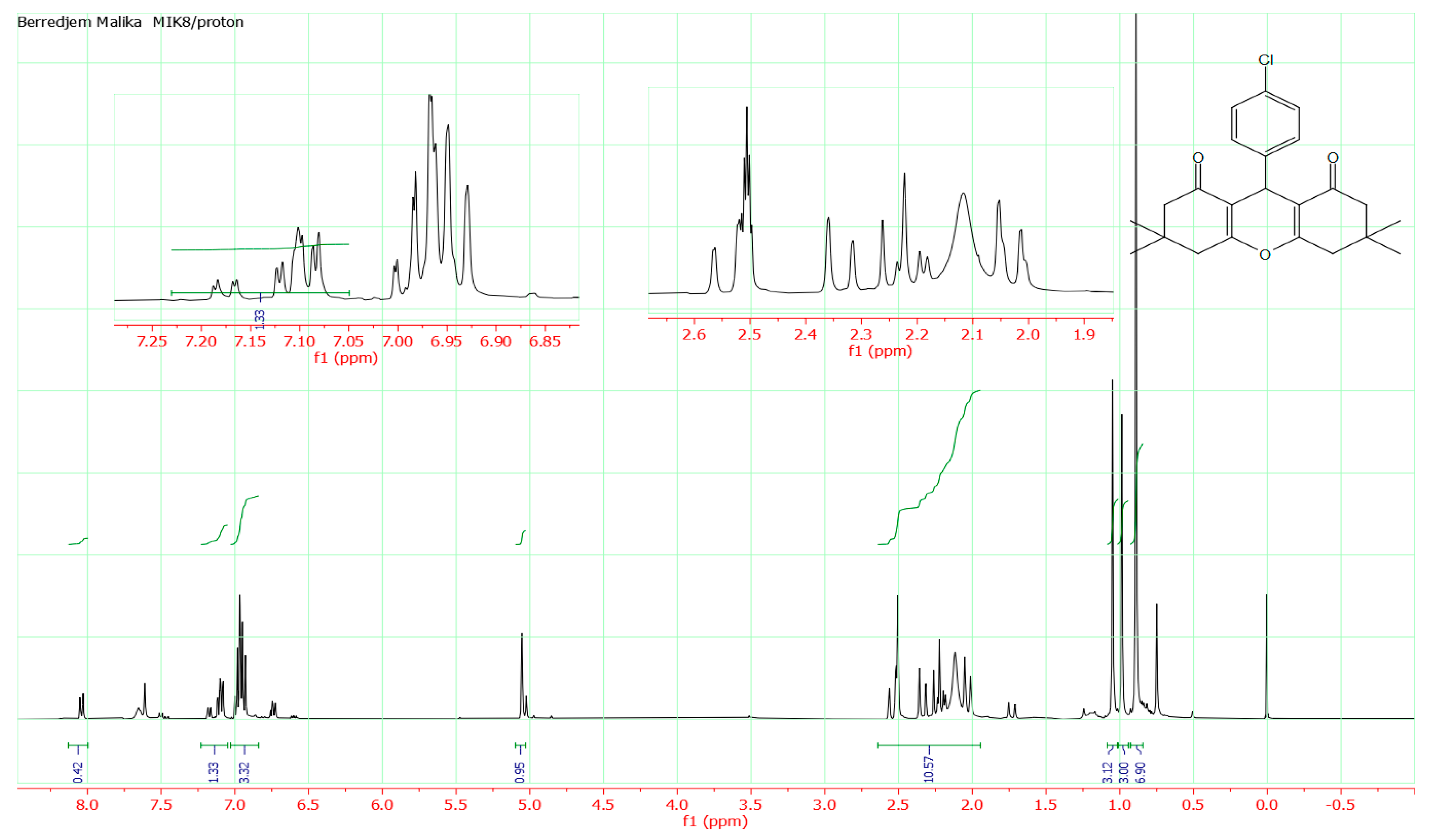
C22H25ClO3; MW: 384; yellow powder; mp: 230-232 °C. 1H NMR (400 MHz, CDCl3): δ 0.89 (s, 6H, 2CH3), 0.98 (s, 3H, CH3), 1.06 (s, 3H, CH3), 2.18-2.25 (2d, J = 13.6 Hz, 4H, 2CH2), 2.46 (s, 4H, 2CH2), 5.1 (s, 1H, CH), 6.90-7.11 (m, 4H, Ar-H). 13C NMR (CDCl3, 100 MHz): δ 27.29, 29.28, 31.46, 32.20, 40.84, 50.69, 115.27, 128.22, 129.77, 132.03, 142.69, 162.41, 196.35. IR (KBr disc, cm−1): 1680 (C=O), 1587 (C=C), 1235 (C–O), 750 (C–H).
3. Results and Discussion
Synthesis
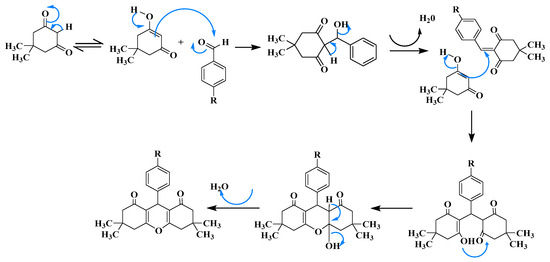
In the aqueous system catalyzed by linear alkylbenzene sulfonic acid (LABSA), the formation of a micellar environment plays a crucial role. Acting as both a Brønsted acid and a surfactant, LABSA generates micelles in water that concentrate and spatially organize the reactants. This microheterogeneity enhances the kinetics and selectivity by bringing key reaction intermediates into proximity, thereby promoting efficient carbon–carbon bond formation. In contrast to mineral acids or other sulfonic acids with different micellar profiles such as DBSA [14], which has greater steric bulk, LABSA exhibits a distinct reactivity profile that preferentially steers the transformation toward 1,8-dioxo-octahydroxanthene derivatives rather than other products like sulfonamides [15]. Mechanistically, the reaction proceeds first via a Knoevenagel condensation between the enol form of dimedone and the aromatic aldehyde, generating an α,β-unsaturated intermediate. This intermediate then undergoes a Michael addition with a second molecule of dimedone, followed by intramolecular cyclization and dehydration to form the tricyclic xanthene core.
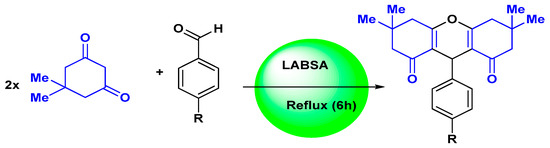
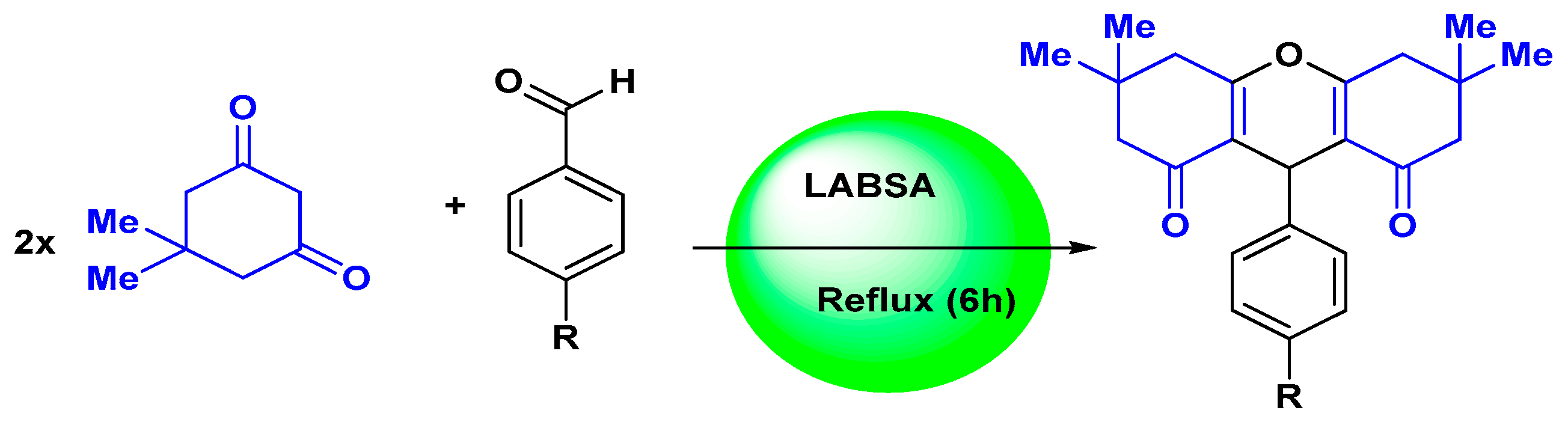
In the LABSA-catalyzed aqueous system, micellar catalysis and Brønsted acid activation collectively facilitated efficient carbon–carbon bond formation. Despite the structural similarity to DBSA, LABSA afforded a distinct reactivity profile, steering the transformation toward 1,8-dioxo-octahydroxanthene derivatives rather than sulfonamide frameworks. Mechanistically, the process proceeds via initial Knoevenagel condensation between the enolized form of dimedone and the aromatic aldehyde to yield an α,β-unsaturated intermediate, which undergoes Michael addition with a second molecule of dimedone. Subsequent intramolecular cyclization and dehydration afford the tricyclic xanthene core (Scheme 1).
Scheme 1.
Synthesis of xanthene-1,8-dione derivatives.
LABSA performs a dual catalytic role: acting as a proton donor to activate the carbonyl group and as a micellar medium, increasing local concentrations of hydrophobic reactants. This dual function enhances the rate and selectivity while maintaining mild reaction conditions.
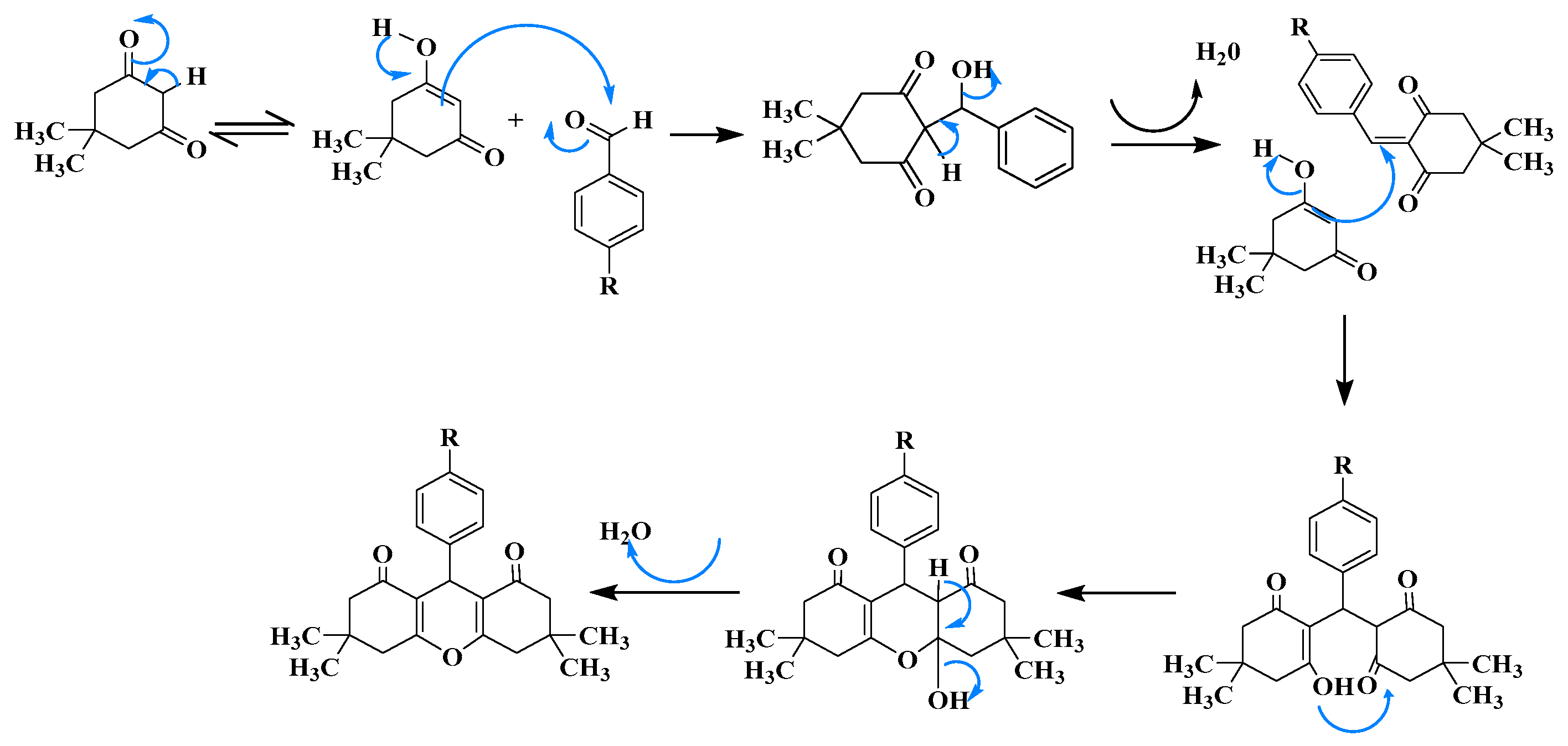
The possible reaction mechanism for the synthesis of Xanthene-1,8-dione derivatives is presented in Scheme 2.
Scheme 2.
Proposed reaction mechanism for LABSA-catalyzed xanthene formation.
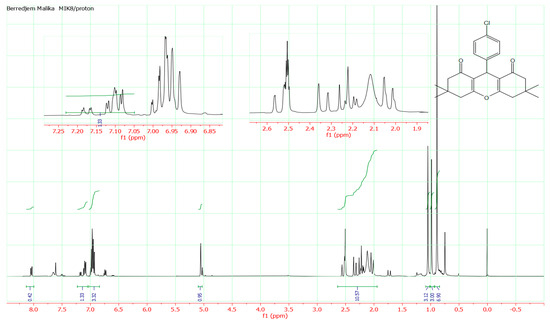
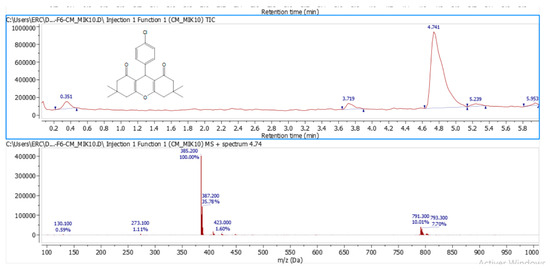
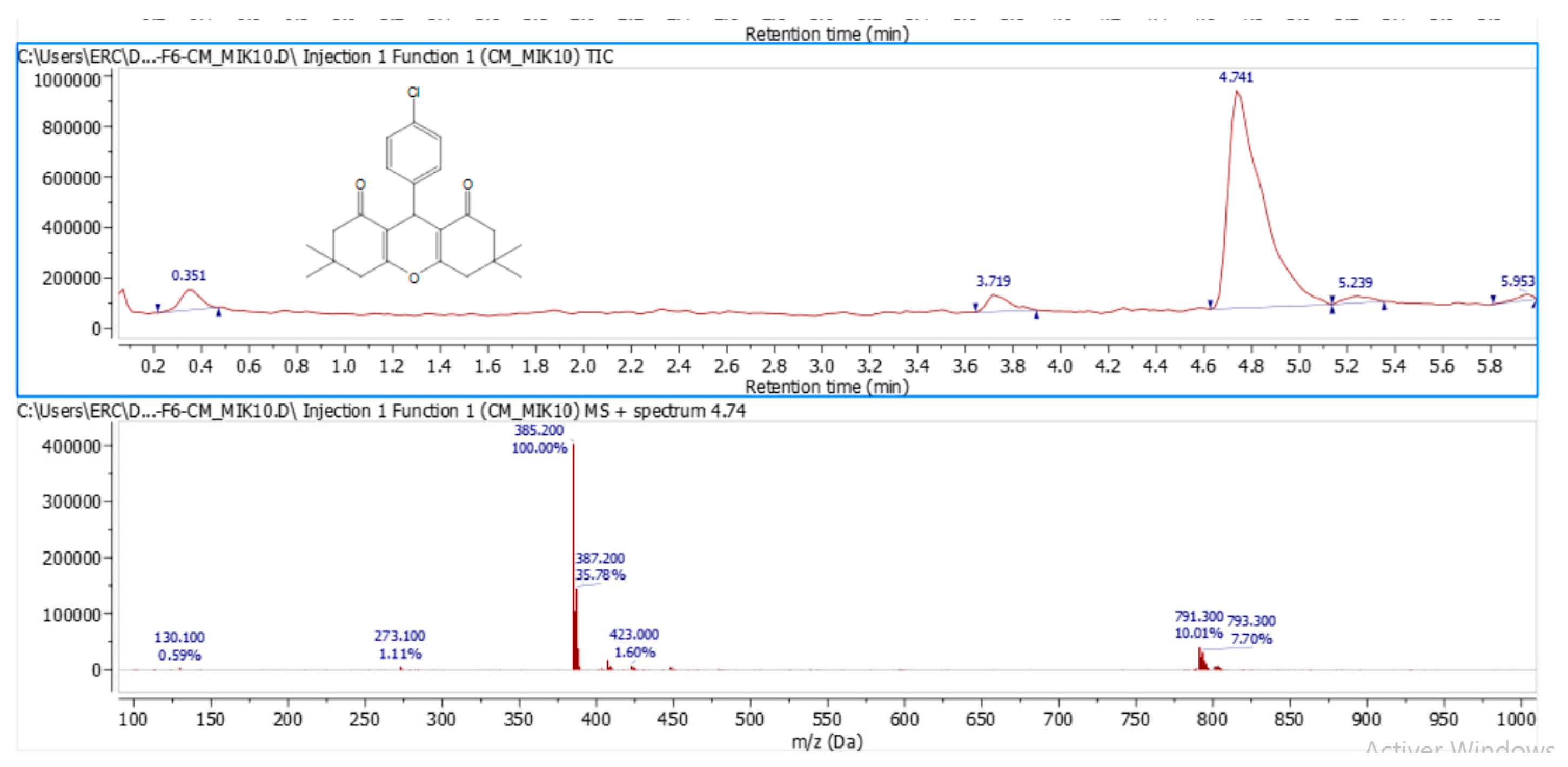
The formation of xanthene derivatives was confirmed by spectroscopic analysis. 1H NMR spectra showed singlets at δ 0.6–1.1 ppm (gem-dimethyl groups at positions 3 and 6), multiplets at δ 2.0–2.4 ppm (cyclohexane CH2), and aromatic signals at δ 6.7–7.3 ppm (Figure 1). The structure of xanthene was confirmed by mass spectrometry (Figure 2).
Figure 1.
NMR1H spectrum of 9-(4-chlorophenyl)-3,3,6,6-tetramethyl-3,4,5,6,7,9-hexahydro-1H-xanthene-1,8(2H) dione.
Figure 2.
Mass spectrum of 9-(4-chlorophenyl)-3,3,6,6-tetramethyl-3,4,5,6,7,9-hexahydro-1H-xanthene-1,8(2H) dione.
This methodology was successfully applied to a variety of aromatic aldehydes bearing electron-donating and electron-withdrawing groups, yielding products in 80–92% yield (Table 1).
Table 1.
Synthesis of 1,8-dioxo-octahydroxanthene derivatives catalyzed by LABSA.
4. Conclusions
An environmentally friendly and efficient protocol was developed for the synthesis of 1,8-dioxo-octahydroxanthene derivatives catalyzed by LABSA in aqueous medium. The reaction proceeds via a Knoevenagel–Michael sequence under mild, solvent-free conditions, affording high yields and excellent purity. The dual catalytic behaviour of LABSA acting both as a proton donor and micellar catalyst makes it a sustainable alternative to conventional acid catalysts. This method highlights a green, scalable, and operationally simple route for valuable heterocycles with potential biological activity, aligning closely with the principles of sustainable chemistry.
Author Contributions
Methodology, I.M.; writing, review and editing, M.B. All authors have read and agreed to the published version of the manuscript.
Funding
This research received no external funding.
Institutional Review Board Statement
Not applicable.
Informed Consent Statement
Not applicable.
Data Availability Statement
No new data were created or analyzed in this study. Data sharing is not applicable to this article.
Acknowledgments
The authors wish to extend their gratitude to the Algerian General Directorate of Scientific Research and Technological Development (DGRSDT) and the Applied Organic Chemistry Laboratory for their support and assistance.
Conflicts of Interest
The authors declare no conflicts of interest.
References
- Kate, A.; Sahu, L.K.; Pandey, J.; Mishra, M.; Sharma, P.K. Green catalysis for chemical transformation: The need for the sustainable development. Curr. Res. Green Sustain. Chem. 2022, 5, 100248. [Google Scholar] [CrossRef] [Scilit]
- Gung, R.R.; Huang, C.-C.; Hung, W.-I.; Fang, Y.-J. The use of hybrid analytics to establish effective strategies for household energy conservation. Renew. Sustain. Energy Rev. 2020, 133, 110295. [Google Scholar] [CrossRef] [Scilit]
- Nova, I.; Epling, B.; Peden, C. Challenges for catalytic exhaust aftertreatment. Catal. Today 2014, 231, 1–2. [Google Scholar] [CrossRef] [Scilit]
- Azizi, N.; Dezfooli, S.; Hashemi, M.M. Chemoselective synthesis of xanthenes and tetraketones in a choline chloride-based deep eutectic solvent. Comptes Rendus Chim. 2013, 16, 997–1001. [Google Scholar] [CrossRef] [Scilit]
- Vasylyev, D.; Priimenko, B.; Aleksandrova, K.; Mykhalchenko, Y.; Gutyj, B.; Mazur, I.; Magrelo, N.; Sus, H.; Dashkovskyy, O.; Vus, U.; et al. Investigation of the Acute Toxicity of New Xanthine Xenobiotics with Noticeable Antioxidant Activity. Ukrainian J. Ecol. 2021, 11, 315–318. [Google Scholar] [CrossRef]
- Madje, B.; Ubale, M.; Bharad, J.; Shingare, M. Alum Promoted Synthesis of 1,8-Dioxo-Octahydroxanthenes in Water. S. Afr. J. Chem. 2010, 63, 36–39. [Google Scholar]
- Kokkirala, S.; Sabbavarapu, N.M.; Yadavalli, V.D.N. β-Cyclodextrin mediated synthesis of 1,8-dioxooctahydroxanthenes in water. Eur. J. Chem. 2011, 2, 272–275. [Google Scholar] [CrossRef] [Scilit]
- Lasemi, Z.; Mehrasbi, E. ZnO nanoparticles: An efficient and reusable catalyst for one-pot synthesis of 1,8-dioxo-octahydroxanthenes. Res. Chem. Intermed. 2013, 41, 2855–2866. [Google Scholar] [CrossRef] [Scilit]
- Makone, S.; Mahurkar, S. A Green Protocol for Efficient Synthesis of 1,8-Dioxo-Octahydroxanthenes Using Ionic Liquid. Green Sustain. Chem. 2013, 3, 27–32. [Google Scholar] [CrossRef]
- Karthick, M.; Abi, E.K.; Someshwar, N.; Anthony, S.P.; Ramanathan, C.R. NaHSO4/SiO2 catalyzed generation of o-quinone/o-thioquinone methides: Synthesis of arylxanthenes/arylthioxanthenes via oxa-6π-electrocyclization. Org. Biomol. Chem. 2020, 18, 8653–8667. [Google Scholar] [CrossRef] [Scilit] [PubMed]
- Ko, S.; Yao, C.-F. Heterogeneous catalyst: Amberlyst-15 catalyzes the synthesis of 14-substituted-14H-dibenzo[a,j]xanthenes under solvent-free conditions. Tetrahedron Lett. 2006, 47, 8827–8829. [Google Scholar] [CrossRef] [Scilit]
- Song, G.; Wang, B.; Luo, H.; Yang, L. Fe3+-montmorillonite as a cost-effective and recyclable solid acidic catalyst for the synthesis of xanthenediones. Catal. Commun. 2007, 8, 673–676. [Google Scholar] [CrossRef] [Scilit]
- Shashi, R.; Begum, N.S.; Panday, A.K. A Rapid Ultrasound Synthesis of Xanthenediones Catalyzed by Boric acid in Ethanol-Water Medium: Single Crystal, DFT and Hirshfeld Surface Analysis of Two Representative Compounds. J. Mol. Struct. 2021, 1228, 129794. [Google Scholar] [CrossRef] [Scilit]
- Esirden, I.; Ulus, R.; Aday, B.; Tanç, M.; Supuran, C.T.; Kaya, M. Synthesis of novel acridine bis-sulfonamides with effective inhibitory activity against the carbonic anhydrase isoforms I, II, IX and XII. Bioorg. Med. Chem. 2015, 23, 6573–6580. [Google Scholar] [CrossRef] [Scilit] [PubMed]
- Abraham, R.; Agola, A.; Shukla, A.; Sharma, R.; Ameta, K.L.; Bellare, J.; Shah, D.O.; Mishra, M.K. Micellar catalysis by dodecylbenzenesulfonic acid in water: Significance of dynamic micelles. J. Mol. Liq. 2024, 401, 124591. [Google Scholar] [CrossRef] [Scilit]

Disclaimer/Publisher’s Note: The statements, opinions and data contained in all publications are solely those of the individual author(s) and contributor(s) and not of MDPI and/or the editor(s). MDPI and/or the editor(s) disclaim responsibility for any injury to people or property resulting from any ideas, methods, instructions or products referred to in the content. |
© 2026 by the authors. Licensee MDPI, Basel, Switzerland. This article is an open access article distributed under the terms and conditions of the Creative Commons Attribution (CC BY) license (https://creativecommons.org/licenses/by/4.0/).