


Abstract
Pyranoquinoline derivatives are an important class of fused N-heterocycles with diverse biological and pharmaceutical applications. Herein, we report a sequential silver-catalyzed cyclization and BF3·Et2O-mediated allylation strategy for the efficient synthesis of allylated pyranoquinoline derivatives from ortho-alkynyl quinoline aldehydes. The protocol proceeds under mild reaction conditions and provides the desired products in good-to-excellent yields. A broad range of substrates was successfully transformed, demonstrating excellent functional group tolerance and synthetic versatility. This sequential cyclization–allylation approach offers a practical and efficient method for the rapid construction and functionalization of biologically relevant pyranoquinoline scaffolds.
1. Introduction
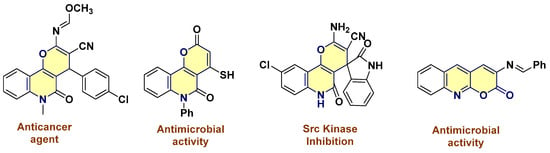
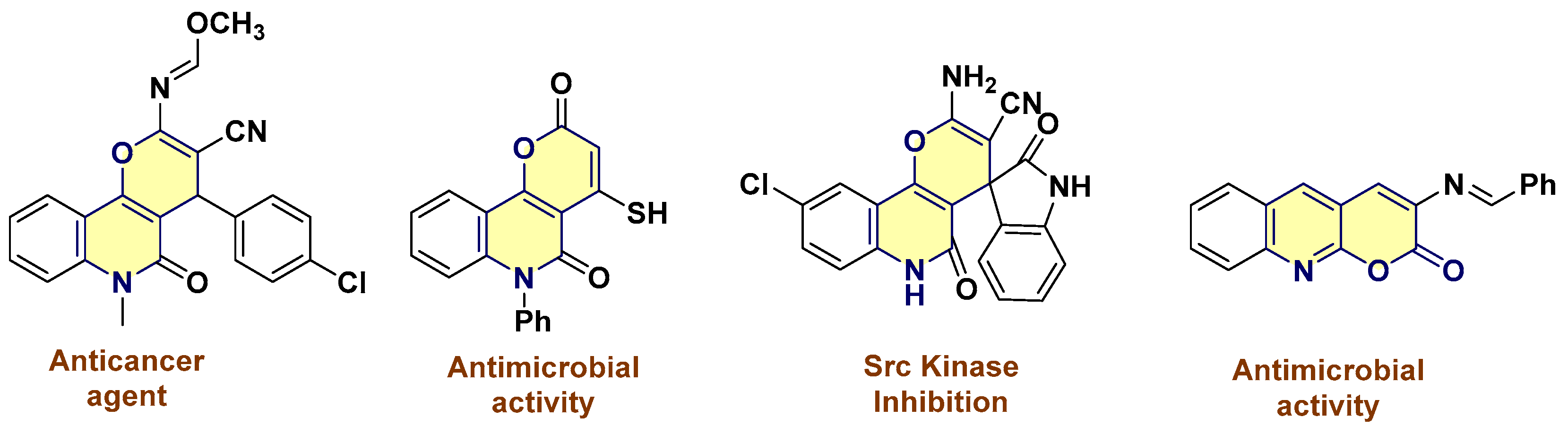
Heterocyclic compounds constitute one of the most important classes of organic molecules owing to their widespread occurrence in natural products, pharmaceuticals, agrochemicals, and functional materials [1]. Among them, oxygen-containing fused heterocycles, particularly pyrano-fused derivatives, have attracted considerable attention because of their structural diversity and broad spectrum of biological and physicochemical properties [2,3]. Pyrano heterocycles are frequently encountered in numerous natural products and bioactive molecules and exhibit a wide range of pharmacological activities, including anticancer, antimicrobial, antiviral, anti-inflammatory, antioxidant, and enzyme inhibitory properties [4]. In addition to their medicinal significance, pyrano-fused frameworks have found applications in organic electronics, fluorescent materials [5], molecular sensors, and optoelectronic devices owing to their rigid π-conjugated structures and favorable photophysical characteristics [6]. Among this family, pyranoquinolines represent a privileged class of fused N,O-heterocycles that combine the unique biological properties of quinoline and pyran motifs within a single molecular framework. Pyranoquinoline derivatives have been reported as anticancer [7], antimicrobial [8], antimalarial [9], anti-inflammatory [7], and antioxidant agents [10], and several members of this class occur in naturally occurring alkaloids [11] or serve as key structural motifs in biologically active compounds and functional materials (Figure 1).
Figure 1.
Biological properties of pyranoquinolines.
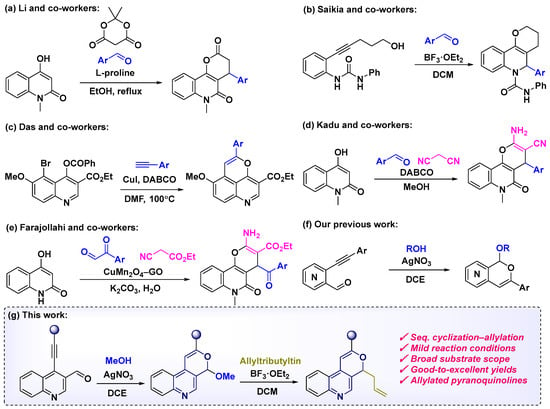
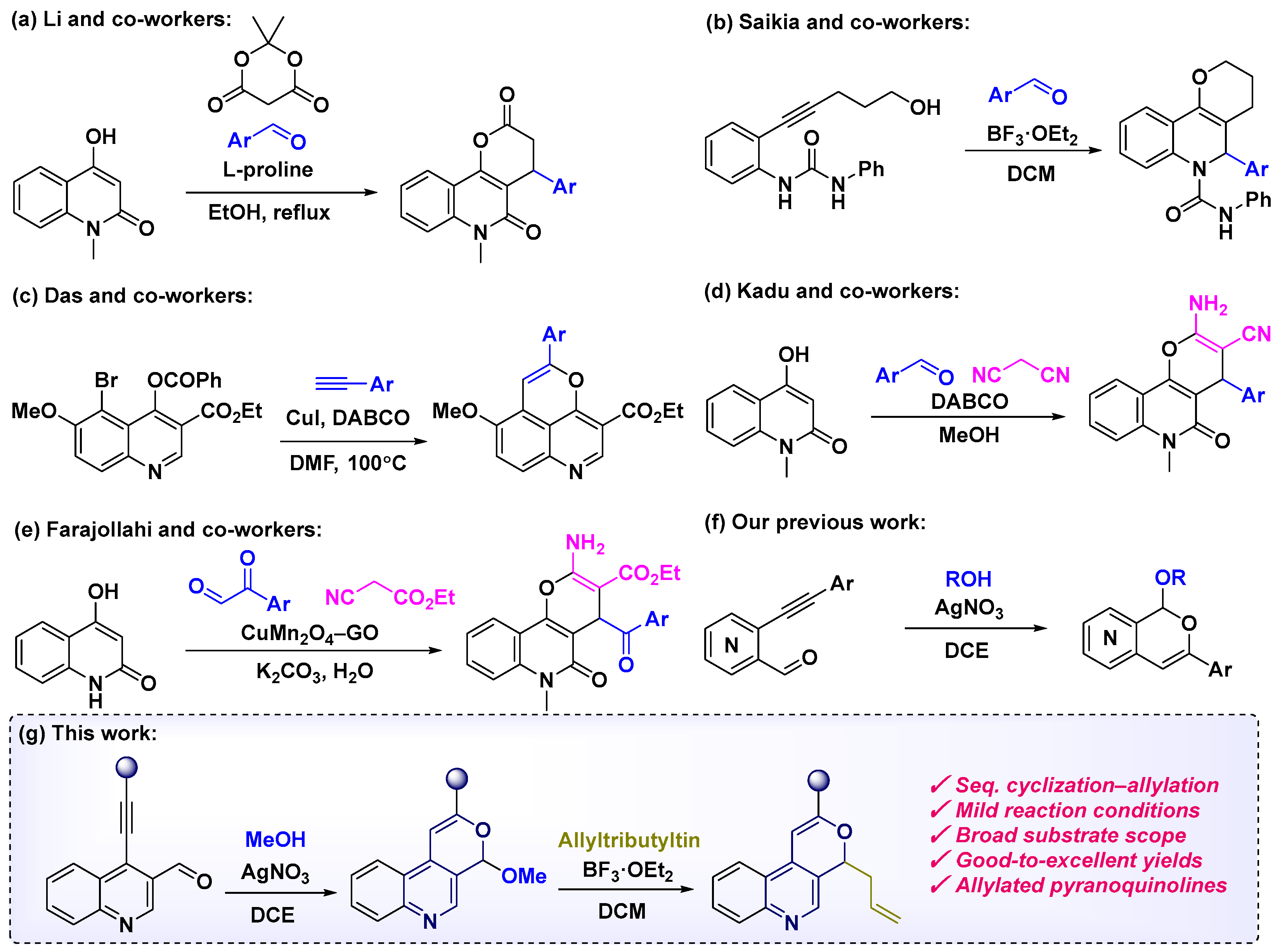
The development of efficient and selective synthetic strategies for the construction and functionalization of pyranoquinoline scaffolds continues to attract significant interest in synthetic and medicinal chemistry [12]. Several elegant approaches have been reported for the synthesis of pyranoquinoline derivatives (Scheme 1). Li and co-workers developed an L-proline-catalyzed three-component reaction to access pyrano[3,2-c]quinolines (Scheme 1a) [13]. Saikia and co-workers reported a Lewis acid-promoted cascade alkynyl Prins–aza-Michael reaction for the regioselective synthesis of pyranoquinolines (Scheme 1b) [14]. Das and co-workers disclosed a Cu(I)-catalyzed Sonogashira coupling/annulation strategy for the construction of pyrano[2,3,4-de]quinolines (Scheme 1c) [15]. Furthermore, Kadu and Farajollahi and their co-workers independently developed efficient multicomponent protocols employing DABCO [16] and a CuMn2O4–GO nanocatalyst [17], respectively, for the synthesis of pyranoquinoline derivatives (Scheme 1d,e). Despite these significant advances, the direct functionalization of pyranoquinoline scaffolds remains largely underexplored.
Scheme 1.
Previous approaches and our approach towards the pyranoquinolines.
Inspired by these elegant reports and our continued interest in the synthesis of fused heterocyclic frameworks, including indenoquinolones [18], pyranoquinolines (Scheme 1f) [19,20], and naphthyridines [21,22], we envisioned that the pyranoquinoline scaffold could serve as a versatile platform for further structural diversification. In particular, the introduction of an allyl group would provide synthetically valuable intermediates for subsequent transformations and facilitate access to structurally diverse fused heterocycles. Accordingly, herein we report a sequential AgNO3-catalyzed cyclization and BF3·Et2O-mediated allylation strategy for the efficient synthesis of allylated pyranoquinoline derivatives under mild reaction conditions (Scheme 1g).
2. Results and Discussion
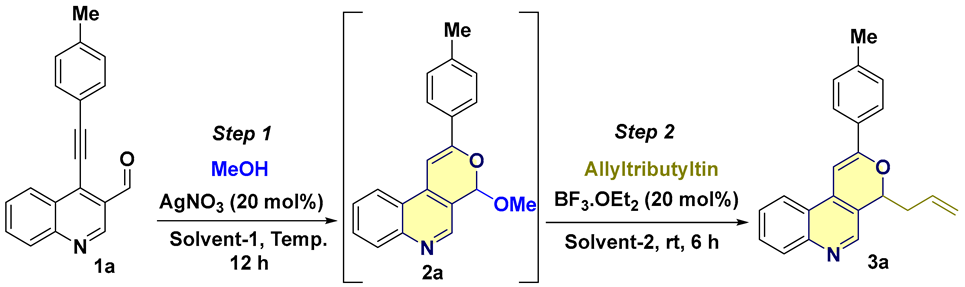
The 4-alkynylquinolinealdehydes (1) were synthesized according to the reported literature procedure and employed as the model substrates for the optimization studies. Initially, various catalysts were screened for both the cyclization and allylation steps, among which AgNO3 (20 mol%) and BF3·Et2O (20 mol%) were identified as the optimal catalysts for the first and second steps, respectively. Subsequently, the effects of solvent, temperature, and reaction time were systematically investigated using substrate 1a (Table 1). When both steps were performed in DCM at room temperature, the desired allylated product 3a was obtained in only 23% yield (entry 1). Replacing DCM with DCE for the silver cyclization and conducting the reaction at 60 °C improved the yield to 52% (entry 2). Gratifyingly, increasing the temperature to 80 °C afforded 3a in an excellent 88% yield after 12 h for the cyclization step followed by 6 h of allylation in DCM (entry 3). However, extending the allylation time to 12 h or prolonging the cyclization step to 24 h resulted in diminished yields of 77% and 69%, respectively (entries 4 and 5). Therefore, the optimal conditions were established as AgNO3 (20 mol%) in DCE at 80 °C for 12 h, followed by BF3·Et2O (20 mol%) in DCM for 6 h. These optimized conditions (Entry 3, highlighted in bold in Table 1) were employed for the subsequent substrate scope studies.
Table 1.
Screening conditions for the synthesis of 3a.
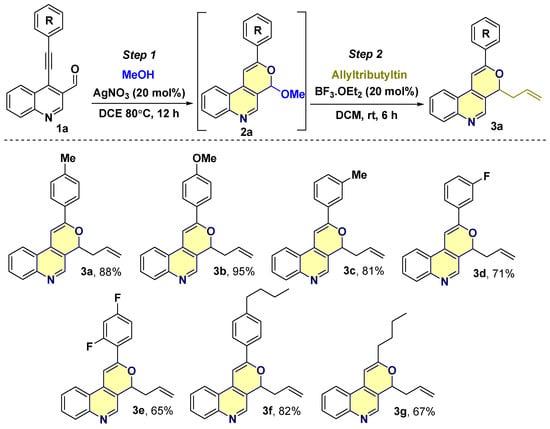
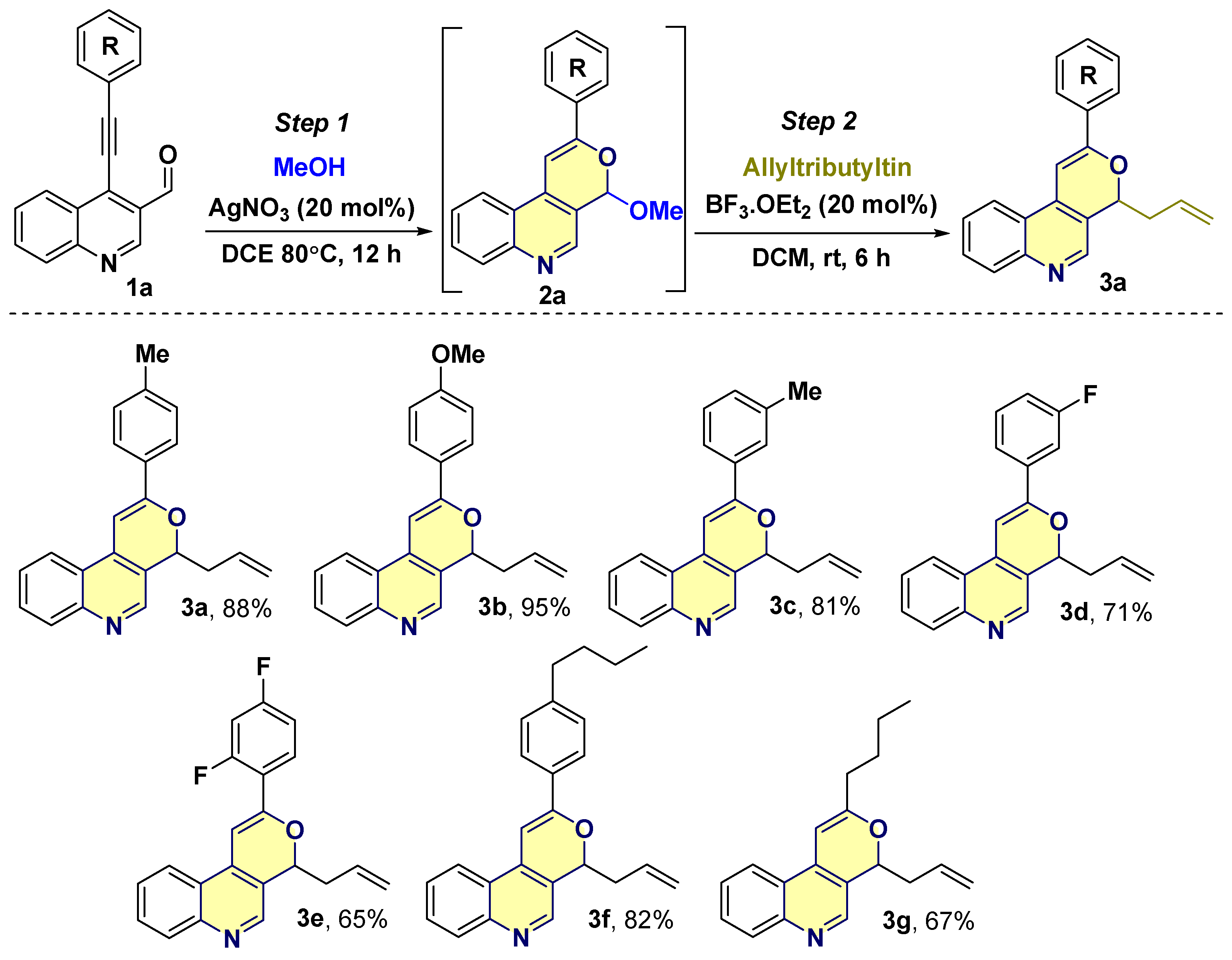
With the optimized conditions established, the substrate scope of the sequential cyclization–allylation protocol was investigated using a variety of ortho-alkynyl quinoline aldehydes (1) (Scheme 2). The methodology proved to be general, affording the corresponding allylated pyranoquinolines in good-to-excellent yields. Substrates bearing electron-donating substituents, such as methyl and methoxy, on the aryl ring underwent smooth transformation to furnish the desired products 3a–c in 81–95% yields, with the p-methoxy-substituted substrate 3b providing the highest yield (95%). Likewise, substrates containing fluoro substituents were well tolerated, affording the corresponding products 3d and 3e in 71% and 65% yields, respectively. Furthermore, an aromatic alkyne bearing a butyl substituent smoothly underwent the sequential cyclization–allylation to furnish 3f in 82% yield, while an aliphatic alkyne bearing a butyl substituent delivered the corresponding allylated pyranoquinoline 3g in 67% yield. These results demonstrate the broad substrate scope and excellent functional group tolerance of the developed sequential cyclization–allylation methodology.
Scheme 2.
Substrate scope of allylated pyranoquinoline.
3. Experimental Section
3.1. General Information, Instrumentation and Chemicals
All chemicals were purchased from Sigma-Aldrich (Hyderabad, India), Alfa Aesar (Hyderabad, India), and S. D. Fine Chemicals (Hyderabad, India) and used without further purification. ACME silica gel (100–200 mesh) was used for column chromatography, and thin-layer chromatography was performed on Merck-pre-coated silica gel 60-F254 plates (Hyderabad, India). TLC plates are visualized by UV light and developed by iodine. All the solvents were obtained from commercial sources and purified using standard methods. All 1H, 13C NMR spectra were recorded on Avance-300, Avance-400, and Avance-500 MHz spectrometers (Bruker BioSpin, Fällanden, Switzerland). Chemical shifts (δ) are referenced to signals at 7.26 and 77.0 ppm, respectively, using TMS (δ = 0) as an internal standard in CDCl3. The peak patterns are indicated as follows: s, singlet; d, doublet; t, triplet; q, quartet; m, multiplet; dd, doublet of doublet; dt, doublet of triplet; tt, triplet of triplet. The coupling constants (Js) are reported in Hertz (Hz). Mass spectral data were compiled using MS (ESI) and high-resolution mass spectrometers (HRMSs) (Thermo Fisher Scientific, Waltham, MA, USA).
3.2. General Procedure (GP)
A screw-capped reaction vial equipped with a magnetic stir bar was charged with ortho-alkynyl quinoline aldehyde 1 (0.20 mmol), methanol (0.20 mmol, 1.0 equiv), and 1,2-dichloroethane (DCE, 2.0 mL). AgNO3 (20 mol%) was then added, and the reaction mixture was stirred at 80 °C for 12 h. After completion of the reaction (monitored by TLC), the mixture was cooled to room temperature, filtered through a short pad of Celite, and the filtrate was concentrated under reduced pressure to afford the crude pyranoquinoline intermediate (2).
The crude residue (2) was then dissolved in CH2Cl2 (2.0 mL), followed by the addition of allyltributyltin (0.20 mmol, 1.0 equiv) and BF3·Et2O (20 mol%). The resulting reaction mixture was stirred at room temperature for 6 h. Upon completion, the solvent was removed under reduced pressure, and the crude product was purified by flash column chromatography on silica gel (230–400 mesh) using ethyl acetate/hexane (3:10) as the eluent to afford the corresponding allylated pyranoquinoline (3a–h).
3.3. Spectral Data
4-Allyl-2-(p-tolyl)-4H-pyrano[3,4-c]quinoline (3a):
Purification with silica gel using (ethyl acetate/ hexane 3:10) afforded compound 3a as a brown semisolid, yield (55 mg, 88%). 1H NMR (400 MHz, CDCl3) δ 8.53 (s, 1H), 8.13 (t, J = 9.0 Hz, 2H), 7.77 (d, J = 8.2 Hz, 2H), 7.71 (t, J = 7.2 Hz, 1H), 7.59 (t, J = 7.5 Hz, 1H), 7.26 (d, J = 8.0 Hz, 2H), 7.01 (s, 1H), 5.95 (ddt, J = 17.1, 10.2, 7.0 Hz, 1H), 5.61 (dd, J = 8.1, 5.4 Hz, 1H), 5.18 (d, J = 9.7 Hz, 1H), 5.12 (dd, J = 17.1, 1.2 Hz, 1H), 2.91 (dt, J = 15.1, 7.7 Hz, 1H), 2.68–2.57 (m, 1H), 2.42 (s, 3H). 13C NMR (126 MHz, CDCl3) δ 158.15, 146.36, 144.81, 140.90, 137.02, 132.45, 130.66, 129.91, 129.81, 129.30, 128.91, 128.36, 126.68, 126.10, 126.00, 122.67, 122.10, 120.02, 119.06, 93.36, 76.32, 38.42, 21.45. HRMS (ESI) calcd. for C22H20NO (M + H)+ 314.1539, found 314.1545.
4-Allyl-2-(4-methoxyphenyl)-4H-pyrano[3,4-c]quinoline (3b):
Purification with silica gel using (ethyl acetate/ hexane 3:10) afforded compound 3b as a brown semisolid, yield (63 mg, 95%). 1H NMR (400 MHz, CDCl3) δ 8.54 (s, 1H), 8.14 (d, J = 7.9 Hz, 1H), 8.09 (d, J = 8.4 Hz, 1H), 7.88–7.78 (m, 2H), 7.71 (ddd, J = 8.3, 6.9, 1.3 Hz, 1H), 7.62–7.54 (m, 1H), 7.02–6.96 (m, 2H), 6.95 (s, 1H), 5.96 (ddt, J = 17.1, 10.2, 7.0 Hz, 1H), 5.61 (dd, J = 8.2, 5.3 Hz, 1H), 5.19 (dd, J = 10.2, 1.3 Hz, 1H), 5.13 (dd, J = 17.1, 1.5 Hz, 1H), 3.95–3.82 (m, 3H), 2.92 (dt, J = 15.4, 7.7 Hz, 1H), 2.64 (ddd, J = 13.3, 6.6, 5.4 Hz, 1H). 13C NMR (101 MHz, CDCl3) δ 161.44, 157.45, 147.14, 145.43, 136.52, 132.66, 129.59, 129.02, 127.77, 126.46, 126.13, 122.65, 122.14, 119.89, 118.96, 113.97, 92.60, 76.39, 55.41, 38.42. HRMS (ESI) calcd. for C22H20NO2 (M + H)+ 330.1489, found 330.1497.
4-Allyl-2-(m-tolyl)-4H-pyrano[3,4-c]quinoline (3c):
Purification with silica gel using (ethyl acetate/ hexane 3:10) afforded compound 3c as a brown semisolid, yield (51 mg, 81%). 1H NMR (400 MHz, CDCl3) δ 8.56 (s, 1H), 8.15 (d, J = 8.2 Hz, 1H), 8.08 (d, J = 8.3 Hz, 1H), 7.77–7.63 (m, 3H), 7.63–7.55 (m, 1H), 7.34 (t, J = 7.9 Hz, 1H), 7.29–7.24 (m, 1H), 7.03 (s, 1H), 5.96 (ddt, J = 17.2, 10.2, 7.0 Hz, 1H), 5.62 (dd, J = 8.0, 5.5 Hz, 1H), 5.19 (d, J = 10.2 Hz, 1H), 5.13 (dd, J = 17.1, 1.4 Hz, 1H), 2.92 (dt, J = 15.1, 7.6 Hz, 1H), 2.69–2.59 (m, 1H), 2.44 (s, 3H). 13C NMR (101 MHz, CDCl3) δ 157.08, 147.78, 146.15, 138.17, 135.47, 133.69, 132.66, 130.96, 129.53, 129.31, 128.42, 126.58, 126.40, 123.21, 122.59, 122.21, 120.26, 118.90, 94.07, 76.41, 38.57, 21.48. HRMS (ESI) calcd. for C22H20NO (M + H)+ 314.1539, found 314.1531.
4-Allyl-2-(3-fluorophenyl)-4H-pyrano[3,4-c]quinoline (3d):
Purification with silica gel using (ethyl acetate/ hexane 3:10) afforded compound 3d as a brown semisolid, yield (45 mg, 71%). 1H NMR (500 MHz, CDCl3) δ 8.58 (s, 1H), 8.13 (d, J = 7.8 Hz, 1H), 8.10 (d, J = 8.3 Hz, 1H), 7.72 (ddd, J = 8.3, 6.9, 1.3 Hz, 1H), 7.66 (ddd, J = 7.8, 1.5, 0.9 Hz, 1H), 7.60 (ddd, J = 8.2, 6.9, 1.2 Hz, 1H), 7.55 (ddd, J = 10.1, 2.5, 1.7 Hz, 1H), 7.41 (td, J = 8.0, 5.8 Hz, 1H), 7.13 (tdd, J = 8.3, 2.6, 0.8 Hz, 1H), 7.05 (s, 1H), 5.95 (ddt, J = 17.1, 10.2, 7.0 Hz, 1H), 5.64 (dd, J = 8.2, 5.3 Hz, 1H), 5.19 (dd, J = 10.2, 1.5 Hz, 1H), 5.13 (ddd, J = 17.1, 2.9, 1.4 Hz, 1H), 2.91 (ddt, J = 15.5, 8.3, 1.1 Hz, 1H), 2.67–2.60 (m, 1H). 13C NMR (101 MHz, CDCl3) δ 162.90 (d, J = 245.9 Hz), 155.62 (d, J = 2.8 Hz), 147.59, 145.91, 135.98 (d, J = 7.9 Hz), 135.18, 132.41, 130.06 (d, J = 8.1 Hz), 129.58, 129.44, 126.73, 122.49, 122.20, 121.55 (d, J = 2.9 Hz), 120.50, 119.14, 116.98 (d, J = 21.3 Hz), 112.95 (d, J = 23.4 Hz), 95.02, 76.49, 38.67. 19F NMR (377 MHz, CDCl3) δ −112.43 (s). HRMS (ESI) calcd. for C21H17FNO (M + H)+ 318.1289, found 318.1275.
4-Allyl-2-(2,4-difluorophenyl)-4H-pyrano[3,4-c]quinoline (3e):
Purification with silica gel using (ethyl acetate/ hexane 3:10) afforded compound 3e as a brown semisolid, yield (44 mg, 65%). 1H NMR (400 MHz, CDCl3) δ 9.11 (s, 1H), 8.28 (dd, J = 8.3, 0.9 Hz, 1H), 8.09 (d, J = 8.3 Hz, 1H), 7.69 (ddd, J = 8.4, 6.9, 1.4 Hz, 1H), 7.63–7.60 (m, 1H), 7.60–7.55 (m, 1H), 6.95 (tdd, J = 9.3, 4.8, 2.7 Hz, 2H), 5.92 (ddt, J = 10.2, 7.4, 6.8 Hz, 1H), 5.47 (dd, J = 8.2, 4.7 Hz, 1H), 5.21–5.13 (m, 2H), 2.78–2.69 (m, 1H), 2.66–2.57 (m, 1H). 13C NMR (151 MHz, CDCl3) δ 164.27 (dd, J = 27.9, 12.2 Hz), 162.58 (dd, J = 30.2, 12.2 Hz), 148.68, 147.02, 137.67, 134.25 (d, J = 9.7 Hz), 133.89, 129.56 (d, J = 4.0 Hz), 127.51, 126.60, 125.73, 125.40, 118.84, 112.03 (dd, J = 22.1, 3.2 Hz), 107.27 (dd, J = 15.9, 3.6 Hz), 104.64 (t, J = 25.3 Hz), 95.97, 87.63, 70.44, 42.85. 19F NMR (377 MHz, CDCl3) δ −104.11 (d, J = 7.4 Hz), −104.34 (d, J = 7.1 Hz). HRMS (ESI) calcd. for C21H16F2NO (M + H)+ 336.1194, found 336.1185.
4-Allyl-2-(4-butylphenyl)-4H-pyrano[3,4-c]quinoline (3f):
Purification with silica gel using (ethyl acetate/ hexane 3:10) afforded compound 3f as a brown semisolid, yield (58 mg, 82%). 1H NMR (500 MHz, CDCl3) δ 8.57 (s, 1H), 8.14 (d, J = 8.2 Hz, 1H), 8.07 (d, J = 8.3 Hz, 1H), 7.79 (d, J = 8.3 Hz, 2H), 7.70 (ddd, J = 8.3, 6.9, 1.2 Hz, 1H), 7.60–7.54 (m, 1H), 7.28–7.24 (m, 2H), 7.01 (s, 1H), 5.97 (ddt, J = 17.2, 10.2, 7.0 Hz, 1H), 5.62 (dd, J = 8.1, 5.4 Hz, 1H), 5.18 (dd, J = 10.2, 1.4 Hz, 1H), 5.14 (dd, J = 17.1, 1.5 Hz, 1H), 2.92 (dt, J = 15.3, 7.7 Hz, 1H), 2.72–2.57 (m, 3H), 1.64 (dq, J = 12.9, 7.6 Hz, 2H), 1.43–1.35 (m, 2H), 0.95 (t, J = 7.4 Hz, 3H). 13C NMR (101 MHz, CDCl3) δ 157.45, 147.35, 145.72, 145.63, 136.05, 132.66, 131.06, 129.46, 129.13, 128.62, 126.43, 126.03, 122.61, 122.18, 120.15, 118.89, 93.42, 76.37, 38.48, 35.52, 33.39, 22.31, 13.90. HRMS (ESI) calcd. for C25H26NO (M + H)+ 356.2009, found 356.2001.
4-Allyl-2-butyl-4H-pyrano[3,4-c]quinoline (3g):
Purification with silica gel using (ethyl acetate/ hexane 3:10) afforded compound 3g as a brown semisolid, yield (37 mg, 67%). 1H NMR (400 MHz, CDCl3) δ 8.46 (s, 1H), 8.03 (d, J = 8.4 Hz, 1H), 7.98 (d, J = 8.5 Hz, 1H), 7.66 (ddd, J = 8.4, 6.9, 1.4 Hz, 1H), 7.52 (ddd, J = 8.2, 6.9, 1.2 Hz, 1H), 6.25 (s, 1H), 5.87 (ddt, J = 17.2, 10.3, 7.0 Hz, 1H), 5.44 (dd, J = 7.6, 5.8 Hz, 1H), 5.18–5.06 (m, 2H), 2.85–2.74 (m, 1H), 2.61–2.50 (m, 1H), 2.35–2.29 (m, 2H), 1.63 (tt, J = 8.0, 4.2 Hz, 2H), 1.47–1.37 (m, 2H), 0.96 (t, J = 7.3 Hz, 3H). 13C NMR (126 MHz, CDCl3) δ 162.90, 147.70, 146.22, 135.53, 132.75, 129.36, 129.17, 126.14, 122.60, 121.74, 119.21, 118.63, 94.35, 76.13, 38.85, 34.33, 28.91, 22.30, 13.82. HRMS (ESI) calcd. for C19H22NO (M + H)+ 280.1696, found 280.1688.
4. Conclusions
In conclusion, we have developed an efficient sequential silver-catalyzed cyclization and BF3·Et2O-mediated allylation strategy for the synthesis of allylated pyranoquinoline derivatives. The protocol proceeds under mild reaction conditions and provides the desired products in good-to-excellent yields with broad substrate scope and excellent functional group tolerance. The sequential transformation enables the direct functionalization of pyranoquinoline scaffolds through the installation of a synthetically valuable allyl group, providing versatile intermediates for further structural diversification. The operational simplicity and efficiency of this methodology make it a practical approach for the preparation of biologically relevant allylated fused N-heterocycles.
Author Contributions
Conceptualization, K.C. and K.R.R.; methodology, K.C.; validation, K.C., V.R.P. and K.R.R.; formal analysis, K.C. and V.R.P.; investigation, K.C.; resources, K.R.R.; data curation, K.C.; writing—original draft preparation, K.C.; writing—review and editing, K.C., V.R.P. and K.R.R.; visualization, K.C.; supervision, K.R.R.; project administration, K.R.R.; funding acquisition, K.R.R. All authors have read and agreed to the published version of the manuscript.
Funding
K.C. thanks CSIR-India (SRF; 31/014(2827)/2019-EMR-I) for the financial support in the form of a senior research fellowship (SRF). K.R.R. thanks the Director, CSIR-IICT, for financial support.
Institutional Review Board Statement
Not applicable.
Informed Consent Statement
Not applicable.
Data Availability Statement
Data are contained within the article.
Acknowledgments
During the preparation of this manuscript, the author(s) used ChatGPT (GPT-4o, OpenAI) and Gemini (Gemini 1.5 Pro, Google) for the purposes of grammar correction and language polishing. The authors have reviewed and edited the output and take full responsibility for the content of this publication.
Conflicts of Interest
The authors declare no conflicts of interest.
References
- Vitaku, E.; Smith, D.T.; Njardarson, J.T. Analysis of the Structural Diversity, Substitution Patterns, and Frequency of Nitrogen Heterocycles among U.S. FDA Approved Pharmaceuticals. J. Med. Chem. 2014, 57, 10257–10274. [Google Scholar] [CrossRef] [Scilit]
- Kumar, S.; Arora, A.; Kumar, S.; Kumar, R.; Senapati, N.N.; Singh, B.K. Pyran-Fused Analogues and Their Potential Applications. Russ. J. Bioorg. Chem. 2025, 51, 373–438. [Google Scholar] [CrossRef] [Scilit]
- Hariri, R.; Afshar, Z.; Mahdavi, M.; Safavi, M.; Saeedi, M.; Najafi, Z.; Sabourian, R.; Karimpour-Razkenari, E.; Edraki, N.; Moghadam, F.H.; et al. Novel Tacrine-Based Pyrano[3’,4’:5,6]Pyrano[2,3-b]Quinolinones: Synthesis and Cholinesterase Inhibitory Activity. Arch. Pharm. 2016, 349, 915–924. [Google Scholar] [CrossRef] [Scilit]
- Uppal, J.; Mir, P.A.; Chawla, A.; Kumar, N.; Kaur, G.; Bedi, P.M.S.; Bhandari, D.D. Pyranoquinolone Derivatives: A Potent Multi-Targeted Pharmacological Scaffold. J. Heterocycl. Chem. 2023, 60, 369–391. [Google Scholar] [CrossRef] [Scilit]
- Roshan Shokranlu, F.; Izadyar, M.; Esmaeili, A.A. Optical Properties of Novel Coumarin-Fused Pyrano-Pyridines: Synthesis and TD-DFT Calculations. J. Mol. Struct. 2026, 1366, 145864. [Google Scholar] [CrossRef] [Scilit]
- Sharapov, A.D.; Fatykhov, R.F.; Khalymbadzha, I.A.; Valieva, M.I.; Nikonov, I.L.; Taniya, O.S.; Kopchuk, D.S.; Zyryanov, G.V.; Potapova, A.P.; Novikov, A.S.; et al. Fluorescent Pyranoindole Congeners: Synthesis and Photophysical Properties of Pyrano[3,2-f], [2,3-g], [2,3-f], and [2,3-e]Indoles. Molecules 2022, 27, 8867. [Google Scholar] [CrossRef] [Scilit]
- Upadhyay, K.D.; Dodia, N.M.; Khunt, R.C.; Chaniara, R.S.; Shah, A.K. Synthesis and Biological Screening of Pyrano[3,2-c] Quinoline Analogues as Anti-Inflammatory and Anticancer Agents. ACS Med. Chem. Lett. 2018, 9, 283–288. [Google Scholar] [CrossRef] [Scilit]
- Watpade, R.; Bholay, A.; Toche, R. Synthesis of New Pyrano-Fused Quinolines as Antibacterial and Antimicrobial Agents. J. Heterocycl. Chem. 2017, 54, 3434–3439. [Google Scholar] [CrossRef] [Scilit]
- Shamsuddin, M.A.; Ali, A.H.; Zakaria, N.H.; Mohammat, M.F.; Hamzah, A.S.; Shaameri, Z.; Lam, K.W.; Mark-Lee, W.F.; Agustar, H.K.; Abd Razak, M.R.M.; et al. Synthesis, Molecular Docking, and Antimalarial Activity of Hybrid 4-Aminoquinoline-Pyrano[2,3-c]Pyrazole Derivatives. Pharmaceuticals 2021, 14, 1174. [Google Scholar] [CrossRef] [Scilit]
- Othman, E.S.; Hassan, H.; Abass, M. Substituted Quinolinones. 31. Some New Pyrano[3,2-c]Quinoline-3-Carboxamides and Their Antioxidant Activity. J. Heterocycl. Chem. 2019, 56, 3257–3266. [Google Scholar] [CrossRef] [Scilit]
- Shobana, N.; Yeshoda, P.; Shanmugam, P. A Convenient Approach to the Synthesis of Prenyl-, Furo- and Pyrano-Quinoline Alkaloids of the Rutaceae. Tetrahedron 1989, 45, 757–762. [Google Scholar] [CrossRef] [Scilit]
- Aly, A.A.; El-Naby, H.A.A.; Ahmed, E.K.; Gedamy, S.A.; Alshammari, M.B.; Ahmad, A.; Bräse, S. Catalytic Syntheses of Pyrano[3,2-c]Quinolone and -Quinoline Derivatives and Their Potential Therapeutic Agents. Curr. Org. Chem. 2024, 29, 181–212. [Google Scholar] [CrossRef] [Scilit]
- Zhu, S.; Wang, J.; Xu, Z.; Li, J. An Efficient One-Pot Synthesis of Pyrano[3,2-c]Quinolin-2,5-Dione Derivatives Catalyzed by L-Proline. Molecules 2012, 17, 13856–13863. [Google Scholar] [CrossRef] [Scilit]
- Biswas, S.; Saikia, A.K. Cascade Alkynyl Prins Cyclization and Aza-Michael Reaction: En Route to Regioselective Pyrano- and Isochromenoquinoline Scaffolds. J. Org. Chem. 2024, 89, 14454–14471. [Google Scholar] [CrossRef] [Scilit]
- Mandal, A.; Ghosh, P.; Das, S. Expeditious Synthesis of Pyrano[2,3,4-de]Quinolines by a Copper(I)-Catalyzed Cascade Sonogashira Coupling/Annulation Reaction. Eur. J. Org. Chem. 2026, 29, e202500612. [Google Scholar] [CrossRef] [Scilit]
- Kadu, V.D.; Gaikwad, S.G.; Konapure, S.R. An Organocatalyzed Multicomponent Reaction: A Rapid and Efficient Practical Approach for 4H-Pyrano[3,2-c]Quinoline-3-Carbonitriles Synthesis. ChemistrySelect 2024, 9, e202303629. [Google Scholar] [CrossRef] [Scilit]
- Farajollahi, A.; Noroozi Pesyan, N.; Poursattar Marjani, A.; Alamgholiloo, H. Development of CuMnxOy (x = 2, and y = 4)-GO Heterostructure for the Synthesis of Pyranoquinoline Derivatives. Sci. Rep. 2023, 13, 10112. [Google Scholar] [CrossRef] [Scilit]
- Chahal, K.; Potluri, V.R.; Tomy, D.; Vashishtha, K.; Reddy, K.R. Synthesis of Indeno-Quinolones and Their Functionalization toward 5-HT3 Receptor. J. Org. Chem. 2025, 90, 14943–14948. [Google Scholar] [CrossRef] [Scilit]
- Chahal, K.; Badhavath, R.; Matharu, S.K.; Vinod, A.; Vani, D.; Potluri, V.R.; Sridhar, B.; Reddy, K.R. Silver-Catalyzed Regioselective Synthesis of Pyrano Heterocycles: A Versatile Route to Samoquasine A Derivatives. Org. Biomol. Chem. 2024, 22, 8898–8903. [Google Scholar] [CrossRef] [Scilit]
- Vani, D.; Chahal, K.; Preethi, P.; Balasubramanian, S.; Rajender Reddy, K. Synthesis of Substituted Pyrano[3,4-b]Quinolines by Silver-Catalyzed Regioselective Intramolecular Cyclization of 3-Alkynylquinoline Aldehydes. Asian J. Org. Chem. 2022, 11, e202100740. [Google Scholar] [CrossRef] [Scilit]
- Chahal, K.; Badhavath, R.; Reddy, K.R. Silver-Catalyzed Synthesis of Functionalized 1,7-Naphthyridine Derivatives Using 2-Aminobenzamide Derivatives and Ortho-Alkynylquinoline Carbaldehydes as Starting Materials. Chem. Proc. 2025, 18, 103. [Google Scholar] [CrossRef] [Scilit]
- Vashishtha, K.; Chahal, K.; Bhoi, N.; Tomy, D.; Sridhar, B.; Alla, M.; Reddy, K.R. Silver-Catalyzed Synthesis of Polyfunctionalized 1,7- and 2,7-Benzonaphthyridine Scaffolds and Access to Perlolidine Derivatives. Org. Biomol. Chem. 2025, 23, 9677–9682, Correction in Org. Biomol. Chem. 2025, 23, 10225–10226. https://doi.org/10.1039/d5ob01410g. [Google Scholar] [CrossRef] [Scilit]

Disclaimer/Publisher’s Note: The statements, opinions and data contained in all publications are solely those of the individual author(s) and contributor(s) and not of MDPI and/or the editor(s). MDPI and/or the editor(s) disclaim responsibility for any injury to people or property resulting from any ideas, methods, instructions or products referred to in the content. |
© 2026 by the authors. Licensee MDPI, Basel, Switzerland. This article is an open access article distributed under the terms and conditions of the Creative Commons Attribution (CC BY) license.