


Abstract
This study explores the oxidation reaction of sulfide groups present in methyl 1-(4-chlorophenyl)-4-((4-chlorophenyl)amino)-2,6-bis(4-(methylthio)phenyl)-1,2,5,6-tetrahydropyridine-3-carboxylate towards the corresponding sulfoxide and sulfone, under green reaction conditions: ethanol as solvent, aqueous hydrogen peroxide as oxidant agent, phosphomolybdic acid as redox catalyst at atmospheric pressure. The optimum conditions for obtaining the sulfoxide were 0.2 mmol substrate, 0.34 mL H2O2 30% w/V, 1% mol phosphomolybdic acid, ethanol at 50 °C for 15 h; meanwhile, the sulfone was obtained at the reflux temperature. To our knowledge, neither the oxidation reaction of the sulfur atom in tetrahydropyridines nor the corresponding sulfoxides and sulfones are reported in the literature.
1. Introduction
Tetrahydropyridines (THP), especially highly substituted ones, present diverse biological activities as anti-inflammatory [1,2], antimalarial [3], antimicrobial [4,5], anticancer [6,7], antioxidant [8,9], among others. Different synthetic methodologies for preparing substituted THP have been reported [10]. However, the multicomponent reaction involving two equivalents of an aniline, two equivalents of aromatic aldehyde, and one equivalent of β-ketoester, assisted by an acid catalyst, stands out since its high Atom Economy and operational simplicity [11,12].
As an acid catalyst for the multicomponent reaction, we employed commercial phosphomolybdic acid (PMo). This solid Keggin heteropolyacid possesses strong Brönsted acidity and can be used in catalytic amounts, unlike traditional inorganic acids, which are used stoichiometrically and require large amounts of alkali for neutralization, generating high volumes of waste [13,14]. Moreover, PMo presents redox properties, making it suitable for use as a catalyst in oxidation reactions for activating eco-friendly oxidizing agents, such as aqueous hydrogen peroxide. Our research group has successfully employed PMo under mild conditions for the synthesis of high-value-added compounds and the oxidation of alcohols, phenols, anilines, and sulfides [15,16,17,18].
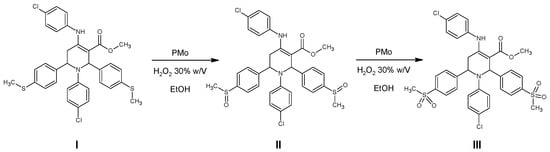
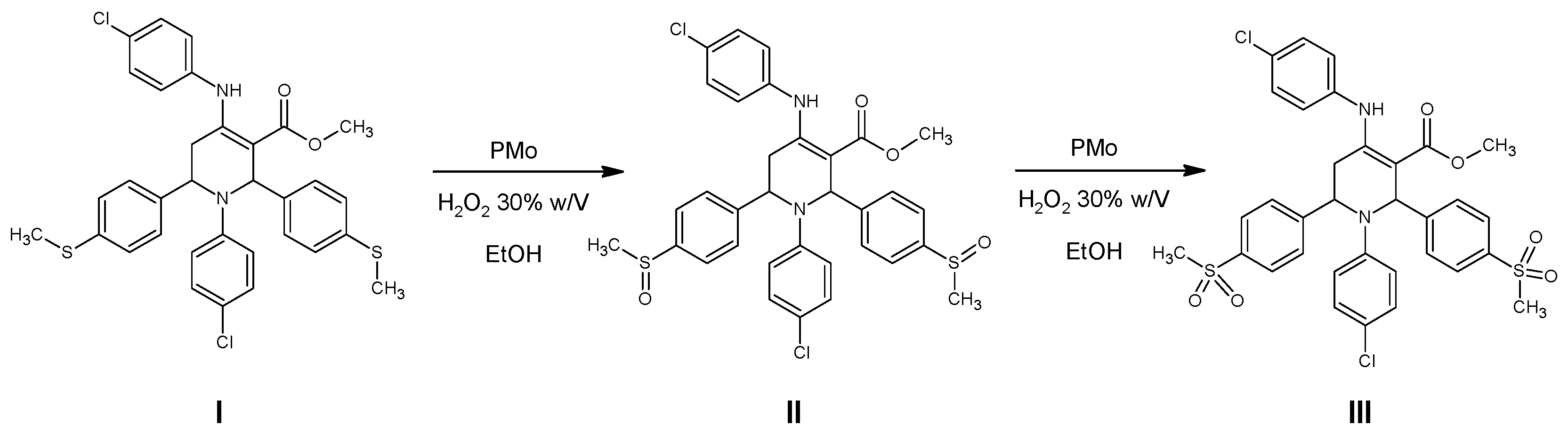
This work focuses on THP obtained using 4-(methylthio)benzaldehyde. These THPs, with sulfur atoms, will then be oxidized to sulfoxide or sulfone, using hydrogen peroxide as the oxidant agent and PMo as a catalyst (Figure 1). In order to analyze the selectivity towards the corresponding sulfoxide and sulfone, different temperatures and amounts of oxidizing agent and catalyst were tested.
Figure 1.
Oxidation reaction of THP.
The oxidation compounds, which are unreported in the literature, are expected to present biological properties, as pyridine analogues with proven biological activity. On the other hand, sulfoxides and sulfones are of interest in both industry and research, particularly due to their therapeutic properties [19,20].
2. Materials and Methods
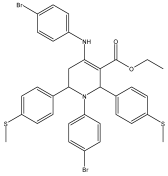
The starting THP I (methyl 1-(4-chlorophenyl)-4-((4-chlorophenyl)amino)-2,6-bis(4-(methylthio)phenyl)-1,2,5,6-tetrahydropyridine-3-carboxylate) was prepared via a one-pot multicomponent reaction between methyl acetoacetate, 4-chloroaniline, and 4-(methylthio)benzaldehyde, in a 1:2:2 molar ratio, in methanol under reflux for 5 h. assisted by phosphomolybdic acid, which acts in this case as an acid catalyst.
The oxidation reaction was carried out in a glass reaction tube, in which I (0.1 mmol) was put in contact with PMo (as catalyst) and H2O2 30% w/V (as oxidant agent) in ethanol (2 mL). The reaction mixture was maintained under magnetic stirring in an oil bath. Various temperatures and amounts of the oxidizing agent were tested. The reaction was monitored by thin-layer chromatography, using petroleum ether/ethyl acetate (2:1) as eluent. The product was purified by column chromatography and characterized by melting point determination (Bioamerican apparatus) and Nuclear Magnetic Resonance (NMR) spectroscopy (Bruker Avance Neo 500 and Bruker 300 Ultrashield, Germany).
All reagents were commercial products used without further purification, unless oth-erwise stated. Analytical thin layer chromatography (TLC) was performed using Merck silica gel GF 254 plates (Merck KGaA, Darmstadt, Germany). Flash column chromatography was performed on silica gel (200–300 mesh).
3. Results and Discussion
Compound I was isolated from the reaction mixture as an insoluble solid after cooling, washed with fresh ethanol, dried, and recrystallized from i-propanol. A pale-yellow solid (52% yield) was obtained, mp: 157–159 °C, 1H-NMR (500 MHz, Chloroform-d) δ 10.22 (s, 1H, NH), 7.29 (s, 1H Ar), 7.21 (s, 2H Ar), 7.19 (s, 1H Ar), 7.12 (d, 2H Ar), 7.06 (d, 4H Ar), 7.02 (d, 2H Ar), 6.43 (d, 2H Ar), 6.31 (d, 2H Ar), 6.29 (s, 1H H2), 5.07 (d, 1H H6), 3.95 (s, 3H Me), 2.85 (dd, 1H H5), 2.70 (dd, 1H H5), 2.50 (d, 6H MeS).
The oxidation of I was first carried out at 50 °C by adding 0.09 mL of H2O2 at the beginning of the reaction and an additional portion after 4 h (Table 1, Entry 1). Scaling up the reaction required a longer reaction time (Table 1, Entry 2). Next, a larger amount of oxidant agent was used (Table 1, Entry 3), which enhanced the reaction yield. Finally, performing the reaction under reflux led to a decrease in yield (Entry 4).
Table 1.
Optimization of the oxidation reaction of THP I.
Compound IIb: 1H-NMR (300 MHz, Acetone-d6) δ 10.33 (s, 1H NH), 7.90 (d, 4H Ar), 7.70 (d, 2H Ar), 7.51 (d,2H Ar), 7.26 (d, 2H Ar), 7.08 (d, 2H Ar), 6.59–6.50 (m, 5H H2,Ar), 5.64 (d, 1H H6), 3.96 (s, H Me), 3.15 (d, 2HH5), 2.11 (s, 6H MeSO).
Compound III: 1H-NMR (500 MHz, Chloroform-d) δ 10.20 (s, 1H NH), 7.89 (m, 6H Ar), 7.51 (d, 2H Ar), 7.41 (dd, 1H, Ar), 7.33 (d, 2H Ar), 7.28 (s, 1H Ar), 7.16 (d, 2H Ar), 7.05 (d, 2H Ar), 6.43 (s, 1H H2), 5.27–5.22 (m, 1H H6), 3.99 (s, 3H Me), 3.09 (s, 6H MeSO2), 2.87 (d, 1H H5), 2.79 (d, 1H H5).
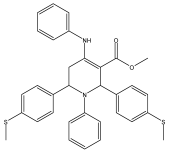
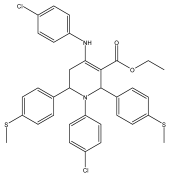
The optimized reaction conditions to obtain the sulfoxide (0.2 mmol I, 0.34 mL H2O2 30% w/V, 1% mmol phosphomolybdic acid, 4 mL ethanol, 50 °C, 15 h) were extended to other THP prepared from different alkyl acetoacetates and substituted anilines (Table 2).
Table 2.
Oxidation of different THP.
4. Conclusions
In the present work, various THPs were efficiently synthesized through an atom-economical multicomponent reaction catalyzed by PMo acting as a solid acid. Furthermore, the sulfide groups of these THPs were selectively oxidized (to the sulfoxide at 50 °C and the sulfone at reflux) under green conditions using ethanol, hydrogen peroxide, and PMo, now operating as a redox catalyst. Following reaction optimization, three oxidation products were obtained and comprehensively characterized by melting point and NMR spectroscopy. To our knowledge, neither the oxidation reaction of the sulfur atom in THP nor the corresponding sulfoxides and sulfones are reported in the literature.
Author Contributions
E.M.C.: Methodology, data curation, formal analysis. M.B.C.M.: Conceptualization, methodology, investigation, supervision, data curation, formal analysis, writing—review and editing. M.C.M.: Methodology, data curation, formal analysis. V.P.: Conceptualization, methodology, investigation, supervision, data curation, formal analysis, writing—review and editing. G.P.R.: Conceptualization, methodology, writing—review and editing, funding acquisition. All authors have read and agreed to the published version of the manuscript.
Funding
This work was supported by CONICET (PIP0111), UNLP (X941, X1038), ANPCyT (PICT-2021-00438), the Willians Foundation (N101, 2024), CIC-PBA (E.M.C. grant).
Institutional Review Board Statement
Not applicable.
Informed Consent Statement
Not applicable.
Data Availability Statement
The data presented in this study are available on request from the corresponding author.
Acknowledgments
The authors gratefully acknowledge the financial and scientific support provided by Universidad Nacional de La Plata (UNLP), Consejo Nacional de Investigaciones Científicas y Técnicas (CONICET), Agencia Nacional de Promoción Científica y Tecnológica (ANPCyT), Comisión de Investigaciones Científicas de la Provincia de Buenos Aires (CIC-PBA), and Fundación Williams. V.P., M.C.M., and G.P.R. are members of CONICET; M.B.C.M. is a member of CIC-PBA, and E.M.C. received a CIC-PBA grant.
Conflicts of Interest
The authors declare no conflicts of interest.
References
- Patil, K.N.; Mane, R.A.; Jadhav, S.B.; Mane, M.M.; Helavi, V.B. One pot multicomponent synthesis of highly functionalized tetrahydropyridine using copper (II) triflate as catalyst and their anti-inflammatory activity. Chem. Data Collect. 2019, 21, 100233. [Google Scholar] [CrossRef] [Scilit]
- Yoon, K.J.P.; Redda, K.K.; Mazzio, E.; Soliman, K.F.A. Inhibitory effects of novel tetrahydropyridine derivatives on nitric oxide and reactive oxygen species production in glioma cells. Drug Dev. Res. 2004, 61, 189–196. [Google Scholar] [CrossRef] [Scilit]
- Misra, M.; Pandey, S.K.; Pandey, V.P.; Pandey, J.; Tripathi, R.; Tripathi, R.P. Organocatalyzed highly atom economic one pot synthesis of tetrahydropyridines as antimalarials. Bioorg. Med. Chem. 2009, 17, 625–633. [Google Scholar] [CrossRef] [Scilit] [PubMed]
- Vianna, J.S.; Ramis, I.B.; Bierhals, D.; von Groll, A.; Ramos, D.F.; Zanatta, N.; Lourenço, M.C.; Viveiros, M.; Almeida da Silva, P.E. Tetrahydropyridine derivative as efflux inhibitor in Mycobacterium abscessus. J. Glob. Antimicrob. Resist. 2019, 17, 296–299. [Google Scholar] [CrossRef] [Scilit] [PubMed]
- Anand, P.S.; Sethukumar, A.; Kumar, C.U.; Krishnasamy, K.; Senthan, S.; Manikandan, G.; Prakasam, B.A. Synthesis, stereochemical, single crystal X-ray structural and antimicrobial studies of some isobutyl-1, 2, 6-triaryl-4-(arylamino)-1, 2, 5, 6-tetrahydropyridine-3-carboxylates: Exploring RAHB with S (6) graph set. J. Mol. Struct. 2021, 1227, 129563. [Google Scholar]
- Das, S.; da Silva, C.J.; de M. Silva, M.; de A. Dantas, M.D.; de Fátima, Â.; Ruiz, A.L.T.G.; da Silva, C.M.; de Carvalho, J.E.; Santos, J.C.C.; Figueiredo, I.M.; et al. Highly functionalized piperidines: Free radical scavenging, anticancer activity, DNA interaction and correlation with biological activity. J. Adv. Res. 2018, 9, 51–61. [Google Scholar] [CrossRef] [Scilit] [PubMed]
- Aeluri, R.; Jones Ganji, R.; Kumar Marapaka, A.; Pillalamarri, V.; Alla, M.; Addlagatta, A. Highly functionalized tetrahydropyridines are cytotoxic and selective inhibitors of human puromycin sensitive aminopeptidase. Eur. J. Med. Chem. 2015, 106, 26. [Google Scholar] [CrossRef] [Scilit] [PubMed]
- Naicker, L.; Venugopala, K.N.; Narayanaswamy, K.; Shode, F.; Odhav, B. Antimicrobial and antioxidant activities of piperidine derivatives. Afr. J. Pharm. Pharmacol. 2015, 9, 783. [Google Scholar] [CrossRef] [Scilit]
- Aiello, D.; Jonas, H.; Carbone, A.; Carbone, D.; Pecoraro, C.; Tesoriere, L.; Köhler, J.; Wünsch, B.; Diana, P. Synthesis and antioxidative properties of 1, 2, 3, 4-tetrahydropyridine derivatives with different substituents in 4-position. Molecules 2022, 27, 7423. [Google Scholar] [PubMed]
- Mateeva, N.N.; Winfield, L.L.; Redda, K.K. The chemistry and pharmacology of tetrahydropyridines. Curr. Med. Chem. 2005, 12, 551. [Google Scholar] [CrossRef] [Scilit]
- Ballini, R. Eco-Friendly Synthesis of Fine Chemicals; The Royal Society of Chemistry: London, UK, 2009. [Google Scholar] [CrossRef] [Scilit]
- Anastas, P.; Warner, J. Green Chemistry: Theory and Practice; Oxford University Press: Oxford, UK, 1998. [Google Scholar]
- Wilson, K.; Clark, J. Solid acids and their use as environmentally friendly catalysts in organic synthesis. Pure Appl. Chem. 2000, 72, 1313–1319. [Google Scholar] [CrossRef] [Scilit]
- Heravi, M.; Bakhtiari, F.; Bamoharram, F. 12-Molybdophosphoric acid: A recyclable catalyst for the synthesis of Biginelli-type 3, 4-dihydropyrimidine-2 (1H)-ones. Catal. Commun. 2006, 7, 373. [Google Scholar]
- D’Alessandro, O.; Sathicq, A.G.; Palermo, V.; Sanchez, L.M.; Thomas, H.; Vázquez, P.; Constantieux, T.; Romanelli, G. Doped Keggin heteropolyacids as catalyst in the solvent-free, multicomponent synthesis of substituted 3, 4-dihydropyrimidin-2-(1H)-ones. Curr. Org. Chem. 2012, 16, 2763. [Google Scholar] [CrossRef] [Scilit]
- Palermo, V.; Sathicq, Á.; Constantieux, T.; Rodríguez, J.; Vázquez, P.; Romanelli, G. New Vanadium Keggin Heteropolyacids Encapsulated in a Silica Framework: Recyclable Catalysts for the Synthesis of Highly Substituted Hexahydropyrimidines Under Suitable Conditions. Catal. Lett. 2015, 15, 1022. [Google Scholar] [CrossRef] [Scilit]
- Palermo, V.; Romanelli, G.P.; Vazquez, P.G. Simple and friendly sulfones synthesis using aqueous hydrogen peroxide with a reusable Keggin molybdenum heteropolyacid, immobilized on aminopropyl-functionalized silica. Phosphorus Sulfur Silicon Relat. Elem. 2009, 184, 3258. [Google Scholar] [CrossRef] [Scilit]
- Palermo, V.; Castillo, J.-C.; Macías, M.A.; Martínez, J.J.; Langer, P.; Romanelli, G.P. Phosphomolybdic acid-catalyzed one-pot multicomponent synthesis of 1, 2, 5, 6-tetrahydropyridine derivatives. ChemistrySelect 2024, 9, e202403739. [Google Scholar]
- Fernandez, I.; Khiar, N. Recent developments in the synthesis and utilization of chiral sulfoxides. Chem. Rev. 2003, 103, 3651. [Google Scholar] [CrossRef] [Scilit] [PubMed]
- Ahmad, I.; Shagufta. Sulfones: An important class of organic compounds with diverse biological activities. Int. J. Pharm. Pharm. Sci. 2015, 7, 19. [Google Scholar]

Disclaimer/Publisher’s Note: The statements, opinions and data contained in all publications are solely those of the individual author(s) and contributor(s) and not of MDPI and/or the editor(s). MDPI and/or the editor(s) disclaim responsibility for any injury to people or property resulting from any ideas, methods, instructions or products referred to in the content. |
© 2026 by the authors. Licensee MDPI, Basel, Switzerland. This article is an open access article distributed under the terms and conditions of the Creative Commons Attribution (CC BY) license.