


Abstract
Sustainable chemistry concepts are illuminating the path for researchers to utilize tree branches in the cellulose synthesis, preparation/, or fabrication processes. This represents a revolutionary solution that links waste management with the transition to a green economy, aiming to reduce harmful carbon emissions resulting from burning and replace them with bio-based materials for important environmental remediation. The central objective of this research was to isolate the cellulose-based structure in nano-size from three sources of shrub and tree stems: bougainvillea, fig, and pine, using an alkaline method followed by bleaching with hydrogen peroxide. The nanocellulose samples (N-Cell.bo., N-Cell.fi., N-Cell.pi.) were physicochemically characterized using XRD, FTIR, and FESEM to confirm the isolation of the cellulose phase and the absence of accompanying impurities. Physicochemical characterization revealed that the nanocellulose samples have diverse morphologies—ranging from extended fibers to folded sheets—and have semi-crystalline structures with appropriate crystalline sizes, and are rich in functional groups of sugar units. The ability of the (N-Cell.bo, N-Cell.fi., N-Cell.pi.) samples to remove aflatoxin B1 and Allura Red Ac was studied in both alkaline (pH 8 and10) and acidic media (pH 4 and 6). The removal study demonstrated very good removal efficiency, depending on the type of pollutant and the medium. A kinetic study of two pollutants at various concentrations (3, 9 and 12 ppm) showed that the removal reactions were attribute to a first-order kinetic model. This study provides a promising future perspective for applying the rich potential of plants in environmental science.
Keywords:
sustainable chemistry; nanocellulose; plants; removal; Allura Red AC; aflatoxin B1; kinetic study 1. Introduction
The increasing demand for environmentally sustainable technologies has accelerated the search for renewable, biodegradable, and high-performance materials capable of addressing pressing environmental challenges [1]. Environmental sustainability aims to balance economic development, environmental protection, and resource conservation by promoting the efficient utilization of natural resources while minimizing ecological impacts [2]. In this context, nanotechnology has emerged as one of the most promising scientific disciplines for developing innovative materials with enhanced physicochemical properties and multifunctional capabilities [3]. Integrating sustainability principles with nanoscience has paved the way for designing green nanomaterials derived from renewable resources with tailored morphology, surface chemistry, and functionality; this reduces reliance on petroleum-based materials and contributes to circular bioeconomy strategies [4,5]. Natural polymers have garnered significant attention as sustainable building blocks [6] for the fabrication of advanced nanomaterials, owing to their abundance, renewability, biodegradability, and low environmental impact [7]. Among these biopolymers, cellulose—the most abundant renewable biopolymer on Earth—has emerged as an exceptional feedstock for producing nanocellulose, a material possessing distinctive structural and functional properties [8]. Continuous advancements in extraction, purification, and surface modification techniques have vastly expanded the potential applications of nanocellulose across environmental [9], biomedical [10], packaging [11], and energy [12] sectors. Nanocellulose encompasses a family of cellulose-based nanomaterials, primarily comprising cellulose nanocrystals (CNCs), cellulose nanofibers (CNFs), and bacterial nanocellulose (BNC) [13]. These materials exhibit a unique set of structural properties that distinguish them from conventional cellulose fibers [14,15,16,17]. Furthermore, the abundance of surface hydroxyl groups facilitates versatile chemical modifications, enabling the incorporation of diverse active functional groups that enhance adsorption capacity and selectivity toward target pollutants [18]. Combined with superior accessibility to reactive sites and enhanced interfacial interactions, these characteristics make nanocellulose highly attractive for advanced environmental remediation technologies [19]. This is driven by the rapid expansion of highly efficient environmental applications for nanocellulose in recent years, particularly in water and wastewater treatment [20], where it is used to remove a wide spectrum of hazardous pollutants- including inorganic, organic, and even biological contaminants [21]. Of particular importance is its increasing use in the adsorption of mycotoxins, which pose a significant threat to food safety, public health, and agricultural sustainability [22]. The mechanisms by which nanocellulose materials remove mycotoxins involve various interactions, such as hydrogen bonding, electrostatic attraction, and hydrophobic interactions [23]. Similarly, nanocellulose composites have demonstrated excellent performance in removing synthetic dyes from contaminated aquatic systems, owing to their porous structure, high surface reactivity, and tunable surface functionality [21]. These advantages offer an eco-friendly alternative to conventional adsorbents while supporting the development of sustainable water purification technologies [24]. Recent research has focused on enhancing adsorption efficiency through chemical modification, the incorporation of metal oxide nanoparticles, magnetic modification, and hybridization with biopolymers to improve selectivity, regeneration, and reusability [25], underscoring the growing importance of nanocellulose as a versatile, sustainable nanoplatform capable of addressing complex environmental pollution issues [8]. Therefore, in this study, green chemistry principles were successfully applied to synthesize nanocellulosic (N-Cell.) materials from pine and fig tree branches, as well as bougainvillea shrubs. Detailed characterization of the materials revealed variations in their structural properties and purity. A significant and novel application of the prepared cellulosic materials was the removal of a hazardous fungal contaminant (aflatoxin B1) and a dye (Allura Red AC)—substances that pose serious risks to the environment and safety. Kinetic studies and various removal parameters demonstrated high efficiency and distinct differences among the prepared N-Cell. materials.
2. Experiments
Nanocellulose was isolated from each sample following the same procedures used by Abdel-Halim et al. [26], with some modifications. Details of all experiments are provided in the Supplementary Materials.
3. Results and Discussions
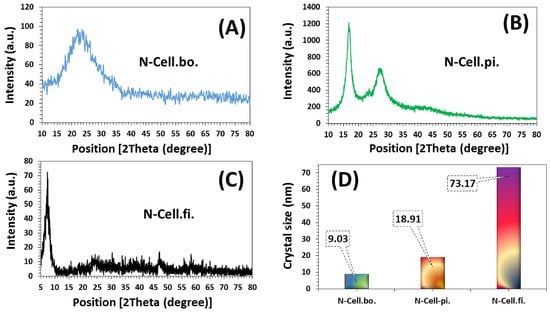
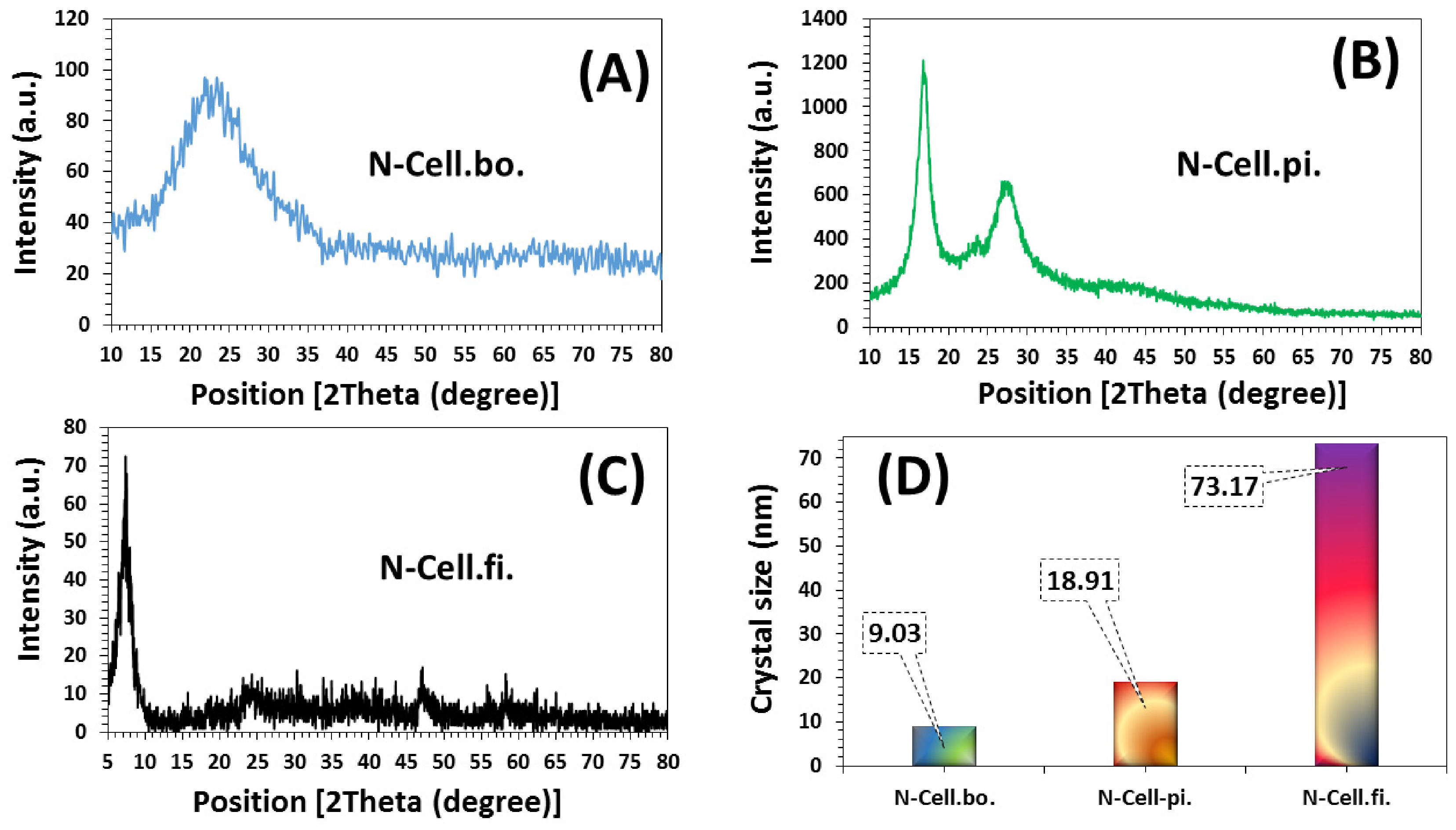
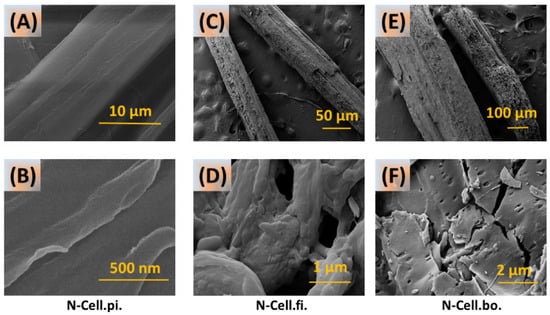
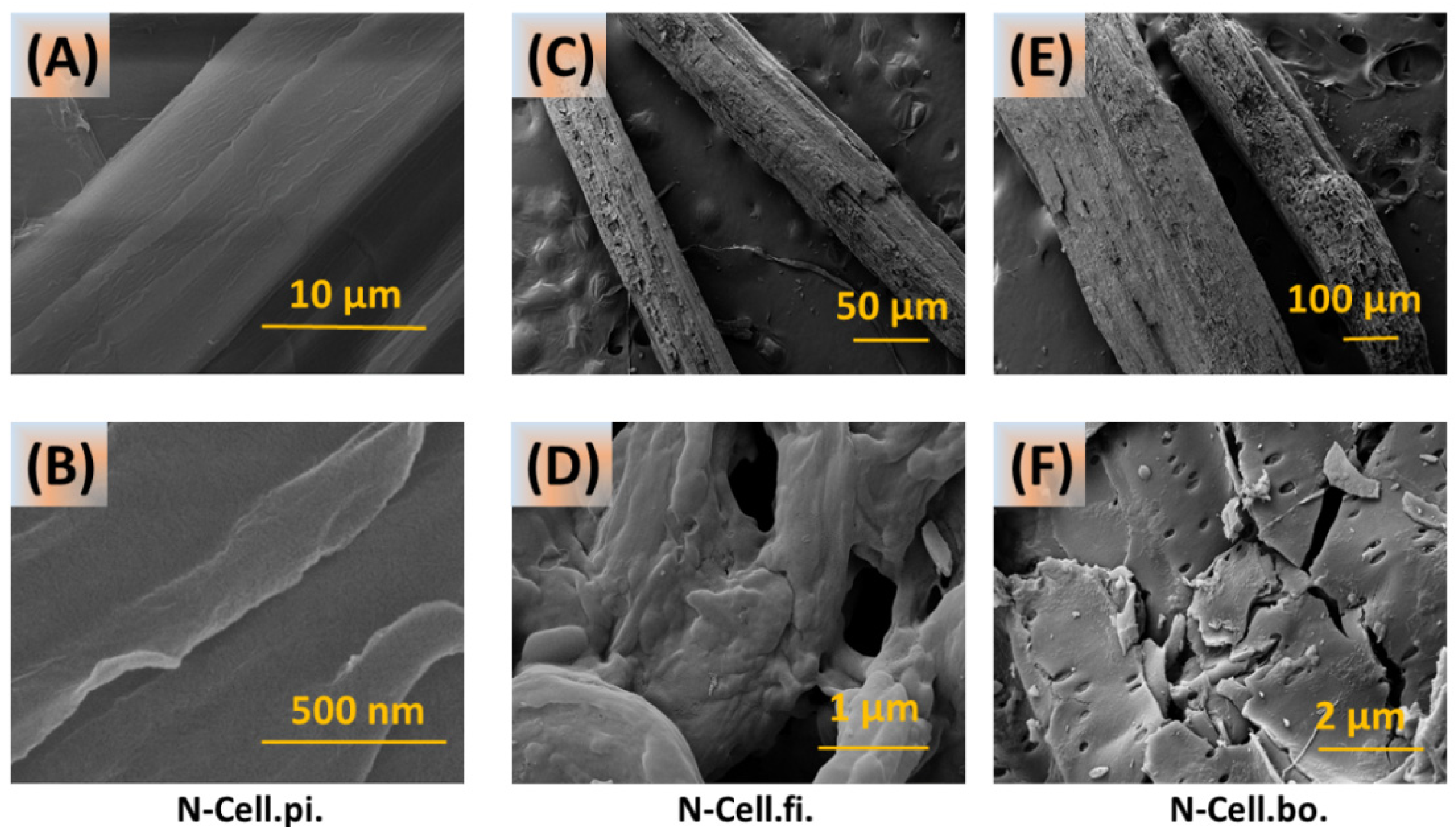
As evidenced by the X-ray diffraction patterns in Figure 1A–C, samples N-Cell.bo, N-Cell.fi, and N-Cell.pi exhibited the characteristic semi-crystalline structure of Cellulose I, with (1 −1 0), (110), and (200) crystal planes. Variations in peak intensity/breadth and crystal size—calculated using the equation given in Kara’s paper [27]—indicated differences in crystalline ordering and nanoscale crystallite domains. This structure arises as a result of the compaction and stabilization of the β-D-glucopyranose chains by hydrogen bonding, with no clear evidence of a new crystalline phase. Figure 1D illustrated a clear difference in the crystal size: the N-Cell.fi sample exhibited the largest grain size, followed by the N-Cell.pi sample, and then the N-Cell.bo sample. This variation can be explained by a sequence that aligns with the FWHM (Full Width at Half Maximum) values. FESEM images revealed morphological variations—manifesting as finer fibrous structures and differing degrees of fibrillation—across the three N-Cell. samples. These transformations are characterized by the following features: the N-Cell.pi. sample (Figure 2A,B) showed a distinct fibrous structure with pronounced fibrillation, greater compaction, and a convoluted surface; the N-Cell.fi. sample (Figure 2C,D) displayed a finer fibrous structure with superior fibrillation and a porous/dense surface; and the N-Cell.bo. sample (Figure 2E,F) exhibited partial fibrillation with tree-branch-like fibers featuring fine pitting and a smooth cracked/surface throughout. Detailed discussions of XRD, FESEM, and FTIR outcomes are provided in the Supplementary Materials.
Figure 1.
X-ray diffraction pattern of (A) N-Cell.bo., (B) N-Cell.pi., (C) N-Cell.fi. and (D) variation in crystal size values for all N-Cell. samples.
Figure 2.
FESEM images of (A,B) N-Cell.pi., (C,D) N-Cell.fi., (E,F) N-Cell.bo. at various magnifications.
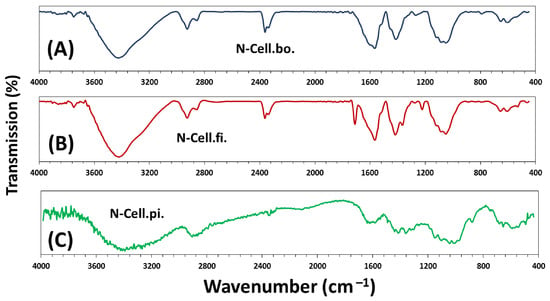
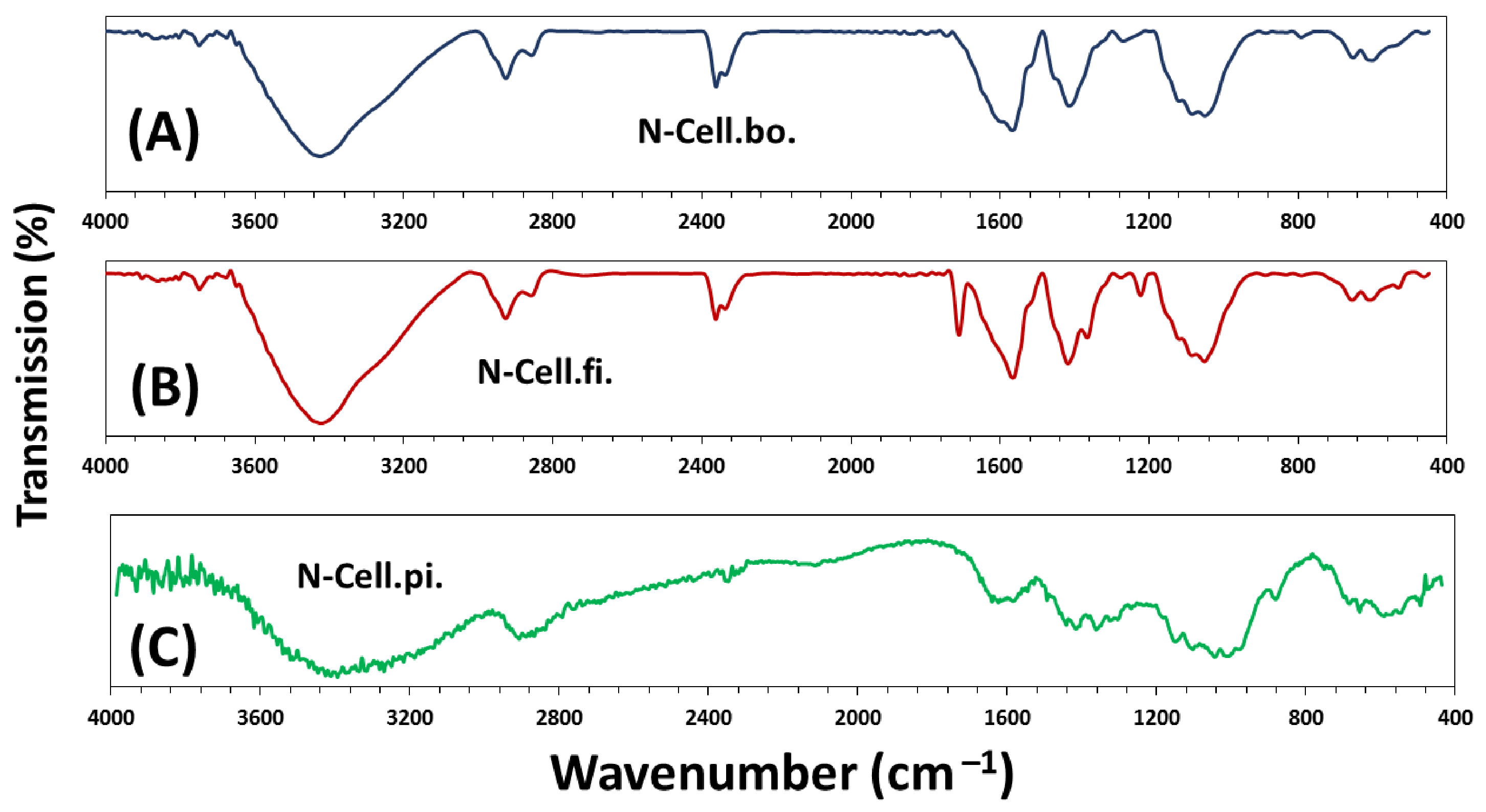
Figure 3A–C reveal both similarities and differences in the FT-IR spectra of the prepared cellulose samples. Peaks corresponding to various functional groups characteristic of the cellulose backbone were observed. The N-Cell.fi. and N-Cell.bo. samples showed similarities, with most functional groups clearly attributable to hemicellulose and lignin. This indicated that these two cellulose samples were not sufficiently pure. In contrast, the N-Cell.pi. sample proved to be the best, as peaks associated with the cellulose backbone structure clearly predominated. The conclusions drawn from the FT-IR spectra are further supported by XRD and FESEM outcomes.
Figure 3.
FT-IR spectra of (A) N-Cell.bo. sample, (B) N-Cell.fi. sample, and (C) N-Cell.pi. sample.
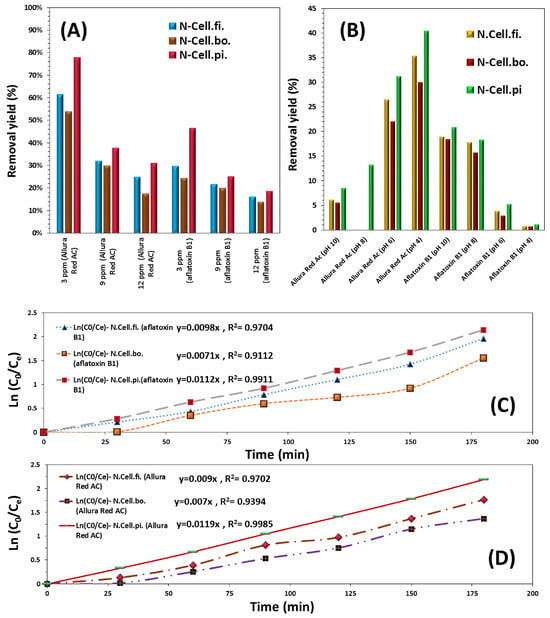
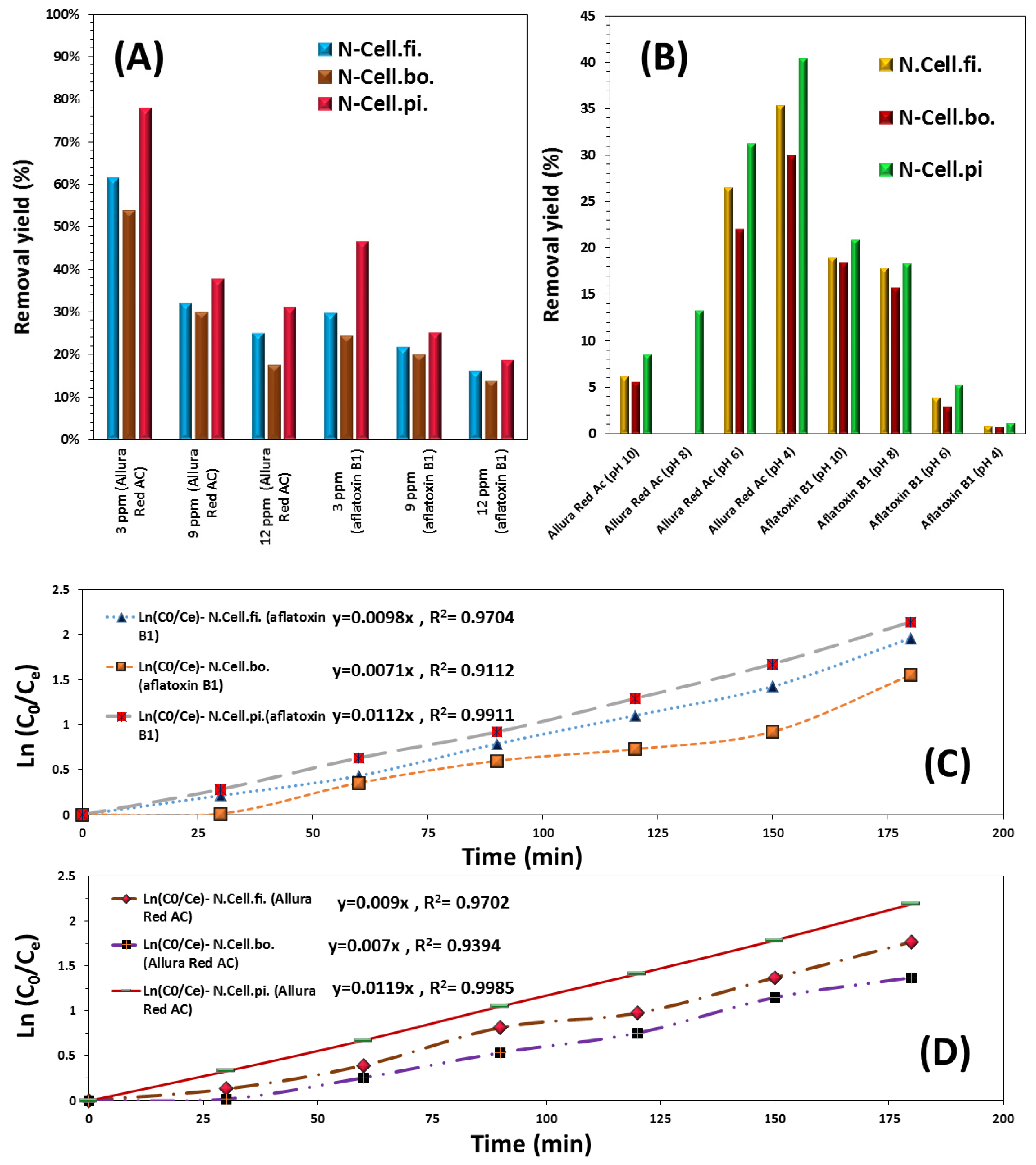
It can be observed from Figure 4A that the aflatoxin B1 removal yield at pH 4 was very low, falling within the range of 0.8–1%. This can be attributed to the repulsion between the positively charged aflatoxin molecules—due to the abundant surrounding of acidic hydrogen ions and their conversion into positively charged species—and the surface of the nanostructured parent materials of cellulose—whose hydroxyl groups become protonated in the acidic medium. Therefore, it cannot be attracted to the surface of any prepared cellulosic material (N-Cell.bo., N-Cell.pi. and N-Cell.fi.). In an acidic medium (pH 6), the hydrogen ion concentration is low, resulting in reduced protonation of the cellulose surface. An equilibrium is established between the aflatoxin B1 molecule—which carries a weak positive charge under these conditions—and the minimally protonated cellulose surface, leading to a better removal yield. The removal yield was higher in alkaline media (pH 8 and pH 10) than in an acidic one. This is notable because hydroxyl ions react with aflatoxin B1 molecules, structurally converting them into the unstable phenolic compound coumarinic acid, which facilitates its removal using the cellulose matrix. Regarding the removal rate of Allura Red AC, a higher removal yield was observed compared to aflatoxin B1 in both acidic and alkaline media. All prepared cellulosic structures demonstrated a greater capacity for removing the dye in an acidic medium than in an alkaline one. The anionic nature of the dye results in a partial modification of its charge; however, the sulfonate groups remain strongly negative in highly acidic media (pH 4) compared to less acidic ones (pH 6). Conversely, the surface of the cellulosic structure remains exposed to the influence of hydrogen ions, leading to an increase in its positive charge. This facilitates the unobstructed binding of Allura Red molecules to the positively ionized sites on the cellulosic surface, thereby enhancing electrostatic attraction. However, in alkaline media—whether weakly, strongly, or moderately basic—negatively charged hydroxyl ions (OH−) are abundant; they strongly compete with negatively charged Allura Red AC molecules for the limited binding sites on the cellulose structure. This competition cannot be entirely eliminated, thereby preventing the Allura Red AC molecules from establishing effective electrostatic interactions with the cellulose structures [28]. As indicated by Figure 4B, an increase in the concentration of either of the two pollutants reduces the removal yield. The uptake of molecules of each pollutant—even at low initial concentrations—is substantial, owing to the abundance and accessibility of surface sites on the cellulose structure across all samples. These same sites become more densely occupied as the concentration of the pollutant molecules increases. Finally, the most important observation is that the cellulose structure derived from pine branches (N-Cell.pi.) exhibited the best removal capacity among all the cellulose structures (N-Cell.fi. and N-Cell.bo.), owing to its higher-purity cellulose composition—free of hemicellulose and lignin—compared to the other two samples. The kinetic behavior of the removal of aflatoxin B1 (Figure 4C) and Allura Red AC (Figure 4D) by the three prepared samples (N-Cell.pi., N-Cell.fi. and N-Cell.bo.) was evaluated using the first-order kinetic model. The plots of Ln(C0/Ce) vs. removal time displayed an approximately linear relationship, suggesting that the removal process can be reasonably described by an apparent first-order kinetic (Equation (1)). Also, the half-time of the removal reaction can be calculated by Equation (2):
where, C0, Ce and t are the initial pollutant concentration, equilibrium pollutant concentration at time and time required to perform the removal procedure, respectively. Also, kt is the apparent first-order kinetic rate constant. The “ kt “ and “R2” values were estimated from the slopes of the kinetic plots and from the linear equation. The related values are also tabled in Table S1. As noted in Table S1 and Figure 4C, the calculated “kt and R2” indicated that the removal rate of aflatoxin B1 followed the order: N-Cell.pi. > N-Cell.fi. > N-Cell.bo. In the same manner, for Allura Red AC (Figure 4D), the calculate values “kt and R2” were larger than the same values for aflatoxin B1. Accordingly, the kinetic rate followed the same order “N-Cell.pi. > N-Cell.fi. > N-Cell.bo.”. The scientific interpretation of the higher “kt” values for N-Cell.pi is that the removal rate for both pollutants is significantly faster than that of the other two cellulose samples. This suggests a more rapid interaction between Aflatoxin B1/Allura Red AC and the preferred active sites on the corresponding N-Cell. Overall, N-Cell.pi. possessed the strongest removal capacity toward both pollutants, whereas N-Cell.bo. showed the lowest removal capacity and kinetic rate. The generally high “R2” verified that the apparent first-order kinetic model provides a satisfactory description of the removal kinetics, particularly for the N-Cell.pi. sample. It should be noted that the relevant UV-Visible spectra were provided in the supporting file (Figures S1 and S2), and all kinetic study indicators were tabulated in Table S1.
Figure 4.
(A) Relationship between removal efficiency and changes in initial pollutant concentrations; (B) relationship between removal efficiency and changes in the pH of the removal medium for both pollutants; (C) removal reaction kinetics for aflatoxin B1; and (D) removal reaction kinetics for Allura Red AC for all N-Cell. samples.
4. Conclusions
In summary, three cellulose-based nanostructures were synthesized from green sources, exhibiting distinct differences in their physicochemical properties. Analyses of crystalline phases, morphology, and structure revealed that one specific sample outperformed the other prepared samples. Aflatoxin B1 removal was greater in alkaline media than in acidic media; conversely, the removal of Allura Red AC on the surfaces of the prepared structures followed this order: N-Cell.pi. > N-Cell.fi. > N-Cell.pi. The kinetic investigation demonstrated that the removal of the two pollutants can be reasonably described by a first-order kinetic model. Although the degree of agreement varied according to the experimental conditions. N-Cell.pi., yielding the highest kt and R2 values (kt = 0.0112 min−1 “for aflatoxin B1” and 0.0119 min−1 “for Allura Red AC”, R2 = 0.9911 “for aflatoxin B1” and R2 = 0.9985 “for Allura Red AC”) and reducing half-lives (approximately from 61.9 min to 58.2 min), exhibited the most favorable kinetic performance. Nevertheless, further investigation using complementary kinetic models and mechanistic analyses would be valuable in distinguishing the contributions of adsorption, surface reaction, and mass transfer phenomena to the overall pollutant removal process.
Supplementary Materials
The following supporting information can be downloaded at: https://www.mdpi.com/article/10.3390/chemproc2026022068/s1. Figure S1, Figure S2 and Table S1 were included in the materials support file [29,30,31,32,33,34,35,36,37,38,39,40,41]. The explanation for each figure is provided as follows: Figure S1: UV-Visible of Allura Red AC—after removal from its solution—at (A) pH 4 (B) pH 6 (C) pH 8 and (D) pH 10; Figure S2: UV-Visible of (A) aflatoxin B1—after removal from its solution— at (A) pH 4 (B) pH 6 (C) pH 8 and (D) pH 10; Table S1: The kinetic study indicators.
Author Contributions
G.K.K.: Supervision, Investigation, Formal analysis, Conceptualization, Methodology, Visualization, Validation, Reviewing and Editing, Project administration, Writing—original draft, Resources; M.A.-S., A.N. and M.Z.: Conceptualization, Writing, Funding Acquisition, Resources; A.-A.D., S.M. and N.A.B.: Visualization, Writing and Resources. All authors have read and agreed to the published version of the manuscript.
Funding
This research received no external funding.
Institutional Review Board Statement
No in vitro or in vivo studies were conducted; therefore, no approvals for such purposes were required.
Informed Consent Statement
The current study does not involve human subjects; therefore, there is no need to obtain informed consent from any study participants.
Data Availability Statement
The raw/processed data required to reproduce these findings cannot be shared at this time as the data also forms part of an ongoing study.
Acknowledgments
The authors wish to acknowledge the support of this work by Latakia University, Latakia, Syria.
Conflicts of Interest
The authors declare no conflicts of interest.
References
- Popescu, C.; Dissanayake, H.; Mansi, E.; Stancu, A. Eco breakthroughs: Sustainable materials transforming the future of our planet. Sustainability 2024, 16, 10790. [Google Scholar] [CrossRef] [Scilit]
- Yang, Z.; Solangi, Y.A. Analyzing the relationship between natural resource management, environmental protection, and agricultural economics for sustainable development in China. J. Clean. Prod. 2024, 450, 141862. [Google Scholar] [CrossRef] [Scilit]
- Musa, A.A.; Bello, A.; Adams, S.M.; Onwualu, A.P.; Anye, V.C.; Bello, K.A.; Obianyo, I.I. Nano-enhanced polymer composite materials: A review of current advancements and challenges. Polymers 2025, 17, 893. [Google Scholar] [CrossRef] [Scilit]
- Ingle, A.P.; Saxena, S.; Moharil, M.P.; Rivaldi, J.D.; Ramos, L.; Chandel, A.K. Production of biomaterials and biochemicals from lignocellulosic biomass through sustainable approaches: Current scenario and future perspectives. Biotechnol. Sustain. Mater. 2025, 2, 3. [Google Scholar] [CrossRef] [Scilit]
- Yin, Y.; Talapin, D. The chemistry of functional nanomaterials. Chem. Soc. Rev. 2013, 42, 2484–2487. [Google Scholar] [CrossRef] [Scilit]
- Iroegbu, A.O.C.; Ray, S.S. Recent developments and future perspectives of biorenewable nanocomposites for advanced applications. Nanotechnol. Rev. 2022, 11, 1696–1721. [Google Scholar] [CrossRef] [Scilit]
- Matei, E.; Predescu, A.M.; Râpă, M.; Țurcanu, A.A.; Mateș, I.; Constantin, N.; Predescu, C. Natural polymers and their nanocomposites used for environmental applications. Nanomaterials 2022, 12, 1707. [Google Scholar] [CrossRef] [Scilit]
- Thomas, B.; Raj, M.C.; B, A.K.; Joy, J.; Moores, A.; Drisko, G.L.; Sanchez, C. Nanocellulose, a versatile green platform: From biosources to materials and their applications. Chem. Rev. 2018, 118, 11575–11625. [Google Scholar] [CrossRef] [Scilit]
- Hansini, A.M.P.; Galpaya, G.D.C.P.; Gunasena, M.D.K.M.; Abeysundara, P.M.; Kirthika, V.; Bhagya, L.; Koswattage, K.R. From nature to innovation: Advances in nanocellulose extraction and its multifunctional applications. Molecules 2025, 30, 2670. [Google Scholar] [CrossRef] [Scilit]
- Al-Zu’bi, M.; Fan, M. Nanocellulose technologies: Production, functionalization, and applications in medicine and pharmaceuticals-a review. J. Biomed. Mater. Res. Part B Appl. Biomater. 2025, 113, e35585. [Google Scholar] [CrossRef] [Scilit]
- Reshmy, R.; Philip, E.; Paul, S.A.; Madhavan, A.; Sindhu, R.; Binod, P.; Sirohi, R. Nanocellulose-based products for sustainable applications-recent trends and possibilities. Rev. Environ. Sci. Bio/Technol. 2020, 19, 779–806. [Google Scholar] [CrossRef] [Scilit]
- Peter, S.; Lyczko, N.; Gopakumar, D.; Maria, H.J.; Nzihou, A.; Thomas, S. Nanocellulose and its derivative materials for energy and environmental applications. J. Mater. Sci. 2022, 57, 6835–6880. [Google Scholar] [CrossRef] [Scilit]
- Randhawa, A.; Dutta, S.D.; Ganguly, K.; Patil, T.V.; Patel, D.K.; Lim, K.T. A review of properties of nanocellulose, its synthesis, and potential in biomedical applications. Appl. Sci. 2022, 12, 7090. [Google Scholar] [CrossRef] [Scilit]
- Li, T.; Chen, C.; Brozena, A.H.; Zhu, J.Y.; Xu, L.; Driemeier, C.; Hu, L. Developing fibrillated cellulose as a sustainable technological material. Nature 2021, 590, 47–56. [Google Scholar] [CrossRef] [Scilit]
- Deng, Y.; Zhu, T.; Cheng, Y.; Zhao, K.; Meng, Z.; Huang, J.; Lai, Y. Recent advances in functional cellulose-based materials: Classification, properties, and applications. Adv. Fiber Mater. 2024, 6, 1343–1368. [Google Scholar] [CrossRef] [Scilit]
- Ray, U.; Zhu, S.; Pang, Z.; Li, T. Mechanics design in cellulose-enabled high-performance functional materials. Adv. Mater. 2021, 33, 2002504. [Google Scholar] [CrossRef] [Scilit]
- Antony Jose, S.; Cowan, N.; Davidson, M.; Godina, G.; Smith, I.; Xin, J.; Menezes, P.L. A comprehensive review on cellulose nanofibers, nanomaterials, and composites: Manufacturing, properties, and applications. Nanomaterials 2025, 15, 356. [Google Scholar] [CrossRef] [Scilit]
- Faiz Norrrahim, M.N.; Mohd Kasim, N.A.; Knight, V.F.; Mohamad Misenan, M.S.; Janudin, N.; Ahmad Shah, N.A.; Zin Wan Yunus, W.M. Nanocellulose: A bioadsorbent for chemical contaminant remediation. RSC Adv. 2021, 11, 7347–7368. [Google Scholar] [CrossRef] [Scilit]
- Balakrishnan, A.; Mathew, F.P.; Tom Joseph, M.; Varghese, M.M.; Aryamol, K.S.; Chinthala, M.; Weng, B. Engineered cellulose-supported photocatalysts for clean energy and environmental remediation: Progress and prospects. J. Mater. Chem. A 2026, 14, 5473–5519. [Google Scholar] [CrossRef] [Scilit]
- Shak, K.P.Y.; Pang, Y.L.; Mah, S.K. Nanocellulose: Recent advances and its prospects in environmental remediation. Beilstein J. Nanotechnol. 2018, 9, 2479–2498. [Google Scholar] [CrossRef] [Scilit]
- Abdelhamid, H.N. Nanocellulose-based materials for water pollutant removal: A review. Int. J. Mol. Sci. 2024, 25, 8529. [Google Scholar] [CrossRef] [Scilit]
- Thipchai, P.; Sringarm, K.; Punyodom, W.; Jantanasakulwong, K.; Thanakkasaranee, S.; Panyathip, R.; Rachtanapun, P. Production of nanocellulose from sugarcane bagasse and development of nanocellulose conjugated with polylysine for fumonisin B1 toxicity absorption. Polymers 2024, 16, 1881. [Google Scholar] [CrossRef] [Scilit]
- Yang, X.; Biswas, S.K.; Han, J.; Tanpichai, S.; Li, M.C.; Chen, C.; Yano, H. Surface and interface engineering for nanocellulosic advanced materials. Adv. Mater. 2021, 33, 2002264. [Google Scholar] [CrossRef] [Scilit]
- Das, R.; Lindstrom, T.; Sharma, P.R.; Chi, K.; Hsiao, B.S. Nanocellulose for sustainable water purification. Chem. Rev. 2022, 122, 8936–9031. [Google Scholar] [CrossRef] [Scilit]
- Kheraldeen Kara, G.; Rabbani, M. Experimental study of methylene blue adsorption from aqueous solutions onto Fe3O4/NiO nano mixed oxides prepared by ultrasonic assisted co-precipitation. J. Nanostruct. 2019, 9, 287–300. [Google Scholar]
- Abdel-Halim, E.S.; Alanazi, H.H.; Alghamdi, A.A. Extraction and bleaching of olive tree branch cellulose. BioResources 2015, 10, 7136–7150. [Google Scholar] [CrossRef] [Scilit][Green Version]
- Kara, G.K.; Tadjarodi, A.; Kehtari, M. Designing a novel 3D nanofibrous scaffold based on nanoalloy AuAg NPs (AuAg@ PAN NFs) for osteogenic differentiation of human adipose derived mesenchymal stem cells (hADMSCs). Eur. Polym. J. 2022, 167, 111073. [Google Scholar] [CrossRef] [Scilit]
- Drannikov, A.A.; Blinova, E.A.; Korel, A.V.; Samokhin, A.G.; Dubovskaya, P.I.; Lazurenko, D.V.; Litvinova, E.A. Novel biosorbents based on carboxyethyl chitosan for Allura Red dye contaminated water treatment. Chim. Techno Acta 2024, 11, 15. [Google Scholar] [CrossRef] [Scilit]
- Sathish, J.; Palani, R.; Seenuvasan, M. Development and characterization of nanocellulose hydrogel for enhanced water retention and controlled nutrient release in sustainable agriculture. Indian J. Chem. Technol. 2026, 33, 628–638. [Google Scholar] [CrossRef] [Scilit]
- Lv, Y.; Li, Q.; Yang, W.; Zhang, Z.; Li, Y. Recent advances in functional design of nanocellulose and their intelligent application. Int. J. Smart Nano Mater. 2025, 16, 245–283. [Google Scholar] [CrossRef] [Scilit]
- Zhou, Q.; Zha, W.; Zhong, K.; Xu, J.; Lin, L.; Huang, Y.; Sui, X.; Liu, Y.; Xiao, Y. Structure-activity relationship and regulatory mechanism of nanocellulose with different length-diameter ratio on the gelling behavior of soybean protein-derived amyloid fibrils. Food Hydrocoll. 2025, 168, 111521. [Google Scholar] [CrossRef] [Scilit]
- Mijailović, D.M.; Gane, P.A.; Dimić-Mišić, K.; Imani, M.; Stojanović, D.B.; Uskoković, P.S. High-performance crystalline nanocellulose (CNC) supercapacitor separator: Achieved by maximizing alkali-induced gel stress-response prior to aerogel compression forming. J. Power Sources 2025, 633, 236476. [Google Scholar] [CrossRef] [Scilit]
- Zhang, M.; Xu, T.; Liu, K.; Zhu, L.; Miao, C.; Chen, T.; Gao, M.; Wang, J.; Si, C. Modulation and Mechanisms of Cellulose-Based Hydrogels for Flexible Sensors. Susmat 2024, 5, e255. [Google Scholar] [CrossRef] [Scilit]
- Wang, W.; Sun, Y.; Tong, Z.; Yu, H. Green Solvent Systems for Cellulose Dissolution and Regeneration: Hydrogen-Bond Engineering Toward Sustainable Functional Materials. ChemSusChem 2026, 19, e70919. [Google Scholar] [CrossRef] [Scilit]
- Chen, L.; Yu, L.; Qi, L.; Eichhorn, S.J.; Isogai, A.; Lizundia, E.; Zhu, J.Y.; Chen, C. Cellulose nanocomposites by supramolecular chemistry engineering. Nat. Rev. Mater. 2025, 10, 728–749. [Google Scholar] [CrossRef] [Scilit]
- Bai, J.; Li, M.; Yuan, Y.; Zhao, T.; Yang, Y.; Xu, Z.; Li, Q.; Zhou, Y. Surface modified cellulose nanofibrils with γ-Aminopropyltriethoxysilane (KH550) for the performance enhancement of Portland cement systems. Constr. Build. Mater. 2025, 486, 141956. [Google Scholar] [CrossRef] [Scilit]
- Somsesta, N.; Chamamporn, C.; Wongsopanakun, N.; Sonaka, P.; Hongrattanavichit, I. Surface-coated paper packaging with nanocellulose modified with quaternary ammonium organosilane and precipitated calcium carbonate for improved water repellency and antibacterial activity. Sci. Rep. 2025, 15, 25723. [Google Scholar] [CrossRef] [Scilit]
- Eriksson, R.; Mariam, I.; Ramser, K.; Patel, A. Characterization of bacterial nanocellulose cultivated on polyethylene terephthalate (PET) monomers via raman and fourier transform infrared spectroscopy. Sci. Rep. 2026, 16, 13133. [Google Scholar] [CrossRef] [Scilit]
- Manjula, R.; Reddy, E.R.; Rani, J.D.; Poongodi, R.; Sharma, B.K.; Nagaraj, K. Rice Husk-Derived Engineered Nanocellulose at Nano-Geo Interfaces for Mitigating Anthropogenic Heavy Metal Contamination. Environ. Geochem. Health 2026, 48, 137. [Google Scholar] [CrossRef] [Scilit]
- Joo, H.-W.; Wang, Y.; Srubar, W.V.; Hubler, M.H. Bacterial nanocellulose for repair and repeated self-healing of concrete. Constr. Build. Mater. 2026, 539, 147460. [Google Scholar] [CrossRef] [Scilit]
- Yadav, C.; Chu, K.H.; Hassan, Z.; Lee, J.-H.; Jang, W.-D. Nanocellulose sponges embedding metal oxide nanoparticles for adsorption and photodegradation of microplastics. Chemosphere 2025, 386, 144614. [Google Scholar] [CrossRef] [Scilit]
Disclaimer/Publisher’s Note: The statements, opinions and data contained in all publications are solely those of the individual author(s) and contributor(s) and not of MDPI and/or the editor(s). MDPI and/or the editor(s) disclaim responsibility for any injury to people or property resulting from any ideas, methods, instructions or products referred to in the content. |
© 2026 by the authors. Licensee MDPI, Basel, Switzerland. This article is an open access article distributed under the terms and conditions of the Creative Commons Attribution (CC BY) license.