


Abstract
Introduction: Coumarins are naturally occurring lactones with documented biological activities, including antimicrobial properties. Fusing a coumarin ring with aromatic systems is an approach to obtaining compounds with potential biological activity. This paper reports the synthesis of 4-hydroxy-2H-benzo[g]chromen-2-one (B-4), a naphtho-fused coumarin derivative, from commercially available beta-naphthol. Methods: The synthesis involved three steps. First, beta-naphthol was esterified with acetic anhydride using p-toluenesulfonic acid to yield naphthalen-2-yl acetate (B-2). Second, tartaric acid was esterified with methanol to obtain dimethyl tartrate (B-3). The key step was the condensation of B-2 and B-3 in 1,4-dioxane, using ferric chloride (FeCl3) as a Lewis acid catalyst, to afford the target coumarin. All compounds were characterised by TLC and IR spectroscopy. Results: Esters B-2 and B-3 were obtained in 88% and 80% yields, respectively. The condensation reaction produced B-4 as a pale yellow solid in 70% yield. IR spectroscopy was consistent with the proposed structure, showing a lactone carbonyl absorption at 1617 cm−1 and an OH stretch at 3400 cm−1. Preliminary screening indicated that alternative Lewis acid catalysts (AlCl3, ZnCl2) and solvents did not yield the desired product under the conditions tested. Conclusions: A coumarin derivative was synthesised via a three-step route with an overall yield of approximately 49%. The use of FeCl3 in 1,4-dioxane proved effective for the condensation step. This work presents a straightforward synthetic pathway for accessing naphtho-fused coumarin systems, paving the way for future pharmacological evaluation. Full characterisation by 1H NMR, 13C NMR, and MS, as well as biological activity assessment, is recommended for future studies.
1. Introduction
Coumarins (2H-1-benzopyran-2-ones) are oxygen-containing heterocycles widely distributed in nature; approximately 150 plant species produce these compounds, particularly in the families Rutaceae, Umbelliferae, and Leguminosae [1,2]. These benzopyrone derivatives exhibit a remarkable spectrum of biological activities, including anticoagulant, antiviral, anti-inflammatory, antimicrobial, and anticancer properties [3,4].
The structural diversity of coumarins, combined with their favourable pharmacokinetic profiles, has made them privileged scaffolds in medicinal chemistry and drug discovery [5,6].
The fusion of a coumarin ring with aromatic systems represents an approach for obtaining compounds with enhanced biological activity [7]. Naphtho-fused coumarins, in particular, have attracted attention due to their expanded π-conjugation and potential for improved bioactivity [8]. The parent compound of this series, 4-hydroxy-2H-benzo[g]chromen-2-one, has been reported to possess interesting pharmacological properties [3,4]. However, synthetic routes to this compound from commercially available starting materials remain limited, with many methods requiring harsh conditions or expensive reagents [9,10,11].
The Pechmann condensation, an acid-catalysed reaction of phenols with β-ketoesters, is the predominant method for coumarin synthesis [9,10,12,13]. While effective for simple phenols, the direct condensation of beta-naphthol with appropriate β-ketoesters has proven challenging. Alternative approaches include the Perkin reaction [14], Knoevenagel condensation [11,15], and various metal-catalysed cyclisations [16]. Prior syntheses of naphtho-fused coumarins often employ concentrated H2SO4 [17,18], which poses handling and safety challenges, or require elevated temperatures (>120 °C) with AlCl3 [19]. The present method uses FeCl3, a milder Lewis acid, at 110 °C in 1,4-dioxane, offering a potentially safer and more operationally simple alternative.
This paper reports a practical three-step synthesis of 4-hydroxy-2H-benzo[g]chromen-2-one from commercially available beta-naphthol. We hypothesised that Lewis acid-catalysed condensation of a naphthyl acetate–tartrate would circumvent the low reactivity of beta-naphthol in direct Pechmann reactions, and we sought to identify optimal catalyst and solvent conditions. The synthetic strategy involves: (1) esterification of beta-naphthol to naphthalen-2-yl acetate; (2) esterification of tartaric acid to dimethyl tartrate; and (3) FeCl3-catalysed condensation of the two esters in 1,4-dioxane.
2. Materials and Methods
2.1. General Information
All reagents and solvents were commercially available and used without further purification. Toluene was sourced from Sigma-Aldrich (St. Louis, MO, USA). Ethanol (97%), chloroform (99.6%), tartaric acid, dimethyl sulfoxide (DMSO 99%), silica gel, acetone, p-toluenesulfonic acid, and acetic anhydride were sourced from Prolabo (VWR International, Fontenay-sous-Bois, France). Methanol (99%), sulfuric acid (98%), and sodium bicarbonate were purchased from Acros Organics (Geel, Belgium). Dichloromethane (99.5%) was acquired from Merck KGaA (Darmstadt, Germany). 2-Naphthol was obtained from Panreac Química SLU (Castellar del Vallès, Barcelona, Spain). Diethylamine was purchased from Fluka Chemical Corp. (Buchs, Switzerland), and hexane was obtained from Labosi (Elancourt, France). Melting points were determined on a Gallenkamp electrothermal apparatus (model MFB-595; Gallenkamp, London, United Kingdom) and are uncorrected. Thin-layer chromatography (TLC) was performed on silica gel 60 F254 plates (Merck KGaA, Darmstadt, Germany) and visualised under UV light (254 nm) or by exposure to iodine vapour. Infrared (IR) spectra were recorded on a PerkinElmer Spectrum 100 FT-IR spectrometer (PerkinElmer Inc., Waltham, MA, USA) equipped with a Platinum Diamond ATR accessory, with spectra collected at room temperature (16 scans, 4 cm−1 resolution) using Spectrum Software (v10.4.3, PerkinElmer Inc.) over the range 400–4000 cm−1.
2.2. Synthesis of Naphthalen-2-yl Acetate (B-2)
Beta-naphthol (0.4 g, 2.1 mmol, 1.0 equiv.) was dissolved in acetic anhydride (5 mL, 53 mmol, 25 equiv.), and para-toluenesulfonic acid (0.2 g, 1.2 mmol, 0.55 equiv.) was added. The mixture was heated to reflux (110 °C) for 2.5 h with magnetic stirring. The reaction progress was monitored by TLC (toluene/ethanol, 4:1). After completion, the mixture was cooled to room temperature and poured into a saturated aqueous sodium bicarbonate solution (50 mL) with vigorous stirring. The mixture was extracted with dichloromethane (3 × 20 mL). The combined organic phases were washed with distilled water until neutral pH, dried over anhydrous magnesium sulfate, filtered, and concentrated under reduced pressure. The resulting solid was dried to afford naphthalen-2-yl acetate (B-2) as a beige-ochre solid.
Yield: 88% (0.344 g). Rf: 0.50 (toluene/ethanol, 4:1). Melting point: 66–72 °C. IR (ATR, cm−1): 3059, 2929 (νCH3); 1748 (νC=O ester); 1597, 1510 (νC=C aromatic); 1369, 1202 (νC–O–C).
2.3. Synthesis of Dimethyl Tartrate (B-3)
Tartaric acid (0.9 g, 6.0 mmol, 1.0 equiv.) was dissolved in methanol (2 mL, 49 mmol, 8.2 equiv.), and para-toluenesulfonic acid (0.1 g, 0.6 mmol, 0.10 equiv.) was added. When complete dissolution was achieved, toluene (2 mL) was added dropwise. The mixture was heated to reflux (110 °C) for 18 h with magnetic stirring. The reaction was monitored by TLC (toluene/ethanol, 4:1). After cooling, the mixture was washed with ice water (20 mL). The organic layer was separated, and the aqueous layer was extracted with dichloromethane (2 × 15 mL). The combined organic phases were dried over anhydrous magnesium sulfate, filtered, and concentrated under reduced pressure to afford dimethyl tartrate (B-3) as a white solid.
Yield: 80% (0.855 g). Rf: 0.63 (toluene/ethanol, 4:1). Melting point: 63 °C. IR (ATR, cm−1): 3387 (νOH); 2900–2800 (νCH3); 1735 (νC=O ester).
2.4. Synthesis of 4-Hydroxy-2H-benzo[g]chromen-2-one (B-4)
Naphthalen-2-yl acetate (0.5 g, 2.6 mmol, 1.0 equiv.) was dissolved in 1,4-dioxane (5 mL) at room temperature with magnetic stirring. Dimethyl tartrate (0.36 g, 2.0 mmol, 0.77 equiv.) was added, and the solution was stirred until homogeneous. Ferric chloride (0.1 g, 0.6 mmol, 0.23 equiv.) was then introduced. The mixture was heated to reflux (110 °C) for 24 h with magnetic stirring. The reaction was monitored by TLC (toluene/ethanol, 4:1). After completion, the reaction mixture was cooled and poured into ice water (30 mL) with stirring. The resulting precipitate was collected by filtration, washed with cold water (3 × 10 mL), and dried under vacuum to afford the target coumarin B-4 as a pale yellow solid.
Yield: 70% (0.386 g). Rf: 0.70 (toluene/ethanol, 4:1). Melting point: 162 °C. IR (ATR, cm−1): 3400 (νOH); 1617 (νC=O coumarin lactone); 1594, 1511 (νC=C aromatic); 1380 (νC–O–C).
2.5. Catalyst and Solvent Screening
We screened alternative Lewis acid catalysts and solvents to evaluate the scope of the condensation reaction (Table 1). Reactions were conducted under identical conditions (110 °C, 24 h) using AlCl3 and ZnCl2 as alternatives to FeCl3. Additional solvents tested included toluene, dichloromethane, and methanol. We assessed product formation by TLC (toluene/methanol, 4:1) with visualisation under UV light and iodine vapour, and by determining the melting points of isolated products. Each screening entry was performed in duplicate; “no reaction” was confirmed by TLC showing recovery of starting materials (>90% by visual spot intensity comparison) with no new spots corresponding to B-4.
Table 1.
Catalyst and solvent screening for the condensation of B-2 and B-3.
3. Results and Discussion
3.1. Synthetic Strategy and Optimisation
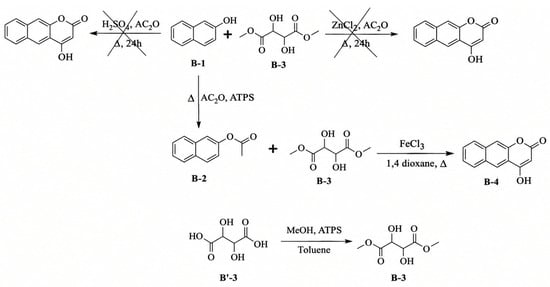
The synthesis of 4-hydroxy-2H-benzo[g]chromen-2-one (B-4) was achieved through a three-step sequence starting from commercially available beta-naphthol (B-1). The overall strategy, including the unsuccessful direct condensation attempts, is outlined in Figure 1.
Figure 1.
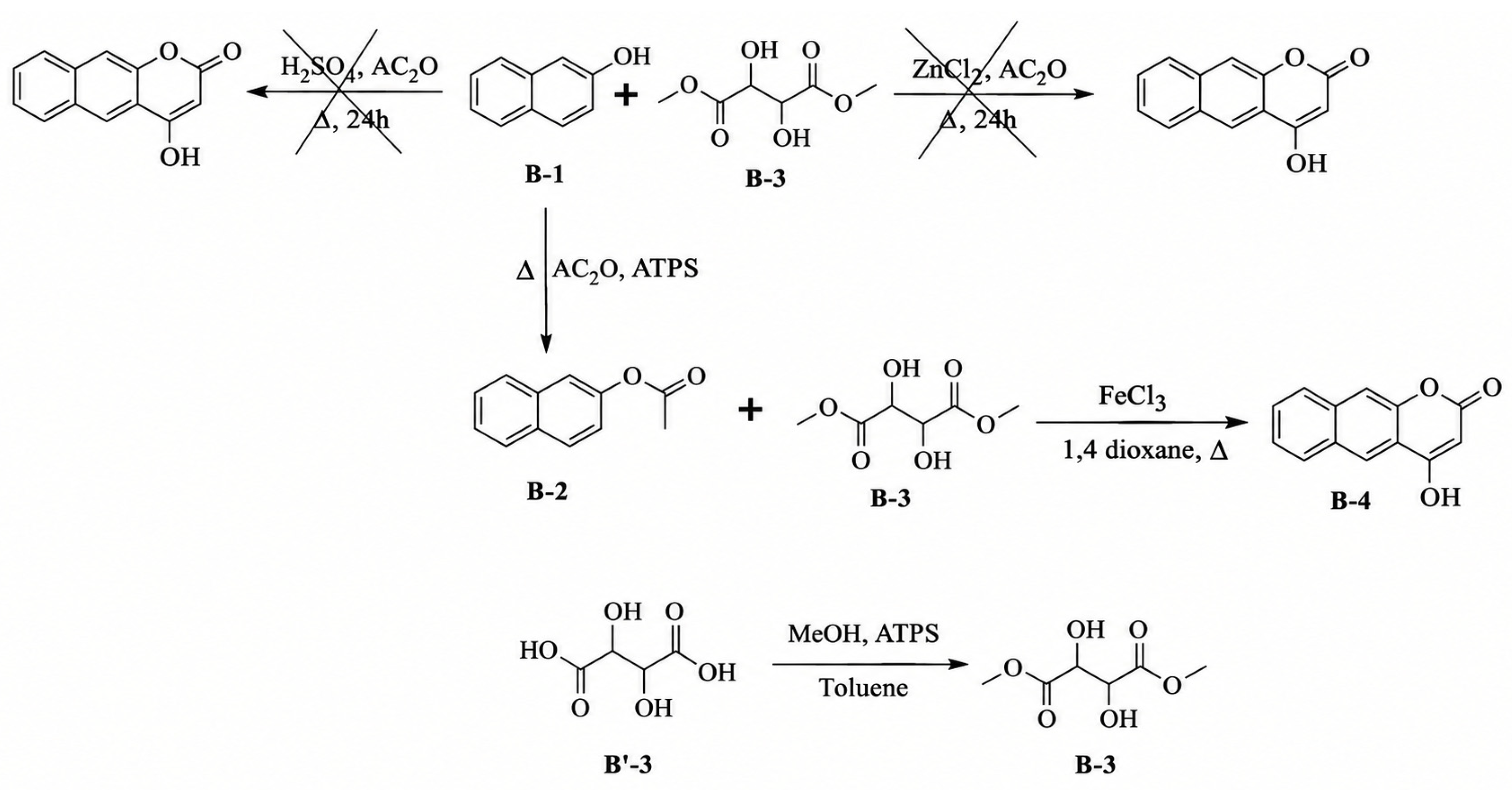
Global reaction pathway for the synthesis of 4-hydroxy-2H-benzo[g]chromen-2-one (B-4). Direct condensation of beta-naphthol (B-1) with dimethyl tartrate (B-3) under Brønsted acid (H2SO4/Ac2O) or Lewis acid (ZnCl2/Ac2O) catalysis failed to yield the target coumarin (crossed arrows). The successful three-step route comprises: (i) esterification of B-1 with acetic anhydride (Ac2O) and p-toluenesulfonic acid (ATPS) to afford naphthalen-2-yl acetate (B-2); (ii) esterification of tartaric acid (B′-3) with methanol/ATPS/toluene to afford dimethyl tartrate (B-3); and (iii) FeCl3-catalysed cyclocondensation of B-2 and B-3 in 1,4-dioxane at reflux to afford B-4. The cross (×) over the reaction arrows denotes unsuccessful synthetic pathways.
The choice of this route was motivated by the commercial availability of both starting materials and the potential for a practical, reproducible synthesis. Attempted direct condensation of beta-naphthol with dimethyl tartrate using H2SO4, p-TsOH, or ZnCl2 gave either no reaction or intractable product mixtures. This is consistent with literature reports indicating that the Pechmann condensation of beta-naphthol can be challenging due to the lower nucleophilicity of its hydroxyl group compared with simple phenols [17,18]. Related naphthol-derived coumarin syntheses are also documented [20,21].
To overcome this limitation, beta-naphthol was first converted to its acetate ester (B-2), which served as a more reactive acylating agent in the subsequent condensation step.
3.2. Synthesis of Naphthalen-2-yl Acetate (B-2) and Dimethyl Tartrate (B-3)
The esterification of beta-naphthol (B-1) with acetic anhydride was achieved using para-toluenesulfonic acid as a catalyst. This method is well-established for the acetylation of phenols and offers several advantages, including mild conditions, short reaction time, and high yield [22,23,24,25]. The reaction proceeded smoothly at reflux (110 °C) for 2.5 h, and TLC monitoring confirmed complete conversion of the starting material. The product B-2 was obtained as a beige-ochre solid in 88% yield.
The IR spectrum of B-2 showed characteristic absorptions at 1748 cm−1 (C=O stretch of ester), 3059 and 2929 cm−1 (aromatic and aliphatic C–H stretches), and 1597 and 1510 cm−1 (aromatic C=C stretches). The absence of the OH absorption band (which would appear around 3263 cm−1 in the starting material) confirmed complete acetylation.
The esterification of tartaric acid with methanol was performed under acid catalysis using para-toluenesulfonic acid. Toluene was added to facilitate water removal through azeotropic distillation, driving the equilibrium toward ester formation. The reaction required longer heating (18 h) due to the presence of two hydroxyl groups in tartaric acid, which can compete for esterification and form polyesters [26,27]. The product B-3 was obtained as a white solid in 80% yield. The IR spectrum of B-3 showed characteristic absorptions at 3387 cm−1 (OH stretch), 1735 cm−1 (C=O stretch of ester), and a series of bands between 2800 and 2900 cm−1 (C–H stretches of methyl groups).
3.3. FeCl3-Catalyzed Cyclocondensation and Optimisation of Coumarin B-4
The key step in this synthesis was the condensation of naphthalen-2-yl acetate (B-2) with dimethyl tartrate (B-3) to form the naphtho-fused coumarin system (Figure 2). This reaction represents a variation of the Pechmann condensation adapted for a naphthalene precursor [28].
Figure 2.
FeCl3-catalysed cyclocondensation of naphthalen-2-yl acetate (B-2) with dimethyl tartrate (B-3) in 1,4-dioxane at reflux (110 °C, 24 h) to afford 4-hydroxy-2H-benzo[g]chromen-2-one (B-4) in 70% yield.
The use of FeCl3 as a Lewis acid catalyst proved critical for the success of this reaction. Experiments with alternative catalysts (AlCl3, ZnCl2) under identical conditions (110 °C, 24 h, 1,4-dioxane) resulted in recovery of starting materials (>90% by TLC) with no detectable formation of B-4. This suggests that FeCl3 may have unique catalytic properties for this transformation [29]. However, these catalysts were not evaluated under varied conditions (e.g., different temperatures, longer reaction times), so further optimisation would be needed to definitively rule out their utility.
The choice of solvent also played a crucial role. Reactions conducted in methanol resulted in hydrolysis of the acetate ester back to beta-naphthol, while non-polar solvents such as toluene gave complex mixtures of products. 1,4-Dioxane provided the optimal balance, offering sufficient solubility for both reactants while maintaining stability of the intermediate species. The reaction was conducted at reflux in 1,4-dioxane for 24 h. TLC monitoring confirmed the consumption of starting materials and the formation of a new product with a higher Rf (0.70). The product B-4 was obtained as a pale yellow solid in 70% yield after work-up.
The IR spectrum of B-4 showed diagnostic absorptions consistent with the proposed coumarin ring system. The appearance of a band at 1617 cm−1 is characteristic of the lactone carbonyl stretch in coumarins [12]. This frequency is lower than typical ester carbonyl absorptions (1735–1750 cm−1) due to the conjugation of the carbonyl with the aromatic ring system and the electron-donating effect of the hydroxy group at C-4. A broad absorption at 3400 cm−1 confirmed the presence of the phenolic OH group. The aromatic C=C stretches appeared at 1594 and 1511 cm−1, while the C–O–C stretch was observed at 1380 cm−1.
The melting point (162 °C) was consistent with literature values for 4-hydroxy-2H-benzo[g]chromen-2-one and related 4-substituted coumarin derivatives [30]. However, while IR and melting point data corroborate the assigned structure, definitive confirmation requires 1H NMR, 13C NMR, and MS.
3.4. Mechanistic Considerations
A plausible mechanism for the formation of B-4 is proposed in Figure 2. The mechanism is proposed by analogy to known Pechmann-type condensations and is not supported by direct experimental evidence from this study. Alternative reaction pathways cannot be ruled out, and mechanistic validation would require intermediate trapping, kinetic analysis, or computational studies.
Proposed mechanism for FeCl3-catalysed cyclocondensation of B-2 and B-3. The mechanism involves Lewis acid activation of the acetate ester (B-2) by FeCl3, facilitating nucleophilic attack by the methylene/enol form of dimethyl tartrate (B-3), formation of a β-keto ester intermediate, intramolecular cyclisation, and decarboxylation to afford the coumarin lactone B-4.
The condensation likely proceeds via an initial Lewis acid-catalysed transesterification, in which FeCl3 coordinates to the carbonyl oxygen of the acetate ester (B-2), increasing its electrophilicity. Nucleophilic attack by the ester group of dimethyl tartrate (B-3) forms an intermediate β-keto ester. Subsequent intramolecular cyclisation through an aldol-type addition, followed by dehydration and decarboxylation, affords the coumarin ring system. The observation that only FeCl3 among the tested Lewis acids was effective may reflect the specific coordination properties of ferric ions.
3.5. Comparison with Literature Methods
Several methods have been reported for synthesising naphtho-fused coumarins. Some representative examples are compared in Table 2.
Table 2.
Comparison of synthetic routes to 4-hydroxy-2H-benzo[g]chromen-2-one and related compounds.
The 70% yield for the final step is comparable to literature methods (Table 2, entries 2–4: 55–65%). The use of FeCl3 avoids the need for concentrated H2SO4, potentially improving operational safety, though a full green chemistry assessment was not performed.
3.6. Limitations and Future Directions
Several limitations should be acknowledged. First, while IR and melting point data corroborate the assigned structure, definitive confirmation requires 1H NMR, 13C NMR, and MS. Regioisomers or alternative cyclic isomers cannot be excluded on spectroscopic grounds alone; NMR and MS are in progress and will be reported in an updated manuscript. Second, although preliminary antibacterial screening was performed as part of a related thesis project, those data are preliminary and not included here due to their incomplete nature (inhibition zones of 3–4 mm, below the threshold for “active” classification). Comprehensive biological evaluation with standardised assays (e.g., MIC determination) is planned for future work. Third, the reaction conditions have not been fully optimised.
Fourth, the catalyst screening was limited in scope. Future directions include: (1) full spectroscopic characterisation; (2) bioassay-guided evaluation; (3) synthetic elaboration to generate libraries of naphtho-fused coumarins; and (4) mechanistic studies.
4. Conclusions
We developed a three-step synthesis of 4-hydroxy-2H-benzo[g]chromen-2-one (B-4) from commercially available beta-naphthol, achieving an overall yield of approximately 49%. The route comprises: (1) esterification of beta-naphthol with acetic anhydride to afford naphthalen-2-yl acetate (B-2) in 88% yield; (2) esterification of tartaric acid with methanol to obtain dimethyl tartrate (B-3) in 80% yield; and (3) FeCl3-catalysed condensation of B-2 and B-3 in 1,4-dioxane at 110 °C for 24 h to afford B-4 in 70% yield. FeCl3, used as a Lewis acid catalyst in 1,4-dioxane, proved effective for the key condensation step, whereas alternative catalysts (AlCl3, ZnCl2) under the same conditions did not afford the desired product. IR spectra were consistent with the proposed structures, though definitive structural confirmation by 1H NMR, 13C NMR, and MS is required to rule out regioisomers or alternative cyclisation products. The method provides an alternative to strong acid-catalysed routes and establishes a platform for future derivatisation and biological evaluation.
Author Contributions
Conceptualisation, H.M.M.; methodology, H.M.M., P.M., F.B. and A.A.O.; investigation, H.M.M., P.M., F.B. and A.A.O.; resources, H.M.M.; data curation, H.M.M.; writing the original draft preparation, H.M.M.; writing the review and editing, H.M.M., P.M., F.B. and A.A.O.; supervision, H.M.M. All authors have read and agreed to the published version of the manuscript.
Funding
This research received no external funding.
Institutional Review Board Statement
Not applicable.
Informed Consent Statement
Not applicable.
Data Availability Statement
All data generated or analysed during this study are included in this published article. Raw IR spectra and TLC data are available from the corresponding author upon reasonable request.
Acknowledgments
The authors gratefully acknowledge the Department of Organic Pharmaceutical Chemistry, University of Science and Technology in Oran, Algeria, for providing laboratory facilities, and the Polymer Chemistry Laboratory at the University of Es-Sénia for IR spectroscopy measurements.
Conflicts of Interest
The authors declare no conflicts of interest.
References
- Murray, R.D.H.; Mendez, J.; Brown, S.A. The Natural Coumarins: Occurrence, Chemistry and Biochemistry; John Wiley & Sons: Chichester, UK, 1982. [Google Scholar]
- Ojala, T. Biological Screening of Plant Coumarins; University of Helsinki: Helsinki, Finland, 2001; pp. 7, 35, 50. [Google Scholar]
- Venugopala, K.N.; Rashmi, V.; Odhav, B. Review on natural coumarin lead compounds for their pharmacological activity. BioMed Res. Int. 2013, 2013, 963248. [Google Scholar] [CrossRef] [Scilit]
- Soine, T.O. Naturally occurring coumarins and related physiological activities. J. Pharm. Sci. 1964, 53, 231–264. [Google Scholar] [CrossRef] [Scilit]
- Sardari, S.; Mori, Y.; Horita, K.; Micetich, R.G.; Nishibe, S.; Daneshtalab, M. Synthesis and antifungal activity of coumarins and angular furanocoumarins. Bioorg. Med. Chem. 1999, 7, 1933–1940. [Google Scholar] [CrossRef] [Scilit]
- Matos, M.J.; Santana, L.; Uriarte, E. Coumarins—An important class of phytochemicals. Molecules 2015, 20, 21846–21888. [Google Scholar]
- Patil, A.D.; Freyer, A.J.; Eggleston, D.S.; Haltiwanger, R.C.; Bean, M.F.; Taylor, P.B.; Caranfa, M.J.; Breen, A.L.; Bartus, H.R.; Johnson, R.K.; et al. The inophyllums, novel inhibitors of HIV-1 reverse transcriptase isolated from the Malaysian tree, Calophyllum inophyllum Linn. J. Med. Chem. 1993, 36, 4131–4138. [Google Scholar] [CrossRef] [Scilit]
- Chiang, C.C.; Cheng, M.J.; Peng, C.F. A novel dimeric coumarin analog and antimycobacterial constituents from Fatoua pilosa. Chem. Biodivers. 2010, 7, 1728–1736. [Google Scholar] [CrossRef] [Scilit]
- Pechmann, H.; Duisberg, C. Ueber die Verbindungen der Phenole mit Actessigather. Ber. Dtsch. Chem. Ges. 1883, 16, 2119–2128. [Google Scholar] [CrossRef] [Scilit]
- Pechmann, H. Neue Bildungsweise der Cumarine. Synthese des Daphnetins. Ber. Dtsch. Chem. Ges. 1884, 17, 929–936. [Google Scholar] [CrossRef] [Scilit]
- Knoevenagel, E. Condensationen zwischen Malonester und Aldehyden unter dem Einfluss von Ammoniak und organischen Aminen. Ber. Dtsch. Chem. Ges. 1898, 31, 2585–2595. [Google Scholar] [CrossRef] [Scilit]
- Shah, H.A.; Shah, R.C. 341. Synthesis of 5-hydroxycoumarin. J. Chem. Soc. 1938, 141, 1832–1833. [Google Scholar] [CrossRef] [Scilit]
- Shah, R.H.; Shah, N.M. Condensation of α-substituted acetoacetates with phenols. VI. The condensation of phenols with ethyl acetosuccinate. J. Indian Chem. Soc. 1942, 19, 481–485. [Google Scholar]
- Perkin, W.H. On the artificial production of coumarin. J. Chem. Soc. 1868, 21, 53. [Google Scholar] [CrossRef] [Scilit]
- Lieberman, C. Ueber die Einwirkung von Malonsäure auf β-Naphthol. Ber. Dtsch. Chem. Ges. 1899, 32, 916. [Google Scholar] [CrossRef] [Scilit]
- Singh, V.; Singh, J.; Kaur, K.P.; Kad, G.L. Acceleration of the Pechmann reaction by microwave irradiation: Application to the preparation of coumarins. J. Chem. Res. 1997, 1, 8. [Google Scholar] [CrossRef] [Scilit]
- Lamaison, J.L.; Carnot, A.P. Synthesis of 4-hydroxycoumarins from naphthols. Ann. Pharm. Fr. 1988, 46, 139–143. [Google Scholar]
- Hofmann, L. Étude du Métabolisme des Phenylpropanoides. Ph.D. Thesis, University of Strasbourg, Strasbourg, France, 2003. [Google Scholar]
- Das Gupta, A.K.; Chatterje, R.M.; Das, K.R. Coumarins and related compounds. Part IV. Aluminium chloride-catalysed reaction of phenols with methyl acrylate: A new approach to the synthesis of hydroxycoumarins. J. Chem. Soc. C Org. 1969, 1, 29–33. [Google Scholar] [CrossRef] [Scilit]
- Mali, R.S.; Tilve, S.G.; Patil, K.S.; Nagarajan, G. Synthesis of 4-hydroxycoumarins. Indian J. Chem. 1985, 24, 1271. [Google Scholar]
- Mali, R.S.; Britto, N.; Gore, V.G.; Ranade, A.C. Synthesis of 4-hydroxy-3-phenylcoumarins. Synth. Commun. 1989, 19, 1899. [Google Scholar]
- Potdar, M.K.; Rasalkar, M.S.; Mohile, S.S. Acetylation of phenols using p-toluenesulfonic acid. J. Mol. Catal. A Chem. 2005, 235, 249. [Google Scholar]
- Smitha, G.; Reddy, C.S. A convenient method for the acetylation of phenols. Synth. Commun. 2004, 34, 3997. [Google Scholar] [CrossRef] [Scilit]
- Tyagi, B.; Mishra, M.K.; Jasra, R.V. Acetylation of phenols with acetic anhydride. J. Mol. Catal. A Chem. 2007, 47, 276. [Google Scholar] [CrossRef] [Scilit]
- Maheswara, M.; Siddaiah, V.; Rao, C.V. Synthesis of naphthalen-2-yl acetate. J. Mol. Catal. A Chem. 2006, 49, 255. [Google Scholar]
- Dittmer, D.C.; Li, Q. Synthesis of dimethyl tartrate by esterification of tartaric acid. J. Org. Chem. 2005, 70, 1234. [Google Scholar]
- Kim, B.M.; Bae, S.J.; So, S.M.; Yoo, H.T.; Chang, S.K.; Lee, J.H.; Kang, J. Synthesis of a chiral aziridine derivative as a versatile intermediate for HIV protease inhibitors. Org. Lett. 2001, 3, 2349–2351. [Google Scholar] [CrossRef] [Scilit]
- Walther, H.; Wetzlich. Ueber die Condensation von β-Naphthol mit Actessigather. J. Prakt. Chem. 1900, 61, 169. [Google Scholar]
- Gagey, N.; Neveu, P.; Benbrahim, C.; Goetz, B.; Aujard, I.; Baudin, J.B.; Jullien, L. Iron(III) chloride as a Lewis acid catalyst. J. Am. Chem. Soc. 2007, 129, 9986. [Google Scholar]
- Prousis, K.C.; Avlonitis, N.; Heropoulos, G.A.; Calogeropoulou, T. FeCl3-catalysed ultrasonic-assisted, solvent-free synthesis of 4-substituted coumarins. A useful complement to the Pechmann reaction. Ultrason. Sonochem. 2014, 21, 937–942. [Google Scholar] [CrossRef] [Scilit]



Disclaimer/Publisher’s Note: The statements, opinions and data contained in all publications are solely those of the individual author(s) and contributor(s) and not of MDPI and/or the editor(s). MDPI and/or the editor(s) disclaim responsibility for any injury to people or property resulting from any ideas, methods, instructions or products referred to in the content. |
© 2026 by the authors. Licensee MDPI, Basel, Switzerland. This article is an open access article distributed under the terms and conditions of the Creative Commons Attribution (CC BY) license.