


Abstract
Breast cancer is the most prevalent malignancy and a common type of cancer in women globally, accounting for more than 10% of newly diagnosed cancer cases annually. In the present research, we evaluated the potential anticancer effects of phytochemicals from Syzygium cumini L. against breast cancer acting via the inhibition of PI3Kα through ADMET and a molecular docking approach. The phytochemicals from Syzygium cumini were screened for their toxicity and drug likeness through ADMET analysis using SwissADME followed by the molecular docking of the most accepted compound using maestro 13.7.125 (Schrodinger Ltd., Wilmington, DE, USA) software. Protein binding receptors (PDB ID: 4L2Y) were obtained from the Protein Data Bank. This study investigated the molecular mechanism underlying the anticancer activity of selected phytochemicals against breast cancer. A total of 12 compounds were initially screened for drug likeness and pharmacokinetic properties through ADMET profiling, of which four compounds, including the standard drug paclitaxel, satisfied the pre-defined drug likeness and pharmacokinetic criteria. Subsequently, docking was performed to evaluate their binding interactions against PI3Kα. Among the evaluated compounds, gallic acid exhibited the strongest binding interactions with a docking score of −5.49 Kcal/mol. The integration of computational approaches enables the systematic identification of bioactive phytochemicals for anticancer potential, prediction of molecular targets and signaling pathways and comprehensive evaluation of their pharmacokinetics, toxicological properties and drug likeness properties, thereby accelerating the discovery and optimization of novel therapeutic candidates.
1. Introduction
Breast cancer is the most frequently diagnosed type of cancer among females, accounting for nearly one-third of all cancer cases in women. The disease is the second most major cause of death from cancers, after lung cancer. Therefore, even in view of the advancements made in breast cancer diagnosis and therapy, resulting in higher survival rates, there is an apparent need for novel treatment options and predictive and prognostic markers. Treatment modalities differ according to the molecular subtype of breast cancer [1]. The rise in the number of cancer cases in recent years and their effect on different aspects of human existence have made cancer one of the most pressing issues of the century [2].
With natural products exhibiting characteristics like structure diversity, a wide source range, and biological activity, they possess great potential to be used in developing drugs in today’s world. Natural products and derivatives (such as plant sources—phenolic acids, alkaloids, polysaccharides, saponins, quinones, terpenes, sterols, terpenes, saponins) are being investigated to treat breast cancer [3].
Despite breast cancer being among the deadliest cancers, there is an imperative need to find efficacious therapeutic approaches which can target more than one molecular pathway at once. It is in this scenario that the use of Syzygium cumini (jamun) for anticancer treatment has gained much research interest across the world because of its several biological properties. Syzygium cumini has traditionally been used in several places where Ayurveda has been in practice because of its rich composition of biologically active components like flavonoids, alkaloids and phenolic acids [4].
The systematic study of the anticancer potential of Syzygium cumini L., especially the active ingredient present in it called ellagic acid, with respect to the oncogenes associated with breast cancer, has helped us in identifying the importance of STAT-3 and JUN in controlling multiple biological processes involved in the growth, survival, and metastasis of cancerous cells [5]. In the present study, we explored the potential anticancer efficacy of bioactive compounds derived from Syzygium cumini L. targeting PI3Kα through an integrated approach combining ADMET analysis and molecular docking studies.
2. Materials and Methods
2.1. In Silico ADMET Analysis of Selected Compounds
The phytocompounds selected from Syzygium cumini L. were screened for drug likeness and ADMET properties through SWISS ADME (http://www.swissadme.ch, accessed on 2 September 2026). The compounds were screened for human intestinal absorption, blood–brain barrier permeation, the CYP1A2 inhibitor, the CYP2C19 inhibitor, the CYP3A4 inhibitor, the CYP2D6 inhibitor and LD50 [6].
2.2. Molecular Docking
Based on the ADMET analysis, the compounds that fit the criteria for ADMET and drug likeness properties were subjected to molecular docking to assess the binding affinity of ligands with the selected protein. Protein targets were obtained from the Protein Data Bank (https://www.rcsb.org/, accessed on 2 September 2026). Molecular docking was carried out using Maestro v 13.7 (Schrodinger Ltd., Wilmington, DE, USA), and visualization was done with the help of Discovery studio visualizer 2021 [7].
3. Results and Discussion
3.1. In Silico ADMET Analysis
The in silico ADMET profiling of the 12 selected phytoconstituents and one standard drug (paclitaxel) showed considerable variations in drug likeness, GI absorption, BBB permeability, CYP enzyme interaction prediction, and predicted acute toxicity (LD50DM). According to the Lipinski rule, out of all the phytoconstituents, β-sitosterol, Stigmasterol, Betulin and the drug under study, paclitaxel, were found to be accepted since they had similar physicochemical properties which were comparable to traditional drug likeness criteria. Considering the human intestinal absorption (HIA) aspect, it was observed that ellagic acid, betulinic acid and oleanolic acid had positive predicted absorption, while the rest of the compounds had negative predictions, which means that there could be significant differences in their ability in terms of gastrointestinal absorption. Most importantly, the BBB permeation of ellagic acid, quercetin, myricetin, kaempferol and schidigeragenin C was found to be positive, meaning that these phytoconstituents could have a greater capability to pass through the blood–brain barrier and hence could have relevance in terms of central nervous system pharmacology. However, in the case of gallic acid, betulinic acid, oleanolic acid, β-sitosterol, ganoderic acid F, quinic acid, protobassic acid and paclitaxel, it was negative. The cytochrome P450 inhibition prediction results revealed that CYP1A2 was predicted to be inhibited by ellagic acid, quercetin, myricetin, and kaempferol, while CYP2C19 was predicted to be inhibited by myricetin. CYP3A4 inhibition was observed in the case of ellagic acid, while CYP2D6 was predicted to be inhibited by quercetin, myricetin, and kaempferol. The above CYP-mediated interactions might point to the possibility of drug metabolism-related drug–drug interactions and require further verification experimentally. Predicted LD50DM values were in the range of 3.51 to 5.50, where quinic acid had a value of 4.87, while other substances had LD50DM values in the mentioned predicted range, which pointed to comparatively acceptable acute toxicity profiles based on the applied computational model. In terms of predicted LD50DM values, gallic acid (3.51) had the lowest value among other studied compounds, while oleanolic acid (5.50) had the highest one. In general, ADMET prediction analysis revealed that ellagic acid, quercetin, myricetin, kaempferol, and schidigeragenin C appeared to be the most interesting candidate compounds due to their predicted BBB permeation, while ellagic acid also showed predicted HIA (Table 1).
Table 1.
In silico ADMET screening of selected phytoconstituents.
3.2. Molecular DockingAnalysis
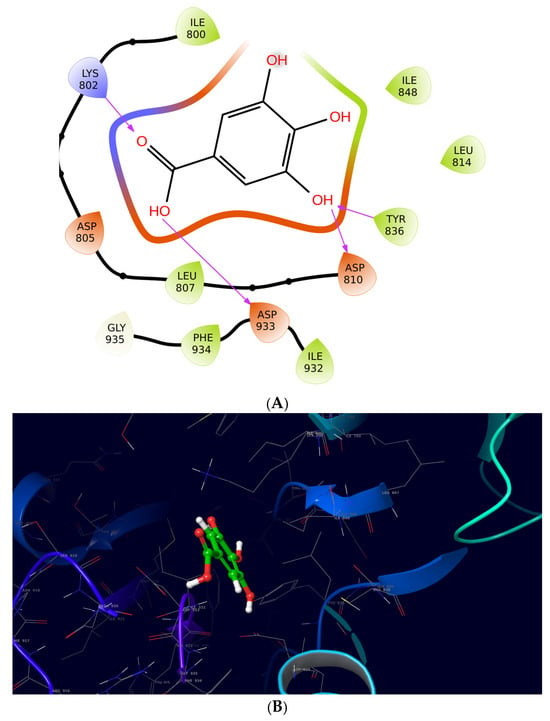
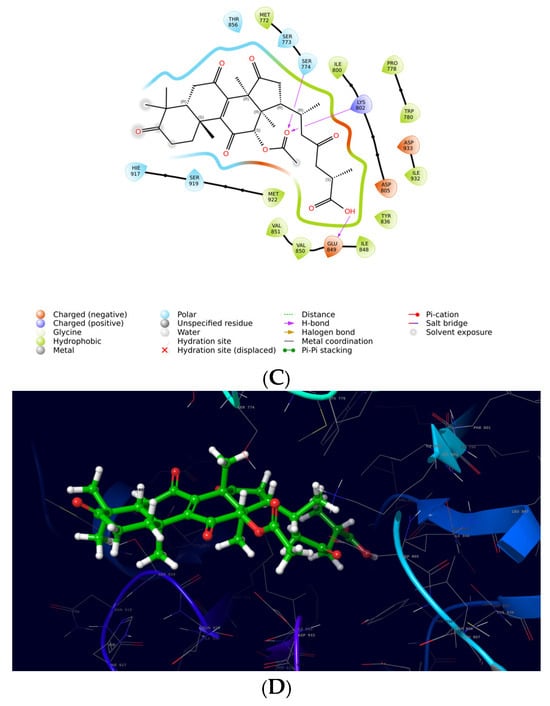
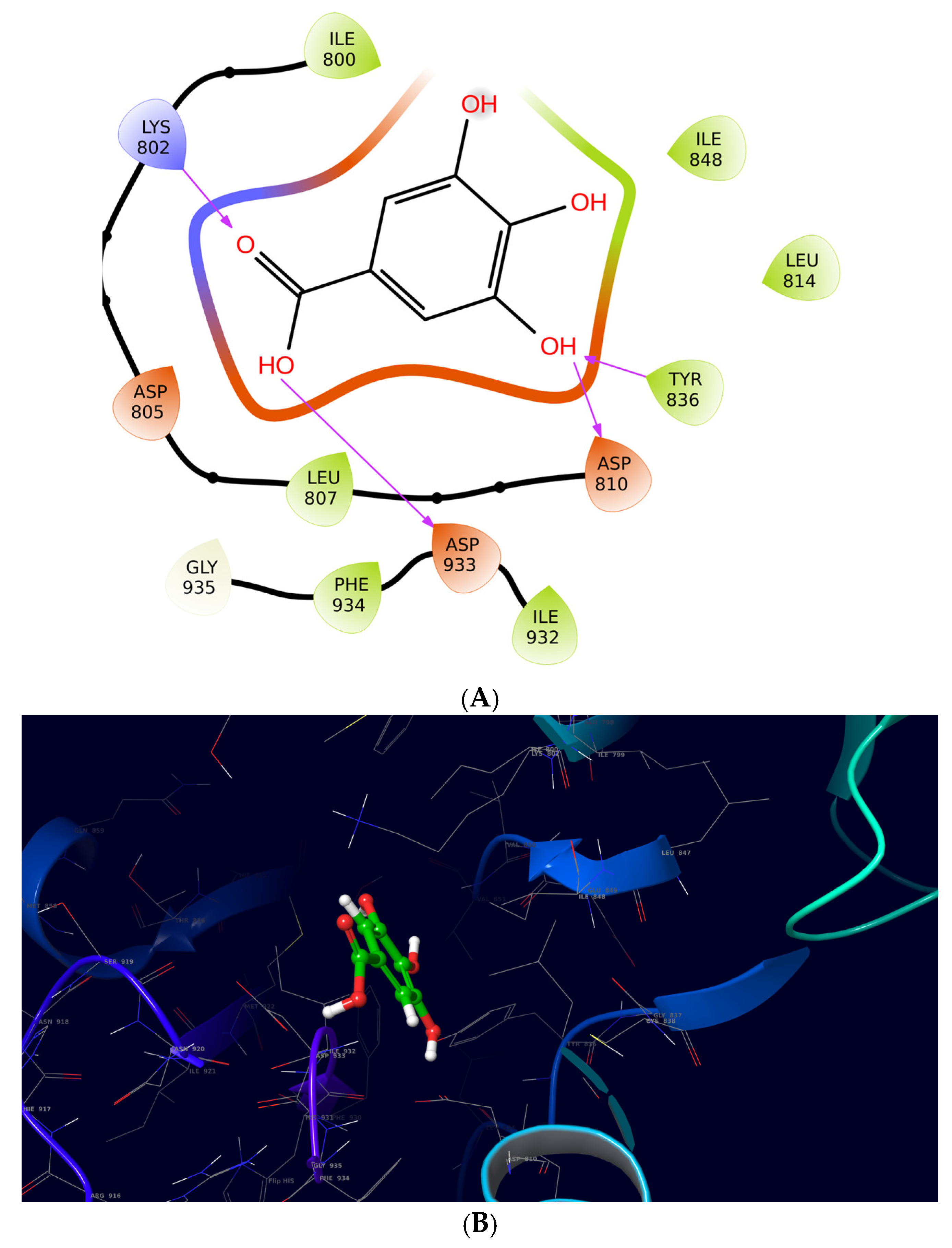
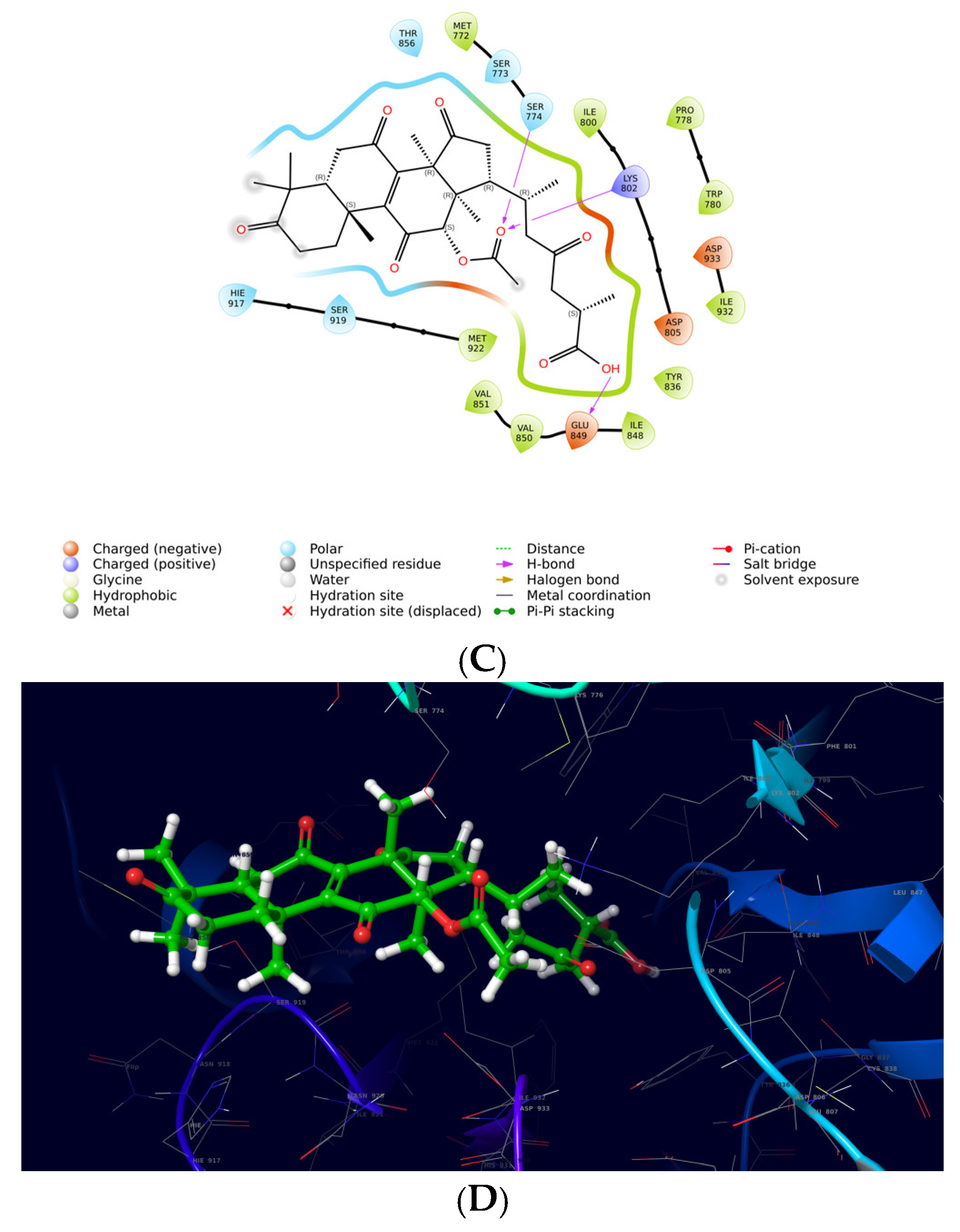
The final selected three compounds identified through ADMET screening along with the standard drug were docked against the target protein 4L2Y.Molecular docking and MM/GBSA binding energies revealed distinct binding affinities between the studied phytocompounds (Table 2). It was observed that gallic acid had the highest docking energy of −5.49 kcal/mol and thus the highest predicted ligand–target binding energy in comparison to β-sitosterol (−4.83 kcal/mol), ganoderic acid F (−4.93 kcal/mol), and thereference drug paclitaxel (−3.51 kcal/mol). Molecular mechanics/generalized Born surface area (MM/GBSA) calculations provided the basis for determining the binding free energies of the phytocompounds; the binding energy of ganoderic acid F was −50.32, β-sitosterol’s was −48.32, and gallic acid’s was −40.99. The negative values for MM/GBSA point towards energetically favorable interactions between the ligands and their respective targets. The overall findings from docking and MM/GBSA analyses point towards the fact that gallic acid has good target recognition ability, whereas ganoderic acid F and β-sitosterol have stable ligand–target interactions. Figure 1 shows the 2D and 3D interaction diagrams for the best docked compound (gallic acid) and standard drug (paclitaxel).
Table 2.
Docking score and binding free energy of docked compounds.
Figure 1.
Interaction diagram of best docked compound gallic acid in 2D (A), in 3D (B) and standard drug paclitaxel in 2D (C), Paclitaxel against 4L2Y target in 3D (D).
4. Conclusions
The current investigation highlights the efficacy of Syzygium cumini L. phytoconstituents in breast cancer therapy through a combination of ADMET in silico and molecular docking methods based on the PI3Kα target. While among the evaluated phytocompounds, some had good drug likeness and pharmacokinetic properties, ellagic acid, quercetin, myricetin, kaempferol, and schidigeragenin C were predicted to have good blood–brain barrier permeability. Further analysis by molecular docking and MM/GBSA methods confirmed that gallic acid had the highest binding affinity towards the PI3Kα target, with a docking score and binding energy of −5.49 and −40.99 kcal/mol, respectively. In addition, β-sitosterol and ganoderic acid F showed energetically favorable binding interactions, which supports the idea of them being promising complementary phytoconstituents. Therefore, the results obtained herein suggest that Syzygium cumini can serve as a potential source of phytoconstituents showing PI3Kα-targeting activity against breast cancer.
Author Contributions
Conceptualization, A.A.; methodology, A.A. and K.M.; writing—original draft preparation, A.A.; writing—review and editing, A.A. and K.M. All authors have read and agreed to the published version of the manuscript.
Funding
This research received no external funding.
Institutional Review Board Statement
Not applicable.
Informed Consent Statement
Not applicable.
Data Availability Statement
The original contributions presented in this study are included in the article.
Acknowledgments
The authors express heartfelt gratitude towards the leadership and management teams of JSS College of Pharmacy, JSS Academy of Higher Education & Research, Mysuru, Karnataka, India.
Conflicts of Interest
The authors declare no conflicts of interest.
References
- Smolarz, B.; Nowak, A.Z.; Romanowicz, H. Breast Cancer—Epidemiology, Classification, Pathogenesis and Treatment (Review of Literature). Cancers 2022, 14, 2569. [Google Scholar] [CrossRef] [Scilit]
- Vineis, P.; Wild, C.P. Global cancer patterns: Causes and prevention. Lancet 2014, 383, 549–557. [Google Scholar] [CrossRef] [Scilit]
- Zhang, J.; Wu, Y.; Li, Y.; Li, S.; Liu, J.; Yang, X.; Xia, G.; Wang, G. Natural products and derivatives for breast cancer treatment: From drug discovery to molecular mechanism. Phytomedicine 2024, 129, 155600. [Google Scholar] [CrossRef] [Scilit]
- Suhail, S.M.; Anand, A.; Biswas, A.S.; Manjula, S.N.; Mruthunjaya, K. Anti-cancer potential of Syzygium cumini and Syzygium Jambolanum extracts against MCF-7 cell line: An in vitro evaluation. Phytomed. Plus 2025, 5, 100753. [Google Scholar] [CrossRef] [Scilit]
- Anand, A.; Manjula, S.N.; Mruthunjaya, K. Network pharmacology, molecular docking, DFT analysis and in-vitro assessment of Syzygium cumini L. as an inhibitor of STAT-3 and JUN against breast cancer. Results Chem. 2026, 28, 103430. [Google Scholar] [CrossRef] [Scilit]
- Saritha, K.; Alivelu, M.; Mohammad, M. Drug-likeness analysis, in silico ADMET profiling of compounds in Kedrostis foetidissima (Jacq.) Cogn, and antibacterial activity of the plant extract. In Silico Pharmacol. 2024, 12, 67. [Google Scholar] [CrossRef] [Scilit]
- Borah, S.; Rajkumari, J.D.; Mahanta, S.; Goswami, N. Computational Identification of Paederia foetida Linn. Phytochemicals as Potential Inhibitors of Staphylococcus aureus Peptide Deformylase. Cell Biochem. Biophys. 2026, 84, 3845–3872. [Google Scholar] [CrossRef] [Scilit]

Disclaimer/Publisher’s Note: The statements, opinions and data contained in all publications are solely those of the individual author(s) and contributor(s) and not of MDPI and/or the editor(s). MDPI and/or the editor(s) disclaim responsibility for any injury to people or property resulting from any ideas, methods, instructions or products referred to in the content. |
© 2026 by the authors. Licensee MDPI, Basel, Switzerland. This article is an open access article distributed under the terms and conditions of the Creative Commons Attribution (CC BY) license.