


Abstract
Carbohydrate-derived isothiocyanates are attractive glycomimetic redox modulators because the sugar scaffold can tune the chemical environment of the electrophilic N=C=S group. Two complementary families of S-glycosyl isothiocyanates bearing the ITC function at C3 or C6 of the glucopyranose ring were investigated to establish how ITC position influences NRF2 /ARE activation, solution stability and predicted ADME-related properties. The compounds vary in anomeric configuration, sulfur substituent, sulfur oxidation state and O-protection pattern. The C6-ITC family displayed the most consistently potent NRF2 activation, whereas the C3-ITC series showed a stronger dependence on sulfur oxidation and individual structural features. Time-dependent 1H NMR studies in (CD3)2SO:D2O (4:1) revealed marked structure-dependent differences in persistence. Within the C3 series, the β-phenylthioether was substantially more stable than its α anomer, while direct comparison of matched phenylsulfones showed a clear improvement in early persistence when the ITC group was moved from C3 to C6. Cheirolin was included as a natural sulfone benchmark. SwissADME analysis showed that matched C3/C6 regioisomers had nearly superimposable physicochemical profiles and identical Lipinski classification, whereas O-protection exerted a clearer influence on polarity and flexibility. These results identify ITC position, anomeric stereochemistry, sulfur chemistry and O-protection as complementary variables for balancing NRF2 activity, kinetic stability and predicted drug-like properties.
1. Introduction
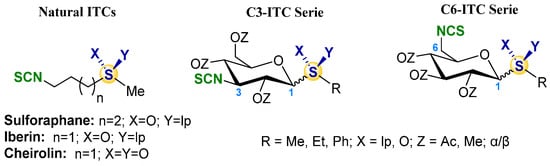
Isothiocyanates (ITCs) are electrophilic molecules whose N=C=S group contributes both to their biological activity and to their chemical reactivity [1]. Natural ITCs such as sulforaphane, iberin and cheirolin (Figure 1) activate the Keap1- NRF2-ARE cytoprotective pathway [2,3,4,5], but the same electrophilicity that enables covalent sensing can also limit chemical persistence in solution [6,7]. Consequently, the development of ITC analogues requires biological potency to be considered alongside chemical stability and physicochemical properties.
Figure 1.
Structures of the natural ITCs and the C3-ITC and C6-ITC S-glycosyl families.
Carbohydrate scaffolds provide stereochemically defined platforms capable of modulating polarity, solubility, conformation and molecular recognition [8,9]. In S-glycosyl ITCs, placement of the sulfur substituent at the anomeric center allows the electrophilic ITC group to be positioned at different sites of the glucopyranose framework. Locating the ITC at C3 or C6 changes its distance and spatial relationship with the anomeric sulfur functionality and creates two closely related positional series in which anomeric configuration, sulfur substituent, oxidation state and O-protection can be varied. Related carbohydrate-derived ITCs have shown that these structural variables can strongly influence NRF2 activation and other biological properties [10,11].
Herein, the C3-ITC and C6-ITC S-glycosyl families are comparatively evaluated through three complementary endpoints: NRF2/ARE activation, time-dependent solution stability by 1H NMR, and in silico physicochemical and ADME profiling with SwissADME. This design permits the contribution of ITC position to be examined together with stereochemistry, sulfur oxidation and carbohydrate protection, providing a structure–property framework for identifying modifications that preserve NRF2 activity while improving kinetic persistence and predicted drug-like behavior.
2. Materials and Methods
2.1. Compound Sets and NRF2/ARE Assay
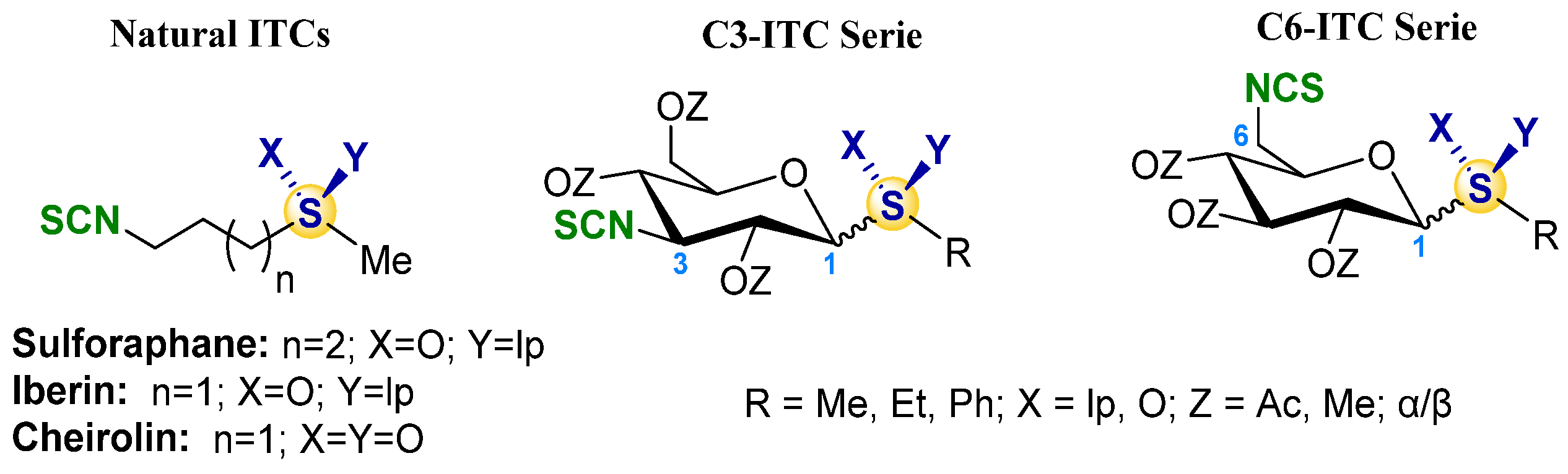
The compound set comprised two positional families of S-glycosyl ITCs (Figure 1). The C3-ITC series contains α- and β-anomers with alkyl or aryl sulfur substituents in thioether, sulfoxide or sulfone oxidation states, including both O-acetylated and selected O-methylated derivatives. The C6-ITC series retains the anomeric sulfur functionality while placing the ITC group at C6 and includes the corresponding thioether, sulfoxide and sulfone variants [10]. The complete compound set and numbering correspondence are provided in Table S1 (Supplementary Material). Representative NRF2/ARE CD values for selected derivatives are discussed below and shown in Figure 2. NRF2/ARE activation was determined in AREc32 cells carrying the pGL-8xARE luciferase reporter [12]. After 24 h exposure, activity was expressed as the CD value, defined as the concentration required to double reporter activity relative to basal conditions. Parallel MTT assays yielded EC50 values above 30 µM for both the C3-ITC and C6-ITC series, indicating that NRF2/ARE activation occurred under non-cytotoxic conditions.
Figure 2.
Structures and representative NRF2/ARE CD values of selected C3-ITC and C6-ITC S-glycosides.
2.2. Solution Stability and SwissADME Analysis
Solution stability was evaluated by time-dependent 1H NMR in aqueous DMSO, (CD3)2SO:D2O (4:1), at room temperature, monitoring the loss of parent resonances and the appearance of degradation signals. The C3-ITC study included representative α- and β-phenylthioethers and sulfone derivatives, whereas the C6 study used phenylsulfone 17β as a positional comparator to the corresponding C3 phenylsulfone. Cheirolin was examined under the same solvent conditions as a natural sulfone reference. SwissADME [13] was used to evaluate the complete C3/C6 S-glycosyl set. Predicted aqueous solubility was estimated with ESOL [14], Lipinski criteria were applied as an initial drug-likeness filter [15], and bioavailability radars were used to compare lipophilicity, size, polarity, solubility, saturation and flexibility.
3. Results and Discussion
3.1. NRF2/ARE Activation of C3- and C6-ITC S-Glycosides
The two positional families showed distinct NRF2 structure–activity relationships (Figure 2). In the C3-ITC series, the ethyl thioethers 1α and 1β were the most active thioethers (CD = 1.49 ± 0.36 and 1.67 ± 0.44 µM, respectively), whereas the phenyl and methyl thioethers were less potent. Oxidation to sulfoxides generally reduced activity, with most O-acetylated sulfoxides showing CD values above 10 µM. Phenylsulfone 9α was a notable exception, retaining strong activity (CD = 2.01 ± 0.38 µM). The C3 results therefore indicate that the effect of sulfur oxidation depends strongly on anomeric configuration, sulfur substituent and protection pattern rather than following a single monotonic trend.
The C6-ITC series showed a broader distribution of potent NRF2 activators. β-phenylthioether 12β was the most active compound (CD = 0.96 ± 0.03 µM), closely followed by β-ethylthioether 14β (CD = 1.04 ± 0.30 µM). Potency was also retained in several oxidized derivatives, including (R)-15β (CD = 2.33 ± 0.25 µM) and phenylsulfone 17β (CD = 1.90 ± 0.70 µM). By contrast, α-phenylthioether 12α (CD = 5.03 ± 1.66 µM) was approximately fivefold less potent than its β epimer, demonstrating a marked anomeric effect in this scaffold.
Overall, C6 substitution was associated with the largest number of low-micromolar NRF2 activators, although selected C3 derivatives also reached comparable activity.
3.2. Comparative Solution Stability
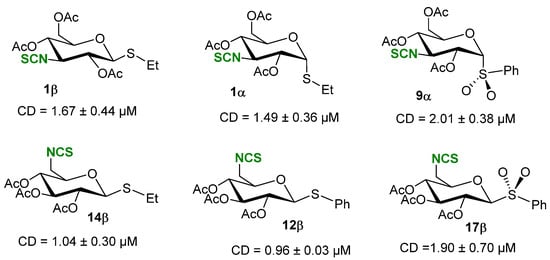
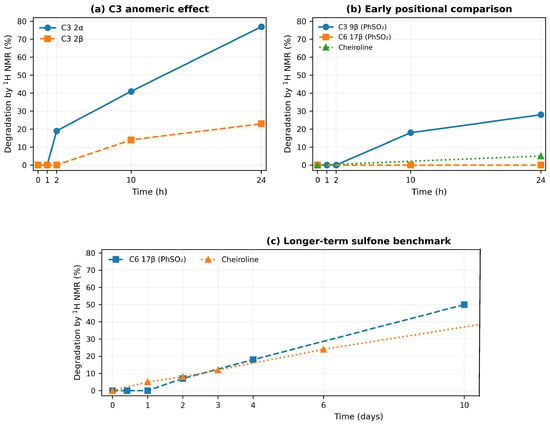
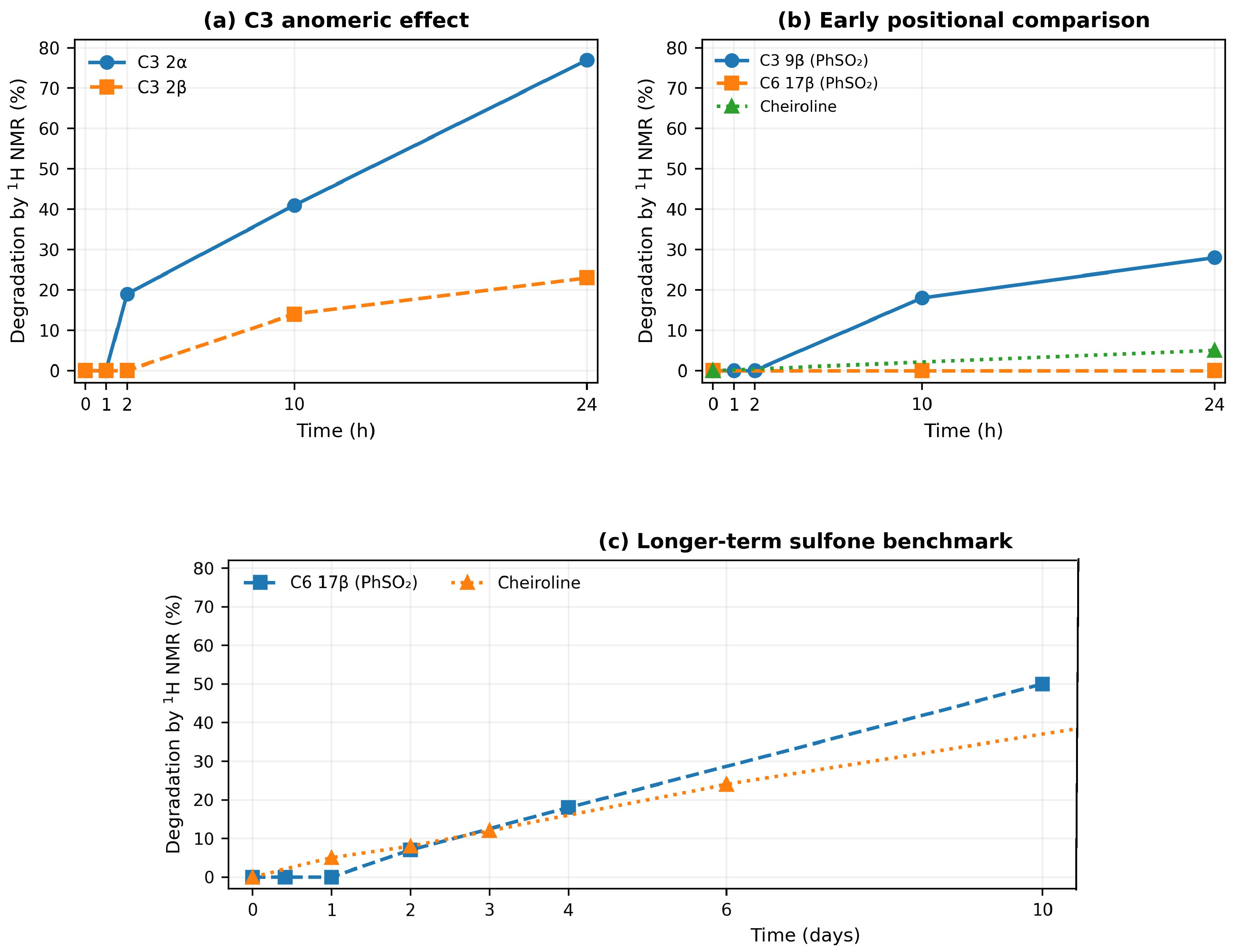
Time-dependent NMR measurements within the C3-ITC family revealed pronounced structure-dependent differences in persistence (Figure 3). After 24 h, phenylthioether 2α showed 77% degradation, whereas the corresponding β-anomer 2β showed 23%, demonstrating a strong anomeric effect in this matched pair. Phenylsulfone 9β showed 28% degradation at 24 h, which is slightly higher than that in β-phenylthioether 2β, while methylsulfone 10β showed only 12% degradation. Thus, neither sulfur oxidation state nor aromatic substitution alone accounts for stability within the C3 series.
Figure 3.
Comparative solution-stability profiles of representative C3-ITC and C6-ITC S-glycosides determined by time-dependent 1H NMR in (CD3)2SO:D2O (4:1) at room temperature. (a) Anomeric effect within the C3 phenylthioether pair 2α and 2β. (b) Early degradation of the matched C3 phenylsulfone 9β and C6 phenylsulfone 17β, with cheirolin included as a natural sulfone reference. (c) Longer-term degradation profiles of C6 phenylsulfone 17β and cheirolin. Lines are included as visual guides between experimentally analysed time points.
Direct positional comparison of the phenylsulfones showed a clear advantage for C6 during the early phase of the experiment. C6 derivative 17β showed no detectable degradation at 10 or 24 h, followed by approximately 7% degradation at 2 days, 18% at 4 days and 50% at 10 days. In contrast, the matched C3 phenylsulfone 9β had already reached 28% degradation at 24 h. Cheirolin showed approximately 5% degradation at 1 day, 8% at 2 days, 12% at 3 days, 24% at 6 days and around 38% after 10 days (Figure 3). These profiles show that relocation of the ITC from C3 to C6 markedly delays the onset of degradation within the glycosyl phenylsulfone pair. The comparison with cheirolin further indicates that the C6 carbohydrate derivative has greater early kinetic persistence, although its long-term decomposition remains appreciable.
3.3. SwissADME Profiling of C3- and C6-ITC S-Glycosides
SwissADME analysis provided a complementary physicochemical comparison of the two S-glycosyl families (Tables S2 and S3). All C3-ITC and C6-ITC derivatives satisfied the Lipinski rule-of-five filter. Importantly, direct comparison of strictly matched C3/C6 regioisomeric pairs (Table S4) showed that relocation of the ITC group from C3 to C6 produced essentially no change in the principal physicochemical descriptors: molecular weight, hydrogen-bond acceptor and donor counts, MLogP, TPSA, number of rotatable bonds and Lipinski classification were identical within each pair. ESOL predictions showed only a minor systematic positional difference, with the C3 analogues displaying Log S values 0.02 units higher (less negative) than their corresponding C6 regioisomers at the precision reported by SwissADME. Thus, the pronounced differences in NRF2 activity and solution persistence between the two positional series are not accompanied by comparably large changes in their predicted physicochemical profiles.
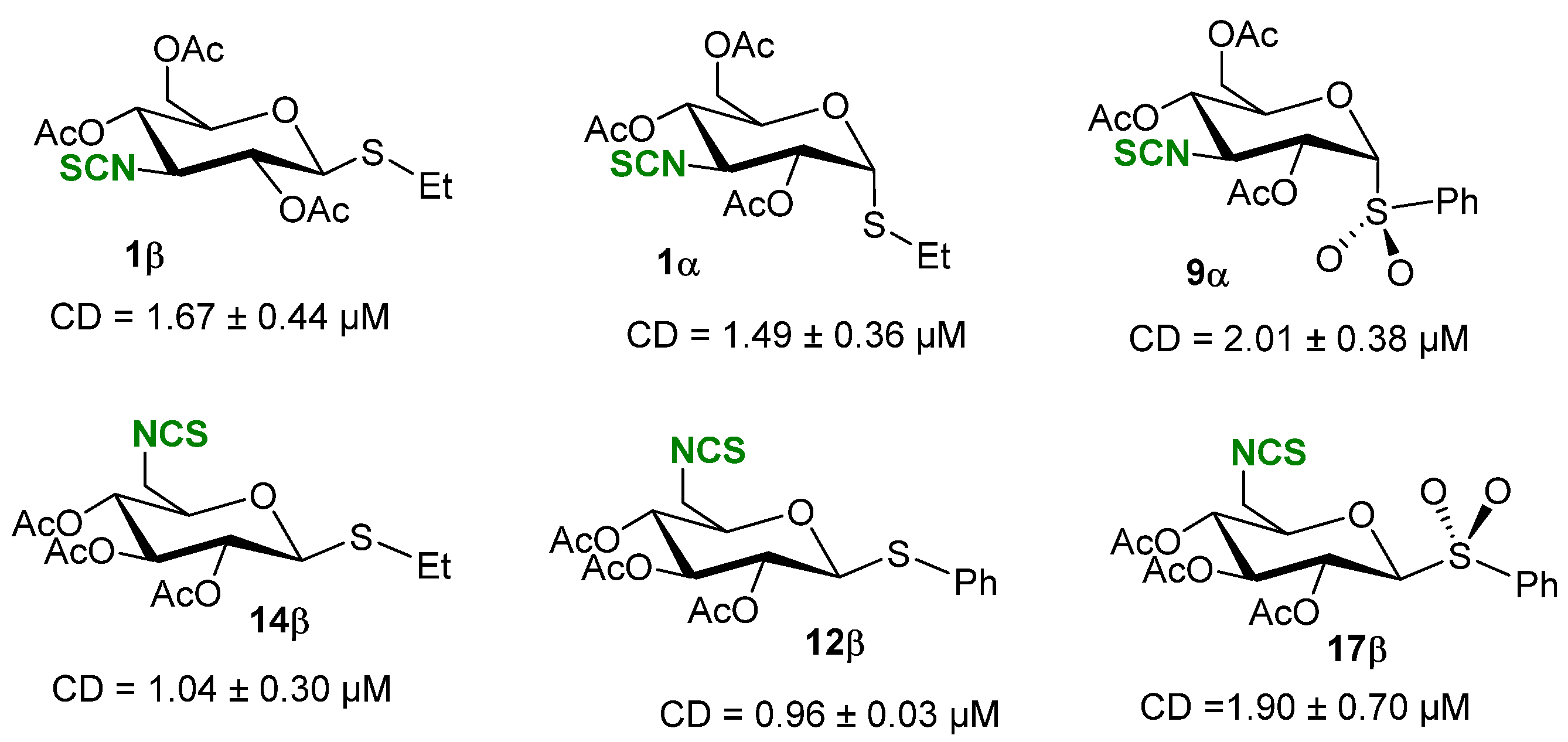
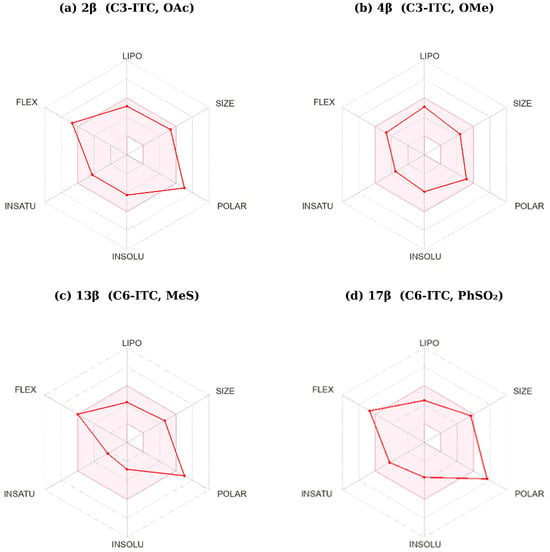
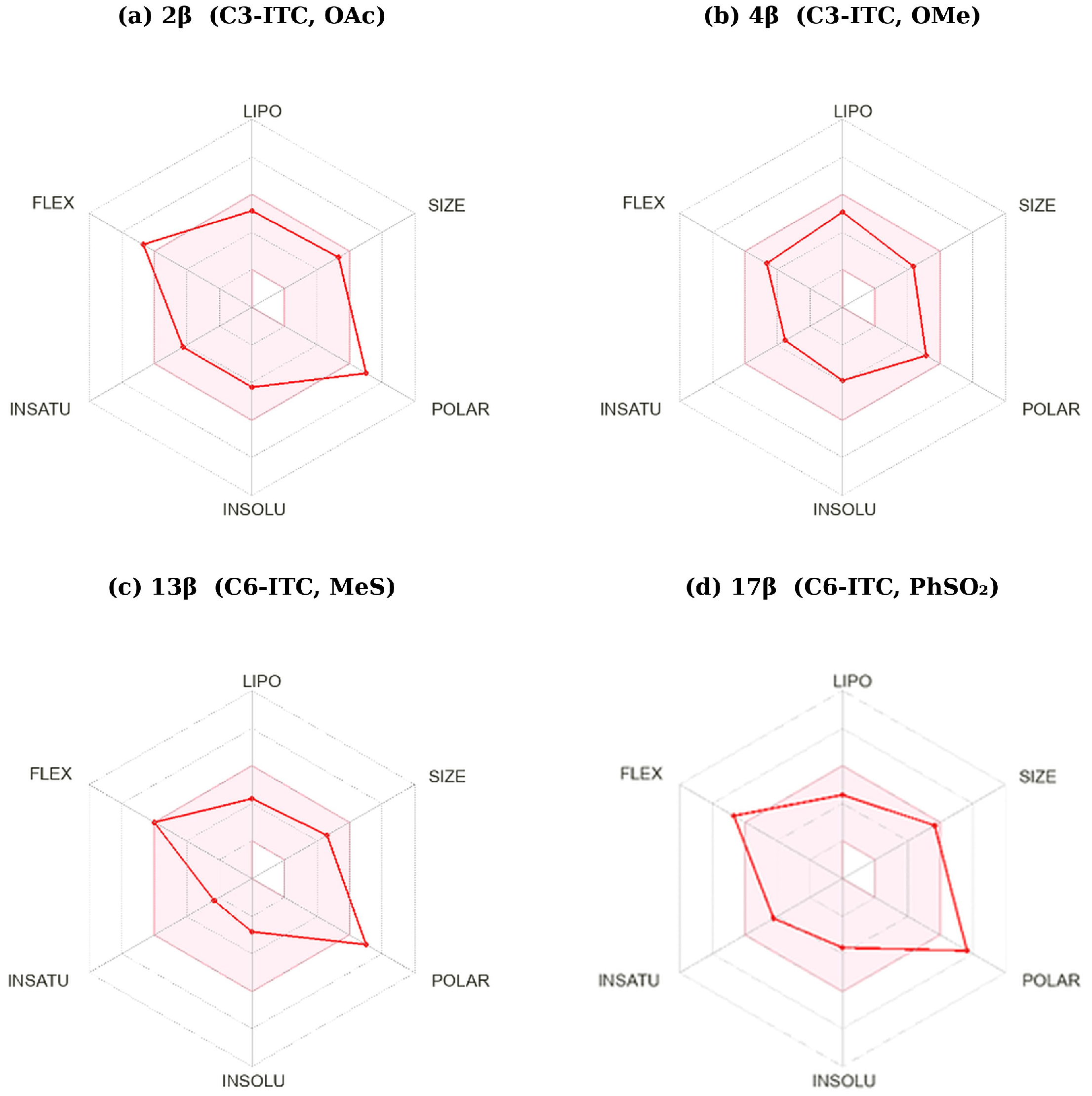
The bioavailability radar was more discriminating with respect to carbohydrate protection (Figure 4; Figures S5 and S6). Lipophilicity, molecular size, predicted solubility and saturation were generally within the preferred regions, whereas polarity and flexibility were the most frequent limiting dimensions. The clearest improvement was associated with O-methylation within the C3 family: compounds 4β, (R)-7β, (S)-7β and 11β satisfied both the polarity and flexibility criteria, whereas the corresponding O-acetylated derivatives were more frequently limited by these dimensions. The C3 methyl-substituted compounds 3β and 10β, together with the C6 methylthioether 13β, satisfied the flexibility criterion but remained outside the preferred polarity range. These results indicate that, within this dataset, O-protection and sulfur chemistry exert a more conspicuous influence on the predicted physicochemical profile than relocation of the ITC group between C3 and C6.
Figure 4.
Representative SwissADME bioavailability radar plots illustrating the principal physicochemical contrasts within the C3-ITC and C6-ITC S-glycosyl families: (a) C3 O-acetylated phenylthioether 2β; (b) C3 O-methylated phenylthioether 4β; (c) C6 methylthioether 13β; and (d) C6 phenylsulfone 17β. The pink area represents the optimal physicochemical space for oral bioavailability. Radar dimensions correspond to lipophilicity (LIPO), size (SIZE), polarity (POLAR), solubility (INSOLU), flexibility (FLEX), and saturation (INSATU).
Integration of the three datasets reveals complementary and partly independent structure–property relationships. C6 placement is associated with the broadest NRF2 potency and, in the directly matched phenylsulfone comparison, with markedly improved early solution persistence. In contrast, matched C3/C6 regioisomers showed almost superimposable SwissADME profiles, indicating that the biological and stability effects associated with ITC relocation occur without a major alteration of the global physicochemical descriptors examined. O-protection emerged as a more prominent determinant of the bioavailability-radar profile. Accordingly, no single structural modification optimizes all three dimensions simultaneously. Within the C6 series, 12β represents the NRF2 potency lead (CD = 0.96 ± 0.03 µM), whereas 17β provides the most extensively characterized balance between NRF2 activation (CD = 1.90 ± 0.70 µM) and solution persistence, with no detectable degradation during the first 24 h. Within the C3 series, O-methylated derivatives such as 4β display a more favorable bioavailability-radar profile, although this physicochemical improvement is not accompanied by maximal NRF2 potency. These complementary profiles support a multidimensional prioritisation strategy in which ITC position, anomeric configuration, sulfur chemistry and carbohydrate protection are considered together rather than biological potency alone.
4. Conclusions
The C3-ITC and C6-ITC S-glycosyl families demonstrate that ITC position is a major determinant of NRF2 activity and solution persistence but has only a minor influence on the SwissADME physicochemical descriptors examined in strictly matched regioisomeric pairs. The C6 series contains the most consistently potent NRF2/ARE activators, led by 12β and 14β, whereas the C3 series shows a more heterogeneous response in which thioethers are generally favoured and selected sulfones retain low-micromolar activity. Time-dependent 1H NMR reveals a marked anomeric effect on C3 stability and a clear improvement in early persistence when the ITC group of the phenylsulfone scaffold is relocated from C3 to C6. Cheirolin provides a natural reference showing that this early stabilisation does not eliminate longer-term degradation.
SwissADME analysis further shows that matched C3/C6 regioisomers occupy essentially the same predicted physicochemical space, whereas O-protection has a more pronounced influence on polarity and flexibility. O-methylated C3 derivatives display the most favourable bioavailability-radar profiles within the two positional series. Overall, the combined analysis identifies distinct optimisation profiles rather than a single universally superior derivative: 12β emerges as the NRF2 potency lead, 17β as the best stability-characterised active C6 derivative, and O-methylated C3 analogues such as 4β as favourable physicochemical comparators. These results show that ITC position, anomeric stereochemistry, sulfur chemistry and O-protection contribute differently to biological activity, kinetic stability and predicted drug-like properties and should therefore be considered jointly when prioritising S-glycosyl ITCs for further development.
Supplementary Materials
The following supporting information can be downloaded at https://www.mdpi.com/article/10.3390/chemproc2026022039/s1, Figure S1: Time-dependent 1H NMR spectra (400 MHz, (CD3)2SO:D2O (4:1)) of cheirolin at 0, 1, 2, 3, 6 and 14 days; Figure S2: Selected regions of the 1H NMR spectra [400 MHz, (CD3)2SO:D2O (4:1)] of compounds (A) 2α, (B) 2β, (C) 9β, and (D) 10β at 0 and 24 h; Figure S3: Selected regions of the 1H NMR spectra [400 MHz, (CD3)2SO:D2O (4:1)] of compounds (A) 2α, (B) 2β, and (C) 9β at 0, 1, 2, 10 and 24 h, and (D) 10β at 0, 1, 2, 5 and 24 h; Figure S4: Time-dependent 1H NMR spectra [400 MHz, (CD3)2SO:D2O (4:1)] of C6-ITC phenylsulfone 17β at 0, 10 h, 1, 2, 4 and 10 days; Figure S5: Bioavailability radar plots of the C6-ITC S-glycosyl derivatives, natural isothiocyanates (iberverin, iberin and cheirolin), and the reference NRF2 activator tert-butylhydroquinone (TBHQ). Parameters include lipophilicity (LIPO), size (SIZE), polarity (POLAR), solubility (INSOLU), flexibility (FLEX), and saturation (INSATU); Figure S6: Bioavailability radar plots of the C3-ITC S-glycosyl derivatives. Parameters include lipophilicity (LIPO), size (SIZE), polarity (POLAR), solubility (INSOLU), flexibility (FLEX), and saturation (INSATU); Table S1: Compound numbering and structural features of the C3-ITC and C6-ITC S-glycosyl series; Table S2: SwissADME-predicted solubility and Lipinski rule-of-five properties of the C6-ITC S-glycosyl series, natural isothiocyanates, and tert-butylhydroquinone (TBHQ); Table S3: SwissADME-predicted solubility and Lipinski rule-of-five properties of the C3-ITC S-glycosyl series; Table S4: SwissADME comparison of strictly matched C3-ITC and C6-ITC regioisomeric pairs.
Author Contributions
Conceptualization, V.V. and I.F.; Methodology, L.A.P., N.K.-F., R.L., R.R., Q.T. and V.C.; Validation, R.L. and V.V.; Formal analysis, L.A.P., N.K.-F., R.L., V.V. and I.F.; Investigation, L.A.P., N.K.-F., R.L., R.R., V.V., Q.T. and V.C.; Data curation, L.A.P., N.K.-F. and R.L.; Writing—original draft, N.K.-F., V.V. and I.F.; Writing—review & editing, N.K.-F., R.R., V.V. and I.F.; Visualization, L.A.P., N.K.-F. and R.R.; Supervision, R.L., V.V. and I.F.; Project administration, V.V. and I.F.; Funding acquisition, I.F. All authors have read and agreed to the published version of the manuscript.
Funding
This work was supported by projects PID2022-138863OB-I00 (to IF), PID2021-123481OB-I00 and PID2024-157469OB-I00 (to RL), all funded by MICIU/AEI/10.13039/501100011033 and by ERDF/EU. RL also acknowledges funding from Comunidad de Madrid (grant P2022/BMD-7230-CAM-22). The US (University of Seville) is also acknowledged for the support provided through its own research plan (VII PPIT-US).
Institutional Review Board Statement
Not applicable.
Informed Consent Statement
Not applicable.
Data Availability Statement
Data supporting the findings of this study are included in the article and Supporting Information. Additional NMR spectra and SwissADME outputs are available from the corresponding author on reasonable request.
Acknowledgments
This work is part of the projects indicated above. We gratefully thank the Centre of Research Technology and Innovation of the University of Seville (CITIUS) for NMR facilities.
Conflicts of Interest
The authors declare no conflicts of interest.
References
- Recio, R.; Vengut-Climent, E.; Borrego, L.G.; Khiar, N.; Fernández, I. Biologically Active Isothiocyanates: Protecting Plants and Healing Humans. In Studies in Natural Products Chemistry; Elsevier: Amsterdam, The Netherlands, 2017; pp. 167–242. [Google Scholar] [CrossRef] [Scilit]
- Kensler, T.W.; Wakabayashi, N.; Biswal, S. Cell Survival Responses to Environmental Stresses via the Keap1-Nrf2-ARE Pathway. Annu. Rev. Pharmacol. Toxicol. 2007, 47, 89–116. [Google Scholar] [CrossRef] [Scilit] [PubMed]
- Itoh, K.; Mimura, J.; Yamamoto, M. Discovery of the Negative Regulator of Nrf2, Keap1: A Historical Overview. Antioxid. Redox Signal. 2010, 13, 1665–1678. [Google Scholar] [CrossRef] [Scilit] [PubMed]
- Zhang, Y.; Gordon, G.B. A Strategy for Cancer Prevention: Stimulation of the Nrf2-ARE Signaling Pathway. Mol. Cancer Ther. 2004, 3, 885–893. [Google Scholar] [CrossRef] [Scilit]
- Ernst, I.M.A.; Palani, K.; Esatbeyoglu, T.; Schwarz, K.; Rimbach, G. Synthesis and Nrf2-Inducing Activity of the Isothiocyanates Iberverin, Iberin and Cheirolin. Pharmacol. Res. 2013, 70, 155–162. [Google Scholar] [CrossRef] [Scilit] [PubMed]
- Recio, R.; Elhalem, E.; Benito, J.M.; Fernández, I.; Khiar, N. NMR Study on the Stabilization and Chiral Discrimination of Sulforaphane Enantiomers and Analogues by Cyclodextrins. Carbohydr. Polym. 2018, 187, 118–125. [Google Scholar] [CrossRef] [Scilit] [PubMed]
- Cirilli, R.; Gallo, F.R.; Multari, G.; Palazzino, G.; Mustazza, C.; Panusa, A. Study of Solvent Effect on the Stability of Isothiocyanate Iberin, a Breakdown Product of Glucoiberin. J. Food Compos. Anal. 2020, 92, 103515. [Google Scholar] [CrossRef] [Scilit]
- Cipolla, L.; Araújo, A.C.; Bini, D.; Gabrielli, L.; Russo, L.; Shaikh, N. Discovery and Design of Carbohydrate-Based Therapeutics. Expert Opin. Drug Discov. 2010, 5, 721–737. [Google Scholar] [CrossRef] [Scilit] [PubMed]
- Meutermans, W.; Le, G.T.; Becker, B. Carbohydrates as Scaffolds in Drug Discovery. ChemMedChem 2006, 1, 1164–1194. [Google Scholar] [CrossRef] [Scilit] [PubMed]
- Prieto, L.A.; Khiar-Fernández, N.; Calderón-Ruiz, R.; Giraud, E.; Calderón-Montaño, J.M.; Lucía-Tamudo, J.; León, R.; Pérez-Simón, J.A.; López-Lázaro, M.; Recio, R.; et al. Potent Nrf2-Inducing C6-Isothiocyanate Glucose Derivatives with Dual Antioxidant and Antitumor Activity. Antioxidants 2026, 15, 123. [Google Scholar] [CrossRef] [Scilit] [PubMed]
- Prieto, L.A.; Khiar-Fernández, N.; Calderón-Montaño, J.M.; López-Lázaro, M.; Lucía-Tamudo, J.; Nogueira, J.J.; León, R.; Moreno, N.; Valdivia, V.; Recio, R.; et al. Exploring the Broad-Spectrum Activity of Carbohydrate-Based Iberin Analogues: From Anticancer Effect to Antioxidant Properties. Eur. J. Med. Chem. 2025, 289, 117469. [Google Scholar] [CrossRef] [Scilit] [PubMed]
- Wang, X.J.; Hayes, J.D.; Wolf, C.R. Generation of a Stable Antioxidant Response Element-Driven Reporter Gene Cell Line and Its Use to Show Redox-Dependent Activation of Nrf2 by Cancer Chemotherapeutic Agents. Cancer Res. 2006, 66, 10983–10994. [Google Scholar] [CrossRef] [Scilit] [PubMed]
- Daina, A.; Michielin, O.; Zoete, V. SwissADME: A Free Web Tool to Evaluate Pharmacokinetics, Drug-Likeness and Medicinal Chemistry Friendliness of Small Molecules. Sci. Rep. 2017, 7, 42717. [Google Scholar] [CrossRef] [Scilit] [PubMed]
- Delaney, J.S. ESOL: Estimating Aqueous Solubility Directly from Molecular Structure. J. Chem. Inf. Comput. Sci. 2004, 44, 1000–1005. [Google Scholar] [CrossRef] [Scilit] [PubMed]
- Lipinski, C.A.; Lombardo, F.; Dominy, B.W.; Feeney, P.J. Experimental and Computational Approaches to Estimate Solubility and Permeability in Drug Discovery and Development Settings. Adv. Drug Deliv. Rev. 2001, 46, 3–26. [Google Scholar] [CrossRef] [Scilit] [PubMed]
Disclaimer/Publisher’s Note: The statements, opinions and data contained in all publications are solely those of the individual author(s) and contributor(s) and not of MDPI and/or the editor(s). MDPI and/or the editor(s) disclaim responsibility for any injury to people or property resulting from any ideas, methods, instructions or products referred to in the content. |
© 2026 by the authors. Licensee MDPI, Basel, Switzerland. This article is an open access article distributed under the terms and conditions of the Creative Commons Attribution (CC BY) license.