


Abstract
This work represents the first-ever meso-direct incorporation of borodipirromethenes to amide-containing molecules throughout Biellmann BODIPY by meso-functionalization. The present study employs the well-known ability of the -SMe group as a salient group in a novel reactivity fashion with amides as a reaction partner in the presence of K2CO3, CuTC and the catalytic system of CuI/phen in sustainable 2-MeTHF/H2O at 90 °C to afford 16 derivatives of meso-amidoBODIPYs in a yield range of 12 to 67% in 2.5 to 24 h of reaction time.
1. Introduction
Amides are one of the most characteristic functional groups in chemistry. In general, amides are well-known for their increased stability in the N-acyl bond and low nucleophilicity of nitrogen. Moreover, around 25% of commercially available drugs contain an amide functional group [1]. Also, we can find amides in peptides, materials, agrochemicals, natural products, etc. Derivatization of fluorophores as cyanines, coumarins or BODIPYs has emerged as an important field in the creation of novel materials because of its application in biomedical sciences. In that sense, structural modification around the BODIPY core has been studied because simple modification can cause a fluorogenic response [2].
The seminal work of Saucedo et al. discusses meso-amidoBODIPY synthesis, employing BODIPY amino-derivative treatment with NaH and acyl chlorides to afford an amide derivative. Since then, similar reactivity fashions have been reported for the creation of these types of compounds, but by this manner, they could not be labeled preformed amides [3].
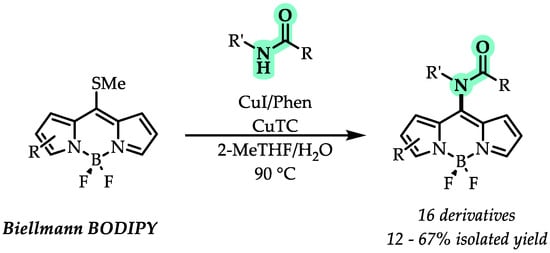
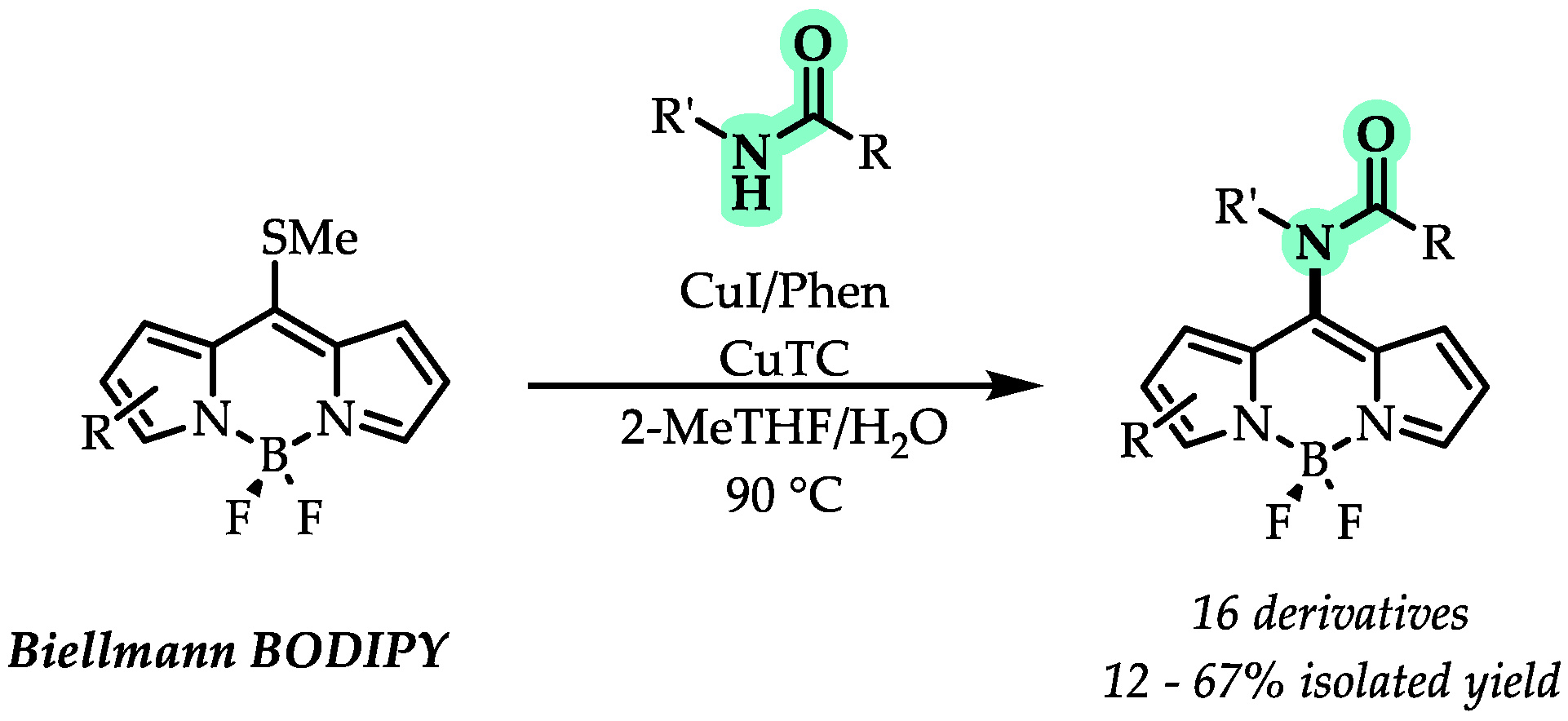
Typical ways for amide N-arylation had been studied by Ullmann, Goldberg, Buchwald, Hartwig and Ma by using Cu, Pd and Ni catalysis between aryl halide and amides as reaction parters [4]. In that sense, Peña-Cabrera has reported the use of meso-methylsulfanylBODIPY, the Biellmann BODIPY, in cross-coupling Pd-catalyzed Liebeskind-Srogl or Sonogashira reaction [5,6]. So, in this work, we present the first attempt of the application of the Ullmann–Goldberg N-arylation type-reaction for meso-amideBODIPY synthesis using the Biellmann BODIPY heterocycle as a synthetic fluorescent platform and amide-containing molecules in the presence of catalytic system CuI/phen in a sustainable 2-MeTHF/H2O solvent system at 90 °C as shown in Scheme 1.
Scheme 1.
Overview of the present work.
2. Materials and Methods
The starting materials and reagents were commercially available at Sigma-Aldrich website unless otherwise stated. Solvents were distilled and dried by standard procedures. Reactions were carried out in oven- or flame-dried glassware, without an inert atmosphere unless noted. Progress was monitored by TLC on silica gel F-254 (Merck, Darmstadt, Germany) under UV (254/365 nm). Flash chromatography was performed on silica gel Kieselgel 60 (70–230 mesh) with hexanes/ethyl acetate mixtures. HRMS samples were ionized by ESI+ and recorded via the TOF method. Biellmann BODIPY derivatives were purchased from Cuántico de México (Guanajuato, Mexico).
3. Results
First of all, N-(p-methoxyphenyl)benzamide was selected as the standard amide for trying to obtain amidation product B1 with Biellmann BODIPY as the reaction partner. After several essays, meso-amidoBODIPY B1 was obtained in 67% isolated yield after 24 h by treatment with CuI and phenanthroline, K2CO3 and copper (I) 2-thiophenecarboxilate in a 2-MeTHF/H2O system at 90 °C.
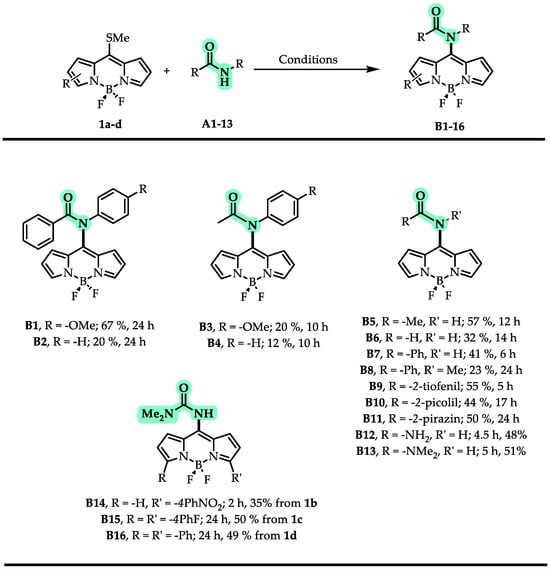
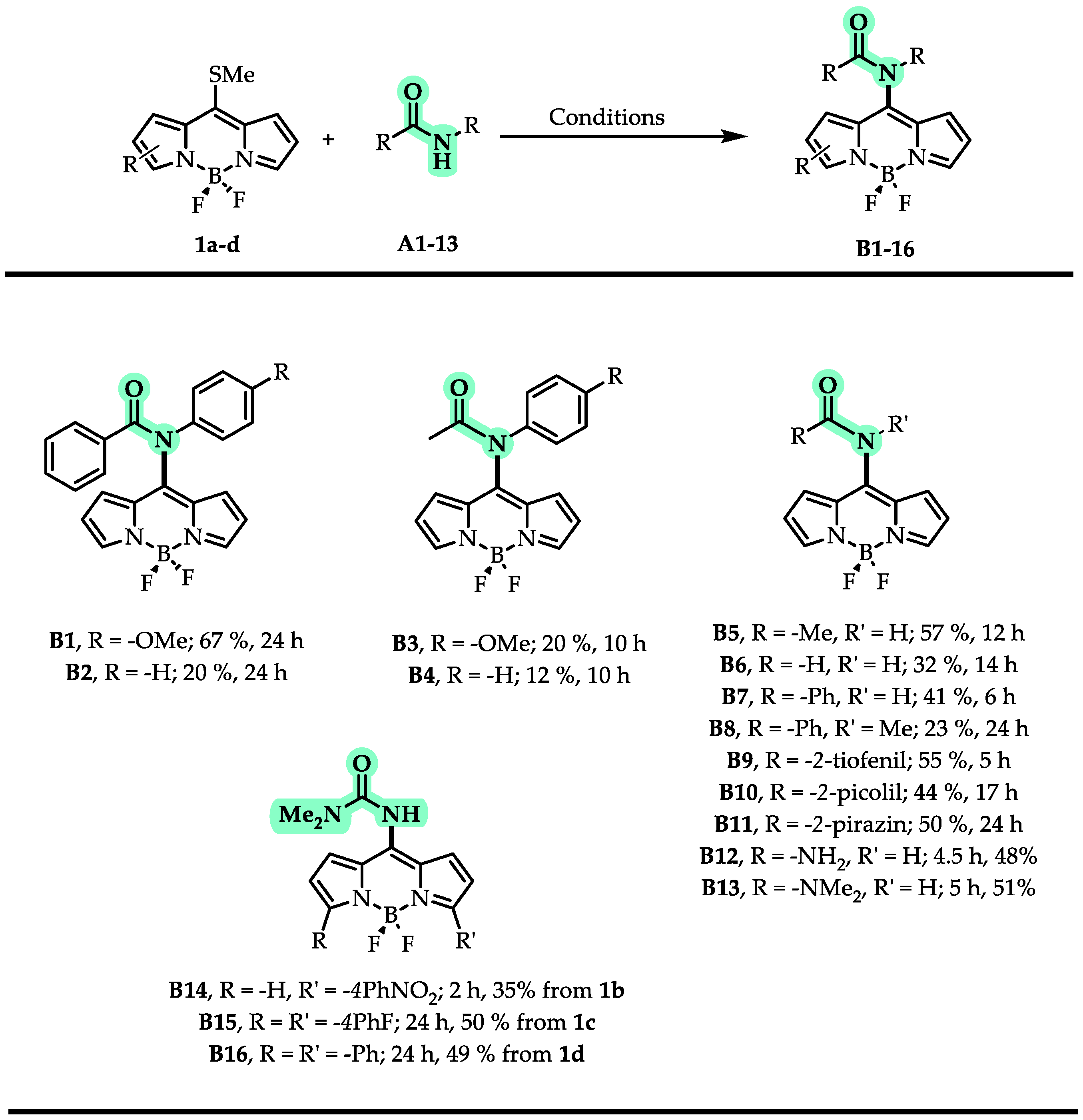
With this result in hand, we now focused on implementing the new method to a series of structurally simple amides for the synthesis of a series of meso-amidoBODIPYs B1–16. Some of those products were structurally modified Biellmann BODIPYs under the aforementioned reaction conditions. The products B1–16 were obtained in a range of 12 to 67% isolated yield after 2.5 to 24 h. The reaction conditions were applied to secondary amides derived from N-phenyl benzamide A1–2, N-phenyl acetamides A3–4, and one example of N-alkyl benzamide A8, and primary amides as acetamide A5, formamide A6, benzamide A7, heterocyclic carboxamides derived from thiophene, pyridine and pyrazine A9–11 and a pair of urea derivatives A12–13. The results show reduced reaction times in the coupling of primary amides rather than those for secondary amides. Also, isolated yields for secondary amides have almost generally reduced values. In direct comparison with this observation, benzamide A7 afforded coupled product B7 in 41% after 6 h. On the other hand, N-methyl benzamide A8 illustrates a drastically increased reaction time for obtaining the corresponding product B8 with a notably decreased yield of 23%. The synthesis of B12–13 derivatives demonstrates significantly reduced reaction times and yields around 50%.
In the case of the structurally modified Biellmann BODIPYs, the new reaction was applied to 3-aryl nor 3,5-diaryl BODIPYs 1b–d with amide A13. For the 3-(4-nitrophenyl)-8-methylsulfanylBODIPY 1b amidation case, the reaction time was reduced by the -NO2 electron-withdrawing group; despite this modification, the isolated yield was around 35%. In the case of 1c–d, the diaryl modification denotes an increase in the reaction time but did not affect yield compared with B13 synthesis. Products B15–16 yield around 50%. Summarized results are presented in Scheme 2.
Scheme 2.
Scope of direct-meso amidation of Biellmann BODIPYs 1a–d by amide-containing molecules A1–13.
The present work is currently under development, so the physicochemical properties and optical features of B1–16 are not presented.
4. Conclusions
In this report, we present the preliminary results of the first attempt of synthesis of meso-amidoBODIPYs by direct incorporation of amide-containing compounds to the meso carbon of BODIPY employing meso-methylsulfanylBODIPY, the Biellmann BODIPY, as a synthetic platform in an Ullmann–Goldberg approach by the use of a copper (I)/diamine catalytic system in a sustainable mixture of 2-MeTHF/water at 90 °C.
5. Compounds Characterization
- B1. HRMS-TOF (ESI+): m/z calculated for C23H18BF2N3O2 [M + NH4]+, 435.1839, found 435.1802.
- B2. HRMS-TOF (ESI+): m/z calculated for C22H16BF2N3O [M + H]+, 388.1442, found 388.1431.
- B3. HRMS-TOF (ESI+): m/z calculated for C17H14BF2N3O [M + H]+, 326.1290, found 326.1274.
- B4. HRMS-TOF (ESI+): m/z calculated for C18H16BF2N3O2 [M + H]+, 356.1398, found 356.1380.
- B6. HRMS-TOF (ESI+): m/z calculated for C10H8BF2N3O [M + H]+, 236.0807, found 236.0810.
- B8. HRMS-TOF (ESI+): m/z calculated for C17H14BF2N3O [M + H]+, 326.1296, found 326.1274.
- B9. HRMS-TOF (ESI+): m/z calculated for C14H10BF2N3OS [M + H]+, 318.097, found 318.081.
- B12. HRMS-TOF (ESI+): m/z calculated for C10H9BF2N4O [M + Na]+, 273.0735, found 273.0756.
- B13. HRMS-TOF (ESI+): m/z calculated for C12H13BF2N4O [M + Na]+, 301.1058, found 301.1045.
- B14. HRMS-TOF (ESI+): m/z calculated for C18H16BF2N5O3 [M + H]+, 400.1406, found 400.1390.
- B15. HRMS-TOF (ESI+): m/z calculated for C24H19BF4N4O [M + H]+, 467.1680, found 467.1665.
- B16. HRMS-TOF (ESI+): m/z calculated for C24H21BF2N4O [M + H]+, 430.1776, found 430.1780.
Author Contributions
Conceptualization, E.P.-C.; methodology, A.S.Z.-V.; validation, A.S.Z.-V., M.A.V., J.L.B.-V. and E.P.-C.; formal analysis, A.S.Z.-V., M.A.V., J.L.B.-V. and E.P.-C.; investigation, A.S.Z.-V.; resources, E.P.-C.; data curation, E.P.-C.; writing—original draft preparation, A.S.Z.-V.; writing—review and editing, E.P.-C.; visualization, E.P.-C.; supervision, M.A.V., J.L.B.-V. and E.P.-C.; project administration, E.P.-C.; funding acquisition, E.P.-C. All authors have read and agreed to the published version of the manuscript.
Funding
This research was funded by DAIP-UG (grant #076-2025 and #226/2026).
Institutional Review Board Statement
Not applicable.
Informed Consent Statement
Not applicable.
Data Availability Statement
The datasets presented in this article are not readily available. Requests to access the datasets should be directed to E.P.-C.
Acknowledgments
A.S.Z.-V. wish to thank SECIHTI (Mexico) for a graduate scholarship. The authors appreciate the Guanajuato National Laboratory UG-UAA-CONACyT (# 316011) for their generous allocation of analytical resources.
Conflicts of Interest
The authors declare no conflicts of interest.
Abbreviations
The following abbreviations are used in this manuscript:
| BODIPY | Borodipirromethene |
| -SMe | Methylsulfanyl substituent |
| CuTC | Copper (I) 2-thiophenecarboxilate |
| K2CO3 | Potassium Carbonate |
| CuI | Copper Iodide |
| Phen | Phenanthroline |
| 2-MeTHF | 2-methyl tetrahydrofuran |
| NaH | Sodium Hydride |
| UV | Ultraviolet light |
References
- Ojeda-Porras, A.; Gamba-Sánchez, D. Recent Developments in Amide Synthesis Using Nonactivated Starting Materials. J. Org. Chem. 2016, 81, 11548−11555. [Google Scholar] [CrossRef] [Scilit] [PubMed]
- Ulrich, G.; Ziessel, R.; Harriman, A. The Chemistry of Fluorescent Bodipy Dyes: Versatility Unsurpassed. Angew. Chem. Int. Ed. 2008, 47, 1184–1201. [Google Scholar] [CrossRef] [Scilit] [PubMed]
- Shi, W.; Li, J.; He, X.; Zhou, S.; Sun, H.; Wu, H. Tuning the Physicochemical Properties of BODIPY for Bioimaging via meso-Amino Acylation. Org. Lett. 2022, 24, 3368−3372. [Google Scholar] [CrossRef] [Scilit] [PubMed]
- Morrison, K.M.; Stradiotto, M. Advances in Copper and Nickel C─N and C─O Cross-Couplings of (Hetero)Aryl Chlorides Enabled by Ancillary Ligand Development. Chem. Eur. J. 2025, 31, e202501858. [Google Scholar] [CrossRef] [Scilit] [PubMed]
- Yang, R.; Guan, H.; Jin, J.; Zheng, T.; He, L.; Zhang, Y.; Tian, L.; Wang, J.; Li, X. A Review on the Synthetic Methods for the BODIPY Core. Compounds 2025, 5, 42. [Google Scholar] [CrossRef] [Scilit]
- Díaz-Rivera, M.d.R.J.; Turlakov, G.; Valenzuela-Soto, J.H.; Arias, E.; Moggio, I.; García-Muñoz, B.; Aguilar-Aguilar, A.; Vázquez, M.A.; Peña-Cabrera, E. Sonogashira-like Reaction of the Biellmann BODIPY and Fluorescence Staining of the Tomato Crop Bacterial Pathogen Clavibacter michiganensis with the Resulting Products. Eur. J. Org. Chem. 2025, 28, e202500601. [Google Scholar] [CrossRef] [Scilit]
Disclaimer/Publisher’s Note: The statements, opinions and data contained in all publications are solely those of the individual author(s) and contributor(s) and not of MDPI and/or the editor(s). MDPI and/or the editor(s) disclaim responsibility for any injury to people or property resulting from any ideas, methods, instructions or products referred to in the content. |
© 2026 by the authors. Licensee MDPI, Basel, Switzerland. This article is an open access article distributed under the terms and conditions of the Creative Commons Attribution (CC BY) license.