


Abstract
Polyethylenimine supported on silica (PEI–SiO2) is an efficient heterogeneous catalyst for the Knoevenagel condensation of dehydroacetic acid (DHA) with aromatic and heteroaromatic aldehydes. The combination of the basic PEI phase with the acidic silanol groups of silica provides an acid–base cooperative catalytic system and gives higher activity than PEI alone under the conditions examined. Microwave irradiation enables the condensations to be performed under solvent-free reaction conditions within short reaction times. The solid catalyst can be readily recovered, washed, and reused for at least five cycles, with isolated yields remaining in the 90–94% range for the model reaction. The method was applied to a broad set of aromatic and heteroaromatic aldehydes, affording the corresponding 4-hydroxy-6-methyl-3-(arylacryloyl)-2H-pyran2-ones.
1. Introduction
Dehydroacetic acid (DHA; 3-acetyl-4-hydroxy-6-methyl-2H-pyran-2-one) is a versatile synthetic building block, and derivatives of DHA are associated with a broad range of biological activities [1]. DHA can be prepared readily from ethyl acetoacetate [2]. The methyl group of the acetyl substituent is sufficiently acidic to undergo Knoevenagel-type condensation with aldehydes in the presence of acid–base catalysts. Early examples employed piperidine as a basic catalyst in chloroform [3], while other acid–base catalytic systems have subsequently been described. Rehse reported the use of the PTS–pyridine pair as an efficient catalytic system [4].
The aim of the present study was to evaluate polyethylenimine supported on silica (PEI–SiO2) as a recyclable heterogeneous catalyst [5] for the condensation of DHA with aromatic and heteroaromatic aldehydes. The study first compares representative acidic, basic, and acid–base catalysts under conventional heating, then examines the effect of catalyst loading and microwave irradiation [6], evaluates catalyst recycling, and finally explores the substrate scope.
2. Results and Discussion
2.1. General
Microwave-irradiation reactions were performed with monomode microwave apparatus Synthewave 402 microwave reactor (Prolabo, Paris, France) operating at 2450 MHz.
NMR spectra were recorded at 400 MHz for 1H NMR and 100.6 for 13C NMR with a Bruker AC 400 spectrometer (Rheinstetten, Germany) with CDCl3 as solvent and TMS as an internal standard.
PEI was BASF (Ludwigshafen, Germany) product and reagents were obtained from Aldrich (St. Louis, MO, USA).
2.2. Catalyst Screening
As an initial screening experiment, the condensation of p-anisaldehyde (Ar = C6H4– 4 OCH3) with DHA was examined in the absence of solvent under conventional heating at 100 °C (Scheme 1). Product formation was quantified by 1H NMR spectroscopy using anisole as the internal standard.
Scheme 1.
Condensation of p-anisaldehyde with DHA.
The catalyst classes examined were as follows:
- Basic catalysts: butylamine (>75% conversion), polyethylenimine (PEI, 50%), pyridine (0%), and piperidine (50%).
- Acidic catalysts: boric acid (30%) and camphorsulfonic acid (55%).
- Acid–base catalysts: sulfamic acid (40%), β-alanine (55%), and PEI supported on silica (PEI–SiO2, >75%).
Butylamine and PEI–SiO2 gave the highest conversion among the catalysts tested.
Several other catalysts led to incomplete conversion and/or by-products. PEI alone was less active than PEI–SiO2 under the same conditions. The higher activity of the supported material may result from cooperative interactions between the basic amine functions of PEI and the acidic silanol groups present at the silica surface.
2.3. Microwave Activation
In this communication, we describe the use of PEI–SiO2 in the condensation of dehydroacetic acid with aromatic aldehydes under microwave irradiation without solvent and with short reaction times. Under these conditions, the syntheses are consistent with green-chemistry principles. The condensation of p-anisaldehyde with DHA was investigated under microwave irradiation; the optimum conditions were 359 W for 15 min.
2.4. Catalyst Recycling
The reusability of PEI–SiO2 was investigated for five consecutive cycles using the 29 Knoevenagel condensation of p-anisaldehyde (1 h) with DHA under microwave irradiation (350 W, 15 min). After each cycle, the catalyst was recovered, washed with acetonitrile, and characterized by FT-IR spectroscopy. No significant changes were observed in the FT-IR spectrum after five cycles.
The isolated yield remained between 90% and 94% over the five cycles (Table 1), indicating that the catalyst retains a high level of activity under the recycling conditions 35 examined. Conversion values from the catalyst-screening experiments are therefore 36 distinguished here from the isolated yields reported for recycling.
Table 1.
Results obtained using recycled PEI–SiO2 catalyst.
2.5. Substrate Scope
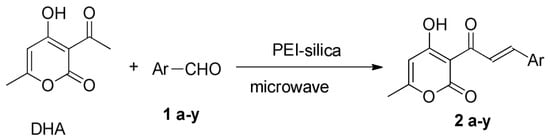
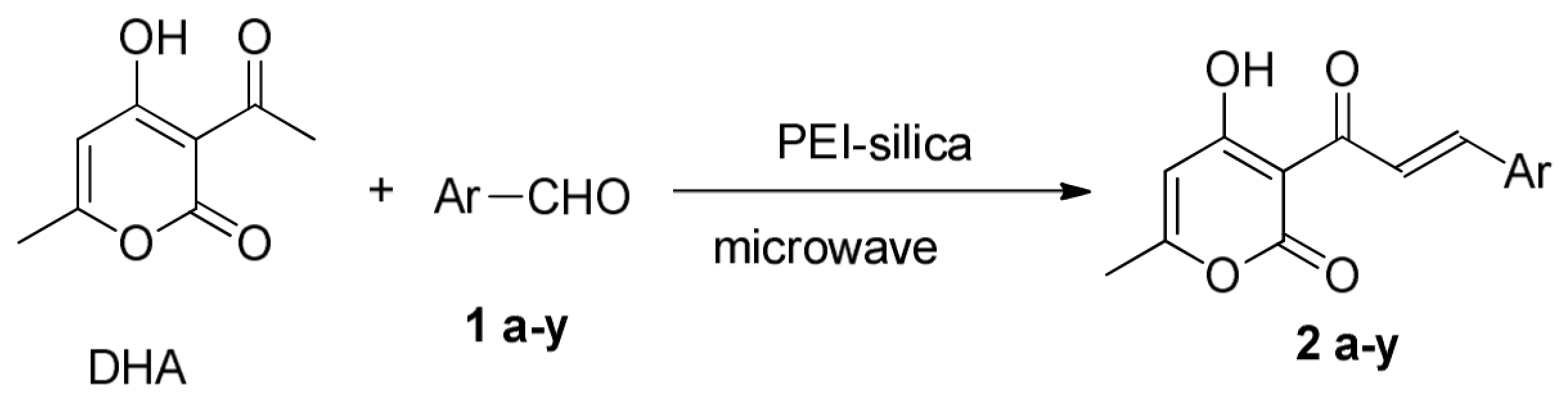
The scope of the reaction was examined with a range of aromatic and heteroaromatic aldehydes (1a–w) in the presence of PEI–SiO2 under microwave irradiation (Scheme 2). The substrates include electron-donating groups (OMe, SMe, iPr), electron-withdrawing groups (NO2, CN), halogens, hydroxy substituents, and heteroaromatic rings (pyridyl, furyl, and thienyl). The corresponding 4-hydroxy-6-methyl-3-(arylacryloyl)-2H-pyran-2-ones were characterized by 1H and 13C NMR spectroscopy, IR spectroscopy, mass spectrometry, and melting-point analysis, as appropriate. Literature melting points are reported in Table 2 for comparison [7,8,9,10,11,12].
Scheme 2.
Condensation of DHA with aromatic and heteroaromatic aldehydes.
Table 2.
Condensation of DHA with aromatic and heteroaromatic aldehydes using PEI–SiO2 under microwave irradiation.
Conditions: 350 W, 3–20 min. Most products were obtained predominantly as the E isomer (>98%). The exceptions were compound 2 (Z/E = 3:4) and compound 4 (Z/E = 2:5). The close 16 agreement between the experimental and literature melting points supports the assigned product identities.
3. Experimental
3.1. Preparation of PEI–SiO2 (20:1 Silica/PEI, w/w)
Silica gel (Merck Grade 7734; 70–230 mesh; particle size 63–200 μm; 20 g) was 21 added to a solution of polyethylenimine (PEI; molecular weight approximately 2,000,000) prepared from 4.2 g of an aqueous 24 wt% PEI solution (corresponding to approximately 1.0 g of PEI) in ethanol (40 mL). After stirring, the solvent was removed under reduced pressure to give a white, free-flowing powder.
3.2. Catalyst-Screening Experiment
DHA (2.5 mmol), p-anisaldehyde (2.5 mmol), and anisole (0.2 mmol) as the internal standard were combined with the appropriate catalyst in individual test tubes. The tubes were heated on a hot plate at up to 100 °C for 2 h. After cooling, the products were analyzed by 1H NMR spectroscopy.
3.3. Recycling of PEI–SiO2
After each reaction cycle, the PEI–SiO2 catalyst was recovered, washed, and dried before reuse. The recycled catalyst was analyzed by FT-IR spectroscopy; the reported bands were 1592.2 cm−1 (N–H) and 1063.1, 786.3, and 662.6 cm−1 (Si–O–Si). No significant changes were observed after five cycles. The isolated product yield remained in the range of 90–94% over five cycles (Table 1).
3.4. General Procedure for the Condensation of DHA with Aromatic Aldehydes
DHA (5 mmol) and the aldehyde (5 mmol) were adsorbed onto 3 g of PEI–SiO2 catalyst. The mixture was irradiated at 350 W for 3–20 min with a Synthewave (Prolabo), depending on the substrate. Reaction progress was monitored by removing a small sample of the solid, extracting it with acetonitrile (1 mL), and analyzing the extract by thin-layer chromatography (TLC). After completion, irradiation was stopped and the product was extracted by elution with dichloromethane or acetonitrile. The solvent was removed under reduced pressure. The crude product was recrystallized from ethanol or purified by flash chromatography on silica gel. Product identity was assessed by 1H and 13C NMR spectroscopy, IR spectroscopy, mass spectrometry, melting point, and TLC Rf comparison with authentic samples, as available.
4. Conclusions
PEI–SiO2 is readily prepared from commercially available materials and functions as an efficient recyclable heterogeneous catalyst for the Knoevenagel condensation of DHA with aromatic and heteroaromatic aldehydes. Under microwave irradiation, the reaction can be performed under solvent-free conditions in short reaction times. The catalyst retained high activity over five recycling cycles for the model reaction. The substrate scope demonstrates that the method can be applied to a diverse set of substituted aromatic and heteroaromatic aldehydes. The proposed acid–base cooperative effect of PEI and silica provides a plausible explanation for the higher activity of the supported catalyst, although a more detailed mechanistic study would be required to establish this point definitively.
Overall, the results support PEI–SiO2 as a practical recyclable catalyst for solvent-free Knoevenagel condensations of DHA under microwave irradiation.
Author Contributions
Conceptualization, D.V.; methodology, D.V.; investigation, F.Z. and N.B.; writing—original draft preparation, D.V.; writing—review and editing, D.V. and N.B. All authors have read and agreed to the published version of the manuscript.
Funding
This research received no external funding.
Institutional Review Board Statement
Not applicable.
Informed Consent Statement
Not applicable.
Data Availability Statement
The data presented in this article are contained within the manuscript. A complete dataset and the full experimental characterization will be provided in the full paper.
Conflicts of Interest
The authors declare no conflicts of interest.
References
- Moreno-Mañas, M.; Pleixats, R. Dehydroacetic Acid, Triacetic Acid Lactone, and Related Pyrones. In Advances in Heterocyclic Chemistry; Academic Press: Waltham, MA, USA, 1992; Volume 53, pp. 1–84. [Google Scholar] [CrossRef] [Scilit]
- Arndt, F. Dehydroacetic Acid. Org. Synth. 1940, 20, 26. [Google Scholar] [CrossRef] [Scilit]
- Wiley, R.H.; Jarboe, C.H.; Ellert, H.G. 2-Pyrones. XV. Substituted 3-Cinnamoyl-4-hydroxy-6-methyl-2-pyrones from Dehydroacetic Acid. J. Am. Chem. Soc. 1955, 77, 5102–5105. [Google Scholar] [CrossRef] [Scilit]
- Rehse, K.; Brandt, F. Azaaromatische Anticoagulantien und ihre N-Oxide. Arch. Pharm. 1983, 316, 1030–1034. [Google Scholar] [CrossRef] [Scilit]
- Zaoui, F.; Villemin, D.; Bar, N.; Didi, M.A. Polyethyleneimine (PEI) on silica as catalyst in Knoevenagel and Michael reactions. Sc. Stud. Res. Chem. Chem. Eng. Biotech. 2017, 18, 1–8. [Google Scholar]
- Ben Alloum, A.; Labiad, B.; Villemin, D. Application of microwave heating techniques for dry organic reactions. J. Chem. Soc. Chem. Commun. 1989, 25, 386–387. [Google Scholar] [CrossRef] [Scilit]
- Ait-Baziz, N.; Rachedi, Y.; Chemat, F.; Handi, M. Solvent Free Microwave-Assisted Knoevenagel Condensation of Dehydroacetic Acid with Benzaldehyde Derivatives. Asian J. Chem. 2008, 20, 2610–2622. [Google Scholar]
- Rehse, K.; Schinkel, W.; Siemann, U. Gerinnungsphysiologisch aktive 4-Hydroxy-2-pyrone. Arch. Pharm. 1980, 313, 344–351. [Google Scholar] [CrossRef] [Scilit]
- Wulfson, N.S.; Rozinov, B.V.; Ovchinnikov, Y.A.; Kiryushkin, A.A.; Shemyakin, M.M. Claisen—Schmidt reaction with heterocyclic analogs of 2′-hydroxyacetophenone Communication 2. Condensation of dehydroacetic acid with aromatic aldehydes. Bull. Acad. Sci. USSR Div. Chem. Sci. 1966, 15, 1541–1545. [Google Scholar] [CrossRef] [Scilit]
- Mohanty, S.K.; Sridhar, R.; Padmanvan, S.Y. Fungicidal activity and synthesis of 5-thiopyrazolones and compounds having α-pyrone attached to pyrazolin nucleus. Indian J. Chem. 1977, 15B, 1146–1148. [Google Scholar]
- Rehse, K.; Schinkel, W. Photocyclisierung von anticoagulanten 6-Alkyl-4-hydroxy-2-pyronen. Arch. Pharm. 1983, 316, 845–849. [Google Scholar] [CrossRef] [Scilit]
- Ramkumar, K.; Tambov, K.V.; Gundla, R.; Manaev, A.V.; Yarovenko, V.; Traven, V.F.; Neamati, N. Discovery of 3-acetyl-4-hydroxy-2-pyranone derivatives and their difluoridoborate complexes as a novel class of HIV-1 integrase Inhibitors. Bioorg. Med. Chem. 2008, 16, 8988–8998, Corrigendum in Bioorganic Med. Chem. 2009, 17, 929. https://doi.org/10.1016/j.bmc.2008.08.082. [Google Scholar] [CrossRef] [Scilit]



Disclaimer/Publisher’s Note: The statements, opinions and data contained in all publications are solely those of the individual author(s) and contributor(s) and not of MDPI and/or the editor(s). MDPI and/or the editor(s) disclaim responsibility for any injury to people or property resulting from any ideas, methods, instructions or products referred to in the content. |
© 2026 by the authors. Licensee MDPI, Basel, Switzerland. This article is an open access article distributed under the terms and conditions of the Creative Commons Attribution (CC BY) license.