


Abstract
Black rot represents an important bacterial disease impacting major Brassicaceae crops, including cabbage, broccoli, and turnip. It is caused by the Gram-negative phytopathogen Xanthomonas campestris pv. campestris (Xcc)—known for the industrial production of the exopolysaccharide xanthan—that invades host tissues through natural openings or wounds. Infection leads to colonization of the vascular system and parenchyma, resulting in characteristic V-shaped chlorotic lesions and degradation of plant vasculature. Traditional control strategies depend primarily on copper-based compounds; however, their effectiveness is often limited, and prolonged application promotes the emergence of resistant strains. In this context, essential oils (EO) have gained attention as biodegradable and environmentally compatible alternatives rich in natural antimicrobial compounds. This study assessed the bactericidal activity of Cymbopogon citratus, Eucalyptus globulus, Foeniculum vulgare, Origanum vulgare, Rosmarinus officinalis, and Satureja montana EOs against a highly virulent Xcc strain (CPBF 278) using the spectrophotometric Alamar Blue cell viability assay. At a concentration of 1 µL.mL−1, the carvacrol-rich S. montana EO achieved complete inhibition (100 ± 0.0%), while O. vulgare oil demonstrated a strong activity (97.9±1.1%), with the former exhibiting a rapid action under 60 min of contact. These results indicate that selected EOs can offer promising sustainable alternatives for black rot management. Their development as potential phytosanitary products could lead to reduced dependence on copper pesticides, minimize resistance development, and support environmentally responsible crop protection, thereby advancing resilient and ecologically balanced crop production systems.
1. Introduction
Xanthomonas campestris is a Gram-negative, rod-shaped bacterium belonging to the family Xanthomonadaceae and is widely recognized as a significant phytopathogen affecting numerous economically important crops worldwide. This species comprises multiple pathovars exhibiting host specificity, with X. campestris pv. campestris (Xcc) being the causal agent of black rot in the Brassicaceae family. Due to its broad distribution, seed-borne nature and capacity for rapid dissemination under favorable environmental conditions, Xcc represents a major constraint to agricultural productivity and food security [1]. The disease can cause substantial reductions in crop quality and yield, particularly when infection occurs during early stages of plant development. Yield losses can be higher in regions with warm, humid climates that favor bacterial proliferation and spread. Xcc invades plants primarily through hydathodes, stomata, or wounds, subsequently colonizing the vascular tissues. Systemic infection disrupts water and nutrient transport, leading to its characteristic symptoms. In crucifers, early symptoms include V-shaped chlorotic lesions at the leaf margins, which progress inward towards the midrib. As the disease advances, affected tissues become necrotic, and blackening of the veins becomes evident, with this typical symptom being used as a diagnostic feature. Severe infections can result in stunted growth, premature leaf drop, reduced head formation in cabbage, and complete crop failure under epidemic conditions. The ability of Xanthomonas to adhere to plant surfaces, form biofilms and deliver virulence factors into host cells contributes to their establishment and the development of the disease [2].
Management of black rot is based mainly on preventive and integrated practices because, once established, systemic infections are difficult to eliminate. Important measures include use of certified pathogen-free seeds, removal of infected plant debris and cruciferous weeds, rotation with non-host crops, avoidance of overhead sprinkler irrigation, disinfection of equipment, and the use of resistant or tolerant cultivars when available. Copper-based products may help reduce surface bacterial populations, but their performance can be inconsistent, particularly when facing systemic infections. The repeated application of chemicals may also select for resistant pathogen populations and raise concerns regarding environmental accumulation and non-target effects [1,3]. These limitations have brought increased interest in the use of alternative antimicrobial agents that can be incorporated into integrated disease-management programs.
Essential oils (EOs), extracted from plants, have gained considerable attention as potential biocontrol agents. These complex volatile mixtures are composed of secondary metabolites, primarily terpenes (mono- and sesquiterpenes) and phenylpropanoids, although other classes of compounds can occur in high amounts. These bioactive constituents can exhibit broad-spectrum antimicrobial properties against bacteria, fungi, and viruses. Against phytopathogenic bacteria, including Xanthomonas spp., EOs have shown promising inhibitory activities in vitro and, in some cases, under greenhouse and field or plant-associated conditions [4,5]. The antibacterial activity of EOs is largely attributed to their ability to disrupt cell membranes, alter membrane permeability, interfere with enzyme systems, and induce leakage of cellular contents. Compounds such as thymol, carvacrol, eugenol, and citral have demonstrated particularly strong antimicrobial effects [6]. Their mechanisms of action may involve membrane destabilization, inhibition of quorum sensing, suppression of biofilm formation, and interference with the production of virulence factors. Additionally, some EOs can stimulate plant defense responses by inducing systemic resistance. These multifaceted effects make them attractive candidates for incorporation into integrated pest management (IPM) programs [7].
The growing demand for sustainable crop protection strategies highlights the importance of studying alternative approaches to manage black rot. Research on EOs and their bioactive constituents as control agents is thus a high priority scientific area. Such research could contribute to the development of plant-based high-specificity bactericides aiming at reducing the impact of this destructive pathogen while minimizing reliance on synthetic chemicals.
2. Materials and Methods
2.1. Essential Oil Composition
The EOs were obtained from local retail sellers and comprised EOs of eucalypt leaves (Eucalyptus globulus), fennel shoots (Foeniculum vulgare), oregano shoots (Origanum vulgare), lemongrass leaves (Cymbopogon citratus), rosemary flowering shoots (Rosmarinus officinalis) and winter savory flowering shoots (Satureja montana). Their chemical composition was determined through gas chromatography/mass spectrometry [Shimadzu GC2010 gas chromatographer coupled to a GC-MS-QP2010 Plus Mass Spectrometer (Shimadzu, Kyoto, Japan)] by injecting 0.1 µL of each EO diluted (1:1, v/v) in n-hexane (95%, Optima grade for HPLC and GC-MS, Fisher Chemicals, Hampton, NH, USA). The chromatographic separation was performed with a Zebron column ZB-5HT (30 m length, 0.25 mm I.D., 0.25 μm film thickness) (Phenomenex, Torrance, CA, USA). A split sampling technique (ratio 1:100) was used, with the injector temperature set to 250 °C and a helium (He) flow of 1.5 mL/min. The GC oven temperature program was set to increase from 45 to 175 °C at 3 °C/min, and then up to 300 °C at 15 °C/min, with a final isothermal step for 10 min [8]. The mass spectrometer was operated in EI mode (70 eV) and scanned from 40 to 850 m/z. The ion source temperature was set at 240 °C, and the interface temperature was maintained at 280 °C. Peak assignment was performed through AMDIS software version 2.68 (National Institute of Standards and Technology of the US Department of Commerce, Gaithersburg, MD, USA) by using the National Institute of Standards and Technology (NIST) and Wiley spectral databases and a laboratory built mass spectra library.
2.2. Bioactivity Against Xanthomonas campestris pv. campestris
The bacterial isolate CPBF 278, belonging to the very common race 6, ST8 [9], was obtained from Coleção Portuguesa de Bactérias Fitopatogénicas (CPBF), held by the Phytobacteriology Laboratory of Instituto Nacional de Investigação Agrária e Veterinária (INIAV), Oeiras, Portugal. The strain, cryopreserved at −80 °C, was routinely cultured on Yeast Dextrose Chalk Agar (YDC) (Duchefa Biochemie, Haarlem, The Netherlands) medium under sterile conditions. Plates were incubated for 48 h at 26-28 °C to obtain fresh bacterial growth. A bacterial suspension of Xcc was prepared in sterile phosphate-buffered saline (PBS; 10 mM, pH 7.4) (Sigma-Aldrich, St. Louis, MO, USA) and adjusted to a final concentration of 6 × 10⁸ cells.mL−1. This suspension was used to evaluate EO bioactivity using the Alamar Blue spectrophotometric bioassay in 96-well microtiter plates. Briefly, for each well, 85 µL of bacterial suspension was mixed with 10 µL of resazurin sodium salt solution (1 mM) (Sigma-Aldrich, St. Louis, MO, USA) and 5 µL of EO stock solution (20 µL.mL−1 in HPLC-grade methanol) (Fisher Chemicals, Hampton, NH, USA). Blank wells received 5 µL of HPLC-grade methanol instead of EO, while negative control wells contained heat-inactivated bacterial suspensions (95 °C for 7 min) to represent non-viable cells and account for potential interference of the EO on the reaction. Each treatment was performed in eight replicates. Absorbance was measured hourly for 15 h at 570 nm (resorufin maximum) and 600 nm (resazurin reference wavelength) using a Thermo Scientific Multiskan Skyhigh Microplate Spectrophotometer (Thermo Fisher Scientific, MA, USA), allowing monitoring the bacterial metabolic activity over time.
2.3. Data Treatment and Statistical Analysis
Absorbance data was processed by subtracting the corresponding negative control values from each treatment at each time point. The corrected absorbance values were then compared with those obtained for blank samples to determine the percentage of inhibition. The resulting inhibition percentages were plotted as a function of time, and a sigmoidal logistic model was fitted to the data to estimate the upper asymptote (maximum metabolic activity) and the half-maximal effective time (ET50). Curve fitting was performed using OriginPro 2019 version 9.6 (OriginLab, Northampton, MA, USA) selecting to the following equation: y = C + (D − C)/1 + exp {b [log (x) − log (ET50)]} [8], where C and D represent the lower (set to 0) and upper asymptotes of the sigmoidal curve, respectively, b is the slope parameter, and ET50 corresponds to the time (min) required to reach a response halfway between C and D.
3. Results and Discussion
Gas chromatography–mass spectrometry analysis of the EOs showed that their chemical profiles were predominantly composed of monoterpenes. An exception was observed for Foeniculum vulgare (Apiaceae), whose EO was largely dominated by the phenylpropanoid trans-anethole (75%) (Table 1). In Eucalyptus globulus (Myrtaceae), the EO profile was characterized by a high proportion of the oxygenated monoterpene 1,8-cineole, accounting for 75% of the total composition. The EO of Cymbopogon citratus (Poaceae) displayed a more diverse composition, mainly consisting of the aldehyde monoterpene isomers geranial (35%) and neral (22%), along with geraniol (18%) and the monoterpene hydrocarbon β-myrcene (20%).
Table 1.
Major constituents (≥5% relative abundance) of essential oils (EOs) from eucalypt (Eucalyptus globulus), fennel (Foeniculum vulgare), lemongrass (Cymbopogon citratus), oregano (Origanum vulgare), rosemary (Rosmarinus officinalis), and winter savory (Satureja montana), as assessed by gas chromatography–mass spectrometry (GC–MS).
In contrast, Rosmarinus officinalis (Lamiaceae) EO was richer in monoterpene hydrocarbons than in oxygenated derivatives, with β-myrcene (31%) and α-pinene (16%) as the major constituents, alongside the ketone verbenone (11%). The EO of Origanum vulgare (Lamiaceae) showed high relative amounts of the monoterpene alcohols α-terpineol (42%), linalool (17%) and the phenol thymol (13%). The EO of Satureja montana (Lamiaceae) was distinguished by a high content of the phenolic monoterpene carvacrol (64%), accompanied by γ-terpinene (18%).
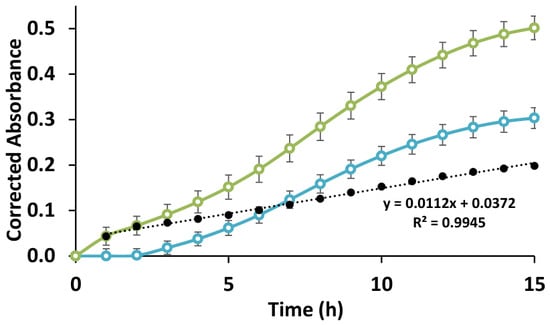
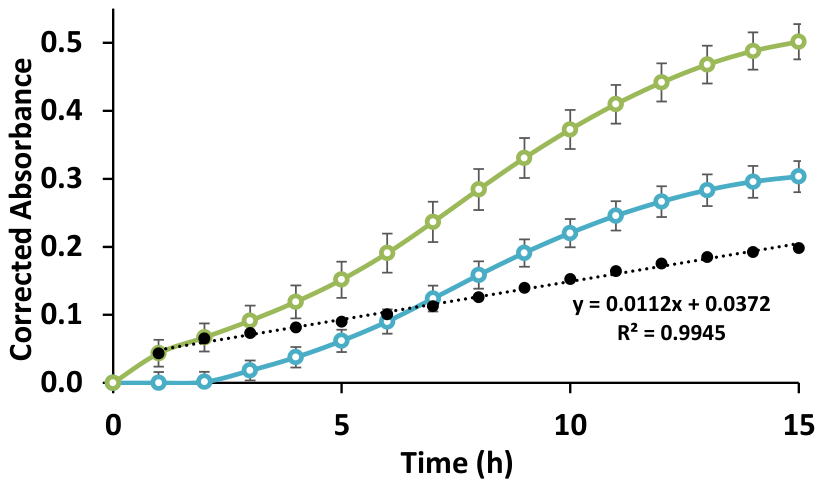
To determine EO antibacterial strength, Xcc metabolic activity was monitored through the irreversible reduction in resazurin to resorufin, a process directly proportional to aerobic respiration. For the results obtained for each replicate and treatment, absorbance values were first normalized and then corrected by subtracting the corresponding normalized negative control (Atreatment − Anegative control). The obtained absorbance values for resorufin production, measured at 570 nm, were consistently lower than the ones measured for resazurin consumption measured at 600 nm, suggesting that the bioassay conditions are leading to a reduction in resorufin to other products (such as the protonated resorufin anion or dihydroresorufin), which are less detectable at 570 nm [10]. For example, using the methanol blank treatment (Figure 1), cumulative resazurin consumption (the green curve in Figure 1) is higher than cumulative resorufin production (the blue curve in Figure 1).
Figure 1.
Corrected absorbance values for methanol blank treatment measured at 600 nm (green), 570 nm (blue), and the difference in corrected absorbance (A600-A570; black filled circles) as a measure of resorufin reduction to colorless products over time.
To determine the impact of these secondary reactions, corrected absorbance values for the 570 nm measured curve were subtracted from those obtained for the 600 nm measured curve. Resorufin loss appeared in a direct proportionality (black filled circles in Figure 1, R2 = 0.99), indicating a constant reduction reaction [10]. Throughout the time-course analysis, higher amount of resorufin led to a higher amount of reduced resorufin, an increase estimated at approximately 0.012 absorbance units per hour. Consequently, the inhibitory activity of the EOs was assessed based on resazurin consumption rather than resorufin accumulation, as the latter underestimates metabolic activity due to ongoing resorufin degradation.
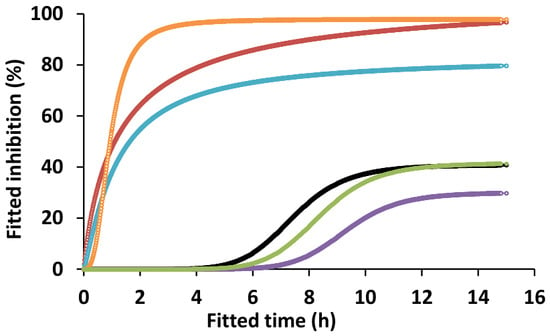
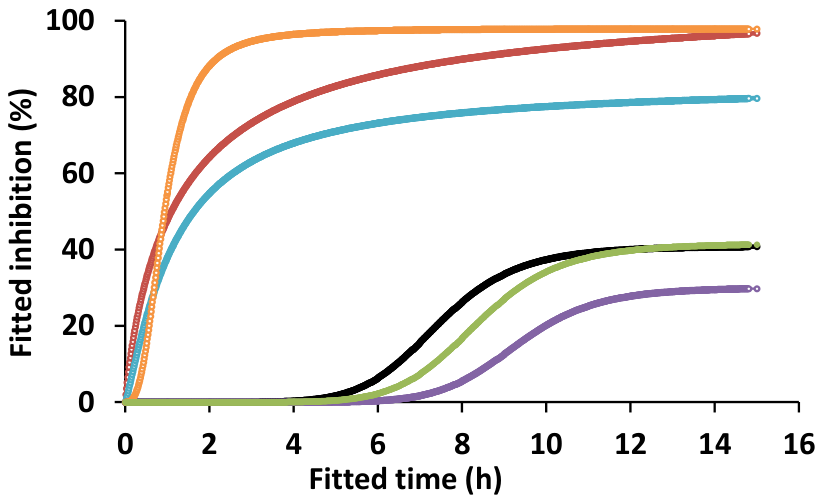
The activity of the tested EOs was evaluated at each time point by comparison with the methanol control. The percentage inhibition of metabolic activity was calculated and plotted as a function of time (Figure 2). A logistic model was then fitted to the data to estimate the upper asymptote (maximum response) and the half-maximal effective time (ET50, min), defined as the time required to reach 50% of the response between baseline and maximum activity. The EOs from S. montana, O. vulgare, and C. citratus stood out as the most active, reaching 100.0 ± 0.0%, 97.9 ± 1.1%, and 83.4 ± 3.0%, respectively, at 1 µL mL−1, and showing ET50 values between 55.1 ± 3.1 min and 77.0 ± 3.9 min (Table 2). The remaining EOs showed weak activities (below 42%) and higher ET50 values.
Figure 2.
Antibacterial activity expressed by the percentage inhibition (fitted curve) of methanol blank control by the essential oils obtained from Satureja montana (red line), Origanum vulgare (orange line), Cymbopogon citratus (cyan line), Eucalyptus globulus (black line), Foeniculum vulgare (green line), and Rosmarinus officinalis (purple line).
Table 2.
Antibacterial activity of essential oils extracted from Eucalyptus globulus, Foeniculum vulgare, Cymbopogon citratus, Rosmarinus officinalis, Origanum vulgare, and Satureja montana. Inhibition (%) is relative to methanol blank control, half maximal effective time (ET50, min) is the time which induces a biological response halfway between the baseline and maximum. The goodness-of-fit for the sigmoidal curve was evaluated through adjusted R2.
For C. citratus EO, the antibacterial activity observed against Xcc is consistent with previous reports describing the susceptibility of Xanthomonas spp. and other Gram-negative phytopathogens to lemongrass-derived volatiles [5,11,12]. In the present study, C. citratus EO induced a marked reduction in metabolic activity, indicating a rapid and sustained antibacterial effect. This activity is likely associated with its high citral (geranial and neral) content, which has been reported to disrupt bacterial membrane integrity, alter permeability and interfere with enzymatic systems essential for cell viability [13].
The EOs of S. montana and O. vulgare exhibited the highest inhibitory effects; however, while O. vulgare EOs are known to have a strong influence on X. campestris, direct evidence of S. montana EO activity is limited. Nevertheless, EO efficacy is directly influenced by its chemical composition, which in these species can be variable, typically presenting separate chemotypes [14,15]. The EOs used in this study were rich in the phenolic monoterpenes carvacrol and thymol, compounds known to exert strong antimicrobial effects against Gram-negative bacteria. For example, carvacrol has been shown to increase membrane permeability, disrupt proton motive force, and induce leakage of intracellular components, ultimately leading to cell death [13]. Notably, X. campestris has been reported as being highly sensitive, requiring relatively low concentrations of O. vulgare EO to inhibit bacterial growth [16].
Overall, while the activity of C. citratus or O. vulgare EOs corroborates existing knowledge on the sensitivity of Gram-negative phytopathogens to these EOs, the results obtained for S. montana EO highlight its potential as a less explored antibacterial agent of Xcc. These findings support the compiled evidence that EOs rich in oxygenated monoterpenes and phenolic compounds can effectively impair bacterial metabolism, although further studies are required to validate their efficacy under in planta conditions and to elucidate their specific modes of action in this pathogen. Even though they present a high potential, challenges remain in the practical application of EOs in agriculture. Issues such as volatility, phytotoxicity at high concentrations, limited persistence under field conditions, and variability in chemical composition must be addressed. Advances in formulation technologies, including nanoemulsions and encapsulation systems, must be optimized to enhance stability and bioavailability, corroborating this efficacy.
Author Contributions
Conceptualization, J.M.S.F.; methodology, G.G. and J.M.S.F.; software, J.M.S.F.; formal analysis, G.G. and J.M.S.F.; investigation, G.G. and J.M.S.F.; resources, L.C., O.V.-D., D.T. and J.M.S.F.; data curation, J.M.S.F.; writing—original draft preparation, J.M.S.F.; writing—review and editing, G.G., L.C., O.V.-D., D.T. and J.M.S.F.; funding acquisition, L.C., O.V.-D., D.T. and J.M.S.F. All authors have read and agreed to the published version of the manuscript.
Funding
This research was partly funded by Fundação para a Ciência e a Tecnologia (FCT/MCTES), through national funds, under the projects UID/04551/2025 (GreenIT), UID/04046/2025 (BioISI) and UID/04449/2025 (Laboratório HERCULES).
Institutional Review Board Statement
Not applicable.
Informed Consent Statement
Not applicable.
Data Availability Statement
The raw data supporting the findings of this study are available from the corresponding author (Jorge M. S. Faria) upon reasonable request.
Acknowledgments
The authors wish to thank Alicja Surowiak (Wrocław University of Science and Technology).
Conflicts of Interest
The authors declare no conflicts of interest.
References
- Vicente, J.G.; Holub, E.B. X Anthomonas Campestris Pv. Campestris (Cause of Black Rot of Crucifers) in the Genomic Era Is Still a Worldwide Threat to Brassica Crops. Mol. Plant Pathol. 2013, 14, 2–18. [Google Scholar] [CrossRef] [Scilit]
- Ryan, R.P.; Vorhölter, F.-J.; Potnis, N.; Jones, J.B.; Van Sluys, M.-A.; Bogdanove, A.J.; Dow, J.M. Pathogenomics of Xanthomonas: Understanding Bacterium–Plant Interactions. Nat. Rev. Microbiol. 2011, 9, 344–355. [Google Scholar] [CrossRef] [Scilit] [PubMed]
- Rodrigues, T.C.; Gois, I.B.; Fernandes, R.P.M.; Blank, A.F.; Sandes, R.D.D.; Leite Neta, M.T.S.; Narain, N.; Arrigoni-Blank, M. de F. Chemical Characterization and Antimicrobial Activity of Essential Oils from Croton Grewioides Baill. Accessions on the Phytopathogen Xanthomonas Campestris Pv. Campestris. Pestic. Biochem. Physiol. 2023, 193, 105454. [Google Scholar] [CrossRef] [Scilit]
- Roeschlin, R.A.; Favaro, M.A.; Bertinat, B.; Lorenzini, F.G.; Paytas, M.J.; Fernandez, L.N.; Marano, M.R.; Derita, M.G. Botanical-Based Strategies for Controlling Xanthomonas Spp. in Cotton and Citrus: In Vitro and In Vivo Evaluation. Plants 2025, 14, 957. [Google Scholar] [CrossRef] [Scilit]
- Kolozsváriné Nagy, J.; Móricz, Á.M.; Böszörményi, A.; Ambrus, Á.; Schwarczinger, I. Antibacterial Effect of Essential Oils and Their Components against Xanthomonas Arboricola Pv. Pruni Revealed by Microdilution and Direct Bioautographic Assays. Front. Cell. Infect. Microbiol. 2023, 13, 1204027. [Google Scholar] [CrossRef] [Scilit]
- Burt, S. Essential Oils: Their Antibacterial Properties and Potential Applications in Foods—A Review. Int. J. Food Microbiol. 2004, 94, 223–253. [Google Scholar] [CrossRef] [Scilit] [PubMed]
- Bajpai, V.K.; Kang, S.-R.; Xu, H.; Lee, S.-G.; Baek, K.-H.; Kang, S.-C. Potential Roles of Essential Oils on Controlling Plant Pathogenic Bacteria Xanthomonas Species: A Review. Plant Pathol. J. 2011, 27, 207–224. [Google Scholar] [CrossRef] [Scilit]
- Faria, J.M.S.; Cavaco, T.; Gonçalves, D.; Barbosa, P.; Teixeira, D.M.; Moiteiro, C.; Inácio, M.L. First Report on the Synergistic Interaction between Essential Oils against the Pinewood Nematode Bursaphelenchus Xylophilus. Plants 2023, 12, 2438. [Google Scholar] [CrossRef] [Scilit]
- Cruz, J.; Tenreiro, R.; Cruz, L. Inference of the Phylogenetic Diversity and Population Structure of Xanthomonas Campestris Affecting Brassicaceae Using a Multilocus Sequence Typing-based Approach. Plant Pathol. 2018, 67, 948–956. [Google Scholar] [CrossRef] [Scilit]
- Vieira-da-Silva, B.; Castanho, M.A.R.B. Resazurin Reduction-Based Assays Revisited: Guidelines for Accurate Reporting of Relative Differences on Metabolic Status. Molecules 2023, 28, 2283. [Google Scholar] [CrossRef] [Scilit]
- Sharma, M.; Suma, R.; Chowdhury, N.; Borgohain, T.; Hiremath, S.; Chikkaputtaiah, C.; Saikia, B. In Vitro and in Silico Analysis of Broad-Spectrum Bio-Activity of Essential Oils Derived from Medicinal and Aromatic Plants against Microbial Phytopathogens. Eur. J. Plant Pathol. 2024, 170, 955–971. [Google Scholar] [CrossRef] [Scilit]
- Todorović, B.; Potočnik, I.; Rekanović, E.; Stepanović, M.; Kostić, M.; Ristić, M.; Milijašević-Marčić, S. Toxicity of Twenty-Two Plant Essential Oils against Pathogenic Bacteria of Vegetables and Mushrooms. J. Environ. Sci. Health Part B 2016, 51, 832–839. [Google Scholar] [CrossRef] [Scilit]
- Nazzaro, F.; Fratianni, F.; De Martino, L.; Coppola, R.; De Feo, V. Effect of Essential Oils on Pathogenic Bacteria. Pharmaceuticals 2013, 6, 1451–1474. [Google Scholar] [CrossRef] [Scilit] [PubMed]
- Capdevila, S.; Grau, D.; Cristóbal, R.; Moré, E.; De las Heras, X. Chemical Composition of Wild Populations of Thymus Vulgaris and Satureja Montana in Central Catalonia, Spain. JSFA Rep. 2025, 5, 234–246. [Google Scholar] [CrossRef] [Scilit]
- Machado, A.M.; Lopes, V.; Barata, A.M.; Póvoa, O.; Farinha, N.; Figueiredo, A.C. Essential Oils from Origanum Vulgare Subsp. Virens (Hoffmanns. & Link) Ietsw. Grown in Portugal: Chemical Diversity and Relevance of Chemical Descriptors. Plants 2023, 12, 621. [Google Scholar] [CrossRef] [Scilit]
- Simirgiotis, M.J.; Burton, D.; Parra, F.; López, J.; Muñoz, P.; Escobar, H.; Parra, C. Antioxidant and Antibacterial Capacities of Origanum Vulgare L. Essential Oil from the Arid Andean Region of Chile and Its Chemical Characterization by GC-MS. Metabolites 2020, 10, 414. [Google Scholar] [CrossRef] [Scilit]

Disclaimer/Publisher’s Note: The statements, opinions and data contained in all publications are solely those of the individual author(s) and contributor(s) and not of MDPI and/or the editor(s). MDPI and/or the editor(s) disclaim responsibility for any injury to people or property resulting from any ideas, methods, instructions or products referred to in the content. |
© 2026 by the authors. Licensee MDPI, Basel, Switzerland. This article is an open access article distributed under the terms and conditions of the Creative Commons Attribution (CC BY) license.