


Abstract
The purpose of the present study was to extract essential oil (EO) from the aerial parts of Aloysia citrodora (AC) harvested from western Algeria and to determine its chemical profile using GC-MS analysis. This study also aimed to prepare inclusion complexes of Aloysia citrodora essential oil (ACEO) in β-CD using physical mixture (PM) and co-precipitation (CP) methods. The complexation yields and efficiencies were determined. FT-IR spectroscopy was used to characterize the obtained inclusion complexes. The GC-MS analysis revealed the presence of α-citral at 22.65%, an unidentified oxygenated compound (14.63%), Limonene (13.62%), and β-spathulenol (5.03%). The recovery yields were 80.34% and 71.67% for the PM and CP methods, respectively. The complexation efficiencies were 62.12% and 85.45% for PM and CP, respectively. The FTIR spectra confirmed the interaction between the EO and the β-CD cavity, supporting the formation of inclusion complexes. In addition, the inclusion complex showed greater antioxidant activity compared to the free EO. In conclusion, the promising results obtained confirm that β-cyclodextrin encapsulated the essential oil of Aloysia citrodora.
1. Introduction
Currently, various industrial sectors—including the agri-food, cosmetics, and pharmaceutical industries—are experiencing growing demand for natural products and are showing great interest in promoting and developing these natural biochemical products. In this context, the excellent reputation of essential oils for their natural origin, diverse chemical compositions, and biological activities makes them particularly attractive for use in various products. In cosmetics and food products, essential oils (Eos) are primarily used for their preservative and sensory properties. This is because most of these essential oils are regulated and considered safe or “GRAS” by the Food and Drug Administration (FDA) [1].
Eos are characterized by their low solubility in aqueous media, instability, and susceptibility to degradation, which limit their incorporation into different formulated products [2]. To overcome these limitations, several studies have focused on the encapsulation of essential oils [3]. Encapsulation with cyclodextrins is one of the most promising strategies, especially for highly volatile and poorly water-soluble molecules [4].
Cyclodextrins are a family of cyclic oligosaccharides that possess a hydrophobic interior cavity capable of trapping host molecules and a hydrophilic outer surface that allows them to serve as a matrix for the walls of inclusion complexes [5]. The formation of an inclusion complex requires that the host molecule have a size and geometry compatible with the type of CD used for encapsulation. In addition, the hydrophobic nature of the host molecule is a critical parameter for complex formation [6].
Essential oils have been the subject of several studies investigating complexation with different types of cyclodextrins with the aim of expanding their applications, particularly in the food industry for the microencapsulation of natural antimicrobial and antioxidant agents. In such complexes, cyclodextrins protect essential oils from oxidation and photodegradation [7].
Aloysia citrodora (AC) is an aromatic medicinal plant widely used in traditional medicine for its therapeutic properties. This variety is mainly cultivated for its lemon-scented leaves, traditionally used to relieve gastrointestinal symptoms, spasms, fever, asthma attacks, colds, diabetes, anxiety, and insomnia [8].
With the aim of improving the stability of Aloysia citrodora essential oil (ACEO) and expanding its applications, this study aims to encapsulate the EO using β-CD and to evaluate the formed inclusion complexes in terms of encapsulation yield and efficiency, release study, as well as to analyze the molecular interaction using FTIR and antioxidant activity using DPPH and ABTS assays.
2. Materials and Methods
2.1. Plant Material and Extraction of Essential Oil
Fresh aerial parts of AC were harvested from Tlemcen, Algeria, between March and May 2023,botanically identified and shade dried at room temperature. The EO was extracted from the dried leaves by hydrodistillation using a Clevenger apparatus and stored in dark glass test tubes at 4 °C until further use.
2.2. GC-MS Analysis
Essential oil was analyzed by GC-MS ((Agilent Technologies Auto System XL, PerkinElmer, Shelton, CT, USA) using HP-5MS (30 m × 0.25 mm × 0.25 μm) and Stabilwax (60 m × 0.20 mm × 0.25 μm) capillary columns. Helium (Sigma-Aldrich, St. Louis, MO, USA) was used as the carrier gas (0.3 mL min−1), with splitless injection (0.2 μL) at 250 °C. The oven was programmed from 60 °C (8 min) to 250 °C at 2 °C min−1, with a final hold of 15 min. Ionization was by electron impact at 70 eV.
2.3. Preparation of Inclusion Complexes
2.3.1. Co-Precipitation Method (CP)
Essential oil-β-cyclodextrin inclusion complexes were prepared by the co-precipitation method at a molar ratio of 1:1 (EO: β-CD). Since essential oils are multi-component mixtures, the molar ratio calculation was based on the molecular weight of the major constituent of the essential oil, which is α- citral (Mw ≈ 152.23 g/mol), corresponding to an experimental mass ratio of approximately 1: 7.46 (w/w) of (EO: β-CD). First, β-CD (Sigma-Aldrich, USA) was dissolved in 10 mL of distilled water for 30 min under magnetic stirring at 60 °C. Next, the mixture was cooled to 30 °C, and the essential oil, solubilized in 10 mL of ethanol (Sigma-Aldrich, St. Louis, MO, USA), was added dropwise under magnetic stirring for 30 min. The mixture was then vacuum-filtered, and the resulting samples were stored in desiccators [9].
2.3.2. Physical Mixture Method (PM)
The physical mixture was prepared in a 1:1 molar ratio of essential oil to β-CD as described above. In a glass mortar containing the weighed amount of β-CD, the EO was added by simple manual mixing at room temperature. The powder resulting from this preparation was stored in airtight glass containers in a desiccator.
2.4. Characterization of ICs
2.4.1. Complexation Yield
The complexation yield, or the total amount of solid powder recovered at the end of each preparation method, is expressed as a percentage. It is calculated by dividing the total mass of the recovered solid powder by the initial total mass of β-CD and essential oil used [10].
2.4.2. Complexation Efficiency (CE)
CE is expressed as the percentage of essential oil encapsulated within the cyclodextrin cavity relative to the initial amount used to prepare the inclusion complex. It is determined using a spectroscopic method and calculated using the following equation:
The encapsulated EO amount was determined as the difference between the total EO trapped in the inclusion complex and the EO adsorbed on its surface. For total EO, 5 mg of IC was dissolved in 5 mL of acetonitrile (95 g/100 mL) (Sigma-Aldrich, St. Louis, MO, USA), homogenized, and left for 24 h at room temperature. After centrifugation and filtration, absorbance was measured at 272 nm. Surface-adsorbed EO was quantified by washing 0.5 g of IC with 5 mL acetonitrile for 20 min, followed by centrifugation, filtration, and absorbance measurement. EO calibration curves were used to calculate the total and adsorbed amounts [11].
2.4.3. Release Study of CP -βCD- AC Essential Oil
The release of EO from inclusion complexes prepared by co-precipitation (CP-IC) was studied in a phosphate-buffered solution (pH 7.4) at 37 °C by adding 200 mg of the complex to 30 mL of buffered solution under magnetic stirring (400 rpm) for 24 h. 2 mL samples were manually withdrawn at regular intervals and then replaced with the dissolution solvent to maintain a constant volume. The accumulated amount of ACEO released from the IC was assessed by UV-visible spectroscopy [12].
2.4.4. Fourier Transform Infrared Spectroscopy (FTIR)
To perform the FTIR analysis, an Agilent 600 spectrophotometer covering the wavenumber range of 4,000 to 400 cm−1, with a 4 cm−1 resolution and 16 scans per sample, was used. Solid samples (β-CD, PM and CP-IC) were pulverized and extensively blended with KBr. The KBr pellets were then made by pressing the sample mixture using a hydraulic press. Liquid samples (EREO) were prepared employing the method of KBr windows.
2.4.5. Evaluation of Antioxidant Activity
DPPH Assay
The antioxidant activity of the EO, β-CD, and CP-IC was evaluated using the DPPH method, and it was expressed as the percentage of inhibition (I %) [13]. Briefly, 1 mL of DPPH solution (0.006%, w/v) was mixed with 1 mL of sample at different concentrations. After 30 min in the dark at room temperature, absorbance was measured at 517 nm (Optizen POP). Ascorbic acid served as the positive control, while DPPH solution mixed with ethanol (1:1, v/v) served as the negative control. The inhibition percentage (I%) was calculated as follows:
where Ac is the absorbance of control samples and As is the absorbance of the test samples.
Inhibition (%) = (Ac − As)/Ac × 100
ABTS Free Radical Scavenging Assay
The ABTS•+ radical was generated by mixing equal volumes of 7 mM ABTS and 2.45 mM potassium persulfate, followed by 16 h incubation in the dark. The solution was di-luted to an absorbance of 0.700 ± 0.02 at 734 nm, mixed with EREO and CP-IC at different concentrations, and incubated for 10 min in the dark [14]. Absorbance was measured at 734 nm, using ascorbic acid as a positive control. Inhibition (%) was calculated using the DPPH formula.
3. Results and Discussion
3.1. Extraction Yield
The EO extracted in the current study was a fresh yellow-greenish liquid with a lemon-like aroma. The extraction yield was 0.3%. A similar yield (0.27%) was obtained from the same plant material collected from Mascara in Algeria, which is close to our results [15]. In Argentina, A. triphylla samples collected from different regions yielded 0.4% [16]. Several studies suggest that such variations are influenced by the extraction method, soil composition, geographic location, seasonal changes, climate conditions, plant maturity, and the time of day when harvesting occurs, which also play a significant role.
3.2. Chemical Composition
The ten major compounds identified in the essential oil, along with their retention times and percentages, are presented in Table 1.
Table 1.
Major compounds identified in the essential oil.
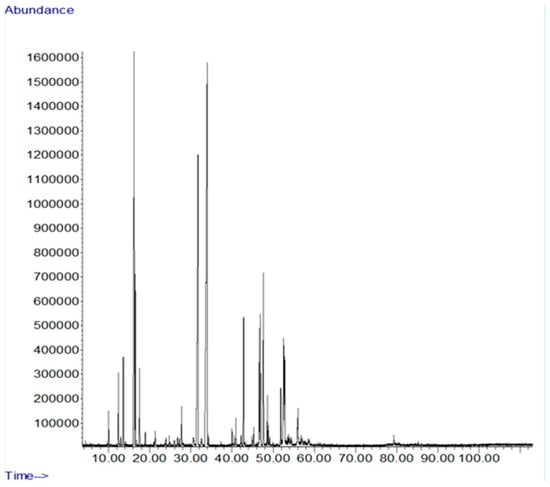
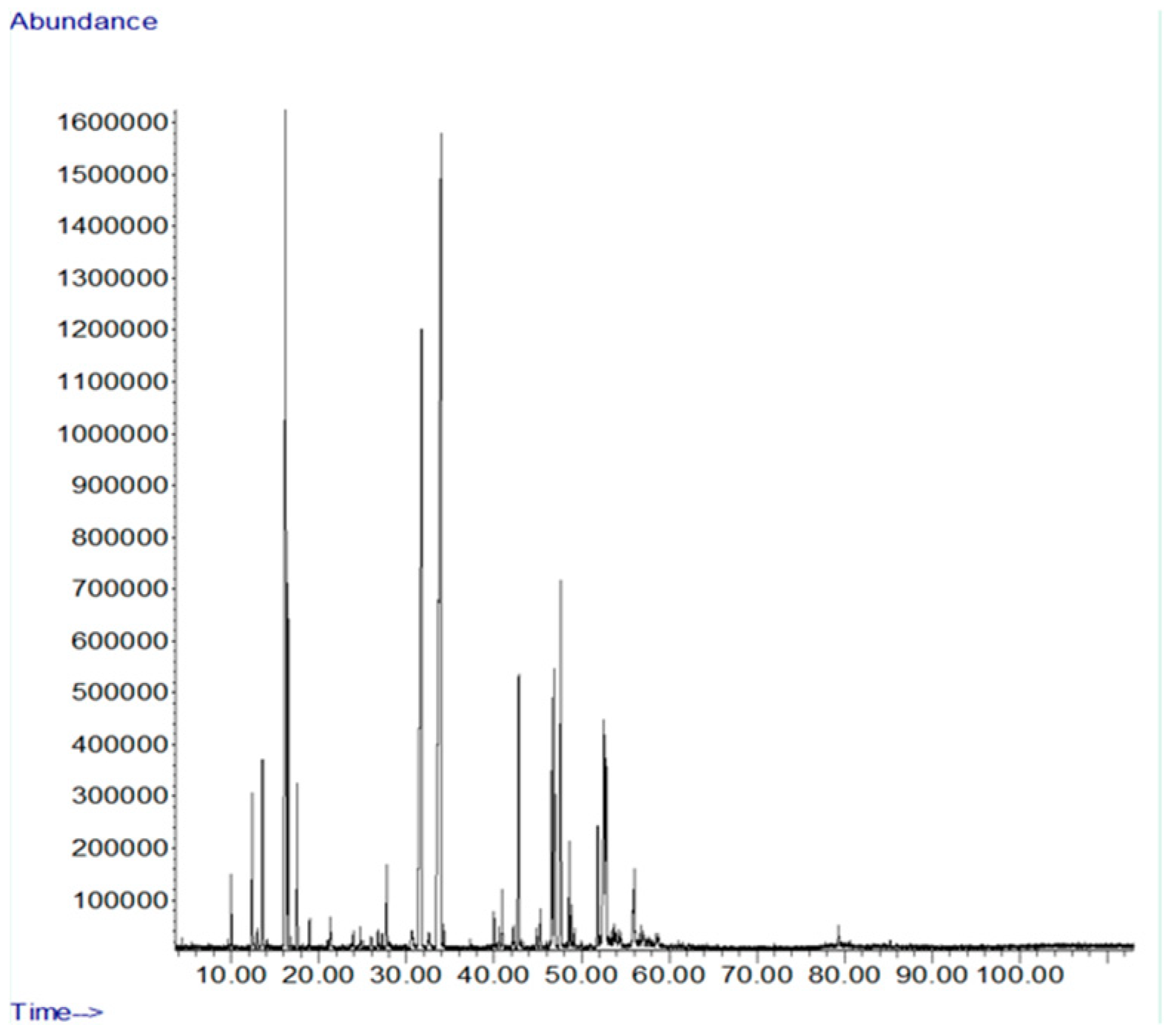
GC-MS analysis EO shows that the major compounds identified were α-citral (22.65%), an unidentified oxygenated compound (14.63%), Limonene (13.62%), β-spathulenol (5.03%), Octadecanoic acid (4.23%), eucalyptol (3.57%), Ar-Curcumene (3.57%), Sabinene (3.44%),α-copaene (3.22%), β-Citronellene (3%) (Table 1 and Figure 1). The results of the current study align with previous studies, with geranial identified as one of the major constituents of Citriodora species essential oil [17].
Figure 1.
Chromatogram of essential oil.
3.3. Characterization of the Inclusion Complexes
3.3.1. Complexation Yield
Table 2 presents the powder yield of inclusion complexes prepared by the CP method and by PM. The results obtained show that the PM method yielded the highest recovery rate, around 80.34%, compared to the co-precipitation method, which yielded a recovery rate of 71.67%. For both methods, the total amount of powder recovered is less than the amount of essential oil and β-CD used initially. This can be explained by losses during preparation.
Table 2.
Comparison of inclusion complex yields obtained by CP and PM.
3.3.2. Complexation Efficiency (CE)
Table 3 shows the complexation efficiencies of IC prepared by physical mixing and co-precipitation.
Table 3.
Comparison of complexation efficiencies obtained by CP and PM.
Complexation by co-precipitation yielded the highest CE of 85.45% compared with the physical mixture method, which resulted in a CE of 62.12%. In a previous study, the encapsulation of the same essential oil with β-CD using the freeze-drying method yielded a CE of 51.96 ± 2.08%, which was significantly lower than that obtained in our study [17]. Kaddour et al. reported that coprecipitation of Eucalyptus radiata essential oil with β-CD yielded a CE of 87.73%, and the physical mixture resulted in a CE of 58.96% [18]. All of these results confirm that the efficiency of encapsulation depends on the complexation method used and its operating conditions, such as mechanical agitation and drying.
3.3.3. Release Profile of ACEO- β-CD Inclusion Complex Prepared by CP
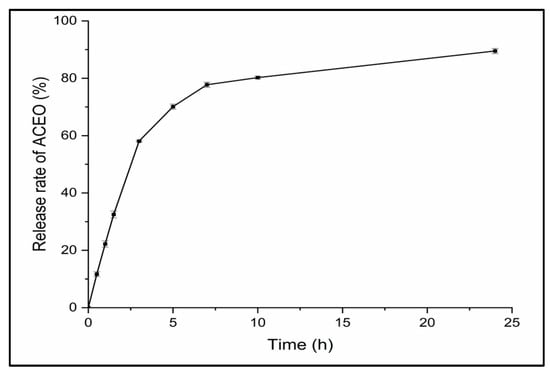
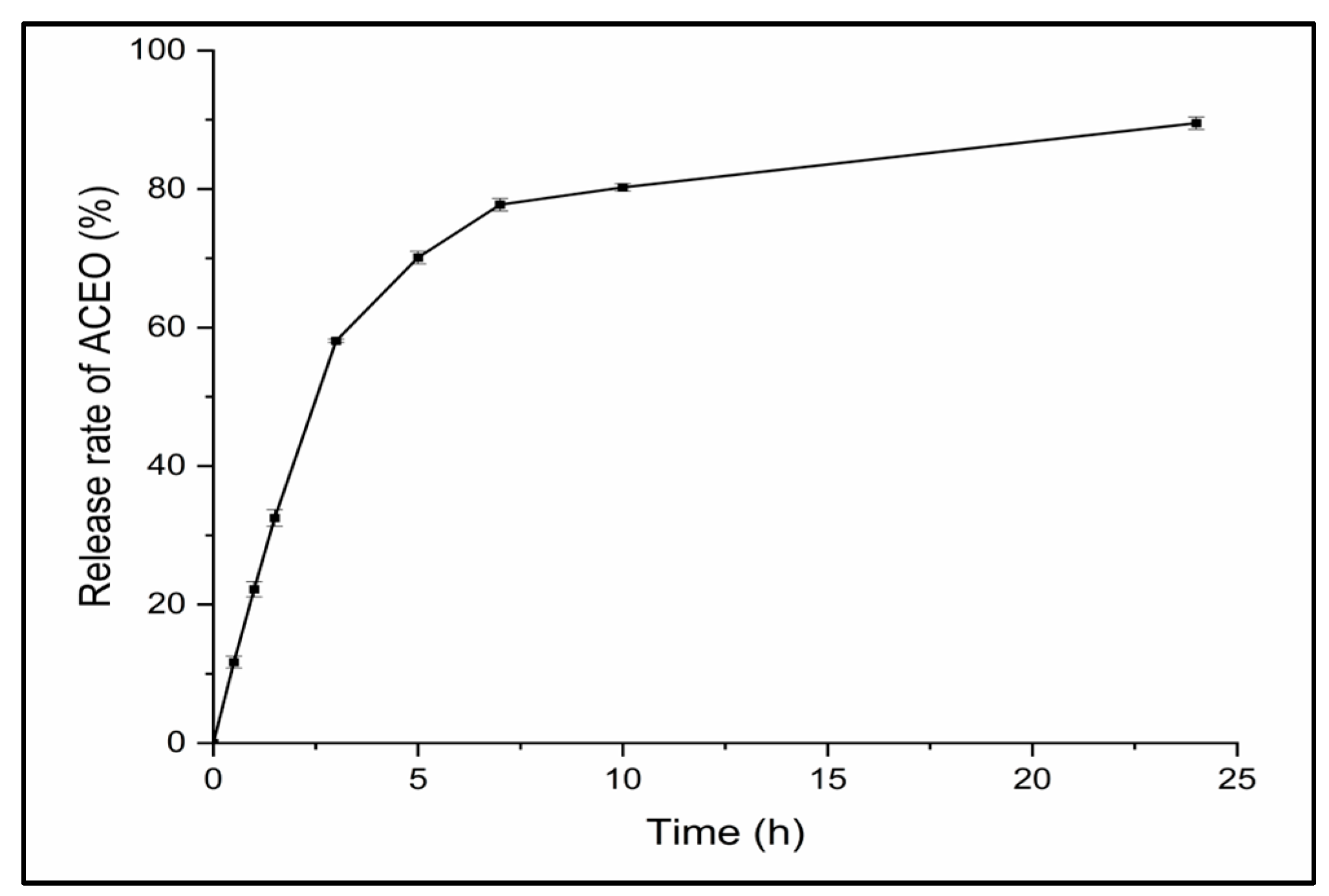
The release of encapsulated ACEO in a phosphate-buffered solution (pH 7.4) at 37 °C is illustrated in Figure 2. The release profile obtained contained two phases: an initial rapid phase with a release rate of 56.45% during the first 3 h, which can be explained by the rapid diffusion of the EO fraction adsorbed on the surface of the inclusion complex. A second release phase, which is slower and more gradual, with a cumulative release rate reaching 89% after 24 h, is attributed to the diffusion of the oily fraction trapped within the β-CD cavity.
Figure 2.
Release profile of essential oil.
3.3.4. Fourier Transform Infrared Spectroscopy (FTIR)
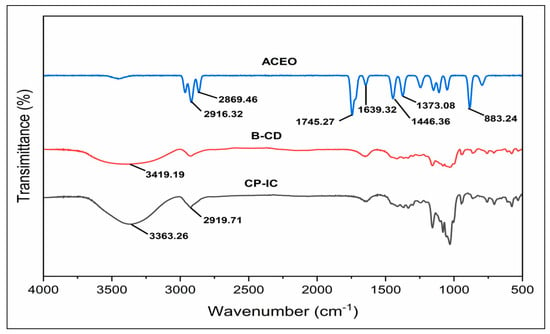
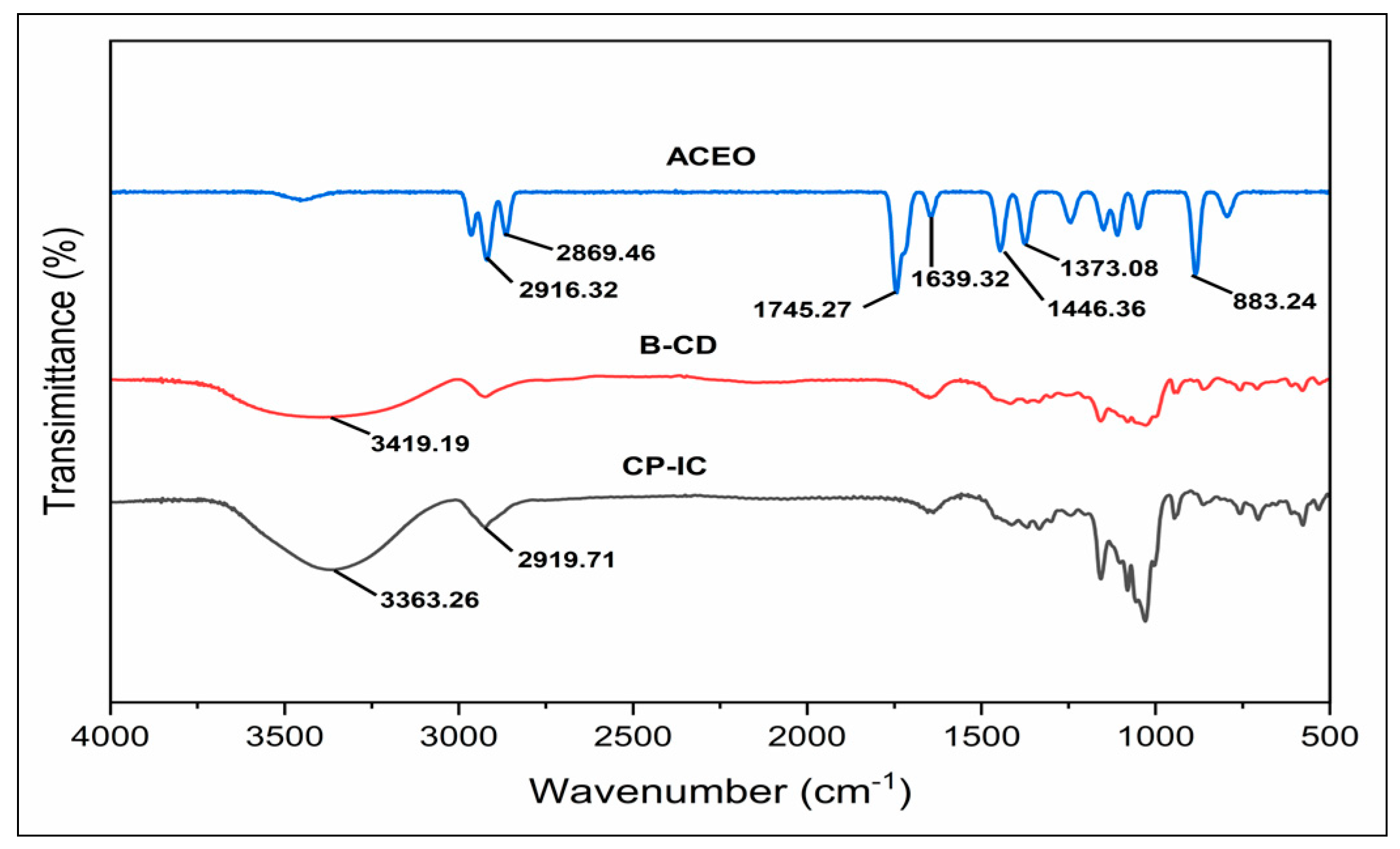
FTIR spectra of ACEO, β-CD, and inclusion complexes are shown in Figure 3.
Figure 3.
FTIR spectra.
A comparison of the FTIR spectra of the CP -βCD- AC essential oil inclusion complex and those of the EO and β-CD shows that the characteristic peaks of the EO are absent or altered in the inclusion complex. Among these, the peaks at 1745.27 and 1639.32 cm−1, which can be attributed to C=O stretching vibrations, and the peaks at 1373.08 cm−1 and 1446 cm−1 corresponding to CH2 bending and the stretching of the C−H bonds in the terminal methylene groups (=CH2). There is also a decrease in the intensity of the peaks between 2939 and 2869 cm−1. The detection of these changes in the vibrational spectrum of the complexed essential oil compared to that of the free essential oil confirms the interaction of the essential oil within the BCD cavity and supports the successful formation of the inclusion complex [19].
3.3.5. Antioxidant Properties of Essential Oil and Its Inclusion Complexes
The results of the antioxidant activity of free essential oil, inclusion complex, and ascorbic acid evaluated using the DPPH and ABTS methods are presented in Table 4.
Table 4.
DPPH and ABTS antioxidant activities.
For both the DPPH and ABTS assays, the free radical scavenging activity of the inclusion complex was higher than that of the free essential oil, with IC50 values of 0.98 mg/mL and 0.35 mg/mL, respectively. These results confirm that complexation with β-CD enhanced the antioxidant activity of the essential oil. This improvement in antioxidant activity may be due to the increased solubility and reduced evaporation of the essential oil and its compounds following encapsulation.
4. Conclusions
This study demonstrates that the essential oil was successfully encapsulated in β-CD using the co-precipitation method, with a yield of 71.67% and a complexation efficiency of 85.45%. The formation of inclusion complexes is confirmed by FTIR analysis. The release profile of the essential oil from the inclusion complex suggests sustained release behavior. Moreover, encapsulation enhanced EO antioxidant activity. Therefore, this approach provides the potential for essential oil applications in the cosmetic and food industries. Further studies are needed to optimize the formulation and evaluate its stability and biological efficacy.
Author Contributions
Conceptualization, F.K.; methodology, F.K. and R.H.; software, F.K.; validation, F.K. and S.A.; formal analysis, F.K., S.A., A.K. and R.H.; investigation, F.K.; resources, A.K.; data curation, F.K.; writing—original draft preparation, F.K.; writing—review and editing, F.K. and S.A.; visualization, F.K.; supervision, F.K. All authors have read and agreed to the published version of the manuscript.
Funding
This research received no external funding.
Institutional Review Board Statement
Not applicable.
Informed Consent Statement
Not applicable.
Data Availability Statement
The dataset used and/or analyzed during the current study is available from the corresponding author.
Conflicts of Interest
The authors declare no conflicts of interest.
References
- Miyoshi, J.H.; da Silva Crozatti, T.T.; de Brito, J.R.; dos Santos, H.; Castro, J.C.; Sato, F.; da Silva, L.H.; Mulati, A.C.N.; de Moura Costa, G.F. Complexation of essential oils with beta-cyclodextrin: Characterization of complexes, determination of antimicrobial, antioxidant activities and application. LWT 2024, 214, 117143. [Google Scholar] [CrossRef] [Scilit]
- Rodrigues, L.B.; Martins, A.O.B.P.B.; Ribeiro-Filho, J.; Cesário, F.R.A.S.; e Castro, F.F.; de Albuquerque, T.R.; Fernandes, M.N.M.; da Silva, B.A.F.; Júnior, L.J.Q.; de Sousa Araújo, A.A. Anti-inflammatory activity of the essential oil obtained from Ocimum basilicum complexed with β-cyclodextrin (β-CD) in mice. Food Chem. Toxicol. 2017, 109, 836–846. [Google Scholar] [CrossRef] [Scilit] [PubMed]
- Anaya-Castro, M.A.; Ayala-Zavala, J.F.; Muñoz-Castellanos, L.; Hernández-Ochoa, L.; Peydecastaing, J.; Durrieu, V. β-Cyclodextrin inclusion complexes containing clove (Eugenia caryophyllata) and Mexican oregano (Lippia berlandieri) essential oils: Preparation, physicochemical and antimicrobial characterization. Food Packag. Shelf Life 2017, 14, 96–101. [Google Scholar] [CrossRef] [Scilit]
- Cevallos, P.A.P.; Buera, M.P.; Elizalde, B.E. Encapsulation of cinnamon and thyme essential oils components (cinnamaldehyde and thymol) in β-cyclodextrin: Effect of interactions with water on complex stability. J. Food Eng. 2010, 99, 70–75. [Google Scholar] [CrossRef] [Scilit]
- Jug, M.; Radić, K.; Nižić Nodilo, L.; Galić, E.; Petković, T.; Jurić, M.; Golub, N.; Jerić, I.; Vitali Čepo, D. Exploring cyclodextrin complexes of lipophilic antioxidants: Benefits and challenges in nutraceutical development. Int. J. Mol. Sci. 2025, 26, 11682. [Google Scholar] [CrossRef] [Scilit] [PubMed]
- Andrade, T.A.; Freitas, T.S.; Araújo, F.O.; Menezes, P.P.; Dória, G.A.A.; Rabelo, A.S.; Quintans-Júnior, L.J.; Santos, M.R.; Bezerra, D.P.; Serafini, M.R. Physico-chemical characterization and antibacterial activity of inclusion complexes of Hyptis martiusii Benth essential oil in β-cyclodextrin. Biomed. Pharmacother. 2017, 89, 201–207. [Google Scholar] [CrossRef] [Scilit] [PubMed]
- Yuan, C.; Wang, Y.; Liu, Y.; Cui, B. Physicochemical characterization and antibacterial activity assessment of lavender essential oil encapsulated in hydroxypropyl-beta-cyclodextrin. Ind. Crops Prod. 2019, 130, 104–110. [Google Scholar] [CrossRef] [Scilit]
- Fitsiou, E.; Mitropoulou, G.; Spyridopoulou, K.; Vamvakias, M.; Bardouki, H.; Galanis, A.; Chlichlia, K.; Kourkoutas, Y.; Panayiotidis, M.Ι.; Pappa, A. Chemical composition and evaluation of the biological properties of the essential oil of the dietary phytochemical Lippia citriodora. Molecules 2018, 23, 123. [Google Scholar] [CrossRef] [Scilit] [PubMed]
- Galvão, J.; Silva, V.; Ferreira, S.; França, F.; Santos, D.; Freitas, L.; Alves, P.; Araújo, A.; Cavalcanti, S.; Nunes, R. β-cyclodextrin inclusion complexes containing Citrus sinensis (L.) Osbeck essential oil: An alternative to control Aedes aegypti larvae. Thermochim. Acta 2015, 608, 14–19. [Google Scholar] [CrossRef] [Scilit]
- Torres-Alvarez, C.; Castillo, S.; Sánchez-García, E.; Aguilera González, C.; Galindo-Rodríguez, S.A.; Gabaldón-Hernández, J.A.; Báez-González, J.G. Inclusion complexes of concentrated orange oils and β-cyclodextrin: Physicochemical and biological characterizations. Molecules 2020, 25, 5109. [Google Scholar] [CrossRef] [Scilit] [PubMed]
- Gomes, C.; Moreira, R.G.; Castell-Perez, E. Microencapsulated antimicrobial compounds as a means to enhance electron beam irradiation treatment for inactivation of pathogens on fresh spinach leaves. J. Food Sci. 2011, 76, E479–E488. [Google Scholar] [CrossRef] [Scilit] [PubMed]
- Kavetsou, E.; Pitterou, I.; Katopodi, A.; Petridou, G.; Adjali, A.; Grigorakis, S.; Detsi, A. Preparation, characterization, and acetylcholinesterase inhibitory ability of the inclusion complex of β-cyclodextrin–cedar (Juniperus phoenicea) essential oil. Micro 2021, 1, 250–266. [Google Scholar] [CrossRef] [Scilit]
- Molyneux, P. The use of the stable free radical diphenylpicrylhydrazyl (DPPH) for estimating antioxidant activity. Songklanakarin J. Sci. Technol. 2004, 26, 211–219. [Google Scholar]
- Magri, A.; Ramos, M.; Mellinas, C.; Jiménez, A.; Garrigós, M.C. Encapsulation of lemongrass essential oil in cyclodextrins and maltodextrin: Antioxidant, antimicrobial and release studies. Carbohydr. Polym. Technol. Appl. 2025, 10, 100749. [Google Scholar] [CrossRef] [Scilit]
- Djadouni, F. Characterization and evaluation of antimicrobial activity of Algerian Aloysia triphylla essential oil against clinical female genital pathogens. Rev. Agric. 2020, 11, 58–67. [Google Scholar]
- Oliva, M.d.l.M.; Beltramino, E.; Gallucci, N.; Casero, C.; Zygadlo, J.; Demo, M. Antimicrobial activity of essential oils of Aloysia triphylla (LHer.) Britton from different regions of Argentina. Boletín Latinoam. y del Caribe de Plantas Med. y Aromáticas 2010, 9, 29–37. [Google Scholar]
- Recio-Cázares, S.L.; Comett-Figueroa, P.I.; Navarro-Amador, R.; López-Malo, A.; Palou, E. β-Cyclodextrin inclusion complex with essential oil from lippia (Aloysia citriodora): Preparation, physicochemical characterization, and its application on beef. ACS Food Sci. Technol. 2024, 4, 3076–3087. [Google Scholar] [CrossRef] [Scilit]
- Kaddour, F.; Abbad, S.; Braham, T.E.C.; Smahi, H.; Keniche, A.; Hassaine, R. Encapsulation of Eucalyptus radiata Essential Oil in β-Cyclodextrin (β-CD): Formulation and Characterization of the Inclusion Complexes. ChemistrySelect 2026, 11, e74444. [Google Scholar] [CrossRef] [Scilit]
- Kringel, D.H.; Antunes, M.D.; Klein, B.; Crizel, R.L.; Wagner, R.; de Oliveira, R.P.; Dias, A.R.G.; Zavareze, E.d.R. Production, characterization, and stability of orange or eucalyptus essential oil/β-cyclodextrin inclusion complex. J. Food Sci. 2017, 82, 2598–2605. [Google Scholar] [CrossRef] [Scilit] [PubMed]

Disclaimer/Publisher’s Note: The statements, opinions and data contained in all publications are solely those of the individual author(s) and contributor(s) and not of MDPI and/or the editor(s). MDPI and/or the editor(s) disclaim responsibility for any injury to people or property resulting from any ideas, methods, instructions or products referred to in the content. |
© 2026 by the authors. Licensee MDPI, Basel, Switzerland. This article is an open access article distributed under the terms and conditions of the Creative Commons Attribution (CC BY) license.