


Abstract
Glucose-derived chiral auxiliaries were investigated as stereodivergent platforms for the preparation and transfer of a chiral CF3SO fragment toward fluorinated sulforaphane (SFN) isosteres. DAG-derived trifluoromethanesulfinates showed a base-dependent reversal of stereochemical preference but limited chromatographic stability. The more robust DCG auxiliary enabled the isolation of both diastereomeric trifluoromethanesulfinates. Reactivity proved strongly nucleophile-dependent: Grignard reagents promoted double substitution at sulfur, whereas 3-azidopropoxide afforded enantioenriched 3-azidopropyl trifluoromethanesulfinates in 30–35% yield and 65–70% ee. Conversion of the azide into an isothiocyanate provided a CF3-containing sulfinate isostere of SFN. These results establish glucose-derived trifluoromethanesulfinates as modular stereodivergent intermediates for fluorinated SFN analogues.
1. Introduction
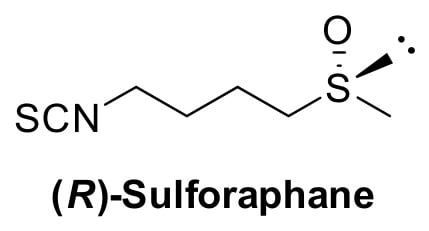
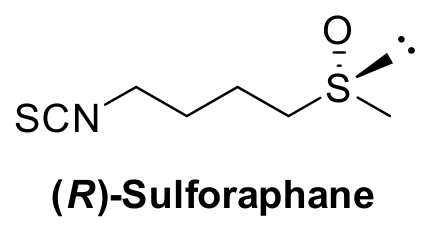
Sulforaphane (SFN), (R)-1-isothiocyanato-4-(methylsulfinyl)butane (Figure 1), was first isolated from Lepidium draba and later identified as a major bioactive constituent of broccoli [1,2,3]. Because the SFN scaffold combines an isothiocyanate group with a stereogenic sulfinyl centre, sulfur stereochemistry is relevant to the design of new analogues [4,5,6].
Figure 1.
Structures of naturally occurring (R)-sulforaphane.
Our group previously developed a carbohydrate-based approach to chiral sulfoxides through diacetone-D-glucose (DAG)-derived sulfinates [7]. Introducing a trifluoromethyl group at the sulfinyl sulfur of SFN is attractive because fluorination can markedly alter molecular properties, but CF3 also substantially changes sulfur reactivity [8,9,10,11].
A glucose-derived trifluoromethanesulfinate can in principle serve as a common precursor to two classes of fluorinated SFN isosteres. Carbon nucleophiles would provide CF3-containing sulfoxides, whereas oxygen nucleophiles would retain the S–O bond to give trifluoromethanesulfinate esters. Variation of the nucleophile can further modulate chain length and functionalization, enabling access to SFN homologues and more highly functionalized analogues [12,13].
The present study therefore examines the stereodivergent formation of DAG- and DCG-derived trifluoromethanesulfinates and evaluates their reactivity toward carbon- and oxygen-based nucleophiles as complementary routes to fluorinated SFN isosteres.
2. Methods
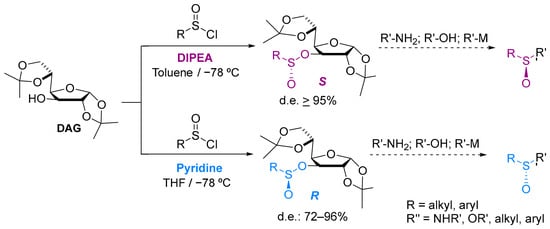
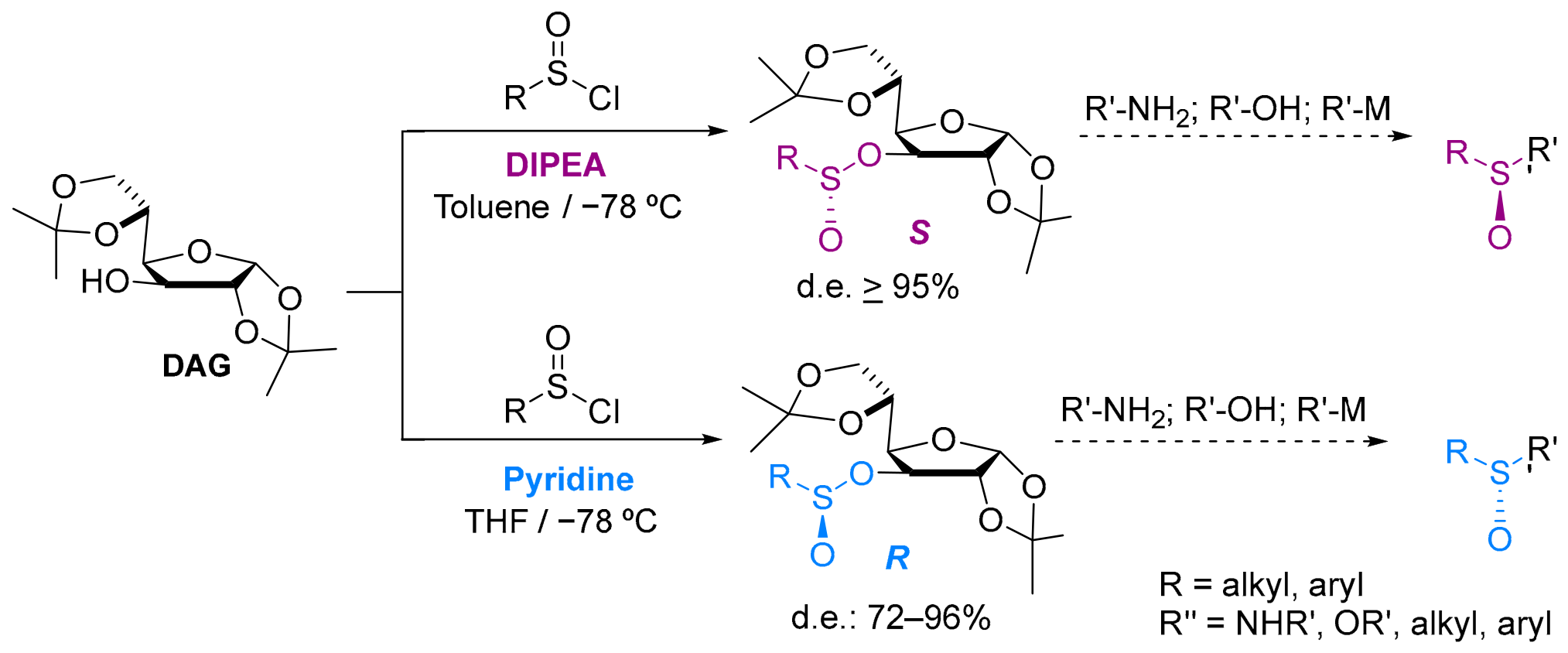
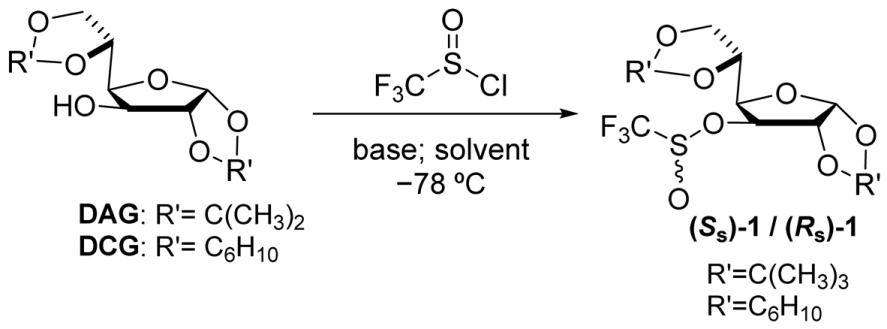
The synthetic strategy was based on the previously developed DAG methodology (Scheme 1) [7]. Reaction of a glucose-derived alcohol with trifluoromethanesulfinyl chloride generates diastereomeric sulfinates that differ in the configuration of the newly formed sulfur stereocentre; the base determines the preferred configuration. In the CF3-substituted system, the same chiral sulfinate can in principle lead either to a CF3-sulfoxide or to a trifluoromethanesulfinate ester, depending on the nucleophile employed.
Scheme 1.
General glucose-derived sulfinate strategy applied to stereodivergent CF3-sulfinyl transfer.
DAG was first used to evaluate base/solvent effects on stereochemical induction. Because the resulting DAG-derived trifluoromethanesulfinates were unstable on silica gel, the more robust dicyclohexylidene-D-glucose (DCG) auxiliary was subsequently used to isolate both diastereomeric reagents. The complete screening of conditions is given in Table S1. Full experimental details and characterization data are provided in the Supplementary Materials.
Isolated DCG-derived sulfinates were then reacted with Grignard reagents or with 3-azidopropoxide. The azide products serve as direct precursors to sulforaphane analogues and can be converted into the corresponding isothiocyanates via a Staudinger/aza-Wittig-type sequence using triphenylphosphine and carbon disulfide (Scheme 2) [14].
Scheme 2.
Synthesis of isothiocyanates via a Staudinger/aza-Wittig-type sequence using triphenylphosphine and carbon disulfide.
3. Results and Discussion
3.1. Stereodivergent Formation of Glucose-Derived Trifluoromethanesulfinates
For DAG, DIPEA in THF afforded the best selectivity toward the (Ss) sulfinate (87:13, 74% d.e.), whereas collidine in THF reversed the preference and favoured the (Rs) diastereomer (21:79, 58% d.e.). Thus, changing the base enabled stereodivergent access to opposite configurations at sulfur from the same carbohydrate source. However, the DAG-derived products proved too unstable for reliable chromatographic isolation.
Switching to DCG preserved the stereochemical trend while improving robustness. DIPEA/THF gave an 82:18 ratio favouring (Ss) sulfinate, whereas collidine/THF afforded a 19:81 ratio favouring (Rs) sulfinate. Unlike the DAG analogues, both DCG-derived sulfinates were isolated chromatographically in useful yields, making them practical CF3-sulfinyl transfer reagents (Table 1).
Table 1.
Optimal conditions for the stereodivergent synthesis of DAG- and DCG-derived trifluoromethanesulfinates from CF3SOCl.
Only the best-performing conditions are shown; the complete screening is provided in Table S1 of the Supplementary Materials.
The principal advantage of DCG over DAG was therefore not a higher intrinsic diastereoselectivity, but the ability to isolate and use both stereochemical series.
3.2. Reactivity Toward Carbon Nucleophiles
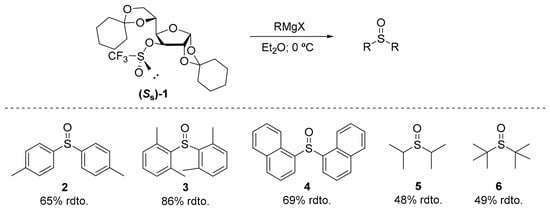
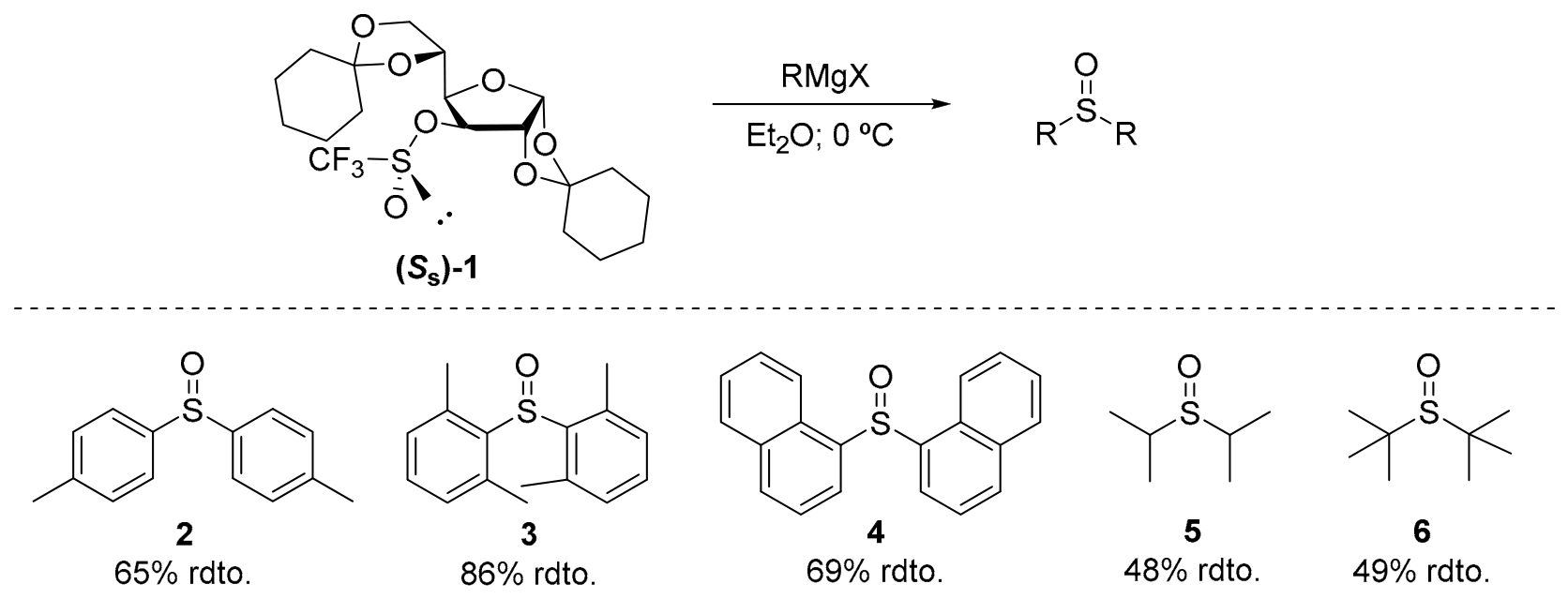
Treatment of (Ss) sulfinate with aromatic and aliphatic Grignard reagents did not predominantly afford the expected CF3-containing sulfoxides. Instead, symmetrical sulfoxides 2–6 were obtained, consistent with sequential nucleophilic substitution at sulfur. Representative products were isolated in 48–86% yield (Scheme 3).
Scheme 3.
Reaction of DCG-derived (Ss) trifluoromethanesulfinate with Grignard reagents. Under the conditions explored, double substitution at sulfur afforded symmetrical sulfoxides 2–6 rather than the expected CF3-containing sulfoxides.
Under the conditions explored to date, strongly nucleophilic carbon reagents favoured double substitution at sulfur rather than formation of the desired CF3-sulfoxide. Further optimization will therefore be required to achieve selective mono-substitution.
3.3. Productive CF3-Sulfinyl Transfer to Alkoxides
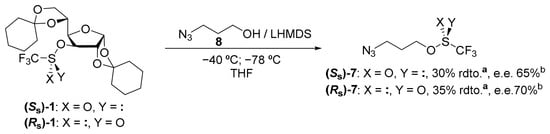
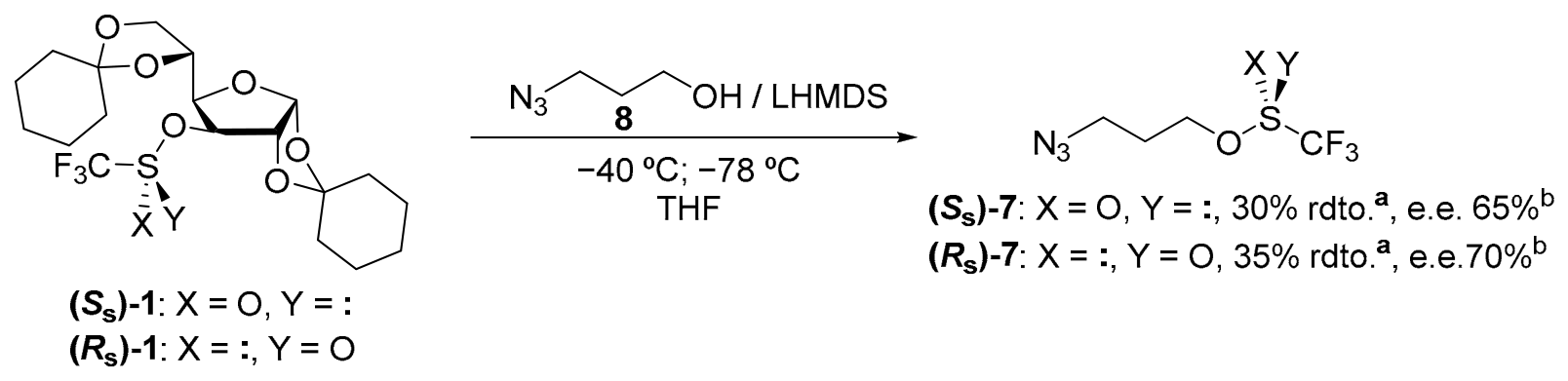
In contrast, 3-azidopropoxide underwent productive substitution at sulfur with retention of the CF3SO framework. Reaction with (Ss)-1 afforded (Ss)-7 in 30% yield and 65% e.e., whereas reaction with (Rs)-1 gave (Rs)-7 in 35% yield and 70% e.e. The moderate enantioselectivities are consistent with partial racemization at sulfur during substitution (Scheme 4).
Scheme 4.
Stereoselective transfer of the CF3SO group from DCG-derived trifluoromethanesulfinates to 3-azidopropoxide, affording scalemic trifluoromethanesulfinates (Ss)-7 and (Rs)-7. a Isolated product yield obtained by column chromatography; b e.e. determined by HPLC using an AD-H chiral column with hexane:isopropanol 99:1 as the mobile phase, at a flow rate of 0.5 mL/min.
4. Conclusions
Glucose-derived trifluoromethanesulfinates constitute stereodivergent intermediates for the preparation of fluorinated SFN isosteres. Base selection in the DAG/DCG systems controls the configuration at sulfur, while DCG provides the robustness required to isolate both diastereomeric CF3-sulfinylating reagents.
Their reactivity is strongly nucleophile-dependent: carbon nucleophiles currently favour double substitution, whereas 3-azidopropoxide enables productive transfer of the CF3SO unit and subsequent access to a CF3-containing sulfinate isostere of SFN. Overall, the platform offers a modular entry to fluorinated SFN analogues through variation of sulfur connectivity, chain length and functionalization.
5. Experimental Section
5.1. General Information
Reactions were monitored by TLC and purified by flash chromatography on silica gel. NMR spectra were recorded on Bruker DRX-300 and DRX-500 spectrometers. Enantiomeric excesses were determined by chiral HPLC and optical rotations were measured using the sodium D line. Full characterization data are provided in the Supplementary Materials.
5.2. Representative Procedures
DCG-derived trifluoromethanesulfinates (Rs)-1 and (Ss)-1 were prepared from DCG and CF3SOCl in THF at −78 °C using either DIPEA or collidine, followed by acidic quench and chromatographic purification. Grignard reactions were carried out in Et2O under argon at 0 °C. 3-Azidopropyl trifluoromethanesulfinates (Rs)-7 and (Ss)-7 were obtained by reaction of the corresponding alkoxide, generated with LHMDS, with the corresponding sulfinate at low temperature.
Supplementary Materials
The following supporting information can be downloaded at: https://www.mdpi.com/article/10.3390/chemproc2026022104/s1, Table S1. Complete screening of base/solvent conditions used for the stereodivergent preparation of DAG- and DCG-derived trifluoromethanesulfinates.
Author Contributions
Conceptualization, I.F. and V.V.; methodology, I.F., V.V. and R.R.; validation, I.F., V.V. and R.R.; formal analysis, I.F., V.V., R.R., P.L. and T.L.; investigation, I.F., V.V., P.L., M.E.M., A.C. and T.L.; resources, I.F.; data curation, P.L. and T.L.; writing—original draft preparation, I.F. and V.V.; writing—review and editing, I.F., V.V. and R.R.; visualization, R.R. and V.V.; supervision, I.F. and V.V.; project administration, I.F.; funding acquisition, I.F. All authors have read and agreed to the published version of the manuscript.
Funding
This work was funded by Ministerio de Ciencia, Innovación y Universidades (grant number PID2019-104767RB-I00/AEI/10.13039/501100011033 and grant PID2022-138863OB-I00 financed by MCIN/AEI/10.13039/501100011033/FEDER, EU). The US (University of Seville) is also acknowledged for the support provided through its own research plan (VII PPIT-US). This work is part of grant DGP_PRED_2024_01383, funded by the Junta de Andalucía/CUII and by FSE+.
Institutional Review Board Statement
Not applicable.
Informed Consent Statement
Not applicable.
Data Availability Statement
Dataset available on request from the authors.
Acknowledgments
We gratefully thank the Centre of Research Technology and Innovation of the University of Seville (CITIUS) for NMR facilities.
Conflicts of Interest
The authors declare no conflicts of interest.
References
- Procházka, Ž. Isolation of Sulforaphane from Hoary Cress (Lepidium draba L.). Collect. Czech. Chem. Commun. 1959, 24, 2429–2430. [Google Scholar] [CrossRef] [Scilit]
- Prochaska, H.J.; Santamaria, A.B.; Talalay, P. Rapid Detection of Inducers of Enzymes That Protect against Carcinogens. Proc. Natl. Acad. Sci. USA 1992, 89, 2394–2398. [Google Scholar] [CrossRef] [Scilit] [PubMed]
- Zhang, Y.; Talalay, P.; Cho, C.G.; Posner, G.H. A Major Inducer of Anticarcinogenic Protective Enzymes from Broccoli: Isolation and Elucidation of Structure. Proc. Natl. Acad. Sci. USA 1992, 89, 2399–2403. [Google Scholar] [CrossRef] [Scilit] [PubMed]
- Kamal, M.M.; Akter, S.; Lin, C.N.; Nazzal, S. Sulforaphane as an Anticancer Molecule: Mechanisms of Action, Synergistic Effects, Enhancement of Drug Safety, and Delivery Systems. Arch. Pharm. Res. 2020, 43, 371–384. [Google Scholar] [CrossRef] [Scilit] [PubMed]
- Razis, A.F.A.; Iori, R.; Ioannides, C. The Natural Chemopreventive Phytochemical R-Sulforaphane Is a Far More Potent Inducer of the Carcinogen-Detoxifying Enzyme Systems in Rat Liver and Lung than the S-Isomer. Int. J. Cancer 2011, 128, 2775–2782. [Google Scholar] [CrossRef] [Scilit] [PubMed]
- Calcaterra, A.; D’Acquarica, I. The Market of Chiral Drugs: Chiral Switches versus de Novo Enantiomerically Pure Compounds. J. Pharm. Biomed. Anal. 2018, 147, 323–340. [Google Scholar] [CrossRef] [Scilit] [PubMed]
- Fernández, I.; Khiar, N.; Llera, J.M.; Alcudia, F. Asymmetric Synthesis of Alkane- and Arenesulfinates of Diacetone-D-Glucose (DAG): An Improved and General Route to Both Enantiomerically Pure Sulfoxides. J. Org. Chem. 1992, 57, 6789–6796. [Google Scholar] [CrossRef] [Scilit]
- Wojaczyńska, E.; Wojaczyński, J. Modern Stereoselective Synthesis of Chiral Sulfinyl Compounds. Chem. Rev. 2020, 120, 4578–4611. [Google Scholar] [CrossRef] [Scilit] [PubMed]
- Gillis, E.P.; Eastman, K.J.; Hill, M.D.; Donnelly, D.J.; Meanwell, N.A. Applications of Fluorine in Medicinal Chemistry. J. Med. Chem. 2015, 58, 8315–8359. [Google Scholar] [CrossRef] [Scilit] [PubMed]
- Purser, S.; Moore, P.R.; Swallow, S.; Gouverneur, V. Fluorine in Medicinal Chemistry. Chem. Soc. Rev. 2008, 37, 320–330. [Google Scholar] [CrossRef] [Scilit] [PubMed]
- Romanenko, V.D.; Thoumazet, C.; Lavallo, V.; Tham, F.S.; Bertrand, G. Synthesis and Reactivity of a Stable Crystalline Diastereomerically Pure Trifluoromethanesulfinic Acid Derivative: (S)-(−)-1-Trifluoromethylsulfinyl-(R)-4-Phenyloxazolidin-2-One. Chem. Commun. 2003, 39, 1680–1681. [Google Scholar] [CrossRef] [Scilit]
- Elhalem, E.; Recio, R.; Werner, S.; Lieder, F.; Calderón-Montaño, J.M.; López-Lázaro, M.; Fernández, I.; Khiar, N. Sulforaphane Homologues: Enantiodivergent Synthesis of Both Enantiomers, Activation of the Nrf2 Transcription Factor and Selective Cytotoxic Activity. Eur. J. Med. Chem. 2014, 87, 552–563. [Google Scholar] [CrossRef] [Scilit] [PubMed]
- Khiar, N.; Werner, S.; Mallouk, S.; Lieder, F.; Alcudia, A.; Fernández, I. Enantiopure Sulforaphane Analogues with Various Substituents at the Sulfinyl Sulfur: Asymmetric Synthesis and Biological Activities. J. Org. Chem. 2009, 74, 6002–6009. [Google Scholar] [CrossRef] [Scilit] [PubMed]
- Isoda, T.; Hayashi, K.; Tamai, S.; Kumagai, T.; Nagao, Y. Efficient Synthesis of Isothiocyanates Based on the Tandem Staudinger/Aza-Wittig Reactions and Mechanistic Consideration of the Tandem Reactions. Chem. Pharm. Bull. 2006, 54, 1616–1619. [Google Scholar] [CrossRef] [Scilit] [PubMed][Green Version]



Disclaimer/Publisher’s Note: The statements, opinions and data contained in all publications are solely those of the individual author(s) and contributor(s) and not of MDPI and/or the editor(s). MDPI and/or the editor(s) disclaim responsibility for any injury to people or property resulting from any ideas, methods, instructions or products referred to in the content. |
© 2026 by the authors. Licensee MDPI, Basel, Switzerland. This article is an open access article distributed under the terms and conditions of the Creative Commons Attribution (CC BY) license.