


Abstract
Background: Diabetic neuropathy (DN) is a common complication of diabetes mellitus that remains frequently undetected by conventional diagnostic methods. Sudomotor dysfunction, reflecting small-fiber impairment, has emerged as a potential early marker. SUDOSCAN, a rapid and non-invasive device measuring electrochemical skin conductance (ESC), has been proposed as a screening tool for early DN. The objective of this study was to systematically evaluate the diagnostic performance and clinical utility of SUDOSCAN in the early detection of DN. Methods: A systematic review was conducted in accordance with the PRISMA 2020 guidelines. Studies assessing SUDOSCAN-derived ESC in adults with diabetes were included. Data on diagnostic accuracy, correlations with established neuropathy measures, and clinical applicability were extracted. Where feasible, pooled sensitivity and specificity were estimated using a random-effects model. Results: Fifteen studies (n = 7343 participants) were included in the qualitative synthesis, with five of them contributing to the quantitative analysis. Reduced ESC values were consistently associated with DN, including early and asymptomatic cases. Pooled sensitivity and specificity for detecting DN were 0.81 (95% CI 0.73–0.87) and 0.73 (95% CI 0.57–0.85), respectively. ESC values correlated with neuropathy severity scores and autonomic dysfunction measures. However, substantial heterogeneity was observed due to variability in diagnostic criteria, ESC thresholds, and study populations. Conclusions: SUDOSCAN is a feasible, rapid, and non-invasive tool for detecting DN, particularly in the early-stage or small-fiber disease. It shows promise as a screening and adjunctive diagnostic modality, especially when combined with established clinical tools. Nevertheless, the lack of standardized thresholds limits its standalone use.
1. Introduction
Diabetes mellitus (DM) represents a major health issue all over the world, as it affects more than 850 million people, and has a prevalence that is expected to rise substantially over the next decades [1]. Among its chronic complications, diabetic neuropathy represents one of the most common and debilitating, affecting up to 50% of individuals with a long evolution of the disease. Distal symmetric polyneuropathy, the most prevalent form, is characterized by numbness, tingling, burning pain, progressive sensory loss, and, sometimes, motor dysfunction, and is a major contributor to foot ulceration, amputation, and reduced quality of life. Furthermore, neuropathic changes begin early in the course of the disease, long before clinical symptoms are obvious, underscoring the need for timely and sensitive diagnostic approaches [2].
Early diabetic neuropathy frequently involves small unmyelinated C fibers and myelinated Aδ fibers, which mediate thermal perception and autonomic functions, including sudomotor activity [3]. Small-fiber dysfunction may occur before abnormalities are detectable by conventional nerve conduction studies (NCS), which primarily assess large myelinated fibers [4]. Consequently, reliance solely on NCS may delay diagnosis and intervention. Alternative methods for detecting small-fiber neuropathy, such as intraepidermal nerve fiber density assessed via skin biopsy, quantitative sensory testing, and corneal confocal microscopy (CCM), offer greater sensitivity but are limited by invasiveness, cost, technical expertise requirements, and limited availability in routine clinical settings [5]. These constraints highlight a significant unmet need for rapid, non-invasive, and reliable tools able to identify early neuropathic changes.
Sudomotor dysfunction has emerged as a promising surrogate marker of early small-fiber impairment. Sweat glands are innervated by postganglionic sympathetic C fibers, and abnormalities in sweat production may reflect early small-fiber damage [6]. SUDOSCAN is a non-invasive device designed to assess sudomotor function by measuring electrochemical skin conductance (ESC) of the hands and feet [7].
Over the past decade, several studies have evaluated the performance of SUDOSCAN in patients with type 1 and type 2 DM. Reduced ESC values have been associated with clinically diagnosed diabetic peripheral neuropathy (DPN), abnormal neuropathy scores, impaired vibration perception thresholds, and abnormalities in autonomic function testing. Furthermore, some investigations suggest that SUDOSCAN may detect neuropathic changes even in asymptomatic individuals or in early-stage disease, supporting its potential role as a screening tool. However, reported diagnostic accuracy varies across studies, and heterogeneity in study design, reference standards, and ESC cut-off thresholds complicates interpretation of the existing data [8].
Given the growing interest in SUDOSCAN as a practical and accessible diagnostic modality, a comprehensive synthesis of available data is warranted. This systematic review aims to evaluate the utility of SUDOSCAN in the early diagnosis of diabetic neuropathy, focusing on its diagnostic performance, correlation with established neuropathy measures, and potential role in clinical practice. By critically appraising current evidence, we seek to clarify whether SUDOSCAN can serve as a reliable screening or adjunctive tool for early detection of diabetic neuropathy.
2. Materials and Methods
2.1. Study Design and Reporting Standards
This systematic review was conducted in accordance with the PRISMA 2020 (Preferred Reporting Items for Systematic Reviews and Meta-Analyses) guidelines to ensure methodological transparency and reproducibility [9]. The review was registered in the Open Science Framework (OSF) under registration number 9js4r.
2.2. Eligibility Criteria
Studies were eligible for inclusion if they evaluated sudomotor function using ESC measured by SUDOSCAN in adult populations with DM, at risk of diabetic neuropathy. Some of the eligible studies reported diagnostic performance for DPN, including sensitivity, specificity, or sufficient data to construct 2 × 2 contingency tables.
Reference standards for DPN diagnosis included clinical examination scores (e.g., neuropathy disability score), NCS, or validated composite diagnostic criteria. Given variability in diagnostic criteria across studies, multiple definitions of DPN were accepted, which was anticipated to contribute to between-study heterogeneity.
Studies focusing exclusively on non-diabetic neuropathy, case reports, reviews, and non-human studies were excluded.
2.3. Information Sources and Search Strategy
A systematic electronic literature search was performed in PubMed/MEDLINE, Embase, and Scopus from database inception to 20 January 2026. The search strategy combined terms related to diabetic neuropathy and sudomotor dysfunction, namely (“SUDOSCAN”[Title/Abstract] OR “electrochemical skin conductance”[Title/Abstract]) AND (“diabetic neuropathy”[Title/Abstract] OR “diabetic peripheral neuropathy”[Title/Abstract]). Conference abstracts, dissertations, and unpublished studies were not systematically searched. Studies published in languages other than English and French were excluded because translation resources were not available.
2.4. Study Selection
Two reviewers independently screened titles and abstracts, followed by full-text assessment of potentially eligible studies. Disagreements were resolved through discussion and consensus. The study selection process was summarized in a PRISMA flow diagram [9].
2.5. Data Extraction
Data were independently extracted by two reviewers using a standardized form. Extracted variables included study characteristics (author, year, country), population characteristics (sample size, DM type, disease duration), SUDOSCAN parameters (foot or hand ESC values and thresholds), reference standards for neuropathy diagnosis, and reported diagnostic performance metrics.
Where available, data were extracted to reconstruct 2 × 2 contingency tables (true positives, false positives, true negatives, false negatives) to enable quantitative synthesis.
2.6. Definition of Early Diabetic Neuropathy
Early diabetic neuropathy was defined as neuropathy detected in asymptomatic or minimally symptomatic individuals, typically involving small-fiber dysfunction, with or without abnormalities on NCS.
2.7. Index Test Description
SUDOSCAN is a non-invasive device that assesses sudomotor function by measuring ESC through reverse iontophoresis and chronoamperometry. The device applies a low direct current to stainless steel electrodes on which the patient places the palms and soles. Chloride ions in sweat react with the electrodes, generating a current proportional to sweat gland function. Reduced ESC values are interpreted as indicative of impaired small-fiber function and autonomic dysfunction [8]. ESC is expressed in microsiemens (µS), with lower values reflecting impaired sudomotor function. Previous normative studies have established reference ranges stratified by age and ethnicity. In many studies, feet ESC values below approximately 60–70 µS were considered abnormal, although thresholds varied. The test is rapid (its usual duration is about 2–3 min), requires minimal patient preparation, and provides quantitative results with limited operator dependence [7].
2.8. Quality Assessment
The methodological quality and risk of bias of included studies were assessed using the QUADAS-2 (Quality Assessment of Diagnostic Accuracy Studies-2) tool [10]. This evaluates the risk of bias across four domains: patient selection, index test, reference standard, and flow and timing.
Assessments were performed independently by two reviewers, with disagreements resolved by consensus.
2.9. Data Synthesis and Statistical Analysis
A two-stage approach was used for data synthesis, consistent with recommendations for diagnostic test accuracy reviews [11,12].
First, a qualitative synthesis was conducted to summarize study characteristics, ESC thresholds, and reported diagnostic performance.
Second, where sufficient data were available, an exploratory quantitative synthesis was performed. Sensitivity and specificity estimates were pooled using a random-effects model to account for between-study variability. Due to heterogeneity in study populations, neuropathy definitions, and ESC thresholds, as well as incomplete reporting of 2 × 2 data in several studies, a full hierarchical bivariate meta-analysis was not feasible.
Heterogeneity was anticipated and interpreted in light of differences in clinical populations, diagnostic criteria, and study design.
Analyses and figures were generated using MedCalc Statistical Software (version 23.5).
2.10. Assessment of Evidence Certainty
The certainty of the evidence was evaluated using principles adapted from the GRADE approach for diagnostic tests [13], considering risk of bias, inconsistency, indirectness, imprecision, and publication bias.
3. Results
3.1. Study Selection
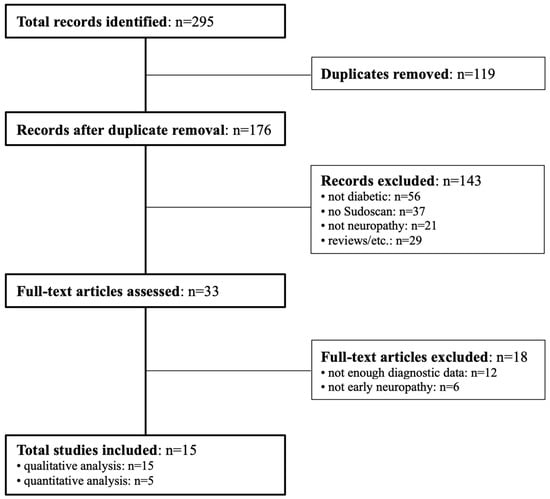
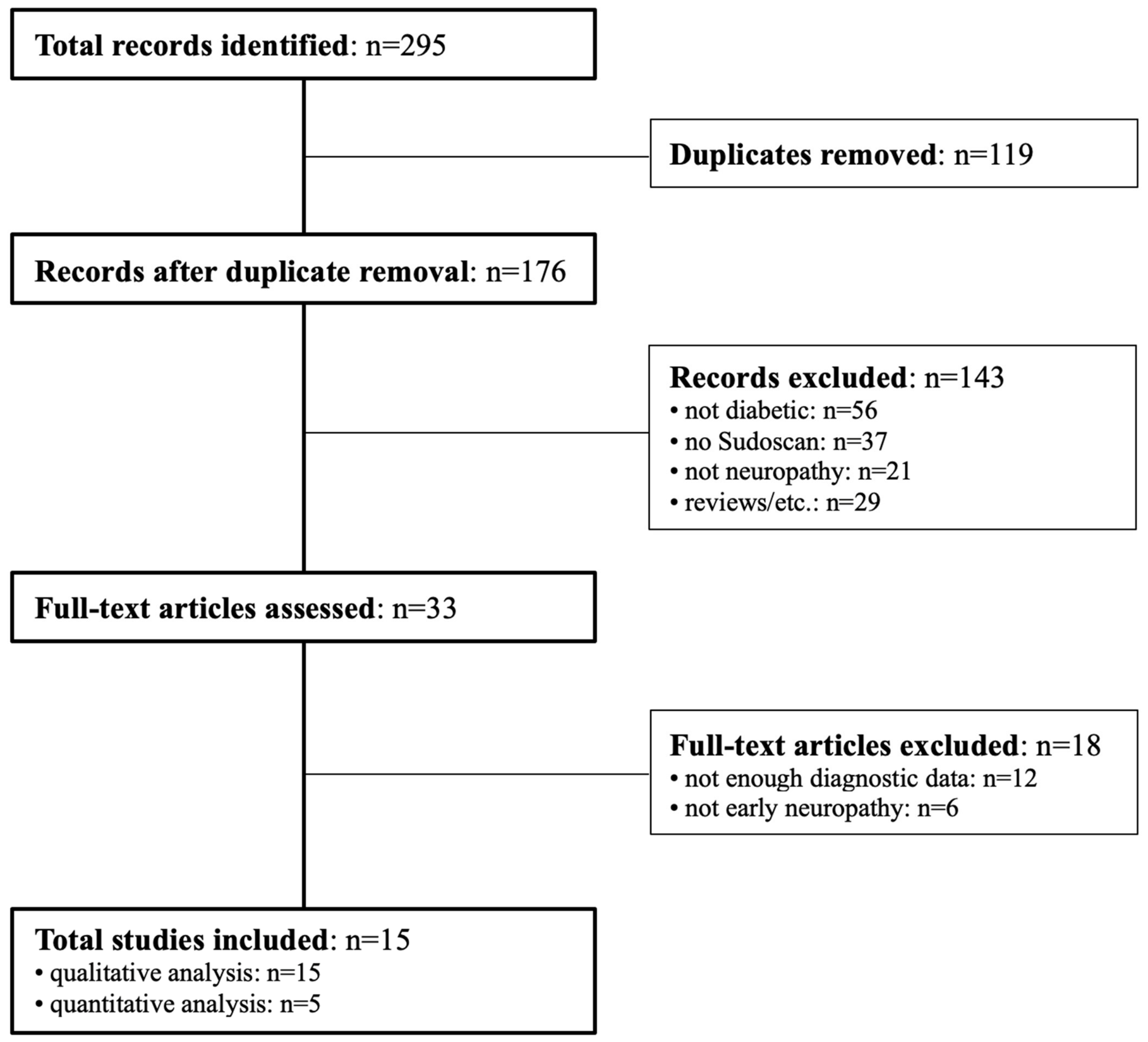
The database search identified a total of 295 records. After removal of 119 duplicates, 176 titles and abstracts were screened, of which 33 articles underwent full-text review. A total of 15 studies met the inclusion criteria and were included in the qualitative synthesis.
Of these, a subset of studies (n = 5) reported sufficient diagnostic accuracy data (sensitivity and specificity, or data enabling reconstruction of 2 × 2 contingency tables) and were included in the quantitative synthesis.
The study selection process is presented in the PRISMA flow diagram Figure 1.
Figure 1.
PRISMA flow diagram of the study selection.
3.2. Characteristics of the Studies Included
The included studies were published between 2013 and 2024 and comprised heterogeneous populations, including patients with type 1 and type 2 DM, with varying disease duration and neuropathy severity.
The sample sizes ranged from 45 to 2243 participants, comprising a total number of 7343 subjects. The studies used different reference standards for DPN, including clinical scoring systems, NCS, or composite diagnostic criteria.
SUDOSCAN-derived ESC, particularly foot ESC, was evaluated across studies using different diagnostic thresholds, most commonly ranging between 60 and 70 µS.
The main characteristics of the included studies are presented in Table 1.
Table 1.
Main characteristics of the studies evaluating SUDOSCAN in early diabetic neuropathy.
3.3. Risk of Bias and Quality Assessment
Risk of bias assessment using QUADAS-2 revealed variability across studies.
The most common concerns were related to patient selection, with several studies using case–control or enriched populations, index test interpretation, due to lack of prespecified ESC thresholds in some studies, and reference standards, which were not uniform across studies. Overall, applicability concerns were moderate, primarily reflecting differences in study populations and diagnostic definitions of DPN.
3.4. Qualitative Synthesis
Across the studies included in this review, SUDOSCAN-derived ESC showed a consistent association with the presence of diabetic neuropathy. Lower ESC values were generally observed in patients with clinically defined DPN compared with those without neuropathy.
Several studies reported moderate to high sensitivity for detecting neuropathy, particularly in early or small-fiber predominant disease. However, specificity varied substantially across studies, likely reflecting differences in diagnostic thresholds, study populations, and reference standards.
In addition to its use for diagnostic purposes, ESC values were frequently correlated with neuropathy severity scores and measures of autonomic dysfunction, supporting the biological plausibility of sudomotor testing as a marker of small-fiber impairment.
3.4.1. SUDOSCAN and Early (Subclinical/Asymptomatic) Diabetic Neuropathy
- Evidence that ESC declines early in the course of diabetes
Several studies supported the concept that sudomotor dysfunction may be detectable alongside, or even before, early clinical neuropathy manifestations. In one of the earlier clinical validations, SUDOSCAN measurements differentiated neuropathy and non-neuropathy groups and were positioned as a practical method for identifying small-fiber/autonomic involvement in DM [16]. Similarly, studies evaluating diabetic outpatients reported that ESC abnormalities could be identified in routine clinic settings, supporting the feasibility of early screening [15].
In a large cohort of recently diagnosed type 2 DM patients, sudomotor alterations measured by SUDOSCAN were present in a substantial proportion of participants, indicating that measurable dysfunction can occur early in the course of the disease; however, diagnostic sensitivity compared with the chosen clinical reference standard was variable [17]. These findings aligned with the broader small-fiber neuropathy literature describing early involvement of unmyelinated fibers in DM and the relative insensitivity of purely large-fiber tools for early disease detection [28].
- Screening performance in asymptomatic or minimally symptomatic populations
Studies explicitly targeting asymptomatic or early neuropathy have generally shown that SUDOSCAN can identify a subgroup with abnormal ESC who may have subclinical neuropathic involvement. In Chinese cohorts with type 2 DM, SUDOSCAN was described as effective for screening asymptomatic diabetic neuropathy, with ESC correlating with neuropathy measures used in those studies [22]. Additional work in Chinese populations also supported the relationship between ESC and vibration perception threshold, strengthening construct validity for peripheral nerve dysfunction even when overt neuropathic symptoms may be limited [19,27]. In community and clinic screening contexts, integrating SUDOSCAN into multi-complication screening pathways has been proposed as a “one-stop” approach to identify early neuropathy and the high-risk foot phenotype [14].
Nevertheless, results have not been uniformly strong across all settings. In newly diagnosed type 2 DM cohorts, performance characteristics depended heavily on the definition of neuropathy, the population risk profile, and the selected cut-offs, factors that introduce spectrum effects and may reduce sensitivity for very mild disease [17].
3.4.2. Diagnostic Accuracy for DPN and Relationship to Reference Standards
- Comparisons with clinical neuropathy tools
Several studies compared SUDOSCAN against clinical screening instruments. Combining SUDOSCAN with established bedside screening tools (e.g., the Michigan Neuropathy Screening Instrument) improved screening utility compared with either method alone in some cohorts, suggesting a complementary role for ESC alongside symptom/sign-based assessment [24]. This “combined screening” strategy is particularly relevant for early detection, where clinical signs may be subtle, and symptom reporting may be inconsistent.
- Comparisons with large-fiber testing
Where NCSs were used, correlations between ESC and NCS parameters tended to be modest, consistent with the conceptual model that ESC reflects small-fiber/autonomic sudomotor function, while NCS measures large-fiber conduction [16]. In a diagnostic utility study for DPN, SUDOSCAN demonstrated clinically useful discrimination, but findings varied by neuropathy severity and case-mix. This pattern is expected: SUDOSCAN may be most sensitive to early small-fiber dysfunction, whereas NCS becomes more abnormal with more advanced or mixed-fiber neuropathy [25].
- Comparisons with sudomotor/autonomic reference tests
Some studies evaluated SUDOSCAN in relation to autonomic scoring frameworks or cardiovascular autonomic neuropathy (CAN) screening. One of these studies demonstrated the feasibility of combining heart rate variability with ESC as a screening and severity evaluation approach for CAN, supporting a role for SUDOSCAN in broader autonomic phenotyping relevant to early neuropathy [20]. Additional studies examined ESC as a substitute for quantitative sudomotor axon reflex test-related components in autonomic scoring approaches, reporting correlations with autonomic symptom instruments and composite autonomic measures in type 2 DM [18]. Recent observational studies also explored associations between ESC-derived CAN scores and Ewing test results, highlighting ongoing attempts to position SUDOSCAN within autonomic screening pathways [23].
While these autonomic-focused studies are not all specific to early DPN, they reinforce the idea that sudomotor impairment is an early autonomic signal that may coexist with peripheral small-fiber dysfunction, and therefore may contribute to earlier identification of diabetic neuropathy phenotypes [18,20,23].
3.4.3. Factors Influencing ESC and Heterogeneity Across Studies
Across cohorts, ESC values were influenced by population characteristics (age, DM duration, metabolic control, comorbidities) and by methodological differences (cut-offs, limb measured, and reference standard choice) [7,16,17,22]. Some studies also investigated associations between ESC and microvascular complications (e.g., chronic kidney disease or retinopathy), which may confound or contextualize the interpretation of ESC as a neuropathy marker, particularly in early disease, where microvascular burden may already be evolving [21,26]. These findings suggest that ESC may capture a broader “microvascular-neuroautonomic” risk phenotype, which could be clinically helpful but also complicates single-purpose diagnostic interpretation.
3.4.4. Risk of Bias and Applicability
Risk of bias considerations were common across the included literature. Many studies used case–control designs or enriched clinic samples that may inflate diagnostic performance compared with general screening populations (patient selection bias) [10]. Index test conduct was typically standardized, but pre-specified cut-offs were not consistent across studies (threshold bias) [7,16]. Reference standards varied widely, and some were imperfect proxies for small-fiber neuropathy (reference standard bias), particularly when early neuropathy was the target condition. Timing between SUDOSCAN and reference tests was usually short or cross-sectional, but reporting was not uniform [10].
3.4.5. Summary of Findings
Collectively, the evidence indicates that SUDOSCAN-derived ESC is frequently reduced in DM patients with neuropathy and may detect sudomotor dysfunction compatible with early small-fiber involvement, in asymptomatic or early-stage cohorts [16,17,22,24]. Diagnostic accuracy is heterogeneous and appears dependent on neuropathy definition, disease stage, and population risk spectrum [17,25]. The most consistent signal is that SUDOSCAN provides a rapid, non-invasive quantification of sudomotor dysfunction that can complement existing screening tools and may be particularly relevant where early neuropathy is suspected but conventional large-fiber testing remains normal or limited in availability [16,24,25].
3.5. Quantitative Synthesis
A quantitative synthesis was feasible for a subset of 5 studies [8,14,19,22,25] reporting sufficient diagnostic accuracy data for foot ESC in the detection of DPN Table 2.
Table 2.
Diagnostic accuracy of SUDOSCAN.
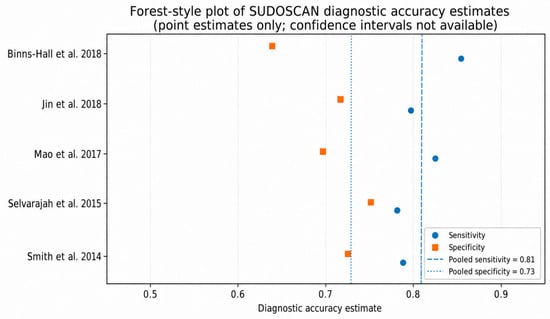
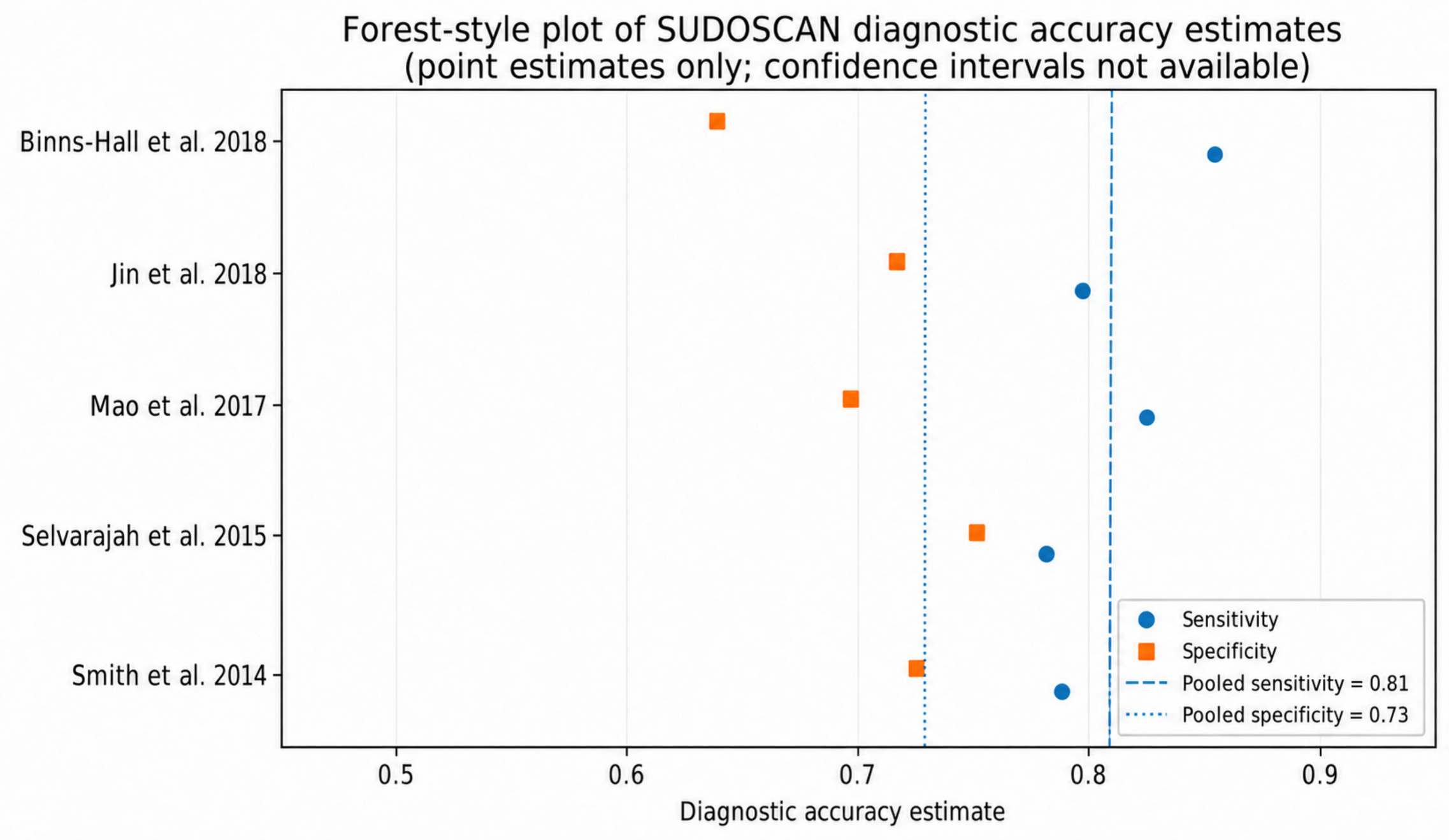
Reported sensitivity ranged from 0.78 to 0.85, while specificity ranged from 0.65 to 0.75. ESC thresholds varied from 60 to 77 µS, indicating clinically relevant threshold heterogeneity.
Using a random-effects model, the pooled sensitivity was 0.81 (95% CI 0.73–0.87) and the pooled specificity was 0.73 (95% CI 0.57–0.85). The corresponding positive likelihood ratio was approximately 3.0, the negative likelihood ratio approximately 0.26, and the diagnostic odds ratio approximately 11.6. These findings suggest that SUDOSCAN has moderate diagnostic accuracy and may be more useful as a screening or adjunctive test than as a standalone confirmatory diagnostic tool.
Formal heterogeneity statistics, including I2, could not be validly calculated from the currently available extracted data because study-level 2 × 2 contingency tables, standard errors, or confidence intervals were not consistently available. Therefore, heterogeneity was assessed qualitatively and through visual inspection of forest plots.
Variability was apparent in ESC thresholds, reference standards, and study populations, with specificity showing greater dispersion than sensitivity.
A Forest-style plot of SUDOSCAN diagnostic sensitivity and specificity was generated to improve interpretability Figure 2. This plot should be considered descriptive.
Figure 2.
Forest-style plot of sensitivity and specificity for the studies included in the quantitative synthesis (Point estimates are shown for each study. Confidence intervals are not displayed because the extracted dataset did not include 2 × 2 contingency data or standard errors) [8,14,19,22,25].
4. Discussion
Over recent years, SUDOSCAN has attracted increasing interest for the assessment of neuropathic changes. The available literature does not clearly document the technical evolution of the device; however, the core sensing principle appears to have remained largely unchanged, relying on low-voltage direct current, reverse iontophoresis, and chloride-dependent electrochemical conductance measured at the sweat glands [29].
Nevertheless, the design of studies using SUDOSCAN has evolved over time. Early clinical studies primarily focused on feasibility, reproducibility, correlations with skin biopsy findings or autonomic function tests, and the establishment of thresholds for neuropathy detection [15,16]. A major development was the publication of large normative datasets, along with the recognition that ESC values vary according to ethnicity, age, sex, body habitus, and other demographic factors [7].
Over time, the platform gained popularity among patients with DM and expanded beyond simple ESC measurement into a broader “risk analytics” tool that integrates ESC values with demographic variables such as age and body mass index to estimate metabolic risk. Consequently, later studies frequently reported outputs including CAN risk, nephropathy risk, or diabetes risk [18,20]. Furthermore, SUDOSCAN has also been evaluating individuals with prediabetes, with findings suggesting—rather than conclusively demonstrating—that it may detect sudomotor or small-fiber abnormalities and serve as a rapid screening or risk-stratification tool. However, the evidence in this population remains limited due to small sample sizes, cross-sectional study designs, and imperfect reference standards; therefore, SUDOSCAN should not be considered a stand-alone diagnostic test for prediabetic neuropathy [30].
This systematic review evaluated the utility of SUDOSCAN for the early diagnosis of diabetic neuropathy, with particular emphasis on small-fiber and autonomic involvement. Across the 15 included studies, SUDOSCAN-derived ESC consistently demonstrated lower values in patients with diabetic neuropathy compared with those without neuropathy, including asymptomatic or minimally symptomatic individuals. Overall, the evidence suggests that SUDOSCAN is a feasible, rapid, and non-invasive screening tool that may help identify early neuropathic changes, particularly those related to small-fiber and sudomotor dysfunction.
The most consistent finding across studies was the association between reduced ESC and diabetic neuropathy diagnosed using clinical scores, vibration perception thresholds, NCS, or autonomic testing [16,17,22,24,25]. Importantly, several studies specifically addressed early or asymptomatic neuropathy.
These findings align with the pathophysiological understanding that small unmyelinated C fibers are affected early in DM, often before large-fiber abnormalities become evident on NCS [28]. Because SUDOSCAN evaluates sweat gland function, mediated by postganglionic sympathetic C fibers, it may be particularly sensitive to early small-fiber impairment. This theoretical advantage is supported by studies showing modest correlations between ESC and NCS parameters, but stronger associations with clinical neuropathy scores and vibration perception thresholds [16,25].
Several studies also evaluated SUDOSCAN in combination with established screening tools. Oh et al. demonstrated that combining SUDOSCAN with the Michigan Neuropathy Screening Instrument improved screening accuracy compared with either of these methods alone [24]. This suggests that SUDOSCAN may not replace conventional tools, but could enhance diagnostic performance when integrated into multimodal screening strategies.
Early detection of diabetic neuropathy remains challenging. Traditional NCS primarily assesses large myelinated fibers and may not detect early small-fiber dysfunction. While intraepidermal nerve fiber density measurement via skin biopsy is considered a reference standard for small-fiber neuropathy, it is invasive and impractical for routine screening. Quantitative sensory testing provides functional assessment, but is time-consuming and requires specialized expertise [5].
In contrast, SUDOSCAN offers a rapid (2–3 min), operator-independent, and non-invasive assessment of sudomotor function [15,16]. The feasibility of incorporating SUDOSCAN into routine diabetes clinics was demonstrated by Calvet et al. and Binns-Hall et al., who reported successful implementation in outpatient screening pathways [14,15]. Such practical advantages are particularly relevant for large-scale screening in primary care or resource-limited settings.
However, diagnostic accuracy varied across studies. While several investigations reported moderate discrimination between neuropathy and non-neuropathy groups [16,25], sensitivity was sometimes lower in populations with very early or mild disease [17]. This variability likely reflects differences in neuropathy definitions, ESC cut-offs, and case-mix characteristics.
The studies included in this review involved participants from different regions worldwide and with varying baseline characteristics. In addition, the definition of DPN was not consistent. ESC values and cutoff thresholds varied depending on the population and study setting; however, it remains unclear to what extent these differences are attributable to ethnicity or geography, as opposed to factors such as age, sex, body mass index, DM duration, and the specific definition of DPN used. Several studies commonly applied foot ESC thresholds below 60 μS [14,21,22], whereas some studies used higher thresholds of 70 OR 77 μS [8,17,25]. These findings suggest that ESC cutoff values should ideally be validated locally rather than assumed to be universally applicable.
Furthermore, both palm/hand and sole/foot ESC values tend to decrease in diabetic neuropathy. However, sole/foot ESC is more consistently emphasized and generally demonstrates slightly better diagnostic performance, particularly for early DPN detection. Sole/foot ESC also appears to be the more sensitive measure for early DPN, which is consistent with the length-dependent nature of neuropathy that typically affects the feet first. Although palm/hand ESC also declines, it seems to be useful when interpreted alongside foot ESC [8,14,31].
In addition to DPN, some studies evaluated SUDOSCAN in the context of CAN. Lai et al. demonstrated that combining heart rate variability with ESC improved screening for CAN in type 2 DM [20]. Similarly, Huang et al. reported correlations between ESC and composite autonomic scoring systems, suggesting that SUDOSCAN may serve as a substitute for more complex sudomotor tests, such as the quantitative sudomotor axon reflex test, in certain settings [18]. Nica et al. further showed associations between ESC-derived scores and Ewing test results, reinforcing the relationship between sudomotor dysfunction and cardiovascular autonomic impairment [23].
These findings highlight that sudomotor dysfunction may represent an early manifestation of broader autonomic and microvascular involvement in DM. Given that autonomic neuropathy is associated with increased cardiovascular morbidity and mortality, early detection using a simple tool such as SUDOSCAN may have important clinical implications.
Several included studies extended the analysis beyond neuropathy, demonstrating associations between reduced ESC and other microvascular complications, such as chronic kidney disease and diabetic retinopathy [21,26]. While these findings do not directly establish SUDOSCAN as a diagnostic test for DPN, they suggest that ESC may reflect generalized microvascular or neurovascular dysfunction. This broader pathophysiological signal could enhance its value in integrated DM complications screening, but also complicates interpretation if ESC reductions are not specific to neuropathy alone [32].
CCM represents another non-invasive approach that has gained increasing attention as a surrogate marker of small-fiber neuropathy because it allows in vivo visualization and quantification of the corneal sub-basal nerve plexus. CCM has demonstrated good diagnostic utility and can detect small nerve fiber loss in both subclinical and established DPN [33].
In terms of sensitivity, CCM may offer a more direct structural assessment of small-fiber loss than SUDOSCAN, particularly when compared with skin biopsy or detailed neuropathy phenotyping, although diagnostic performance varies according to the corneal nerve parameter analyzed and the image-analysis method used [33,34]. By contrast, the pooled estimates in the present review indicate that SUDOSCAN has useful sensitivity (0.81) but moderate specificity (0.73), supporting its role primarily as a screening or adjunctive test rather than a standalone confirmatory tool.
From a practical perspective, SUDOSCAN is faster, largely operator-independent, and can be performed in a standard diabetes clinic within 2–3 min, whereas CCM requires dedicated ophthalmic imaging equipment, trained image acquisition and analysis, and integration with eye-care services [35]. Therefore, CCM may be better suited for specialist assessment, longitudinal trials, and objective small-fiber quantification, while SUDOSCAN appears more accessible for broad screening and risk stratification in primary care or high-throughput diabetes clinics. A pragmatic diagnostic pathway may involve SUDOSCAN as an initial accessible screen, with CCM reserved for confirmation, phenotyping, or research settings where high-resolution small-fiber structural assessment is required.
Strength and Limitations
The strengths of the available literature include consistent demonstration of reduced ESC in neuropathy across diverse populations, inclusion of asymptomatic and early-stage cohorts, feasibility data supporting implementation of SUDOSCAN in routine clinical practice, and growing evidence linking ESC with autonomic dysfunction. The consistency of findings across geographically diverse cohorts (Europe, North America, Latin America, Asia) enhances generalizability.
Despite promising findings, several limitations must be acknowledged.
First, most studies were cross-sectional, limiting assessment of predictive validity. It remains unclear whether abnormal ESC predicts progression to clinically overt neuropathy or foot ulceration.
Second, substantial heterogeneity exists in neuropathy definitions and ESC thresholds. Some studies used clinical scoring systems, whereas others relied on NCS or autonomic testing, and the cut-offs for abnormal ESC varied. Consequently, only a limited exploratory meta-analysis of pooled sensitivity and specificity was feasible.
Third, many studies were conducted in specialized clinics rather than community-based screening populations, introducing potential spectrum bias [10].
Finally, while ESC correlates with neuropathy measures, correlations are generally moderate, suggesting that SUDOSCAN should not be viewed as a standalone diagnostic tool.
5. Conclusions
Taken together, the evidence suggests that SUDOSCAN may serve as a screening tool for early small-fiber neuropathy, an adjunct to established screening instruments, a rapid method for autonomic neuropathy risk stratification, and a potential component of integrated microvascular complication screening. Its non-invasive nature and minimal operator dependency make it particularly suitable for large-scale screening.
However, until standardized ESC thresholds are established and longitudinal predictive data become available, SUDOSCAN should be interpreted within the broader clinical context.
Based on the results of this systematic review, as well as on other existing data, future research should focus on establishing standardized, age- and ethnicity-adjusted ESC cut-offs, conducting longitudinal studies to assess predictive value for neuropathy progression, comparing SUDOSCAN directly with skin biopsy-confirmed small-fiber neuropathy, and evaluating cost-effectiveness in primary care screening models.
To conclude, SUDOSCAN-derived ESC demonstrates useful sensitivity and moderate specificity for the detection of DPN in clinical practice. While the available evidence supports its role as a screening and adjunctive diagnostic tool, substantial heterogeneity and methodological limitations across studies reduce confidence in pooled estimates.
Author Contributions
Conceptualization, M.A.S., C.C. and A.V.; methodology, C.V.; software, C.V.; writing—original draft preparation, M.A.S., C.C. and O.M.; writing—review and editing, D.C.J. and A.V.; visualization, A.V.; supervision, A.V.; project administration, O.M. All authors have read and agreed to the published version of the manuscript.
Funding
We would like to acknowledge the “Victor Babes” University of Medicine and Pharmacy of Timisoara for paying the APC. The funder had no role in study design, data collection/analysis, decision to publish, or manuscript preparation.
Institutional Review Board Statement
Not applicable.
Informed Consent Statement
Not applicable.
Data Availability Statement
The original contributions presented in this study are included in the article. Further inquiries can be directed to the corresponding author.
Acknowledgments
The authors used ChatGPT v5.3, an AI language model developed by OpenAI (San Francisco, CA, USA), to exclusively improve the manuscript’s language and readability. AI assistance did not generate or alter data, analyses, or interpretations. All the scientific content, interpretations, and conclusions are the original work of the authors. The authors have reviewed and edited the output and take full responsibility for the content of this publication.
Conflicts of Interest
The authors declare no conflicts of interest.
Abbreviations
The following abbreviations are used in this manuscript:
| DN | Diabetic neuropathy |
| ESC | Electrochemical skin conductance |
| DM | Diabetes mellitus |
| NCS | Nerve conduction studies |
| CCM | Corneal confocal microscopy |
| DPN | Diabetic peripheral neuropathy |
| µS | Microsiemens |
| CAN | Cardiovascular autonomic neuropathy |
References
- International Diabetes Federation. IDF Diabetes Atlas, 11th ed.; International Diabetes Federation: Brussels, Belgium, 2025. [Google Scholar]
- Callaghan, B.C.; Cheng, H.T.; Stables, C.L.; Smith, A.L.; Feldman, E.L. Diabetic neuropathy: Clinical manifestations and current treatments. Lancet Neurol. 2012, 11, 521–534. [Google Scholar] [CrossRef] [Scilit]
- Vinik, A.I.; Erbas, T.; Casellini, C.M. Diabetic cardiac autonomic neuropathy, inflammation and cardiovascular disease. J. Diabetes Investig. 2013, 4, 4–18. [Google Scholar] [CrossRef] [Scilit] [PubMed]
- England, J.D.; Gronseth, G.S.; Franklin, G.; Carter, G.T.; Kinsella, L.J.; Cohen, J.A.; Asbury, A.K.; Szigeti, K.; Lupski, J.R.; Latov, N.; et al. Practice parameter: Evaluation of distal symmetric polyneuropathy: Role of autonomic testing, nerve biopsy, and skin biopsy (an evidence-based review). Report of the American Academy of Neurology, American Association of Neuromuscular and Electrodiagnostic Medicine, and American Academy of Physical Medicine and Rehabilitation. Neurology 2009, 72, 177–184. [Google Scholar] [PubMed]
- Lauria, G.; Hsieh, S.T.; Johansson, O.; Kennedy, W.R.; Leger, J.M.; Mellgren, S.I.; Nolano, M.; Merkies, I.S.J.; Polydefkis, M.; Smith, A.G.; et al. European Federation of Neurological Societies/Peripheral Nerve Society Guideline on the use of skin biopsy in the diagnosis of small fiber neuropathy. Report of a joint task force of the European Federation of Neurological Societies and the Peripheral Nerve Society. Eur. J. Neurol. 2010, 17, 903–912. [Google Scholar] [PubMed]
- Low, P.A.; Benarroch, E.E. Clinical Autonomic Disorders, 3rd ed.; Lippincott Williams & Wilkins: Philadelphia, PA, USA, 2008. [Google Scholar]
- Vinik, A.I.; Smith, A.G.; Singleton, J.R.; Callaghan, B.; Freedman, B.I.; Tuomilehto, J.; Bordier, L.; Bauduceau, B.; Roche, F. Normative values for electrochemical skin conductances and impact of ethnicity on quantitative assessment of sudomotor function. Diabetes Technol. Ther. 2016, 18, 391–398. [Google Scholar] [CrossRef] [Scilit]
- Selvarajah, D.; Cash, T.; Davies, J.; Sankar, A.; Rao, G.; Grieg, M.; Pallai, S.; Gandhi, R.; Wilkinson, I.D.; Tesfaye, S. SUDOSCAN: A simple, rapid, and objective method with potential for screening for diabetic peripheral neuropathy. PLoS ONE 2015, 10, e0138224. [Google Scholar] [CrossRef] [Scilit]
- Page, M.J.; McKenzie, J.E.; Bossuyt, P.M.; Boutron, I.; Hoffmann, T.C.; Mulrow, C.D.; Shamseer, L.; Tetzlaff, J.M.; Akl, E.A.; Brennan, S.E.; et al. The PRISMA 2020 statement: An updated guideline for reporting systematic reviews. BMJ 2021, 372, n71. [Google Scholar] [CrossRef] [Scilit]
- Whiting, P.F.; Rutjes, A.W.; Westwood, M.E.; Mallett, S.; Deeks, J.J.; Reitsma, J.B.; Leeflang, M.M.G.; Sterne, J.A.C.; Bossuyt, P.M.M.; QUADAS-2 Group. QUADAS-2: A revised tool for the quality assessment of diagnostic accuracy studies. Ann. Intern. Med. 2011, 155, 529–536. [Google Scholar] [CrossRef] [Scilit] [PubMed]
- Deeks, J.J.; Macaskill, P.; Irwig, L. The performance of tests of publication bias and other sample size effects in systematic reviews of diagnostic test accuracy was assessed. J. Clin. Epidemiol. 2005, 58, 882–893. [Google Scholar] [CrossRef] [Scilit]
- Deeks, J.J.; Bossuyt, P.M. Cochrane Handbook for Systematic Reviews of Diagnostic Test Accuracy, 1st ed.; Wiley Cochrane Series; Wiley-Blackwell: Hoboken, NJ, USA, 2023. [Google Scholar]
- Schünemann, H.J.; Mustafa, R.A.; Brozek, J.; Steingart, K.R.; Leeflang, M.; Murad, M.H.; Bossuyt, P.; Glasziou, P.; Jaeschke, R.; Lange, S.; et al. GRADE guidelines: 21 part 1. Study design, risk of bias, and indirectness in rating the certainty across a body of evidence for test accuracy. J. Clin. Epidemiol. 2020, 122, 129–141. [Google Scholar] [CrossRef] [Scilit]
- Binns-Hall, O.; Selvarajah, D.; Sanger, D.; Walker, J.; Scott, A.; Tesfaye, S. One-stop microvascular screening service: An effective model for the early detection of diabetic peripheral neuropathy and the high-risk foot. Diabet. Med. 2018, 35, 887–894. [Google Scholar] [CrossRef] [Scilit]
- Calvet, J.H.; Dupin, J.; Winiecki, H.; Schwarz, P.E. Assessment of small fiber neuropathy through a quick, simple and non invasive method in a German diabetes outpatient clinic. Exp. Clin. Endocrinol. Diabetes 2013, 121, 80–83. [Google Scholar] [CrossRef] [Scilit]
- Casellini, C.M.; Parson, H.K.; Richardson, M.S.; Nevoret, M.L.; Vinik, A.I. SUDOSCAN, a noninvasive tool for detecting diabetic small fiber neuropathy and autonomic dysfunction. Diabetes Technol. Ther. 2013, 15, 948–953. [Google Scholar] [CrossRef] [Scilit]
- García-Ulloa, A.C.; Almeda-Valdes, P.; Cuatecontzi-Xochitiotzi, T.E.; Ramírez-García, J.A.; Díaz-Pineda, M.; Garnica-Carrillo, F.; González-Duarte, A.; Narayan, K.M.V.; Aguilar-Salinas, C.A.; Hernández-Jiménez, S. Detection of sudomotor alterations evaluated by SUDOSCAN in patients with recently diagnosed type 2 diabetes. BMJ Open Diabetes Res. Care 2022, 10, e003005. [Google Scholar] [CrossRef] [Scilit] [PubMed]
- Huang, C.C.; Lai, Y.R.; Cheng, B.C.; Chiu, W.C.; Lin, T.Y.; Chiang, H.C.; Kuo, C.-E.A.; Lu, C.-H. SUDOSCAN as substitute for quantitative sudomotor axon reflex test in composite autonomic scoring scale and its correlation with composite autonomic symptom scale 31 in type 2 diabetes. Neurophysiol. Clin. 2023, 53, 102915. [Google Scholar] [CrossRef] [Scilit]
- Jin, J.; Wang, W.; Gu, T.; Chen, W.; Lu, J.; Bi, Y.; Zhu, D. The application of SUDOSCAN for screening diabetic peripheral neuropathy in Chinese population. Exp. Clin. Endocrinol. Diabetes 2018, 126, 472–477. [Google Scholar] [CrossRef] [Scilit]
- Lai, Y.R.; Huang, C.C.; Cheng, B.C.; Tsai, N.W.; Chiu, W.C.; Chang, H.W.; Chen, J.; Lu, C. Feasibility of combining heart rate variability and electrochemical skin conductance as screening and severity evaluation of cardiovascular autonomic neuropathy in type 2 diabetes. J. Diabetes Investig. 2021, 12, 1671–1679. [Google Scholar] [CrossRef] [Scilit] [PubMed]
- Lin, K.; Wu, Y.; Liu, S.; Huang, J.; Chen, G.; Zeng, Q. The application of SUDOSCAN for screening microvascular complications in patients with type 2 diabetes. PeerJ 2022, 10, e13089. [Google Scholar] [CrossRef] [Scilit] [PubMed]
- Mao, F.; Liu, S.; Qiao, X.; Zheng, H.; Xiong, Q.; Wen, J.; Liu, L.; Tang, M.; Zhang, S.; Zhang, Z.; et al. SUDOSCAN is an effective screening method for asymptomatic diabetic neuropathy in Chinese type 2 diabetes mellitus patients. J. Diabetes Investig. 2017, 8, 363–368. [Google Scholar] [CrossRef] [Scilit]
- Nica, A.E.; Rusu, E.; Dobjanschi, C.; Rusu, F.; Sivu, C.; Parliteanu, O.A.; Radulian, G. The relationship between the Ewing test, SUDOSCAN, Cardiovascular Autonomic Neuropathy Score and Cardiovascular Risk Score calculated with SCORE2-Diabetes. Medicina 2024, 60, 828. [Google Scholar] [CrossRef] [Scilit]
- Oh, T.J.; Song, Y.; Jang, H.C.; Choi, S.H. SUDOSCAN in combination with the Michigan Neuropathy Screening Instrument is an effective tool for screening diabetic peripheral neuropathy. Diabetes Metab. J. 2022, 46, 319–326. [Google Scholar] [CrossRef] [Scilit]
- Smith, A.G.; Lessard, M.; Reyna, S.; Doudova, M.; Singleton, J.R. The diagnostic utility of SUDOSCAN for distal symmetric peripheral neuropathy. J. Diabetes Complicat. 2014, 28, 511–516. [Google Scholar] [CrossRef] [Scilit] [PubMed]
- Wang, M.; Chen, N.; Wang, Y.; Ni, J.; Lu, J.; Zhao, W.; Cui, Y.; Du, R.; Zhu, W.; Zhou, J. Association of sudomotor dysfunction with risk of diabetic retinopathy in patients with type 2 diabetes. Endocrine 2024, 84, 951–957. [Google Scholar] [CrossRef] [Scilit] [PubMed]
- Zhu, X.; Mao, F.; Liu, S.; Zheng, H.; Lu, B.; Li, Y. Association of SUDOSCAN values with vibration perception threshold in Chinese patients with type 2 diabetes mellitus. Int. J. Endocrinol. 2017, 2017, 8435252. [Google Scholar] [CrossRef] [Scilit]
- Langlois, V.; Bedat Millet, A.L.; Lebesnerais, M.; Miranda, S.; Marguet, F.; Benhamou, Y.; Marcorelles, P.; Lévesque, H. La neuropathie des petites fibres [Small fiber neuropathy]. Rev. Med. Interne 2018, 39, 99–106. [Google Scholar] [CrossRef] [Scilit] [PubMed]
- Vittrant, B.; Ayoub, H.; Brunswick, P. From Sudoscan to bedside: Theory, modalities, and application of electrochemical skin conductance in medical diagnostics. Front. Neuroanat. 2024, 18, 1454095. [Google Scholar] [CrossRef] [Scilit]
- Cabré, J.J.; Mur, T.; Costa, B.; Barrio, F.; López-Moya, C.; Sagarra, R.; García-Barco, M.; Vizcaíno, J.; Bonaventura, I.; Ortiz, N.; et al. Feasibility and effectiveness of electrochemical dermal conductance measurement for the screening of diabetic neuropathy in primary care. Decoding Study (Dermal Electrochemical Conductance in Diabetic Neuropathy). J. Clin. Med. 2019, 8, 598. [Google Scholar] [CrossRef] [Scilit]
- Carbajal-Ramírez, A.; Hernández-Domínguez, J.A.; Molina-Ayala, M.A.; Rojas-Uribe, M.M.; Chávez-Negrete, A. Early identification of peripheral neuropathy based on sudomotor dysfunction in Mexican patients with type 2 diabetes. BMC Neurol. 2019, 19, 109. [Google Scholar] [CrossRef] [Scilit]
- Cobuz, C.; Ungureanu-Iuga, M.; Anton-Paduraru, D.T.; Cobuz, M. Possible use of the SUDOSCAN Nephropathy Risk Score in chronic kidney disease diagnosis: Application in patients with type 2 diabetes. Biosensors 2025, 15, 620. [Google Scholar] [CrossRef] [Scilit]
- Gad, H.; Petropoulos, I.N.; Khan, A.; Ponirakis, G.; MacDonald, R.; Alam, U.; A Malik, R. Corneal confocal microscopy for the diagnosis of diabetic peripheral neuropathy: A systematic review and meta-analysis. J. Diabetes Investig. 2022, 13, 134–147. [Google Scholar] [CrossRef] [Scilit]
- Chen, X.; Graham, J.; Dabbah, M.A.; Petropoulos, I.N.; Ponirakis, G.; Asghar, O.; Alam, U.; Marshall, A.; Fadavi, H.; Ferdousi, M.; et al. Small nerve fiber quantification in the diagnosis of diabetic sensorimotor polyneuropathy: Comparing corneal confocal microscopy with intraepidermal nerve fiber density. Diabetes Care 2015, 38, 1138–1144. [Google Scholar] [CrossRef] [Scilit]
- Carmichael, J.; Fadavi, H.; Ishibashi, F.; Howard, S.; Boulton, A.J.M.; Shore, A.C.; Tavakoli, M. Implementation of corneal confocal microscopy for screening and early detection of diabetic neuropathy in primary care alongside retinopathy screening: Results from a feasibility study. Front. Endocrinol. 2022, 13, 891575. [Google Scholar] [CrossRef] [Scilit]

Disclaimer/Publisher’s Note: The statements, opinions and data contained in all publications are solely those of the individual author(s) and contributor(s) and not of MDPI and/or the editor(s). MDPI and/or the editor(s) disclaim responsibility for any injury to people or property resulting from any ideas, methods, instructions or products referred to in the content. |
© 2026 by the authors. Licensee MDPI, Basel, Switzerland. This article is an open access article distributed under the terms and conditions of the Creative Commons Attribution (CC BY) license.