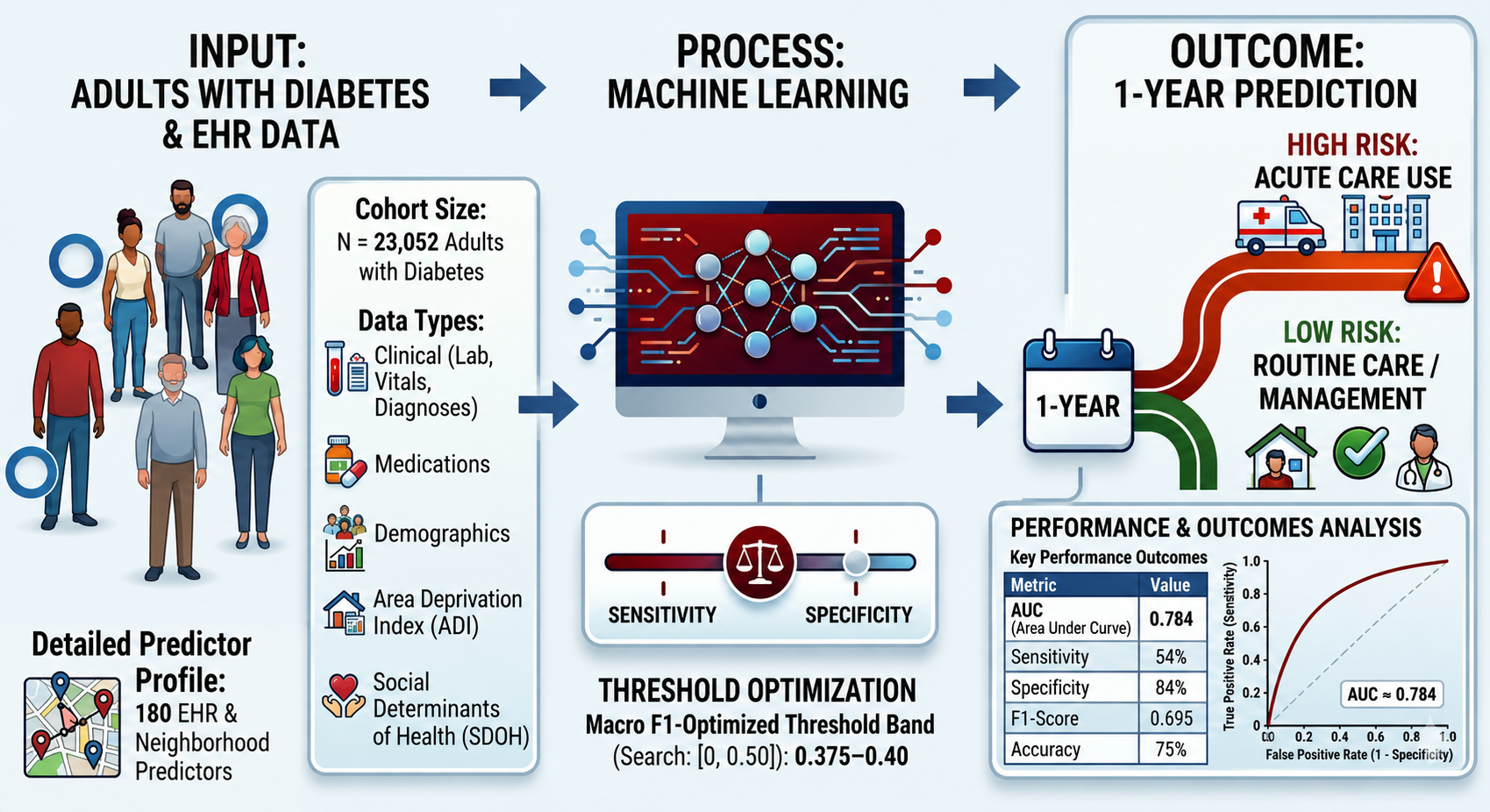

Threshold-Optimized Electronic Health Record-Based Machine Learning for Predicting 1-Year Acute Care Use in Adults with Diabetes at an Urban Health Care System

 , ,
, ,
Abstract
1. Introduction
2. Materials and Methods
2.1. Study Cohort
2.2. Data Preprocessing
2.2.1. Encounter
2.2.2. Demographics
2.2.3. Address and the Area Deprivation Index (ADI)
2.2.4. Vitals
2.2.5. Diagnosis
2.2.6. Prescribing
2.2.7. Laboratory Results
2.3. Outcome
2.4. Covariates
- Demographics/ADI: 29 covariates;
- Encounter Statistics: 14 covariates;
- BMI and Vitals: 9 covariates;
- Prescribing: 5 covariates;
- Diagnoses: 39 covariates;
- Laboratory Results: 84 covariates;
- A detailed list of covariates in each group is described in Appendix B.
2.5. Predictive Models
2.5.1. Baseline Models
2.5.2. Threshold Selection
2.5.3. Model Development and Evaluation Pipeline
2.5.4. Probability Calibration
2.5.5. Software
2.6. AI Use Statement
3. Results
3.1. Study Population and Descriptive Characteristics
3.2. Machine Learning Predictive Model Outcomes
3.2.1. Baseline Model Performance (0.5 Threshold)
3.2.2. Threshold Optimization and Operating-Point Performance
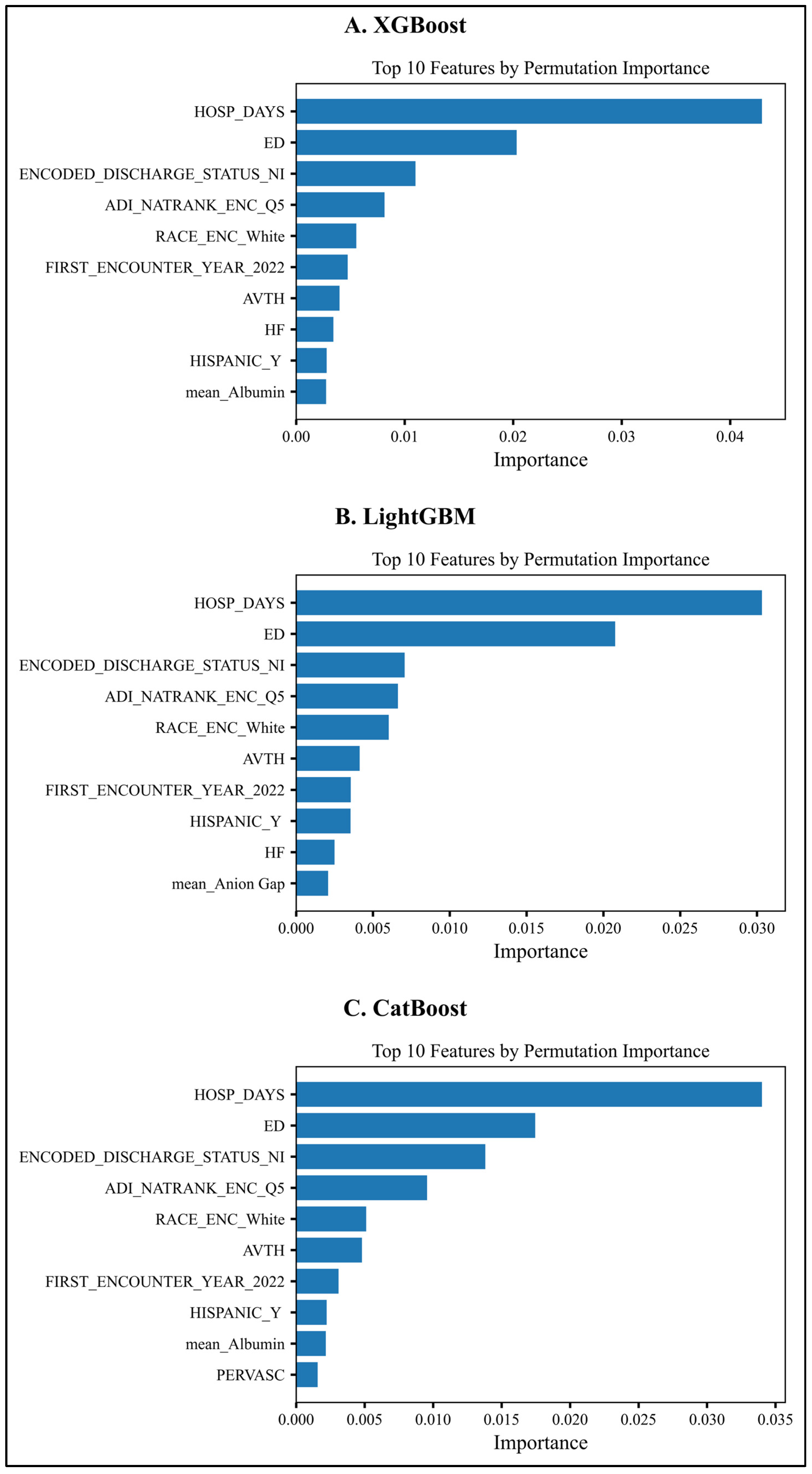
3.2.3. Model Interpretability with Optimization: Permutation Feature Importance
4. Discussion
4.1. Principal Findings
4.2. Clinical Implications: Clinical Risk Stratification for ACU Within One Year
4.2.1. Using One-Year ACU Prediction to Shift from Reactive to Proactive Diabetes Care
4.2.2. Prior Utilization as a Pragmatic Trigger for Care Management Escalation
4.2.3. Care Transitions Are High-Yield Intervention Points
4.2.4. Social Context and Neighborhood Disadvantage Should Inform Intervention Design
4.2.5. Equity Considerations When Race/Ethnicity Is Predictive
4.3. Modeling Implications: Discrimination, Calibration, and Threshold-Based Decisions
4.3.1. Discrimination (AUC) vs. Decision Performance (Macro F1): Why Thresholding Matters
4.3.2. Calibration and Threshold Selection Support Clinically Meaningful Action Policies
4.3.3. Imbalanced Outcomes: Why Accuracy Alone Is Insufficient
4.3.4. Interpretability and Clinician Trust: Connecting “Black Box” Models to Actionable Signals
4.4. Limitations
4.5. Future Directions
5. Conclusions
Author Contributions
Funding
Institutional Review Board Statement
Informed Consent Statement
Data Availability Statement
Conflicts of Interest
Abbreviations
| ACU | Acute Care Use |
| ADI | Area Deprivation Index |
| AUC | Area Under the Receiver Operating Characteristic Curve |
| ML | Machine Learning |
| EHR | Electronic Health Record |
| TUHS | Temple University Health System |
| ED | Emergency Department |
| IP | Inpatient Hospitalizations |
| OS | Observation Stays |
| BMI | Body Mass Index |
| RUCA | Rural–Urban Commuting Area |
| NATRANK | ADI National Rank |
| ROC | Receiver Operating Characteristic |
| AVTH | Ambulatory and Telehealth Visits |
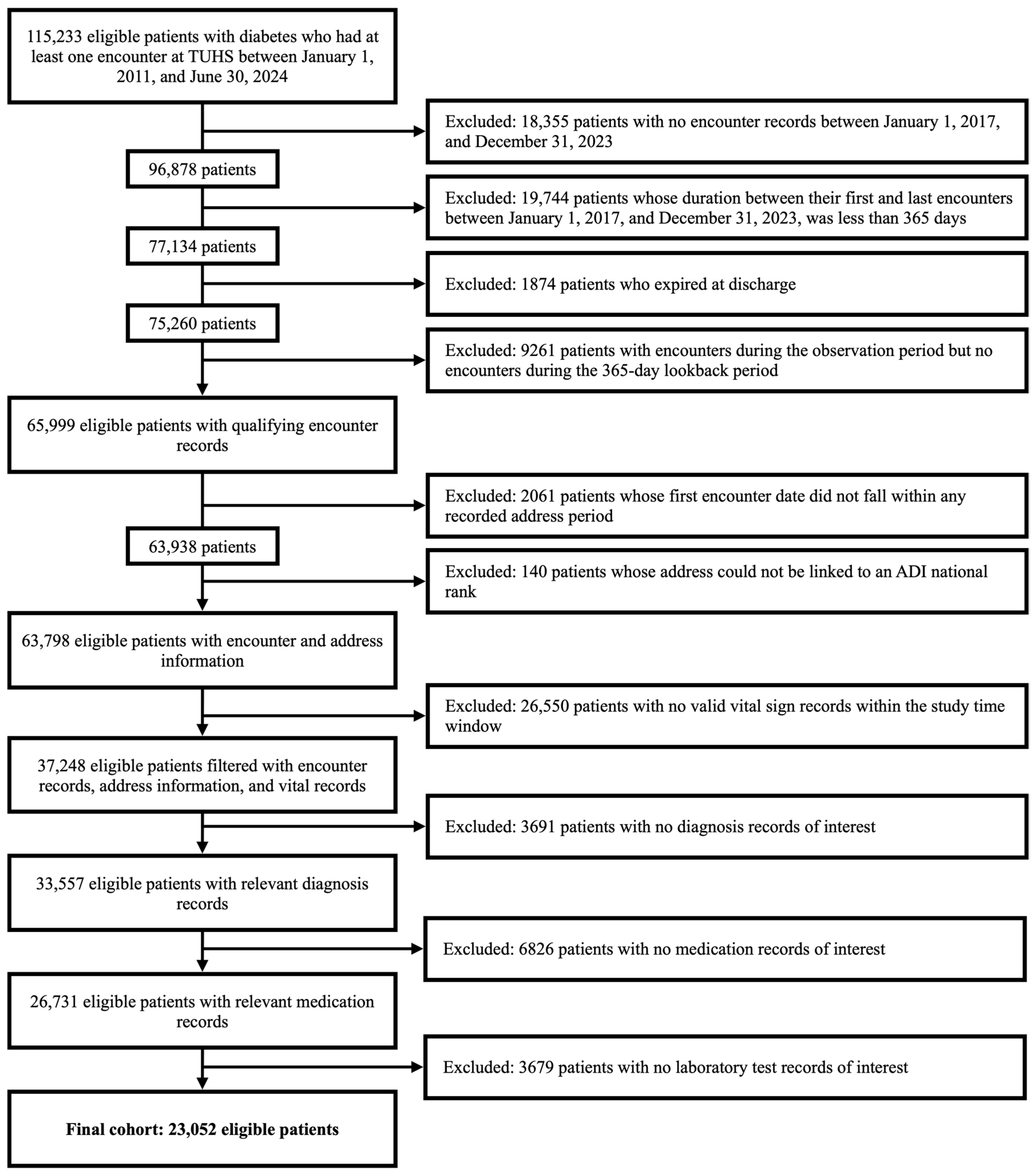
Appendix A. Cohort Selection Process

Appendix B. Model Covariates
Appendix B.1. Demographics/ADI (29 Covariates)
Appendix B.2. Encounter Statistics (14 Covariates)
Appendix B.3. BMI and Vitals (9 Covariates)
Appendix B.4. Medications (5 Covariates)
Appendix B.5. Diagnoses (39 Covariates)
Appendix B.6. Laboratory Results (84 Covariates)
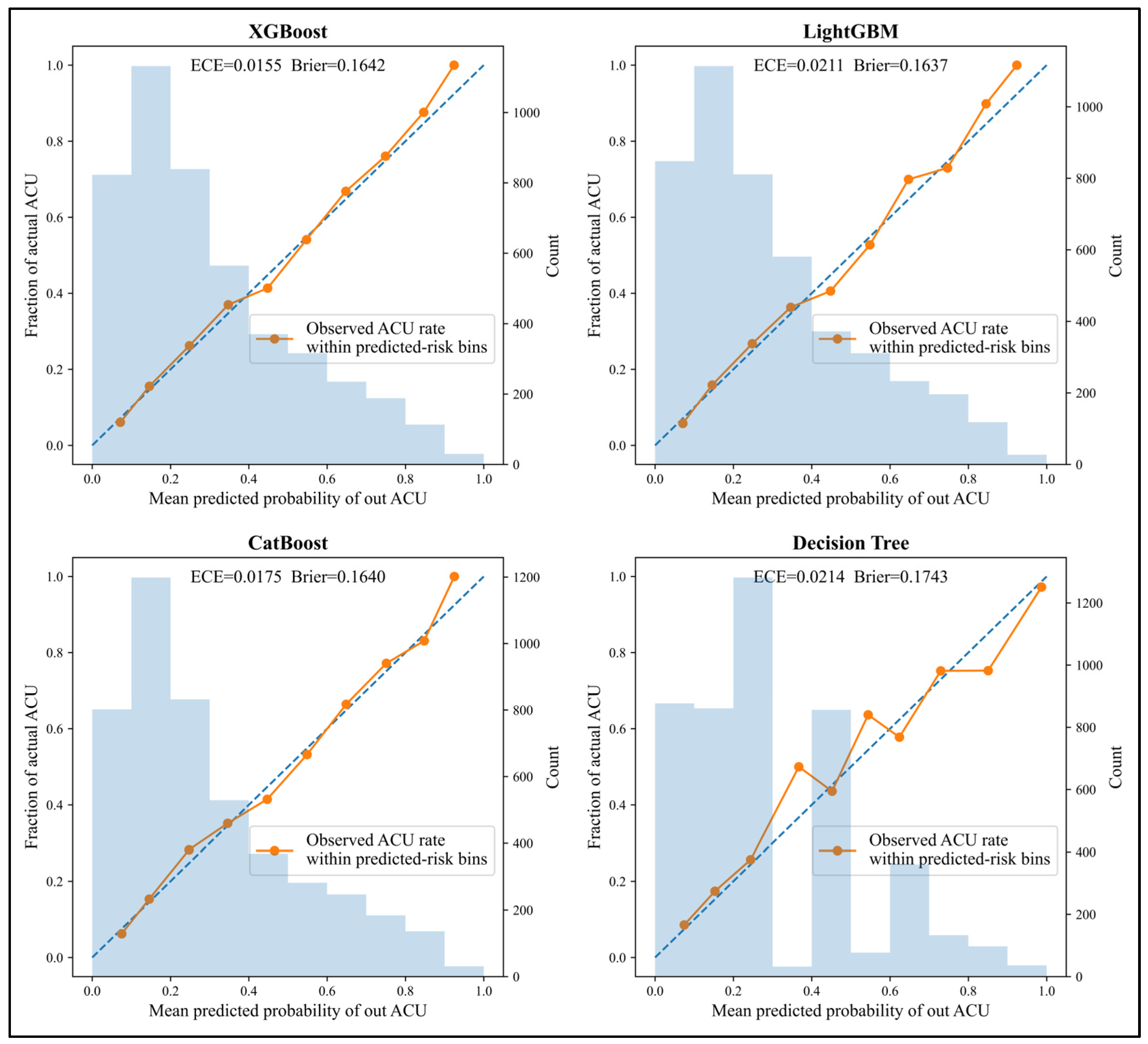
Appendix C. Comparison of Calibration Performance, ECE, and Brier Scores Across XGBoost, LightGBM, CatBoost, and Decision Tree Models

Appendix D. Training-Set Cross-Validation AUC Stability

| Classifier | Mean AUC | SD | Mean ± SD |
|---|---|---|---|
| Decision Tree | 0.7555 | 0.0054 | 0.7555 ± 0.0054 |
| XGBoost | 0.7869 | 0.0073 | 0.7869 ± 0.0073 |
| LightGBM | 0.7872 | 0.0073 | 0.7872 ± 0.0073 |
| CatBoost | 0.7871 | 0.0068 | 0.7871 ± 0.0068 |
Appendix E. Comparison of Selected Prior Studies Predicting Diabetes-Related Hospitalization, Readmission, or Acute Care Use
| Study | Population | Outcome | Horizon | Model | Validation | AUC | Key Difference from the Present Study |
|---|---|---|---|---|---|---|---|
| Rubin et al., 2016 [19] | Diabetes, hospitalized | 30-day readmission | 30-day | Risk score | Internal | 0.65–0.68 | 30-day readmission; hospitalized patients only |
| Rubin et al., 2017 [18] | Diabetes + CVD, hospitalized | 30-day readmission | 30-day | Risk score | Internal | ~0.67 | 30-day readmission; CVD subset only |
| Shang et al., 2021 [50] | Diabetes, hospitalized | 30-day readmission | 30-day | ML classifiers | Internal | 0.70–0.78 | 30-day readmission; single hospitalization |
| Hai et al., 2023 [7] | Diabetes, hospitalized | 30-day readmission | 30-day | Deep learning | Internal | ~0.74 | 30-day readmission; hospitalized patients only |
| Rubin et al., 2023 [14] | Diabetes (±discharge Dx) | 30-day readmission | 30-day | Risk score | Internal | 0.64–0.70 | 30-day readmission; mixed inpatient/outpatient |
| Present study | Diabetes, outpatient + inpatient | 1-year all-cause ACU (ED + IP + OS) | 1-year | XGBoost, LightGBM, CatBoost | Internal (80/20 split) | ~0.78 | Broader 1-year composite ACU; full outpatient + inpatient cohort; ADI integrated |
References
- National Diabetes Statistics Report. Available online: https://www.cdc.gov/diabetes/php/data-research/index.html (accessed on 30 September 2025).
- Parker, E.D.; Lin, J.; Mahoney, T.; Ume, N.; Yang, G.; Gabbay, R.A.; Elsayed, N.A.; Bannuru, R.R. Economic Costs of Diabetes in the U.S. in 2022. Diabetes Care 2024, 47, 26–43. [Google Scholar] [CrossRef] [Scilit] [PubMed]
- Nirantharakumar, K.; Hemming, K.; Narendran, P.; Marshall, T.; Coleman, J.J. A Prediction Model for Adverse Outcome in Hospitalized Patients with Diabetes. Diabetes Care 2013, 36, 3566–3572. [Google Scholar] [CrossRef] [Scilit] [PubMed]
- Wändell, P.; Wierzbicka, M.; Sigurdsson, K.; Olofsson, A.; Wachtler, C.; Wessman, T.; Melander, O.; Ekelund, U.; Björkelund, A.; Carlsson, A.C. Development and evaluation of a machine learning prediction model for short-term mortality in patients with diabetes or hyperglycemia at emergency department admission. Cardiovasc. Diabetol. 2025, 24, 383. [Google Scholar] [CrossRef] [Scilit] [PubMed]
- Cook, C.B.; Naylor, D.B.; Hentz, J.G.; Miller, W.J.; Tsui, C.; Ziemer, D.C.; Waller, L.A. Disparities in diabetes-related hospitalizations: Relationship of age, sex, and race/ethnicity with hospital discharges, lengths of stay, and direct inpatient charges. Ethn. Dis. 2006, 16, 126–131. [Google Scholar] [PubMed]
- Rubin, D.J.; Shah, A.A. Predicting and Preventing Acute Care Re-Utilization by Patients with Diabetes. Curr. Diabetes Rep. 2021, 21, 34. [Google Scholar] [CrossRef] [Scilit] [PubMed]
- Hai, A.A.; Weiner, M.G.; Paranjape, A.; Livshits, A.; Brown, J.R.; Obradovic, Z.; Rubin, D.J. Deep learning vs traditional models for predicting hospital readmission among patients with diabetes. In Proceedings of the AMIA Annual Symposium Proceedings; AMIA: Los Angeles, CA, USA, 2023; p. 512. [Google Scholar]
- Neto, C.; Senra, F.; Leite, J.; Rei, N.; Rodrigues, R.; Ferreira, D.; Machado, J. Different scenarios for the prediction of hospital readmission of diabetic patients. J. Med. Syst. 2021, 45, 11. [Google Scholar] [CrossRef] [Scilit] [PubMed]
- Wadhera, R.K.; Joynt Maddox, K.E.; Desai, N.R.; Landon, B.E.; Md, M.V.; Gilstrap, L.G.; Shen, C.; Yeh, R.W. Evaluation of hospital performance using the excess days in acute care measure in the hospital readmissions reduction program. Ann. Intern. Med. 2021, 174, 86–92. [Google Scholar] [CrossRef] [Scilit] [PubMed]
- Rodriguez-Gutierrez, R.; Herrin, J.; Lipska, K.J.; Montori, V.M.; Shah, N.D.; McCoy, R.G. Racial and Ethnic Differences in 30-Day Hospital Readmissions Among US Adults with Diabetes. JAMA Netw. Open 2019, 2, e1913249. [Google Scholar] [CrossRef] [Scilit] [PubMed]
- Chen, S.; Bergman, D.; Miller, K.; Kavanagh, A.; Frownfelter, J.; Showalter, J. Using applied machine learning to predict healthcare utilization based on socioeconomic determinants of care. AM J. Manag. Care 2020, 26, 26–31. [Google Scholar] [CrossRef] [Scilit] [PubMed]
- Liu, V.B.; Sue, L.Y.; Wu, Y. Comparison of machine learning models for predicting 30-day readmission rates for patients with diabetes. J. Med. Artif. Intell. 2024, 7, 23. [Google Scholar] [CrossRef] [Scilit]
- Hu, T.-L.; Chao, C.-M.; Wu, C.-C.; Chien, T.-N.; Li, C. Machine Learning-Based Predictions of Mortality and Readmission in Type 2 Diabetes Patients in the ICU. Appl. Sci. 2024, 14, 8443. [Google Scholar] [CrossRef] [Scilit]
- Rubin, D.J.; Maliakkal, N.; Zhao, H.; Miller, E.E. Hospital Readmission Risk and Risk Factors of People with a Primary or Secondary Discharge Diagnosis of Diabetes. J. Clin. Med. 2023, 12, 1274. [Google Scholar] [CrossRef] [Scilit] [PubMed]
- Gregory, N.S.; Seley, J.J.; Dargar, S.K.; Galla, N.; Gerber, L.M.; Lee, J.I. Strategies to Prevent Readmission in High-Risk Patients with Diabetes: The Importance of an Interdisciplinary Approach. Curr. Diab. Rep. 2018, 18, 54. [Google Scholar] [CrossRef] [Scilit] [PubMed]
- Hai, A.A.; Weiner, M.G.; Livshits, A.; Brown, J.R.; Paranjape, A.; Hwang, W.; Kirchner, L.H.; Mathioudakis, N.; French, E.K.; Obradovic, Z. Domain generalization for enhanced predictions of hospital readmission on unseen domains among patients with diabetes. Artif. Intell. Med. 2024, 158, 103010. [Google Scholar] [CrossRef] [Scilit] [PubMed]
- Rubin, D.J. Hospital Readmission of Patients with Diabetes. Curr. Diabetes Rep. 2015, 15, 17. [Google Scholar] [CrossRef] [Scilit] [PubMed]
- Rubin, D.J.; Golden, S.H.; McDonnell, M.E.; Zhao, H. Predicting readmission risk of patients with diabetes hospitalized for cardiovascular disease: A retrospective cohort study. J. Diabetes Its Complicat. 2017, 31, 1332–1339. [Google Scholar] [CrossRef] [Scilit] [PubMed]
- Rubin, D.J.; Handorf, E.A.; Golden, S.H.; Nelson, D.B.; McDonnell, M.E.; Zhao, H. Development and validation of a novel tool to predict hospital readmission risk among patients with diabetes. Endocr. Pract. 2016, 22, 1204–1215. [Google Scholar] [CrossRef] [PubMed]
- Li, T.-C.; Li, C.-I.; Liu, C.-S.; Lin, W.-Y.; Lin, C.-H.; Yang, S.-Y.; Chiang, J.-H.; Lin, C.-C. Development and validation of prediction models for the risks of diabetes-related hospitalization and in-hospital mortality in patients with type 2 diabetes. Metabolism 2018, 85, 38–47. [Google Scholar] [CrossRef] [Scilit] [PubMed]
- Rubin, D.J.; Donnell-Jackson, K.; Jhingan, R.; Golden, S.H.; Paranjape, A. Early readmission among patients with diabetes: A qualitative assessment of contributing factors. J. Diabetes Its Complicat. 2014, 28, 869–873. [Google Scholar] [CrossRef] [Scilit] [PubMed]
- Karunakaran, A.; Zhao, H.; Rubin, D.J. Predischarge and Postdischarge Risk Factors for Hospital Readmission Among Patients with Diabetes. Med. Care 2018, 56, 634–642. [Google Scholar] [CrossRef] [Scilit] [PubMed]
- Liss, D.T.; Ackermann, R.T.; Cooper, A.; Finch, E.A.; Hurt, C.; Lancki, N.; Rogers, A.; Sheth, A.; Teter, C.; Schaeffer, C. Effects of a Transitional Care Practice for a Vulnerable Population: A Pragmatic, Randomized Comparative Effectiveness Trial. J. Gen. Intern. Med. 2019, 34, 1758–1765. [Google Scholar] [CrossRef] [Scilit] [PubMed]
- Lo, Y.-T.; Liao, J.C.; Chen, M.-H.; Chang, C.-M.; Li, C.-T. Predictive modeling for 14-day unplanned hospital readmission risk by using machine learning algorithms. BMC Med. Inform. Decis. Mak. 2021, 21, 288. [Google Scholar] [CrossRef] [Scilit] [PubMed]
- Maleki, F.; Ovens, K.; Gupta, R.; Reinhold, C.; Spatz, A.; Forghani, R. Generalizability of machine learning models: Quantitative evaluation of three methodological pitfalls. Radiol. Artif. Intell. 2022, 5, e220028. [Google Scholar] [PubMed]
- Vabalas, A.; Gowen, E.; Poliakoff, E.; Casson, A.J. Machine learning algorithm validation with a limited sample size. PLoS ONE 2019, 14, e0224365. [Google Scholar] [CrossRef] [Scilit] [PubMed]
- Zhao, H.; Tanner, S.; Golden, S.H.; Fisher, S.G.; Rubin, D.J. Common sampling and modeling approaches to analyzing readmission risk that ignore clustering produce misleading results. BMC Med. Res. Methodol. 2020, 20, 281. [Google Scholar] [CrossRef] [Scilit] [PubMed]
- De Hond, A.; Raven, W.; Schinkelshoek, L.; Gaakeer, M.; Ter Avest, E.; Sir, O.; Lameijer, H.; Hessels, R.A.; Reijnen, R.; De Jonge, E. Machine learning for developing a prediction model of hospital admission of emergency department patients: Hype or hope? Int. J. Med. Inform. 2021, 152, 104496. [Google Scholar] [CrossRef] [Scilit] [PubMed]
- Lu, H.; Uddin, S. Explainable Stacking-Based Model for Predicting Hospital Readmission for Diabetic Patients. Information 2022, 13, 436. [Google Scholar] [CrossRef] [Scilit]
- Abdel Hai, A.; Weiner, M.G.; Livshits, A.; Brown, J.R.; Paranjape, A.; Obradovic, Z.; Rubin, D.J. Spatial Knowledge Transfer with Deep Adaptation Network for Predicting Hospital Readmission. In Artificial Intelligence in Medicine; Springer: Cham, Switzerland, 2023; pp. 130–139. [Google Scholar]
- Liu, C.; Huang, Z.; Liu, T.; Ge, Y.; Yuan, J.; Lin, Y.; Wang, C.; Zhang, J.; Wang, X.; Hua, Y.; et al. Construction and validation of a hypoglycemia risk prediction model for hospitalized type 2 diabetes patients based on machine learning. BMC Endocr. Disord. 2025, 25, 291. [Google Scholar] [CrossRef] [Scilit] [PubMed]
- Fingar, K.R.; Reid, L.D. Diabetes-Related Inpatient Stays, 2018; Agency for Healthcare Research and Quality: Rockville, ND, USA, 2021.
- Zhang, Y.; Bullard, K.M.; Imperatore, G.; Holliday, C.S.; Benoit, S.R. Proportions and trends of adult hospitalizations with diabetes, United States, 2000–2018. Diabetes Res. Clin. Pract. 2022, 187, 109862. [Google Scholar] [CrossRef] [Scilit] [PubMed]
- Brisimi, T.S.; Xu, T.; Wang, T.; Dai, W.; Paschalidis, I.C. Predicting diabetes-related hospitalizations based on electronic health records. Stat. Method Med. Res. 2019, 28, 3667–3682. [Google Scholar]
- Emi-Johnson, O.G.; Nkrumah, K.J. Predicting 30-Day Hospital Readmission in Patients with Diabetes Using Machine Learning on Electronic Health Record Data. Cureus 2025, 17, e82437. [Google Scholar] [CrossRef] [Scilit] [PubMed]
- Shi, M.; Yang, A.; Lau, E.S.H.; Luk, A.O.Y.; Ma, R.C.W.; Kong, A.P.S.; Wong, R.S.M.; Chan, J.C.M.; Chan, J.C.N.; Chow, E. A novel electronic health record-based, machine-learning model to predict severe hypoglycemia leading to hospitalizations in older adults with diabetes: A territory-wide cohort and modeling study. PLoS Med. 2024, 21, e1004369. [Google Scholar] [CrossRef] [Scilit] [PubMed]
- Tan, J.K.; Quan, L.; Salim, N.N.M.; Tan, J.H.; Goh, S.-Y.; Thumboo, J.; Bee, Y.M. Machine Learning–Based Prediction for High Health Care Utilizers by Using a Multi-Institutional Diabetes Registry: Model Training and Evaluation. JMIR AI 2024, 3, e58463. [Google Scholar] [CrossRef] [Scilit] [PubMed]
- Cannon, A.; Handelsman, Y.; Heile, M.; Shannon, M. Burden of illness in type 2 diabetes mellitus. J. Manag. Care Spec. Pharm. 2018, 24, S5–S13. [Google Scholar] [CrossRef] [Scilit] [PubMed]
- Alizadeh, J.M.; Patel, J.S.; Tajeu, G.; Chen, Y.; Hollin, I.L.; Patel, M.K.; Fei, J.; Wu, H. Predicting Emergency Department Visits for Patients with Type II Diabetes. arXiv 2024, arXiv:2412.08984. [Google Scholar]
- 2020 Rural-Urban Commuting Area Codes. Available online: https://www.ers.usda.gov/data-products/rural-urban-commuting-area-codes (accessed on 30 December 2025).
- Kind, A.J.; Buckingham, W.R. Making neighborhood-disadvantage metrics accessible—The neighborhood atlas. N. Engl. J. Med. 2018, 378, 2456. [Google Scholar] [CrossRef] [Scilit] [PubMed]
- Elixhauser Comorbidity Software Refined for ICD-10-CM. Available online: https://hcup-us.ahrq.gov/toolssoftware/comorbidityicd10/comorbidity_icd10.jsp (accessed on 12 January 2026).
- Vickers, A.J.; Elkin, E.B. Decision curve analysis: A novel method for evaluating prediction models. Med. Decis. Mak. 2006, 26, 565–574. [Google Scholar] [CrossRef] [Scilit] [PubMed]
- Elkan, C. The foundations of cost-sensitive learning. In Proceedings of the International Joint Conference on Artificial Intelligence; ACM: New York, NY, USA, 2001; pp. 973–978. [Google Scholar]
- Lipton, Z.C.; Elkan, C.; Naryanaswamy, B. Optimal thresholding of classifiers to maximize F1 measure. In Proceedings of the Joint European Conference on Machine Learning and Knowledge Discovery in Databases; Springer: Berlin/Heidelberg, Germany, 2014; pp. 225–239. [Google Scholar]
- O’Brien, R.; Ishwaran, H. A random forests quantile classifier for class imbalanced data. Pattern Recognit. 2019, 90, 232–249. [Google Scholar] [CrossRef] [Scilit] [PubMed]
- Draznin, B.; Gilden, J.; Golden, S.H.; Inzucchi, S.E.; PRIDE investigators; Baldwin, D.; Bode, B.W.; Boord, J.B.; Braithwaite, S.S.; Cagliero, E. Pathways to quality inpatient management of hyperglycemia and diabetes: A call to action. Diabetes Care 2013, 36, 1807–1814. [Google Scholar] [CrossRef] [Scilit] [PubMed]
- Sezik, S.; Cingiz, M.Ö.; İbiş, E. Machine Learning-Based Model for Emergency Department Disposition at a Public Hospital. Appl. Sci. 2025, 15, 1628. [Google Scholar] [CrossRef] [Scilit]
- Chin, M.H.; Afsar-Manesh, N.; Bierman, A.S.; Chang, C.; Colón-Rodríguez, C.J.; Dullabh, P.; Duran, D.G.; Fair, M.; Hernandez-Boussard, T.; Hightower, M.; et al. Guiding Principles to Address the Impact of Algorithm Bias on Racial and Ethnic Disparities in Health and Health Care. JAMA Netw. Open 2023, 6, e2345050. [Google Scholar] [CrossRef] [Scilit] [PubMed]
- Shang, Y.; Jiang, K.; Wang, L.; Zhang, Z.; Zhou, S.; Liu, Y.; Dong, J.; Wu, H. The 30-days hospital readmission risk in diabetic patients: Predictive modeling with machine learning classifiers. BMC Med. Inform. Decis. Mak. 2021, 21, 1472–6947. [Google Scholar] [CrossRef] [Scilit] [PubMed]


| Characteristics | All Patients N = 23,052 | Patients with ACU N = 7039 | Patients Without ACU N = 16,013 | p-Value |
|---|---|---|---|---|
| Sex, N (%) | <0.001 | |||
| Male | 10,973 (47.60) | 3204 (45.52) | 7769 (48.52) | |
| Female | 12,079 (52.40) | 3835 (54.48) | 8244 (51.48) | |
| Rural/Urban, N (%) | <0.001 | |||
| Rural (RUCA = 0.0) | 456 (1.98) | 86 (1.22) | 370 (2.31) | |
| Urban (RUCA = 1.0) | 22,596 (98.02) | 6953 (98.78) | 15,643 (97.69) | |
| Age years, N (%) | <0.001 | |||
| 18–44 | 1942 (8.42) | 634 (9.01) | 1308 (8.17) | |
| 45–64 | 9479 (41.12) | 2995 (42.55) | 6484 (40.49) | |
| 65–74 | 6652 (28.86) | 1932 (27.45) | 4720 (29.48) | |
| ≥5 | 4979 (21.60) | 1478 (21.00) | 3501 (21.86) | |
| Race, N (%) | <0.001 | |||
| White | 8048 (34.91) | 1463 (20.78) | 6585 (41.12) | |
| Black | 7998 (34.70) | 3131 (44.48) | 4867 (30.39) | |
| Other | 1012 (4.39) | 164 (2.33) | 848 (5.30) | |
| Unknown and not reported | 5994 (26.00) | 2281 (32.41) | 3713 (23.19) | |
| Ethnicity, N (%) | <0.001 | |||
| Hispanic | 5093 (22.09) | 2127 (30.22) | 2966 (18.52) | |
| Non-Hispanic | 16,758 (72.70) | 4482 (63.67) | 12,276 (76.66) | |
| Unknown and not reported | 1201 (5.21) | 430 (6.11) | 771 (4.81) | |
| Area Deprivation Index (ADI), N (%) | <0.001 | |||
| Q1 | 1146 (4.97) | 154 (2.19) | 992 (6.19) | |
| Q2 | 3913 (16.97) | 653 (9.28) | 3260 (20.36) | |
| Q3 | 4559 (19.78) | 970 (13.78) | 3589 (22.41) | |
| Q4 | 4682 (20.31) | 1443 (20.50) | 3239 (20.23) | |
| Q5 | 8606 (37.33) | 3765 (53.49) | 4841 (30.23) | |
| Other | 146 (0.63) | 54 (0.77) | 92 (0.57) |
| Classifier | Accuracy | Balanced Accuracy | Macro F1 | Sensitivity | Specificity | AUC (Test Set) |
|---|---|---|---|---|---|---|
| Decision Tree | 0.7439 | 0.6280 | 0.6372 | 0.3303 | 0.9257 | 0.7529 |
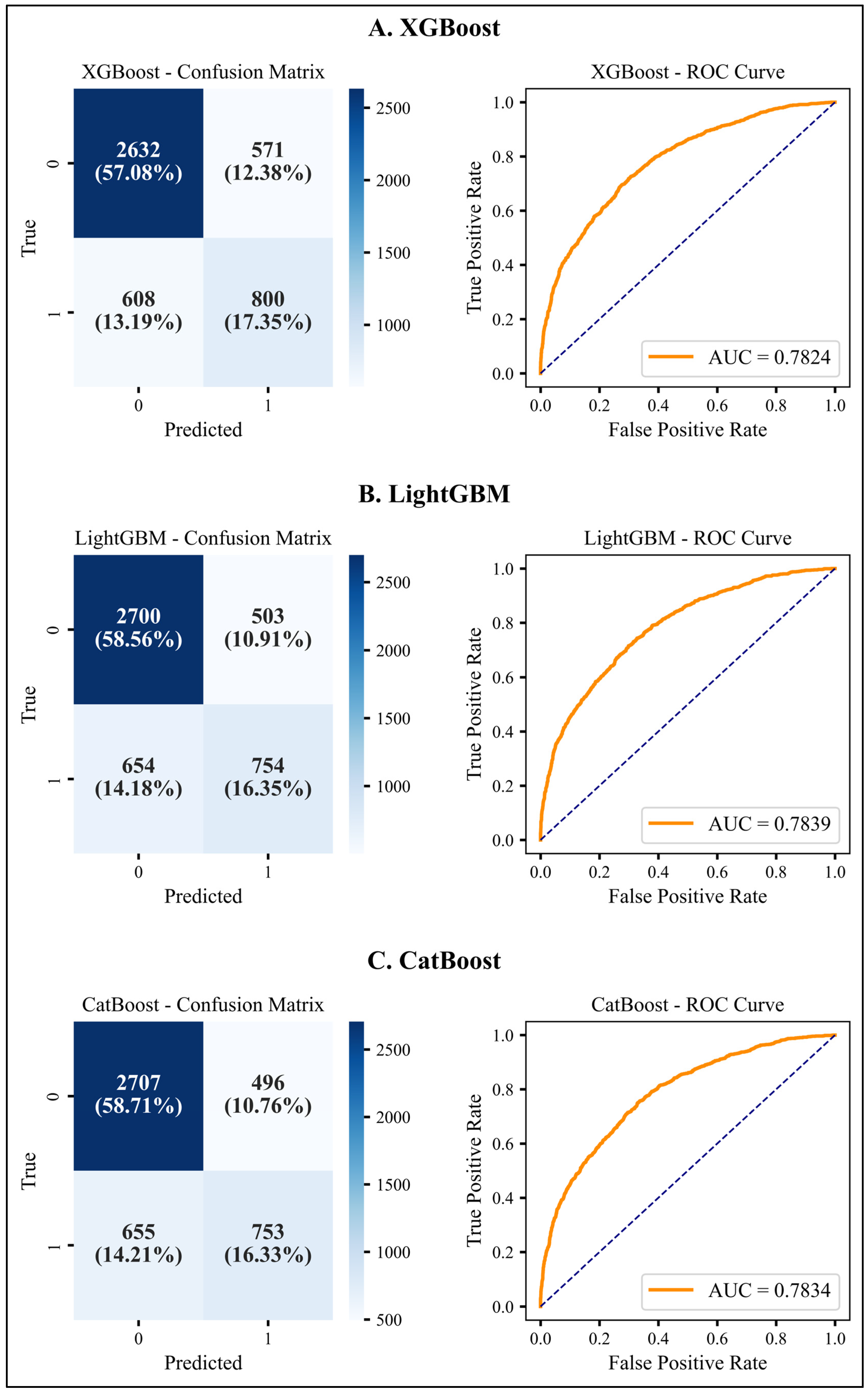
| XGBoost | 0.7636 | 0.6690 | 0.6834 | 0.4261 | 0.9120 | 0.7824 |
| LightGBM | 0.7643 | 0.6701 | 0.6845 | 0.4283 | 0.9120 | 0.7839 |
| CatBoost | 0.7640 | 0.6694 | 0.6838 | 0.4261 | 0.9126 | 0.7834 |
| Classifier | Accuracy | Balanced Accuracy | Macro F1 | Sensitivity | Specificity | Fitted Threshold | AUC (Test Set) |
|---|---|---|---|---|---|---|---|
| Decision Tree | 0.7200 | 0.6850 | 0.6792 | 0.5952 | 0.7749 | 0.400 | 0.7529 |
| XGBoost | 0.7443 | 0.6950 | 0.6964 | 0.5682 | 0.8217 | 0.375 | 0.7824 |
| LightGBM | 0.7491 | 0.6892 | 0.6947 | 0.5355 | 0.8430 | 0.400 | 0.7839 |
| CatBoost | 0.7504 | 0.6900 | 0.6957 | 0.5348 | 0.8451 | 0.400 | 0.7834 |
| Classifier | AUC (Test Set) | Bootstrap AUC Mean | 95% CI | Brier Loss |
|---|---|---|---|---|
| Decision Tree | 0.7529 | 0.7530 | 0.7389–0.7677 | 0.1743 |
| XGBoost | 0.7824 | 0.7825 | 0.7681–0.7969 | 0.1642 |
| LightGBM | 0.7839 | 0.7839 | 0.7694–0.7984 | 0.1637 |
| CatBoost | 0.7834 | 0.7835 | 0.7691–0.7980 | 0.1640 |
Disclaimer/Publisher’s Note: The statements, opinions and data contained in all publications are solely those of the individual author(s) and contributor(s) and not of MDPI and/or the editor(s). MDPI and/or the editor(s) disclaim responsibility for any injury to people or property resulting from any ideas, methods, instructions or products referred to in the content. |
© 2026 by the authors. Licensee MDPI, Basel, Switzerland. This article is an open access article distributed under the terms and conditions of the Creative Commons Attribution (CC BY) license.
Share and Cite
Lee, J.; Sharma, H.; Yu, G.; Obradovic, Z.; McCoy, R.G.; Rubin, D.J. Threshold-Optimized Electronic Health Record-Based Machine Learning for Predicting 1-Year Acute Care Use in Adults with Diabetes at an Urban Health Care System. Diabetology 2026, 7, 116. https://doi.org/10.3390/diabetology7060116
Lee J, Sharma H, Yu G, Obradovic Z, McCoy RG, Rubin DJ. Threshold-Optimized Electronic Health Record-Based Machine Learning for Predicting 1-Year Acute Care Use in Adults with Diabetes at an Urban Health Care System. Diabetology. 2026; 7(6):116. https://doi.org/10.3390/diabetology7060116
Chicago/Turabian StyleLee, Jinha, Hardik Sharma, Geonsik Yu, Zoran Obradovic, Rozalina G. McCoy, and Daniel J. Rubin. 2026. "Threshold-Optimized Electronic Health Record-Based Machine Learning for Predicting 1-Year Acute Care Use in Adults with Diabetes at an Urban Health Care System" Diabetology 7, no. 6: 116. https://doi.org/10.3390/diabetology7060116
APA StyleLee, J., Sharma, H., Yu, G., Obradovic, Z., McCoy, R. G., & Rubin, D. J. (2026). Threshold-Optimized Electronic Health Record-Based Machine Learning for Predicting 1-Year Acute Care Use in Adults with Diabetes at an Urban Health Care System. Diabetology, 7(6), 116. https://doi.org/10.3390/diabetology7060116