


Abstract
Purpose: Photoselective vaporization of the prostate (PVP) with the GreenLight laser is an established minimally invasive treatment for benign prostatic hyperplasia (BPH), yet its effects on voiding physiology remain incompletely characterized. Most prior studies rely on symptom scores and uroflowmetry as surrogate endpoints. This study evaluates the urodynamic mechanisms underlying clinical improvement following GreenLight PVP using paired pressure-flow studies. Methods: We performed a single-center retrospective review of patients who underwent GreenLight XPS PVP for BPH-related bladder outlet obstruction at a community hospital. Inclusion required complete pre- and postoperative pressure-flow urodynamic studies (UDS) and symptom assessments (IPSS). Key urodynamic parameters included maximum flow rate (Qmax), average flow rate (Qavg), detrusor pressure at maximum flow (Pdet@Qmax), maximum detrusor pressure (max Pdet), bladder outlet obstruction index (BOOI), and post-void residual (PVR). Postoperative UDS were performed at 12 months. Statistical analysis employed the Wilcoxon signed-rank test for continuous variables. Results: Of 98 total patients (mean age 71.3 years), paired uroflowmetry was available in 87 patients and pressure-flow data in 64. IPSS improved significantly from 17.1 to 9.5 at 12 months (p < 0.05). Qmax increased by 76%, from 6.25 to 11.0 mL/s (p < 0.05), and Qavg increased by 35%, from 4.0 to 5.4 mL/s (p < 0.05). Max Pdet decreased significantly from 84.8 to 61.2 cmH2O (p < 0.05), and BOOI improved from 46.7 to 28.9 (p < 0.05). Pdet@Qmax and PVR did not change significantly. Conclusions: GreenLight PVP produces measurable restoration of voiding mechanics, evidenced by reduced peak detrusor pressures, improved outlet obstruction index, and enhanced urinary flow. These findings confirm that symptomatic improvement is underpinned by objective urodynamic de-obstruction. Larger prospective studies with longer follow-up are warranted.
1. Introduction
Benign prostatic hyperplasia (BPH) is a highly prevalent condition that is present in up to 80% of men over the age of 80 and in up to 50% of men over the age of 50 [1]. The condition results in lower urinary tract symptoms (LUTS) secondary to bladder outlet obstruction (BOO), which can substantially impair physical and mental well-being and may lead to serious pathological sequelae if left untreated [2] First-line management focuses on symptom control with medical therapy, including alpha-1 blockers or combination therapies (alpha-1 blockers + 5-alpha-reductase inhibitors or alpha-1 blockers + muscarinic receptor antagonist) [3]. While initial management typically involves these pharmacological interventions, the progressive nature of the disease makes surgical treatment a necessity in a significant portion of patients when medical therapy fails [2,4].
Historically, transurethral resection of the prostate (TURP) has been considered the surgical gold standard for moderate-to-severe lower urinary tract symptoms secondary to BPH due to its durable symptom relief and well characterized outcomes [5,6]. Despite its efficacy, TURP carries several postoperative risks that warrant consideration, including significant catheterization times and prolonged hospital stays [6]. Additionally, some patients require blood transfusions postoperatively, and the procedure can lead to other complications such as urinary tract infections and dilutional hyponatremia, though bipolar TURP substantially reduces the risk of the latter through the use of isotonic irrigation [7,8]. Moreover, guidelines additionally recognize anatomical endoscopic enucleation procedures, including holmium laser enucleation of the prostate, as highly effective size-independent surgical options with durable long-term outcomes. Contemporary AUA guidelines present laser-based treatments as a viable alternative to TURP in men with moderate to severe LUTS due to their comparable short- and intermediate-term effects [2,9]. As such, these laser-based procedures are becoming increasingly favored due to their improved safety profiles and comparable functional outcomes [2,9].
Photoselective vaporization of the prostate (PVP) with the GreenLight laser has emerged as a viable alternative to traditional TURP, gaining widespread acceptance in national guidelines as a safe and effective minimally invasive treatment option [4,5,10]. This treatment uses a 532 nm wavelength that is selectively absorbed by hemoglobin in soft tissue and allows for rapid vaporization with minimal bleeding [4,11]. The key advantages of GreenLight PVP over conventional TURP include shorter hospitalization, reduced postoperative catheterization requirements, lower rates of retrograde ejaculation, and minimal risk of dilutional hyponatremia [6,7,8]. These characteristics have made GreenLight PVP particularly attractive for high-risk surgical candidates and patients with significant comorbidities [12,13,14].
Comparative safety analyses demonstrate that GreenLight PVP is associated with significantly reduced postoperative morbidity compared to that of TURP. In a recent meta-analysis, TURP was associated with a higher risk of perioperative transfusion, while long-term reoperation rates for urethral stricture and bladder neck contracture were comparable between the two procedures [5]. However, GreenLight PVP has been shown to have a lower incidence of persistent or regrowth adenoma at medium-term follow-up [5,15]. Long-term clinical data at five-year follow-up demonstrate sustained improvements in both symptom severity and urinary flow parameters, establishing GreenLight PVP’s durability as a therapeutic option [4,16].
Despite the growing acceptance of GreenLight PVP and its demonstrated efficacy in improving subjective symptom scores, its urodynamic effects remain less well described than its symptom outcomes. Most prior studies have relied on symptom scores, uroflowmetry, and post-void residuals as surrogates for de-obstruction. These metrics are useful but only indirectly reflect the interplay between detrusor function and outlet resistance. As a result, detailed urodynamic analysis that evaluates bladder storage function, detrusor contractility, and bladder obstruction during the postoperative period remains poorly characterized. Formal urodynamic assessment may offer a more objective understanding of how GreenLight PVP changes voiding physiology beyond what can be measured with uroflowmetry or symptom questionnaires alone.
The present study aims to systematically evaluate the impact of GreenLight PVP on voiding mechanics using paired pressure-flow urodynamics with long-term follow-up in a real-world, single-surgeon cohort.
2. Methods
We conducted a single-center retrospective review of clinical data collected from patients at a community-based hospital who underwent GreenLight photoselective vaporization of the prostate for bladder outlet obstruction secondary to benign prostatic enlargement. GreenLight PVP was the preferred surgical treatment for patients with symptomatic benign prostatic obstruction at our institution, based on surgeon judgment, patient characteristics, prostate anatomy, comorbidities, and shared decision making. The study took place at the Urology Department of Emerson Hospital in Concord, Massachusetts, USA.
Surgical technique. All procedures were exclusively performed by an experienced urologist using the GreenLight XPS™ Laser System (Boston Scientific, Marlborough, MA, USA) with the MoXy™ 532 nm fiber optic fiber and power settings of 80–180 watt output. All PVP surgeries were performed in an identical manner using a standardized enucleation technique, and total laser vaporization duration times were recorded.
Eligibility. We identified men who underwent GreenLight PVP and who had both preoperative and postoperative pressure-flow UDS data available. Inclusion criteria included the following: (1) BPH/LUTS or urinary retention with an indication to receive surgery; (2) treatment with GreenLight PVP; (3) complete pre- and postoperative UDS; and (4) availability of subjective symptom assessments (International Prostate Symptom Score, IPSS). Exclusion criteria included: (1) prior history of TURP or simple prostatectomy; (2) documented neurogenic lower urinary tract dysfunction; and (3) technically inadequate UDS.
Study Cohorts. The overall study cohort consisted of all patients who underwent GreenLight PVP and had postoperative symptom assessment. Because this was a retrospective analysis of real-world clinical practice, complete objective pressure-flow studies were not available for every patient. Accordingly, analyses were performed using all available paired observations for each outcome. Patient-reported outcomes (IPSS) were analyzed in the overall cohort, whereas uroflowmetry and pressure-flow analyses were restricted to patients with complete paired measurements.
Ethical considerations. The study was conducted under a retrospective chart review protocol for which the BRANY Institutional Review Board granted a waiver of ethics on 13 September 2023 (IRB #23-12-574-1399). The study period extends from June 2018 through October 2025, as the retrospective database was subsequently updated to include additional clinical records during routine patient care through October 2025. The records for the entire duration of the study period were incorporated under the same approved retrospective chart review protocol and waiver because all data were derived from existing clinical documentation and were analyzed retrospectively in accordance with the approved protocol.
Variables. From the electronic medical record, we abstracted demographic information and relevant clinical factors (age, PSA), operative details (laser platform, energy [kJ], operative time, catheter duration, perioperative complications), and functional outcomes.
Symptom burden and sexual function were obtained retrospectively from routine questionnaire documentation. The IPSS score (range 0–35) was used as the validated urinary symptom measure. For each patient, we abstracted the preoperative score and postoperative scores at 1 month, 3 months, 6 months, and 12 months following their PVP procedure.
Urodynamic measures were abstracted from multichannel pressure-flow studies aligned with International Continence Society (ICS) standards. A transurethral catheter recorded intravesical pressure (Pves), and a rectal catheter recorded abdominal pressure (Pabd); detrusor pressure (Pdet) was calculated as Pdet = Pves − Pabd. All urodynamic testing was conducted with the patient in a seated position, and sterile saline was infused into the bladder with a medium fill rate of 50 mL/min.
For each pre- and postoperative pressure-flow study, the following parameters were abstracted: maximum urinary flow rate (Qmax, mL/s), average urinary flow rate (Qavg, mL/s), detrusor pressure at maximum flow (Pdet@Qmax, cmH2O), maximum detrusor pressure during voiding (max Pdet, cmH2O), and post-void residual (PVR, mL). The presence of detrusor overactivity and impaired compliance was recorded when present.
To summarize the interplay between bladder contractility and outlet resistance in a standardized way, we utilized the bladder outlet obstruction index (BOOI), which estimates the degree of outlet resistance during voiding, whereby BOOI is defined as
- ○
- Obstructed: BOOI > 40;
- ○
- Equivocal: BOOI 20–40;
- ○
- Unobstructed: BOOI < 20.
- UDS Interpretation:
Follow-up. Routine follow-up visits included clinical examination, assessment of functional outcomes via IPSS questionnaires, bladder scan for post-void residual measurement, uroflowmetry, and cystoscopy, if medically indicated. Data was retrospectively collected at routine follow ups at 1, 3, 6, and 12 months. Postoperative UDS were performed at the 12-month follow-up, and all tracings were reviewed by an experienced urologist to confirm technical adequacy and consistency of parameter extraction.
Data collection and statistical analysis. Data were abstracted from operative logs, urodynamic reports, and patient progress notes into a de-identified analytic dataset. All analyzed urodynamic studies were performed for clinical indications as part of routine patient care and were not obtained solely for research purposes. The primary endpoints were preoperative and postoperative objective voiding parameters, including Qavg, Qmax, Pdet@Qmax, max Pdet, and PVR.
All data underwent a univariate analysis. Given the moderate sample size, the paired pre/post design, and the known tendency of pressure-flow urodynamic parameters (e.g., Pdet@Qmax, max Pdet, BOOI) to be skewed by physiologic outliers and floor/ceiling effects, a non-parametric approach was adopted a priori for all paired comparisons. Accordingly, the Wilcoxon signed-rank test was applied uniformly across all paired pre- and postoperative outcome variables. For descriptive purposes, baseline demographics, operative variables (age, PSA, lasing energy, operative time), and paired IPSS scores are presented as mean ± standard deviation (SD), consistent with convention in the literature for these measures. The paired urodynamic and uroflowmetric variables (Qmax, Qavg, voided volume, Pdet@Qmax, max Pdet, BOOI, PVR) are presented as the median with interquartile range (IQR), reflecting their expected non-normal distribution. Categorical variables are presented as frequencies and percentages, and their statistical comparisons were conducted using the Chi-square test. A p-value of 0.05 was used to determine statistical significance.
3. Results
A total of 98 patients were included in the study from June 2018 to October 2025 and had postoperative symptom assessments available for analysis. The mean age was 71.3 years (SD: 10.2). Because this was an analysis of a real-world, retrospective cohort, complete objective voiding physiology data were not available for every patient. Within the pressure-flow UDS and uroflowmetry, entries with missing fields and physiologically implausible values were excluded during data cleaning. Consequently, paired uroflowmetry variables were available for a total of 87 patients, while pressure-derived measures were available in a slightly smaller subset of 64 patients. Accordingly, symptom outcomes are presented for the overall cohort, while objective analyses are reported for the corresponding paired datasets.
The mean lasing energy was 135.9 kJ (range 14.8–508.0 kJ), and the average operation time was 20.9 min (range 3.0–65.0 min). There was no significant intraoperative blood loss in any of the patients. Reoperation was not necessary in any of the patients (Table 1).
Table 1.
Baseline characteristics and operative details of overall study cohort (N = 98).
Symptom outcomes. Among 98 paired observations, LUTS severity improved significantly after GreenLight PVP. Preoperatively, IPSS had a mean of 17.1 (SD 8.2). Postoperatively, IPSS improved to 11.8 (SD 7.8; p < 0.05), indicating a robust symptom reduction in this real-world cohort. When examined at follow-up using paired comparisons, symptom improvement was evident early and continued to evolve over the first several postoperative months. Compared with baseline, IPSS was significantly lower at 1 month (mean 15.4, SD 9.2 pre-op vs. mean 12.5, SD 7.9; p < 0.05), at 3 months (mean 13.8, SD 8.9 pre-op vs. mean 9.8, SD 8.0; p < 0.05), at 6 months (mean 14.8 pre-op, SD 9.4 vs. mean 8.4, SD 7.6; p < 0.05), and at 12 months (mean 16.5, SD 6.3 pre-op vs. mean 9.5, SD 8.3; p < 0.05). To further characterize postoperative symptom trajectory, paired comparisons anchored at 1 month showed additional change between 1 and 3 months (mean 14.3, SD 9.2 at 1 month vs. mean 10.6, SD 9.0; p < 0.05) and between 1 and 6 months (mean 13.9, SD 9.5 at 1 month vs. mean 8.6, SD 7.9; p < 0.05). However, the 1- vs. 12-month comparison was not statistically significant (mean 7.09, SD 4.4 at 1 month vs. mean 6.9, SD 5.9 at 12 months; p = 0.19). Taken together, these results point to early symptomatic improvement after PVP with continued postoperative symptom evolution from 3–6 months and maintenance of improvement thereafter.
Objective uroflowmetry and urodynamic outcomes. The improvements in subjective symptoms coincide with improved micturition parameters. Uroflow measurements were evaluated using combined available entries from uroflowmetry, as well as UDS-derived flow parameters. Of the 87 patients with complete uroflowmetry data, urinary flow improved significantly after PVP, with the average flow rate (Qavg) increasing by 35%, from 4.0 mL/s (IQR 3.0–5.4) preoperatively to 5.4 mL/s (IQR 3.7–6.7) postoperatively (p < 0.05). Maximum flow rate (Qmax) increased by 76%, from 6.25 mL/s (IQR 4.3–14.0) to 11.0 mL/s (IQR 7.5–19.2) (p < 0.05). Further, voided volume increased from 217.9 mL (IQR 147.1–301.6) to 230.3 (IQR 184.8–338.5) (p < 0.05).
Among the 64 patients with paired pressure-derived metrics, peak detrusor pressures decreased following PVP. Maximum detrusor pressure (max Pdet) decreased from a median of 84.8 cmH2O (IQR 56.6–108.0) to 61.2 cmH2O (IQR 33.78–100.93) (p < 0.05). Detrusor pressure at maximum flow (Pdet@Qmax) decreased from 63.0 cmH2O (IQR 36.7–76.4) to 56.2 cmH2O (IQR 26.7–69.9) but was not statistically significant (p = 0.29). Consistent with reduced outlet resistance, the bladder outlet obstruction index (BOOI) improved significantly from 46.7 (IQR 21.83–68.2) to 28.9 (IQR 7.8–51.6) (p < 0.05). Post-void residual volume did not change significantly (38 mL vs. 41 mL; p = 0.18).
Overall, GreenLight PVP was associated with marked symptom improvement, increased urinary flow and voided volumes, and reduced outlet obstruction with a decrease in peak detrusor pressures, while Pdet@Qmax did not significantly change in the available paired UDS subset (Table 2).
Table 2.
Objective uroflowmetry data (N = 87) and pressure-derived voiding metrics (N = 64).
4. Discussion
This real-world cohort study demonstrates that GreenLight laser photovaporization of the prostate produces marked improvements in both subjective symptom burden and objective voiding parameters. The most notable physiologic changes were improved urinary flow, reduced peak detrusor pressure, and lower bladder outlet obstruction index. By combining symptom scores, uroflowmetry, and pressure-flow studies, this analysis offers a more direct view of the mechanisms underlying the clinical improvement seen after GreenLight PVP.
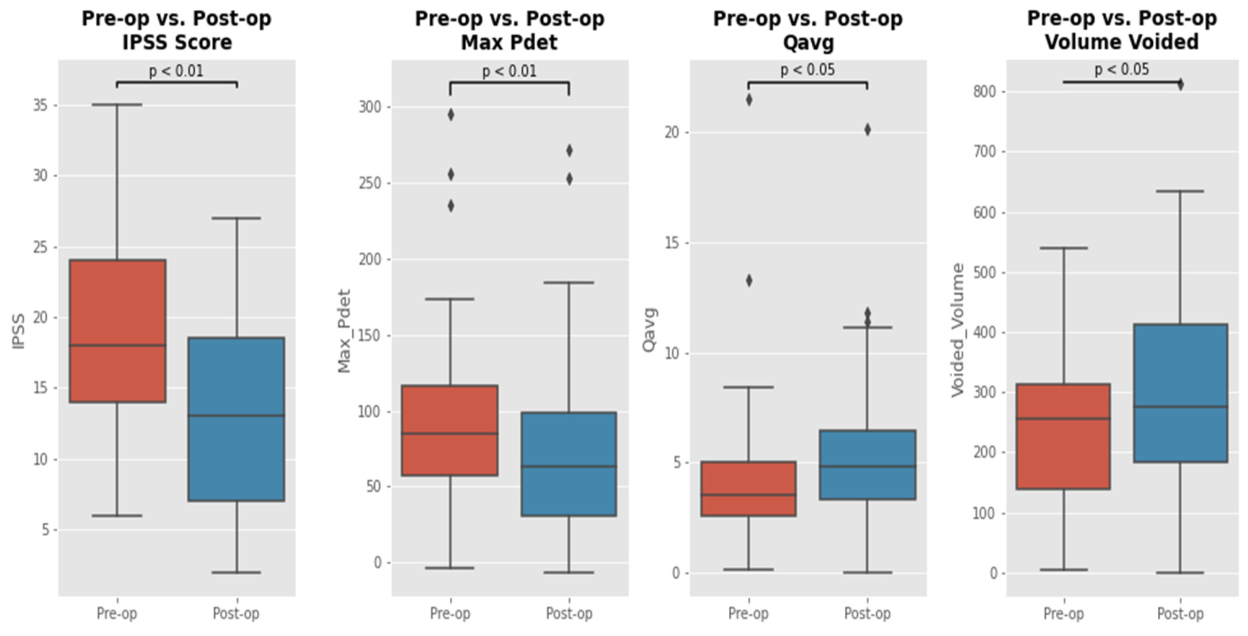
The reduction in IPSS represents a clinically meaningful improvement in lower urinary tract symptom severity. This improvement of approximately 31% in IPSS scores is consistent with previous reports in the literature demonstrating the efficacy of GreenLight PVP. Prior five-year experience studies with the 180-W XPS laser system have documented sustained IPSS reductions exceeding 80% at three-month follow, with the improvement reaching approximately 75% at long-term five-year follow-up [4]. Additional large-scale multicenter analyses have confirmed IPSS improvements across diverse patient populations and surgical techniques [16,17]. The degree of symptom improvement in the present study was somewhat more modest, which may reflect differences in baseline symptom severity, patient selection, or the inclusion of real-world consecutive patients rather than a highly selected study population. Nevertheless, the trajectory of symptom improvement in our cohort showed rapid initial gains at one month, with continued symptom improvement through three to six months and maintenance across the follow-up period (Figure 1).
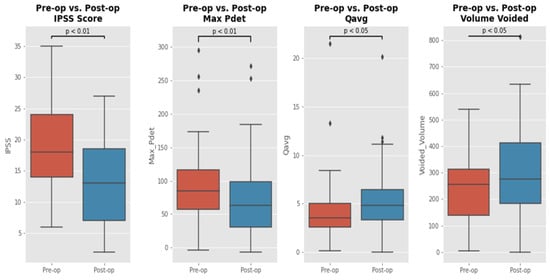
Figure 1.
Urodynamic parameter changes following photovaporization of the prostate. Box plots represent the median and interquartile range, with whiskers indicating the full data range. Statistical comparisons were performed using the Wilcoxon signed-rank test. A p-value < 0.05 was considered statistically significant.
The objective flow findings are also of particular significance. Qmax increased by 76%, from 6.25 to 11.0 mL/s, and Qavg increased by 35%, from 4.0 to 5.4 mL/s. These findings suggest substantial improvement in emptying efficiency following surgery. In a recent meta-analysis comparing GreenLight PVP vs. TURP, both procedures demonstrated significant improvements in Qmax, though differences between the two approaches at two-year follow-up were minimal and not statistically significant [18]. The findings of the present study suggest that GreenLight PVP produces urinary flow improvements that are in the upper range of reported values. Furthermore, the increase in average flow rate and the increase in voided volume further suggest more efficient emptying and improved voiding dynamics after treatment. However, we acknowledge that the absolute postoperative Qmax of 11.0 mL/s, while representing a 76% improvement, remains modest compared to the population mean for men without obstruction. Flow rates below 15 mL/s are traditionally considered reduced, and our cohort demonstrated values in this range postoperatively. Recent literature on bladder recovery suggests that residual reductions in flow parameters can reflect either incomplete tissue resection, changes in detrusor contractility during recovery from chronic obstruction, or underlying detrusor dysfunction in selected patients [19]. Our real-world patient population likely included heterogeneous baseline pathophysiology—including patients with chronic obstruction-induced detrusor changes and varying degrees of baseline contractility—which may not achieve complete normalization in all subjects, despite adequate mechanical de-obstruction.
The improvement in BOOI provides objective confirmation of reduced outlet resistance after GreenLight PVP. The BOOI is derived from the relationship between detrusor pressure at maximum flow and maximum flow rate and serves as a validated urodynamic parameter for quantifying the severity of outlet obstruction. The improvement in BOOI from 46.7 to 28.9 is consistent with meaningful mechanical relief of bladder outlet obstruction. This supports the interpretation that postoperative symptom and flow improvements were not simply subjective but reflected true de-obstruction. It is, however, important to acknowledge that although this improvement reached statistical significance, the postoperative BOOI values remained within ranges suggesting residual outlet resistance in some patients. BOOI values below 20 typically indicate minimal obstruction, while values between 20 and 40 represent equivocal obstruction. Our findings thus demonstrate significant statistical improvement while recognizing that complete normalization of obstruction parameters was not uniformly achieved across the cohort. This pattern is consistent with the heterogeneity observed in bladder recovery following chronic obstruction, where individual variation in detrusor function and compliance recovery influences long-term deobstruction outcomes. Nevertheless, this finding supports the interpretation that postoperative symptom and flow improvements were not simply subjective but reflected meaningful deobstruction, even where residual outlet resistance persisted.
The marked reduction in maximum detrusor pressure offers additional insight into the physiologic effect of PVP treatment. Chronic outlet obstruction increases detrusor workload and can lead to compensatory hypertrophy and elevated voiding pressures. In this study, max Pdet decreased from 84.8 to 61.2 cmH2O, suggesting that the bladder required less pressure to void after PVP. Prior studies have similarly shown that photovaporization reduces obstruction and normalizes voiding dynamics over time. Hamann et al. previously established that photovaporization of the prostate effectively combats obstruction by normalizing voiding parameters, with improvements sustained over 12-month follow-up periods [19]. A previous randomized controlled trial comparing GreenLight HPS 120 W laser photovaporization to TURP observed similar reductions in infravesical obstruction, demonstrating significant 20 cmH2O reductions in micturition pressure in both treatment groups [7]. Therefore, this finding seems to suggest restoration of more efficient mechanistic coupling between detrusor contraction and urinary flow, resulting in adequate flow at lower intravesical pressures.
Further, there was a marked increase in voided volume from a median of 217.9 to 230.3 mL. This increase in voided volume suggests improved functional bladder capacity, which may reflect both resolution of outlet obstruction, allowing for improved emptying, and potential recovery of detrusor function. Long-term quality of life improvements have been demonstrated to correlate strongly with increased voided volume and reduced post-void residual volume [20]. Recent studies examining storage symptoms have shown that while voiding function improves dramatically, storage symptom improvement may persist independently and requires separate assessment [21]. This distinction is clinically important, as it suggests that obstruction relief addresses voiding dysfunction, while storage symptoms may evolve through a separate mechanism.
An interesting finding from the present study involves the relationship between maximum detrusor pressure and detrusor pressure at maximum flow. While maximum detrusor pressure decreased significantly, the detrusor pressure at maximum flow showed a numerical decrease that did not reach statistical significance. This may reflect more complex postoperative voiding physiology. One potential explanation for the stability of Pdet@Qmax is that patients may have relied less on Valsalva maneuvers and accessory abdominal muscle contractions following the procedure. Mechanistically, the bladder may have been able to generate effective flow with less overall peak pressure, even if pressure at maximum flow changed to a lesser degree. This interpretation remains strictly hypothetical, but it may help explain why max Pdet and PDet@Qmax levels did not move in parallel.
The present study raises important questions regarding the role of urodynamic testing in the evaluation and management of benign prostatic hyperplasia. While symptom scores and noninvasive uroflowmetry are now widely accepted as standard metrics for assessing BPH severity and treatment response, routine pressure-flow studies remain uncommon in real-world clinical practice. However, our data suggest that urodynamics can provide useful mechanistic information, especially in patients with complex symptoms or mixed presentations. In this real-world cohort, only a subset of the full cohort had complete pressure-flow data, which reflects the practical limits of routine urodynamic testing in real-world practice. Nevertheless, the subset of patients who underwent urodynamic evaluation demonstrated clear patterns that improve our understanding of the treatment’s mechanisms. Similarly, postoperative urodynamics could quantify the magnitude of obstruction relief achieved and validate level of success of treatment, along with setting a new objective voiding baseline.
5. Study Limitations
While this study provides valuable urodynamic data that underlie the mechanics of photovaporization, several limitations merit acknowledgement. Although it includes prospectively gathered data in a standard clinical protocol, the study’s retrospective design is inherently subject to selection bias. The retrospective single-center design limits causal inference and introduces potential selection bias. Furthermore, the absence of comparator surgical cohorts precludes conclusions regarding the relative physiologic effects of PVP compared with those of other surgical treatments for benign prostatic obstruction. Prospective multicenter studies directly comparing standardized pressure-flow outcomes after HoLEP, TURP, Aquablation, GreenLight PVP, and other minimally invasive surgical therapies would further define procedure-specific changes in bladder outlet dynamics.
Further, the number of patients with complete urodynamic data was substantially lower than the overall cohort number. This reflects the realities of a real-world practice setting in which a portion of otherwise available urodynamic measurements could not be included because they contained missing fields or were physiologically implausible values identified during data cleaning (e.g., negative flow or pressure recordings or values inconsistent with basic urodynamic physiology). Exclusion of these records was necessary to avoid bias from erroneous measurements but further reduced the final analytic sample size. The smaller pressure-flow cohort (n = 64) relative to the overall study population (N = 98) limits the statistical power available to detect smaller-magnitude differences in urodynamic parameters, such as the observed change in Pdet@Qmax, and may reduce the generalizability of the pressure-flow findings to the broader population of patients undergoing GreenLight PVP, particularly to those for whom urodynamic testing is not routinely pursued. Therefore, these findings should be interpreted with appropriate caution and confirmed in larger prospective multicenter studies with standardized urodynamic follow-up.
Additionally, follow-up duration was limited to 12 months for this study. Longer-term data would provide further information regarding the durability of obstruction relief and the evolution of urodynamic parameters over time. Future prospective comparative studies incorporating standardized pressure-flow testing across multiple surgical modalities are warranted.
6. Conclusions
This real-world cohort study provides detailed urodynamic characterization of the mechanisms underlying clinical improvements seen in patients with benign prostatic hyperplasia treated with GreenLight photovaporization. The reduction in the maximum detrusor pressure and bladder outlet obstruction index, coupled with marked improvements in maximum and average flow rates, demonstrates that symptom relief is underpinned by measurable restoration of voiding mechanics. These findings highlight the value of integrating comprehensive urodynamic assessment into the evaluation of patients with BPH. Larger prospective studies with longer follow-up are needed to better define the durability of these changes and potentially compare them across treatment modalities.
Author Contributions
Conceptualization, J.S.K. and L.S.L.; methodology, J.S.K., C.M.H. and L.S.L.; software, P.J.S.; validation, J.S.K., P.J.S. and L.S.L.; formal analysis, J.S.K., C.M.H., P.J.S. and L.S.L.; investigation, J.S.K., C.M.H. and L.S.L.; resources, L.S.L.; data curation, J.S.K., C.M.H. and L.S.L.; writing—original draft, J.S.K. and L.S.L.; writing—review and editing, J.S.K. and L.S.L.; visualization, P.J.S.; supervision, L.S.L.; project administration, L.S.L. All authors have read and agreed to the published version of the manuscript.
Funding
This research received no external funding.
Institutional Review Board Statement
Ethics approval was waived by the BRANY Institutional Review Board due to the retrospective nature of the study, which involved review and analysis of existing clinical data collected during routine patient care and posed no more than minimal risk to participants. Approval Code: #23-12-574-1399, granted on 13 September 2023.
Informed Consent Statement
The requirement for individual patient informed consent was waived by the BRANY Institutional Review Board due to the retrospective nature of the study.
Data Availability Statement
The original contributions presented in this study are included in the article. Further inquiries can be directed to the corresponding author.
Conflicts of Interest
The authors declare no conflicts of interest.
References
- Lieber, M.M.; Rhodes, T.; Jacobson, D.J.; McGree, M.E.; Girman, C.J.; Jacobsen, S.J.; Sauver, J.L.S. Natural history of benign prostatic enlargement: Long-term longitudinal population-based study of prostate volume doubling times. BJU Int. 2010, 105, 214–219. [Google Scholar] [CrossRef] [Scilit] [PubMed]
- Nunes, R.L.V.; Antunes, A.A.; Constantin, D.S. Contemporary surgical treatment of benign prostatic hyperplasia. Rev. Assoc. Med. Bras. 2017, 63, 711–715. [Google Scholar] [CrossRef] [Scilit] [PubMed]
- Sandhu, J.S.; Bixler, B.R.; Dahm, P.; Goueli, R.; Kirkby, E.; Stoffel, J.T.; Wilt, T.J. Management of lower urinary tract symptoms attributed to benign prostatic hyperplasia: AUA guideline amendment 2023. J. Urol. 2023, 211, 11–19. [Google Scholar] [CrossRef] [Scilit] [PubMed]
- Ajib, K.; Mansour, M.; Zanaty, M.; Alnazari, M.; Hueber, P.-A.; Meskawi, M.; Valdivieso, R.; Tholomier, C.; Pradere, B.; Misrai, V.; et al. Photoselective vaporization of the prostate with the 180-W XPS GreenLight laser: Five-year experience of safety, efficiency, and functional outcomes. Can. Urol. Assoc. J. 2018, 12, E318. [Google Scholar] [CrossRef] [Scilit] [PubMed]
- Castellani, D.; Pirola, G.M.; Rubilotta, E.; Gubbiotti, M.; Scarcella, S.; Maggi, M.; Gauhar, V.; Teoh, J.Y.-C.; Galosi, A.B. GreenLight laser photovaporization versus transurethral resection of the prostate: A systematic review and meta-analysis. Res. Rep. Urol. 2021, 13, 263–271. [Google Scholar] [CrossRef] [Scilit] [PubMed]
- Mattevi, D.; Luciani, L.; Spina, R.; Divan, C.; Cicuto, S.; Cai, T.; Vattovani, V.; Puglisi, M.; Chiodini, S.; Malossini, G. Comparison of GreenLight 180-W XPS laser vaporization versus transurethral resection of the prostate: Outcomes of a single regional center. Arch. Ital. Urol. Androl. 2020, 92, 169–174. [Google Scholar] [CrossRef] [Scilit] [PubMed]
- Pereira-Correia, J.A.; Sousa, K.D.d.M.; Santos, J.B.P.; Perpétuo, D.d.M.; Lopes-Da-Silva, L.F.; Krambeck, R.L.; Muller, V.J.F.; Vaz, F.P. GreenLight HPS 120-W laser vaporization versus transurethral resection of the prostate (<60 mL): A 2-year randomized double-blind prospective urodynamic investigation. BJU Int. 2012, 110, 1184–1189. [Google Scholar] [CrossRef] [Scilit] [PubMed]
- Burdziak, H.; Syryło, T.; Grabińska, A.; Burdziak, K.; Ławiński, J.; Tomaka, M.; Zieliński, H. Efficacy and safety of photoselective vaporization of the prostate using the GreenLight XPS 180-W laser and simple prostatectomy for high-volume prostate hypertrophy: A comparative analysis. Cent. Eur. J. Urol. 2024, 77, 64–76. [Google Scholar] [CrossRef] [Scilit] [PubMed]
- Fu, Y.; Wen, X.; Yin, Y.; Wang, C.; Mai, J. Comparison of effectiveness and postoperative complications of different surgical methods in the treatment of benign prostatic hyperplasia: A systematic review and meta-analysis based on randomized controlled trials. Transl. Androl. Urol. 2022, 11, 842–858. [Google Scholar] [CrossRef] [Scilit] [PubMed]
- Malde, S.; Lam, W.; Adwin, Z.; Hashim, H. Pharmacological and interventional treatment of benign prostatic obstruction: An evidence-based comparative review. BJUI Compass 2021, 2, 238–259. [Google Scholar] [CrossRef] [Scilit] [PubMed]
- Campobasso, D.; Ferrari, G.; Frattini, A. GreenLight laser: A laser for every prostate and every urologist. World J. Urol. 2020, 40, 295–296. [Google Scholar] [CrossRef] [Scilit] [PubMed]
- MacDonald, A.; Fathy, M.; Nikoufar, P.; Hodhod, A.; Hadi, R.A.; Vangala, S.K.; Bassuony, M.; Zakaria, A.S.; Shahrour, W.; Elmansy, H. Safety and clinical outcomes of GreenLight laser prostatectomy in octogenarians. Can. Urol. Assoc. J. 2023, 18, E65–E72. [Google Scholar] [CrossRef] [Scilit] [PubMed]
- MacDonald, A.; Fathy, M.; Nikoufar, P.; Hodhod, A.; Hadi, R.A.; Alhelal, S.; Alaradi, H.; Zakaria, A.S.; Shahrour, W.; Elmansy, H. Efficacy of GreenLight laser prostatectomy in urinary retention. Can. Urol. Assoc. J. 2023, 18, E120–E126. [Google Scholar] [CrossRef] [Scilit] [PubMed]
- Waters, D.K.; Khalid, R.; Mustafa, F.; Omeire, F.; Jones, B.J. Safety profile of GreenLight XPS laser photoselective vaporisation of the prostate in patients at high risk of bleeding. J. Clin. Urol. 2021, 16, 333–339. [Google Scholar] [CrossRef] [Scilit]
- Campobasso, D.; Marchioni, M.; De Nunzio, C.; Destefanis, P.; Fasolis, G.; Varvello, F.; Voce, S.; Reale, G.; Cai, T.; Malossini, G.; et al. Predictors of re-intervention after GreenLight laser photoselective vaporization of the prostate: Multicenter long-term follow-up experience. Mini Invasive Surg. 2021, 5, 92. [Google Scholar] [CrossRef] [Scilit]
- Lichy, I.; Law, K.; Tholomier, C.; Nguyen, D.-D.; Sadri, I.; Bouhadana, D.; Couture, F.; Zakaria, A.S.; Bhojani, N.; Zorn, K.C.; et al. Global experience and progress in GreenLight XPS 180-W photoselective vaporization of the prostate. World J. Urol. 2022, 40, 1513–1522. [Google Scholar] [CrossRef] [Scilit] [PubMed]
- Campobasso, D.; Marchioni, M.; Altieri, V.M.; Greco, F.; De Nunzio, C.; Destefanis, P.; Ricciardulli, S.; Bergamaschi, F.; Fasolis, G.; Varvello, F.; et al. GreenLight photoselective vaporization of the prostate: One laser for different prostate sizes. J. Endourol. 2020, 34, 54–60. [Google Scholar] [CrossRef] [Scilit] [PubMed]
- Porto, B.C.; Benedicto, B.C.; Constantinou, B.T.; Hobaica, N.C.; Passerotti, C.C.; de Lima, R.D.; Sanderberg, R.A.S.; Artifon, E.L.A.; Otoch, J.P.; da Cruz, J.A.S. GreenLight photoselective laser vaporisation versus transurethral resection of the prostate for large prostates: Systematic review and meta-analysis. Transl. Androl. Urol. 2025, 14, 1261–1272. [Google Scholar] [CrossRef] [Scilit] [PubMed]
- Hamann, M.F.; Naumann, C.M.; Seif, C.; van der Horst, C.; Jünemann, K.-P.; Braun, P.M. Functional outcome following photoselective vaporisation of the prostate (PVP): Urodynamic findings within 12 months follow-up. Eur. Urol. 2008, 54, 902–910. [Google Scholar] [CrossRef] [Scilit] [PubMed]
- Sun, I.; Yoo, S.; Park, J.; Cho, S.Y.; Jeong, H.; Son, H.; Oh, S.-J.; Paick, J.-S.; Cho, M.C. Quality of life after photoselective vaporization and holmium laser enucleation of the prostate: Five-year outcomes. Sci. Rep. 2019, 9, 8261. [Google Scholar] [CrossRef] [Scilit] [PubMed]
- Hsieh, Y.-C.; Wang, C.-T.; Kao, Y.-L.; Cheng, Y.-S.; Wu, K.-Y.; Ho, Y.-H.; Chuang, M.-S.; Huang, Y.-C.; Ou, Y.-C. Therapeutic efficacy of 180-W GreenLight laser photoselective vaporization of the prostate for storage symptoms concomitant with benign prostatic obstruction and a search for outcome predictors. Neurourol. Urodyn. 2024, 43, 646–654. [Google Scholar] [CrossRef] [Scilit] [PubMed]

Disclaimer/Publisher’s Note: The statements, opinions and data contained in all publications are solely those of the individual author(s) and contributor(s) and not of MDPI and/or the editor(s). MDPI and/or the editor(s) disclaim responsibility for any injury to people or property resulting from any ideas, methods, instructions or products referred to in the content. |
© 2026 by the authors. Licensee MDPI, Basel, Switzerland. This article is an open access article distributed under the terms and conditions of the Creative Commons Attribution (CC BY) license.