


Abstract
Background: Celiac disease (CD) is a systemic immune-mediated enteropathy with a broad spectrum of extraintestinal manifestations driven by aberrant mucosal IgA responses and increased intestinal permeability. These same mechanisms provide a compelling biological rationale for urinary tract involvement. The aim of this systematic review was to assess whether adults with CD carry an elevated risk of IgAN, UTI, or IC/BPS compared with adults without CD. Methods: A PRISMA 2020-compliant systematic review was conducted (PROSPERO: CRD420261358537). PubMed and Scopus were searched up to April 2026. Eligible studies enrolled adults (≥18 years) with confirmed CD, reported a urinary outcome, and included a comparator group. Risk of bias was assessed using the Newcastle–Ottawa Scale and Mendelian Randomization quality criteria. Results: Fifteen studies (1987–2025) were included. For IgAN (n = 13), a register-based cohort showed an over 18-fold elevated risk in adults with biopsy-confirmed CD (adj. HR: 18.98; 95%CI: 2.29–157.63), independently corroborated by Mendelian Randomization (OR: 1.44; 95%CI: 1.17–1.78). Early cross-sectional AGA studies reflect non-specific IgA dysregulation, not true CD autoimmunity. For UTI (n = 1), no significant association was identified in a single large registry study. For IC/BPS (n = 1), no clinical observational evidence exists and genetic causal analysis found no association. Conclusions: CD is consistently associated with elevated IgAN risk across independent study designs, supporting systematic CD screening in IgAN patients and prompt GFD initiation. For UTI and IC/BPS, adequately designed prospective studies are needed.
1. Introduction
Celiac disease (CD) is a chronic immune-mediated enteropathy triggered by dietary gluten in genetically predisposed individuals, with an estimated global seroprevalence of approximately 1.4% and a biopsy-confirmed prevalence of 0.7% in the general population [1]. The condition is characterised by small intestinal villous atrophy, crypt hyperplasia, and intraepithelial lymphocytosis resulting from an HLA-DQ2- or HLA-DQ8-restricted adaptive immune response to gluten-derived gliadin peptides, which are deamidated and rendered more immunogenic by the tissue transglutaminase 2 (tTG2) enzyme [2]. Currently, the only established treatment remains lifelong adherence to a gluten-free diet (GFD), which achieves mucosal healing and prevents complications in the majority of compliant patients [2,3,4]. Although historically conceptualised as an enteropathy confined to the gastrointestinal tract, CD is now firmly recognised as a systemic condition with a broad spectrum of extraintestinal manifestations affecting virtually every organ system, including the liver, skin, nervous system, musculoskeletal apparatus, and reproductive system [5]. The Oslo consensus definitions formalised this spectrum by distinguishing classical, non-classical, subclinical, and potential forms of CD, acknowledging that the clinical presentation is not reliably predicted by the degree of mucosal injury [2].
Emerging evidence has identified the urinary tract as a potential extraintestinal domain of involvement in CD. Three distinct clinical entities have been investigated: urinary tract infection (UTI), interstitial cystitis/bladder pain syndrome (IC/BPS), and IgA nephropathy (IgAN). The biological plausibility for an association between CD and each of these conditions rests on two converging mechanisms operative across all three domains. First, increased intestinal permeability driven by zonulin-mediated dysregulation of tight junctions in active CD allows luminal antigens to enter systemic circulation and trigger immune responses at remote sites [6]. Second, CD is characterised by a global perturbation of mucosal IgA homeostasis: overproduction of polymeric IgA by gut-associated lymphoid tissue, combined with defective galactosylation of IgA1 glycoforms, generates circulating immune complexes capable of depositing in vascular and organ parenchymal tissues and impairing mucosal pathogen clearance [6,7].
Urinary tract infections represent the second most common bacterial infection in the general population. Their potential link with CD rests on the immunological consequences of active disease, including hyposplenism, impaired neutrophil function, and defective secretory IgA-mediated pathogen clearance at mucosal surfaces [5].
IC/BPS is a chronic inflammatory bladder condition with a prevalence ranging from 1.2 to 575 per 100,000 women depending on the diagnostic criteria applied. It has long been associated with systemic autoimmune diseases, suggesting a shared immune-mediated aetiology [8]. The hypothesis that CD may predispose to IC/BPS is biologically plausible, given shared features of aberrant mucosal immune activation, defective barrier function, mast cell-mediated inflammation, and female predominance [9].
IgA nephropathy is the most common primary glomerulonephritis worldwide, with an incidence of 31–45 cases per million population per year [10], and a clinical course that leads to end-stage renal disease in 20–40% of patients within 20 years of diagnosis [7,10]. Its pathogenesis follows a multi-hit model in which galactose-deficient IgA1 (Gd-IgA1) produced at mucosal sites acts as an autoantigen recognised by IgG autoantibodies, generating immune complexes that deposit in the glomerular mesangium [7]. Beyond the shared mechanisms outlined above, CD and IgAN are further linked by the gut–kidney axis [11], and, distinctively, by the direct involvement of tTG2 with IgA-tTG colocalization deposits have been identified in renal tissue of patients with active CD, implicating the primary CD autoantigen in IgAN pathogenesis [12].
The present systematic review aims to synthesise the available evidence on this association in a unique framework. Specifically, the review addresses the following pre-specified research questions: (1) whether adults with CD are at increased risk of UTI compared with adults without CD; (2) whether CD is associated with a higher prevalence or incidence of IC/BPS; (3) whether CD is associated with an increased risk of IgAN and what is the magnitude of this risk; (4) whether the risk of urinary conditions differs between active, untreated CD and established disease on GFD; and (5) whether the association between CD and urinary conditions is modified by sex.
2. Materials and Methods
This systematic review was conducted and reported in accordance with the Preferred Reporting Items for Systematic Reviews and Meta-Analyses (PRISMA) 2020 guidelines [13] (PRISMA Checklist is in the Supplementary Materials S1). The review protocol was prospectively registered in the PROSPERO international register of systematic reviews (CRD420261358537) and conducted according to a pre-specified PECO framework.
The population comprised adults (≥18 years) with a confirmed diagnosis of celiac disease, either biopsy-proven (Marsh ≥ II lesion with positive serology) or serologically confirmed, regardless of treatment status at time of urinary outcome assessment. The exposure was a clinical diagnosis of CD or, in Mendelian Randomization analyses, genetic liability to CD derived from genome-wide association study (GWAS) instruments. No formal comparator was pre-specified beyond the requirement for a reference group without CD or without the corresponding genetic liability, which could include general population controls, matched controls, or disease-free registry reference individuals. The primary outcomes were the incidence or prevalence of UTI, the incidence or prevalence of IC/BPS, and the incidence, prevalence, or relative risk of IgAN. Secondary outcomes included risk of recurrent UTI, risk of end-stage renal disease (ESRD) in the context of IgAN, and data on the association between CD activity status and urinary outcomes.
2.1. Eligibility Criteria
Eligible study designs included randomized controlled trials, non-randomized interventional studies, prospective and retrospective observational studies, registry-based cohort studies, Mendelian Randomization analyses, and case series providing clinically or mechanistically relevant data on CD–renal tissue interactions, with a minimum of five patients for case series. Studies were excluded if: (i) the population did not include adults with a confirmed CD diagnosis or a defined CD genetic liability; (ii) no comparator group without CD (or without the genetic liability) was available for risk or prevalence estimation; or (iii) the urinary outcome was reported descriptively without any measure of effect size or statistical test linking CD status to the outcome. Studies reporting urinary outcomes as purely prognostic associations in patients not selected on the basis of CD exposure, case reports and reviews were excluded. No restrictions were applied on language or date of publication.
2.2. Information Sources and Search Strategy
A systematic search was conducted in PubMed and Scopus with no date or language restrictions. All databases were last searched up to 30 April 2026.
The PubMed search string included terms for the exposure (“celiac disease” OR “coeliac disease” OR “gluten” OR “tissue transglutaminase”) combined with terms for the outcomes (“IgA nephropathy” OR “glomerulonephritis” OR “urinary tract infection” OR “interstitial cystitis” OR “bladder pain syndrome” OR “renal disease”), filtered to human studies. In addition to database searching, forward and backward citation searching was performed on all included studies, and reference lists of relevant narrative and systematic reviews were hand-searched to identify additional eligible records.
2.3. Selection Process
Records retrieved from the database searches were deduplicated and screened in two sequential phases. In the first phase, titles and abstracts were independently screened by two reviewers against the eligibility criteria; discordant decisions were resolved by discussion. In the second phase, full texts of potentially eligible records were retrieved and independently assessed by two reviewers. Disagreements were resolved by consensus discussion among all reviewers. Reasons for exclusion at the full-text stage were documented.
2.4. Data Collection Process
Data were extracted independently by two reviewers using a pre-specified and piloted data extraction form. Discrepancies were resolved by consensus. Authors were not contacted for additional data. For each included study, the following information was collected: first author and year of publication, country, study design, sample size, clinical population (disease stage, CD diagnostic method, treatment context, GFD adherence status), nature of the comparator group, CD assessment method and biological sample type, timing of CD assessment relative to outcome ascertainment, outcomes reported, and effect estimates with measures of precision, and, where available, data stratified by GFD status and by sex.
2.5. Risk-of-Bias Assessment
Risk of bias was assessed independently by two reviewers for each included study using tools selected according to study desiagn. For cohort and case–control studies, the standard Newcastle–Ottawa Scale (NOS) was applied, yielding a maximum score of 10 across three domains, with the following cut-offs: ≥8 = low risk; 6–7 = low–moderate risk; 4–5 = moderate risk; ≤3 = high risk. For cross-sectional studies, an adapted version of the NOS was applied in which three domains not applicable to this design—outcome not present at start of study, sufficiency of follow-up duration, and adequacy of follow-up cohort—were rated as not applicable and excluded from the denominator, yielding a maximum score of 7, with the following cut-offs: 6–7 = low to low–moderate risk; 4–5 = moderate risk; ≤3 = high risk. One study was assessed with explicit acknowledgement of the structural limitations of the NOS in this context [12]. Mendelian Randomization studies [14,15] were evaluated using the guidelines and reviewer checklist of Burgess et al. [16], which systematically examines ten domains: research motivation and scope, data sources, selection of genetic variants, variant harmonization, primary analysis, robust sensitivity methods, other sensitivity approaches, extensions and additional analyses, data presentation, and interpretation. Discrepancies between reviewers were resolved by consensus.
2.6. Synthesis Methods
Given the substantial clinical and methodological heterogeneity among included studies with respect to study design, CD diagnostic methods, comparator populations, and outcome definitions, a quantitative meta-analysis was not performed. Evidence was synthesised through a structured narrative synthesis, conducted in accordance with the Synthesis Without Meta-analysis (SWiM) reporting guideline [17].
2.7. Reporting Bias Assessment
Given the limited number of studies available for each outcome domain formal statistical assessment of publication bias was not feasible. The potential for reporting bias was assessed qualitatively by considering the distribution of statistically significant versus non-significant findings across included studies and by consulting trial registers to identify registered studies with unpublished results.
2.8. Certainty of Evidence
The certainty of evidence for each outcome domain was assessed using the Grading of Recommendations Assessment, Development and Evaluation (GRADE) framework. Certainty was rated across five domains: risk of bias, inconsistency, indirectness, imprecision, and publication bias. Starting certainty was high for cohort and registry studies and was downgraded according to standard criteria. Mendelian Randomization evidence was initially treated as observational-equivalent and rated accordingly.
3. Results
3.1. Study Selection and Characteristics
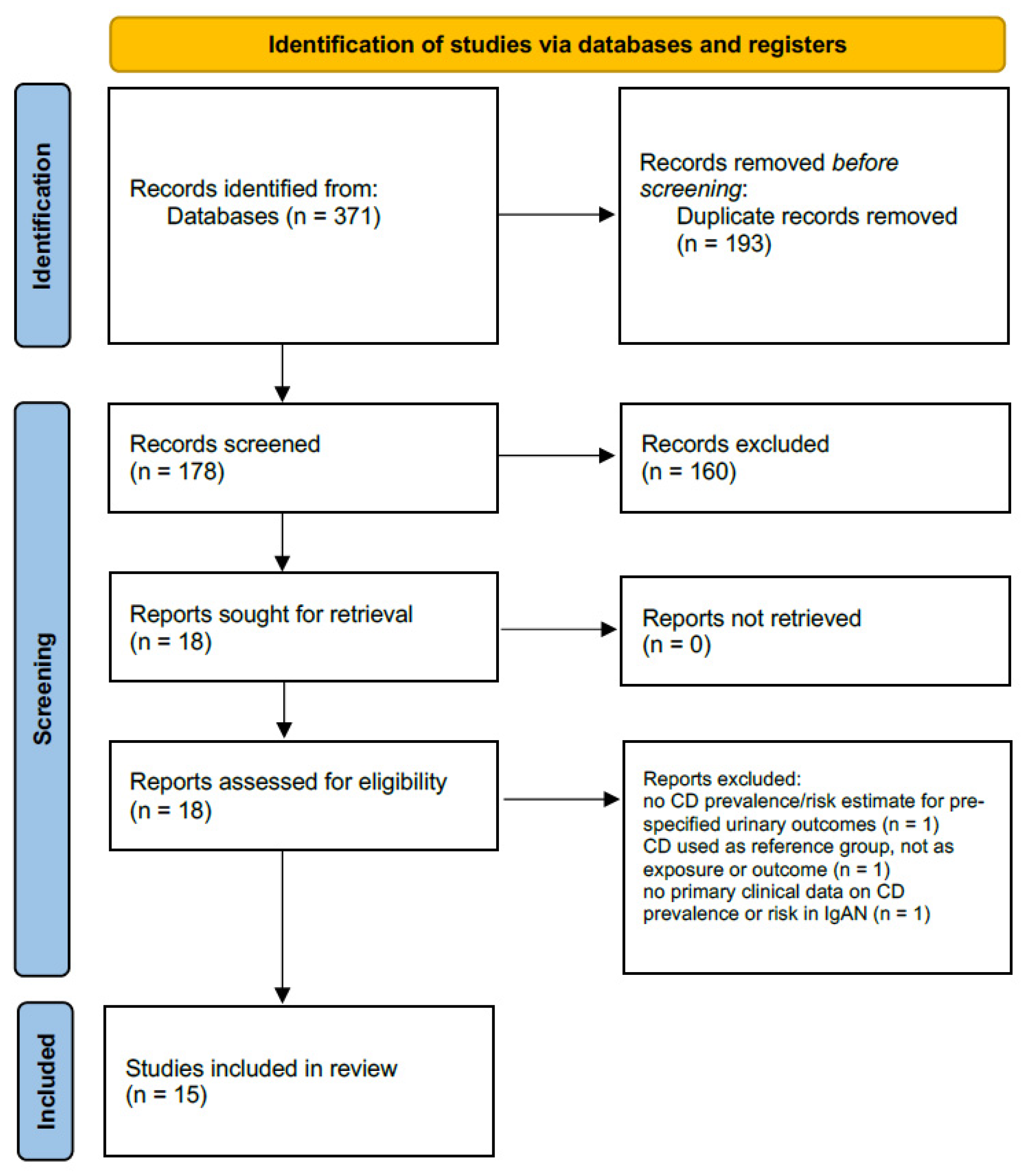
The systematic search retrieved 371 records from PubMed (n = 111) and Scopus (n = 266). After removal of 193 duplicates, 184 records were screened by title and abstract. Eighteen full texts were assessed for eligibility, of which three were excluded (reasons detailed in PRISMA flowchart below). Fifteen studies met the eligibility criteria and were included in the narrative synthesis. The PRISMA flowchart is reported in Figure 1.
Figure 1.
PRISMA flowchart.
The included studies were published between 1987 and 2025 and were conducted across eight countries: Finland (n = 5), Italy (n = 2), France (n = 1), Estonia (n = 1), Sweden (n = 2), the United States (n = 1), India (n = 1), and multinational GWAS-derived populations (n = 2). Study characteristics are summarised in Table 1.
Table 1.
Characteristics of included studies.
Based on clinical domain and primary outcome, studies were grouped as follows: (1) CD and prevalence of celiac autoimmunity or CD in IgAN patients (cross-sectional and cohort designs) [12,18,19,20,21,22,23,24,25,26]; (2) risk of IgAN in adults with established CD [27]; (3) genetic causal effect of CD liability on IgAN and other renal outcomes [14]; (4) CD and risk of UTI [28]; and (5) genetic causal effect of autoimmune diseases including CD on IC/BPS [15].
Risk-of-bias assessment identified four studies at low risk of bias [21,24,27,29], four at low–moderate risk [19,22,25,26], three at moderate risk [18,20,23], two at high or high–moderate risk [12,28], and two rated low risk by Mendelian Randomization criteria [14,15]. Both MR studies satisfied the core assumptions and were rated at low risk of bias overall; minor limitations were noted regarding restriction to European-ancestry populations and, for Wu et al. (2025), the absence of an independent validation dataset [15]. Full risk-of-bias assessments are presented in Table 2.
Table 2.
Risk-of-bias assessment for included studies. Observational studies were assessed using the Newcastle–Ottawa Scale (NOS); Mendelian Randomization studies were evaluated using the guidelines and reviewer checklist of Burgess et al.
CD was assessed across six methodological approaches applied to serum, archival tissue, or GWAS summary statistics. The evolution of CD diagnostic standards across the study period constitutes a fundamental source of methodological heterogeneity: studies using IgA-AGA as the sole marker cannot be directly compared with those applying biopsy-confirmed diagnoses. This heterogeneity was a primary driver of the decision not to perform a meta-analysis.
3.2. CD and IgA Nephropathy
Thirteen studies addressed the CD–IgAN relationship across four methodological tiers: early cross-sectional studies using first-generation anti-gliadin antibodies (IgA-AGAs) without biopsy confirmation; studies applying validated CD-specific serology and/or biopsy-confirmed CD; register-based cohort evidence; and Mendelian Randomization (MR).
IgA-AGA elevations were detected in 22–70% of IgAN patients across three early studies [18,19,20] with EMA and IgA-tTG consistently negative in all three series, indicating non-specific polyclonal IgA dysregulation rather than true CD autoimmunity. Pierucci et al. (2002) reported a distinct finding: EMA positivity in 44.4% of IgAN patients, predominantly of the IgG1 rather than IgA isotype and without confirmatory duodenal biopsy, a result of uncertain pathological significance that has not been replicated [22]. This interpretation was confirmed by Moeller et al. (2014) in the most comprehensive case–control serological study in the literature (n = 99 IgAN, n = 96 matched controls), which found no significant elevation of any CD-specific marker in IgAN [24]. Smerud et al. (2009) reported mucosal reactivity to a rectal gluten challenge in 30% of IgAN patients, with no increase in CD-specific serology or HLA DQ2/DQ8 frequency, a finding of uncertain significance given the unvalidated challenge technique used [23].
Among studies using validated methods, Collin et al. (2002) found biopsy-confirmed CD in 3.6% (95%CI: 1.6–7.0%) of a consecutive IgAN cohort (n = 223), an estimate four- to eight-fold above contemporaneous population prevalence [21]. Two Finnish cohort studies from the Tampere group documented celiac autoimmunity in 0.6–8.2% of IgAN patients [25,26]. A mechanistic case series from the same group detected IgA-tTG colocalization deposits in renal biopsies of all three IgAN patients with active CD on a gluten-containing diet; these deposits were absent in the single patient with CD already established on GFD [12].
The strongest epidemiological evidence is provided by Nurmi et al. (2022), a register-based Finnish cohort of 1072 patients with biopsy-confirmed CD followed for a median of 46 years, which demonstrated a markedly elevated risk of IgAN (adj. HR: 18.98; 95%CI: 2.29–157.63) and of chronic glomerulonephritis (adj. HR: 3.33; 95%CI: 1.52–7.29), both independent of type 1 diabetes [27]. No significant renal risk elevation was observed in patients with dermatitis herpetiformis. This finding is corroborated by the MR analysis of Ge et al. (2024), which demonstrated a causal effect of genetic liability to CD on IgAN risk (OR: 1.44; 95%CI: 1.17–1.78; p = 5.7 × 10⁻⁴) without evidence of horizontal pleiotropy [14]. Dutta et al. (2023), limited by a critically low consent rate of approximately 21%, reported IgA-tTG seropositivity in 15.6% of an Indian IgAN cohort (32 of 151 consenting) [28].
3.3. CD and Urinary Tract Infection
A single registry-based study addressed this domain, linking Swedish national registries across over 1.6 million pregnancies (1973–2001) [28]. No statistically significant association was identified between CD and UTI during pregnancy or with recurrent pre-pregnancy UTI. The study’s restriction to pregnant women and the limited sensitivity of birth-questionnaire UTI recording, which relied on clinician-reported diagnoses rather than urine-culture confirmation, substantially limit generalisability.
3.4. CD and Interstitial Cystitis or Bladder Pain Syndrome
No observational clinical study has directly examined IC/BPS prevalence in patients with confirmed CD. The only eligible evidence was the bidirectional MR analysis by Wu et al. (2025), which found no statistically significant causal relationship between genetic liability to CD and IC/BPS in either direction [15].
3.5. GRADE
The certainty of evidence for each outcome was assessed using the GRADE framework (Table 3). Certainty was rated very low for cross-sectional CD prevalence estimates in IgAN, the genetic causal effect of CD on IgAN (MR), first-generation AGA serological studies, and CD in IC/BPS MR analysis. The register-based risk estimate for IgAN in CD [27] and the UTI registry study [28] were rated low certainty.
Table 3.
GRADE certainty of evidence assessment.
4. Discussion
This systematic review aimed to provide a rigorous synthesis of evidence on the association between CD and three distinct urinary tract conditions in adult population. Across the 15 included studies, a directionally consistent signal emerges for the IgAN domain: multiple independent lines of evidence suggest that CD is associated with a materially elevated risk of IgAN. However, the overall certainty of evidence is low across all three urinary domains. For UTI, the available evidence is restricted to a single registry-based study with important scope limitations. For IC/BPS, no observational clinical evidence exists, and the only available data did not confirm a causal association.
The most coherent body of evidence in this review pertains to the CD–IgAN domain. The landmark finding is provided by the register-based Finnish cohort of Nurmi et al. (2022), which demonstrated an over 18-fold adjusted hazard ratio for IgAN in patients with biopsy-confirmed CD compared with matched reference individuals [27]. This estimate is directionally consistent with the earlier Swedish population-based cohort (0–95 years) of Welander et al. (2013), which identified a 3.03-fold increased risk of IgAN in 27,160 biopsy-confirmed CD patients compared with 133,949 matched controls [30]. The convergence of these two geographically independent register-based cohorts, both using biopsy-confirmed CD diagnoses and large matched reference groups, constitutes the most robust epidemiological evidence currently available. Furthermore, the Mendelian Randomization analysis by Ge et al. (2024) demonstrated that genetic liability to CD causally elevates the risk of IgAN [14], providing causal inference that is independent of confounding by indication and CD treatment effects. The convergence of a register-based phenotypic association and a MR-based genetic causal estimate, using entirely different methodological paradigms, substantially strengthens the inference that the CD–IgAN link reflects a genuine biological relationship rather than a confounding artifact.
The earlier cross-sectional literature, by contrast, is difficult to interpret collectively. The key distinction that emerged from this review is the divergence between studies using first-generation anti-gliadin antibodies (IgA-AGAs) and those using validated CD-specific serology or biopsy confirmation. IgA-AGAs are elevated in 22–70% of IgAN patients across these early studies; however, as demonstrated by all three series and subsequently confirmed by Moeller et al. (2014) in a well-characterised case–control study [24], these elevations are not accompanied by CD-specific markers. The polyclonal IgA dysregulation intrinsic to IgAN, characterised by aberrant galactosylation of IgA1 and hyperresponsiveness to mucosal antigens, is a sufficient explanation for non-specific AGA elevation without implying true gluten-sensitive enteropathy [7]. The study by Moeller et al. is particularly informative in this regard: applying the most comprehensive serological panel in the literature, including both native and deamidated gliadin antibodies, IgA-tTG2, EMA, and HLA DQ genotyping, it found no significant elevation of any CD-specific marker in IgAN compared with matched controls. This result must be weighed appropriately against the positive AGA findings of earlier, smaller, and less controlled studies.
The biological plausibility of the CD–IgAN link rests on several mechanistically well-characterised convergent pathways. Both diseases are characterised by aberrant mucosal IgA immune responses: in CD, gliadin-specific IgA autoantibodies to tTG2 are produced at the gut mucosa and deposit in extraintestinal tissues; in IgAN, hypo-galactosylated IgA1 (Gd-IgA1) produced at mucosal sites forms immune complexes that deposit in the glomerular mesangium [7]. The gut–kidney axis—the concept that dysregulated gut-associated lymphoid tissue immune responses can drive renal IgA deposition—is now established both in human epidemiology and experimental models [11]. In an IgAN humanised double-transgenic mouse model expressing human IgA1 and CD89, dietary gluten exacerbated IgA mesangial deposition, hematuria, and IgA1-sCD89 immune complex formation through a gliadin-CD89 interaction mechanism; a GFD prevented these changes [31]. Conversely, tTG2—the primary autoantigen of CD—has been demonstrated to be mechanistically necessary for the formation of mesangial IgA immune complexes in IgAN, as tTG2 knockout almost abolishes IgAN development in transgenic models [32].
The mechanistic case series by Nurmi et al. (2021) adds a further dimension: IgA-tTG colocalization deposits were detected in renal biopsies of IgAN patients with active CD on a gluten-containing diet and, critically, in three of five IgAN patients without CD, but were absent in IgAN patients with CD already on GFD [12]. While the case series design and absence of a formal control group preclude any quantitative conclusions, these findings raise the intriguing possibility that subclinical celiac autoimmunity, below the diagnostic threshold for CD, may contribute to renal IgA deposition in a subgroup of IgAN patients, and that gluten withdrawal could attenuate this mechanism. This is consistent with clinical case reports documenting proteinuria reduction or even complete nephrotic syndrome remission following GFD initiation in patients with co-existing CD and IgAN [33]. Whether GFD offers renal benefit in IgAN patients without concurrent CD remains an open and clinically important question that awaits a prospective randomised evaluation [34]. The link between CD and IgAN has also been explored in the paediatric context: a recent narrative review specifically addressing renal involvement in childhood CD confirmed that IgAN represents one of the most frequently reported associations, alongside urolithiasis and diabetic nephropathy, while noting that prospective paediatric studies with adequate follow-up remain lacking [35].
A clinically significant and mechanistically informative finding of Nurmi et al. (2022) is the absence of statistically significant elevation in renal outcomes in patients with dermatitis herpetiformis (DH), despite DH being a well-established cutaneous manifestation of CD with identical gluten-driven autoimmunity, Marsh III villous atrophy in the majority, and circulating tTG-specific IgA [27]. This phenotype-dependence suggests that the CD–IgAN association may not be driven by gluten-triggered tTG2 autoimmunity alone, but may depend on additional disease-specific factors such as the magnitude and systemic distribution of mucosal IgA immune complex production, the degree of intestinal inflammation, or treatment-associated differences [27]. Alternatively, the absence of detectable risk in DH may simply reflect the smaller sample size and correspondingly lower statistical power in that group. Mechanistic and larger epidemiological studies comparing IgA nephropathy incidence across CD phenotypes are needed to resolve this question.
A further methodological issue common to several included studies is the use of IgA-tTG seropositivity without confirmatory duodenal biopsy as a proxy for CD. While IgA-tTG has high sensitivity and specificity for CD, false positivity occurs in other inflammatory and autoimmune conditions including type 1 diabetes and autoimmune liver disease [36]. In the absence of biopsy confirmation, the prevalence estimate of celiac autoimmunity in IgAN may have overestimated true biopsy-confirmed CD prevalence.
The evidence base for the association between CD and UTI in adults is limited to a single large registry-based study which found no statistically significant association between diagnosed or undiagnosed CD and UTI risk during pregnancy or recurrent UTI before pregnancy [28]. Although point estimates for undiagnosed CD were consistently above 1.0, none achieved conventional statistical significance, and the study population was restricted to pregnant Swedish women, a population in whom UTI risk is physiologically elevated and in whom the immunological context may differ substantially from the non-pregnant adult state.
The biological hypothesis linking CD to increased UTI susceptibility is plausible, resting on three mechanistic pillars: (1) systemic immunodeficiency in active CD, including hyposplenism and impaired neutrophil function; (2) defective secretory IgA-mediated pathogen clearance at mucosal surfaces in patients with ongoing small bowel inflammation [6]; and (3) potential alterations in urothelial barrier function secondary to systemic inflammation or nutritional deficiencies. Paediatric data, while limited, are mixed: a retrospective cohort study by Saalman & Fällström (1996) reported a significantly higher incidence of first-time UTI in children with CD compared with an unselected paediatric population, with the majority of cases occurring during the period of untreated, active disease [37]; whereas Kalyoncu and Urgancı (2018), in a prospective case–control study of 120 children with CD and 45 healthy controls, found no significant difference in UTI prevalence overall, although all five UTI cases occurred exclusively in children non-compliant with GFD [38]. Taken together, both studies suggest that UTI risk, if elevated in CD, may be confined to the period of active, untreated disease. However, the transition from paediatric to adult immunology and the physiological differences between childhood and adult urinary anatomy and immune competence make direct extrapolation unwarranted. No population-based adult cohort study with appropriate CD diagnostic criteria, outpatient UTI capture, and non-pregnant controls currently exists.
The pre-specified research question regarding IC/BPS as a potential urinary extraintestinal manifestation of CD could not be addressed by any observational clinical study. The sole available evidence found no statistically significant genetic causal relationship between CD liability and IC/BPS in either direction [15]. The absence of clinical evidence may in part reflect the diagnostic difficulties inherent to IC/BPS, which requires exclusion of multiple confusable conditions, its lower prevalence relative to UTI and IgAN, and historically limited clinical awareness of this condition as a potential autoimmune comorbidity. The epidemiological associations between IC/BPS and systemic autoimmune diseases are well-documented [8], lending biological plausibility to a potential CD association that the current literature has not yet explored in adequately designed studies.
The GRADE assessment yielded very low certainty for CD prevalence estimates in IgAN (cross-sectional studies), the genetic causal CD–IgAN effect (MR study), first-generation AGA serological findings, and the CD-IC/BPS MR analysis, and low certainty for the register-based IgAN risk estimate and the UTI registry study. The fundamental driver of downgrading across all domains was serious risk of bias in most included studies (predominantly cross-sectional or retrospective designs, single-centre recruitment, limited or absent biopsy confirmation), compounded by imprecision (small absolute event counts, wide confidence intervals) and inconsistency (particularly for the serological evidence, where findings diverge markedly across methods). A prior systematic review and meta-analysis by Wijarnpreecha et al. (2016), pooling eight studies, reported a pooled risk ratio of 2.01 (95%CI: 1.44–2.81) for overall kidney disease in CD [39]; however, this estimate predates the high-quality register-based evidence and the MR analysis now available, and was driven largely by ESRD data from Swedish national registries.
The clinical implications of these findings are nonetheless significant, particularly for the IgAN domain. The converging epidemiological and mechanistic evidence suggests that systematic serological screening for CD in patients presenting with IgAN is warranted, and that confirmed co-existing CD should be treated promptly with GFD. Beyond IgAN, the markedly elevated long-term risk of renal comorbidity in CD patients supports the inclusion of periodic renal function monitoring, encompassing serum creatinine, urinalysis, and proteinuria assessment, as part of routine follow-up in adults with confirmed CD. Regarding UTI, the available evidence suggests that susceptibility, if elevated, may be confined to the period of active, untreated disease, reinforcing the importance of strict GFD adherence as a potentially protective measure. This conclusion is further supported by case reports of complete IgAN remission following GFD in patients with concurrent CD [33]. Whether GFD or targeted tTG2 inhibition might offer renal benefit in IgAN patients without concurrent CD requires prospective investigation in adequately powered randomised trials.
The principal strengths of this review are its methodological rigour: pre-specified eligibility criteria anchored in a PROSPERO-registered protocol, application of the NOS risk-of-bias framework adapted for different study designs, GRADE certainty rating, and strict systematic delineation of the serological-versus-biopsy-confirmed CD distinction as a critical analytical criterion. By explicitly grouping studies by methodological approach within the IgAN domain, this review avoids the categorical error of treating IgA-AGA-positive and biopsy-confirmed CD studies as comparable evidence of the same phenomenon.
The principal limitations are those of the underlying evidence base. The predominance of cross-sectional and single-centre retrospective studies, the heterogeneity of CD diagnostic criteria across a 40-year publication span, and the overlap of the Tampere group cohorts [12,25,26,27], which share patient populations and must not be treated as independent replication, collectively limit the strength of any conclusions. The search was restricted to the published literature, introducing potential publication bias toward positive findings; however, formal assessment was not feasible given the small number of studies per outcome domain. Additionally, the search was conducted in two databases; although Scopus provides broad coverage that substantially overlaps with EMBASE indexing, and comprehensiveness was further augmented by systematic forward and backward citation searching on all included studies, studies indexed exclusively in EMBASE or other specialised sources may not have been captured. The absence of studies addressing IC/BPS as a primary outcome in patients with confirmed CD represents the most consequential evidence gap identified by this review, as this domain was pre-specified as a primary research question. Furthermore, none of the included studies in the UTI or IC/BPS domains was conducted outside the pregnant-women context UTI or outside a GWAS-derived MR framework, highlighting the absence of appropriately designed observational studies for both outcomes. Finally, the pre-specified secondary research questions addressing the modifying effects of GFD status and sex on the CD–urinary outcome association could not be answered, as no included study reported stratified analyses for either variable. These represent additional priority areas for future prospective research.
5. Conclusions
Despite the low certainty of the current evidence, the directional consistency of the CD–IgAN association across multiple study designs supports biological plausibility and warrants clinical awareness. The available data support systematic CD screening in adults with IgAN and prompt GFD initiation in confirmed cases. For UTI and IC/BPS, the evidence base is insufficient to draw clinical conclusions, and both domains represent critical priorities for future adequately designed prospective research. Should the CD–IgAN signal be confirmed in sufficiently powered prospective studies with biopsy-confirmed endpoints and formally tested CD-by-renal-outcome interaction analyses, serological CD screening could become a component of standard nephrology workup in IgAN patients, with potential implications for a gluten-targeted treatment strategy in a subset of this population. Future prospective cohort studies should incorporate GFD adherence status and sex-stratified analyses as core components of their design, to enable systematic answers to these pre-specified but currently unanswerable research questions.
Supplementary Materials
The following supporting information can be downloaded at https://www.mdpi.com/article/10.3390/uro6030023/s1. Supplementary Materials S1: PRISMA Checklist.
Author Contributions
Conceptualization, M.L.G. and G.G.; methodology, M.L.G.; software, M.L.G.; validation, M.L.G. and G.G.; formal analysis, M.L.G. and G.G.; investigation, M.L.G. and G.G.; resources, M.L.G.; data curation, M.L.G.; writing—original draft preparation, M.L.G. and G.G.; writing—review and editing, M.L.G. and G.G.; visualization, M.L.G.; supervision, M.L.G. and G.G.; project administration, M.L.G.; funding acquisition, M.L.G. All authors have read and agreed to the published version of the manuscript.
Funding
This research received no external funding.
Institutional Review Board Statement
Not applicable.
Informed Consent Statement
Not applicable.
Data Availability Statement
No new data were generated in this study. All data supporting the findings are derived from previously published studies cited in the reference list and are available from the respective original sources.
Conflicts of Interest
The authors declare no conflicts of interest.
Abbreviations
The following abbreviations are used in this manuscript:
| AGA | Anti-gliadin antibody |
| CD | Celiac disease |
| CI | Confidence interval |
| DH | Dermatitis herpetiformis |
| EMA | Anti-endomysial antibody |
| ESRD | End-stage renal disease |
| eFGR | Estimated glomerula filtration rate |
| Gd-IgA | Galactose-deficient IgA1 |
| GFD | Gluten-free diet |
| GN | Glomerulonephritis |
| GRADE | Grading of Recommendations Assessment, Development and Evaluation |
| GWAS | Genome-wide association study |
| HLA | Human leukocyte antigen |
| HR | Hazard ratio |
| IC/BPS | Interstitial cystitis/bladder pain syndrome |
| IgA | Immunoglobulin A |
| IgAN | IgA nephropathy |
| IgG | Immunoglobulin G |
| IVW | Inverse variance weighting |
| MN | Membranous nephropathy |
| MR | Mendelian Randomization |
| NOS | Newcastle–Ottawa Scale |
| OR | Odds ratio |
| PECO | Population, Exposure, Comparator, Outcome |
| PRISMA | Preferred Reporting Items for Systematic Reviews and Meta-Analyses |
| SNP | Single nucleotide polymorphism |
| SWiM | Synthesis Without Meta-analysis |
| tTG2 | Tissue transglutaminase 2 |
| UTI | Urinary tract infection |
References
- Singh, P.; Arora, A.; Strand, T.A.; Leffler, D.A.; Catassi, C.; Green, P.H.; Kelly, C.P.; Ahuja, V.; Makharia, G.K. Global Prevalence of Celiac Disease: Systematic Review and Meta-analysis. Clin. Gastroenterol. Hepatol. 2018, 16, 823–836.e2. [Google Scholar] [CrossRef] [Scilit] [PubMed]
- Ludvigsson, J.F.; Leffler, D.A.; Bai, J.C.; Biagi, F.; Fasano, A.; Green, P.H.; Hadjivassiliou, M.; Kaukinen, K.; Kelly, C.P.; Leonard, J.N.; et al. The Oslo definitions for coeliac disease and related terms. Gut 2013, 62, 43–52. [Google Scholar] [CrossRef] [Scilit] [PubMed]
- Durazzo, M.; Ferro, A.; Brascugli, I.; Mattivi, S.; Fagoonee, S.; Pellicano, R. Extra-Intestinal Manifestations of Celiac Disease: What Should We Know in 2022? J. Clin. Med. 2022, 11, 258. [Google Scholar] [CrossRef] [Scilit] [PubMed]
- Ludvigsson, J.F.; Bai, J.C.; Biagi, F.; Card, T.R.; Ciacci, C.; Ciclitira, P.J.; Green, P.H.R.; Hadjivassiliou, M.; Holdoway, A.; van Heel, D.A.; et al. Diagnosis and management of adult coeliac disease: Guidelines from the British Society of Gastroenterology. Gut 2014, 63, 1210. [Google Scholar] [CrossRef] [Scilit] [PubMed]
- Lauret, E.; Rodrigo, L. Celiac disease and autoimmune-associated conditions. BioMed Res. Int. 2013, 2013, 127589. [Google Scholar] [CrossRef] [Scilit] [PubMed]
- Fasano, A. Zonulin and its regulation of intestinal barrier function: The biological door to inflammation, autoimmunity, and cancer. Physiol. Rev. 2011, 91, 151–175. [Google Scholar] [CrossRef] [Scilit] [PubMed]
- Wyatt, R.J.; Julian, B.A. IgA nephropathy. N. Engl. J. Med. 2013, 368, 2402–2414. [Google Scholar] [CrossRef] [Scilit] [PubMed]
- van de Merwe, J.P. Interstitial cystitis and systemic autoimmune diseases. Nat. Clin. Pract. Urol. 2007, 4, 484–491. [Google Scholar] [CrossRef] [Scilit] [PubMed]
- Keller, J.J.; Chen, Y.K.; Lin, H.C. Comorbidities of bladder pain syndrome/interstitial cystitis: A population-based study. BJU Int. 2012, 110, E903–E909. [Google Scholar] [CrossRef] [Scilit] [PubMed]
- Schena, F.P.; Nistor, I. Epidemiology of IgA Nephropathy: A Global Perspective. Semin. Nephrol. 2018, 38, 435–442. [Google Scholar] [CrossRef] [Scilit] [PubMed]
- Floege, J.; Feehally, J. The mucosa-kidney axis in IgA nephropathy. Nat. Rev. Nephrol. 2016, 12, 147–156. [Google Scholar] [CrossRef] [Scilit] [PubMed]
- Nurmi, R.; Korponay-Szabo, I.; Laurila, K.; Huhtala, H.; Niemela, O.; Mustonen, J.; Makela, S.; Kaukinen, K.; Lindfors, K. Celiac Disease-Type Tissue Transglutaminase Autoantibody Deposits in Kidney Biopsies of Patients with IgA Nephropathy. Nutrients 2021, 13, 1594. [Google Scholar] [CrossRef] [Scilit] [PubMed]
- Page, M.J.; McKenzie, J.E.; Bossuyt, P.M.; Boutron, I.; Hoffmann, T.C.; Mulrow, C.D.; Shamseer, L.; Tetzlaff, J.M.; Akl, E.A.; Brennan, S.E.; et al. The PRISMA 2020 statement: An updated guideline for reporting systematic reviews. BMJ 2021, 372, n71. [Google Scholar] [CrossRef] [Scilit] [PubMed]
- Ge, Y.M.; Peng, S.L.; Wang, Q.; Yuan, J. Causality between Celiac disease and kidney disease: A Mendelian Randomization Study. Medicine 2024, 103, e39465. [Google Scholar] [CrossRef] [Scilit] [PubMed]
- Wu, L.; Wang, T.; Bai, M.; Chen, J.; Ning, J.; Jin, Q.; Ma, Y.; Xu, X.; Hao, Z.; Yang, R. Causal role of common autoimmune diseases in interstitial cystitis/bladder pain syndrome: Mendelian randomization (MR) study. Medicine 2025, 104, e41484. [Google Scholar] [CrossRef] [Scilit] [PubMed]
- Burgess, S.; Davey Smith, G.; Davies, N.M.; Dudbridge, F.; Gill, D.; Glymour, M.M.; Hartwig, F.P.; Kutalik, Z.; Holmes, M.V.; Minelli, C.; et al. Guidelines for performing Mendelian randomization investigations: Update for summer 2023. Wellcome Open Res. 2019, 4, 186. [Google Scholar] [CrossRef] [Scilit] [PubMed]
- Campbell, M.; McKenzie, J.E.; Sowden, A.; Katikireddi, S.V.; Brennan, S.E.; Ellis, S.; Hartmann-Boyce, J.; Ryan, R.; Shepperd, S.; Thomas, J.; et al. Synthesis without meta-analysis (SWiM) in systematic reviews: Reporting guideline. BMJ 2020, 368, l6890. [Google Scholar] [CrossRef] [Scilit] [PubMed]
- Laurent, J.; Branellec, A.; Heslan, J.M.; Rostoker, G.; Bruneau, C.; André, C.; Intrator, L.; Lagrue, G. An increase in circulating IgA antibodies to gliadin in IgA mesangial glomerulonephritis. Am. J. Nephrol. 1987, 7, 178–183. [Google Scholar] [CrossRef] [Scilit] [PubMed]
- Sategna-Guidetti, C.; Ferfoglia, G.; Bruno, M.; Pulitano, R.; Roccatello, D.; Amore, A.; Coppo, R. Do IgA antigliadin and IgA antiendomysium antibodies show there is latent coeliac disease in primary IgA nephropathy? Gut 1992, 33, 476. [Google Scholar] [CrossRef] [Scilit] [PubMed]
- Ots, M.; Uibo, O.; Metsküla, K.; Uibo, R.; Salupere, V. IgA-antigliadin antibodies in patients with IgA nephropathy: The secondary phenomenon? Am. J. Nephrol. 1999, 19, 453–458. [Google Scholar] [CrossRef] [Scilit] [PubMed]
- Collin, P.; Syrjänen, J.; Partanen, J.; Pasternack, A.; Kaukinen, K.; Mustonen, J. Celiac disease and HLA DQ in patients with IgA nephropathy. Am. J. Gastroenterol. 2002, 97, 2572–2576. [Google Scholar] [CrossRef] [PubMed]
- Pierucci, A.; Fofi, C.; Bartoli, B.; Simonetti, B.M.; Pecci, G.; Sabbatella, L.; Di Tola, M.; Greco, R.; Anania, M.C.; Picarelli, A. Antiendomysial antibodies in Berger’s disease. Am. J. Kidney Dis. 2002, 39, 1176–1182. [Google Scholar] [CrossRef] [Scilit] [PubMed]
- Smerud, H.K.; Fellström, B.; Hällgren, R.; Osagie, S.; Venge, P.; Kristjánsson, G. Gluten sensitivity in patients with IgA nephropathy. Nephrol. Dial. Transplant. 2009, 24, 2476–2481. [Google Scholar] [CrossRef] [Scilit] [PubMed]
- Moeller, S.; Canetta, P.A.; Taylor, A.K.; Arguelles-Grande, C.; Snyder, H.; Green, P.H.; Kiryluk, K.; Alaedini, A. Lack of serologic evidence to link IgA nephropathy with celiac disease or immune reactivity to gluten. PLoS ONE 2014, 9, e94677. [Google Scholar] [CrossRef] [Scilit] [PubMed]
- Nurmi, R.; Metso, M.; Porsti, I.; Niemela, O.; Huhtala, H.; Mustonen, J.; Kaukinen, K.; Makela, S. Celiac disease or positive tissue transglutaminase antibodies in patients undergoing renal biopsies. Dig. Liver Dis. 2018, 50, 27–31. [Google Scholar] [CrossRef] [Scilit] [PubMed]
- Nurmi, R.; Pohjonen, J.; Metso, M.; Porsti, I.; Niemela, O.; Huhtala, H.; Mustonen, J.; Kaukinen, K.; Makela, S. Prevalence of Inflammatory Bowel Disease and Celiac Disease in Patients with IgA Nephropathy over Time. Nephron 2021, 145, 78–84. [Google Scholar] [CrossRef] [Scilit] [PubMed]
- Nurmi, R.; Pasternack, C.; Salmi, T.; Hervonen, K.; Koskinen, I.; Jarvelin, J.; Huhtala, H.; Collin, P.; Mustonen, J.; Kaukinen, K.; et al. The risk of renal comorbidities in celiac disease patients depends on the phenotype of celiac disease. J. Intern. Med. 2022, 292, 779–787. [Google Scholar] [CrossRef] [Scilit] [PubMed]
- Dutta, R.; Rawat, R.; Das, P.; Singh, G.; Kumari, A.; Ahmad, M.; Chauhan, A.; Ahuja, V.; Agrawal, S.K.; Makharia, G.K. Identification of celiac disease associated IgA nephropathy by IgA anti-tissue transglutaminase2 antibody deposits in archived formalin-fixed tissues. Saudi J. Gastroenterol. 2023, 29, 59–65. [Google Scholar] [CrossRef] [Scilit] [PubMed]
- Olén, O.; Montgomery, S.M.; Ekbom, A.; Bollgren, I.; Ludvigsson, J.F. Urinary tract infections in pregnant women with coeliac disease. Scand. J. Gastroenterol. 2007, 42, 186–193. [Google Scholar] [CrossRef] [Scilit] [PubMed]
- Welander, A.; Sundelin, B.; Fored, M.; Ludvigsson, J.F. Increased risk of IgA nephropathy among individuals with celiac disease. J. Clin. Gastroenterol. 2013, 47, 678–683. [Google Scholar] [CrossRef] [Scilit] [PubMed]
- Papista, C.; Lechner, S.; Ben Mkaddem, S.; LeStang, M.B.; Abbad, L.; Bex-Coudrat, J.; Pillebout, E.; Chemouny, J.M.; Jablonski, M.; Flamant, M.; et al. Gluten exacerbates IgA nephropathy in humanized mice through gliadin-CD89 interaction. Kidney Int. 2015, 88, 276–285. [Google Scholar] [CrossRef] [Scilit] [PubMed]
- Berthelot, L.; Papista, C.; Maciel, T.T.; Biarnes-Pelicot, M.; Tissandie, E.; Wang, P.H.; Tamouza, H.; Jamin, A.; Bex-Coudrat, J.; Gestin, A.; et al. Transglutaminase is essential for IgA nephropathy development acting through IgA receptors. J. Exp. Med. 2012, 209, 793–806. [Google Scholar] [CrossRef] [Scilit] [PubMed]
- Koivuviita, N.; Tertti, R.; Heiro, M.; Metsarinne, K. A case report: A patient with IgA nephropathy and coeliac disease. Complete clinical remission following gluten-free diet. NDT Plus 2009, 2, 161–163. [Google Scholar] [CrossRef] [Scilit] [PubMed]
- Coppo, R.; Amore, A.; Roccatello, D. Dietary antigens and primary immunoglobulin A nephropathy. J. Am. Soc. Nephrol. 1992, 2, S173–S180. [Google Scholar] [CrossRef] [Scilit] [PubMed]
- Starcea, I.M.; Miron, I.; Lupu, A.; Ioniuc, I.; Alecsa, M.; Azoicai, A.; Morariu, I.D.; Munteanu, V.; Lupu, V.V.; Mocanu, A. Unraveling chronic kidney disease in children: A surprising manifestation of celiac disease. Front. Pediatr. 2024, 12, 1384591. [Google Scholar] [CrossRef] [Scilit] [PubMed]
- Fasano, A.; Catassi, C. Clinical practice. Celiac disease. N. Engl. J. Med. 2012, 367, 2419–2426. [Google Scholar] [CrossRef] [Scilit] [PubMed]
- Saalman, R.; Fällström, S.P. High incidence of urinary tract infection in patients with coeliac disease. Arch. Dis. Child. 1996, 74, 170–171. [Google Scholar] [CrossRef] [Scilit] [PubMed]
- Kalyoncu, D. Urinary tract infections in pediatric patients with celiac disease. Eurasian J. Med. Investig. 2018, 2, 224–226. [Google Scholar] [CrossRef] [Scilit]
- Wijarnpreecha, K.; Thongprayoon, C.; Panjawatanan, P.; Thamcharoen, N.; Pachariyanon, P.; Nakkala, K.; Cheungpasitporn, W. Celiac disease and the risk of kidney diseases: A systematic review and meta-analysis. Dig. Liver Dis. 2016, 48, 1418–1424. [Google Scholar] [CrossRef] [Scilit] [PubMed]

Disclaimer/Publisher’s Note: The statements, opinions and data contained in all publications are solely those of the individual author(s) and contributor(s) and not of MDPI and/or the editor(s). MDPI and/or the editor(s) disclaim responsibility for any injury to people or property resulting from any ideas, methods, instructions or products referred to in the content. |
© 2026 by the authors. Licensee MDPI, Basel, Switzerland. This article is an open access article distributed under the terms and conditions of the Creative Commons Attribution (CC BY) license.