


Abstract
Purpose: Simultaneous liver–kidney transplantation (SLK) eligible candidates may receive SLK or liver-alone transplant (LA) with access to kidney transplant after initial LA (KAL). We aimed to characterize SLK-eligible recipient outcomes according to treatment approach. Methods: This study utilized 2017–2023 SRTR data to identify SLK-eligible deceased donor liver transplants. Recipients were placed into two groups based on whether SLK was performed; non-SLK patients were sub-stratified into LA and KAL cohorts. After baseline comparisons, 2-year patient and graft survival outcomes were characterized by univariable and multivariable Cox proportional hazard regression and Kaplan–Meier analysis. Results: Among 4879 candidates identified, 3746 (76.8%) underwent SLK, 1023 (21.0%) LA, and 110 (2.3%) KAL. SLK recipients maintained the highest eGFRs at 6 months, 1 year, and 2 years post-transplant (p < 0.01). Compared to SLK recipients, non-SLK recipients had a higher 2-year risk of mortality (aHR 2.46, p < 0.01), all-cause events (aHR 1.91, p < 0.01), and liver graft failure (HR 1.55, p = 0.02). LA conferred a higher 2-year mortality risk (aHR 2.98, p < 0.01) and all-cause event risk (aHR 2.25, p < 0.01), while KAL had comparable mortality risk to SLK (aHR 0.43, p = 0.40). Conclusions: When SLK-eligible candidates undergo transplants, SLK remains the optimal path forward, even when a safety net kidney can be performed.
1. Introduction
First demonstrated by Margreiter at Innsbruck University in 1983, simultaneous liver–kidney transplantation (SLK) has gained traction for patients with end-stage liver disease and severe renal dysfunction [1,2]. After the adoption of the Model for End-Stage Liver Disease (MELD) score in 2002, SLK has accounted for nearly 9% of all adult liver transplants nationwide [3]. Such patients with both liver and renal impairment have potential for native renal recovery after liver-alone transplant (LA), but it remains challenging to reliably predict which patients recover native function and which may necessitate kidney transplantation [4,5]. With this, many providers err on the side of caution and opted for SLK to lower the risk of poor patient and graft survival after liver transplantation (LT) in patients with renal dysfunction, likely contributing to the rise in SLK frequency in the 2000s [6].
On August 10, 2017, the Organ Procurement and Transplantation Network (OPTN) introduced the first medical eligibility-based allocation criteria for SLK with two primary objectives [7]. First, SLK eligibility was delineated for liver candidates who have coexisting chronic kidney disease (CKD), sustained acute kidney injury (AKI), and inherited metabolic disorders as evaluated by transplant nephrology and the transplant center [7]. The second formalized a route for LA recipients who do not recover renal function to gain access to expedited kidney-after-liver transplant (KAL), ahead of other local kidney-alone transplant (KA) candidates [7]. With this, the criteria have aimed to optimize SLK equity to those patients most in need while minimizing futile SLK, reduce geographic variability, and allocate kidney transplants judiciously via the safety net protocol [8]. Perhaps expectedly, there was a subsequent reduction in the number of SLKs performed and an increase in KALs in the immediate years after [9,10].
Many studies have sought to assess the criteria’s effects on outcomes. It has been demonstrated that LA patients with post-LT renal impairment experience higher patient mortality and graft loss than SLK patients, even when controlling for early mortality [11,12]. However, some note that LT recipients who had pre-LT renal impairment but not renal failure do not benefit from SLK in terms of 1- and 5-year post-transplant survival compared to LA recipients [9]. One study described no change in overall patient and graft survival between before and after the 2017 criteria implementation along with a subsequent decrease in the frequency of deceased-donor kidney transplants, suggesting that the policy redirected unnecessary kidney transplantation while preserving outcomes [10].
Given the heterogeneity of patients who may meet SLK eligibility, we reason that some patients will experience varying outcomes based on their type of transplant and degree of post-transplant renal recovery. Given the increasing incidence of liver disease, kidney disease and subsequent growing shortage of donor organs, we aimed to investigate the best path for SLK-eligible candidates by characterizing post-transplant outcomes, namely patient survival, graft survival, and renal outcomes, according to whether candidates proceed with SLK or an alternative strategy, be it LA or KAL.
2. Materials and Methods
2.1. Study Design
This study used data from the Scientific Registry of Transplant Recipients (STR). The SRTR data system includes data on all donors, wait-listed candidates, and transplant recipients in the US, submitted by the members of the Organ Procurement and Transplantation Network (OPTN). The Health Resources and Services Administration (HRSA), U.S. Department of Health and Human Services provides oversight to the activities of the OPTN and SRTR contractors.
Our study cohort included all adult liver transplant recipients (≥18 years old) who underwent transplantation after the implementation of SLK criteria on 17 August 2017. To ensure a minimum of one year of follow-up, recipients who underwent liver transplantation after 31 March 2023, were excluded. Additional exclusion criteria included living donor transplantation, multi-organ transplantation other than liver and kidney (e.g., pancreas, heart, lung, or intestine), and a history of prior liver or kidney transplantation. Waitlist and transplant data were analyzed with a last follow-up date of 30 September 2023. This study was approved by the Johns Hopkins University Institutional Review Board (IRB00352819).
2.2. SLK Eligibility Determination and Study Inclusion
Patients were categorized as SLK-eligible by adapting the OPTN SLK guidelines to the SRTR database, using diagnosis, organ(s) transplanted, and serial waitlist data before transplant, including measured serum creatinine and dialysis requirement. Patients were considered to be SLK-eligible if they were listed for a kidney before LT, received SLK, or met medical eligibility criteria via CKD, sustained AKI, or inherited metabolic disorders; the breakdown of eligibility determination is summarized in Table S1. The Chronic Kidney Disease Epidemiology Collaboration (CKD-EPI) equation was used to calculate estimated glomerular filtration rate (eGFR) for all patients [13].
The final cohort included all deceased donor liver transplant recipients who were SLK eligible at the time of transplant. Based on the organ(s) received at the time of first transplant, patients were then classified as SLK recipients or LA recipients. The SLK recipient cohort did not differentiate between those that underwent a single surgical procedure versus those that had a staged approach with sequential SLK. Additionally, the subset of LA recipients who proceeded to receive a kidney transplant at any time after their initial transplanted were assigned to the KAL group, regardless of whether they were safety net eligible (i.e., requiring dialysis or having an eGFR ≤ 20 between 60 and 365 days after initial liver transplant) [8]. We hypothesized that among eligible patients, SLK would confer superior post-transplant outcomes versus LA recipients but, that with the safety net policy in place, KAL would have comparable outcomes to SLK.
2.3. Pre-Transplant Data
Pre-transplant baseline and demographic characteristics were compared between all three subgroups of patients, including age, sex, body mass index (BMI), race/ethnicity, liver diagnosis, order of organ(s) listing, dialysis requirement, eGFR at time of transplant, MELD score at time of transplant with a breakdown of its components, length of waitlist time, length of hospitalization, liver donor age, liver donor race/ethnicity, donation after circulatory death (DCD), liver donor cold ischemic time, and pre-transplant functional status. This data characterization allowed for the identification of any differences that could have altered post-transplant outcomes.
2.4. Post-Transplant Data
Post-transplant data included a maximum of 2 years of follow-up data, namely patient survival, liver graft survival, kidney graft survival if applicable, serial measured serum creatinine, listing for kidney transplantation, receival of kidney transplantation, and re-transplantation. In the SRTR registry, follow-up serum creatinine values are recorded at 6 months, 1 year, and 2 years after liver transplantation and were used to calculate eGFRs for comparison. Data was summarized by transplant group.
Post-transplant renal outcomes were characterized for all patients, namely post-LT eGFR values at 6 months, 1 year and 2 years. Additionally, thresholds of eGFR < 30 mL/min2 and <60 mL/min2 were applied and compared at 6 months and 1 year. Survival outcomes included both overall patient survival and event free survival, with events including mortality, graft failure, and re-transplantation. Additionally, liver graft failure data was collected for all patients, and kidney graft failure data was gathered for SLK and KAL recipients.
2.5. Statistical Analysis
Baseline demographical characteristics and post-transplant outcomes were compared between the SLK, LA, and KAL groups using Student’s t-tests or Wilcoxon rank-sum tests for continuous variables and chi-squared tests or Fisher’s exact tests for categorical variables, as appropriate.
The four primary outcomes—overall patient survival, event free survival, liver graft survival, and kidney graft survival—were compared using Kaplan–Meier estimates via overall and pairwise log-rank testing and Cox proportional hazard analyses via hazard ratios and 95% confidence intervals, with both univariable and multivariable regression models. Covariates of multivariable models were selected a priori centered on clinical relevance and a literature review, and included recipient age, recipient sex, latest pre-transplant, cold ischemic time, liver donor age, liver donor sex, and DCD status. The SLK group served as the reference group for all comparisons.
For select analyses, LA and KAL recipients were combined to represent SLK-eligible patients who did not SLK. We reasoned that this combined group would offer a more meaningful comparison to SLK group, as it highlighted the potential risk of not performing SLK in eligible candidates. For such analyses, this combined cohort was labeled as “Non-SLK” recipients.
For overall patient survival and event free survival, Kaplan–Meier estimates were generated comparing SLK to Non-SLK. Cox regression models were computed for the LA group, KAL group, and Non-SLK group, referenced to SLK.
For kidney graft survival, Kaplan–Meier estimates were plotted for SLK vs. KAL patients. Cox regression models were computed for KAL group with SLK as the reference.
For liver graft survival, Kaplan–Meier estimates were plotted for SLK vs. LA patients. Cox regression models were conducted for the LA group and Non-SLK group, referenced to SLK.
All statistical analysis was carried out using STATA/IC 16.1 (StataCorp LLC, College Station, TX, USA). Significance was set to a p-value ≤ 0.05 for all tests.
3. Results
3.1. Study Population and Baseline Characteristics
From 17 August 2017 to 1 September 2022, we identified 4879 adult liver transplant recipients who met SLK eligibility criteria according to OPTN guidelines. Among them, 3746 (76.8%) underwent SLK and 1133 undergoing LA, of whom 110 subsequently underwent KAL. Of these KALs, 28 (25.5%) occurred within 2–6 months, 20 (18.2%) within 6–9 months, 23 (20.9%) within 9–12 months, and 39 (35.5%) in 1–2 years. The median days to kidney transplant after LT was 308 (IQR 182–445) within the 2-year follow-up period.
Demographic and baseline characteristics are outlined in Table 1. The median age was similar across all three groups. The majority of patients in all groups were male (≥50.0%) and white (≥59.6%). The most common indications for liver transplantation were alcoholic liver disease (30–33%) and non-alcoholic steatohepatitis (NASH) (28–34%), now referred to as metabolic dysfunction-associated steatohepatitis. Regarding pre-transplant functional status, SLK recipients tended to score higher on the Karnofsky Performance Status with improved functional status compared to LA and KAL recipients (p < 0.01) (Table S2).
Table 1.
Demographics and baseline characteristics of SLK eligible transplant recipients and donors in the United States, 2017–2023.
Of all SLK recipients, 58.3% were first listed for liver and kidney transplants simultaneously, compared to only 14.9% of LA recipients and 37.7% of KAL recipients (p < 0.01). Conversely, only 34.7% of SLK recipients were listed for liver first, compared to 83.9% of LA and 60.9% of KAL recipients (p < 0.01). Also, 6.9% of SLK recipients were listed for kidney first, compared to 1.3% of LA and 1.8% of KAL recipients (p < 0.01). The median waitlist time differed significantly between groups, with SLK recipients having the shortest duration at 55 days (IQR 10–222), compared to 160 days (IQR 68–402) for LA recipients and 101 days (IQR 19–298) for KAL recipients (p < 0.01). Of all 4879 SLK-eligible candidates, 3578 (73.3%) patients had a dialysis requirement at some time point before liver transplant. Overall and upon excluding those on dialysis, pre-transplant median eGFR was markedly lower in SLK recipients compared to LA and KAL recipients (p < 0.01). Lastly, pre-LT MELD score was lower in SLK recipients (median 30, IQR 24–35) compared to LA (median 37, IQR 32–40) and KAL recipients (median 34, IQR 28–30) (p < 0.01) with SLK recipients having a greater contribution of serum creatinine to the high MELD scores (Table 1 and Table S3).
Donor characteristics also varied significantly between groups. SLK recipients received organs from younger donors (median age 35 years) compared to LA (median 37 years) and KAL recipients (median 43 years) (p < 0.01). DCD was more common for SLK recipients (9%) than for LA (4%) and KAL recipients (4%) (p < 0.01). Liver cold ischemia time was shortest for SLK recipients (median 6 h, IQR 5–7) and longest for KAL recipients (median 7 h, IQR 5–8) (p < 0.01).
3.2. Post-Transplant Renal Outcomes
Post-transplant renal function was assessed using eGFRs at 6 months, 1 year, and 2 years (Table 2). SLK recipients maintained the highest post-transplant eGFR, with median values of 59, 57, and 57 mL/min2 at 6 months, 1 year, and 2 years, respectively (p < 0.01). In contrast, LA recipients showed significantly lower renal recovery (median 49, 49, and 48 mL/min2 at 6 months, 1 year, and 2 years, respectively, p < 0.01). KAL recipients had the lowest eGFR at 6 months (median 18 mL/min2) but showed improvement later (41 and 50 mL/min2 at 1 and 2 years, respectively, p < 0.01), approaching that of SLK recipients. When applying the post-transplant eGFR thresholds, SLK recipients had lower rates of <30 mL/min2 and <60 mL/min2 eGFRs at 6 months and 1 year when compared to the LA and KAL recipients (Table 2). Lastly, among the 1133 Non-SLK recipients, 223 (19.7%) experienced post-transplant renal failure requiring listing, of which 110 patients went on to receive the kidney transplants as KALs.
Table 2.
Post-transplant survival and renal outcomes for SLK eligible transplant recipients in the United States, 2017–2023.
3.3. Survival Outcomes
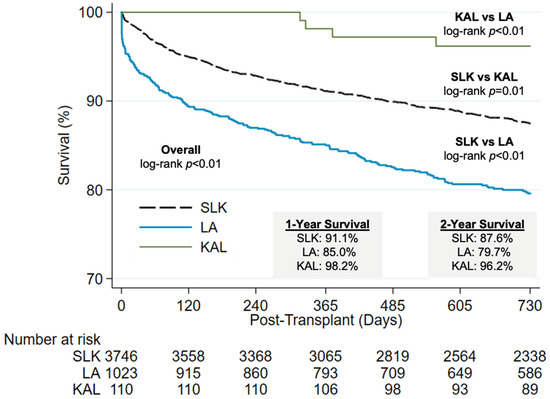
Kaplan–Meier survival estimates for patients up to 2 years post-transplantation demonstrated higher 2-year mortality in the LA group compared to SLK recipients (p < 0.01) (Table 3, Figure 1). In the multivariable Cox proportional hazard analysis, LA recipients had approximately three-fold increased risk of mortality compared to SLK recipients (adjusted HR (aHR) 2.98, 95% CI 1.92–4.65, p < 0.01) (Table 3). The combined Non-SLK group showed a lower aHR compared to the LA group alone, but the risk of mortality remained increased (aHR 2.46, 95% CI 1.60–3.79, p < 0.01). KAL recipients, however, did not reveal a significant difference in adjusted mortality risk compared to SLK recipients (aHR 0.43, 95% CI 0.05–3.11, p = 0.40).
Table 3.
Overall post-transplant mortality risk according to type of procedure using Cox proportional hazard modeling.
Figure 1.
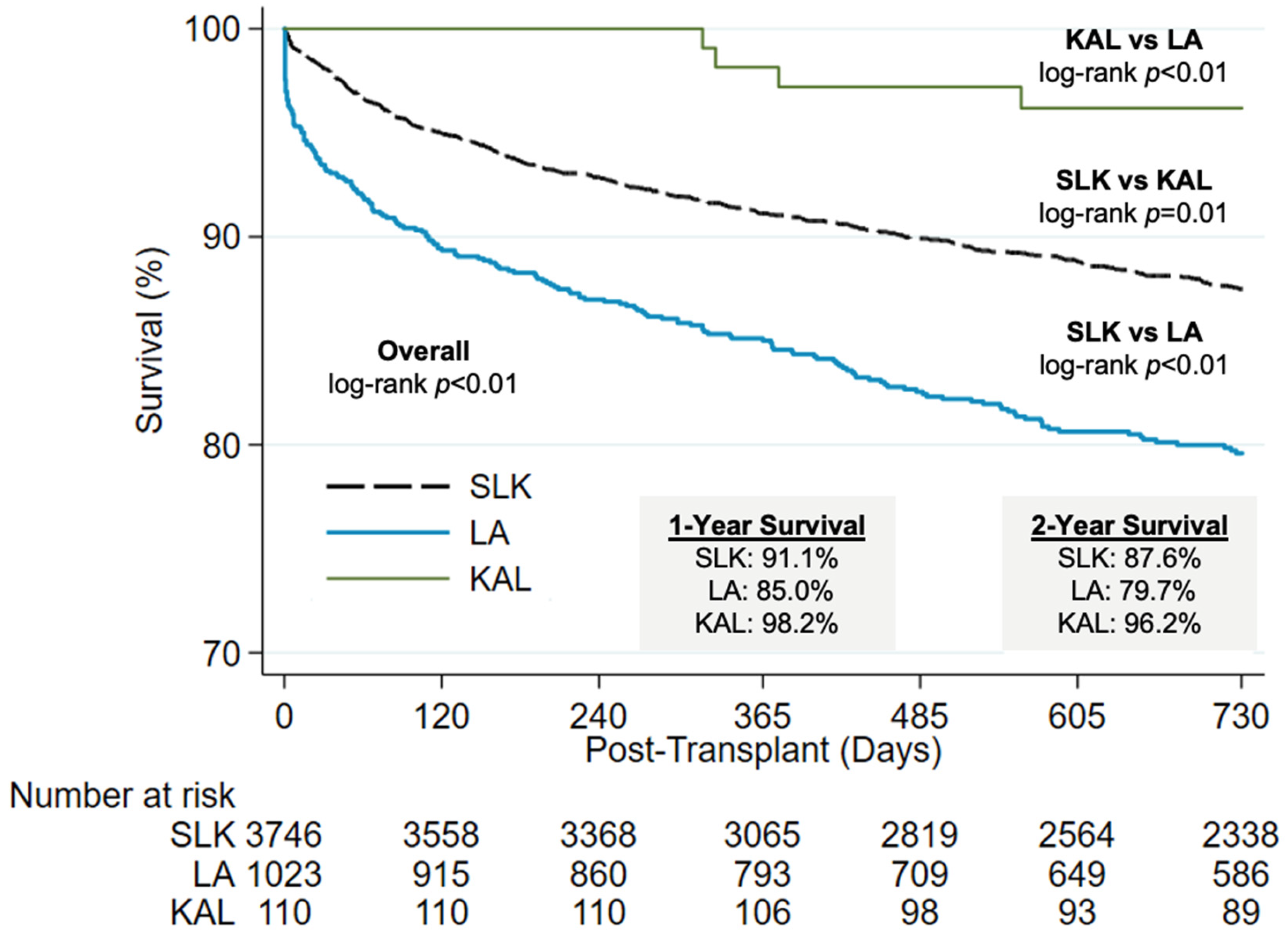
Kaplan–Meier analysis for post-transplant overall patient survival stratified by treatment approach. 1-year and 2-year survival rates are shown for each group in figure. Log-rank p-values are presented for overall analysis and as pairwise comparisons amongst the three groups. Survival axis is scaled from 70% to 100%. At-risk table presented at bottom of figure. KAL kidney-after-liver transplant, LA liver-alone transplant, SLK simultaneous liver–kidney transplant.
3.4. Graft Survival and Event-Free Survival
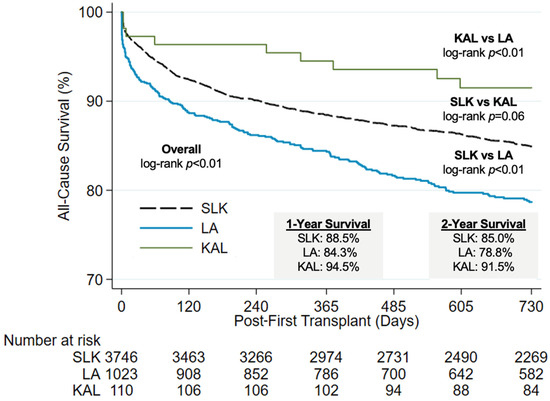
Event-free survival, in which events included mortality, liver graft failure, kidney graft failure, and re-transplantation, was significantly better for SLK recipients compared to the LA group (p < 0.01) (Figure 2). At 1 year, event-free survival was 88.5% for SLK, 84.3% for LA, and 94.5% for KAL recipients (p < 0.01). At 2 years, these rates declined to 85.0%, 78.8%, and 91.5% respectively (p < 0.01). In the Cox proportional hazards model adjusted for covariates, LA recipients had more than double the risk of experiencing all-cause events, compared to SLK recipients (aHR 2.25, 95% CI 1.45–3.47, p < 0.01) (Table 4). The combined Non-SLK group also showed significantly higher risk (aHR 1.91, 95% CI 1.24–2.90, p < 0.01).
Figure 2.
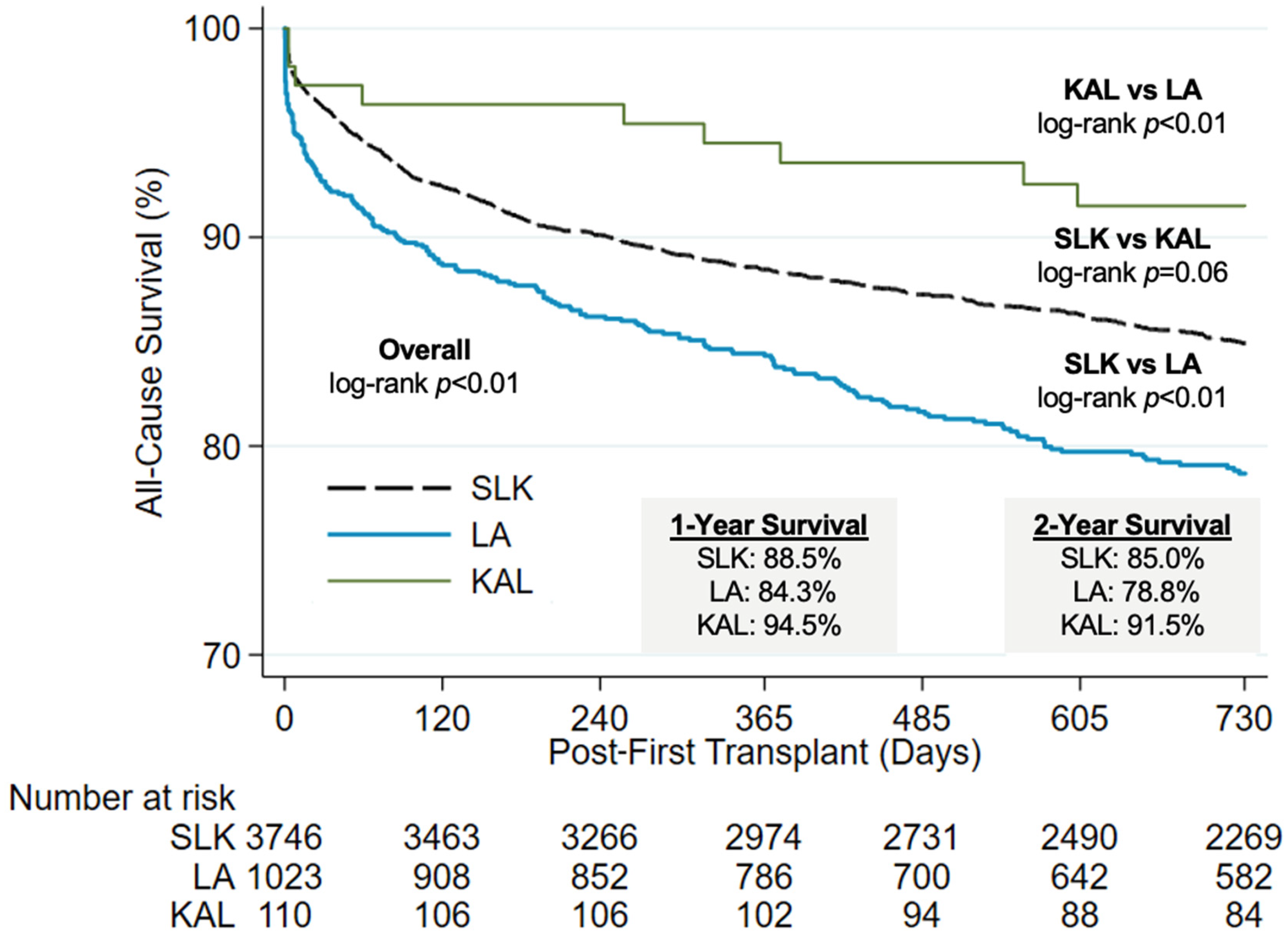
Kaplan–Meier analysis for post-transplant event-free patient survival stratified by treatment approach. 1-year and 2-year survival rates are shown for each group in figure. Log-rank p-values are presented for overall analysis and as pairwise comparisons amongst the three groups. All-cause survival axis is scaled from 70% to 100%. At-risk table presented at bottom of figure. KAL kidney-after-liver transplant, LA liver-alone transplant, SLK simultaneous liver–kidney transplant.
Table 4.
Overall post-transplant risk of event occurrence according to type of procedure using Cox proportional hazard modeling.
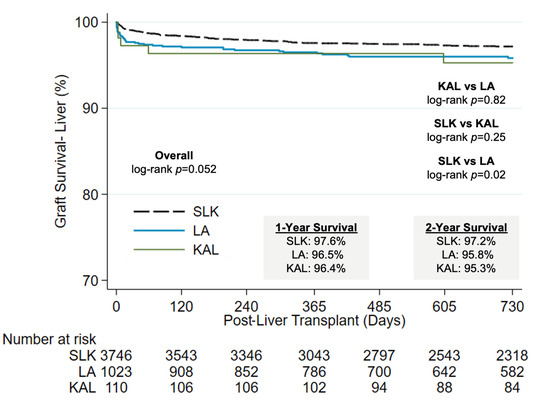
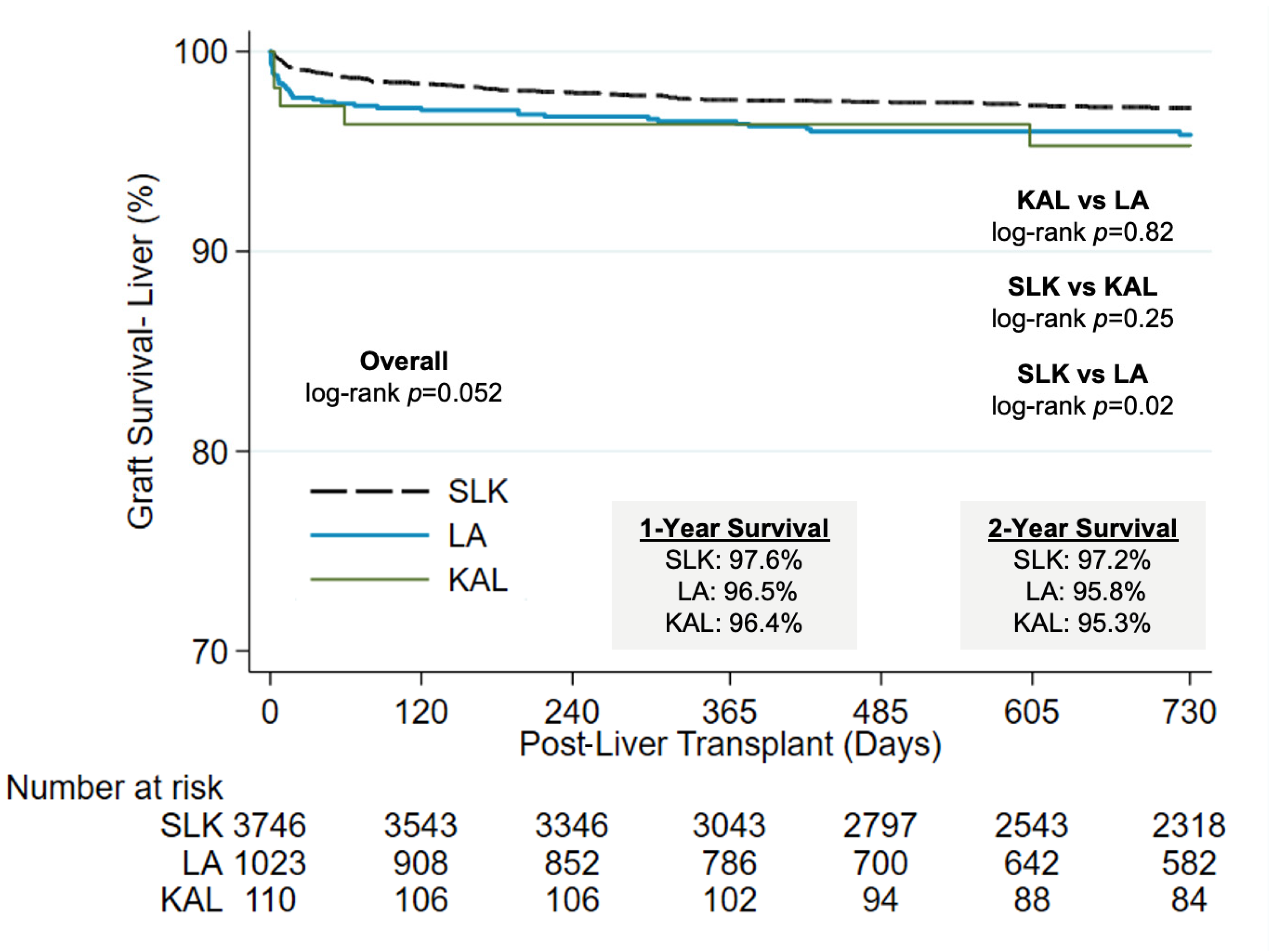
Kidney graft survival was significantly improved in KAL recipients compared to SLK recipients (p < 0.01), with an unadjusted hazard ratio of 0.13 (95% CI 0.04–0.42, p < 0.01) (Table S4, Figure S1). Due to the limited sample size, the adjusted ratio was calculated using Poisson regression modeling and was no longer significant (aHR 0.32, 95% CI 0.11–1.01, p = 0.05). For liver graft survival, SLK and LA patients were significantly different, (HR 1.53, 95% CI 1.05–2.22, p = 0.02) (Table 5, Figure 3). This difference persisted when combining LA and KAL patients into a single cohort (HR 1.55, 95% CI 1.05–2.22, p = 0.02), indicating a decreased risk for liver graft failure with SLK (Table 5). However, after adjusting for covariates, these differences became statistically insignificant.
Table 5.
Risk of post-transplant liver graft loss according to type of procedure using Cox proportional hazard modeling.
Figure 3.
Kaplan–Meier analysis for liver graft survival post-liver transplant stratified by treatment approach. 1-year and 2-year liver graft survival rates are shown for each group in figure. Liver graft survival axis is scaled from 70% to 100%. At-risk table presented at bottom of figure. Log-rank p-values are presented for overall analysis and as pairwise comparisons amongst the three groups. KAL kidney-after-liver transplant, LA liver-alone transplant, SLK simultaneous liver–kidney transplant.
4. Discussion
The implementation of standardized OPTN criteria for SLK in 2017 represented a significant policy shift aimed at optimizing allocation of limited organ resources while preserving outcomes for patients with concurrent liver and kidney dysfunction. Our analysis demonstrates that SLK provides the optimal outcomes for SLK-eligible candidates. Non-SLK recipients demonstrated poorer survival outcomes, graft survival, and renal outcomes, as nearly 20% of recipients had post-transplant renal failure necessitating subsequent kidney listing or kidney transplant. Though KAL may serve as a viable alternative in select cases, it was infrequently utilized and typically occurred later in the post-LT period with median time to kidney transplant after LT nearing 1 year. Interestingly, KAL recipients experienced lower kidney graft failure rates compared to SLK recipients upon univariable analysis, suggesting a benefit to this sequential approach to the patients that survive the obligatory 60 day waiting period, especially in patients with higher MELD scores [14]. Our study builds upon the findings of Wilk et al. (2021), who conducted a two-year review of the OPTN’s allocation policy and found that implementation of SLK criteria effectively reduced unnecessary kidney transplantation while preserving outcomes [10].
4.1. Contemporary Trends and Study Findings
Among the 4879 SLK-eligible LT recipients identified from August 2017 to September 2022, 3746 (76.8%) underwent SLKs. The frequency of SLK transplantation had been steadily increasing since the MELD score was implemented in 2002 until the OPTN formalized eligibility criteria in August 2017 [6,15]. Following implementation, SLK volume initially decreased by 9% in 2018 compared to 2017, as would be expected with increased regulation, but has subsequently rebounded to near pre-policy levels [10]. It is difficult to delineate which of the three avenues study participants achieved eligibility, namely between CKD and sustained AKI, with the available data in SRTR. Nonetheless, SLK recipients experienced the shortest waitlist time (median 55 days) compared to LA (160 days) and KAL recipients (101 days). Perhaps expectedly, pre-LT renal function was worse in SLK recipients compared to LA and KAL recipients. These findings suggest that the OPTN criteria prioritized SLK allocation toward those with the most severe renal dysfunction, consistent with the intended purpose of the policy [9,10]. Interestingly, SLK recipients had lower MELD scores than LA and KAL recipients and had a greater contribution of serum creatinine to elevated MELD scores, suggesting that significantly poor renal function was the driving factor in shuttling eligible patients into the SLK treatment pathway.
Notably, 1133 (23.2%) of SLK-eligible candidates received LAs, 110 (9.7%) of whom proceeded to undergo KALs within the study period. This substantial divergence between SLK eligibility and actual SLK utilization suggests potential opportunities for optimization of the current allocation system and raises important questions about the factors influencing transplant approach selection. For instance, given that we observed a trend towards improved pre-transplant functional status and lower MELD scores in SLK recipients, centers may be opting for initial LTs in patients deemed to be too frail for SLKs or for whom, the higher quality of grafts needed for a successful SLK would significantly postpone their transplant timeline. These patterns align with previous analyses demonstrating significant variability in SLK utilization across transplant centers and underscore the complex decision-making process involved in determining optimal transplant strategies for patients with dual organ dysfunction [16,17].
4.2. SLK and Improved Outcomes
Post-transplant outcomes strongly favored SLK recipients across multiple metrics, aligning with previous studies demonstrating superior outcomes in similar cohorts [18]. SLK recipients experienced significantly improved 2-year survival when compared to LA recipients, with nearly a three-fold higher risk of mortality in LA recipients after adjustment. This mortality risk remained elevated even when combining LA and KAL recipients into the Non-SLK cohort. Therefore, from an intent to treat standpoint, an SLK is the best path for eligible patients. SLK recipients also showed superior event-free survival compared to the combined Non-SLK group. Renal function outcomes followed expected patterns, with SLK recipients maintaining the highest post-transplant eGFR values throughout the two-year follow-up period. These findings reflect previous research showing that SLK improves survival for patients with end-stage liver disease and severe renal dysfunction [4,19,20]. Particularly, Sharma et al. demonstrated a survival benefit with SLK over LA for recipients with renal dysfunction pre-liver transplant, while Fong et al. showed that SLK resulted in better long-term outcomes compared to LA for cirrhotic patients with renal failure [4,19].
4.3. Outcomes in LA and KAL Patients
While SLK demonstrated a survival advantage over LA recipients and the combined Non-SLK group, our findings suggest that KAL may still warrant consideration as an alternative approach for certain patients. KAL recipients did not experience a significant difference in mortality risk compared to SLK recipients. Given the small sample size and several important caveats that merit discussion, this finding should be interpreted cautiously. First, KAL recipients represent a selected population who had survived long enough to receive their kidney transplant, introducing survival bias; that is, patients who died before receiving a kidney would be classified as LA recipients. Nevertheless, when combining LA and KAL recipients into the Non-SLK cohort, the adjusted hazard ratio for mortality was 2.46 compared to SLK recipients, which is lower than that of LA recipients alone (aHR 2.95). This suggests that KAL may partially mitigate the increased mortality risk associated with Non-SLK [21,22]. Second, KAL was observed to occur relatively late in the post-transplant period, typically after 6 months, despite safety net prioritization being available after 60 days. This delay may contribute to worse outcomes as prolonged renal dysfunction is associated with higher morbidity and mortality [14,23].
If KAL were utilized more frequently and earlier during the post-transplant period, it might provide a more effective alternative to SLK for selected patients. Previous studies show that early KAL, defined as kidney transplantation occurring 60 to 365 days after LT, provides equivalent survival outcomes compared to SLK [21]. This equivalence in survival suggests that KAL, under the safety net policy, can be a viable alternative to SLK, particularly when considering organ scarcity and the potential to avoid unnecessary renal graft use. Further, since KAL recipients capture only those who survived long enough to receive kidney transplantation following LT, early KAL transplantation may benefit those not represented by the current group of survivors.
4.4. Graft Failure Considerations
Analysis of graft failure revealed interesting patterns that may reflect immunological differences between transplant approaches. In unadjusted analyses, SLK recipients demonstrated lower rates of liver graft failure compared to Non-SLK recipients. After adjustment for covariates, these differences were no longer statistically significant, suggesting that patient and donor characteristics may partially explain the observed differences. Nevertheless, these findings align with the theoretical immunological advantage conferred by SLK, which may reduce the risk of allograft rejection as described by several previous studies [3,24,25].
Conversely, kidney graft survival was significantly improved for KAL recipients compared to SLK recipients before adjustment, although no events of graft loss were recorded beyond the day of transplant. Nevertheless, this concurs with a prior study that demonstrated comparable graft survival between KAL recipients and kidney-alone patients while SLK patients had lower graft survival [26]. This observation highlights the potentially controversial nature of the safety net policy, which provides liver recipients preferential access to quality kidneys, diverting organs from kidney-alone candidates [10]. However, it also demonstrates that when appropriately implemented, the safety net can effectively provide renal replacement therapy to liver recipients who develop post-transplant renal dysfunction [10,26].
4.5. Limitations
This is a retrospective study by design, which comes with inherent limitations such as selection bias, inability to determine causation, and difficulty with defining proper control groups. While the SRTR database contains many variables for thousands of patients, there is limited or lack of detail regarding several aspects, including differences between single-stage SLK and sequential SLK, reasons for why SLK-eligible candidates do not undergo SLK such as frailty, post-LT dialysis requirement, and specific reasons for the timing of KAL. We also acknowledge that the approach to SLK has evolved significantly over the last decade such that we were not able to adjust for parameters outside of the SRTR database. We also do not account for geographical or regional differences that may exist within SLK practice. We also did not include cause-specific mortality into our analysis, including cancer-related deaths for recipients with malignancy-related transplant indications; this may have introduced bias into the survival analyses as not all deaths may have been attributable to transplant strategy or organ failure. Lastly, we recognize the potential for incomplete or inaccurate data, particularly in capturing rapidly evolving clinical scenarios, such as a post-LA patients developing severe renal dysfunction shortly after transplant before the safety net kidney timeline. With this, we reason that we may underestimate the true prevalence of poor post-LT renal outcomes, such as kidney listing and kidney transplants.
5. Conclusions
Since the OPTN SLK guidelines were implemented in 2017, SLK remains to be the best path forward for SLK-eligible patients. While most underwent SLK, nearly a quarter of SLK-eligible candidates received only the liver transplant upfront and subsequently, experienced lower post-LT eGFRs, poorer renal outcomes, lower overall survival, lower event-free survival, and higher risk of liver graft loss. While the KAL recipients had comparable post-transplant survival, event-free survival, and lower risk of kidney graft loss to SLK recipients, it was both less frequently utilized and utilized later in the post-LT period, most often occurring 6 months after LT. Given that the safety net kidney allocation comes into effect just 60 days post-LT, perhaps KAL should be prioritized sooner or made more accessible for SLK-eligible LA recipients to mitigate some of the differences in outcomes between SLK and Non-SLK recipients. The findings from this study highlight the importance for further investigation and discussions on the reasons for not performing SLK upfront and for utilizing KAL earlier in the post-LT period.
Supplementary Materials
The following supporting information can be downloaded at: https://www.mdpi.com/article/10.3390/livers6030042/s1, Figure S1: Kaplan–Meier analysis for kidney graft survival post-kidney transplant stratified by treatment approach. Start date for Kaplan–Meier timeline of post-transplant kidney graft survival was calculated from the date of kidney transplant. 1-year and 2-year kidney graft survival rates are shown for each group on figure. Kidney graft survival axis is scaled from 70% to 100%. At-risk table presented at bottom of figure; Table S1: Breakdown of determining candidates’ SLK eligibility for study inclusion using recent OPTN medical eligibility criteria; Table S2: Pre-transplant functional status according to Karnofsky performance status of all SLK eligible liver transplant recipients; Table S3: Pre-transplant MELD score and breakdown of MELD components for all SLK-Eligible transplant recipients; Table S4: Risk of post-transplant kidney graft loss according to type of procedure using Cox proportional hazard modeling.
Author Contributions
Conceptualization, M.M.S., S.H., R.T.J. and B.P.; methodology M.M.S., S.H. and B.P.; software M.M.S., S.H. and B.H.; validation M.M.S. and S.H.; formal analysis M.M.S. and S.H.; investigation M.M.S., S.H., B.H., R.T.J., D.J.F. and H.M.; resources A.-F.K., E.A.K., R.W., S.W., A.M.C., A.B.M., D.L.S., A.G. and B.P.; data curation M.M.S., S.H. and B.H.; writing—original draft preparation, M.M.S., S.H., B.H., R.T.J., D.J.F. and H.M.; writing—review and editing, A.-F.K., E.A.K., R.W., S.W., A.M.C., A.B.M., D.L.S., A.G. and B.P.; supervision, E.A.K. and B.P. All authors have read and agreed to the published version of the manuscript.
Funding
This research received no external funding.
Institutional Review Board Statement
The study was conducted in accordance with the Declaration of Helsinki and approved by the Johns Hopkins University Institutional Review Board (approval code: IRB00352819; approval date: 29 September 2016).
Informed Consent Statement
Patient consent was waived because this study was conducted using fully de-identified data from the Scientific Registry of Transplant Recipients (SRTR). Because the dataset contains no direct or indirect patient identifiers and does not allow for re-identification, we believe that the project does not meet the federal definition of human subjects research and thus does not require informed consent.
Data Availability Statement
The data that support the findings of this study are available upon request to the corresponding author. These data were derived from the following resources available in the public domain: Scientific Registry of Transplant Recipients (https://www.srtr.org/).
Conflicts of Interest
There was no funding acquired for this study. The authors of this manuscript have no conflicts of interest to disclose. The data reported here have been supplied by the Hennepin Healthcare Research Institute (HHRI) as the contractor for the Scientific Registry of Transplant Recipients (SRTR). The interpretation and reporting of these data are the responsibility of the author(s) and in no way should be seen as an official policy of or interpretation by the SRTR or the U.S. Government.
Abbreviations
The following abbreviations are used in this manuscript:
| aHR | adjusted hazard ratio |
| AKI | acute kidney injury |
| BMI | body mass index |
| CKD | chronic kidney disease |
| CKD-EPI | Chronic Kidney Disease Epidemiology Collaboration |
| CI | confidence interval |
| DCD | donation after circulatory death |
| eGFR | estimated glomerular filtration rate |
| HRSA | Health Resources and Services Administration |
| IQR | interquartile range |
| KAL | kidney-after-liver transplantation |
| KA | kidney-alone transplant |
| LA | liver-alone transplant |
| LT | liver transplantation |
| MELD | Model for End-Stage Liver Disease |
| NASH | non-alcoholic steatohepatitis |
| OPTN | Organ Procurement and Transplantation Network |
| SLK | simultaneous liver–kidney transplantation |
| SRTR | Scientific Registry of Transplant Recipients |
References
- Spechtenhauser, B.; Hochleitner, B.W.; Konigsrainer, A.; Mair, P.; Hormann, C.; Steurer, W.; Vogel, W.; Graziadei, I.; Margreiter, R. Combined liver-kidney transplantation: A single-center report. Transplant. Proc. 1999, 31, 3177–3180. [Google Scholar] [CrossRef] [Scilit]
- Enestvedt, C.K. PRO: Simultaneous Liver-Kidney Transplantation in the Current Era: Still the Best Option. Clin. Liver Dis. 2020, 16, 266–271. [Google Scholar] [CrossRef] [Scilit]
- Bari, K.; Sharma, P. Optimizing the Selection of Patients for Simultaneous Liver-Kidney Transplant. Clin. Liver Dis. 2021, 25, 89–102. [Google Scholar] [CrossRef] [Scilit]
- Fong, T.-L.; Khemichian, S.; Shah, T.; Hutchinson, I.V.; Cho, Y.W. Combined Liver-Kidney Transplantation Is Preferable to Liver Transplant Alone for Cirrhotic Patients with Renal Failure. Transplantation 2012, 94, 411–416. [Google Scholar] [CrossRef] [Scilit]
- Israni, A.K.; Xiong, H.; Liu, J.; Salkowski, N.; Trotter, J.F.; Snyder, J.J.; Kasiske, B.L. Predicting End-Stage Renal Disease After Liver Transplant. Am. J. Transplant. 2013, 13, 1782–1792. [Google Scholar] [CrossRef] [Scilit]
- Nair, G.; Nair, V. Simultaneous Liver–Kidney Transplantation. Clin. Liver Dis. 2022, 26, 313–322. [Google Scholar] [CrossRef] [Scilit] [PubMed]
- Policies—OPTN. Available online: https://optn.transplant.hrsa.gov/policies-bylaws/policies/ (accessed on 21 May 2024).
- Samoylova, M.L.; Wegermann, K.; Shaw, B.I.; Kesseli, S.J.; Au, S.; Park, C.; Halpern, S.E.; Sanoff, S.; Barbas, A.S.; Patel, Y.A.; et al. The Impact of the 2017 Kidney Allocation Policy Change on Simultaneous Liver-Kidney Utilization and Outcomes. Liver Transplant. 2021, 27, 1106–1115. [Google Scholar] [CrossRef] [Scilit] [PubMed]
- Formica, R.N.; Aeder, M.; Boyle, G.; Kucheryavaya, A.; Stewart, D.; Hirose, R.; Mulligan, D. Simultaneous Liver–Kidney Allocation Policy: A Proposal to Optimize Appropriate Utilization of Scarce Resources. Am. J. Transplant. 2016, 16, 758–766. [Google Scholar] [CrossRef] [Scilit] [PubMed]
- Wilk, A.R.; Booker, S.E.; Stewart, D.E.; Wiseman, A.; Gauntt, K.; Mulligan, D.; Formica, R.N. Developing simultaneous liver-kidney transplant medical eligibility criteria while providing a safety net: A 2-year review of the OPTN’s allocation policy. Am. J. Transplant. 2021, 21, 3593–3607. [Google Scholar] [CrossRef] [Scilit]
- Sellarés, J.; Reeve, J.; Loupy, A.; Mengel, M.; Sis, B.; Skene, A.; de Freitas, D.G.; Kreepala, C.; Hidalgo, L.G.; Famulski, K.S.; et al. Molecular Diagnosis of Antibody-Mediated Rejection in Human Kidney Transplants. Am. J. Transplant. 2013, 13, 971–983. [Google Scholar] [CrossRef] [Scilit]
- Lunsford, K.E.; Bodzin, A.S.; Markovic, D.; Zarrinpar, A.; Kaldas, F.M.; Gritsch, H.A.; Xia, V.; Farmer, D.G.; Danovitch, G.M.; Hiatt, J.R.; et al. Avoiding Futility in Simultaneous Liver-kidney Transplantation: Analysis of 331 Consecutive Patients Listed for Dual Organ Replacement. Ann. Surg. 2017, 265, 1016–1024. [Google Scholar] [CrossRef] [Scilit] [PubMed]
- Levey, A.S.; Stevens, L.A.; Schmid, C.H.; Zhang, Y.L.; Castro, A.F., III; Feldman, H.I.; Kusek, J.W.; Eggers, P.; Van Lente, F.; Greene, T.; et al. A New Equation to Estimate Glomerular Filtration Rate. Ann. Intern. Med. 2009, 150, 604–612. [Google Scholar] [CrossRef] [Scilit] [PubMed]
- Cullaro, G.; Sharma, P.; Jo, J.; Rassiwala, J.; VanWagner, L.B.; Wong, R.; Lai, J.C.; Magee, J.; Schluger, A.; Barman, P.; et al. Temporal Trends and Evolving Outcomes After Simultaneous Liver-Kidney Transplantation: Results from the US SLKT Consortium. Liver Transplant. 2021, 27, 1613–1622. [Google Scholar] [CrossRef] [Scilit]
- Singal, A.K.; Ong, S.; Satapathy, S.K.; Kamath, P.S.; Wiesner, R.H. Simultaneous liver kidney transplantation. Transpl. Int. 2019, 32, 343–352. [Google Scholar] [CrossRef] [Scilit] [PubMed]
- Luo, X.; Massie, A.B.; Haugen, C.E.; Choudhury, R.; Ruck, J.M.; Shaffer, A.A.; Zhou, S.; Segev, D.L.; Garonzik-Wang, J.M. Baseline and Center-Level Variation in Simultaneous Liver-Kidney Listing in the United States. Transplantation 2018, 102, 609–615. [Google Scholar] [CrossRef] [Scilit]
- Cheng, X.S.; McElroy, L.M.; Sanoff, S.L.; Kwong, A.J. One size does not fit all: Differential benefits of simultaneous liver-kidney transplantation by eligibility criteria. Liver Transplant. 2023, 29, 1208–1215. [Google Scholar] [CrossRef] [Scilit]
- Martin, E.F.; Huang, J.; Xiang, Q.; Klein, J.P.; Bajaj, J.; Saeian, K. Recipient survival and graft survival are not diminished by simultaneous liver-kidney transplantation: An analysis of the united network for organ sharing database. Liver Transplant. 2012, 18, 914–929. [Google Scholar] [CrossRef] [Scilit]
- Sharma, P.; Shu, X.; Schaubel, D.E.; Sung, R.S.; Magee, J.C. Propensity score-based survival benefit of simultaneous liver-kidney transplant over liver transplant alone for recipients with pretransplant renal dysfunction. Liver Transplant. 2016, 22, 71–79. [Google Scholar] [CrossRef] [Scilit]
- Gonwa, T.A.; McBride, M.A.; Anderson, K.; Mai, M.L.; Wadei, H.; Ahsan, N. Continued Influence of Preoperative Renal Function on Outcome of Orthotopic Liver Transplant (OLTX) in the US: Where Will MELD Lead Us? Am. J. Transplant. 2006, 6, 2651–2659. [Google Scholar] [CrossRef] [Scilit]
- Jay, C.L.; Washburn, W.K.; Rogers, J.; Harriman, D.; Heimbach, J.; Stratta, R.J. Difference in Survival in Early Kidney after Liver Transplantation Compared with Simultaneous Liver-Kidney Transplantation: Evaluating the Potential of the “Safety Net”. J. Am. Coll. Surg. 2020, 230, 463–473. [Google Scholar] [CrossRef] [Scilit]
- Ghali, P.; Ibrahim, R.M.; Hodge, D.; White, L.; Wadei, H.M. Kidney after liver transplantation does not have an increased risk of rejection compared to liver alone. Clin. Transplant. 2024, 38, e15311. [Google Scholar] [CrossRef] [Scilit]
- Dixon, W.; Feng, S.; Roll, G.R.; Tavakol, M.; Fenton, C.; Cullaro, G. The type, duration, and severity of pretransplant kidney injury predict prolonged kidney dysfunction after liver transplantation. Liver Transplant. 2024, 30, 1159–1168. [Google Scholar] [CrossRef] [Scilit] [PubMed]
- Simpson, N.; Cho, Y.W.; Cicciarelli, J.C.; Selby, R.R.; Fong, T.-L. Comparison of Renal Allograft Outcomes in Combined Liver-Kidney Transplantation Versus Subsequent Kidney Transplantation in Liver Transplant Recipients: Analysis of UNOS Database. Transplantation 2006, 82, 1298–1303. [Google Scholar] [CrossRef] [Scilit] [PubMed]
- Rana, A.; Robles, S.; Russo, M.J.; Halazun, K.J.; Woodland, D.C.; Witkowski, P.; Ratner, L.E.; Hardy, M.A. The combined organ effect: Protection against rejection? Ann. Surg. 2008, 248, 871–879. [Google Scholar] [CrossRef] [Scilit] [PubMed]
- Schold, J.D.; Mohan, S.; Jackson, W.E.; Stites, E.; Burton, J.R.; Bababekov, Y.J.; Saben, J.L.; Pomposelli, J.J.; Pomfret, E.A.; Kaplan, B. Differential in Kidney Graft Years on the Basis of Solitary Kidney, Simultaneous Liver-Kidney, and Kidney-after-Liver Transplants. Clin. J. Am. Soc. Nephrol. CJASN 2024, 19, 364–373. [Google Scholar] [CrossRef] [Scilit]

Disclaimer/Publisher’s Note: The statements, opinions and data contained in all publications are solely those of the individual author(s) and contributor(s) and not of MDPI and/or the editor(s). MDPI and/or the editor(s) disclaim responsibility for any injury to people or property resulting from any ideas, methods, instructions or products referred to in the content. |
© 2026 by the authors. Licensee MDPI, Basel, Switzerland. This article is an open access article distributed under the terms and conditions of the Creative Commons Attribution (CC BY) license.