


Abstract
Despite increasing global attention to reproductive health, significant knowledge gaps and misconceptions about abortion and contraception persist among young adults, including medical students. Understanding their knowledge and attitudes is crucial for developing effective educational strategies. This study aimed to assess the knowledge and attitudes regarding abortion and contraceptive methods among undergraduate Romanian health-professions students. A cross-sectional study was conducted between April and December 2024, using a validated, self-administered questionnaire distributed online. The final sample included 510 students from various medical fields. Data were analyzed using descriptive statistics and chi-square tests, with a p-value < 0.05 considered statistically significant. Most participants were female (77.45%), reflecting the feminization trend in medical education. Overall, 95.88% of respondents declared awareness of abortion, yet significant knowledge gaps remained, particularly regarding legal gestational limits for medical abortion. Notably, 66.47% identified infertility as a potential complication of abortion, though this did not differ significantly by gender. Regarding attitudes, students generally supported abortion in cases involving maternal health risks (74.12%) or sexual assault (79.22%), while acceptance decreased in socio-economic or personal contexts, especially among male students. Contraceptive knowledge was high for condoms (99.22%) and oral contraceptives (95.88%), with no significant gender differences for individual methods after correction for multiple comparisons. Importantly, 64.35% of male students believed that condoms reduce sexual pleasure, and 87.85% of female students expressed concern about the side effects of oral contraceptives. Furthermore, 60.59% of participants believed that access to abortion services in Romania is insufficient, and nearly 80% advocated for legal measures to improve accessibility. Male students were significantly more likely than female students to report not knowing what surgical abortion on demand is (16.52% vs. 2.53%; OR = 0.13, female vs. male, 95% CI 0.06–0.29, p < 0.0001), a gender gap that remained significant after correction for multiple comparisons. In multivariable linear regression, year of study was the strongest independent predictor of objective knowledge (β = 0.31, 95% CI 0.14–0.47, p < 0.001), and students enrolled in Dentistry/Pharmacy programs scored significantly lower than those in General Medicine (β = −0.83, 95% CI −1.32 to −0.34, p = 0.001), whereas gender and age were not independently associated with knowledge after adjustment (p = 0.581 and p = 0.519–0.794, respectively). The findings reveal substantial gaps in knowledge and persistent misconceptions about abortion and contraception among future healthcare providers, particularly regarding legal gestational limits. Gender differences were significant for attitudes toward abortion in non-medical contexts, but were not robust for most individual knowledge items once corrected for multiple comparisons. Targeted educational interventions are urgently needed to address misinformation, promote reproductive autonomy, and prepare future healthcare professionals to provide comprehensive, unbiased reproductive healthcare.
1. Introduction
Research indicates that knowledge about abortion and its legal status is often limited among the general population, including women of reproductive age and healthcare professionals. Studies have shown that fewer than 50% of women have accurate awareness of abortion laws in their countries [1]. Significant knowledge gaps also exist regarding abortion methods, safety, and long-term medical consequences [2,3]. Misinformation about the health effects of abortion is common, including inaccurate beliefs linking abortion to breast cancer and mental health issues [4]. Higher levels of accurate abortion knowledge are associated with more pro-choice attitudes [5]. Common sources of abortion information include media, family members, and healthcare providers [6], yet adolescents in particular face unique barriers in accessing accurate abortion information and services [7].
These knowledge-related challenges are taking place in a global context where access to abortion is becoming increasingly restricted. In recent years, several countries have implemented highly restrictive abortion laws, directly impacting women’s reproductive rights and health. For instance, abortion is completely banned in Malta, without exception. In Poland, the procedure is only permitted under very limited circumstances, and in the United States, the overturning of Roe v. Wade has led many states to implement near-total bans [8]. History and public health data have shown that restricting legal access to abortion does not reduce its incidence, but rather forces women to seek unsafe, clandestine procedures—greatly increasing the risk of complications and maternal death [9].
Romania’s experience under the communist regime is a stark illustration of this phenomenon: when abortion was criminalized, maternal mortality rates soared due to unsafe, illegal procedures [10]. The World Health Organization emphasizes that access to safe and legal abortion services is essential for protecting maternal health and reducing preventable deaths [11]. In Romania today, abortion on demand is legally available before three months of pregnancy for surgical procedures, and medical abortion is permitted up to 63 days of amenorrhea. However, the extent to which future healthcare providers accurately understand these specific legal limits, and whether this understanding differs across health-professions training tracks, remains insufficiently studied. Because graduates of medicine, dentistry, nursing, radiology, and other allied health programs will all interact with, counsel, or refer patients considering abortion or contraception in their future practice, examining knowledge and attitudes across this broader group of undergraduate health-professions students—rather than restricting the focus to medical students alone—addresses a specific gap in the Romanian literature and strengthens the practical relevance of the present findings.
In this context, the role of healthcare providers—particularly general practitioners and gynecologists—is vital. They are responsible for supporting women by providing accurate, evidence-based information and ensuring access to appropriate reproductive healthcare. Ongoing education of medical professionals, coupled with a compassionate and informed approach to reproductive health, is essential to meeting women’s needs and supporting informed decision-making [6,11].
The present study aimed to evaluate self-perceived and objective knowledge, as well as attitudes, regarding abortion and contraceptive methods among Romanian undergraduate health-professions students. In addition, a composite objective knowledge score was derived from questionnaire content items to provide a quantitative assessment of abortion-related knowledge. Specifically, the study addressed the following research questions: (1) What are the main knowledge gaps and misconceptions regarding abortion and contraception among undergraduate health-professions students? (2) Do knowledge and attitudes regarding abortion and contraception differ according to gender? and (3) Which demographic and educational characteristics are independently associated with objective abortion-related knowledge? By addressing these questions, the study sought to identify specific areas in which reproductive-health education among future healthcare professionals may require further strengthening.
Given these challenges and developments, understanding young people’s knowledge and attitudes toward abortion, especially among future healthcare professionals, is crucial. Such research can inform educational interventions and public health policies aimed at reducing misinformation, promoting reproductive health, and ensuring access to safe and legal abortion services, ultimately contributing to the protection of women’s health and rights.
2. Materials and Methods
2.1. Study Design and Target Population
This was an observational, cross-sectional study conducted between April and December 2024 at the “Iuliu Hațieganu” University of Medicine and Pharmacy in Cluj-Napoca. The study was carried out in the following phases: questionnaire development and validation (April 2024), data collection (April–September 2024), and data analysis (October–December 2024).
Participants were recruited from multiple faculties/programs, including General Medicine, Dental Medicine, Pharmacy, Balneophysiokinetotherapy, Radiology and Medical Imaging, General Nursing, and Dental Technology. Eligible participants were undergraduate students enrolled at the university during the study period who accessed the questionnaire link and voluntarily agreed to participate; no further inclusion or exclusion criteria were applied beyond study enrollment. Of the invited programs, General Medicine, Dental Medicine, Pharmacy, Balneophysiokinetotherapy, and Radiology and Medical Imaging were represented among respondents; no completed responses were received from General Nursing or Dental Technology students, and these two programs are therefore not represented in the analytic sample or in the program-level results reported below.
The protocol was evaluated and approved by the Scientific Research Ethics Committee of the “Iuliu Hațieganu” University of Medicine and Pharmacy, Cluj-Napoca, Romania (No. 66, 19 April 2024).
2.2. Questionnaire Development and Validation
A structured, self-administered questionnaire was developed specifically to explore abortion- and contraception-related knowledge and attitudes. The questionnaire was designed based on a comprehensive literature review and aligned with the Romanian legal and medical context.
The validation process comprised four stages. First, an expert panel review assessed content accuracy and relevance; this review was conducted by two clinical experts (a midwife and an obstetrician-gynecologist), for whom a formal Content Validity Index was not computed. Second, pilot testing was carried out, in which the draft questionnaire was distributed to 70 students, of whom 32 completed it (45.7% response rate), constituting the pilot validation sample. Third, the questionnaire was revised based on participants’ feedback. Finally, internal consistency was evaluated: each of the 57 items in the draft questionnaire was paired with a companion 5-point Likert item asking respondents to rate their agreement with that item, and Cronbach’s alpha was computed across these 57 item-level agreement ratings using the pilot sample (n = 32), yielding α = 0.986, indicating very high internal consistency.
For the seven-item Likert-scale attitude subscale used in the main analysis (abortion-acceptability scenarios; see Section 3.3), all items are scored in the same direction (higher = more permissive), so no reverse-coding was required. In the final analytic sample (n = 510), this subscale showed Cronbach’s α = 0.916 (corrected item-total correlations ranging from 0.60 to 0.83) and McDonald’s ω = 0.93 (single-factor loadings from a principal-axis extraction; the first factor accounted for 67% of the common variance, supporting essential unidimensionality of the subscale). Test–retest reliability was not assessed, as the questionnaire was administered on a single occasion.
For the abortion-acceptability items, response options followed a standard four-point Likert format (totally agree, agree, disagree, totally disagree) capturing gradations in the strength of endorsement rather than a binary judgment. “Totally agree” and “agree” are therefore reported as distinct categories throughout this manuscript, since collapsing them would discard information about attitude intensity that is relevant to interpreting the findings; where a combined endorsement rate is useful, it can be obtained by summing the “totally agree” and “agree” percentages reported in Section 3.3.
The questionnaire was designed in Romanian and subsequently translated into English for publication purposes. The final questionnaire included 35 single-choice and multiple-choice questions, as well as Likert-scale items assessing knowledge accuracy and personal views on the topic.
2.3. Participants and Data Collection
The questionnaire was distributed electronically using Google Forms (Google Inc., Mountain View, CA, USA) through the internal university network and was accompanied by an introductory letter, a self-assessment tool and an informed consent to be agreed upon prior to filling in the questionnaire. All answers were given anonymously. Several items (e.g., knowledge of abortion types, contraceptive methods known and used) allowed multiple selections; for these items, percentages are calculated as the proportion of respondents selecting each option and therefore do not sum to 100% within a question. Because the university enrolls students from Romanian-, English-, and French-language tracks, the questionnaire was administered in three parallel language versions (Romanian, English, French); responses were harmonized into a single coded dataset prior to analysis.
2.4. Statistical Analysis
Descriptive statistics were used to summarize the demographic characteristics of the participants, knowledge and attitudes towards abortion, as well as views and usage of contraceptive methods. All questionnaire items were mandatory in the Google Forms interface, so there were no item-level missing responses in the analytic sample beyond the five incomplete submissions excluded prior to analysis (Section 3.1); consequently, the same denominator (395 female, 115 male, 510 total) applies to every item reported in Section 3. Categorical variables were expressed as absolute frequencies (number) and relative frequencies (percentage) and compared between genders using the chi-square (χ2) test or, when more than 20% of expected cell counts were below 5, Fisher’s exact test. For each comparison, the effect size was additionally quantified using Cramér’s V. To further characterize the magnitude and precision of gender differences given the unequal group sizes (395 female vs. 115 male), odds ratios (female relative to male, with the Haldane-Anscombe continuity correction) with 95% confidence intervals were additionally computed for every binary gender comparison and are reported directly alongside each comparison in the Section 3. Because each table involved multiple simultaneous comparisons across items, p-values within each table were adjusted for multiplicity using the Holm–Bonferroni step-down procedure; both the unadjusted p-value and the Holm-adjusted p-value are reported, and statistical significance was based on the Holm-adjusted value. To move beyond self-reported (perceived) knowledge, a composite objective knowledge score (range 0–10) was constructed for each respondent by summing correct responses to four content domains: the legal gestational limit for surgical abortion on demand (0–1), the legal gestational limit for medical abortion (0–1), correct identification of abortion methods (0–3), and correct identification of abortion complications (0–5); this score was compared between groups using the Mann–Whitney U test, given its non-normal distribution. A multivariable linear regression model was additionally fitted to examine the independent associations of gender, age group, program of study, year of study, parental education level, and area of origin (urban/rural) with the objective knowledge score. A p-value of less than 0.05 was considered statistically significant. Statistical analyses were performed using Python (version 3.11; Python Software Foundation, Wilmington, DE, USA) with the pandas, SciPy, and statsmodels libraries.
3. Results
3.1. Sociodemographic Data of the Study Population
A total of 515 questionnaire responses were collected. Of these, five incomplete responses were excluded from the final analysis. Therefore, statistical analyses were performed on a sample of 510 fully completed questionnaires. Out of the 510 participating students, 395 (77.45%) were female and 115 (22.55%) were male (Table 1). The age distribution did not show significant differences between genders (p = 0.650). Most respondents were aged between 18 and 20 years (51.76%), followed by those aged 21–24 years (36.47%) and those over 24 years old (11.76%).
Table 1.
Sociodemographic characteristics of the study population (N = 510).
Marital status did not differ significantly between genders (p = 0.306, Fisher’s exact test; see Methods, Section 2.4). The majority of participants were single (55.88%) or in a relationship (42.35%); only 6 students (1.18%) reported being married, and 3 (0.59%) preferred not to disclose their marital status.
Regarding the place of origin, the majority of students came from urban areas (75.29%), while 24.71% were from rural areas. No significant differences were observed between genders in this regard (p = 0.983).
Parental education level varied significantly between genders (p = 0.024). Most participants reported that their parents had higher education (77.84%), followed by those whose parents had completed high school (17.45%), and a smaller proportion whose parents had less than high school education (4.71%).
The majority of respondents were enrolled in General Medicine (75.49%), followed by students in Dentistry or Pharmacy (18.82%), and those in Radiology and Medical Imaging (5.69%).
3.2. Knowledge Regarding Abortions
Overall, 489 out of 510 respondents (95.88%) declared that they were knowledgeable about abortion, while 21 students (4.12%) reported no knowledge (Table 2). These findings reflect a high level of general awareness regarding abortion among health-professions students.
Table 2.
Abortion-related knowledge among health-professions students, stratified by gender.
Regarding abortion-related knowledge, most students had heard of spontaneous abortion (87.45%) and abortion on demand (85.88%). A higher proportion of female students reported having heard of spontaneous abortion compared to male students (89.37% vs. 80.87%; p = 0.0155, OR = 2.00, 95% CI 1.14–3.50), although this difference did not remain significant after correction for multiple comparisons (Holm-adjusted p = 0.512). No significant gender difference was found for abortion on demand (87.34% vs. 80.87%; p = 0.0794, OR = 1.65, 95% CI 0.95–2.84). Knowledge of therapeutic abortion (63.80% vs. 66.09%; p = 0.652, OR = 0.91, 95% CI 0.59–1.40) and recurrent abortion (28.10% vs. 36.52%; p = 0.0829, OR = 0.68, 95% CI 0.44–1.05) did not differ significantly between genders.
When asked about the source of information regarding abortion on demand, family (21.18%), media (20.98%), and school (20.98%) were the most frequently reported sources. Female students were more likely to report social media as a source of information (20.00% vs. 10.43%; p = 0.0184, OR = 2.08, 95% CI 1.10–3.93), although this difference did not survive correction for multiple comparisons (Holm-adjusted p = 0.589). No other source showed a statistically significant gender difference, including healthcare institutions (8.10% vs. 6.96%; p = 0.688, OR = 1.13, 95% CI 0.52–2.48).
In terms of perceived locations where abortions on demand are performed, hospitals and private obstetrics–gynecology clinics were most commonly selected by both genders (61.37% and 63.14%, respectively), with no significant gender differences. A slightly higher proportion of male students believed that abortions could be performed at home (7.83% vs. 5.82%; p = 0.4356, OR = 0.71, 95% CI 0.32–1.55, female vs. male), although this difference was not statistically significant. Concerning knowledge of abortion methods, female students reported somewhat higher awareness of medical abortion compared to male students (84.81% vs. 76.52%; p = 0.0376, OR = 1.72, 95% CI 1.04–2.86), although this difference did not remain significant after Holm correction (p = 1.000). There were no significant differences between genders regarding knowledge of surgical methods such as instrumental curettage or aspiration by curettage. When asked about the gestational limits for abortion procedures in Romania, female students were more aware that surgical abortion on demand is legally available before three months of pregnancy (77.22% vs. 62.61%; p = 0.0017, OR = 2.03, 95% CI 1.30–3.15), a difference that fell just short of significance after Holm correction (p = 0.061). Furthermore, a notably higher proportion of male students selected “I do not know what surgical abortion on demand is” (16.52% vs. 2.53%; p < 0.0001, OR = 0.13, 95% CI 0.06–0.29, female vs. male), a difference that remained highly significant after correction for multiple comparisons, indicating a genuine gender gap in knowledge about legal gestational limits.
Regarding medical abortion, the correct legal limit in Romania is no later than 63 days from the first day of the last menstrual cycle, and this option was identified by 39.24% of female and 32.17% of male students (p = 0.1687, OR = 1.35, 95% CI 0.87–2.10). A significantly higher proportion of male students reported not knowing what medical abortion is (12.17% vs. 3.04%; p = 0.0001, OR = 0.23, 95% CI 0.10–0.50, female vs. male), a difference that remained significant after Holm correction (p = 0.004). When asked about potential complications of abortion on demand, the most recognized were bleeding (85.88%), infection (79.02%), and infertility (66.47%). Female students identified infertility as a complication somewhat more often than male students (68.61% vs. 59.13%; OR = 1.51, 95% CI 0.99–2.32), but this difference did not reach conventional statistical significance (p = 0.058); we return to the interpretation of this item in the Discussion, given uncertainty over what should be scored as a fully “correct” answer here. Male students more frequently reported not knowing what abortion on demand is (10.43% vs. 3.29%; p = 0.0018, OR = 0.29, 95% CI 0.13–0.65, female vs. male), though this did not survive correction for multiple comparisons (Holm-adjusted p = 0.063).
3.3. Attitudes and Perceptions Regarding Abortions
In terms of attitudes towards abortion in various pregnancy contexts, students demonstrated high overall approval in situations involving severe risks to the mother’s health or pregnancies resulting from sexual assault, with no significant gender differences. Specifically, 74.12% of respondents totally agreed with abortion in the case of serious health risks to the woman, and 79.22% totally agreed when the pregnancy was a result of rape. When considering the likelihood of severe fetal malformations, both female and male students expressed comparable levels of acceptance, with 54.71% totally agreeing with the option of abortion in such cases (p = 0.8168).
However, gender differences emerged in scenarios related to socioeconomic status and personal choice. In the case of women from low-income families unable to afford raising a child, female students were more likely to totally agree with abortion (46.84%) compared to male students (34.78%; p = 0.0220). Additionally, male students were more likely to totally disagree with abortion in this context (12.17% vs. 5.82%; p = 0.0208), although neither of these two differences remained significant after Holm correction (Holm-adjusted p = 0.0832 for both). Similar patterns were observed regarding marital status and the desire for more children. In the scenario of single women not wishing to marry the father of the child, a trend toward greater acceptance was observed among female students (37.47% totally agreeing vs. 27.83% of males; p = 0.0569). Notably, male students were significantly more likely to totally disagree with abortion in this context (22.61% vs. 12.66%; p = 0.0084; Holm-adjusted p = 0.0336).
The most pronounced gender differences were identified regarding personal autonomy over pregnancy termination. Female students were significantly more likely to totally agree with abortion if the woman decides, for personal reasons, to terminate the pregnancy (50.38% vs. 35.65%; p = 0.0054; Holm-adjusted p = 0.0216). Conversely, male students showed a higher tendency to totally disagree with abortion in this circumstance (14.78% vs. 7.09%; p = 0.0105; Holm-adjusted p = 0.0315). These findings are summarized in Table 3.
Table 3.
Attitudes towards abortion according to gender and pregnancy context.
Gender-stratified numeric values and statistical comparisons for these seven scenarios are reported in Table 3 above; as this table already conveys the full pattern of results, a separate bar-chart figure was considered redundant and has therefore been omitted.
Concerning perceptions of access to abortion on demand, a majority of respondents (60.59%) believed that women currently do not have sufficient access to this procedure. Notably, this perception was significantly more prevalent among female students (64.81%) compared to male students (46.09%) (p = 0.0003, OR = 2.15, 95% CI 1.41–3.27). Conversely, male students were significantly more likely to report uncertainty, with 39.13% selecting “I do not know,” compared to 20.00% of female students (p < 0.0001, OR = 0.39, 95% CI 0.25–0.61, female vs. male). Regarding legal restrictions on abortion on demand, most participants expressed opposition to legal limitations, with 79.02% indicating that the law should not intervene to restrict access. Although a slightly higher proportion of male students supported legal limitations (19.13% vs. 13.16%; OR = 0.64, 95% CI 0.37–1.09, female vs. male), this difference did not reach statistical significance (p = 0.1099).
When asked whether the law should intervene to allow or facilitate access to abortion on demand, a strong majority of both female (77.97%) and male (78.26%) students responded affirmatively, with no significant gender difference (p = 0.9480, OR = 0.99, 95% CI 0.60–1.64). These findings suggest broad support among health-professions students for maintaining or improving legal access to abortion on demand, irrespective of gender (Table 4).
Table 4.
Attitudes towards legal access to abortion on demand, stratified by respondents’ gender.
3.4. Knowledge and Usage of Contraceptive Methods
Regarding knowledge of contraceptive methods, almost all participants were familiar with condoms (99.22%) and combined oral contraceptives (95.88%), with no significant differences between female and male respondents (condom: p = 0.579, OR = 0.38, 95% CI 0.02–7.05; COC: p = 0.593, OR = 1.46, 95% CI 0.57–3.73). The condom comparison’s very wide confidence interval reflects a near-ceiling effect (100% male awareness), which limits its informativeness.
Some nominal gender differences emerged for individual contraceptive methods, but none remained statistically significant once corrected for multiple comparisons. Female students reported somewhat higher awareness of implants or injectable contraceptives (81.77% vs. 69.57%; p = 0.0047, OR = 1.97, 95% CI 1.23–3.15, Holm-adjusted p = 0.066), intrauterine devices (IUD) (90.13% vs. 83.48%; p = 0.0481, OR = 1.82, 95% CI 1.01–3.28, Holm-adjusted p = 0.529), the diaphragm (48.35% vs. 33.91%; p = 0.0062, OR = 1.81, 95% CI 1.18–2.79, Holm-adjusted p = 0.081), and tubal ligation (79.24% vs. 66.09%; p = 0.0035, OR = 1.96, 95% CI 1.25–3.09, Holm-adjusted p = 0.053), while awareness of the vaginal ring did not differ significantly between genders (65.57% vs. 56.52%; p = 0.0761, OR = 1.47, 95% CI 0.96–2.23).
Awareness of vasectomy (82.03% of female vs. 77.39% of male students; p = 0.265, OR = 1.34, 95% CI 0.81–2.22) and of the withdrawal method (57.97% vs. 57.39%; p = 0.911, OR = 1.03, 95% CI 0.68–1.56) did not differ significantly between genders. No significant gender differences were observed in knowledge of spermicides (p = 0.148, OR = 0.74, 95% CI 0.49–1.12), the lactational amenorrhea method (p = 0.360, OR = 1.28, 95% CI 0.73–2.26), the calendar method (p = 0.0431, OR = 1.55, 95% CI 1.01–2.37, not significant after Holm correction), or emergency contraception (p = 0.125, OR = 1.38, 95% CI 0.91–2.10). Only one female respondent reported not being aware of any of the listed contraceptive methods.
Overall, once the data were corrected and adjusted for multiple comparisons, awareness of most individual contraceptive methods did not differ significantly by gender; both female and male students reported broadly similar, and generally high, awareness across methods, including methods specific to the other sex. These findings are presented in Table 5.
Table 5.
Knowledge of Contraceptive Methods among Female and Male Respondents.
Regarding contraceptive practices among respondents, the most commonly reported method was condom use, selected by 54.51% of participants. Male students reported significantly higher condom use compared to female students (68.70% vs. 50.38%; p = 0.0005, OR = 0.47, 95% CI 0.30–0.72, female vs. male). In addition, 64.35% of male respondents believed that condoms reduce sexual pleasure.
Combined oral contraceptives were reported considerably more frequently by female students (25.32% vs. 10.43%; p = 0.0007, OR = 2.82, 95% CI 1.50–5.28), reflecting their role as a female-controlled contraceptive method. Other methods such as implants, intrauterine devices, the vaginal ring, and the calendar method were used infrequently by both genders, with no significant gender differences. The diaphragm, spermicides, the lactational amenorrhea method, tubal ligation, and vasectomy were each reported by no more than one to three male respondents and by no female respondents.
Emergency contraception use did not differ significantly by gender (5.82% of female vs. 6.09% of male respondents; p = 0.916, OR = 0.91, 95% CI 0.39–2.13).
A small proportion of respondents indicated being sexually active but not using any contraceptive method (2.94%), with no significant gender difference (p = 1.0000). Additionally, 11.76% reported not using contraception because they were not sexually active (13.16% of female vs. 6.96% of male students; p = 0.069, OR = 1.93, 95% CI 0.91–4.12), and 14.71% preferred not to disclose their contraceptive practices, with no significant gender differences for either category.
Overall, these findings reveal that while condom use is predominant, especially among male students, female students demonstrate greater use of hormonal methods such as oral contraceptives. The data also indicate a low uptake of long-acting or less conventional contraceptive methods among both genders (Table 6).
Table 6.
Contraceptive methods used by respondents.
Lastly, when surveyed about the reasons for not accepting the use of combined oral contraceptives (COC), the main reason was the fear of potential adverse reactions, mentioned by 87.85% of female respondents. Additionally, 42.78% expressed concerns due to a lack of knowledge about the long-term consequences of COC use. On the other hand, other reasons were cited less frequently: 5.32% of women found COC difficult to obtain, while 4.81% admitted being unable to take the pills correctly. A small percentage mentioned feeling ashamed to buy them (1.52%) or stated that they do not know what this type of medication is (2.28%). These findings highlight that fear of side effects and insufficient information are the primary barriers to accepting combined oral contraceptives among women in the study.
3.5. Objective Knowledge Score
In addition to the item-level knowledge questions presented above, a composite objective knowledge score (range 0–10) was calculated for each participant, combining correct identification of the legal gestational limits for surgical and medical abortion with correct identification of abortion methods and complications (see Section 2.4). The mean objective knowledge score across the sample was 6.47 ± 2.22 (out of a maximum of 10). Female students obtained a slightly higher mean score than male students (6.54 ± 2.13 vs. 6.22 ± 2.51), but this difference was not statistically significant (Mann–Whitney U test, p = 0.4303), indicating that the gender differences observed for individual knowledge items in Table 2 do not translate into an overall gender gap in objective knowledge.
Self-perceived knowledge, however, was strongly associated with objective performance: students who declared themselves knowledgeable about abortion (Q1 = “Yes”; n = 489) achieved a substantially higher mean objective knowledge score than those who did not (6.57 ± 2.14 vs. 4.19 ± 2.80; Mann–Whitney U test, p = 0.0002; Table 7). This finding indicates that, while self-perceived knowledge is a meaningful proxy for objective knowledge, it does not fully capture gender-based differences in specific knowledge domains, underscoring the value of assessing objective and perceived knowledge separately.
Table 7.
Objective knowledge score (range 0–10) by gender and by self-perceived knowledge status.
3.6. Multivariable Analysis of Knowledge Score
To identify independent predictors of objective knowledge while accounting for potential confounding, a multivariable linear regression model was fitted with the objective knowledge score as the dependent variable and gender, age group, program of study, year of study, parental education level, and area of origin (urban/rural) as covariates (n = 508; see Section 2.4). The overall model was statistically significant (F(9, 498) = 4.68, p < 0.0001) but explained a modest proportion of the variance in knowledge score (R2 = 0.078, adjusted R2 = 0.061).
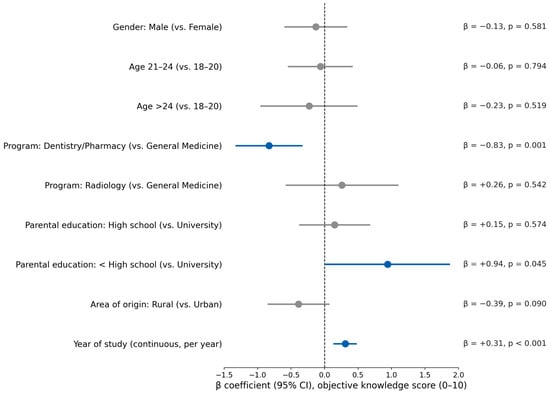
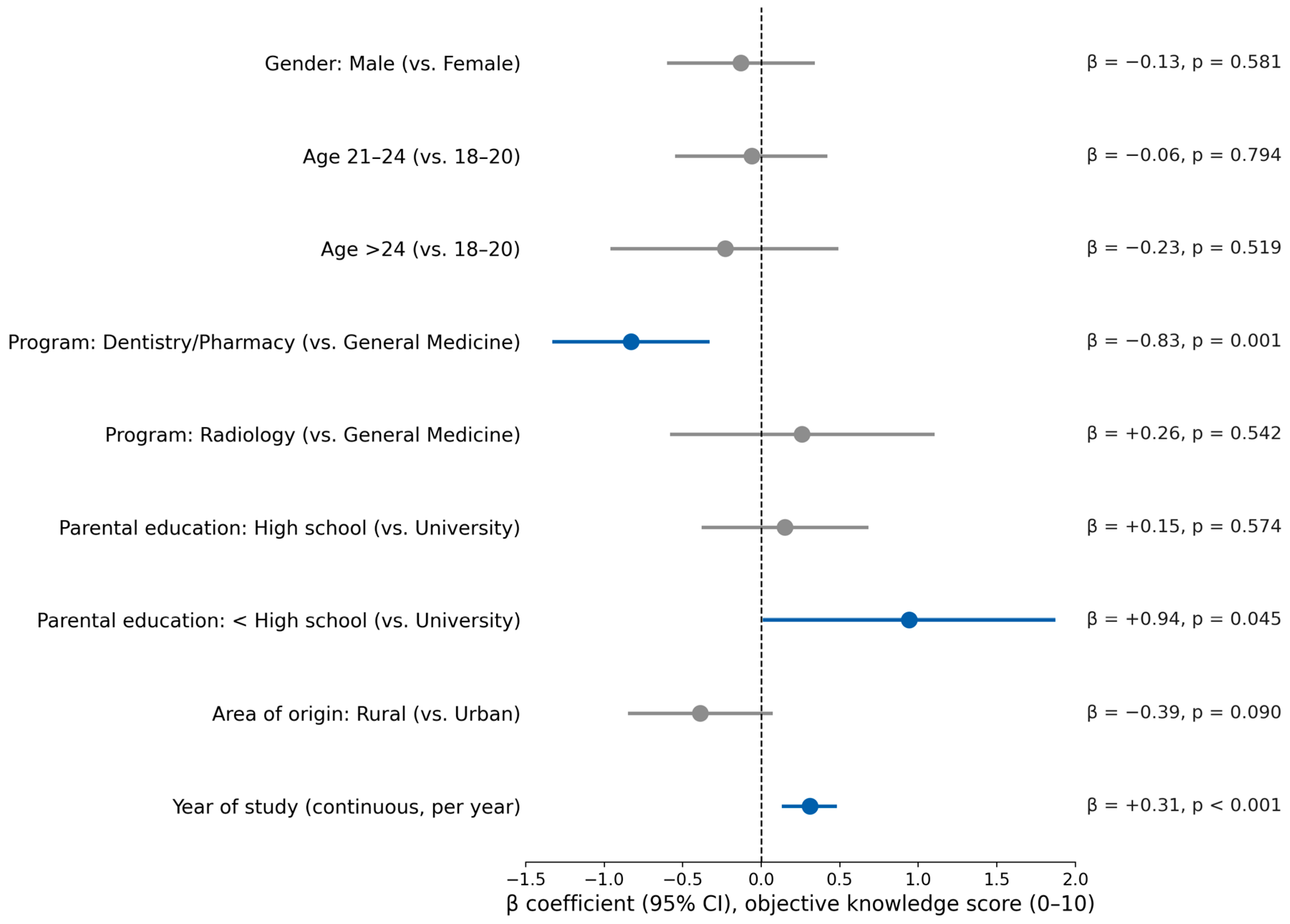
Year of study was the strongest independent predictor, with each additional year of study associated with a 0.31-point increase in knowledge score (β = 0.31, 95% CI 0.14–0.47, p < 0.001), consistent with cumulative acquisition of reproductive-health knowledge over the course of medical training. Compared with students in General Medicine, students enrolled in Dentistry or Pharmacy programs scored significantly lower (β = −0.83, 95% CI −1.32 to −0.34, p = 0.001), while students in Radiology did not differ significantly (β = 0.26, p = 0.542). Students whose parents had less than a high school education scored higher than those whose parents held a university degree (β = 0.94, 95% CI 0.02–1.86, p = 0.045), while parental high-school education was not significantly associated with knowledge score (p = 0.574). Students from rural areas scored somewhat lower than those from urban areas, although this difference approached but did not reach statistical significance (β = −0.39, 95% CI −0.84 to 0.06, p = 0.090). After adjustment for these covariates, gender (p = 0.581) and age group (p = 0.519–0.794) were not independently associated with objective knowledge score, corroborating the unadjusted comparison in Section 3.5. These results suggest that curricular exposure (reflected by year and program of study) and, to a lesser extent, parental educational background are more relevant to objective reproductive-health knowledge among health-professions students than gender or age. Full regression results are presented in Table 8.
Table 8.
Multivariable linear regression predicting objective knowledge score (n = 508).
Figure 1 displays these estimates graphically as a forest plot. The 95% confidence intervals for year of study, enrollment in a Dentistry/Pharmacy program, and parental education below high-school level all exclude zero, visually confirming these as the independent predictors of objective knowledge; the intervals for gender, age group, enrollment in Radiology, and rural area of origin all cross zero, consistent with the non-significant associations reported above.
Figure 1.
Independent predictors of objective abortion-related knowledge. Forest plot of multivariable linear regression coefficients (β) with 95% confidence intervals for the objective knowledge score (n = 508). Blue markers indicate predictors significant at p < 0.05; numeric estimates are reported in Table 8.
3.7. Program-Level Comparison of Knowledge and Attitudes
For the multivariable analysis in Section 3.6 (Table 8), program of study was modeled using the same three broad categories reported in Table 1 (General Medicine, Dentistry or Pharmacy, and Radiology and Medical Imaging), reflecting the faculty-level structure of the university; the General Medicine category, in particular, also includes the 19 students enrolled in the Balneophysiokinetotherapy program, and the Dentistry or Pharmacy category combines Dental Medicine and Pharmacy students. General Nursing and Dental Technology students were also invited (Section 2.1) but submitted no completed responses and are not represented in the sample. To address the five underlying programs individually, as distinct from the three collapsed categories used in Table 1 and Table 8, we disaggregated the sample accordingly (Table 9; n = 506, excluding four respondents whose program of study could not be unambiguously determined from their survey responses).
Table 9.
Knowledge of legal gestational limits and overall attitude toward abortion, by program of study.
Program of study was significantly associated with correct knowledge of the medical abortion gestational limit (63 days; p = 0.039) and with overall attitudes toward abortion (p < 0.001), and showed a non-significant trend for the surgical abortion limit (p = 0.077). Students in Radiology and Medical Imaging (85.71%) and Balneophysiokinetotherapy (84.21%) most often correctly identified the surgical limit, while Pharmacy students did so least often (46.15%); for the medical (63-day) limit, General Medicine students scored highest (41.10%) and Pharmacy and Balneophysiokinetotherapy students lowest (15.38% and 15.79%, respectively). Conversely, General Medicine students expressed, on average, the most liberal attitudes toward abortion across the seven scenarios (attitude index 3.34 ± 0.71), while students in Radiology and Medical Imaging expressed the least permissive attitudes (2.78 ± 0.95). Because the smaller programs (Pharmacy, n = 13; Balneophysiokinetotherapy, n = 19; Radiology and Medical Imaging, n = 28) contributed relatively few respondents compared with General Medicine (n = 365) and Dental Medicine (n = 81), these program-level estimates should be interpreted with caution and regarded as hypothesis-generating rather than definitive.
4. Discussion
This study aimed to assess the level of knowledge regarding abortion and contraception, as well as attitudes toward these topics, among students at a medical faculty in Romania. As expected, the vast majority of respondents were female (77.45%). A statistical comparison between the responses of female and male students was conducted despite the resulting unequal subgroup sizes (395 female, 115 male). Rather than treating this imbalance as a barrier to comparison, we addressed it analytically throughout the Results: gender comparisons are reported together with odds ratios and 95% confidence intervals (Section 2.4), and p-values were adjusted for multiple comparisons within each table, so that several differences that appeared significant using unadjusted p-values did not remain so after correction. This gender distribution is broadly consistent with wider demographic trends in medical education, described below for context, rather than as a methodological justification for the imbalance itself. In Romania, women represent approximately 70% of the medical workforce, as reported in 2024 [12]. Globally, the proportion of women pursuing medical education has grown substantially over recent decades, often surpassing that of men in many regions. Notably, in the United States, women made up the majority of medical school enrollees for the first time in 2019, representing 50.5% of the total student population. This upward trend has continued, with women accounting for 54.9% of medical school enrollments in the 2023–2024 academic year, reflecting an ongoing shift toward greater female representation in medical education [13,14].
4.1. Knowledge Gaps Regarding Abortion Legality and Complications
In this study, 85.88% of participants reported being familiar with the concept of abortion on demand. Family and media were the most commonly reported sources of information (about 21% each), and approximately 61% of respondents were aware that pregnancy terminations are performed in obstetrics and gynecology hospitals. A large proportion of female respondents (77.22%) knew that abortion on demand is legal in Romania up to three months of pregnancy. However, only 39.24% of women correctly identified that medical abortion in Romania is available up to 63 days of amenorrhea. This knowledge gap may plausibly contribute to delays in seeking care, although the cross-sectional design of this study cannot establish that link directly. Many young women may remain unaware of when they should consult a specialist if they wish to terminate a pregnancy, and may not recognize early pregnancy symptoms or know where to seek medical assistance, potentially resulting in delayed presentation for care. The existing literature highlights that, among young people, abortion later in pregnancy is associated with delayed pregnancy recognition, financial and logistical constraints, limited access to specialized services, and decision-making delays caused by social stigma. These factors collectively contribute to cumulative delays and further complicated access to timely medical care [15].
A comparable study by Gutema et al. [16] among college students in Ethiopia yielded partially similar yet less favorable findings. In their study, only 47.1% of participants had heard of induced abortion, 18.8% cited the media as their information source, and 14.1% believed that abortion could be performed at any point during pregnancy. Regarding awareness of abortion complications, 68.61% of our female respondents and 59.13% of our male respondents identified infertility as a potential long-term consequence of abortion, a difference that did not reach statistical significance (p = 0.058). By contrast, in Gutema’s study, only 14.1% of students acknowledged infertility as a possible outcome, indicating that infertility was far more often perceived as a consequence of abortion in our sample, regardless of gender (see below).
The relatively high proportion of respondents identifying infertility as a possible complication of abortion (66.47% overall) warrants careful interpretation. In our objective knowledge score, this response was not counted as correct, as infertility is not listed as a direct procedural complication of abortion in major clinical guidelines, which instead identify bleeding, infection, uterine perforation, and, more rarely, hysterectomy or death as recognized complications. An association between abortion and subsequent infertility has been described in the context of unsafe or complicated procedures, particularly in settings with limited access to safe abortion care, but is not established as a direct outcome of a legal medical abortion performed under appropriate conditions, which is the relevant context in Romania. We therefore interpret the frequency with which students selected infertility as reflecting a persistent, more general perception of abortion as inherently risky to future fertility, rather than a demonstrated knowledge gap regarding a specific, well-documented procedural complication. Because the questionnaire item asked about complications in general terms rather than specifying the clinical context (safe versus unsafe abortion, or short-term versus long-term risk), it cannot fully distinguish between these interpretations, and this ambiguity should be considered when designing future knowledge-assessment instruments on this topic.
4.2. Attitudes Toward Abortion Across Clinical and Social Contexts
Concerning attitudes toward abortion in various contexts, Romanian health-professions students generally expressed supportive views. Over 70% totally agreed with abortion when the woman’s health is at risk or in cases of rape. However, only 54.71% totally agreed with abortion in cases of fetal malformations (84.71% including “agree” responses). Male respondents were notably less supportive of abortion for economic, familial, or personal reasons. Overall, female students were more open than male students to accepting abortion for socio-economic and personal reasons, whereas no gender differences emerged for medical indications. A similar study conducted in Poland by Stokłosa et al. [17] among university students revealed comparable findings: attitudes towards abortion were generally favorable but varied by context and respondent gender. In life-threatening situations for the mother, nearly all participants supported the legality of abortion (94.5% of women and 90.7% of men). In cases of sexual assault, support remained high (85.5% of women and 71.1% of men). For severe fetal malformations incompatible with life, acceptance was also strong (90.1% of women and 82.9% of men). However, for non-lethal conditions such as Down syndrome, support was lower (71.2% of women and 56.6% of men). In situations of socio-economic hardship, acceptance further declined, particularly among men (52% of women and only 38.7% of men). For abortion on demand without medical or social reasons, approval dropped to 45.4% among women and 33.3% among men.
Taken together, the present findings and those of Stokłosa et al. reveal a strikingly similar hierarchy of acceptability across two Central and Eastern European countries with very different abortion laws: situations framed as medical necessity or as resulting from assault are the most broadly accepted, whereas socio-economic hardship and, especially, personal autonomy remain the most contested grounds, with men consistently more restrictive than women on the latter. Because Romania permits abortion on demand while Poland restricts it to a narrow set of exceptions, this convergence suggests that the underlying moral hierarchy of “acceptable” reasons for abortion may be shaped less by the immediate legal environment than by shared cultural and religious influences across the region, and that legal liberalization alone may not be sufficient to shift attitudes toward pregnancy termination for socio-economic or personal reasons.
A study among medical students in the United Kingdom by Gleeson et al. [18] examined attitudes toward abortion, beliefs about fetal rights, women’s rights, the legal framework, and students’ willingness to participate in abortion services in their future practice. The results showed that 62% of students identified as pro-choice, 33% as pro-life, and 7% were undecided. Attitudes were significantly influenced by gender, year of study, and religious practice. Notably, second-year students were more likely to hold pro-choice views compared to first-year students (70% vs. 54%), indicating that perceptions may shift as medical education advances. Students who actively practiced a religion were more likely to adopt pro-life positions. Furthermore, willingness to participate in abortion services correlated with personal beliefs: pro-choice students were more likely to provide unbiased counseling, sign required documentation and perform abortion procedures compared to pro-life students. Willingness decreased with higher levels of involvement: while 93% were open to providing counseling, only 69% were willing to sign paperwork, and just 50% were prepared to perform the procedure. Circumstances of pregnancy strongly influenced their decisions: when the mother’s life was at risk, 84% were willing to sign documentation, whereas in cases of unwanted pregnancy, only 50% were willing. Gender differences were also evident, with a greater proportion of male students (45%) than female students (25%) believing that fathers should have the right to prevent an abortion. Overall, the findings indicated that students’ personal beliefs were aligned with their perspectives on the law and anticipated future professional conduct. Interestingly, the study suggested a trend toward increasingly pro-choice views as students progressed in their training, likely influenced by greater exposure to ethics education and clinical experience.
4.3. Perceived Access to Abortion Services
A significant proportion (60.59%) of the students in our study believed that women in Romania lack sufficient access to abortion services. Nearly 80% felt that legislative measures are needed to improve access to abortion on demand. Similar findings were reported in a study conducted in Germany by Torenz et al. [19], which emphasized regional disparities in access to abortion services, largely due to the decreasing number of facilities and healthcare providers willing to perform the procedure. Since 2003, the number of reporting facilities has decreased by nearly 46%, creating substantial barriers to timely care, especially in southern and western regions. These obstacles disproportionately affect vulnerable groups, including women with limited financial resources or mobility. The authors recommended better data collection and integrating abortion care into routine healthcare planning to ensure adequate availability and accessibility nationwide. Likewise, a qualitative study in Sweden found that individuals seeking medical abortions experienced the waiting period for consultations as a significant barrier. Participants emphasized that options such as telemedicine or home administration of medication would substantially facilitate access to abortion care and alleviate the stress associated with decision-making [20].
4.4. Contraceptive Knowledge and Misconceptions
Regarding contraceptive methods, condoms were the most commonly used. However, 64.35% of male respondents believed that condoms reduce sexual pleasure, while 87.85% of female respondents expressed concerns about the side effects of oral contraceptives. Several studies have explored students’ perceptions of condom use and its impact on sexual satisfaction. For instance, a study by Randolph et al. [21] found that both women and men perceive that using condoms during vaginal intercourse significantly reduces sexual pleasure, with men reporting a greater decrease than women. Additionally, a study among first-year nursing students at Da Nang University of Medical Technology and Pharmacy in Vietnam revealed widespread misconceptions and negative attitudes toward contraceptive methods. More than half of the participants (61.2%) were uncertain whether condom use diminishes sexual pleasure, highlighting common concerns about its potential impact on sexual satisfaction. Regarding combined oral contraceptives, a substantial proportion (57.1%) believed that taking the pills could decrease fertility, reflecting widespread fears about the long-term side effects of oral contraceptives. These findings underscore the urgent need for educational initiatives to dispel misconceptions and promote informed contraceptive choices among young people [22].
5. Limitations
This study has a few limitations that should be acknowledged. First, the cross-sectional design captures students’ knowledge and attitudes at a single point in time, preventing assessment of how these perceptions may evolve throughout their medical education. Longitudinal studies would provide better insights into changes over time. Second, the data were collected through self-reported online questionnaires, which may introduce response biases, including social desirability bias, especially considering the sensitive nature of abortion and contraception. Participants might have provided answers they perceived as socially acceptable rather than reflecting their true beliefs. In addition, because the questionnaire was distributed through the internal university network and completion was voluntary, selection and non-response bias cannot be excluded: students who chose to respond, and to respond fully, may differ systematically (e.g., in interest in the topic or comfort discussing it) from those who did not. Of the 70 students invited to the pilot, only 32 (45.7%) responded, and a comparable non-response pattern may have occurred in the main study. Third, the study sample was limited to students from a single medical university in Romania. Although diverse faculties and linguistic tracks were included, the findings may not be fully generalizable to all medical students nationwide or to students from other health-related educational institutions. Furthermore, the predominance of female respondents, reflective of the current feminization trend in medical education, limited the scope of gender comparisons. The relatively small male subsample reduced statistical power to detect some gender differences: with n = 395 female and n = 115 male respondents, this study had approximately 80% power (two-sided α = 0.05) to detect a between-group difference of about 8 percentage points or more around a baseline proportion of 50%, and correspondingly less power for less prevalent responses; smaller true differences, especially for lower-frequency items, may therefore not have been reliably detected, and non-significant comparisons should be interpreted with this in mind rather than as evidence of equivalence. Additionally, during pilot validation, nearly half of the 32 respondents (15 of 32) gave an identical agreement rating across all 57 item-level validation ratings, a pattern consistent with straightlining; although Cronbach’s alpha remained high even after excluding these respondents (α = 0.976 among the remaining 17), this response pattern should be considered when interpreting the reported internal consistency of the pilot validation. Content validity was assessed by a small expert panel (a midwife and an obstetrician-gynecologist), and a formal Content Validity Index was not calculated; a larger, more diverse panel with a quantified CVI would strengthen future validation work. Lastly, the questionnaire did not explore the influence of personal factors such as religious beliefs, political orientation, or prior exposure to reproductive health education, which are known to impact attitudes toward abortion and contraception. Future studies incorporating these variables could provide a more nuanced understanding of the determinants shaping students’ perspectives.
6. Conclusions
This study provides a comprehensive assessment of knowledge and attitudes toward abortion and contraceptive methods among Romanian undergraduate health-professions students. Overall, the findings reveal that while general awareness of abortion exists among students, significant knowledge gaps and misconceptions persist, particularly concerning the legal gestational limits for medical abortion. Attitudes toward abortion were generally supportive in medical or ethical circumstances, such as threats to maternal health or cases of sexual assault, whereas acceptance declined in socio-economic contexts or situations involving personal choice without medical justification. Gender differences were significant for attitudes toward abortion in these non-medical contexts, with male students expressing more restrictive views than their female counterparts, but were not robust for most individual knowledge items once corrected for multiple comparisons. Given the crucial role that future healthcare professionals play in counseling patients and shaping public perceptions, targeted educational interventions are urgently needed to address misinformation, promote reproductive autonomy, and prepare future healthcare professionals to provide comprehensive, unbiased reproductive healthcare.
Author Contributions
Conceptualization, R.-D.C. and T.T.; validation, A.I.G.-O.; data curation, T.T.; writing—original draft preparation, R.-D.C.; writing—review and editing, T.T. and C.-B.C.; supervision, C.-B.C. All authors have read and agreed to the published version of the manuscript.
Funding
This research received no external funding.
Institutional Review Board Statement
The study was conducted in accordance with the Declaration of Helsinki, and approved by the Scientific Research Ethics Committee of the “Iuliu Hațieganu” University of Medicine and Pharmacy, Cluj-Napoca, Romania (No. 66, 19 April 2024).
Informed Consent Statement
Informed consent was obtained from all subjects involved in the study.
Data Availability Statement
The original contributions presented in this study are included in the article. Further inquiries can be directed to the corresponding author.
Conflicts of Interest
The authors declare no conflicts of interest.
References
- Assifi, A.R.; Berger, B.O.; Tunçalp, Ö.; Khosla, R.; Ganatra, B. Women’s awareness and knowledge of abortion laws: A systematic review. PLoS ONE 2016, 11, e0152224. [Google Scholar] [CrossRef] [Scilit] [PubMed]
- Kavanaugh, M.L.; Carlin, E.E.; Jones, R.K. Patients’ attitudes and experiences related to receiving information about abortion safety. Contraception 2013, 88, 470–477. [Google Scholar] [CrossRef] [Scilit] [PubMed]
- Alvargonzález, D. Knowledge and attitudes about abortion among undergraduate students. Psicothema 2017, 29, 520–526. [Google Scholar] [CrossRef] [Scilit] [PubMed]
- Patev, A.J.; Hood, K.B. Towards a better understanding of abortion misinformation in the USA: A review of the literature. Cult. Health Sex. 2021, 23, 285–300. [Google Scholar] [CrossRef] [Scilit] [PubMed]
- Jacobs, R.J.; Kane, M.N.; Fritz, K. Predictors of abortion attitudes in medical students after the reversal of Roe v. Wade. Cureus 2023, 15, e35421. [Google Scholar] [CrossRef] [Scilit] [PubMed]
- Vongxay, V.; Chaleunvong, K.; Essink, D.R.; Durham, J.; Sychareun, V. Knowledge of and attitudes towards abortion among adolescents in Lao PDR. Glob. Health Action 2020, 13, 1791413. [Google Scholar] [CrossRef] [Scilit] [PubMed]
- Espinoza, C.; Samandari, G.; Andersen, K. Abortion knowledge, attitudes and experiences among adolescent girls: A review of the literature. Sex. Reprod. Health Matters 2020, 28, 1744225. [Google Scholar] [CrossRef] [Scilit] [PubMed]
- Fiala, C.; Agostini, A.; Bombas, T.; Lertxundi, R.; Lubusky, M.; Parachini, M.; Gemzell-Danielsson, K. Abortion: Legislation and statistics in Europe. Eur. J. Contracept. Reprod. Health Care 2022, 27, 345–352. [Google Scholar] [CrossRef] [Scilit] [PubMed]
- Singh, S.; Maddow-Zimet, I. Facility-based treatment for medical complications resulting from unsafe pregnancy termination in the developing world, 2012: A review of evidence from 26 countries. BJOG 2016, 123, 1489–1498. [Google Scholar] [CrossRef] [Scilit] [PubMed]
- Horga, M.; Gerdts, C.; Potts, M. The remarkable story of Romanian women’s struggle to manage their fertility. J. Fam. Plann. Reprod. Health Care 2013, 39, 2–4. [Google Scholar] [CrossRef] [Scilit] [PubMed]
- World Health Organization. Safe Abortion: Technical and Policy Guidance for Health Systems, 2nd ed.; World Health Organization: Geneva, Switzerland, 2015; Available online: https://iris.who.int/handle/10665/173586 (accessed on 17 September 2026).
- Stancu, B.; Popa, S.L.; Ismaiel, A.; Turtoi, D.C.; Brata, A.M.; Duse, T.A.; Pop, C.; Barsan, M.; Padureanu, A.M.; Dita, M.O.; et al. Physician migration in Romania: A study on the emigration preferences within the Cluj County healthcare system. Med. Pharm. Rep. 2024, 97, 251–259. [Google Scholar] [CrossRef] [Scilit] [PubMed]
- Morris, D.B.; Gruppuso, P.A.; McGee, H.A.; Murillo, A.L.; Grover, A.; Adashi, E.Y. Diversity of the national medical student body—Four decades of inequities. N. Engl. J. Med. 2021, 384, 1661–1668. [Google Scholar] [CrossRef] [Scilit] [PubMed]
- Lautenberger, D.M.; Dandar, V.M.; Raezer, C.L.; Sloane, R.A. The State of Women in Academic Medicine: The Pipeline and Pathways to Leadership, 2023–2024; Association of American Medical Colleges: Washington, DC, USA, 2024. [Google Scholar]
- Jacobson, L.E.; Darney, B.G.; Johnston, H.B.; Ganatra, B. A global scoping review of the circumstances of care seeking for abortion later in pregnancy. PLoS Glob. Public Health 2024, 4, e0003965. [Google Scholar] [CrossRef] [Scilit] [PubMed]
- Gutema, R.M.; Dina, G.D. Knowledge, attitude and factors associated with induced abortion among female students of private colleges in Ambo town, Oromia regional state, Ethiopia: A cross-sectional study. BMC Womens Health 2022, 22, 351. [Google Scholar] [CrossRef] [Scilit] [PubMed]
- Stokłosa, M.; Stokłosa, I.; Porwolik, M.; Bugajski, M.; Więckiewicz, G.; Męcik-Kronenberg, T.; Piegza, M.; Pudlo, R.; Gorczyca, P. Mercy procedure or a nightmare? Attitude towards pregnancy termination among Polish university students. Int. J. Environ. Res. Public Health 2022, 19, 213. [Google Scholar] [CrossRef] [Scilit] [PubMed]
- Gleeson, R.; Forde, E.; Bates, E.; Powell, S.; Eadon-Jones, E.; Draper, H. Medical students’ attitudes towards abortion: A UK study. J. Med. Ethics 2008, 34, 783–787. [Google Scholar] [CrossRef] [Scilit] [PubMed]
- Torenz, R.; Vollmer, H.; Eckardt, S.; Wyrobisch-Krüger, A.; Thonke, I.; Hahn, D. Data on regional availability and accessibility of abortion providers in Germany. Res. Health Serv. Reg. 2023, 2, 21. [Google Scholar] [CrossRef] [Scilit] [PubMed]
- Jar-Allah, T.; Edalat, M.; Nyman, V.; Milsom, I.; Gemzell-Danielsson, K.; Rydelius, J.; Hognert, H. Perspectives on abortion services, the pre-abortion visit, and telemedicine abortion: A qualitative study in Sweden. Perspect. Sex. Reprod. Health 2025, 57, 36–44. [Google Scholar] [CrossRef] [Scilit] [PubMed]
- Randolph, M.E.; Pinkerton, S.D.; Bogart, L.M.; Cecil, H.; Abramson, P.R. Sexual pleasure and condom use. Arch. Sex. Behav. 2007, 36, 844–848. [Google Scholar] [CrossRef] [Scilit] [PubMed]
- Ngoc, T.A.; Sen, H.T.N. Knowledge and attitude towards contraceptive methods among first-year nursing students in Da Nang, Vietnam. Rama Med. J. 2022, 45, 23–32. [Google Scholar] [CrossRef] [Scilit]

Disclaimer/Publisher’s Note: The statements, opinions and data contained in all publications are solely those of the individual author(s) and contributor(s) and not of MDPI and/or the editor(s). MDPI and/or the editor(s) disclaim responsibility for any injury to people or property resulting from any ideas, methods, instructions or products referred to in the content. |
© 2026 by the authors. Licensee MDPI, Basel, Switzerland. This article is an open access article distributed under the terms and conditions of the Creative Commons Attribution (CC BY) license.