


Abstract
Intimate partner violence (IPV) against women is recognized as a public health and human rights issue globally. Nigeria continues to experience a substantial burden of IPV. This study analyzed patterns and multilevel factors associated with violence against women in Nigeria, including emotional, physical, and sexual violence. This study analyzed data from 5458 women aged 15 to 49 years who participated in the 2024 Nigeria Demographic and Health Survey (NDHS). We computed multivariable binary logistic regression and Firth logistic regression (for relatively rare events). Women whose partners consumed alcohol had higher odds of experiencing emotional violence (AOR = 2.97), less severe physical violence (AOR = 3.11), severe physical violence (AOR = 3.22), and sexual violence (AOR = 2.07). Partner controlling behaviors, including restricting contact with family or friends, was also consistently linked to elevated IPV risk. Women living with a partner had higher odds of severe physical and sexual violence. Higher education and greater household wealth were associated with lower IPV outcomes. Our study provides practice-relevant evidence and policy implications, including the need for integrated prevention strategies that address behavioral risk factors, strengthen early screening for controlling behaviors, and promote women’s socioeconomic empowerment.
1. Introduction
Violence against women (VAW) remains a major global public health problem and a fundamental violation of human rights [1]. The United Nations defines VAW as “any act of gender-based violence that results in, or is likely to result in, physical, sexual, or mental harm or suffering to women, including threats of such acts, coercion, or arbitrary deprivation of liberty, whether occurring in public or private life” [1,2]. Globally, one in three women (30%) aged 15–49 who have ever been in a relationship have experienced at least one episode of physical and/or sexual violence by an intimate partner since age 15 [1,3]. The recent 2024 Nigeria Demographic and Health Survey (NDHS) showed that 19% of women aged 15–49 have experienced physical violence since age 15. Physical violence varies substantially across regions in Nigeria, ranging from 32% in the South to 11% in the Northwest. Sexual violence affects 5% of women in their lifetime. In Nigeria, fifty-five percent (55%) of ever-partnered women who experienced physical violence and 70% of those who experienced sexual violence attributed it to a current partner [4].
Among all other forms of violence against women, including non-partner sexual violence, harmful traditional practices such as female genital mutilation (FGM), child and forced marriage, economic abuse, stalking, and technology-facilitated violence, intimate partner violence (IPV) is the most common. The World Health Organization defined IPV as any behavior within an intimate relationship that causes physical, sexual, or psychological harm to a current or former partner [1]. IPV affects approximately 27% of ever-partnered women aged 15–49 worldwide [1]. The prevalence of IPV varies across regions, with the African region reporting an estimated 33%, one of the highest globally [1,3]. According to the recent UN Women estimates, more than 50,000 women, an average of 137 per day, were killed by intimate partners or family members in 2024 [3].
Women who experience IPV are reported to be at high risk of serious socioeconomic impacts and negative physical and mental health outcomes, including chronic pain, disability, and reproductive health complications [1,5,6]. Similarly, Bergvall reported that IPV can negatively affect women’s educational and employment opportunities [7]. Children exposed to IPV experience increased emotional distress, lower academic performance, and a higher likelihood of perpetrating violence in future relationships [3,8]. Studies by Noonan & Pilkington [9] and Mazza et al. [10] further highlight that IPV negatively influences the attachment between children and their primary caregivers, which results in an additional risk factor for social, emotional, and psychological impairment. These wide-ranging consequences position IPV as a critical global priority that requires sustained targeted prevention and data-driven policy responses.
Nigeria is among the African countries with a high burden of IPV despite efforts and continued national commitments to safeguarding women [11,12]. The high burden of IPV in Nigeria is shaped by intersecting structural factors, including poverty, inequality, ethnoreligious tensions, and entrenched cultural and patriarchal norms that construct IPV as a private domestic issue rather than a prosecutable offense. This perception not only normalizes violence but also suppresses reporting, as many survivors remain silent to avoid social stigma, family pressure, or fear of retaliation [13,14,15]. Further studies reveal that women who report IPV often face blame for inciting the abuse and pressure from family and religious institutions and often face blame or pressure to remain silent for the sake of preserving the family name [15]. Systemic challenges, such as limited access to shelters, legal aid, and counseling, particularly in rural areas, further exacerbate the situation [16,17]. Prior research also highlights that corruption, lack of confidentiality, and economic dependence on abusers significantly impact women’s ability to seek help, as many fear losing financial support for themselves and their children [18].
Despite increasing research on IPV in Nigeria, important gaps remain in the recent literature. Many previous studies on IPV in Nigeria have focused primarily on descriptive analyses and broad measures of violence, which limit understanding of the independent predictors associated with different forms of IPV [13,19,20].
Moreover, the existing literature tends to focus narrowly on IPV, frequently neglecting other critical aspects of VAW, such as emotional abuse, violence during pregnancy, and technology-facilitated violence. Methodologically, many studies rely primarily on descriptive analyses, which hinder the identification of independent predictors of violence [13,18,21]. The 2024 NDHS provides updated, nationally representative data that disaggregates various forms of VAW, which is essential for analyzing violence across different categories. This analysis will enable researchers to identify correlates of violence at multiple levels of influence, thereby enhancing the overall understanding of VAW dynamics in Nigeria and informing policies and interventions that address these issues comprehensively.
Guided by the Socio-Ecological Model (SEM), this study examines predictors of intimate partner violence (IPV) across individual, interpersonal, institutional, and community levels [22,23]. These factors include women’s socioeconomic characteristics, partner controlling behaviors, partner alcohol use, and broader contextual influences such as region and urban–rural residence. At the individual and relational levels, characteristics such as socioeconomic position, partnership dynamics, and partner behaviors have been consistently linked to IPV risk in Nigeria [18]. At the community and societal levels, regional variation and culturally embedded gender norms shape the acceptability and experience of IPV across Nigeria’s diverse sociocultural contexts.
This study aims to examine patterns and predictors of intimate partner violence (IPV) among Nigerian women using four outcome categories: emotional, less severe physical, severe physical, and sexual violence. Specifically, the study analyzes DHS-defined measures of ever-experienced IPV reported by women participating in the 2024 Nigeria Demographic and Health Survey (NDHS). The study addresses the following research questions: (1) Which sociodemographic, relational, partner, and household factors are associated with different forms of violence against women? (2) Are patterns of emotional, physical, and sexual violence distinct or overlapping? (3) How do controlling behaviors, partner characteristics, and women’s economic empowerment influence the risk of experiencing violence? This study contributes to the literature by using recent nationally representative data to provide an updated understanding of IPV dynamics and key predictors among Nigerian women.
2. Results
Descriptive Statistics and Characteristics of the Respondents
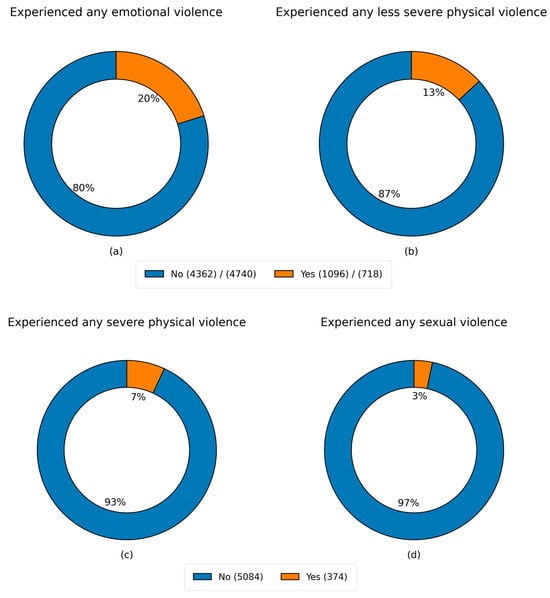
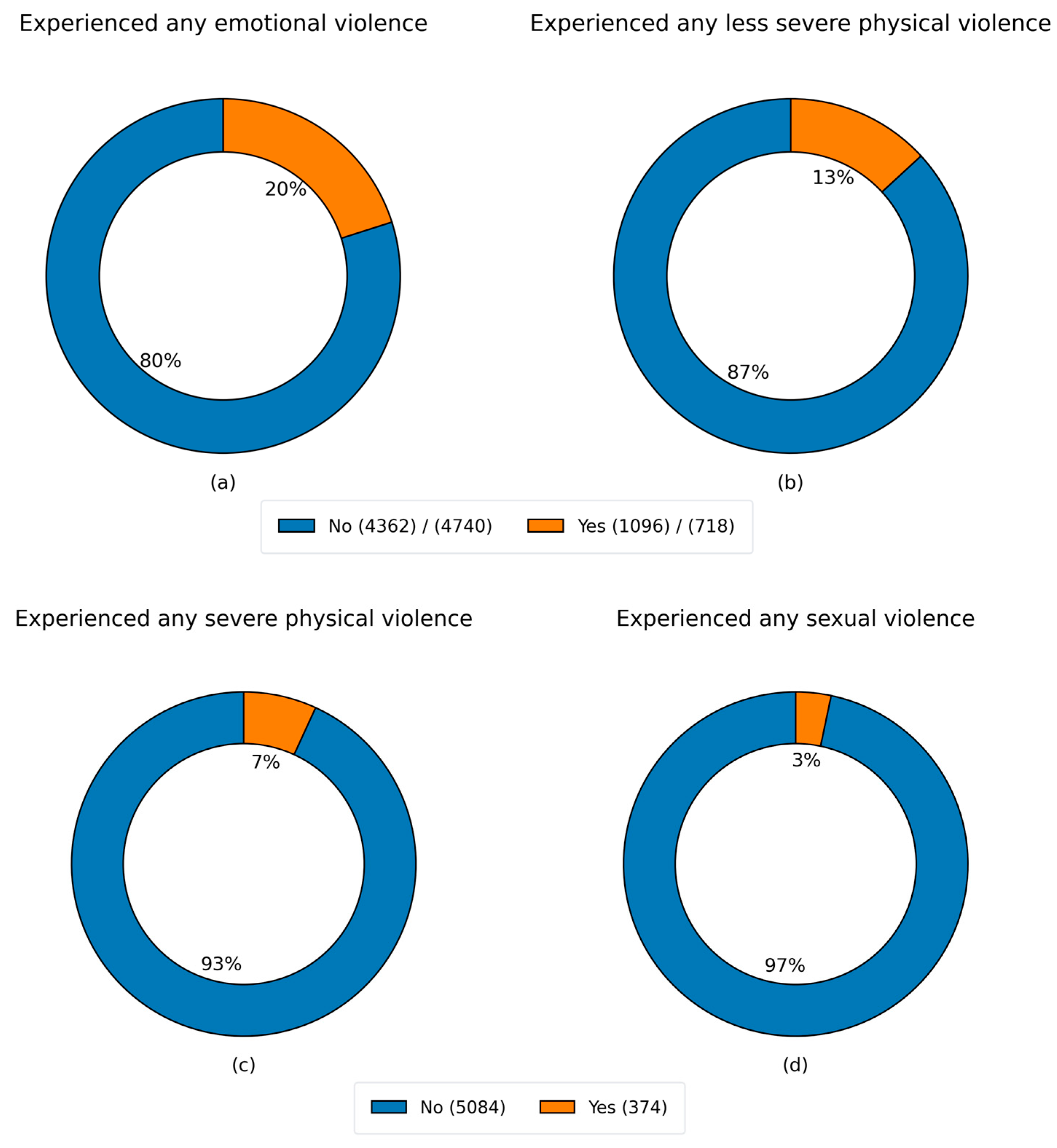
Figure 1 shows that emotional abuse was the most commonly reported form of IPV (19%), followed by less severe physical, severe physical, and sexual violence (11%, 6%, and 4%, respectively). The majority of respondents reported no history of IPV. Overall, 77% reported no form of IPV, 14% reported one form, 8% reported two forms, and 2% reported all three forms assessed in this study. These findings indicate substantial polyvictimization among women who reported IPV, with 71% reporting both physical and emotional abuse, 65% reporting both sexual and emotional abuse, and 16% reporting both physical and sexual abuse. The considerable overlap across IPV categories suggests that many women experienced multiple forms of victimization rather than isolated incidents, a pattern associated with greater psychological and health consequences in previous research.
Figure 1.
(a) Percent of female respondents who ever experienced any emotional violence (n =5458), (b) who experienced any severe physical violence (n = 5458), (c) who ever experienced any less severe physical violence by husband/partner (n = 5458), and (d) who ever experienced any sexual violence by husband/partner (n = 5458).
Table 1 presents the demographic characteristics of the respondents and the descriptive statistics for the dependent and independent variables. Ninety-five percent (95%) of the respondents were married, and the mean age of the female respondents was 31.4 years (±0.16). Twenty-three percent (23%) of the female respondents were 25–29 years, twenty-one percent (21%) of the female respondents were 30–34 years, sixteen percent (16%) of the female respondents were 20–24 years and 35–39 years, twelve percent (12%) of the female respondents were 40–44 years, and six percent (6%) were 15–19 years and 45–49 years. In terms of education, forty-two percent (42%) of the female respondents had no form of education, thirty-two percent (32%) held a middle/high school degree, and thirteen percent (13%) had both an elementary and college or university degree. The majority of the female respondents worked all year (78%), with sixty-three percent (63%) professing Islam, and thirty-six percent (36%) being Christians.
Table 1.
Descriptive Statistics of the Intimate Partner Violence Respondents, 2024.
Table 2 shows that female respondents with a richer wealth index combined (Adjusted Odds Ratio (AOR) = 0.60, CI = 0.37–0.96) and those with the richest wealth index combined (Adjusted Odds Ratio (AOR) = 0.49, CI = 0.29–0.81) had lower odds of experiencing any emotional violence. Female respondents whose partners consumed alcohol had higher odds of experiencing any emotional violence (AOR = 2.97, CI = 2.32–3.79). Partner attempts to restrict women’s contact with family were associated with substantially higher odds of any emotional violence (AOR = 2.92, CI = 1.75–4.87). Compared to the female respondents whose partners permitted them to meet with female friends, female respondents who reported any restriction in meeting with female friends (ever experienced) had higher odds of experiencing any emotional violence (AOR =3.01, CI = 2.13–4.26). Women residing in rural areas had lower odds of emotional violence than those living in urban areas (AOR = 0.74, CI = 0.57–0.96).
Table 2.
Binary Logistic Regression and Firth Logistic Regression of Sociodemographic Characteristics and those who ever experienced any emotional violence (n = 5448), those who ever experienced any less severe physical violence (n = 5448), those who ever experienced any severe physical violence (n = 5448), and those who experienced any sexual violence (n = 5488).
Several factors were associated with less severe physical violence. Women with a college or university education had lower odds of reporting less severe physical violence than women with no education (AOR = 0.41, 95% CI = 0.26–0.66). Women living with a partner had higher odds than married women (AOR = 1.46, 95% CI = 1.05–2.04), whereas Muslim women had lower odds than Christian women (AOR = 0.48, 95% CI = 0.34–0.67). Partner alcohol use remained a strong predictor (AOR = 3.11, 95% CI = 2.47–3.94). Restricting contact with family (AOR = 2.38, 95% CI = 1.62–3.48) and restricting meetings with female friends (AOR = 3.79, 95% CI = 2.84–5.05) were also associated with higher odds of less severe physical violence. Women who resided in the Southeast region (AOR = 2.18, CI = 1.30–3.67), South-south region (AOR = 2.72, CI = 1.62–4.60), and Southwest (AOR = 1.98, CI = 1.17–3.34) had higher odds than those who resided in the Northwest region of reporting ever experiencing any less severe physical violence.
Among factors associated with severe physical violence, higher education was protective. Compared to women who had no formal education, those with a college or university degree had lower odds of reporting any severe physical violence (AOR = 0.41, CI = 0.21–0.78). Women living with a partner had higher odds than married women (AOR = 1.95, 95% CI = 1.33–2.85), while Muslim women had lower odds than Christian women (AOR = 0.50, 95% CI = 0.32–0.79). Partner alcohol use was associated with more than threefold higher odds of severe physical violence (AOR = 3.22, 95% CI = 2.39–4.35). Restricting contact with family (AOR = 2.75, 95% CI = 1.75–4.33) and restricting meetings with female friends (AOR = 2.90, 95% CI = 2.04–4.13) were likewise associated with increased odds of severe physical violence.
Seasonal or occasional workers (vs. those who work all year) had higher odds of reporting any severe sexual violence (AOR =1.95, CI = 1.27–3.01). Women living with a partner had higher odds of reporting ever experiencing any severe sexual violence (AOR = 2.64, CI = 1.46–4.77) in contrast to those who were married. Partner alcohol use was associated with elevated odds of reporting sexual violence (AOR = 2.07, 95% CI = 1.29–3.34). Restricting contact with family (AOR = 2.80, 95% CI = 1.63–4.81) and restricting meetings with female friends (AOR = 3.42, 95% CI = 2.01–5.46) were also strongly associated with sexual violence. Women who reported that their partners had ever restricted contact with family had higher odds of reporting sexual violence (AOR = 2.80, 95% CI: 1.63–4.81). Similarly, women whose partners had ever restricted their ability to meet with female friends had higher odds of reporting sexual violence on the survey (AOR = 3.42, 95% CI: 2.14–5.46).
3. Discussion
This study used the 2024 Nigeria Demographic and Health Survey (DHS-8) Domestic Violence Module to assess ever-experienced emotional, less severe physical, severe physical, and sexual forms of intimate partner violence (IPV) among women in Nigeria. We also aimed to identify multilevel factors associated with these forms of violence, guided by the Socio-Ecological Model. Our descriptive findings reflect “ever experienced” violence and therefore capture cumulative exposure (rather than recent 12-month prevalence); the overall pattern signals a substantial burden of harm among women of reproductive age and reinforces IPV perpetrated by the partner. All independent variables, including partner behaviors, are interpreted consistently as lifetime (ever-experienced) measures in alignment with DHS constructs. IPV became the focus of our study because it is a pressing public health and human rights issue in Nigeria [1,6]. The substantial overlap observed across emotional, physical, and sexual IPV categories suggests that polyvictimization is common among affected women. This finding is important because exposure to multiple forms of abuse has been associated with greater cumulative psychological distress, poorer physical health outcomes, and increased barriers to seeking support compared with exposure to a single form of victimization. Future research should further examine the determinants and consequences of polyvictimization among women in Nigeria. These findings should be interpreted with some caution, as the regression analyses incorporated sampling weights but did not fully account for clustering and stratification, which may affect variance estimation.
Across the IPV indicators, we identified three findings that were striking for their magnitude and population health significance. They included partner alcohol use, partner controlling behaviors, and women’s union status. First, our results showed that women whose partners consumed alcohol had two- to three-times higher odds of reporting emotional, physical, and sexual violence. These findings align with previous research evidence that links alcohol consumption and abuse to IPV through complex pathways. These pathways comprise impaired inhibition, increased conflict escalation, and financial strain, as highlighted in previous studies [1,18,24]. From a public health practice perspective, our study findings support integrating alcohol risk screening and alcohol abuse prevention interventions into IPV-related public health practice involving community programs and clinical workflows, while also strengthening referral options for substance-use treatment where available [25].
Secondly, the indicators of coercive control, including attempts to limit contact with family and restrictions on meeting female friends, were among the most significant factors associated with IPV in our multivariable models. Previous studies have also underscored the significance of coercive control as a central mechanism of partner violence because it isolates women from their kin and friends, erodes their autonomy, and escalates the situations to physical and sexual assault [26,27,28]. These patterns suggest that routine assessment of controlling behaviors and not just physical injuries may serve as a screening mechanism to identify women at an increased risk early on. Such screening can enable effective safety planning and referrals to legal and psychosocial support before violence escalates to its extreme form.
Thirdly, women who were cohabiting had higher odds of reporting physical and sexual IPV compared with women who were married. This pattern has been documented in recent research. It may reflect lower relationship stability and fewer institutional, social, or legal protections associated with informal unions [11,19]. In Nigeria, where customary and statutory systems may shape access to remedies differently, future work should examine whether cohabiting women face distinctive barriers to help-seeking, to obtaining protection orders, or to community support.
Typical social determinants of health showed more nuanced relationships with IPV occurrence. As expected, having completed higher education at college or university was protective against less severe and severe physical violence. Being wealthy was also negatively associated with emotional violence. This is intuitive because education leads to information and awareness about how to deal with or prevent IPV. It also increases connectivity with services, strengthens social networks, and shifts gender-role expectations in ways that reduce IPV risk. However, the direction and magnitude of these associations can vary by context [11,29]. At the same time, a heightened risk of sexual violence among women in poorly paying jobs that are seasonal or occasional may point to economic insecurity and inequities in bargaining position within relationships, consistent with research linking economic vulnerability and economic abuse to IPV risk [7,21]. These findings point to the need for economic empowerment strategies, such as microfinancing, to be paired with gender-empowerment approaches that address norms, power imbalances, and partner behaviors, rather than assuming that income generation alone will reduce IPV.
Our study also showed that geographic location mattered. Women in the Southeast, South-South, and Southwest had higher odds of less severe physical violence compared with the Northwest. Differences in IPV across regions of Nigeria may reflect variations in norms surrounding conflict and discipline, access to services, enforcement of protective laws, and the local political economy. These findings support calls to tailor prevention and response strategies to match subnational realities rather than relying on one-size-fits-all programming [4,30]. Our study also showed lower odds of emotional violence among rural women compared to their urban counterparts. However, these results should be interpreted cautiously because urban–rural differences may partly be due to reporting patterns and social desirability concerns [1,31]. We also found the association of religion with IPV, with Muslim women reporting a lower risk of physical IPV compared with Christian women, after adjusting for other factors. Given the intersectionality of influences from religion, regional cultural differences, ethnicity, and marital practices, denominational differences likely reflect a complex bundle of contextual factors. These associations should be interpreted cautiously, as they likely reflect complex, context-specific social and reporting dynamics rather than direct causal effects. This is best treated as a hypothesis-generating finding that warrants qualitative work to understand community norms, marital expectations, and pathways to support across settings [19].
Our study findings carry important implications for public health practice and policy, implying that differences in gender norms, access to services, and enforcement of protective systems meaningfully influence women’s vulnerability to violence and that prevention strategies must be sensitive to Nigeria’s diverse regional realities. Effective IPV prevention will require integrated approaches. These approaches should address behavioral risk factors such as alcohol misuse. They should also strengthen early screening for coercive control and emotional abuse in health and social service settings. In addition, prevention efforts must expand access to survivor-centered support services, including counseling, legal assistance, and safe shelter options. Programs that promote women’s economic empowerment and education may also help reduce vulnerability, particularly when combined with interventions that challenge harmful gender norms and power imbalances within relationships.
Study Limitations
Our findings should be interpreted in light of several limitations. The Domestic Violence Module in the Demographic and Health Survey relies on self-reports of sensitive experiences. Consequently, there is a potential for under-reporting, despite standardized privacy and safety procedures. Additionally, both outcome and key explanatory variables were based on ever-experienced measures, which limits the temporal interpretation of associations. The module also selects only one eligible woman per household, which reduces within-household representation. In addition, the descriptive estimates presented in this study are based on “ever experienced” measures, which are open to recall bias. In addition, observations with missing, “don’t know,” or not reported responses were excluded from the analysis, which may introduce selection bias and affect generalizability if missingness was systematic rather than random. The cross-sectional design limits causal inference, allowing only tests of association. For example, alcohol use and controlling behaviors are plausibly antecedent risks for IPV, but bidirectional dynamics and unmeasured confounding remain possible [1,6]. Further, although multiple sociodemographic variables were included, we did not conduct formal intersectional analyses due to sparse cell counts across combined subgroups, which limited model stability and interpretability. Future research should explicitly examine how these factors jointly influence IPV risk. Despite these limitations, the nationally representative sample yielded generalizable policy implications.
Our findings imply that the programs to reduce IPV in Nigeria should prioritize (a) addressing alcohol-related risk through integrated screening, regionally customized intervention, and referral pathways; (b) identifying coercive control early within health and social service encounters; and (c) designing women’s economic empowerment initiatives that protect against backlash. Strengthening survivor-centered referral networks for legal aid, psychosocial services, and safe shelter options can be helpful, especially in settings where access is limited [4,32]. In summary, this nationally representative analysis highlights partner alcohol use, coercive control, union status, and socioeconomic context as central drivers of women’s IPV risk in Nigeria. A prevention agenda that tackles these determinants across SEM levels—households, services, communities, and policy environments—offers the strongest path toward reducing IPV and its far-reaching health and social consequences.
4. Materials and Methods
4.1. Data Source
This study utilized secondary data from the 2024 Nigeria Demographic and Health Surveys (DHS), a nationally representative household survey that provides data on a diverse range of indicators in health, nutrition, and population. There are three core questionnaires in DHS: Women, Men, and Household questionnaires. Data collected in each country is processed, tabulated, and presented in a report to describe the living conditions, the demographic, and health situation of the citizens. Women aged 15–49 are eligible to participate in all households, and the sample size ranges from 5000 to 30,000. In addition, men aged 15–59 from a sub-sample are eligible to participate in many surveys [33].
4.2. Sampling Design
A stratified two-stage cluster sampling design was used, and Nigeria was divided into six zones (North central, Northeast, Northwest, Southeast, South-south, and Southwest). The zones comprise 36 states and the Federal Capital Territory (FCT), yielding 37 subnational units. Each state was subdivided into local government areas (LGAs), and each LGA into localities.
The localities were further subdivided into convenient areas called enumeration areas (EAs) and Primary sampling units (PSUs), which were referred to as clusters in the 2024 Nigeria Demographic and Health Survey [4]. The first stage is an Enumeration Area (EA), which is generally drawn from Census files, and in the second stage, a sample of households is drawn from an updated list of households in each EA selected. All women aged 15–49 who were either usual members of the selected households or visitors who stayed in the households the night before the survey were eligible to be interviewed. One eligible woman in each household was randomly selected to be asked additional questions about domestic violence [4,33].
4.3. Data Collection and Study Participants
Data on intimate partner violence (IPV) against women were collected using a standardized Domestic Violence Module administered as part of nationally representative household surveys. In selected households, one woman aged 15–49 is randomly chosen to complete the module, which includes behavior-specific questions about physical, sexual, and emotional IPV by a current or former intimate partner. Although a total of 6828 women were interviewed in the survey, the present analysis was restricted to 5458 women who were eligible for and completed the Domestic Violence Module, consistent with DHS guidelines on respondent selection and data completeness. DHS follows rigorous ethical and safety procedures, including informed voluntary consent, confidentiality safeguards, and privacy during interviews, and provides respondents with information on available support services [33]. Additional information about the questionnaire, data collection instruments, DHS data resources, release date, validation, and application can be found at this link: https://dhsprogram.com/what-we-do/protecting-the-privacy-of-dhs-survey-respondents.cfm DHS Program, accessed on 20 January 2026.
A total of 6828 women were interviewed in the survey; however, the present analysis was restricted to 5458 women who were eligible for and completed the Domestic Violence Module, consistent with DHS guidelines on respondent selection and data completeness.
4.4. Sample Weights
Sampling weights provided by the dataset owners were applied during data analysis to create accurate point estimates and ensure that the results represent the total population of Nigeria [33]. Due to analytical constraints, regression models incorporated sampling weights but did not fully account for the complex survey design features such as clustering and stratification (primary sampling units and strata). As a result, standard errors may be slightly underestimated. This limitation is acknowledged in the interpretation of findings.
4.5. Dependent Variables
The four dependent variables of interest were ever-experienced emotional violence, ever-experienced less severe physical violence, ever-experienced severe physical violence, and ever-experienced sexual violence. All dependent variables were derived from the domestic violence module of the DHS-8 Nigeria Demographic and Health Survey (NDHS) 2023–2024 and defined in accordance with the DHS Guide to Statistics. (1) Emotional violence was measured using DHS items assessing whether the respondent had ever experienced emotional abuse from a husband or intimate partner, including humiliation, threats of harm, or insults. Responses were coded as Yes or No. (2) Physical violence was categorized into less severe and severe forms using DHS recoded variables based on the DHS codebook classification. (3) Less severe physical violence included acts such as being pushed or shaken, being slapped, or having one’s arm twisted or hair pulled. (4) Severe physical violence included acts such as being punched with a fist or object, kicked or dragged, strangled or burned, or threatened with or attacked using a weapon. Respondents were classified as having experienced less severe or severe physical violence if they reported at least one act within the respective category. Sexual violence was measured using DHS items assessing whether the respondent had ever been physically forced to have sexual intercourse or forced to perform other unwanted sexual acts by a husband or intimate partner. All dependent variables were treated as binary outcomes, coded 1 = Yes if the respondent reported experiencing the specified form of violence and 0 = No otherwise. Observations with responses coded as missing, “don’t know,” or not reported were excluded from the analysis.
4.6. Independent Variables
The independent variables of interest representing female participants’ sociodemographic characteristics included age group, educational level, marital status, wealth index, employment status, religion, partner alcohol use, whether the husband or partner tried to limit the respondent’s contact with family, whether the husband or partner did not permit the respondent to meet with female friends, region, and place of residence. At the individual level, age group was operationalized into 5-year age bands (15–19, 20–24, 25–29, 30–34, 35–39, 40–44, and 45–49 years). Educational level was categorized as no education, primary (elementary), secondary (middle/high school), and higher (college/university). Marital status was defined as married or living with a partner. Religion was classified as Christian, Islam, or Other. Employment status captured whether the respondent was currently employed and was categorized as working all year or seasonal/occasional employment.
At the interpersonal level, partner alcohol use was assessed based on the respondent’s report of whether her partner drank alcohol, dichotomized as yes or no. Two indicators of partner controlling behavior were included: whether the husband or partner tried to limit the respondent’s contact with her family, and whether the husband or partner did not permit her to meet with female friends. Each variable was coded as “never” versus “ever experienced restriction,” combining all affirmative responses regardless of timing to ensure stable estimates.
At the institutional level, the wealth index was operationalized into five categories: poorest, poorer, middle, richer, and richest. At the community level, place of residence was classified as urban or rural, and region was categorized into the six geopolitical zones of Nigeria: Northwest, Northeast, North Central, Southeast, South-South, and South-West.
4.7. Statistical Analyses
The data analysis consists of descriptive analysis, binary logistic regression, and Firth logistic regression. Descriptive statistics such as percentages and frequencies were calculated to describe the characteristics of the study population. A binary logistic regression was conducted to examine the association between variables of interest at the individual, interpersonal, institutional, and community levels of the SEM and emotional violence. Additionally, a first-logit regression was performed to assess the association between variables of interest at the individual, interpersonal, institutional level, and community levels of the SEM and the following dependent variables: less severe physical violence, severe physical violence, and sexual violence. Multicollinearity among independent variables was assessed using variance inflation factors (VIF). The mean VIF of 1.53 indicated low multicollinearity and suggested that none of the predictor variables exhibited concerning levels of collinearity. We conceptually considered whether partner controlling behaviors may act as a pathway linking partner alcohol use and IPV outcomes. However, formal mediation analysis was not conducted because the cross-sectional design of the DHS data does not allow clear temporal ordering of variables, which limits causal interpretation. Future longitudinal studies are needed to examine potential mediation pathways. In addition, we considered examining intersectional effects across key sociodemographic variables such as education, wealth, religion, and region. However, due to sparse cell sizes across combinations of these variables and the relatively low prevalence of some outcomes, formal interaction or stratified analyses were not conducted. These constraints limited the stability and interpretability of intersectional models.
5. Conclusions
This study offers new evidence concerning the influence of IPV among women of reproductive age in Nigeria, using a nationally representative quantitative survey data. Our results found that several factors consistently shape women’s risk of emotional, physical, and sexual forms of violence. The findings suggest that some factors increase the risk of IPV among women, including partner alcohol use, coercive controlling behaviors, and union status. In contrast, others show a negative association, suggesting a protective effect, including higher educational attainment and economic resources. Women reporting that their partners consumed alcohol or engaged in controlling behaviors such as restricting contact with family or friends had an increased risk of experiencing multiple forms of violence. These results highlight how abusive behaviors by a partner are warning signs that the relationship may involve broader patterns of abuse, not just a single form of violence, which can escalate risks for women’s safety and well-being. At the same time, the protective association of women’s higher education and wealth with certain forms of violence bolsters the value of their social empowerment and financial independence as part of broader prevention strategies. The observed regional variations further suggest that IPV risk is shaped not only by individual and household characteristics but also by community and sociocultural contexts. Strengthening prevention efforts that address these multilevel determinants remains essential for reducing the burden of violence against women and advancing health, safety, and equity for women across Nigeria.
Author Contributions
Conceptualization, G.S., C.A., K.K. and E.A.; methodology, G.S., K.K. and E.A.; software, K.K. and E.A.; validation, B.S., K.K. and E.A.; formal analysis, K.K. and E.A.; investigation, G.S.; resources, G.S.; data curation, K.K. and E.A.; writing—original draft preparation, K.K., E.A. and C.A.; writing—review and editing, G.S., K.K., E.A., C.A. and B.S.; visualization, B.S.; supervision, G.S.; project administration, G.S.; funding acquisition, G.S. All authors have read and agreed to the published version of the manuscript.
Funding
This research received no external funding.
Institutional Review Board Statement
The study was conducted in accordance with the Declaration of Helsinki and approved by the Institutional Review Board (or Ethics Committee) of Georgia Southern University (Protocol #H26277; approval date: 30 March 2026).
Informed Consent Statement
Informed consent was obtained from all participants by the Demographic and Health Surveys (DHS) Program during the original data collection. For this study, only anonymized secondary data were analyzed; therefore, additional informed consent was not required.
Data Availability Statement
The data used in this study are publicly available from the Demographic and Health Surveys (DHS) Program Data. The DHS data were obtained from the Demographic and Health Surveys (DHS) Program after registration and approval through the DHS data access system. The authors complied with the DHS Program terms of use for secondary data analysis. The Nigeria Demographic and Health Survey (NDHS) 2024 dataset can be accessed upon reasonable request and registration through the DHS Program website: https://dhsprogram.com/data/, accessed on 20 January 2026.
Acknowledgments
During the preparation of this manuscript, the authors used ChatGPT Pro (GPT-5.5 Pro) (OpenAI) to assist with language improvement and flow of the text. The authors reviewed and edited the output and take full responsibility for the content of this publication.
Conflicts of Interest
The authors declare no conflicts of interest.
Abbreviations
The following abbreviations are used in this manuscript:
| Abbreviation | Description |
| AOR | Adjusted Odds Ratio |
| CDC | Centers for Disease Control and Prevention |
| CI | Confidence Interval |
| DHS | Demographic and Health Survey |
| EA | Enumeration Area |
| IPV | Intimate Partner Violence |
| LGA | Local Government Area |
| NDHS | Nigeria Demographic and Health Survey |
| NPC | National Population Commission |
| PSU | Primary Sampling Unit |
| SEM | Socio-Ecological Model |
| UNFPA | United Nations Population Fund |
| VAW | Violence Against Women |
| VIF | Variance Inflation Factor |
| WHO | World Health Organization |
References
- World Health Organization. Violence Against Women. Available online: https://www.who.int/news-room/fact-sheets/detail/violence-against-women (accessed on 9 March 2026).
- United Nations. Declaration on the Elimination of Violence Against Women. Available online: https://digitallibrary.un.org/record/179739?ln=en&v=pdf (accessed on 9 March 2026).
- UN Women. Facts and Figures: Ending Violence Against Women. Available online: https://www.unwomen.org/en/articles/facts-and-figures/facts-and-figures-ending-violence-against-women (accessed on 9 March 2026).
- Federal Ministry of Health and Social Welfare; National Population Commission (NPC) [Nigeria]; ICF. Nigeria Demographic and Health Survey 2024. Available online: https://dhsprogram.com/pubs/pdf/FR395/FR395.pdf (accessed on 9 March 2026).
- Spencer, C.N.; Khalil, M.; Herbert, M.; Aravkin, A.Y.; Arrieta, A.; Baeza, M.J.; Bustreo, F.; Cagney, J.; Calderon-Anyosa, R.J.C.; Carr, S.; et al. Health effects associated with exposure to intimate partner violence against women and childhood sexual abuse: A burden of proof study. Nat. Med. 2023, 29, 3243–3258. [Google Scholar] [CrossRef] [Scilit]
- Miller, E.; McCaw, B. Intimate partner violence. N. Engl. J. Med. 2019, 380, 850–857. [Google Scholar] [CrossRef] [Scilit]
- Bergvall, S. Women’s economic empowerment and intimate partner violence. J. Public Econ. 2024, 239, 105211. [Google Scholar] [CrossRef] [Scilit]
- Nwodu, A.I. Witnessing Domestic Violence and Involvement in Aggressive Behaviors in Adolescence: A Study in the Generation 21 Cohort. Master’s Thesis, University of Porto, Porto, Portugal, 2024. [Google Scholar]
- Noonan, C.B.; Pilkington, P.D. Intimate partner violence and child attachment: A systematic review and meta-analysis. Child Abus. Negl. 2020, 109, 104765. [Google Scholar] [CrossRef] [Scilit] [PubMed]
- Mazza, M.; Marano, G.; Del Castillo, A.G.; Chieffo, D.; Monti, L.; Janiri, D.; Moccia, L.; Sani, G. Intimate partner violence: A loop of abuse, depression and victimization. World J. Psychiatry 2021, 11, 215–221. [Google Scholar] [CrossRef] [Scilit] [PubMed]
- Armah-Ansah, E.K.; Adejumo, S.A.; Ezekobe, E.E.; Jalili, A.; Ahmed, S.; Oko-Oboh, E.; Budu, E.; Oga-Omenka, C. A socio-ecological analysis of intimate partner violence among women of reproductive age in Nigeria: A multilevel analysis of data from 2008 to 2018 Nigeria Demographic and Health Surveys. BMC Public Health 2025, 25, 3971. [Google Scholar] [CrossRef] [Scilit]
- United Nations Population Fund. State of World Population 2023: 8 Billion Lives, Infinite Possibilities: The Case for Rights and Choices. Available online: https://www.unfpa.org/publications/state-world-population-2023-8-billion-lives-infinite-possibilities (accessed on 9 March 2026).
- Benebo, F.O.; Schumann, B.; Vaezghasemi, M. Intimate partner violence against women in Nigeria: A multilevel study investigating the effect of women’s status and community norms. BMC Womens Health 2018, 18, 11014. [Google Scholar] [CrossRef] [Scilit]
- Ayeni, O.B.; Tekbaş, S. Prevalence, frequency, and affecting factors of intimate partner violence against pregnant women in Osun State, Nigeria. Violence Gend. 2022, 9, 36–41. [Google Scholar] [CrossRef] [Scilit]
- Olatunde, O.A. Intimate partner violence in Nigeria: Prevalence, reporting behaviour, and policy implications. Adv. Prev. Med. Health Care 2025, 8, 1081. [Google Scholar] [CrossRef] [Scilit]
- Spencer, C.M.; Oyediran, K.; Stith, S.M. Understanding help-seeking behavior among intimate partner violence victims in Nigeria. J. Interpers. Violence 2025, 40, 3162–3181. [Google Scholar] [CrossRef] [Scilit]
- Mukaddas, H. Intimate partner violence in Nigeria: A review of the literature. Texila Int. J. Acad. Res. 2024, 11, 61–67. [Google Scholar] [CrossRef] [Scilit]
- Oluwole, E.O.; Onwumelu, N.C.; Okafor, I.P. Prevalence and determinants of intimate partner violence among adult women in an urban community in Lagos, Southwest Nigeria. Pan Afr. Med. J. 2020, 36, 345. [Google Scholar] [CrossRef] [Scilit]
- Oyediran, K.A. Intimate partner violence in Nigeria. In International Perspectives on Intimate Partner Violence; Stith, S.M., Spencer, C.M., Eds.; Springer: Cham, Switzerland, 2021; pp. 145–160. [Google Scholar] [CrossRef] [Scilit]
- Ntoimo, T.C.I.; Adeoye, B.; Ntoimo, L.F.C. Inter-generational differentials in perceptions of intimate partner violence in Nigeria. PLoS ONE 2025, 20, e0327214. [Google Scholar] [CrossRef] [Scilit]
- Frost, E.L.; Fawole, O.I.; Okedare, O.O.; Salawu, M.M.; Kiene, S.M.; Augusto, C.; Reed, E. Money, economic abuse, and food insecurity: A qualitative study among young Nigerian women with a history of intimate partner violence. Adolescents 2023, 3, 330–342. [Google Scholar] [CrossRef] [Scilit]
- Centers for Disease Control and Prevention. About Violence Prevention. Available online: https://www.cdc.gov/violence-prevention/about/index.html (accessed on 9 March 2026).
- Willie, T.C.; Kershaw, T.S. An ecological analysis of gender inequality and intimate partner violence in the United States. Prev. Med. 2019, 118, 257–263. [Google Scholar] [CrossRef] [Scilit]
- Devries, K.M.; Child, J.C.; Bacchus, L.J.; Mak, J.; Falder, G.; Graham, K.; Watts, C.; Heise, L. Intimate partner violence victimization and alcohol consumption in women: A systematic review and meta-analysis. Addiction 2014, 109, 379–391. [Google Scholar] [CrossRef] [Scilit] [PubMed]
- Jarnecke, A.M.; Saraiya, T.C. Identifying best practices for substance-related intimate partner violence screening and referral: A narrative review. Front. Psychiatry 2024, 15, 1380102. [Google Scholar] [CrossRef] [Scilit] [PubMed]
- Heise, L.L. Violence against women: An integrated, ecological framework. Violence Against Women 1998, 4, 262–290. [Google Scholar] [CrossRef] [Scilit]
- Meyer, S.R.; Hardt, S.; Brambilla, R.; Shukla, S.; Stöckl, H. Sociological theories to explain intimate partner violence: A systematic review and narrative synthesis. Trauma Violence Abus. 2024, 25, 2316–2333. [Google Scholar] [CrossRef] [Scilit]
- Stark, E. Coercive Control: How Men Entrap Women in Personal Life; Oxford University Press: New York, NY, USA, 2007. [Google Scholar]
- Wado, Y.D.; Mutua, M.K.; Mohiddin, A.; Ijadunola, M.Y.; Faye, C.; Coll, C.V.N.; Barros, A.J.D.; Kabiru, C.W. Intimate partner violence against adolescents and young women in sub-Saharan Africa: Who is most vulnerable? Reprod. Health 2021, 18, 119. [Google Scholar] [CrossRef] [Scilit] [PubMed]
- National Bureau of Statistics. National Strategy to End Violence Against Women and Girls (VAWG) in Nigeria 2022–2026; National Bureau of Statistics: Abuja, Nigeria, 2022.
- Garcia-Moreno, C.; Jansen, H.A.F.M.; Ellsberg, M.; Heise, L.; Watts, C.H. Prevalence of intimate partner violence: Findings from the WHO multi-country study on women’s health and domestic violence. Lancet 2006, 368, 1260–1269. [Google Scholar] [CrossRef] [Scilit]
- National Academies of Sciences, Engineering, and Medicine. Essential Health Care Services Addressing Intimate Partner Violence; The National Academies Press: Washington, DC, USA, 2024. [Google Scholar] [CrossRef] [Scilit]
- Demographic and Health Surveys Program. The DHS Program: Demographic and Health Surveys (DHS). Available online: https://dhsprogram.com/methodology/survey-types/dhs.cfm (accessed on 9 March 2026).

Disclaimer/Publisher’s Note: The statements, opinions and data contained in all publications are solely those of the individual author(s) and contributor(s) and not of MDPI and/or the editor(s). MDPI and/or the editor(s) disclaim responsibility for any injury to people or property resulting from any ideas, methods, instructions or products referred to in the content. |
© 2026 by the authors. Licensee MDPI, Basel, Switzerland. This article is an open access article distributed under the terms and conditions of the Creative Commons Attribution (CC BY) license.